INFLUENCE OF MO
6+
ON FTIR AND
MÖSSBAUER SPECTROSCOPIC
PROPERTIES OF COPPER FERRITE
B.V.Rao
*, A.D.P.Rao
$, V.Raghavendra Reddy
*Department of Physics, S.S. & N College, Narasaraopet, Guntur (Dt.), A.P., India $Department of Nuclear Physics, Andhra University, Visakhapatnam-530 003, India
Inter University Consortium for DAE facilities, University Campus, Indore, India
Abstract:
To understand the impact of Mo6+ on some structural parameters of copper ferrites, it was substituted in the
chemical compositional formulae Cu 1.0-3y Fe 2.0-2x Mo x + y O4.0. Spectra of FTIR and Mössbauer were recorded at room temperature. These are found to show three principal bands of absorption in the range of lower x or y values and started to show a shoulder or split at higher values of x and or y values in the FTIR studies. Based on the Mössbauer spectra, Magnetic hyperfine field, Isomer shift and Line width values are evaluated. Thus generalized chemical compositional formula has been proposed for cation distribution in the Mössbauer studies. The obtained results and evaluated values are interpreted on the basis of different possible mechanisms.
Key words: Copper ferrite, Concentration, Molybdenum, FTIR, Mössbauer
I. INTRODUCTION
Copper ferrite is known to have its own identity and importance over all other spinel ferrites because of its existence in two crystallographic lattice structures namely tetragonal and cubic besides its phase transition at certain critical temperature and concentration of Cu2+ where as other spinel ferrites show only cubic structure. The temperature of the order – disorder transformation depends on the content of octahedral cupric ions and on the non stoichiometry [1]. Its spinel lattice is highly distorted (c/a ~ 1.06) because of Cu2+ ion, as it is a Jahn-Teller(JT) ion arising from the octahedral cupric ions [2,3] and also shows the inability to have a cation/oxygen ratio higher than 3/4. However, on the other hand it found to show anomalous favourable properties [4, 5] for different applications. Part of the Cu2+ ions can be frozen in tetrahedral sites when the ferrites were quenched in air from above the 400°C [6]. The resulting ferrite material shows smaller tetragonal distortion since a great proportion of the cupric ions exist on tetrahedral sites. This sort of behaviour is assumed to show impact on the position and valence of the ions in the crystal structure and Infra- red spectra can give information about position and valence of the ions in crystal lattices. Mazen et al. [7] have
observed two main absorption bands
1,
2 for Cu-Ti ferrite at
1= (540 ± 5) cm-1 and
2= (385 ± 5) cm-1 reflecting these bands as common feature of ferrite. According to Waldron‘s classification [8], vibrations of unit cell of a cubic spinel can be constructed from the contributions of tetrahedral site (A-site) and octahedral site (B-site) atomicposition for the ferrites Cu0.5Fe2.5O4 and Cu0.5Mn0.5 Fe2O4 were found to be 0.28 ± 0.02 and 0.47 ± 0.03 respectively. From the Curie temperature studies of CuxZn1-xFe2O4, Sawant et al. [11] proposed the cation distribution in the form (Zn2+xFe1-x3+)A (Cu1-x2+Fe1+x3+)B O4 and this formulae was found to valid for their system only up to 50% content of zinc. At room temperature, Barber [13] observed the presence of monovalent copper in ‗A‘ sites and divalent Cu both in ‗A‘ and ‗B‘ sites. The tetrahedral cu1+ ions showed remarkable negative shift of the core-levels in comparison with metallic copper (1.4-1.7 eV). Studies of Lenglet et al. [14] on Cu0.5Mnx Fe2.5-xO4 (0<x<1.5) indicated that copper and iron were in divalent and trivalent states respectively while manganese found to be in 2+ and 3+ oxidation states. In literature, though there are some studies of infra -red and Mössbauer spectroscopic studies on copper mixed ferrites, no studies relating to FTIR and Mo6+ substituted cooper ferrites are available. The present investigation by substituting high valence cation such as molybdenum (Mo6+) in copper ferrites has been performed with an aim to know impact of substituted cation on FITR and Mössbauer spectroscopic parameters of copper ferrite.
II. SAMPLES PREPARATION
Two series of Mo6+ substituted copper ferrites have been prepared having the chemical compositional formulae Cu 1.0-3y Fe 2.0-2x Mo x + y O4.0. Substitution of Mo6+ at the expense of Fe3+ varying ‗x‘ or changing Cu2+ with ‗y‘ from 0.00 to 0.40 (x and or y is varied in steps of 0.02 from x or y=0.00 to x=0.08, beyond this, in steps of 0.10) terming them ‗F‘ and ‗C‘ series materials respectively. These materials were calcinated for four hours at 7500
C and sintered at 950 0C in muffle furnace. Samples were heated following heating rate 100 C/hr and cooling was also done at the rate of 100 C/hr until 600 0C and later the furnace cooled in air atmosphere.
III. EXPERIMENTAL DETAILS
XRD spectra confirmed the single phase formation of the intended ferrites. The IR spectra were recorded on a Shimedzu FITR 8001 spectrometer in the range 450 – 4000 cm-1. Mössbauer spectra were obtained at room temperature using Co57 source in rhodium matrix. The Wiffel Company (Germany) manufactured spectrometer was used in the present studies (IUC for DAE facilities, Indore, India).
IV. RESULTS AND DISCUSSION
The obtained spectra of FTIR and Mössbauer studies have been analysed and interpreted the results as given below.
A FTIR Studies
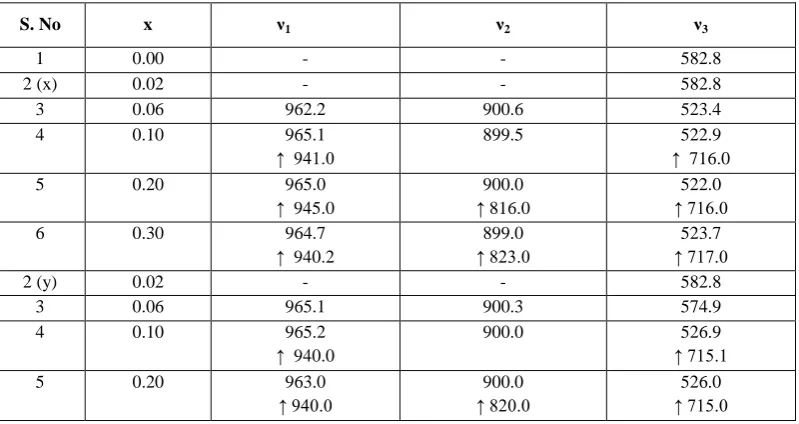
Fig.1. FTIR spectra of Cu1.0 Fe2-2xMox O4 system
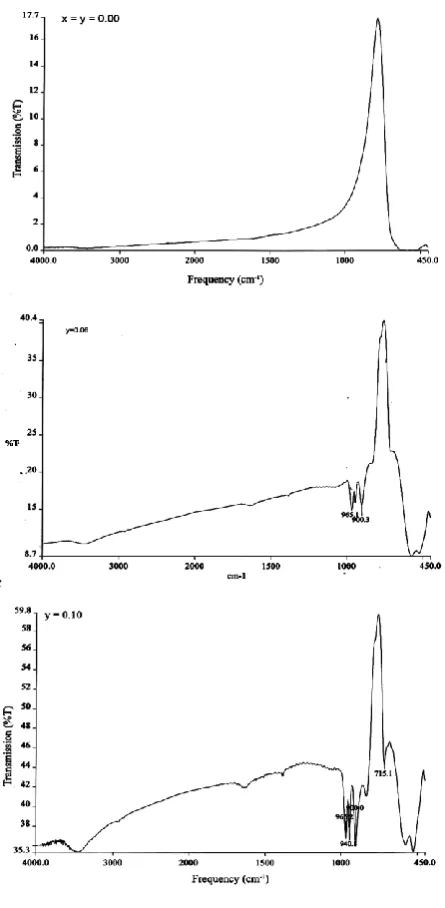
Table 1. The observed principle bands and their shoulders for the Cu 1.0-3yFe 2.0-2x Mo x+y O4.0 system
S. No x ν1 ν2 ν3
1 0.00 - - 582.8
2 (x) 0.02 - - 582.8
3 0.06 962.2 900.6 523.4
4 0.10 965.1
↑ 941.0
899.5 522.9
↑ 716.0
5 0.20 965.0
↑ 945.0
900.0 ↑ 816.0
522.0 ↑ 716.0
6 0.30 964.7
↑ 940.2
899.0 ↑ 823.0
523.7 ↑ 717.0
2 (y) 0.02 - - 582.8
3 0.06 965.1 900.3 574.9
4 0.10 965.2
↑ 940.0
900.0 526.9
↑ 715.1
5 0.20 963.0
↑ 940.0
900.0 ↑ 820.0
526.0 ↑ 715.0
According to Waldron [8], of the 42N normal vibrations, 8 discrete infrared bands only should occur. Each oxide ion is bonded to three octahedral ions and one tetrahedral ion. In the case of normal spinel, the three ‗B‘ site bonds lie along the coordinate axes and provide an isotropic force field which would permit the oxide ion to oscillate in any direction with a constant frequency if the tetrahedral bonds are absent [8]. Therefore the absence of band at high frequency related to ‗A‘ sites in the present materials up to x = y = 0.02 can be understood on the lines mentioned above. But the tetrahedral bonds will show effect by increasing frequency for vibrations along the t – O axis. The observed low frequency band (υ3) at 580 cm-1 can be attributed to the octahedral metal ions and oxygen complexes. The decrease of ‗υ3‘ value from 580 to 523 or 526 cm-1 with increasing concentration of Mo6+, might be due to modified distribution of cations that present in ‗B‘ sites because of Fe3+or Cu+2 ions replacement with substituted Mo6+ and or Fe3+ ions movement to ‗A‘ sites besides existence of copper ions. The observed ‗υ3‘ value deviate some extent with the reported value (450 cm-1) of the basic ferrite; this may be due to variations in the preparative conditions since ferrites are highly sensitive to them. It is known [24] that molybdenum occupies ‗A‘ sites at its lower concentration while at its higher concentration it enters into ‗B‘ sites. This has been substantiated by the results obtained in the present studies of the materials. The obtained high frequency band (υ1) at 965 cm
-1
in which materials have exhibited structural phase transition from tetragonal to cubic due to entry of copper ions into ‗A‘ sites. It is known that 0.25 is the critical value of copper ions occupancy at ‗A‘ sites causing crystal distortion [27]. Though Fe2+ ions strongly prefer to appear in octahedral sites, under some exceptional cases these ions exist in tetrahedral site too as stated by Waldron [8] on basis of his observation in MnFe2O4 system and also by Potakova et al. [23]. Hence the observed shoulder to ‗υ2‘ at 820cm-1 is believed to be because of tetrahedral divalent metal ions and oxygen complexes.
The difference in the position of two strong bands relating to Fe3+ - O2- that occur in octahedral and tetrahedral sites can be attributed to the difference in Fe3+ - O2- distance in ‗A‘ and ‗B‘ sites. The bond length of it in ‗A‘ sites was found to be 0.189 mm, which is smaller than that of in ‗B‘ sites (0.199mm) [28]. Hence it indicates that shorter bond length (tetrahedral) needs high frequency for initiation of normal mode vibration than that of longer bond length (octahedral).
The values of bond lengths have been computed and found the decrease of these values with ‗x‘ and or ‗y‘ indicating increased closer association of metal ions and oxygen due to substituted impurity. Hence increase of frequency value for normal mode vibration of these sites is expected, contrary to this, decrease of these values in the present studies is observed. This could be accounted by a substantial role of crystal field effect [29] that accounted by copper ions. No infrared studies on Cu-Mo-Fe system are available in literature and thus proper data is not existed for comparison of the obtained results. Around 3445 cm-1 a band has been observed for both the series of ferrites from x = y = 0.06 onwards, which may be related to the electronic transitions as studied earlier by Waldron [8] for Ni and Zn ferrites which exhibited at 2700 and 2300 cm-1 respectively. However, according to him, these values are subject to considerable uncertainty, because the portion of scattering caused by the ferrite particles cannot be distinguished from absorption losses.
B Mössbauer studies
In the present studies, typical Mössbauer spectra were recorded at room temperature for F and C series materials using Mössbauer spectrometer in the transmission geometry mode and shown them for one of the series in Fig.3
Fig. 3 Mössbauer spectra of Cu1.0 Fe2-2xMox O4 system
bonds with neighbouring ions and during this process, generation of few Mo4+ ions might take place for maintaining charge balance. In the present studies Mo6+ is believed to occupy ‗A‘ sites reducing number of Fe ions in the ‗F‘ series which results rearrangement of Cu2+ and Fe3+ ions in both tetrahedral (A) and octahedral (B) sites. Consequently, environment around Fe3+ nuclei in both the sub-lattices changes and hence the increase of hyperfine magnetic field is probably due to enhanced contribution of super-transferred hyperfine (STH) field as reported earlier [36]. For further increase of Mo6+, the decrease of hyperfine field values at tetrahedral (A) (hfA) and octahedral (B) sites (hfB) can be ascribed to spin canting that occurs in copper ferrite [30, 34]. However, from 0.06 concentration of Mo6+ onwards, the apparent invariance of magnetic filed in ‗A‘ sub-lattices for the both series of ferrites could be understood in terms of no change in the environment around ‗A‘ sites Fe3+ nuclei expecting Mo6+ going into ‗B‘ sites where change in the environment around ‗B‘ sites Fe3+ nuclei might takes place substantiating the observed decrease of magnetic field. The observed lower values of ‗hfA‘ relative to ‗hfB‘ is understood on the basis of more covalent nature of the Fe3+ - O2- bonds at the tetrahedral site compared to those at the octahedral site [30]. In general, quadrupole splitting (QS) arises due to non-cubic symmetry of Fe3+ at ‗B‘ sites. For the present studies, of all the specimens the observed ‗QS‘ is absent within the experimental errors as reported [34] earlier for Ni / Mn substituted copper ferrite. Probably this may be due to chemical disorder in the materials which apparently masks the shifts in the hyper fine field produced by the quadrupole interaction.
Table 2. Hyperfine field variation of Mo6+ substituted Copper Ferrites
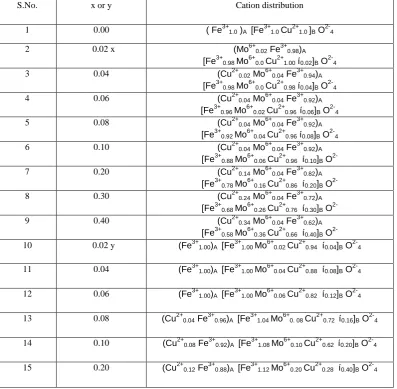
Based on the obtained magnetization, Curie temperature and other experimental results in association with the Mössbauer studies, the cation distribution for both the series has been proposed. The chemical compositional formula of the present copper ferrite with the substitution of Mo6+ is given below
Cu 1.0-3y Fe 2.0-2x Mo x + y O4.0
If ‗x‘ and ‗y‘ values are zero, then the composition of the basic ferrite is (Un-substituted) Cu1.0Fe2.0O4.0. Tetragonal crystalline structure has been observed for the present basic system, which is an inverse spinel. Therefore cation distribution of this chemical composition as reported [39] earlier is given below
(Fe3+1.0)A [Fe3+1.0Cu2+1.0]B O2-4.0
For the ‗F‘ series ferrite system, ‗y‘ is equal to zero and ‗x‘ is variable in the chemical composition, thus the chemical formula can be written as
Cu 1.0 Fe 2.0-2x Mo x O4.0
For the above composition, the generalized formula of the cation distribution is given below ignoring vacancies concentration
(Cu2+q Mo6+x-p Fe3+1-q-(x-p))A [Fe3+1+ q – pMo6+pCu2+1-q]B O2-4
In the ‗F‘ series, substituted Mo6+ impact on cation distribution of all these materials has been presented in Table 3 along with the possible concentration of vacancies () in ‗B‘ sites only, off course these have possibility to occur in both the sites. As molybdenum substitution is made due to iron, initially Mo6+ seems to exist in tetrahedral sites
S.No (x or y)
Hyperfine Field (Gauss)
hfA hfB δH
replacing Fe3+ ions at x=0.02, but at x= 0.04 it occupies ‗A‘ sites along with small amount of Cu2+ that comes from octahedral (B) to tetrahedral sites increasing its concentration in steps of q=0.02 till to x=0.06. Further, the distribution in tetrahedral (A) sites seems to be invariant up to x=0.10 having compliance with the observed no change in the magnetic field value of tetrahedral sub-lattice that given in Table 3 for the materials that exhibited tetragonal crystallographic structure. For higher values of Mo6+i.e. from x=0.20 onwards it found to substitute ‗B‘ site iron ions pushing large number of ‗B‘ site Cu2+ ions into ‗A‘ sites increasing its content having value 0.10 as a function of ‗x‘ while same quantity of Fe3+ ions reduction is occurred with ‗x‘ when these materials changed to crystallographic cubic structure from tetragonal structural phase. As the charge of molybdenum is 6+ and iron is 3+, for maintaining charge balance of the composition, iron has been reduced the two times of Mo quantity that substituted in ‗F‘ series hence vacancies are formed and these are also shown in the cation distribution. The observed significant change in the
Table 3. The proposed cation distribution for the ferrite system Cu 1.0 Fe 2.0-2x Mo x O4.0
S.No. x or y Cation distribution
1 0.00 ( Fe3+1.0 )A [Fe3+1.0Cu2+1.0 ]B O2-4
2 0.02 x (Mo6+0.02 Fe3+0.98)A [Fe3+0.98Mo6+0.0Cu2+1.00 í0.02]B O2-4 3 0.04 (Cu2+0.02 Mo6+0.04 Fe3+0.94)A
[Fe3+0.98Mo6+0.0Cu2+0.98 í0.04]B O2-4 4 0.06 (Cu2+0.04 Mo6+0.04 Fe3+0.92)A
[Fe3+0.96Mo 6+
0.02Cu 2+
0.96 í0.06]B O
2-4 5 0.08 (Cu2+0.04 Mo6+0.04 Fe3+0.92)A
[Fe3+0.92Mo6+0.04Cu2+0.96 í0.08]B O2-4 6 0.10 (Cu2+0.04 Mo6+0.04 Fe3+0.92)A
[Fe3+0.88Mo6+0.06Cu2+0.96 í0.10]B O 2-7 0.20 (Cu2+0.14 Mo6+0.04 Fe3+0.82)A
[Fe3+0.78Mo6+0.16Cu2+0.86 í0.20]B O
2-8 0.30 (Cu2+0.24 Mo
6+ 0.04 Fe
3+ 0.72)A [Fe3+0.68Mo
6+ 0.26Cu
2+
0.76 í0.30]B O
2-9 0.40 (Cu2+0.34 Mo
6+ 0.04 Fe
3+ 0.62)A [Fe3+0.58Mo6+0.36Cu2+0.66 í0.40]B O 2-10 0.02 y (Fe3+1.00)A [Fe3+1.00Mo6+0.02Cu2+0.94 í0.04]B O2-4
11 0.04 (Fe3+1.00)A [Fe3+1.00Mo6+0.04Cu2+0.88 í0.08]B O2-4
12 0.06 (Fe3+1.00)A [Fe3+1.00Mo6+0.06Cu2+0.82 í0.12]B O2-4
13 0.08 (Cu2+0.04 Fe3+0.96)A [Fe3+1.04Mo6+0. 08Cu2+0.72 í0.16]B O2-4
14 0.10 (Cu2+0.08 Fe3+0.92)A [Fe3+1.08Mo6+0.10Cu2+0.62 í0.20]B O2-4
cations distribution over ‗A‘ and ‗B‘ sites can be accounted due to crystalline structure change from tetragonal to cubic In the case of ‗C‘ series ferrite system, ‗x‘ is equal to zero and ‗y‘ is variable in the chemical composition, thus the chemical formula being.
Cu 1.0-3y Fe 2.0 Mo y O4.0. For the above composition the generalized formula of the cation distribution is
(Cu2+q Mo6+p Fe3+1-q-p)A [Fe3+1+ q Mo6+y-p Cu2+1-q-(y-p)]
As the Mo6+ substitution at the expense of Cu2+ is carried out in ‗C‘ series, Mo6+ is expected to enter into ‗B‘ sites. The proposed cation distribution of all these materials been presented besides vacancies concentration () too in the Table 4. Due to inversion nature of present basic (un-substituted) copper ferrite, Cu2+ ions present in ‗B‘ sites, since Mo6+ has been substituted diluting Cu2+ in ‗C‘ series, it seems to occupy ‗B‘ sites unlike F-series ferrites. Therefore cation distribution in ‗A‘ sub lattice does not affect until y = 0.06 which exhibited tetragonal structure. From y = 0.08 onwards Mo6+ seems to push some of the Cu2+ ions from ‗B‘ to ‗A‘ sites with a quantity of 0.04 for each successive rise of ‗y‘ value, consequently the decreased iron ions at ‗A‘ sites has been compensated in ‗B‘ sites. Since the charge of molybdenum is 6+ and copper is 2+, to maintain charge balance, copper has been reduced three times of the Mo quantity for Mo6+ substitution and hence vacancies more than those formed in F-series materials have been expected to form and thus these are also shown in the cation distribution. These have shown their impact on electrical and thermal properties too.
In general, Isomer shift (IS) values indicate iron ions valence state as 3+ and 2+ due to two sextets corresponding to ‗A‘ and ‗B‘ sties. The values of IS obtained for the two series of ferrite systems in the present studies are given in Table 4. Usually, in spinel
Table 4. Isomer shift variation of Mo6+ substituted Copper Ferrites
ferrites ionic bond length of Fe3+-O2- at octahedral sites are larger than tetrahedral sites. Therefore Isomer shift values of ‗B‘ sites are expected to be higher than ‗A‘ sites. Thus the covalence is larger at ‗A‘ sites relative to ‗B‘ sites. In octahedral sites due to smaller covalence larger Isomer shift values arose [40]. The observed values of IS are found to show small decrease than the basic ferrite IS value. On the other hand, small increase of IS values at higher values of ‗x‘ in F-series ferrite system is exhibited. The observed variation in the lattice constant of the present materials also substantiates the modified distance or gap between Mössbauer nucleus and s-electron resulting change in isomer shift values due to substitution of non-magnetic Mo+6 ions. The difference in Isomer shift values due to ‗A‘ and ‗B‘ sites believed to be due to slight sp3+ covalence present at ‗A‘ sites ions [41]
2.2.4. Line width.
The observed variation of FWHM values with increasing concentration of substituent (Mo+6) seems almost absent with very little increase which could be attributed to the experimental errors. However these values of ‗A‘ sites are smaller relative to ‗B‘ sites. This broadening of resonance line due to Fe3+ at ‗B‘ sites can be ascribed to small amount of Fe2+
S. No (x or y) ISA ISB δIS
1 0.00 0.280 0.385 0.105
2(x) 0.02 0.271 0.365 0.094
3 0.06 0.270 0.352 0.082
4 0.10 0.286 0.383 0.097
5 0.30 0.290 0.353 0.063
6 (y) 0.02 0.278 0.373 0.095
7 0.06 0.276 0.355 0.079
ions presence at ‗B‘ sites. Variation in the concentration of Mo6+
makes changes in the environment at Fe3+ ions leading to change in magnetic interaction, consequently it shows little broadening of Zeeman lines. This also might slightly affect Isomer shifts displacing sextets with respect to one another causing general broadening of the lines. The instrumental broadening which had been estimated is very small and it would also contribute to line broadening.
V. CONCLUSIONS
1.
The present mixed ferrites are found to have three principal bands of absorption in the range 450 – 4000 cm-1. Up to 0.02 concentration (x or y) of molybdenum (Mo6+) substitution in both the series of the materials, only one band at low frequency around 582 cm-1 is exhibited clearly and for further concentrations (x or y) of Mo6+, the same has been found at frequency 523 cm-1 in ‗F‘ series, 526 cm-1 in ‗C‘ series. The other two principal bands are resolved clearly at 965 cm-1 and 900 cm-1 for x≥ y≥0.06.2.
From x=y=0.10 onwards the absorption bands present at 965 cm-1 and 523 cm-1 in ‗F‘ series and or 526 cm-1 in ‗C‘ series began to show shoulder or split off at 940 cm-1 and 716 cm-1 respectively. On the other hand, for x≥y≥0.20, the band presented at 900 cm-1 also began to exhibit shoulder at 820 cm-1. The presence of bands takes place due to lattice vibrations of oxide ions against the cations.3.
The evaluated magnetic hyperfine field values at tetrahedral (A) sites (hfA) and at octahedral (B) sites (hfB) are found to increase at x=y=0.02, with the increase of ‗x‘ or ‗y‘ the ‗hfA‘ decreases at 0.06 and then stayed as invariant one, while the ‗hfB‘ also seems to be no change in its value except slight decrease at x=0.10 in ‗F‘ series. In the case of C-series materials ‗hfB‘ increases up to y=0.06 but at y=0.10 it found to deteriorate.4.
For the present ‗F‘ series ferrites the generalized chemical compositional formula of the proposed cation distribution is (Cu2+q Mo6+x-p Fe3+1-q-(x-p))A [Fe3+1+ q – pMo6+pCu2+1-q]B O2-4 and for ‗C‘ series it is (Cu2+q Mo6+p Fe3+1-q-p)A [Fe3+1+ q Mo6+y-p Cu2+1-q-(y-p)]B O-24
5.
The observed values of Isomer Shift (IS) are found to show small decrease than the basic ferrite IS value. On the other hand, small increase of IS values at higher values for ‗x‘ in F-series ferrite system is exhibited.6.
The observed variation of FWHM values with increasing concentration of substituent (Mo+6) seems to be almost absent with very little increase which could be attributed to the instrumental uncertainty.ACKNOWLEDGEMENTS
One of the authors B.V.Rao, is grateful to the UGC, New-Delhi for providing teacher fellowship to carry out this work.
REFERENCES
1. Ohnishi H and Teranishi T, ―Crystal distortion in copper ferrite chromite series‖ J.Phys.Soc.Jpn, vol 16. Pp 35-43, 1961.
2. Jahn H. A. and. Teller E, ―Stability of Polyatomic Molecules in Degenerate Electronic States. in Orbital Degeneracy” Proc. R. Soc. London vol.161, pp 220-235, 1937.
3. Wojtowicz P. J, “Theoretical Model for Tetragonal-to-Cubic Phase Transformations in Transition Metal Spinels“ Phys. Rev. Vol.116, pp 32-45, 1959.
4. Tailhades Ph., Villette C, Rousset A, Kulkarni G. U., Kannan K. R,. Rao C. N. R and Lenglet M.,‖ Cation Migration and Coercivity in Mixed Copper–Cobalt Spinel Ferrite Powders‖ journal of solid state chemistry, vol. 141, pp 56-61, 1998.
5. Darul J, and Kristallogr Z, ―Preparation and neutron diffraction study of polycrystalline Cu-Zn-Fe materials,‖ vol.S30, pp335-340, 2009. 6. Janicki J, Pietrzak J, Porebska A and Suwalski ,J ―Mössbauer Study of Copper Ferrites‖, Phys. Status Solidi, vol.A 72, pp 95-98, 1982. 7. Mazen S.A,..Elfalaky A, Mohamed A.Z and. Hashem H.A.M, ” Effect of Ti4+ substitution in copper ferrite: an analogous study‖ Mat. Chem. &
Phy., vol. 44(3), pp 293-299, 1996
8. Waldron R.D, ―Infrared Spectra of Ferrites‖ Phys. Rev., vol. 99, pp1727-1735, 1955.
9. Elfaloky A, ―substrates using CoSi/Ti bimetallic source materials‖, Appl. Phys. A. Solids Surface (Germany) , vol. A 59, pp389-391, 1994. 10. Cervinka L, and. Simsa Z, ―Distribution of copper ions in some copper-magnetic ferrites‖, Czech, J. Phys. B (Czechoslovakia), vol. 20, pp
470 - 474 (1970).
12. Milligan W.O., Tamai Y.and Richardson J.T., ―Magnetic properties of the dual oxide system CuO-Fe2O3‖ J. Appl. Phys (USA), vol. 34, pp
2093- 2096 , 1963.
13. Dmitry A. Kukuruznyak Jerome G. Moyer Nam T. Nguyen Edward A. Stern Fumio S. Ohuchi , ‖Relationship between electronic and crystal structure in Cu–Ni–Co–Mn–O spinel‖Journal of Electron Spectroscopy and Related Phenomena, vol. 150 | 2-3 | pp.275-281, 2006.
14. Lenglet M., Kasperek J.,.Hannoyer B and.Lopitaux J,‖ Ionic configuration of copper ferrimanganites Cu0.5MnxFe2.5−xO4‖, J. Solid State
Chem. (USA) vol 98, pp 252 -262, 1992.
15. Lipare A.Y.Vasambekar P.N and Vaingankar A.S., ―A.c. susceptibility study of CaCl2 doped copper–zinc ferrite system‖ Bull.Mater.Sci, vol. 26, pp 493 – 497, 2003.
16. Shaikh A. M., Jadhav S. A., Watawe S. C. and Chougule B. K., ―Infrared spectral studies of Zn-substituted Li–Mg ferrites” Mater.Lett., vol. 44, pp 192 – 196, 2000
17. Modi K. B., Gajera J. D, Pandya M. P, Vora G and Joshi H. H. , ― Far Infrared spectral studies of magnesium and aluminum co-substituted lithium ferrites‖ Pramana., vol. 62(5), pp 1173- 1180, 2004.
18. Ladgaonkar B. P. , Kolekar C. B.and Vaingankar A. S. ,‖ Infrared absorption spectroscopic study of Nd3+ substituted Zn–Mg ferrites‖ Bull.Mater.Sci, vol. 25(4), pp 351- 354, 2002.
19. Patil S.A., Otari S.M, Mahajan V.C., .Patil M.G and.Patil A.B, ―Structural, IR and magnetisation studies on La3+ substituted copper ferrite‖ solid state commun., vol. 78(1), pp 39-42, 1991.
20. Ravinder D ,‖ Far-infrared spectral studies of mixed lithium–zinc ferrites‖ Mater. Lett., vol. 40, pp 205 – 208, 1999.
21. Pradeep A.,.Thangasamy C and.Chandrasekaran G,‖Synthesis and structural studies on Ni0.5+xZn0.5CuxFe2-2xO4‖ J.Mater. Sci. Mater. in
Electronics, vol. 15, pp797-802, 2004.
22. Himavathi G, Ph.D.thesesis, ―structural, magnetic and electrical studies of Ti/Nb substituted copper ferrite‖, Andhra University, India, 2002. 23. Potakova V.A, Zverev N.D. and Romanov V.P.,‖ On the cation distribution in Ni 1—x—yFe2+xZnyFe3+2 O4 spinel ferrites,‖ phys.stat.sol.(a)
vol.12, pp 623-627, 1972.
24. Blasse G, Philips Res. Rept. Chem Suppl. No.3 (1964).
25. K.Sailakshmi, B. Ramesh, A.D.P.Rao, P.R.M.Rao and S.B.Raju, ―Effect of Sb5+/Mo6+ on magnetic properties of Mn-Zn ferrites‖ J. Mag. Soc.
Japan 22, Supp., No.S1, 37-39 (1998).
26. Scane J.G. and Stephens R.M, ―Infra-red structural studies on molybdenum co-ordination compounds‖ Proc. Phys.Soc., vol. 92, pp 833-836, 1967
27 Josyulu O.S. and Sobhanadri J.,‖ The far-infrared spectra of some mixed cobalt zinc and magnesium zinc ferrites‖ phys.stat.sol.(a) vol. 65, pp 479-483, 1981.
28. Ohnishi H, Teranshi T and.Miyahara S, ―On the Transition Temperature of Copper Ferrite‖ J.Phys. Soc. Japan, vol.14, pp 106 -106, 1959 29. Evans B.J and Hafner S., ―Mössbauer resonance of Fe57 in oxidic spinels containing Cu and Fe,‖ J.Phys.Chem.solids, vol. 29, pp1573-1588,
1972.
30. Patil S.A., Otari S.M.,.Mahajan V.C,.Patil M.G,.Patil A.B,.Soudagar M.K,.Patil B.L and.Sawant S.R, ―Structural, IR and magnetisation studies
on La3+ substituted copper ferrite‖solid state commun., vol. 78(1), pp39-42, 1991.
31. Almokhtar M. Atef M.Abdalla and Gaffar M.A., ―Phase analysis study of copper ferrite aluminates by X-ray diffraction and Mössbauer pectroscopy‖ J.Mags. Mag. Mat., vol. 272, pp 2216-2218, 2004
32. Watson R. F.and.Freeman A.J, ―Origin of Effective Fields in Magnetic Materials‖phys.Rev, vol.123, pp 2027-2047, 1961.
33. Nagle D.E, .Frauenfelder D.E,.Taylor R.D,.Cochran D.R.F and.Mathias B.T,‖ Temperature Dependence of the Internal Field in Ferromagnets‖
phys. Rev.Lett, vol. 5, pp364 -365, 1960.
34. .Kulkarni R.G, Trivedi B.S., Joshi H.H. and.Baldha G.J, ‖Magnetic properties copper ferrite aluminates‖ vol. 9, pp 375-380, 1996. 35. Muthukumarasamy, Nagarajan T and Narayanasamy A., ‖Mossbauer study of copper-nickel and copper-manganese ferrites‖ J.phys. C: sold
state phys., vol. 15, pp2519 -2528, 1982
36. . Rao A.D.P,.Sridevi, P Lakshmi D.V. and.Raju S.B,‖ ― ICF-9 proc., pp 683, 2004.
37. Price G.D., Price S.L. and.Burdett J.K , ―The factors influencing cation site prefere3nces in spinels‖ phys.Chem.Minerals, vol. 8, 69 – 76, 1982.
38. Jayasree G, Greenwood N.N., Hallam G.C. and Read D.A. ―Magnetic studies on Fe2MoO4 ―, J.Solid State Chem., vol. 11, pp 239-244, 1974.
39. Janicki J, Pietrzak J,. Porebska A, and Suwalski J , ―Mossbauer study of copper ferrites