Temperature Control of Semiconductor
LASER Using Different Controllers
Arjun Kumar singh
1, D.K Tanti
2P.G. Student, Department of Electrical Engineering, B.I.T Sindri, Dhanbad, Jharkhand, India1 Associate Professor, Department of Electrical Engineering, B.I.T Sindri, Dhanbad, Jharkhand, India2
ABSTRACT: This paper presents a method to control the temperature of the semiconductor laser. The output wavelength of semiconductor laser changes with change in temperature. It affects semiconductor laser accuracy and its service life. In order to enable the semiconductor laser work stably & to maintain its temperature stability. A comparative analysis of control performance of advanced approaches namely, PID control, Fuzzy logic control (FLC), and fuzzy self-adaptive PID control has been presented here. The PID controller and fuzzy logic controller cannot meet a wide range of precision temperature control requirements. In order to improve a wide range of temperature control accuracy, a temperature control system of laser by combining PID and fuzzy method named as fuzzy self-adaptive PID controller has been proposed. The results of proposed control system demonstrate the optimised performance in terms of overshoot, rise time and settling time. The comparative analysis shows that fuzzy self-adaptive PID controller has reasonably better performance than others.
KEYWORDS: PID controller, Fuzzy logic controller, Fuzzy self-adaptive PID controller, Semiconductor LASER, Temperature control system MATLAB. MATLAB toolbox [5] has been used for simulation of temperature control of semiconductor LASER.
I. INTRODUCTION
Semiconductor lasers are one of the most important inventions of the 20th century. Since their invention in the early 1960s, semiconductor lasers have been among the most extensively used lasers. Now a day’s semiconductor lasers appear in various areas of our daily life. Semiconductor lasers have the technology of choice for many important applications because of their small size, low cost, high reliability, spectral and modulation characteristics. In telecommunication they send signals for thousand kilometres along optical fibers. Other application includes laser printers, laser pointers, pollution monitoring, displays [1] etc. Various strategies have been applied on the temperature control system, such as PID [3], Fuzzy logic [4] [9], Fuzzy Self-adaptive PID [2] [7], etc.Conventional PID controller is simple in algorithm, good in stability, high in reliability, easy in design, wide in adaptation. It is the most basic controller used in the application of process control. It can obtain satisfactory control effects in variety of linear time-invariant systems, particular in systems whose parameters of nonlinearity controlled object is fixed & non-linear is not very serious[6] [8]. However, with regard to the temperature control system the characteristics of which are distributed parameter, nonlinear, large time delay and large inertia using conventional PID controller, it is very difficult to obtain satisfactory control results [2]. In order to solve this problem, a control method which is fuzzy logic control and fuzzy self-adaptive PID control has been adopted in this paper. The Fuzzy Self-adaptive PID algorithm [2], which is easy to implement and effective, has been widely used in the temperature control system.
II. MODEL OF THE TEMPERATURE SYSTEM
The object of semiconductor laser is a typical first-order delay system in the view of control. It can be expressed as follows 1
𝑡𝑠+1[1]. The transfer function of temperature feedback sensor is 1
𝑡1𝑠+1 [1], the magnification factor of high-
Where t is pure lag time of the controlled object, t1 is the pure lag time of temperature sensor. Where t=2, t1=0.5 are
decided by the lasers and the characteristics of the temperature sensor.
III. RELATED WORK
In order to start the work, a literature survey has been carried out including some of the most important and common databases, namely the IEEE/IEE electronic library, IJSCE, IJARAI and IJICS. The survey spans over the last 27 years from (1988-2014). A number of publications discussing about semiconductor laser, PID, Fuzzy Logic and Fuzzy self-adaptive PID controller have been gone through. The proposed model and transfer function of semiconductor LASER has been in the research paper [1]. The wavelength of semiconductor LASER depends on the temperature i.e. if temperature of semiconductor LASER varies then wavelength of laser also vary. For the better performance of LASER, different types of controllers have been proposed in this thesis. The state of the art of PID controller, basic idea and particular issues discussed include specifications, stability, design, applications, and performance of PID control [6]. The traditional PID control obtain the desired results only in the system model parameters of non-time-variant, when applied to time-variant systems, the system performance will deteriorate, and even instability. Therefore, a Fuzzy logic controller introduces to control the temperature. The basic idea about fuzzy logic has been found in the research papers [4]. In these papers study, it has been shows that fuzzy logic controller gives the better performance than PID controller but the transient response is not better. Therefore, a new controller fuzzy self-adaptive PID controller has been introduced. The self adaptive PID controller adjusts its parameters automatically. The mathematical models and stability analysis of fuzzy self-adaptive PID have been presented in paper [2]. The comparative analysis of PID and fuzzy self-adaptive PID controller shows the better controller out of them [1]. Here a fuzzy control method has been implanted to control the temperature of semiconductor LASER system. However, due to some limiting nature of the fuzzy logic control a new improved technique has been applied known as the fuzzy self-adaptive PID control technique. Among these three type controllers fuzzy self-adaptive PID controller provides better result in controlling the temperature of semiconductor laser.
IV. DESIGN OF TEMPERATURE CONTROLLER
(
i)
Proportional-integral-derivative (PID) controllerPID controllers are a family of controllers. The mnemonic PID refers to the first letters of the names of the individual terms that make up the standard three-term controller. These are P for the proportional term, I for the integral term and D for the derivative term in the controller. Three-term or PID controllers are probably the most widely used industrial controller. Even complex industrial control systems may comprise a control network whose main control building block is a PID control module. The three-term PID controller has had a long history of use and has survived the changes of technology from the analogy era into the digital computer control system age quite satisfactorily. It was the first (only) controller to be mass produced for the high-volume market that existed in the process industries.
Input
Output
+
-
Fig. 1: Model of PID controller (ii) Design of fuzzy controller
Fuzzy control is intelligent control of computer based on fuzzy set theory, fuzzy linguistic variables and fuzzy logic inference, the basic block diagram is shown as in Fig. 2. The control rule of the fuzzy controller is realized by computer program. The process of the realization of one step fuzzy control algorithm is described as the following computer can
𝐾𝑝 (1+ 1 𝑇𝑖𝑠+Tds)
1 𝑡𝑠 + 1 𝐾𝑖
with the given value to get the error signal E, as general, the error signal E election is chosen as an input of fuzzy controller and rate of error is the another input of fuzzy controller
.
Output
Input +
-
Error signal
Fig. 2: Fuzzy control model (iii) Design of fuzzy self-adaptive PID controller
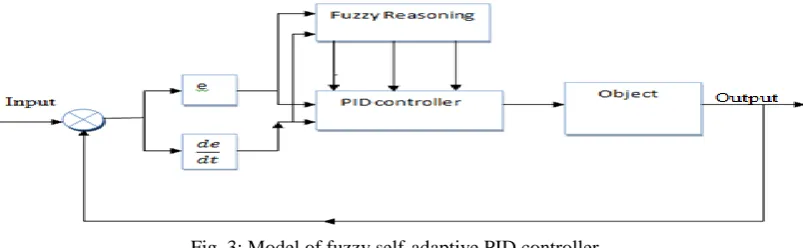
The new fuzzy-PID controller takes conventional PID as the foundation, which uses the theory of fuzzy reason and variable discourse of universe to on-line regulate the parameters of PID automatically. Adaptive fuzzy PID as an input error e and error change rate ec, e and ec meet the different time requirements for self-tuning PID parameters online of PID parameter changes, will constitute the adaptive fuzzy PID control, fuzzy control rules: , Its structure is shown in Figure 3
Fig. 3: Model of fuzzy self-adaptive PID controller
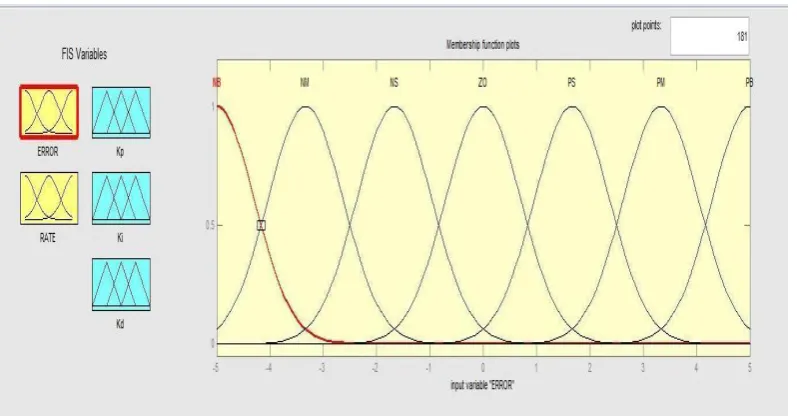
The fuzzy sets of e , ec , Kp , Ki , Kd is { NB, NM, NS, 0, PS, PM, PB }, the region of e , ec are{-5,-4, -3, -2, -1, 0, 1, 2,
3, 4, 5}, and the region of Kp , Ki , Kd are {-5, -4, -3, -2, -1, 0, 1, 2, 3, 4, 5} respectively. Where NB, NM, NS, 0, PS,
PM and PB are linguistic values. They respectively represent "negative big", "negative medium", "negative small", "0", "positive small", "positive medium" "positive big" .
Fig. 3.1: Mamdani fuzzy inference system for fuzzy controller
In FLC, two input variables have been defined which are error and rate of error shown in fig. 3.1. e
ec
Fuzzy logic
control
ler
Object
The membership function is a curve which shows that how each point of input space mapped to membership value between 0 & 1.g.3.2 Membership fnction
Fig. 3.3 Surface view
Surface view shows the pictorial representation of input and output of FLC. (iv) Forming and Reasoning of fuzzy control rules
The essential part of fuzzy self-adaptive PID controller is a set of linguistic rules. It is easy to translate human knowledge into linguistic rules. The forming of any rules can define the actions of the fuzzy controller. In this paper, the fuzzy control rules design is based on the laser can approach the target quick and stable. The relation between
Table 1: Fuzzy rule for 𝐾𝑝
Table 2: Fuzzy rule for 𝐾𝑖
Table 3: Fuzzy rule for 𝐾𝑑
V. SIMULATION MODEL AND RESULTS
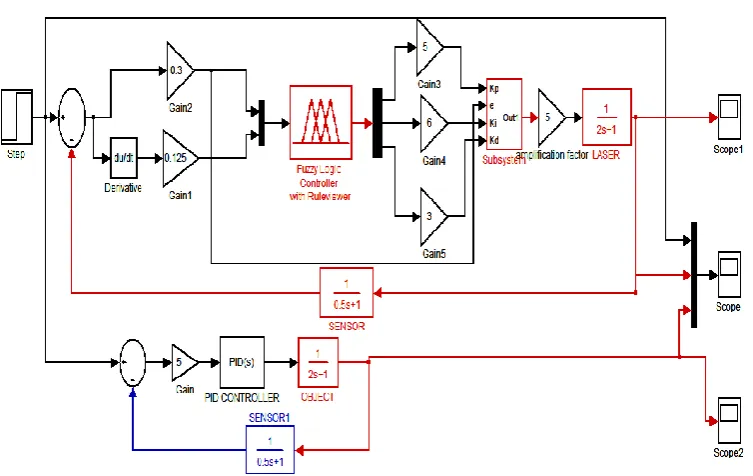
In order to verify the performance of fuzzy self-adaptive PID controller and compare the control performance with the conventional PID and fuzzy logic controller, a simulation model has been developed using MATLAB Software.
e
ec
NB NM NS ZO PS PM PB
NB PB PB PM PM PS ZO ZO NM PB PB PM PS PS ZO NS NS PM PM PM PS ZO NS NS ZO PM PM PS ZO NS NM NM PS PS PS ZO NS NS NM NM PM PS ZO NS NM NM NM NB PB ZO ZO NM NM NM NB NB
e ec
NB NM NS ZO PS PM PB
NB NB NB NM NM NS ZO ZO NM NB NB NM NS NS ZO ZO NS NB NM NS NS ZO PS PS ZO NM NM NS ZO PS PM PM PS NM NS ZO PS PS PM PB PM ZO ZO PS PS PM PB PB PB ZO ZO PS PM PM PB PB
e ec
NB NM NS ZO PS PM PB
Fig. 4: PID and fuzzy logic control model
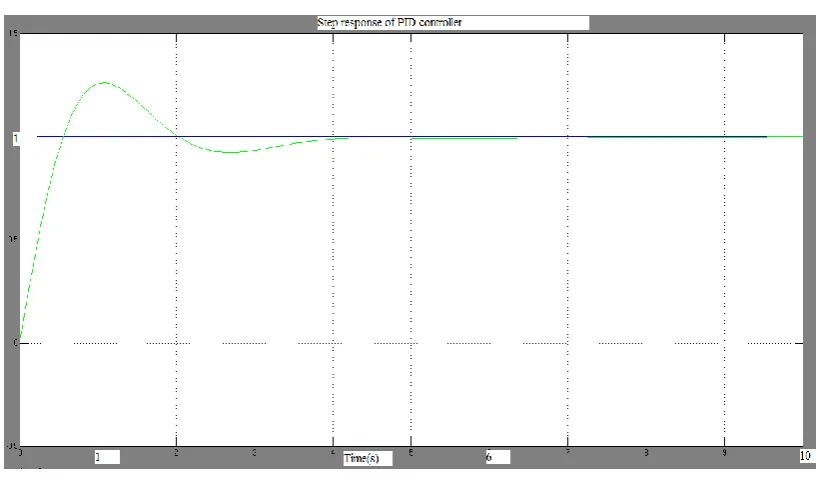
Fig. 6: Step response of PID controller
Fig. 6 shows the PID controller performance. The graph shows the overshoot for this system is 10.6% at 1.2s.
Fig. 7: Step response of FLC controller
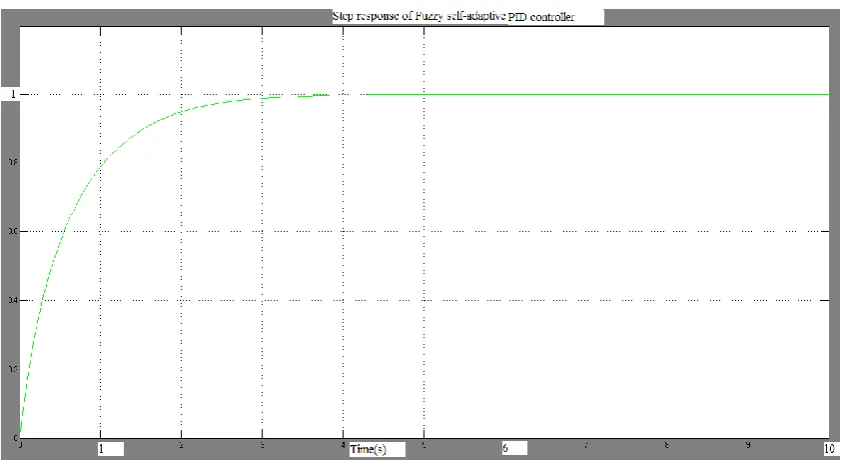
Fig. 8: Step response of fuzzy self-adaptive PID controller
Fig. 8 shows the response of fuzzy self-adaptive PID controller. The fuzzy self-adaptive PID controller has the combined advantages of conventional PID controller and fuzzy logic controller. It improves the settling time.
Fig. 9: Step response of system using conventional PID and FLC controller
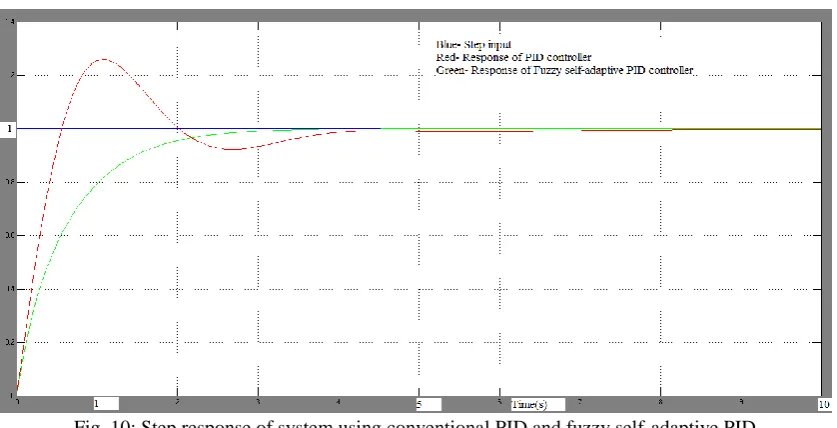
Fig. 10: Step response of system using conventional PID and fuzzy self-adaptive PID Controller
Fig. 10 shows comparison of two controllers named as conventional PID controller and fuzzy self-adaptive PID controller.
The simulation results show that out of all the three controllers named as conventional PID controller, FLC and fuzzy self-adaptive PID controller, the fuzzy self-adaptive controller has zero overshoot, shorter settling time, better adaptability and robustness
.
VI. CONCLUSION
In this paper the comparative analysis of temperature control system of the semiconductor laser based on conventional PID, Fuzzy logic and fuzzy self-adaptive PID controller has been presented. The simulation result shows that the fuzzy self-adaptive PID controller combines the advantages of conventional PID and fuzzy control. It is concluded that the fuzzy self-adaptive PID controller has better dynamic performance, stronger adaptive ability and robustness; it can be applied to the system which has nonlinearity, large time delay and large inertia.
REFERENCES
[1] ZANG Huai-quan, LI Qian “The Automatic Temperature System with Fuzzy Self-adaptive PID Control in Semiconductor Laser” IEEE International Conference on Automation and Logistics Shenyang, China August 2009 :1691-1694.
[2] Hongbo Xin, Tinglei Huang “Temperature Control System Based on Fuzzy Self-Adaptive PID Controller” Third International Conference on Genetic and Evolutionary Computing 2009,:537-540.
[3] Jiang Wei, “Research on the Temperature Control System Based on Fuzzy Self-tuning PID” International Conference on Computer Design and Applications (ICCDA 2010) 2010,: volume3:13-15.
[4] Srismrita Basu “Realization of Fuzzy Logic Temperature Controller” International Journal of Emerging Technology and Advanced Engineering (ISSN 2250-2459, Volume 2, Issue 6, June 2012).
[5] MATLAB toolbox software version 2010(a) has been uses to design the simulation model. [6] Katsuhiko Ogata, “Third edition Modern Control Engineering” University of Minnesota.
[7] Junran Jin. Hengshuo Huang, Junmam Sun, Yongchao Pang, “Study on Fuzzy Self-adaptive PID control System of Biomass Boiler Drum Water” Journal of Sustainable Bioenergy System, 2013, 3,93-98.
[8] M.S.M Aras, M.F. Basar, N. Hasim, M.N. Kamaruddin, H.I. Jaafar, “ Development and Modelling of Water Tank System Using System Identification Method” International Journal of Engineering and Advanced Technology(IJEAT) ISSN: 2249-8958, Volume-2,Issue-6, August 2013:278-283.