Study on Performance Enhancement of
Concrete by Internal Curing
Eswar Sudharsan.C
1, Pa.Suriya
2, R.Jayalakshmi
3Assistant Professor, Department of Civil Engineering, Aarupadai Veedu Institute of Technology, Paiyanoor,
Tamil Nadu, India1
Assistant Professor, Department of Civil Engineering, Aarupadai Veedu Institute of Technology, Paiyanoor,
Tamil Nadu, India 2
Assistant Professor, Department of Civil Engineering, Aarupadai Veedu Institute of Technology, Paiyanoor,
Tamil Nadu, India 3
ABSTRACT: Low water-cement ratio concrete mixtures have been increasingly promoted for use in civil engineering
infrastructure due to potential improvements in strength and durability under practical situations; many structures do not allow curing with water after the construction. It is not sufficient for continuous hydration of cement. One of the methods to overcome the deficiency is internal curing. Internal curing refers to the process by which the hydration of cement occurs because of the availability of additional internal water that is not part of mixing water. Internal curing uses water-filled pre-wetted aggregate to supply water to counteract the effect of self-dehydration after the initial pore structure of the paste has formed. For this reason, fine aggregate is replaced by 20% of PWA and limestone in the mix to find its enhancement of internal curing in this study. The strength properties studied reveal that incorporation of PWA and limestone does have remarkable change in mechanical properties and enhanced some performance aspects of the concrete in their change in curing method.
KEYWORDS: Internal curing, PWA compounds, Hydration, Water absorption, Limestone
I. INTRODUCTION
Concrete is known for its durability and prolonged strength, it is majorly obtained at the early stages of concreting and its curing process. Water provide initially gives initial strength, to attain 98% strength needs 28days of curing under prescribed exposure. But practically it is not possible. It affects major concrete properties and reduces its durability and strength characteristics. Many methods are involved in curing methods to meet independent curing properties. Internal curing is an emerging laboratory process in implementation of curing concrete.
From the ACI-308 Code states that “internal curing refers to the process by which the hydration of cement occurs because of the availability of additional internal water that is not part of the mixing Water.” Conventionally, curing is taken to happen „from the outside to inside‟. In contrast, „internal curing‟ is allowed to for cure „from the inside to outside‟ through the internal reservoirs in the form of saturated lightweight fine aggregates, superabsorbent polymers, or saturated wood fibres.
II. INTERNAL–CURING PROCESS
Shrinkage cracks in HPC can be prevented only for one or two days as the capillary pores are not yet connected internally. Early water curing can lead the skin of concrete to cure well, whereas autogenously shrinkage starts at the centre. This property can be restricted by using pre-soaked LCA. Internal curing can be screened through: Measuring weight-loss X-Ray powder diffraction, X-X-Ray micro chromatography, Thermogravimetry (TGA) measurements, Initial surface absorption tests (ISAT), Compressive strength, Scanning electron microscope (SEM), Change internal RH with time, Water permeability and NMR spectroscopy.
Particle size also affects internal curing, because when size is reduced more area can be watered. The reduction of the grain size (down to 2–4 mm), is shown to be beneficial. However, the further reduction of grain size could result in a decrease of curing efficiency. Aggregate proximity also plays a vital role in IC. The distance of cement particle and WCA is great curing efficiency will be less. So to control his aggregate – aggregate proximity should be maintained. Excess usage of PWA may also reduce the strength. So it should be used in optimum amount to reduce drying shrinkage. The concept of internal curing was established, based on dispersion of very small, saturated WCA throughout the concrete, which serve as tiny reservoirs with sufficient water to compensate for self-desiccation. The spacing among the WCA particles is conveniently small so that the water travels smaller distances to counteract self-desiccation. The amount of water in the WCA can therefore be minimized, thus economizing on the content of the WCA.
A. Advantages of internal curing
IC provides water to keep the relative humidity (RH) high, keeping self-desiccation from occurring.
IC eliminates largely autogenous shrinkage
Higher early age (say 3 day) flexural strength
Higher early age (say 3 day) compressive strength
Lower turnaround time
Greater utilization of cement
Lower maintenance
higher modulus of elasticity
greater curing predictability
B. Properties of limestone
Limestone is calcareous sedimentary rocks formed at the bottom of lakes and seas with the accumulation of shells, bones and other calcium rich goods. It is composed of calcite (CaCO3). The organic matter upon which it settles in lakes or seas, are preserved as fossils. The heat and pressure causes chemical reaction at the bottom and the sediments turn into solid stone, the limestone.
The rock which contains more than 95% of calcium carbonate is known as high-calcium limestone. Recrystallised limestone takes good polish and is usually used as decorative and building stone. A part of calcium molecules if being replaced by magnesium, it is known as magnesium lime stone or dolomite limestone
Physical Properties of Limestone 1. Hardness 3 to 4 on Moh's Scale 2. Density 2.5 to 2.65 Kg/m3
3. Compressive Strength 1800 to 2100 Kg/cm2 4. Water Absorption Less than 1%
5. Porosity Quite low 6. Weather Impact Resistant
Chemical Properties of Limestone
1. Lime (CaO) 38-42%
2. Silica (SiO2) 20-25%
3. Alumina (Al2O3) 2-4%
III. OBJECTIVES OF CONCRETE
1. The objective of this project is to study about the strength of the conventional concrete and comparing it by replacing sand by wetted clay aggregate(WCA) and limestone in the proportion of
a. 10% -WCA
b. 20% -WCA
c. 05% -WCA + 05% limestone
d. 10% -WCA + 10% limestone
e. 20% - limestone
2. To achieve the good strength of concrete 3. To induce more curing in concrete 4. To reduce the water usage under curing
IV. LITREATURE REVIEW
Weber, S. and Reinhardt, H.W. has stated thatthe cement paste has high capillary force to utilize the water absorbed by
WCA and un-hydrate cement. As the WCA acting as a water reservoir, the pores of the cement paste absorb the water from the WCA by capillary suction. The water will stop being moved from the WCA once the RH in the WCA grain and in the cement paste that has hardened is in balance. Hoff, George C has stated that thecapillary suction process enables the pores to continue to absorb water from the WCA. This continues until all the water from the WCA has been transported to the cement paste. This reduction in size of the capillary pores along with capillary suction of water from the WCA creates a pressure difference for water transport from the WCA to the cement paste. Hammer, T.A., Bjontegaard, O., and
Sellevold, E.J. has mentioned that the moisture from the WCA will be transported to the cement paste faster than in the
interior of the element. Because the water in WCA is chemically bound, structure on the surface is denser, reduction in water evaporation. As a result, the process of diffusion becomes slower. The water from the WCA near the surface is then used up faster than in the interior of the concrete, thus causing the near-surface layer of the concrete to become denser in a shorter period of time. Bentz .D.P., Lura .P ; Roberts J.W., used the lightweight aggregate containing high volumes of absorbed moisture in high strength concrete. The benefits of internal curing are increasingly important when supplementary cementitious materials, (silica fume, fly ash, metokaolin, calcined shales, clays and slates, as well as the fines of lightweight aggregate) are included in the mixture. Additionally, internal curing provided by absorbed water minimizes the “plastic” shrinkage due to rapid drying of concretes exposed to unfavourable drying conditions. Ryan H. ,
Javier Castro, Haejin Kim, Dale Bentz, and Jason Weiss Prewetted clay aggregate reduce autogenous shrinkage and
mitigate early-age cracking in high performance concrete, its application has far-reaching consequences for the performance of concrete throughout its lifetime. Durability and sustainability of internal curing concrete favoured good results on the SEM test and chloride penetration test.
V. MATERIALS
A. Cement
The selection of proper grade and good quality of cement is important for obtaining HSC. Some of the important factors, which play a vital role in the selection of the type of cement are compressive strength at various ages, fineness, heat of hydration, alkali content, tri-calcium aluminates (C3A) content, tri-calcium aluminates (C3S) content, di-calcium silicate
(C2S) content and compatibility with admixtures etc., Nowadays practically in site most of the constructions are being done
by Ordinary Portland Cement (OPC). The various tests performed for the cement. The specific gravity of cement was found to be 3.157. The initial and final setting time for cements is found to be 33 minutes and 330 minutes.
B. Fine aggregate
C. Coarse Aggregate
The fractions from 20 mm to 4.75 mm are used as coarse aggregate, conforming to IS: 383 is use. The properties of coarse aggregates such as specific gravity, water absorption, crushing strength and crushing value are found to be 2.80, 0.8%, 85 and 19.37% respectively. These values are within the range as given in IS 383-1970.
D. Pre-wetted Aggregate (PWA)
The term Pre-wetted aggregate is known as the light weight aggregate when allowed to soak in water for the filling of its pores by water. The sample is taken from a clay soil region. The properties of Pre-wetted aggregate such as specific gravity, moister content and water absorption are found to be 2.36, 1.4% and 1.68% respectively. These values are within the range as given in IS 383-1970.
VI. SPECIMEN PREPARATION
A. Preparation of the Pre Wetted Aggregate
The term pre wetted aggregate is known as the light weight aggregate when allowed to soak in water for the filling of its pores by water. The sample is taken from a clay soil region.
We cleared the soil from organic impurities and is allowed to dry in sun for 2 days
Then it is sieved on 4.36mm sieve and soil passing through that sieve is collected
It is then sieved through 1.18 mm sieve and soil retained on the sieve is only taken for experimentation
As this size can only have better availability for storing water inside their pores
Now the sieved sample is oven dried for 24 hours which is kept on a pan
This sample is now similar to the expanded level with loss of its plasticity
It is then kept in room temperature for about a day or two
It is then soaked it water by filling it in a container one third level thus to increase the water absorption at a free environment without any external disturbance
The setup is left undisturbed for 24 hours to 36 hours
Then the sample is taken in percentiles for the concreting
B. Preparation of Lime Stone
The limestone used in this project is baked natural limestone without any external chemical agents. It is collected from a small scale lime baking kiln.
The baked limestone is delivered within hours to the lab in post heated level
It is then crushed using hammer for size ranging 2.36mm to 1.18mm sieve sizes
It is mixed with PWA at the time of concreting
The sample is hand mixed with a care that there will be heat evolving during intact of water in PWA with crushed limestone
The limestone crushed is allowed for complete mixing forming uniform color texture
Then the sample is taken in percentiles for the concreting
C. Concrete
Table.1 Mix design replacement of pre wetted clay and lime stone
Mix Design % of replacement
WCA LS
C0 - -
C1 10% -
C2 20% -
C3 05% 05%
C4 10% 10%
C5 - 20%
VII. RESULT
A. Workability Properties
Measurements on workability of concrete are done by Slump cone test by varying the percentage of pre-wetted clay and lime stone in fine aggregates and values obtained are within the permitted limit as per IS 456-2000 as shown below in Table.2
Table.2 Slump Cone Test Values
Mix Design Mix Slump Cone Test
Values (mm)
C0 0% WCA & 100% Sand 26
C1 10% WCA & 90% Sand 27
C2 20% WCA & 80% Sand 27.5
C3 10% WCA, LS & 90%
Sand 27
C4 20% WCA , LS & 80%
Sand 28
C5 20% LS & 80% sand 26.5
B. Compression Tests for Cubes
For cube compression tests on concrete, cube of size 150mm were employed. All the cubes were tested in saturated condition after wiping out the surface moisture from the specimen. The compressive strength has been calculated using the following formula.
compressive strength=load
area(N mm
2)
0 50 100
C0 C1 C2 C3 C4 C5
Compresive Test Results
7th day
14th day
Compressive strength of cube was measured and calculated as an average of three cylinders for each age as given in Table 3.
Table.3 Average Compressive Strength (MPa)
Mix Design Mix 7th day 14th day 28th day
C0 0% WCA & 100% Sand 20.44 27.6 53.7
C1 10% WCA & 90% Sand 22.7 26.7 59.2
C2 20% WCA & 80% Sand 21.4 27.35 55.82
C3 10% WCA, LS & 90%
Sand 26.4 28.75 63
C4 20% WCA , LS & 80%
Sand 25.05 29.24 61.6
C5 20% LS & 80% sand 23.44 28.5 62.3
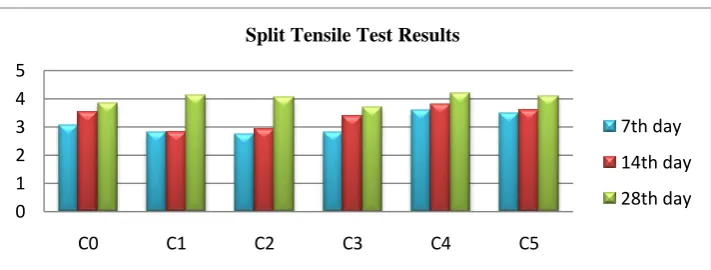
C. Split Tensile Tests for Cylinders
This is an indirect test to determine the tensile strength of the specimen. Splitting tensile tests were carried out on 150mm x 300mm sized cylinder specimens at an age of 7 days using 400 Tone capacity Heico compression testing machine as per IS: 5816 – 1970. The load was applied till the specimen split and readings were noted. The splitting tensile strength has been calculated using the following formula.
split tensile strength = 2 x P
π D x L(N mm
2)
Split tensile strength for cylinder was measured and calculated as an average of three cylinders for each age as given in Table 4.
Table.4 Average Split Tensile Strength (MPa)
Mix Design Mix 7th day 14th day 28th day
C0 0% WCA & 100% Sand 3.09 3.53 3.85
C1 10% WCA & 90% Sand 2.83 2.83 4.13
C2 20% WCA & 80% Sand 2.75 2.93 4.06
C3 10% WCA, LS & 90%
Sand 2.83 3.39 3.69
C4 20% WCA , LS & 80%
Sand 3.6 3.8 4.2
C5 20% LS & 80% sand 3.5 3.6 4.1
0 1 2 3 4 5
C0 C1 C2 C3 C4 C5
Split Tensile Test Results
7th day
14th day
D. Flexural Test For Prism
A beam specimen should be cast for determining the flexural strength of concrete. The standard specimen sizes are 15 cm x 15 cm x 70 cm. A UTM can be used for the test. The testing machine may be set to any reliable type of sufficient capacity for the test. Permissible errors should not be greater than ± 0.5%. The bed of machine should be provided with two steel rollers of 38 mm diameter, on which the specimen is supported. Rollers are placed at a centre-to-centre distance of 60 cm for the 15 cm specimen and at 40 cm for the 10 cm specimen.
The flexural strength of the specimen is expressed as the modulus of rupture F which if „a‟ equals the distance between the line of fracture and the nearer support, measured on the centre line of the tensile side of the specimen, in cm, is calculated to the nearest 0.05 Mpa as follows:
F = PL/(bd2)
when „a‟ is greater than 20 cm for 15 cm specimen or greater than 13.3 cm for 10 cm specimen, or
F = 3Pa/(bd2)
Where,
F = flexural strength, Mpa P = maximum load applied, N L = span length, mm
b = average width of specimen, mm
Flexural strength for Prism was measured and calculated as an average of three cylinders for each age as given in Table 5.
Table.5 Average Flexural Strength (MPa)
Mix Design Mix 7th day 14th day 28th day
C0 0% WCA & 100% Sand 8.03 9.25 10
C1 10% WCA & 90% Sand 8.75 9.75 10.25
C2 20% WCA & 80% Sand 8.25 9.25 10.5
C3 10% WCA, LS & 90%
Sand 8.75 9.5 10
C4 20% WCA , LS & 80%
Sand 8.50 9.25 10.5
C5 20% LS & 80% sand 8.19 9.5 10.5
0 5 10 15
C0 C1 C2 C3 C4 C5
FlexuralTest Results
7th Day
14th Day
VIII. CONCLUSION
Based on the experimental investigation, the following results have been found,
The optimum percentage of sand replacement by WCA & limestone and constant dosage of M30 grade, the target mean compressive and split tensile strength of the cubes and cylinders have been studied.
It has been noted that the strength increase as % replacement of WCA & limestone increases.
Hence it may be possible to replace the fine aggregate by WCA & limestone to achieve the strength.
Hence good result has been obtained through internal curing.
REFERENCES
[1] Bentz .D.P., Lura .P ; Roberts J.W., “Mixture proportioning for Internal curing concrete International” , Vol 27, No 2, 35 - 40, Feb 2005. [2] O. Arioz, K.Kilinc1, B. Karasu, G. Kaya, G. Arslan, M. Tuncan,
[3] A. Tuncan, M. Korkut and S. Kivrak., “A Preliminary Research on the Properties of Pre- watered Expanded Clay Aggregate”, J. Aust. Ceram. Soc. 44 (2008) 23-30.
[4] Lura, P., O. Jensen, and S.-I. Igarashi, “Experimental observation of internal water curing of concrete”, Materials and Structures, 2007. 40(2): pp. 211-220
[5] P. Briatka, P. Makys,(2011) “Desorption and use of Saturated lightweight Aggregate in internal Curing” Slovak Journal of Civil Engineering, 2011, Vol XIX, No.3,31-38.
[6] SemionZhutovsky, Konstantin Kovler.(2012), “Effect of internal curing on durability-related properties of high performance concrete”, Cement and Concrete Research, Volume 42, Issue 1, January 2012, Pages 20–26.
[7] Ryan Henkensiefken, Javier Castro, Haejin Kim, Dale Bentz, and Jason Weiss “Internal Curing Improves Concrete Performance throughout its Life” Concrete In Focus, September-October 2009.
[8] ArnonBentura, Shin-ichiIgarashib, Konstantin Kovlera, “Prevention of autogenous shrinkage in high-strength concrete by internal curing using wetlightweight aggregates”, Cement and Concrete Research, Volume 31, Issue 11, November 2001, Pages 1587–91.
[9] A Internal Curing: A 2010 State-of-the-Art Review , NIST IR 7765,nist.gov/manuscript-publication-search.cfm/pub_id=907729
[10] Villarreal, V.H., and Crocker, D.A., “Development of Internally Cured Concrete for Increased Service Life” Publication FHWA/IN/JTRP-2010/10. Joint Transportation Research Program, Indiana Department of Transportation and Purdue University, West Lafayette, Indiana, 2010.
[11] Castro, J. (2011). Moisture transport in cement-based materials: Application to transport tests and internal curing. Retrieved through Purdue University.
[12] Roberts, J., “High Performance Concrete: Enhancement Th rough Internal Curing”, Concrete InFocus, Vol. Winter 2006, pp.55-59, (2006). [13] Henkensiefken, R., “Internal Curing in Cementitious Systems Made Using Saturated Lightweight Aggregate,” Purdue University, 2008. [14] Henkensiefken, R., Castro, J., Bentz, D.P., Nantung, T., and Weiss, J., “Water Absorption in Internally Cured Mortar Made with Water-Filled Lightweight Aggregate”, Cement and Concrete Research, Vol. submitted, pp. (2008).
[15] IS 456-2000 and SP16