ABSTRACT
LUONG, MARY G. Refining the Retrieval Effort Theory of the Testing Effect as it Relates to Feedback. (Under the direction of Dr. Christopher B. Mayhorn and Dr. Brad
Mehlenbacher).
Refining the Retrieval Effort Theory of the Testing Effect as it Relates to Feedback
by Mary G. Luong
A dissertation submitted to the Graduate Faculty of North Carolina State University
in partial fulfillment of the requirements for the degree of
Doctor of Philosophy
Psychology
Raleigh, North Carolina 2014
APPROVED BY:
_______________________________ ______________________________ Dr. Christopher B. Mayhorn Dr. Brad Mehlenbacher
Committee Co-Chair Committee Co-Chair
DEDICATION
BIOGRAPHY
ACKNOWLEDGMENTS
I’d like to thank my co-chairs, Dr. Christopher Mayhorn and Dr. Brad Mehlenbacher. Your
perspectives and support made the culmination of my graduate school experience one I will look back on with immense gratitude and a sense of humor.
Dr. Gillan and Dr. Boyer’s curiosity about my research provided fuel when my own curiosity
waned. For that investment, I would like to extend my thanks.
TABLE OF CONTENTS
LIST OF TABLES ... vi
LIST OF FIGURES ... vii
INTRODUCTION ... 1
Retrieval Effort Theory of the Testing Effect ... 2
Retrieval Difficulty ... 4
Question Format... 5
Feedback ... 7
FFQs ... 10
Study Overview and Research Questions ... 10
METHOD ... 12
Design ... 12
Participants ... 12
Materials ... 14
Procedure ... 15
RESULTS ... 18
Preliminary Analyses ... 18
Tests of Research Questions ... 19
DISCUSSION ... 24
Summary of Results ... 24
Implications... 26
Limitations ... 27
Future Research ... 28
REFERENCES ... 29
APPENDICES ... 36
Appendix A: Mechanical Turk Informed Consent ... 37
Appendix B: Undergraduate Psychology Course Informed Consent ... 39
Appendix C: Demographics Survey ... 41
Appendix D: Devil’s Hole Fact Sheet ... 42
Appendix E: Geology Questions ... 44
LIST OF TABLES
LIST OF FIGURES
INTRODUCTION
Your psychology professor believes in the power of the testing to improve learning. At the beginning of each class she asks questions about the day’s reading assignment. Today your professor’s question hangs in the air while she waits for your answer. You pause, trying
to retrieve the answer from memory, and give a response. Then professor says, “Let me rephrase the question.” Implicit in the rephrased question is that the first answer was either incorrect or did not contain all the information that the professor was seeking. In other words, she offers you feedback.
Researchers have found that retention is further improved over testing alone when feedback is given during one or more testing events preceding a final test of retention (Kang, McDermott, & Roediger, 2007; Roediger & Karpicke, 2006b). Among testing-effect studies, these gains have been experimentally observed using two kinds of feedback: informing participants whether their response was correct or not and displaying the correct answer to the participant. Considering this relationship between testing and feedback, and that testing has been shown to directly produce learning gains, the present study investigated whether there is an additive benefit to learning of leveraging the testing effect through feedback that is, itself, a test (e.g., a rephrased question). The aim of the research was to refine the retrieval effort theory of the testing effect, as it relates to feedback. The following sections will
introduce the retrieval effort theory, present an overview of retrieval difficulty, summarize characteristics of feedback in the general context of retrieval difficulty, and offer an
explanation of how giving rephrased questions as feedback may serve to refine the retrieval effort theory of the testing effect, as it relates to feedback.
Retrieval Effort Theory of the Testing Effect
(Agarwal, Karpicke, Kang, Roediger, McDermott, 2007; Duchastel, 1981; Glover, 1989; Roediger & Karpicke, 2006a); the latter being of interest to the present study. The retrieval effort theory broadly explains that the mechanism behind the testing effect is the cognitive effort expended in the retrieval of answers from memory (Roediger & Karpicke, 2006a). More importantly, the theory attempts to predict variations in the magnitude of the testing effect such that more cognitive effort employed during testing results in longer retention of the tested material (i.e., higher final retention-test scores).
A wealth of testing effect research has shown that effortful retrieval of information from memory improves retention of that knowledge more than when it is easily recalled. Gardiner, Craik, and Bleasdale (1973) used definitions of uncommon words and captured retrieval latency as the measure of retrieval effort. Over the course of 50 trials, the
experimenters presented participants with “definitions of 50 [uncommon] words whose frequency count was less than 1 per million” (p. 213). After each definition, participants tried
results lend empirical support to the retrieval effort theory; however, they only tell part of the story. By using equally uncommon words, there was no variation in retrieval difficulty. Retrieval Difficulty
Retrieval difficulty follows from Bjork’s (1994, 1999) framework of desirable difficulties. Desirable difficulties are the basis of pedagogical techniques for improving long-term retention that (may) negatively impact short long-term learning. The long-term is used to describe conditions under which learning (or more specifically, encoding) is effortful (Schmidt & Bjork, 1992) up to a surmountable level. Retrieval difficulty refers to elements of the task whereas retrieval effort is related to the individual’s behavior while engaged in the task;
therefore, retrieval difficulty can be manipulated to influence retrieval effort. Learning occurs when individuals expend more retrieval effort while engage in difficult memory tasks that result in successful retrieval. Support for desirable difficulties and retrieval effort has been presented by Pyc and Rawson (2009) who found that participants in the high difficulty but successful retrieval group had higher final test scores (i.e., long-term retention) than those in the low difficulty successful retrieval group. According to Roediger and Karpicke (2006a), testing is an effortful memory task that has desirable difficulty because tests can have varying levels of retrieval difficulty that affect retrieval effort.
There are a number of task elements that can be manipulated to vary retrieval difficulty of a test. In an excellent review by Roediger and Karpicke (2006b), studies have demonstrated the testing effect’s robustness using a breadth of task elements that vary
interval between studying and initial testing, and the retention interval before the final test, to name but a few” (p. 182). Of particular interest to the present study were question format and
type of feedback.
Question Format. Multiple choice questions generally yield high scores but are considered to be at the low end of the retrieval difficulty spectrum because the correct response is guaranteed to be present in the list of choices (Shute, 2008). The retrieval effort employed in answering multiple choice questions, however, can vary widely depending upon their psychometric quality. The proposed study will exclude multiple choice questions for three reasons. First, Roediger and Marsh (2005) found that lures (i.e., distractor choices) in multiple choice questions may lead to acquiring false knowledge. Second, lures can also cause a learner to incorrectly apply existing knowledge (Roediger & Marsh, 2005) thereby diluting the measure of an individual’s true subject knowledge. Third, multiple choice
questions have low fidelity with real world interactions. For example, it is an unlikely scenario that one’s manager would ask a question followed by a series of response options.
It is more likely that the manager is inquiring to be informed rather than to assess the employee’s declarative knowledge.
the free-recall category. Alternatively if the question stem provide cues (e.g., topic
sentences) followed by the above instructions it would be placed in the cued-recall category. The current study excluded open-ended questions due to concerns about accuracy of
automated scoring.
Short-answer and completion (e.g., fill-in-the-blank) questions are generally categorized as cued-recall because of the focused nature of the question stems. Osterlind (1998) advised that the “correct use of short-answer and sentence-completion questions is in
assessing areas that require a great deal of factual recall” (p. 238). To test this factual knowledge the stems for short-answer and completion questions are necessarily specific, which can have a cuing effect. Osterlind (1998) gave the following two stems to illustrate the importance of specificity in these types of questions:
A) “Rain is produced by ______________ clouds” (p. 239).
B) “During thunderstorms, rain is produced by ______________ clouds” (p. 239). The thunderstorm qualifier, which acts as a cue, is important for three reasons. First, A is not specific enough to allow for a one- or two-word response because rain can be produced by several types of clouds. Second, a guess might be the correct response to A but not to B. Third, there is only one correct answer to B.
Feedback. Black and William (1998) described feedback as having two functions: directive and facilitative. Directive feedback is specific and gives learners the details of a problem (e.g., an erroneous response to a test question) and its solution. This directing of the learner often requires little to no retrieval and thus falls on the low end of the retrieval difficulty spectrum. Facilitative feedback, on the other hand, is more general and guides learners to self-identification of the problem and solution (Gilman, 1969). As such, facilitative feedback tends toward the high end of retrieval difficulty.
In an in-depth review, Shute (2008) noted that “… good feedback can significantly improve learning processes and outcomes, if delivered correctly [italics added]” (p. 154). Studies of feedback, generally, and facilitative feedback, specifically, have attempted to address three issues related to delivery and, in turn, retrieval difficulty: specificity
(verification versus elaboration), complexity (feedback types), and timing (immediate versus delayed). The following three sections will review the findings from the feedback literature related to these issues.
correct response. In other words, retrieval difficulty increases as specificity decreases. There is no level of specificity recognized as optimal, but research has shown that feedback that gives enough information to improve a response is more effective and that knowledge of results (i.e., correct/incorrect) feedback is less effective as well as frustrating (Bangert-Drowns et al., 1991; Kulhavy & Stock, 1989; Phye & Sanders, 1994). Some researchers have suggested that specificity may have an inverted U-shaped relationship with learning
(Hogarth, Gibbs, McKinzie, & Marquis, 1991; Irion, 1969; Salmoni, Schmidt, & Walter, 1984). Unfortunately, the support for this position has not been consistent, and what support for the inverted-U hypothesis that has been obtained is not consistent with a specificity or precision explanation (Kluger & Denisi, 1996).
Feedback complexity. Feedback complexity is often discussed together with feedback length because, in most cases, they represent the same challenges. On the spectrum of complexity, a great deal of information can lead to information overload on one end and a dearth of information to confusion on the other. Some examples of feedback, in order of complexity and retrieval difficulty, are: correct/incorrect, error flagging, elaborated, and topic contingent (see Table 1, Shute, 2008). Whereas correct/incorrect feedback provides the learner one piece of information per item, error flagging can give multiple pieces of information as well as locational information. Similarly, elaborated feedback refers to the provision of some general explanation of why the response was incorrect or provides a general framework for coming to the correct responses, and topic contingent feedback provides information from that item’s content domain. Topic contingent feedback can be
simplest feedback should provide information on whether an answer is incorrect and give some clue as to how the answer could be improved. Meta-analytic research by Sleeman, Kelly, Martinak, Ward, and Moore (1989) revealed that there were too many conflicting findings to reach a consensus regarding optimal complexity. It seems likely that situational moderators, such as degree of specificity of the test itself, may play a role in determining what level of feedback complexity is most congruent with learning.
Feedback timing. Feedback timing refers to when the feedback is provided to the learner. In most university settings, students receive feedback at the test level a few days after finishing a paper-based exam; this is known as delayed feedback. With online testing immediate feedback can be provided after a student submits a response. There are a number of contradictory findings regarding which feedback timing is superior for learning, and each side has supporters (Kulik & Kulik, 1988). Proponents of delayed feedback cite the
FFQs
Feedback that is a rephrased question is itself a test. A rephrased question has the potential to act as facilitative feedback because rephrasing of an initial question is an example of elaboration. A search of the feedback literature for the use of questions as facilitative feedback yielded a dearth of results. The potential for Facilitative Feedback Questions (FFQs) to refine the retrieval effort theory comes from its basis in task elements that, conceptually, create high task difficulty and high retrieval effort.
The evidence-based design of FFQs was derived from the following findings in both the testing effect and feedback literature. First, testing that requires more retrieval effort results in longer retention of tested material compared to low retrieval effort testing. Second, cued-recall questions, though less powerful than free-recall questions, still demonstrate improvements in long-term retention for tested material. Third, providing facilitative
feedback that guides learners to self-correct erroneous responses improves learning compared to simply giving the learner the correct response. Fourth, topic-contingent feedback provides clues as to the correct answer which aids in learning. And finally, immediate feedback appears to be more effective than delayed feedback to improve learning of fact-based
material (e.g., a geology article). Thus, FFQ design incorporates the characteristics of testing and feedback that are highly effective in aiding retention.
Study Overview and Research Questions
test. Due to the retrieval difficulty inherent in recall questions, retrieval effort was manipulated to be high by creating a test comprised of short-answer questions. If, as
speculated by Kang, McDermott, and Roediger (2007), increased retrieval difficulty leads to improved feedback encoding, then keeping retrieval difficulty high across all experimental conditions should increase the sensitivity of feedback to produce a measurable effect on retention. In addition, comparing feedback that requires retrieval effort to feedback that does not require any retrieval effort should also increase the potential to find a measurable effect of FFQs on retention.
A secondary purpose of the present research was to acknowledge the possible
moderating effect of working memory capacity (WMC) on the testing effect as described by Tse and Pu (2012). In the present research, WMC was included to determine whether it would moderate any efficacy found in FFQs. Because working memory is part of short-term memory, its effect was measured on the intervening-test and not the retention-test, which were taken immediately after reading the geology article and after a one-week retention interval, respectively.
Thus, the following research questions were investigated:
Research Question 1: Do FFQs offer an additive benefit to learning by leveraging the testing effect through feedback that is, itself, a test?
METHOD Design
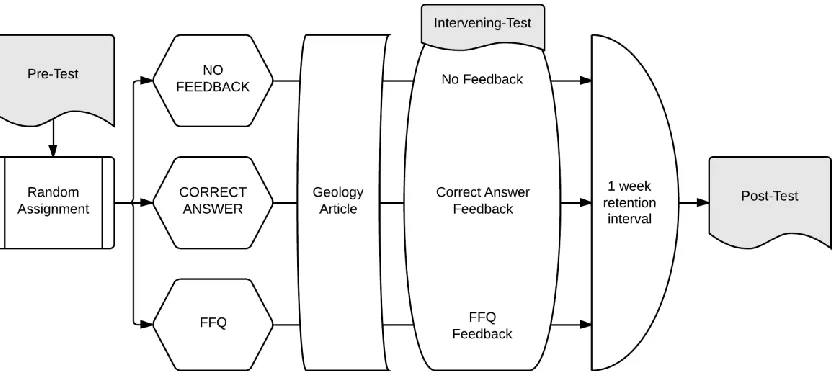
The study used a pre-test, study (geology article), intervening-test (retrieval practice), retention-test design with a one-week retention interval between the intervening-test and the retention-test (see Figure 1).
Figure 1. Study Design Flowchart.
Participants
A total of 236 participants started the study but only 195 returned after the one-week retention interval to complete the study, resulting in an attrition rate of 17%. Of the 195 participants who completed the entire study 18 were dropped from the analyses because they failed to follow instructions; e.g., did not provide their code upon returning from the
course. The remaining 155 participants were recruited through Amazon’s Mechanical Turk online crowdsourcing tool and paid $2.00 for their participation. To minimize reading comprehension confounds, only U.S.-based Mechanical Turk “Workers” were allowed to accept the human-intelligence task (HIT) posted on Mechanical Turk. Behrend, Sharek, Meade, and Wiebe (2011) found that Mechanical Turk is an effective tool for recruiting online behavioral research participants.
The sample was 59% female and the ages were highly varied with a mean of 34 and a standard deviation of 13 years of age. The youngest participant was 19 years of age and the oldest 67. The largest category of educational attainment was completion of an
undergraduate degree (41%). Additionally, 39% of participants completed a portion of an undergraduate degree, 11% completed a graduate degree, and 8% completed high school. Only one participant (<1%) did not complete high school. The majority of the sample reported that they were Caucasian (85%), and representation of other ethnicities was split amongst the rest: African-American (5%), Asian (3%), Hispanic (3%), Other (3%), Native American (<1%), and Pacific Islander (<1%). For all but three participants, English was the primary language.
Materials
The symmetry span test (Unsworth, Redick, Heitz, Broadway, & Engle, 2009;
Conway, Kane, Bunting, Hambrick, Wilhelm, Engle, 2005) is a measure of working memory capacity and an automated version (Redick, Broadway, Meier, Kuriakose, Unsworth, Kane, & Engle, 2012) was administered by Georgia Institute of Technology’s Attention and
Working Memory Lab (http://psychology.gatech.edu/renglelab) with the help of Dr. Jeffrey Foster’s Cog Lab website. Cog Lab was also used to administer the informed consents (see
Appendices A and B). Qualtrics was used for the demographics survey (see Appendix C), to display a re-printed earthquake science article (see Appendix D), and administer a 17-question short-answer test (see Appendix E) during three separate testing events: pre-test, intervening-test, and retention-test. Qualtrics was also used to display the debrief document at the end of the experiment (see Appendix F).
The Devil’s Hole Fact Sheet was prepared by the U.S. Geological Survey as a primer intended for a broad audience of lay readers. Geology was chosen because it is a fact-based discipline and most people lack a deep understanding of geological processes and
The seventeenth question was a check of the participant’s attention. In addition, each of the 16 short-answer, geology questions had a corresponding Facilitative Feedback Question (FFQ). The 16 FFQs (see Appendix E) were crafted by reformatting each short-answer questions into a fill-in-the-blank question and adding elaborative information to aid in self-correcting erroneous response to that short-answer question. All elaborative information was taken directly from the Devil’s Hole Fact Sheet.
Procedure
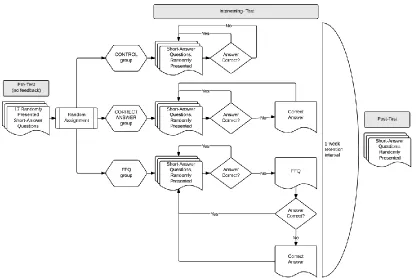
Figure 2. Data Collection Flowchart.
For the pre-test, participants were given the 17 short-answer questions, presented in random order. Qualtric’s Display Logic was used to award one point for each correct answer (see Appendix E for values accepted as correct). Following the pre-test, participants were randomly assigned to one of three experimental groups, based on feedback type – NO FEEDBACK, CORRECT ANSWER, or FFQ (Facilitative Feedback Question) – and taken to their respective instruction pages.
For the CORRECT ANSWER group, instructions included the following statement: “If you get an answer wrong, the correct answer will be shown to you.” For the FFQ group,
wrong, the correct answer will be shown to you.” Both the CORRECT ANSWER and FFQ groups were given a multiple choice question asking what they would see if their answer (to the short-answer question) was wrong. All CORRECT ANSWER and FFQ participants answered the multiple choice question correctly.
Participants then proceeded to the geology article. After reading the article, the 17 short-answer questions were given again as the intervening-test, presented in a new random order. Qualtric’s Display Logic was used to award one point for each correct answer. The intervening-test contained the experimental manipulation. For the NO FEEDBACK group, participants were immediately taken to the next question after submitting each answer. For the CORRECT ANSWER group, an incorrect response was followed by a re-presentation of the question with the correct answer below it as feedback (see Appendix E). After
acknowledging the feedback, participants were shown the next question. For the FFQ group, an incorrect response was immediately followed by the current question’s corresponding FFQ as feedback. In this scenario, participants were given a second opportunity to earn a point by answer the FFQ correctly. An incorrect answer to the FFQ was followed by the correct answer, which was formatted to match the CORRECT ANSWER group’s feedback (see Appendix E). Following a correct answer to the FFQ or acknowledging the correct answer feedback, participants were shown the next question.
undergraduates were also given an initial completion code along with a URL to part two and instructions to email themselves the code and URL. The students were told that URL for part two would not be open until 7 days had elapsed.
Following the one-week retention interval, Mechanical Turk participants were emailed (anonymously via the Mechanical Turk system) instructions along with a website link to begin part two of the study. NCSU undergraduates were emailed, by their instructor, a notice that the part two URL was active. After submitting part one’s completion code, all
returning participants were given the 17 short-answer questions again as the retention-test, presented in a newly randomized order with no feedback. Qualtric’s Display Logic was used to award one point for each correct answer. After completing the retention-test, participants received their debriefing document. The remaining $1.50 was paid to each Mechanical Turk participant using Mechanical Turk’s bonus payment feature. The NSCU undergraduates each received their extra credit.
RESULTS Preliminary Analyses
A one-way ANOVA was conducted to determine if WMC score was different across the three feedback groups. Levene's test of homogeneity of variances was non-significant, p = .17. The differences in WMC score between these groups was not statistically significant, F(2, 173) = 1.80, p = .17.
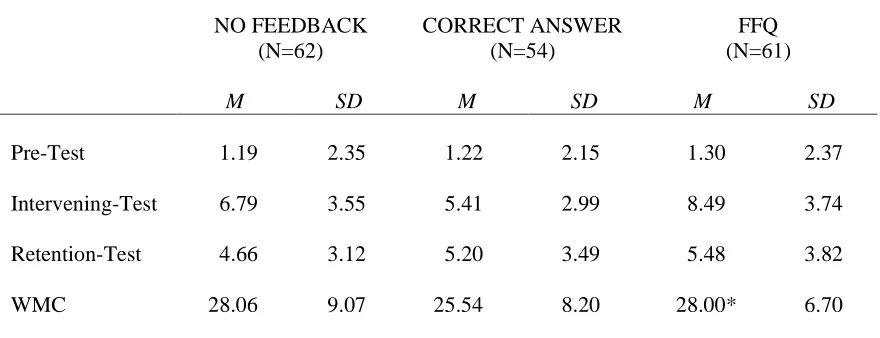
Table 1. Descriptive Statistics of Test and WMC Scores by Type of Feedback
NO FEEDBACK (N=62)
CORRECT ANSWER (N=54)
FFQ (N=61)
M SD M SD M SD
Pre-Test 1.19 2.35 1.22 2.15 1.30 2.37
Intervening-Test 6.79 3.55 5.41 2.99 8.49 3.74
Retention-Test 4.66 3.12 5.20 3.49 5.48 3.82
WMC 28.06 9.07 25.54 8.20 28.00* 6.70
Notes: *N = 60. The test scores are out of 15 possible points; 1 question was an attention check and 1 question was thrown out due to a programming error by the researcher (see Appendix E). The WMC scores are out of 42 possible points.
Tests of Research Questions
Research Question 1: Do FFQs offer an additive benefit to learning by leveraging the testing effect through feedback that is, itself, a test?
only was FFQ not significantly different from CORRECT ANSWER but, inconsistent with the literature, neither feedback group was significantly better than NO FEEDBACK.
Figure 3. Mean Retention-Test Scores by Type of Feedback.
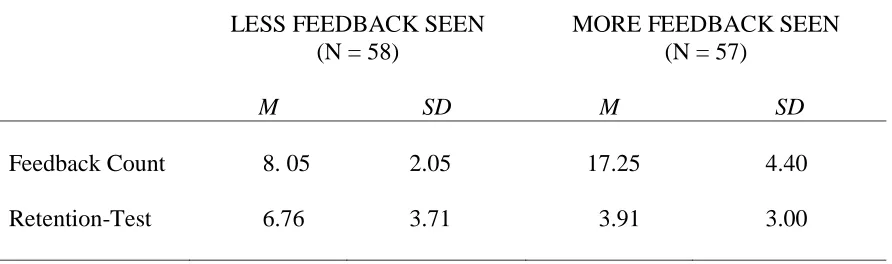
Two alternate interpretations of the data were investigated. The first was based on the amount of feedback seen. The second was based on the desirable difficulties framework of difficult but successful retrieval practice. To investigate amount of feedback seen, feedback counts (Mdn = 11) for participants in CORRECT ANSWER and FFQ groups were recoded into FEEDBACK SEEN with two levels: LESS and MORE. Counts of feedback seen from 0 to 11 were recoded as LESS FEEDBACK SEEN and counts from 12 to 27 became MORE FEEDBACK SEEN. An independent-samples t-test was run to determine if there were significant differences in retention-test scores between participants who saw LESS OR MORE FEEDBACK on the intervening-test (see Table 2 for descriptive statistics). Levene's
4 4.2 4.4 4.6 4.8 5 5.2 5.4 5.6
NO FEEDBACK CORRECT ANSWER FFQ
test of homogeneity of variances was significant, p = . 01. The retention-test score was significantly higher for the LESS FEEDBACK SEEN group than for the MORE
FEEDBACK SEEN group, t(108.92) = 4.53, p < .01. In other words, participants who saw more feedback did not have better retention-test scores than those who saw less feedback.
Table 2. Descriptive Statistics by Amount of Feedback Seen on Intervening-Test Among Participants Who Received Feedback
LESS FEEDBACK SEEN (N = 58)
MORE FEEDBACK SEEN (N = 57)
M SD M SD
Feedback Count 8. 05 2.05 17.25 4.40
Retention-Test 6.76 3.71 3.91 3.00
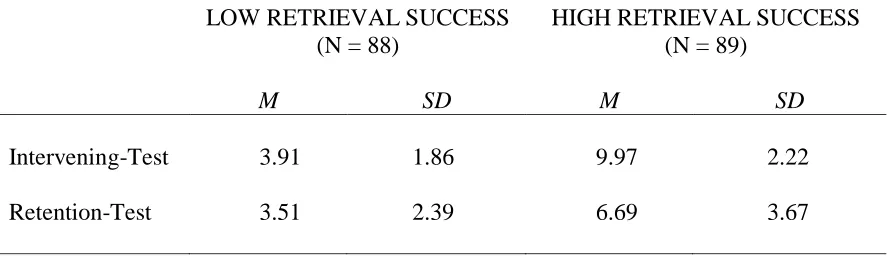
To investigate successful retrieval practice, the intervening-test scores across all participants (Mdn = 7) were recoded into RETRIEVAL SUCCESS with two levels: LOW and HIGH. Scores from 0 to 6 on the intervening-test were recoded as LOW RETRIEVAL SUCCESS and scores from 7 to 15 became HIGH RETRIEVAL SUCCESS. An
these results show that participants, who had more successful retrievals during retrieval practice, had higher retention-test scores than those who had fewer successful retrievals.
Table 3. Descriptive Statistics by Level of Retrieval Success on Intervening-Test for All Participants
LOW RETRIEVAL SUCCESS (N = 88)
HIGH RETRIEVAL SUCCESS (N = 89)
M SD M SD
Intervening-Test 3.91 1.86 9.97 2.22
Retention-Test 3.51 2.39 6.69 3.67
To better understand the RETRIEVAL SUCCESS results, a one-way ANOVA was conducted to determine if intervening-test score was different between the three types of feedback. Levene's test of homogeneity of variances was non-significant, p = .06. Intervening-test score was significantly different between different feedback
groups, F(2,174) = 11.48, p < .001, ω2 = .11. FFQ had the highest intervening-test score, followed by NO FEEDBACK and then CORRECT ANSWER (see Table 1). Tukey post-hoc analysis revealed that the mean increase from NO FEEDBACK to FFQ (1.70, 95% CI [.23, 3.18]) was statistically significant (p = .02), as was the increase from CORRECT ANSWER to FFQ (3.08, 95% CI [1.56, 5.61], p < .001). There was no statistically significant difference between NO FEEDBACK and CORRECT ANSWER.
group than in the LOW RETRIEVAL SUCCESS group, FFQ data was selected for further analysis. Two Pearson's product-moment correlations were run to assess the relationship between successful retrieval on the intervening-test and correctly answering that same question on the retention-test in FFQ participants. In other words, is there a relationship between successfully retrieving the answer to question A on the intervening-test and successfully answering question A on the retention-test?
There was a large positive correlation between number of correctly answered FFQs and number of matching retention-test questions answered correctly, r(54) = .62, p < .001, with number of FFQs answered correctly explaining 38% of the variation in matching retention-test items answered correctly. Similarly, there was a large positive correlation between number of correctly answered short-answer questions (in the FFQ group) and number of matching retention-test questions answered correctly, r(54) = .63, p< .001, with number of short-answer questions answered correctly explaining 40% of the variation in matching retention-test items answered correctly.
Research Question 2: Does working memory capacity (WMC) moderate the strength or directionality of the relationship between type of feedback and intervening-test score?
To further explore WMC, two independent samples t-tests were conducted with FEEDBACK SEEN and RETRIEVAL SUCCESS to determine if there were significant differences in WMC between participants in each of those recoded groups. For FEEDBACK SEEN, Levene's test of homogeneity of variances was non-significant, p > .05. There was no significant difference in WMC between participants who saw LESS FEEDBACK (M = 27.47, SD = 8.10) and those who saw MORE FEEDBACK (M = 26.19, SD = 6.89) on the intervening-test, t(112) = .91, p = .37. For RETRIEVAL SUCCESS, Levene's test of homogeneity of variances was non-significant, p > .05. Participants who had LOW
RETRIEVAL SUCCESS on the intervening-test had significantly lower WMC (M = 25.24, SD = 8.14) than those who had HIGH RETRIEVAL SUCCESS (M = 29.30, SD = 7.56), t(174) = -3.43, p < .01.
DISCUSSION Summary of Results
task during practice but was removed during the retention test, as was the case in the present study.
Within the two groups who saw feedback, an independent-samples t-test showed that seeing more feedback during the intervening-test did not aid in retention. Indeed, participants who saw less feedback had significantly higher retention-test scores than those that saw more feedback on the intervening-test. This sample’s failure to benefit significantly from more feedback helps to explain the non-significant differences in retention-test scores between the three groups. In the cases where less feedback was associated with higher retention-test scores, participants who saw less feedback were more similar than dissimilar to the participants in the NO FEEDBACK group.
Viewed from the perspective of success instead of failure, participants who did well on the intervening-test saw less feedback than those who did poorly. Across all participants, an independent-samples t-test revealed that retention-test score was significantly higher among participants who had high retrieval success on the intervening-test than those who had low retrieval success. A one-way ANOVA showed that intervening-test score (i.e., retrieval success) was highest in the FFQ group. This makes logical sense given that only the participants in the FFQ group were given a chance to correct an erroneous initial answer.
question A’s answer on the intervening-test. This held true for the short-answer questions
retrieved successfully by participants in the FFQ group, as shown in the last Pearson’s product-moment correlation.
The second question this research sought to answer was whether working memory capacity (WMC) moderated the strength or directionality of the relationship between type of feedback and intervening-test score. WMC did not significantly affect the relationship. Despite this non-significant moderation of intervening-test score between the three feedback groups, an independent samples t-test revealed that participants who had high retrieval success, regardless of feedback group, also had higher WMC than participants who had low retrieval success on the intervening-test. Another way to interpret this result is that
participants who had significantly higher WMC also had significantly higher retrieval success.
Implications
Limitations
One major limitation of the present study was the use of fairly unsophisticated
automated scoring. Mis-spellings such as “aqeous” for “aqueous” and “C02” for “CO2” were common causes of missed points and presentation of feedback, where applicable.
A possible limitation of the present study is that there may be some effect of
motivation of participants because the payout was dependent on completing the task, not for performance. If this method were used in a real world setting, e.g., a classroom, then the results of the tests may be more meaningful to the participants and might inspire more effort. Speculatively, increased effort (and in some cases desperation) might enhance the effect of FFQ or suppress the beneficial effect of FFQs with a higher initial score.
In addition, the geology article contained difficult content that would be appropriate in an upper-level college geology course, and this prevented much prior knowledge from being useful. This was intentional for the purpose of preventing ceiling effects, which would have suppressed results. However, there may be differences in how participants respond to FFQs when the content is more familiar or easily accessible.
Continuing this line of thought, the present study only required participants to demonstrate declarative knowledge. However, FFQs might be equally or more effective for tests of procedural knowledge, such as math, physics, or programming. In these cases, the FFQs could be targeted to the discrete elements of the process with varying degrees of specificity.
contribute to the final retention-test score. Such families of items might clump together due to similarities in content or item wording that only become obvious after performing an exploratory factor analysis. For example, if participants tended to fail all items relating to molecular dating even when given FFQs, then there may be cause to speculate that molecular dating might be too complex. Or it could be that FFQs that are verbatim to the article form one factor and items that are adjusted form another. Knowing possible factors could inform future research.
Future Research
REFERENCES
Agarwal, P. K., Karpicke, J. D., Kang, S. H., Roediger, H. L., III., McDermott, K. B. (2007). Examining the testing effect with open- and closed-book tests. Applied Cognitive Psychology, 22(7), 861-876.
Anderson, D. I., Magill, R A., & Sekiya, H. (2001). Motor learning as a function of KR schedule and characteristics of task-intrinsic feedback. Journal of Motor Behavior, 33(1), 59-66.
Bangert-Drowns, R. L., Kulik, C. C, Kulik, J. A., & Morgan, M. T. (1991). The instructional effect of feedback in test-like events. Review of Educational Research,67,213-238. Behrend, T. S., Sharek, D. J., Meade, A. W, & Wiebe, E. N. (2011). The viability of
crowdsourcing for survey research. Behavior Research Methods, 43(3), 800-813. Bjork, R. A. (1994). Memory and metamemory considerations in the training of human
beings. In J. Metcalfe & A. Shimamura (Eds.), Metacognition: Knowing about knowing (pp. 185-205). Cambridge, MA: MIT Press.
Bjork, R. A. (1999). Assessing our own competence: Heuristics and illusions. In D. Gopher & A. Koriat (Eds.), Attention and performance XVII: Cognitive regulation of
performance: Interaction of theory and application (pp. 435–459). Cambridge, MA: MIT Press.
Butler, A. C., Karpicke, J. D., & Roediger, H. L., III. (2008). Correcting a meta-cognitive error: Feedback increases retention of low-confidence correct responses. Journal of Experimental Psychology, 34(4), 918-928.
Butler, A. C., & Roediger, H. L., III. (2008). Feedback enhances the positive effects and reduces the negative effects of multiple-choice testing. Memory & Cognition, 36(3), 604-616.
Carpenter, S. K., & DeLosh, E. L. (2006). Impoverished cue support enhances subsequent retention: Support for the elaborative retrieval explanation of the testing effect. Memory & Cognition, 34, 268-276.
Carpenter, S. K., & Pashler, H. (2007). Testing beyond words: Using test to enhance visuospatial map learning. Psychometric Bulletin & Review, 14(3), 474-478.
Conway, A. R. A., Kane, M. J., Bunting, M. F., Hambrick, D. Z., Wilhelm, O., Engle, R. W. (2005). Working memory span tasks: A methodological review and user’s guide.
Psychonomic Bulletin & Review, 12(5), 769-786.
Corbett, A. T., & Anderson, J. R. (2001). Locus of feedback control in computer-based tutoring: Impact on learning rate, achievement and attitudes. Proceedings of ACM CHI 2001 Conference on Human Factors in Computing Systems (pp. 245-252). New York: Association for Computing Machinery Press.
Dempster, F. N. (1996). Distributing and managing the conditions of encoding and practice. In E.L. Bjork & R.A. Bjork (Eds.), Human memory (pp. 197-236). San Diego, CA: Academic Press.
Duchastel, P. C. (1981). Retention of prose following testing with different types of test. Contemporary Educational Psychology, 6, 217-226.
Epstein, M. L., Lazarus, A. D., Calvano, T. B., Matthews, K. A., Hendel, R. A., Epstein, B. B., et al. (2002). Immediate feedback assessment technique promotes learning and corrects inaccurate first responses. The Psychological Record, 52, 187-201. Gardiner, J. M., Craik, F. I. M., & Bleasdale, F. A. (1973). Retrieval difficulty and
subsequent recall. Memory & Cognition, 1(3), 213-216.
Glover, J. A. (1989). The "testing" phenomenon: Not gone but nearly forgotten. Journal of Educational Psychology, 81, 392-399.
Gilman, D. A. (1969). Comparison of several feedback methods for correcting errors by computer-assisted instruction. Journal of Educational Psychology, 60(6), 503–508. Goodman, J., Wood, R. E., & Hendrickx, M. (2004). Feedback specificity, exploration, and
learning. Journal of Applied Psychology, 89, 248-262.
Hanna, G. S. (1976). Effects of total and partial feedback in multiple-choice testing upon learning. Journal of Educational Research, 69(5), 202-205.
Hogan, R. M., & Kintsch, W. (1971). Differential effects of study and test trials on long-term recognition and recall. Journal of Verbal Learning and Verbal Behavior, 10, 562– 567.
Hogarth, R. M., Gibbs, B. J., McKenzie, C. R. M., & Marquis, M. A. (1991). Learning from feedback: Exactingness and incentives. Journal of Experimental Psychology:
Learning, Memory, and Cognition, 17(4), 734-752.
Irion, A. L. (1969). Principles of skill acquisition. Historical introduction (pp. 1-31). New York: Academic Press.
Jacoby, L. L. (1978). On interpreting the effects of repetition: Solving a problem versus remembering a solution. Journal of Verbal Learning and Verbal Behavior, 17, 649-667.
Kang, S. H. K, McDermott, K. B., & Roediger, H. L., III. (2007) Test format and corrective feedback modify the effect of testing on long-term retention. European Journal of Cognitive Psychology, 19(4-5), 528-558.
Karpicke, J. D. & Roediger, H. L., III. (2007a). Expanding retrieval practice promotes short-term retention, but equally spaced retrieval enhances long-short-term retention. Journal of Experimental Psychology: Learning, Memory, and Cognition, 33, 704-719.
Karpicke, J. D., & Roediger, H. L., III. (2007b). Repeated retrieval during learning is the key to long-term retention. Journal of Memory and Language, 57(2), 151-162.
Kulhavy, R. W., & Anderson, R. C. (1972). Delay-retention effect with multiple-choice tests. Journal of Educational Psychology, 65(5), 505-512.
Kulhavy, R. W., & Stock, W. (1989). Feedback in written instruction: The place of response certitude. Educational Psychology Review, 1(4), 279–308.
Kulik, J. A., & Kulik, C. C. (1988). Timing of feedback and verbal learning. Review of Educational Research, 58(1), 79-97.
Kuo, T. M., & Hirshman, E. (1996). Investigations of the testing effect. American Journal of Psychology, 109, 451-464.
McDaniel, M. A., & Fisher, R. P. (1991). Tests and test feedback as learning sources. Contemporary Educational Psychology, 16, 192-201.
McDaniel, M. A., Kowitz, M. D., & Dunay, P. K. (1989). Altering memory through recall: The effects of cue-guided retrieval processing. Memory & Cognition, 17, 423-434. McDaniel, M. A., & Masson, M. E. J. (1985). Altering memory representations through
retrieval. Journal of Experimental Psychology: Learning, Memory, and Cognition, 11, 371-385.
Nungester, R. J., & Duchastel, P. C. (1982a). Testing versus review: Effects on retention. Journal of Educational Psychology, 74(1), 18-22.
Nungester, R. J., & Duchastel, P. C. (1982b). Testing effects measured with alternate test forms. The Journal of Educational Research, 75(5), 309-313.
Pashler, H., Cepeda, N. J., Wixted, J. T., & Rohrer, D. (2005). When does feedback facilitate learning of words? Journal of Experimental Psychology, 31(1), 3-8.
Phye, G. D., & Sanders, C. E. (1994). Advice and feedback: Elements of practice for problem solving. Contemporary Educational Psychology, 79(3), 286-301.
Pyc, M. A., & Rawson, K. A. (2009). Testing the retrieval effort hypothesis: Does greater difficulty correctly recalling information lead to higher levels of memory? Journal of Memory and Language, 60, 437-447.
Redick, T. S., Broadway, J. M., Meier, M. E., Kuriakose, P. S., Unsworth, N., Kane, M. J., & Engle, R. W. (2012). Measuring working memory capacity with automated complex span tasks. European Journal of Psychological Assessment, 28, 164-171.
Roediger, H. L., III., & Karpicke, J. D. (2006a). Test enhanced learning: Taking memory tests improves long-term retention. Psychological Science, 17, 249-255.
Roediger, H. L., III., & Karpicke, J. D. (2006b). The power of testing memory: Basic
research implications for educational practice. Perspectives on Psychological Science, 1(3), 181-210.
Roediger, H. L., III, & Marsh, E. J. (2005). The positive and negative consequence of
multiple-choice testing. Journal of Experimental Psychology: Learning, Memory, and Cognition, 31, 1155-1159.
Schmidt, R. A., & Bjork, R. A. (1992). New conceptualizations of practice: Common principles in three paradigms suggest new concepts for training. Psychological Science, 3, 207-217.
Schroth, M. L. (1992). The effects of delay of feedback on a delayed concept formation transfer task. Contemporary Educational Psychology, 17(1), 78–82.
Shute, V. J. (2008). Focus on formative feedback. Review of Educational Research, 78(1), 153-189.
Sleeman, D. H., Kelly, A. E., Martinak, R., Ward, R. D., & Moore, J. L. (1989). Studies of diagnosis and remediation with high school algebra students, Cognitive Science, 73,551-568.
Tse, C., & Pu, X. (2012). The effectiveness of test-enhanced learning depends on trait test anxiety and working-memory capacity. Journal Of Experimental Psychology: Applied, 18(3), 253-264.
Tulving, E. (1967). The effects of presentation and recall of material in free-recall learning. Journal of Verbal Learning and Verbal Behavior, 6, 175-184.
Unsworth, N., Redick, T. S., Heitz, R. P., Broadway, J. M., & Engle, R. W. (2009). Complex working memory span tasks and higher-order cognition: A latent-variable analysis of the relationship between processing and storage. Memory, 17, 635-654.
Wheeler, M.A., & Roediger, H.L, III. (1992). Disparate effects of re- peated testing:
Appendix A: Mechanical Turk Informed Consent Principal Investigator: Mary Luong
Faculty Sponsor: Dr. Christopher Mayhorn
INFORMED CONSENT FORM for RESEARCH North Carolina State University
A Geology Learning Study
What are some general things you should know about research studies? You are being asked to participate in a research study. Your participation in this study is voluntary. You have the right to be a part of this study, to choose not to participate or to stop participating at any time. The purpose of research studies is to gain a better understanding of a certain topic or issue. You are not guaranteed any personal benefits from being in a study. Research studies also may pose risks to those that participate. In this consent form you will find specific details about the research in which you are being asked to participate. If you do not understand something in this form it is your right to ask the researcher for clarification or more information. You may print this consent form using your Web browsers print option. If at any time you have questions about your participation, do not hesitate to contact the
researcher named below.
What is the purpose of this study? You are invited to participate in a research study. The goal of this study is to determine the quality of the educational content contained in a geology article.
What will happen if you take part in the study? If you agree to participate in this 2-part study, you will perform an initial task, be asked to answer a few questions about yourself (such as your gender, age), take a short test about geology, read a geology article, take a test about the information you read in the article, wait 1 week, then return and take a final test about the geology article. This study should take approximately 45 minutes of your time.
Risks: There are no risks or discomforts associated with this study.
Benefits: This research will be used to help us understand how to successfully design educational articles that help people learn.
Compensation: You will receive the compensation in two parts. The first payment of $0.50 will be awarded at the end of Part 1 of this study. The final payment of $1.00 will be paid, using Mechanical Turks bonus payment feature, when you return after the 1-week waiting period and complete Part 2 of this study. At the end of each part, a code will be provided that you must enter into Mechanical Turk to confirm you completed that part.
What if you have questions about this study? If you have questions at any time about the study or the procedures, you may contact the researcher, Mary Luong at [email protected], or Dr. Christopher Mayhorn at [email protected].
What if you have questions about your rights as a research participant? If you feel you have not been treated according to the descriptions in this form, or that your rights as a participant in research have been violated during the course of this project, you may contact Deb Paxton, Regulatory Compliance Administrator, Box 7514, NCSU Campus
(919.515.4514).
CONSENT TO PARTICIPATE: By clicking on the I CONSENT option below, you are agreeing with the following statement: I understand that I have been asked to participate in a study. I have read and understand the above information. I know that I can print a copy of this form. I agree to participate in this study with the understanding that I may choose not to participate or to stop participating at any time without penalty or loss of benefits to which I am otherwise entitled.
Appendix B: Undergraduate Psychology Course Informed Consent Principal Investigator: Mary Luong
Faculty Sponsor: Dr. Christopher Mayhorn
INFORMED CONSENT FORM for RESEARCH North Carolina State University
A Geology Learning Study
What are some general things you should know about research studies? You are being asked to participate in a research study. Your participation in this study is voluntary. You have the right to be a part of this study, to choose not to participate or to stop participating at any time. The purpose of research studies is to gain a better understanding of a certain topic or issue. You are not guaranteed any personal benefits from being in a study. Research studies also may pose risks to those that participate. In this consent form you will find specific details about the research in which you are being asked to participate. If you do not understand something in this form it is your right to ask the researcher for clarification or more information. You may print this consent form using your Web browsers print option. If at any time you have questions about your participation, do not hesitate to contact the
researcher named below.
What is the purpose of this study? You are invited to participate in a research study. The goal of this study is to determine the quality of the educational content contained in a geology article.
What will happen if you take part in the study? If you agree to participate in this 2-part study, the 1st PART will take about 40 minutes and include
- an initial task,
- answering a few questions about yourself (such as your gender, age), - taking a short test about geology,
- reading a geology article,
- and taking a test about the information you read in the article. For PART 2, you must
- wait 1 week,
- then return and take a final test about the geology article. Part 2 should take approximately 5 minutes of your time.
Risks: There are no risks or discomforts associated with this study.
Confidentiality: The information in the study records will be kept confidential to the full extent allowed by law. Data will be stored securely in a secured file. No reference will be made in oral or written reports which could link you to the study. You will NOT be asked to enter your name or any personally identifying information in any study materials so that no one can match your identity to the answers that you provide. Your computer IP address is not captured or stored.
Compensation: You will receive extra credit in your course but you MUST COMPLETE BOTH PARTS to get your extra credit.
What if you have questions about this study? If you have questions at any time about the study or the procedures, you may contact the researcher, Mary Luong at [email protected], or Dr. Christopher Mayhorn at [email protected].
What if you have questions about your rights as a research participant? If you feel you have not been treated according to the descriptions in this form, or that your rights as a participant in research have been violated during the course of this project, you may contact Deb Paxton, Regulatory Compliance Administrator, Box 7514, NCSU Campus
(919.515.4514).
Appendix C: Demographics Survey Please indicate your gender.
Male Female
Prefer Not To Answer
Please indicate the highest level of education you have completed: Some high school
High school Some college
Undergraduate degree Graduate degree
Please indicate your ethnic heritage. African/African American
Asian/Asian American Caucasian
Hispanic
Native American/Alaskan Native Native Hawaiian/Pacific Islander Other
Prefer Not To Answer
Is English your first language? Yes
No
How confident are you that you could pass (70% or higher) a geology test? Very Confident
Somewhat Confident Not Confident
How much do you know about geology?
Somewhere between nothing and what I remember from high school/college I have an undergraduate degree in geology
Appendix D: Devil’s Hole Fact Sheet What is Devils Hole?
Devils Hole is a subaqueous cavern in south-central Nevada within a geographically detached unit of Death Valley National Park. The cavern is tectonic in origin and has developed in Cambrian carbonate rocks bordering the Ash Meadows oasis. The open fault zone comprising the cave extends to a depth of at least 130 meters below the water table, which is about 15 meters below land surface. The primary source of groundwater flowing through Devils Hole, and discharging from the major springs within the oasis, is precipitation on the Spring Mountains to the east of the cavern.
Why is Devils Hole of interest to paleoclimatologists?
The importance of Devils Hole to paleoclimatologists is twofold. Below the water table, the near-vertical walls of Devils Hole are coated with up to 40 centimeters of vein calcite that precipitated from groundwater mov-ing through the cavern. The calcite can be accurately and precisely dated with radiometric methods, such that the depth-varying sequences of oxygen and carbon stable isotopes in the calcite provide a record of climatic variations spanning more than 500,000 years. Additionally, rippling subhorizontal cave deposits, called folia, record variations of the water table during the past 120,000 years.
The folia are porous deposits that owe their origin to outgassing, or release of gas, at the water table of CO2 from the slightly supersaturated groundwater flowing through Devils Hole. In Brown’s Room, a remote portion of Devils Hole cave, the folia were sampled up to about 9 meters above the modern water table. Uranium-series dating of these folia has enabled the develop-ment of a 120,000-year hydrograph of water-table fluctuation in the cavern, which indicates a prominent decline during the past 20,000 years.
What paleoclimate phenomena are recorded by the Devils Hole stable isotopic time series?
The Devils Hole oxygen-18 (δ18O) time series is primarily a proxy indicator of
What contributions has Devils Hole research made to the fields of paleoclimatology, paleohydrology, and geochemistry?
Publication of the half-million-year-long Devils Hole δ18O time series in 1992 initiated a decades-long discussion regarding the capability of the Milankovitch hypothesis (also referred to as orbital or astronomical theory) to predict the onset and duration of Pleistocene ice ages, a discussion that continues to this day. The hypothesis is named after Milutin Milankovitch, who mathematically theorized that variations in eccentricity, axial tilt, and precession of the Earth's orbit determined climatic patterns on Earth. The radiometrically dated Devils Hole time series indicates an atmospheric warming beginning more than 10,000 years earlier than the timing of the penultimate major deglaciation (also referred to as
Termination II) as predicted on the basis of the Milankovitch hypothesis. This has been considered to be a direct challenge to the validity of orbital theory.
This challenge was dismissed by some on the grounds that if the earliest indications of warming were ignored, the Devils Hole records might be interpreted as supporting the Milankovitch hypothesis. But this view has been contradicted by others who claimed that early warming, though real, reflected only regional, not global, climate. All in all, the original challenge posed by the early warming recorded in the Devils Hole δ18O time series
continues: it has been reinforced by a variety of studies, not only of interhemispheric paleo-SST warming, but also of sea-level high stands (a direct proxy for global ice volume conditions) that have been directly dated as occurring thousands of years prior to orbitally predicted global deglaciations.
Prior to publication of the Devils Hole δ18O time series, the duration of Pleistocene interglacial intervals was thought to be on the order of 12,000 years, as determined from orbitally tuned chronologies based on marine sediment records. However, an examination of the Devils Hole record published in 1997 revealed that the warmest portion alone of the past four interglaciations lasted on the order of 10,000 to 15,000 years, whereas the entire
duration of the warm intervals (interglacials) persisted in excess of 20,000 years, a finding supported by both Antarctic ice core data and sea level data.
Appendix E: Geology Questions
Q1: In terms of its location relative to water, what type of cavern is Devils Hole?
FFQ1: Try that again ... Extending to a depth of at least 130 meters below the water table, Devil’s Hole is classified as a ______ cavern.
A1: In terms of its location relative to water, what type of cavern is Devils Hole? The correct answer is: subaqueous
Q2: What is the primary source of the groundwater found in Devils Hole?
FFQ2: Try that again ... The primary source of groundwater flowing through Devils Hole, and discharging from the major springs within the oasis, is ____ on the Spring Mountains. A2: What is the primary source of the groundwater found in Devils Hole?
The correct answer is: precipitation
Q3: What is another name for the rippling cave deposits in Devils Hole?
FFQ3: Try that again ... Rippling subhorizontal cave deposits, called ____, record variations of the water table during the past 120,000 years.
A3: What is another name for the rippling cave deposits in Devils Hole? The correct answer is: folia
Q4: What mineral in Devils Hole provides paleoclimatologists a record of ancient climate variations?
FFQ4: Try that again ... Depth-varying sequences of oxygen and carbon stable isotopes in the ____ provide a record of climatic variations spanning more than 500,000 years.
A4: What mineral in Devils Hole provides paleoclimatologists a record of ancient climate variations?
Q5: The Devils Hole oxygen-18 (δ18O) time series appears to correspond to what type of variations?
FFQ5: Try that again ... The Devils Hole δ18O record is highly correlated with major variations in ____ recorded all the way from Pacific Ocean sediments to the Vostok ice core from the East Antarctic Plateau.
A5: The Devils Hole oxygen-18 (δ18O) time series appears to correspond to what type of variations?
The correct answer is: paleotemperatures (“paleotemp” was accepted for scoring purposes) Q6: What stable isotopic time series reflects changes in the density of vegetation near Devils Hole?
FFQ6: Try that again ... The Devils Hole ____ time series is thought to reflect changes in global variations in the ratio of stable carbon isotopes of atmospheric carbon dioxide (CO2) and (or) changes in the density of vegetation in the groundwater-recharge areas.
A6: What stable isotopic time series reflects changes in the density of vegetation near Devils Hole?
The correct answer is: carbon-13 (“carbon 13” or “δ13C” were accepted) Q7: What is another term for the Milankovitch hypothesis?
FFQ7: Try that again ... The Milankovitch hypothesis (also referred to as _____ or _____ theory) theorized that variations in eccentricity, axial tilt, and precession of the Earth's orbit determined climatic patterns on Earth.
NOTE: YOU ONLY NEED TO PROVIDE (1) One ALTERNATE TERM, not both. A7: What is another term for the Milankovitch hypothesis?
The correct answer is: orbital or astronomical theory (“orbit” or “astronom” were accepted) Q8: Prior to the publication of the Devils Hole oxygen-18 (δ18O) time series, how many years was the duration between interglacial intervals thought to be?
FFQ8: Try that again ... Prior to the publication of the Devils Hole oxygen-18 (δ18O) time series, the duration of Pleistocene interglacial intervals was thought to be on the order of ____ years, as determined from orbitally tuned chronologies based on marine sediment records.
A8: Prior to the publication of the Devils Hole oxygen-18 (δ18O) time series, how many years was the duration between interglacial intervals thought to be?
Q9: The subject of this test is Devils Hole. What is the subject of this test?
FFQ9: The subject of this test is Devils Hole. Type the following response below: Devils Hole.
A9: The subject of this test is Devils Hole. What is the subject of this test? The correct answer is: Devils Hole
*Note: Question 9 was an experimental check that the participants were paying attention and was not included in the intervening-test scores. Interestingly, about 5% of participants got this question wrong.
Q10: According to the Devils Hole record, entire interglacials lasted for how many years? FFQ10: Try that again ... An examination of the Devils Hole record published in 1997 revealed that the entire duration of the warm intervals (interglacials) persisted in excess of _____ years, a finding supported by both Antarctic ice core data and sea level data. A10: According to the Devils Hole record, entire interglacials lasted for how many years? The correct answer is: 20,000
Q11: What atmospheric gas has played a role in glacial-interglacial climactic shifts? FFQ11: Try that again ... It is now widely acknowledged that variations in atmospheric greenhouse gases, notably ____, have played a major role in the glacial-interglacial climatic shifts of the Pleistocene.
A11: What atmospheric gas has played a role in glacial-interglacial climactic shifts? The correct answer is: CO2 ( “CO2” or “carbon dioxide” were accepted )
Q12: Although some suggest that the Devils Hole time series supports the Milankovitch hypothesis, critics of that view attribute early warming to what kind of climate change? FFQ12: Try that again ... If the earliest indications of warming were ignored, the Devils Hole records might be interpreted as supporting the Milankovitch hypothesis. But this view has been contradicted by others who claimed that early warming, though real, reflected only ____, not global, climate.
A12: Although some suggest that the Devils Hole time series supports the Milankovitch hypothesis, critics of that view attribute early warming to what kind of climate change? The correct answer is: regional (“region” was accepted)
FFQ13: Try that again ... The folia are porous deposits that owe their origin to _____, or release of gas, at the water table of CO2 from the slightly supersaturated groundwater flowing through Devils Hole.
A13: Folia are formed by CO2 in a process called what? The correct answer is: outgassing (“outgas” was accepted)
Q14: The folia in Devils Hole indicate that the water table was once at least how many meters high?
FFQ14: Try that again ... In Brown’s Room, a remote portion of Devils Hole cave, the folia were sampled up to about ____ meters above the modern water table.
A14: The folia in Devils Hole indicate that the water table was once at least how many meters high?
The correct answer is: 9
Q15: Devils Hole developed in what kind of rocks?
FFQ15: Try that again ... Devils Hole is tectonic in origin and has developed in _____ _____ rocks bordering the Ash Meadows oasis.
A15: Devils Hole developed in what kind of rocks? The correct answer is: Cambrian carbonate
Q16 Dating the Devils Hole folia has produced what type of diagram of water-table fluctuation in the cavern?
FFQ116: Try that again ... Uranium-series dating of Devils Hole folia has enabled the development of a 120,000-year _____ of water-table fluctuation in the cavern, which indicates a prominent decline.
A16: Dating the Devils Hole folia has produced what type of diagram of water-table fluctuation in the cavern?
The correct answer is: hydrograph
Q17 Where is Devils Hole located?
FFQ17: Try that again ... Devils Hole is in south-central _____ within a geographically detached unit of Death Valley National Park.
Appendix F: Debriefing Document
Title of Study: Facilitative Feedback Questions: Refining the Retrieval Effort Theory of the Testing Effect
Principal Investigator: Mary Luong Faculty Sponsor: Dr. Christopher Mayhorn
This study is concerned with the retrieval effort theory of the testing effect. The study was designed to assess the power of facilitative feedback questions to improve long-term retention of the geology article. Facilitative feedback provides elaboration that allows learners to correct themselves.
Everyone read the same geology article and was asked the same questions. Some people got no feedback, others were given the correct answer when they gave an incorrect answer, and still others were given facilitative feedback questions when they gave an incorrect answer. If you would like to receive a report of this research when it is completed (or a summary of the findings), please contact Mary Luong at [email protected].