DNA Sequence Analysis
of
Artificially Evolved ebg Enzyme
and
ebg
Repressor Genes
Barry G. Hall,**+
Paul
W.
Betts* and
John
C.
Wootton*
*Molecular and Cell Biology, University of Connecticut, Storm, Connecticut 06268, +Department of Biology, University of Rochester, Rochester, New York 14627, and *Department of Genetics, University of Leed, Leeds LS2 9JT, England
Manuscript received April 27, 1989
Accepted for publication September 7, 1989
ABSTRACT
The ebg system has been used as a model to study the artificial selection of new catalytic functions of enzymes and of inducer specificities of repressors. A series of mutant enzymes with altered catalytic specificities were previously characterized biochemically as were the changes in inducer specificities of mutant, but fully functional, repressors. The wild type ebg operon has been sequenced, and the sequence differences of the mutant enzymes and repressors have been determined. We now report that, contrary to our previous understanding, ebg enzyme contains 180-kD a-subunits and 20-kD
8-
subunits, both of which are required for full activity. Mutations that dramatically affect substrate specificity and catalytic efficiency lie in two distinct regions, both well outside of the active site region. Mutations that affect inducer specificity of the ebg repressor lie within predicted sugar binding domains. Comparisons of the ebg &galactosidase and repressor with homologous proteins of theEscherichia coli and Klebsiella pneumoniae lac operons, and with the galactose operon repressor, suggest that the ebg and lac operons diverged prior to the divergence of E. coli from Klebsiella. One case of a triple substitution as the consequence of a single event is reported, and the implications of that observation for mechanisms of spontaneous mutagenesis are discussed.
T
HE ebg (evolved @-galactosidase) system of Esch- erichia coli provides a model for studying thedetails of acquisitive evolution via changes in the
catalytic properties of enzymes and accompanying
changes in the properties of regulatory elements
(HALL 1983).
The ebg operon is located on the opposite side of
the chromosome from the lac operon (HALL and
HARTL 1974). The wild-type ebg operon does not
permit utilization of lactose or other 8-galactoside
sugars, however a series of mutations in the regulatory
and structural genes of the ebg operon allow ebg to
replace the lacZ @-galactoside for growth on lactose
(HALL 1982a). The wild-type ebg @-galactosidase is an
ineffective lactase that will not hydrolyze 8-galactoside
sugars effectively enough for growth even when the operon is expressed constitutively at a level such that
ebg @-galactosidase constitutes 5 % of the soluble pro-
tein of the cell. A series of spontaneous mutations in
the structural gene for ebg @-galactosidase can increase
the catalytic efficiency of that enzyme. When effi-
ciency is expressed as Vma,/K,, Class I mutations in-
crease efficiency for lactose 40-fold, but do not signif-
icantly affect the efficiency with which lactulose
(ga-
lactosyl-/3-1,4-fructose) is hydrolyzed (HALL 1981).
Class I1 mutations increase the efficiency of lactose
The publication costs of this article were partly defrayed by the payment of page charges. This article must therefore be hereby marked 'aducrtiscment" in accordance with 18 U.S.C. $1734 solely to indicate this fact.
Genetics 123: 635-648 (December, 1989)
hydrolysis only tenfold, but they increase the effi-
ciency of lactulose hydrolysis 48-fold (HALL 198 1). As
a consequence ebg constitutive class I strains can grow
on lactose, but not lactulose; and constitutive class I1 strains grow well on both sugars.
When both class I and class I1 mutations are present
in the same ebg gene, either as the result of sequential
spontaneous mutations or as the consequence of a
recombination between a class I and a class I1 strain,
the gene is designated as class I V . Genetic analysis
showed that there was about 1% recombination be-
tween the class I and class I1 sites, and it was estimated
that the two sites were about 1000 bp apart within
the gene (HALL and ZUZEL 1980b). Class IV ebg @-
galactosidase is dramatically different from both wild
type enzyme and from class I and class I1 enzymes in
several respects. First, with respect to the wild-type
enzyme, the efficiency of lactose hydrolysis is in-
creased 450-fold, and the efficiency of lactulose hy-
drolysis is increased 140-fold (HALL 1981). Second,
the efficiency with which galactosyl-8-1,4-arabinose
(gal-ara) is hydrolyzed is increased 300-fold (HALL
1981), a level sufficient to permit class I V , but not
wild type, class 1, or class 11, strains to grow on Gal-
Ara (HALL 1978a). Third, class I V enzyme exhibits detectable activity toward lactobionic acid (galactosyl-
@-1,4-gluconic acid), an activity that is undetectable in
purified wild type, class I or class I1 enzymes (HALL
636 B. G . Hall, P. W. Betts and J. C . Wootton
for growth (HALL 1978a), but it does create the po-
tential for lactobionate utilization as the result of
additional mutations. A third mutation in the ebg
0-
galactosidase gene increases the efficiency of lacto- bionate hydrolysis 18-f0ld, and results in a class V
strain that can grow on lactobionate (HALL 1978a,
1981). Fourth, class IV ebg 0-galactosidase (but not
wild-type class I or class I1 enzymes) exhibits transga-
lactosylation activity, an activity that permits class IV
ebg enzyme to synthesize allolactose (galactosyl-P-l,6-
glucose) from lactose (galactosyl-~-l,4-glucose).
An inefficient 0-galactosidase is not the only barrier
that prevents products of the ebg operon from hydro-
lyzing 0-galactoside sugars rapidly enough to permit
growth. Synthesis of ebg enzyme is subject to regula-
tion by the ebg repressor, the product of the ebgR gene
(HALL and HARTL 1974, 1975). The wild-type ebg repressor is not very sensitive to lactose as an inducer, permitting only 100-fold induction of the operon.
Even with the most efficient ebg enzyme, that level of
expression is insufficient for growth on lactose (HALL
and CLARKE 1977). Furthermore, the wild-type re- pressor is completely insensitive to lactulose and Gal-
Ara as inducers (HALL and CLARKE 1977). A deliber-
ate effort was made to select ebgR mutations which
permitted lactulose to act as an effective inducer. T h e mutants that were obtained all resulted in repressor that was 20-40-fold more sensitive to lactulose, ten- fold more sensitive to lactose, and 50-100-fold more
sensitive to Gal-Ara than was wild-type repressor. T h e
basal level of synthesis permitted by the mutant re- pressors was indistinguishable from wild type, thus it
appeared that the mutations affected only sugar bind-
ing, not DNA binding itself (HALL 1978b).
Sequencing of the active site peptides of ebg enzyme
showed that the ebg and lacZ proteins are homologous
(FOWLER and SMITH 1983). That conclusion was con-
firmed by DNA sequencing of one allele of the ebg
operon (STOKES, BETTS and HALL 1985; STOKES and
HALL 1985), and it was shown that both ebg enzyme
and ebg repressor are, respectively, related to the ZacZ
encoded @-galactosidase and the laGI encoded repres-
sor of the lac operon.
Several questions about the ebg system have re-
mained unresolved: Where are the class I , class I1 and
class V sites located in the ebg enzyme gene? How
dispersed are the sites? Do any of these sites coincide with the active site of the enzyme? What is the nature
and locations of the mutations in ebgR that modify the
inducer specificities of the repressor?
In this communication we identify the sites of sev-
eral of the mutations in questions by direct DNA
sequencing. In the course of this study we correct some errors in the previously published sequences (STOKES, BETTS and HALL 1985; STOKES and HALL
1985), and we identify a previously unknown ebg gene
that specifies a second subunit of ebg enzyme.
MATERIALS A N D METHODS
Strains and plasmids: All strains (Table 1) are E. coli K12. All plasmids in Table 1 were constructed by ligating either a Sal1 fragment (pUF2, pUF4, pUF5, pUF7, pUF16, pUFl7 and pUF26) or a SalI-Hind111 fragment (pUF8, pUF9) of genomic DNA from the listed strain into similarly digested plasmid pBR322. All plasmids except pUF8 carry active ebg alleles, and were isolated by selection for growth on lactose as previously described (STOKES, BETTS and HALL
1985). Plasmid pUF8 was isolated by colony hybridization to an ebgA specific probe.
Media and growth conditions have been previously de- scribed (HALL and HARTL 1974, 1975; SANCER et al. 1980; STOKES, BETTS and HALL 1985; STOKES and HALL 1985).
PCR (polymerase chain reaction) amplification of ge- nomic DNA: Amplications were carried out using the Taq DNA polymerase and the GeneAmp Kit produced by Perkin Elmer-Cetus, and reactions were carried out in a Thermal Cycler produced by the same company. DNA for sequencing was produced in two stages. In the first stage the reaction included 100 ng of genomic E. coli DNA as template, and two 20-base oligonucleotide primers with nucleotide tri- phosphates, Taq DNA polymerase and buffers as provided in the GeneAmp kit in a total volume of 100 pl. The first stage reaction consisted of 15 cycles in which DNA was denatured at 94" for 45 seconds, annealed at 55" for 10 sec, and polymerized at 72" for 2 min. The second stage used 2 p1 of the first stage reaction as template, and only one of the two oligonucleotide primers. T h e reaction was carried out for 25 cycles in which DNA was denatured at 94" for 30 sec, annealed at 55" for 5 sec, and polymerized at 72" for 2 min, otherwise conditions were identical to those of the first stage. The amplified DNA was purified over Quiagen-5 tips (Quiagen, Inc.) according to the man- ufacturer's instructions to remove any remaining primer. Purified samples were ethanol precipitated and resuspended in 30 pl. An aliquot of 6 p1 of that preparation was used in a sequencing reaction.
DNA sequencing: Cloned ebg operons were sequenced by subcloning fragments into either plasmid pBlu+ or plas- mid pBlu- (Stratagene, Inc.), and sequencing the double stranded DNA by a modification of the dideoxy method (SANGER et al. 1980). Other alleles were partially sequenced as indicated in Table 3 from single stranded DNA produced by PCR amplification.
ebg Genes
TABLE 1
Strains and plasmids
Corresponding
Strain Relevant genotype Reference plasmid
DS4680A Wild type HALL and HARTL (1 974) pUF 8
A2 ebgR2- ebgA2 HALL and HARTL (1974) pUF 7
A4 ebgR2- ebgA4 HALL and HARTL (1 974) pUF 9
A272 ebgR2- ebgA198 HALL (1978a) pUF 17
A23 ebgR2- ebgA134 HALL (1 978a) None
A27 ebgR2- ebgA138 HALL (1 978a) None
5A 1 ebgR+ ebgA51 HALL and CLARKE (1977) None
RT512 ebgR2- ebgAlO8 HALL and ZUZEL (1980b) pUF 5 5A1032 ebgR105+L ebgA109 HALL (1 982a) pUF 26
SJ 60 ebgR52- ebgA205 ROLSETH, FRIED and HALL (1980) pUF 2
R42 ebgR1- ebgA143 HALL and ZUZEL (1 980b) pUF 16
SJ48 ebgR7- ebgAl68 HALL (1 980) pUF 4
5A101 ebgR103+L ebgA5l HALL (1 97813) None
5A 102 ebgR104+L ebgA51 HALL (1 978b) None
5A103 ebgR105+L ebgA5l HALL (1978b) None
5A 104 ebgR106+L ebgA5l HALL (1978b) None
5A105 ebgR107+L ebgA51 HALL (1978b) None
5A106 ebgR108+L ebgA5l HALL (1978b) None
5A 107 ebgR109+L ebgA5l HALL (1978b) None
5A 108 ebgRl ebgA51 HALL (1978b) None
5A109 ebgRl1 ebgA51 HALL (1978b) None
RESULTS AND DISCUSSION
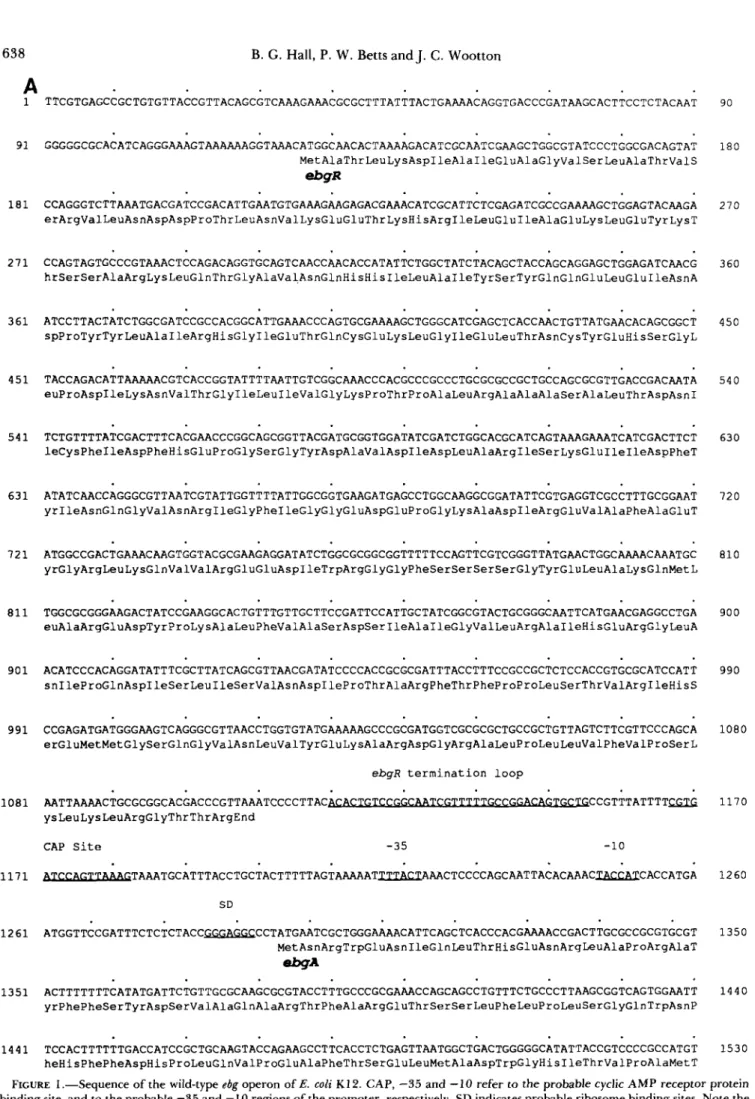
Structure of the ebg operon: The sequence of the
wild type ebg operon is shown in Figure 1. The se-
quence of ebgR is identical to that previously reported
(STOKES and HALL 1985), however, due to a book
keeping error, that sequence was previously identified
as that of the ebgR105+L allele.
The location and gene order of the ebg operon was
previously determined by classical genetic mapping
(HALL and HARTL 1975). We have now compared the
restriction map of the ebg operon, as deduced from
the DNA sequence, with the restriction map of the
whole E. coli chromosome (KOHARA, AKIYAMA and
ISONO 1987). The previously reported gene order (toZC-ebgR-ebgA-argG) is confirmed. However, the re-
striction map places the ebg operon between kilobase
3278 and 3283 of the Kohara map of the E . coli
chromosome. This corresponds to 67.5 min on the
genetic map, rather than 66 min where it was origi-
nally mapped.
We had previously reported that ebg enzyme was
encoded by a single gene, ebgA (STOKES, BETTS and
HALL 1985). We now find that the enzyme consists of
two subunits, encoded by adjacent genes ebgA and
ebgC. Note that ebgC shares a 4-bp overlap with the
end of ebgA. Evidence presented below supports the
hypothesis that the product of the ebgC gene forms
part of the active ebg enzyme. The ebgA gene begins
201 bp (67 amino acids) upstream of the previously
reported site. The ebg operon includes at least one
additional gene, ebgB, that encodes a protein of MW
68,000 (HALL and ZUZEL 1980a), and that is located
distal to ebgC.
A stem-loop that probably functions as a terminator
for the ebgR mRNA encompasses bp 1 120-1 155.
The transcription regulation region includes bp 1167-1266. The ebg operon is subject to catabolite
repression (B. G. HALL, unpublished results). The
region from 1167-1 182 is a good candidate for the
cyclic AMP receptor (CAP) protein binding site. It is
50% identical with the CAP protein binding site of
the l a c operon, and it resembles the consensus CAP
binding region in that which begins with TGTGA and
contains a less well conserved inverted repeat 6 bp
downstream from this sequence (DE CROMBRUGGHE,
BUSBY and
Buc
1984). The putative ebg CAP regionbegins with CGTGA and ends with the partly con-
served inverted repeat TAAAG. The potential -1 0
region at bp 1247-1252 matches the canonical con-
sensus sequence at 4 bases, and the potential -35
region at bp 1217-1 222 matches 4 out of 6 bp of the
canonical consensus sequence. The rather poor fit of
the putative ebg promoter to the canonical consensus,
and the sub-optimal spacing between the -35 and the
-
10 regions of the promoter are also typical of CAP-dependent promoters (DE CROMBRUGGHE, BUSBY and
Buc 1984). The region including bp 1247-1 266 is
palindromic and is a good candidate for the repressor
binding site, however no operator mutants are avail- able to rigorously define that region.
A
19 1
181
271
3 6 1
451
541
6 3 1
721
811
901
991
1081
1171
1261
1351
1441
TTCGTGAGCCGCTGTGTTACCGTTACAGCGTCAAAGAAACGCGCTTTATTTACTGAAAACAGGTGACCCGATAAGCACTTCCTCTACAAT
GGGGGCGCACATCAGGGAAAGTAAAAAAGGTAARCATGGCAACAC~A~AGACATCGCAATCGAAGCTGGCGTATCCCTGGCGACAGTAT MetAlaThrLeuLysAspIleAlaIleGluAlaGlyValSerLeuAlaThrValS
e b g R
CCAGGGTCTTAAATGACGATCCGACATTGAATGTGAAAGAAGAGACGAAACATCGCATTCTCGAGATCGCCGAAAAGCTGGAGTACAAGA erArgValLeuAsnAspAspProThrLeuAsnValLysGluGluThrLysHisArgIleLeuGluIleAlaGluLysLeuGluTyrLysT
CCAGTAGTGCCCGTAAACTCCAGACAGGTGCAGTCAACCAACACCATATTCTGGCTATCTACAGCTACCAGCAGGAGCTGGAGATCAACG hrSerSerA~aArgLysLeuGlnThrGlyAlaValAsnGlnHisHisIleLeuAlaIleTyrSerTyrGlnGlnGluLeuGluIleAsnA
ATCCTTACTATCTGGCGATCCGCCACGGCATTGAAACCCAGTGCGAAAAGCTGGGCATCGAGCTCACCAACTGTTATGAACACAGCGGCT spProTyrTyrLeuAlaIleArgHisGlyIleGluThrGlnCysGluLysLeuGlyIleGluLeuThrAsnCysTyrGluHisSerGlyL
TACCAGACATTAAAAACGTCACCGGTATTTTAATTGTCGGCAAACCCACGCCCGCCCTGCGCGCCGCTGCCAGCGCGTTGACCGACAATA euProAspIleLysAsnValThrGlyIleLeuIleValGlyLysProThrProAlaLeuArgAlaAlaAlaSerAlaLeuThrAspAsn1
TCTGTTTTATCGACTTTCACGAACCCGGCAGCGGTTACGATGCGGTGGATATCGATCTGGCACGCATCAGTAAAGAAATCATCGACTTCT leCysPheIleAspPheHisGluProGlySerGlyTyrAspAlaValAspIleAspLeuAlaArgIleSerLysGluIleIleAspPheT
ATATCAACCAGGGCGTTAATCGTATTGGTTTTATTGGCGGTGAAGATGAGCCTGGCAAGGCGGATATTCGTGAGGTCGCCTTTGCGGAAT yrIleAsnGlnGlyValAsnArgIleGlyPheIleGlyGlyGluAspGluProGlyLysAlaAspIleArgGluValAlaPheAlaGluT
ATGGCCGACTGAAACAAGTGGTACGCGAAGAGGATATCTGGCGCGGCGGTTTTTCCAGTTCGTCGGGTTATGAACTGGCAAAACAAATGC yrGlyArgLeuLysGlnValValArgGluGluAspIleTrpArgGlyGlyPheSerSerSerSerGlyTyrGluLeuAlaLysGlnMetL
TGGCGCGGGAAGACTATCCGAAGGCACTGTTTGTTGCTTCCGATTCCATTGCTATCGGCGTACTGCGGGCAATTCATGAACGAGGCCTGA euAlaArgGluAspTyrProLysAlaLeuPheValAlaSerAspSerIleAlaIleGlyValLeuArgAlaIleHisGluArgGlyLeuA
ACATCCCACAGGATATTTCGCTTATCAGCGTTAACGATATCCCCACCGCGCGATTTACCTTTCCGCCGCTCTCCACCGTGCGCATCCATT snIleProGlnAspIleSerLeuIleSerValAsnAspIleProThrAlaArgPheThrPheProProLeuSerThrValArgIleHisS
CCGAGATGATGGGAAGTCAGGGCGTTAACCTGGTGTATGAAAAAGCCCGCGATGGTCGCGCGCTGCCGCTGTTAGTCTTCGTTCCCAGCA erGluMetMetGlySerGlnGlyValAsnLeuValTyrGluLysAlaArgAspGlyArgAlaLeuProLeuLeuValPheValProSerL
ebgR termination loop
A A T T A A A A C T G C G C G G C A C G A C C C G T T A A A T C C C C T T A C A T T G C C G G A C A G T G C T G C C G T T T A T T T T ~ YsLeuLysLeuArgGlyThrThrArgEnd
CAP Site -35 -10
A T C C A G T T A A A T G C A T T T A C C T G C T A C T T T T T A G T A A A A A T ~ A A C T C C C C A G C A A T T A C A C A A A C ~ C A C C A T G A
SD
ATGGTTCCGATTTCTCTCTACC~CCTATGAATCGCTGGGAAAACATTCAGCTCACCCACGAAAACCGACTTGCGCCGCGTGCGT
M e t A s n A r g T r p G l u A s n I l e G l n L e u T h r H i s G l u A s n A r g L e u A l a P r o A r g A l a T
ACTTTTTTTCATATGATTCTGTTGCGCAAGCGCGTACCTTTGCCCGCGAAACCAGCAGCCTGTTTCTGCCCTTAAGCGGTCAGTGGAATT yrPhePheSerTyrAspSerValAlaGlnAlaArgThrPheAlaArgGluThrSerSerLeuPheLeuProLeuSerGlyGlnTrpAsnP
TCCACTTTTTTGACCATCCGCTGCAAGTACCAGAAGCCTTCACCTCTGAGTTAATGGCTGACTGGGGGCATATTACCGTCCCCGCCATGT heHisPhePheAspHisProLeuGlnValProGluAlaPheThrSerGluLeuMetAlaAspTrpGlyHisIleThrValProAlaMetT
90
180
2 7 0
3 60
450
5 4 0
630
1 2 0
810
900
990
1 0 8 0
1 1 7 0
1260
1350
1440
1 5 3 0
u
1531 GGCAAATGGAAGGTCACGGCAAACTGCAATATACCGACGAAGGTTTTCCGTTCCCCATCGATGTGCCGTTTGTCCCCAGCGATAACCCAA 1620 rpGlnMetGluGlyHisGlyLysLeuGlnTyrThrAspGluGlyPheProPheProIleAspValProPheValProSerAspAsnProT
1621 CCGGTGCCTATCAACGTATTTTCACCCTCAGCGACGGCTGGCAGGGTAAACAGACGCTGATTAAATTTGACGGCGTCGAAACCTATTTTG 1710 hrGlyAlaTyrGlnArgIlePheThrLeuSerAspGlyTrpGlnGlyLysGlnThrLeuIleLysPheAspGlyValGluThrTyrPheG
1711 AAGTCTATGTTAACGGTCAGTATGTGGGTTTCAGCAAGGGCAGTCGCCTGACCGCAGAGTTTGACATCAGCGCGATGGTTAAAACCGGCG 1800 luValTyrValAsnGlyGlnTyrValGlyPheSerLysGlySerArgLeuThrAlaGluPheAspIleSerAlaMetValLysThrGlyA
1801 ACAACCTGTTGTGTGTGCGCGTGATGCAGTGGGCGGACTCTACCTACGTGGAAGACCAGGATATGTGGTGGTCAGCGGGGATCTTCCGCG 1890 spAsnLeuLeuCysValArgValMetGlnTrpAlaAspSerThrTyrValGluAspGlnAspMetTrpTrpSerAlaGlyIlePheArgA
1891 ATGTTTATCTGGTCGGAAAACACCTAACGCATATTAACGATTTCACTGTGCGTACCGACTTTGACGAAGCCTATTGCGATGCCACGCTTT 1980 spValTyrLeuValGlyLysHisLeuThrHisIleAsnAspPheThrValArgThrAspPheAspGluAlaTyrCysAspAlaThrLeuS
1981 CCTGCGAAGTGGTGCTGGAAAATCTCGCCGCCTCCCCTGTCGTCACGACGCTGGAATATACCCTGTTTGATGGCGAACGCGTGGTGCACA 2070 erCysGluValValLeuGluAsnLeuAlaAlaSerProValValThrThrLeuGluTyrThrLeuPheAspGlyGluArgValValHisS
2011 GCAGCGCCATTGATCATTTGGCAATTGAAAAACTGACCAGCGCCACGTTTGCTTTTACTGTCGAACAGCCGCAGCAATGGTCAGCAGAAT 2160 erSerAlaIleAspHisLeuAlaIleGluLysLeuThrSerAlaThrPheAlaPheThrValGluGlnProGlnGlnTrpSerAlaGluS
2161 CCCCTTATCTTTACCATCTGGTCATGACGCTGAAAGACGCCAACGGCAACGTTCTGGAAGTGGTGCCACAACGCGTTGGCTTCCGTGATA 2250 erProTyrLeuTyrHisLeuValMetThrLeuLysAspAlaAsnGlyAsnValLeuGluValValProGlnArgValGlyPheArgAspI
2251 TCAAAGTGCGCGACGGTCTGTTCTGGATCAATAACCGTTATGTGATGCTGCACGGCGTCAACCGTCACGACAACGATCATCGCAAAGGCC 2340 leLysValArgAspGlyLeuPheTrpIleAsnAsnArgTyrValMetLeuHisGlyValAsnArgHisAspAsnAspHisArgLysGlyA
2341 GCGCCGTTGGAATGGATCGCGTCGAGAAAGATCTCCAGTTGATGAAGCAGCACAATATCAACTCCGTGCGTACCGCTCACTACCCGAACG 2430 rgAlaValGlyMetAspArgValGluLysAspLeuGlnLeuMetLysGlnHisAsnIleAsnSerValArgThrAlaHisTyrProAsnA
2431 ATCCGCGTTTTTACGAACTGTGTGATATCTACGGCCTGTTTGTGATGGCGGAAACCGACGTCGAATCGCACGGCTTTGCT~TGTCGGCG 2520 spProArgPheTyrGluLeuCysAspIleTyrGlyLeuPheValMetAlaGluThrAspValGluSerHisGlyPheAlaAsnValGlyA
2521 ATATTAGCCGTATTACCGACGATCCGCAGTGGGAAAAAAGTCTACGTCGAGCGCATTGTTCGCCATATCCACGCGCAGAAA~CCATCCGT 2610 spIleSerArgIleThrAspAspProGlnTrpGluLysValTyrValGluArgIleValArgHisIleHisAlaGlnLysAsnHisProS
2611 CGATCATCATCTGGTCGCTGGGCAATGAATCCGGCTATGGCTGTAACATCCGCGCGATGTACCATGCGGCGAAACGGCTGGATGACACGC 2700 erIleIleIleTrpSerLeuGlyAsnGluSerGlyTyrGlyCysAsnIleArgAlaMetTyrHisAlaAlaLysArgLeuAspAspThrA
2701 GACTGGTGCATTACGAAGAAGATCGCGATGCTGAAGTGGTCGATATTATTTCCACCATGTACACCCGCGTGCCGCTGATGAATGAGTTTG 2790 rgLeuValHisTyrGluGluAspArgAspAlaGluValValAspIleIleSerThrMetTyrThrArgValProLeuMetAsnGluPheG
2791 GTGAATACCCGCATCCGAAGCCGCGCATCATCTGTGAATATGCTCATGCGATGGGGAACGGACCGGGCGGAGCTGACGGAGTACCAGAACG 2880 lyGluTyrProHisProLysProArgIleIleCysGluTyrAlaHisAlaMetGlyAsnGlyProGlyGlyLeuThrGluTyrGlnAsnV
2881 TCTTCTATAAGCACGATTGCATTCAGGGTCATTATGTCTGGGAGTGGTGCGACCACGGGATCCAGGCACAGGACGACCACGGCAATGTCT 2970 alPheTyrLysHisAspCysIleGlnGlyHisTyrValTrpGluTrpCysAspHisGlyIleGlnAlaGlnAspAspHisGlyAsnValT
2911 GGTATAAATTCGGCGGCGACTACGGCGACTATCCCAACAACTATAACTTCTGTCTTGATGGTTTGATCTATTCCGATCAGACGCCGGGAC 3060 rpTyrLysPheGlyGlyAspTyrGlyAspTyrProAsnAsnTyrAsnPheCysLeuAspGlyLeuIleTyrSerAspGlnThrProGlyP
J. C. Wootton
C
3061 CGGGCCTGAAAGAGTACAAACAGGTTATCGCGCCGGTAAAAATCCACGCGCGGGATCTGACTCGCGGCGAGTTGAAAGTCGAAAATAAAC roGlyLeuLysGluTyrLysGlnValIleAlaProValLysIleHisAlaArgAspLeuThrArgGlyGluLeuLysValGluAsnLysL
3151 TGTGGTTTACCACGCTTGATGACTACACCCTGCACGCAGAGGTGCGCGCCGAAGGTGAAAGCCTCGCGACGCAGCAGATTAAACTGCCGG euTrpPheThrThrLeuAspAspTyrThrLeuHisAlaGluValArgAlaGluGlyGluSerLeuAlaThrGlnGlnIleLysLeuPro~
3241 ACGTTGCGCCGAACAGCGAAGCCCCCTTGCAGATCACGCTGCCGCAGCTGGACGCCCGCGAAGCGTTCCTCAACATTACGGTGACCAAAG
spValAlaProAsnSerGluAlaProLeuGlnIleThrLeuProGlnLeuAspAlaArgGluAlaPheLeuAsnIleThrValThrLysA
3331 ATTCCCGCACCCGCTACAGCGAAGCCGGACACCCTATCGCCACTTATCAGTTCCCGCTGAAGGAAAACACCGCGCAGCCAGTGCCTTTCG
spSerArgThrArgTyrSerGluAlaGlyHisProIleAlaThrTyrGlnPheProLeuLysGluAsnThrAlaGlnProValProPheA
3421 CACCAAATAATGCGCGTCCGCTGACGCTGGAAGACGATCGTTTGAGCTGCACCGTTCGCGGCTACAACTTCGCGATCACCTTCTCA~A laProAsnAsnAlaArgProLeuThrLeuGluAspAspArgLeuSerCysThrValArgGlyTyrAsnPheAlaIleThrPheSerLysM
3511 TGAGTGGCAAACCGACATCCTGGCAGGTGAATGGCGAATCGCTGCTGACTCGCGAGCCAAAGATCAACTTCTTCAAGCCGATGATGATCG etSerGlyLysProThrSerTrpGlnValAsnGlyGluSerLeuLeuThrArgGluProLysIleAsnPhePheLysProMetMetIleA
3601 ACAACCACAAGCAGGAGTACGAAGGGCTGTGGCAACCGAATCATTTGCAGATCATGCAGGAACATCTGCGCGACTTTGCCGTAGAACAGA
s p A s n H i s L y s G l n G l u T y r G l u G l y L e u T r p G l n P r o A s n H i s L e u G l n I l e M e t G l n G l u H i s L e u A r g A s p P h e A l a V a l G l u G l n S
3691 GCGATGGTGAAGTGCTGATCATCAGCCGCACAGTTATTGCCCCGCCGGTGTTTGACTTCGGGATGCGCTGCACCTACATCTGGCGCATCG erAspGlyGluValLeuIleIleSerArgThrValIleAlaProProValPheAspPheGlyMetArgCysThrTyrIleTrpArgIleA
3781 CTGCCGATGGCCAGGTTAACGTGGCGCTTTCCGGCGAGCGTTACGGCGACTATCCGCACATCATTCCGTGCATCGGTTTCACCATGGGAA laAla3spClyGlnValAsnValAlaLeuSerGlyGluArgTyrGlyAspTyrProHisIleIleProCysIleGlyPheThrMetGlyI
3871 TTAACGGCGAATACGATCAGGTGGCGTATTACGGTCGTGGACCGGGCGAACTACGCCGACAGCCAGCAGGCTAACATCATCGATATCT leAsnGlyGluTyrAspGlnValAlaTyrTyrGlyArgGlyProGlyGluAsnTyrAlaAspSerGlnGlnAlaAsnIleIleAspIleT
3961 GGCGCCAAGCCGTCGATGCCATGTTCGAGAACTATCCCTTCCCGCAGAACAACGGTAACCGTCAGCATGTCCGCTGGACGGCACTGACTA
rpArgGlnAlaValAspAlaMetPheGluAsnTyrProPheProGlnAsnAsnGlyAsnArgGlnHisValArgTrp~hrAlaLeuThrA
4051 ACCGCCACGGTAACGGTCTGCTGGTGGTTCCGCAGCGCCCAATTAACTTCAGCGCCTGGCACTATACCCAGGAAAACATCCACGCTGCCC snArgHisGlyAsnGlyLeuLeuValValProGlnArgProIleAsnPheSerAlaTrpHisTyrThrGlnGluAsnIleHisAlaAlaG
4141 AGCACTGTAACGAGCTGCAGCGCAGTGATGACATCACCCTGAACCTCGATCACCAGCTGCTTGGCCTCGGCTCCAACTCCTGGGGCAGCG 1nHisCysAsnGluLeuGlnArgSerAspAspIleThrLeuAsnLeuAspHisGlnLeuLeuGlyLeuGlySerAsnSerTrpGlySerG
4231 AGGTGCTGGACTCCTGGCGCGTCTGGTTCCGTGACTTCAGCTACGGCTTTACGTT~TGCCGGTTTCTGGCGGAGAAGCTACCGCGCAAA luValLeuAspSerTrpArgValTrpPheArgAspPheSerTyrGlyPheThrLeuLeuProValSerGlyGlyGluAlaThrAlaGlnS
SD
4321 GCCTGGCGTCGTATGAGTTCGGCGCAGGGTTCTTTTCCACGAATTTGCACACGGBEBBTAAGCAATGAGGATCATCGATAACTTAGAACA erLeuAlaSerTyrGluPheGlyAlaGlyPhePheSerThrAsnLeuHisThrGluAsnLysGlnEnd IleIleAspAsnLeuGluGl
Start of ebgC overlaps end of ebgA MetArg
4411 GTTCCGCCAGATTTACGCCTCTGGCAAGAAGTGGCAACGCTGCGTTGAAGCGATTGAAAATATCGACAACATTCAGCCTGGCGTCGCCCA nPheArgGlnIleTyrAlaSerGlyLysLysTrpGlnArgCysValGluAlaIleGluAsnIleAspAsnIleGlnProGlyValAlaHi
4501 CTCCATCGGTGACTCATTGACTTACCGCGTGGAGACAGACTCCGCGACCGATGCGCTATTTACCGGGCATCGACGCTATTTTGAAGTGCA sSerIleGlyAspSerLeuThrTyrArgValGluThrAspSerAlaThrAspAla~uPheThrGlyHisArgArgTyrPheGluValHi
FIGURE 1C
3150
3240
3330
3420
3510
3600
3690
3780
3870
3960
4050
4140
4230
4320
4410
4500
64
D
45914681
4771
4861
4951
TTACTACCTGCAAGGGCAGCAAAAAATTGAATATGCGCCGAAAGAGACATTACAGGTAGTGG~TATTATCGTGATGAAACTGACCGTGA 4680
sTyrTyrLeuGlnGlyGlnGlnLysIleGluTyrAlaProLysGluThrLeuGlnValValGluTyrTyrArgAspGluThrAspArgG1
ATATTTAAAAGGCTGCGGAGAAACCGTTGAGGTCCACGAAGGGC~ATCGTTATTTGCGATATCCATG~GCGTATCGGTTTATCTGCAA 4770 uTyrLeuLysGlyCysGlyGluThrValGluValHisGluGlyGlnIleValIleCysAspIleHisGluAlaTyrArgPheIleCysAs
TAACGCGGTCAAAAAAGTGGTTCTCAAAGTCACCATCGAAGATGTTATTTCCATAACAAATAACAACTACGGCGGCAAAAGGAGTTTGCC 4860 nAsnAlaValLysLysValValLeuLysValThrIleGluAspValIleSerIleThrAsnAsnAsnTyrGlyGlyLysArgSerLeuPr
GCCACCGCTACCCTACTCATTTTCGGAGATGTGTTATGTCTGATACCAAACGTAATACAATCGGCAAATTCGGCTTCGTCTCGCTGACTT 4950 oProProLeuProTyrSerPheSerGluMetCysTyrValEnd
TTGCCGCCGTTTACAGCTTTAACAACGTTATGA 4983
FIGURE 1D
TABLE 2
Properties of ebg operon gene products
MW MW
Gene Span Product (calculated) (SDS-PAGE)
ebgR bp126-1109 Repressor 36,169 Not determined
ebgA bp1293-4388 @-Galactosidase, CY subunit 117,927 120,0005
ebgC bp4385-4903 @-Galactosidase, @ subunit 19,917 22,000
ebgB After bp 4979 Unknown 79,OOob
a From HALL (1976).
*
From HALL and ZUZEL (1980a).Properties of the ebg gene products, as deduced
from the DNA sequence, are compared with some actual properties in Table 2.
Evidence that the ebgC gene product is part of the active ebg enzyme: Purified preparations of ebg en-
zyme that were used in a previous study (HALL 1981)
occasionally contained a contaminating protein of
MW -18,000 as judged by SDS-PAGE gels stained
with Coomassie brilliant blue. A similar contaminating
band was detected by M. SINNOTT (personal commu-
nication). Because the intensity of that band was quite
variable relative to the 120,000 MW ebgA encoded
band, it was assumed that the band represented an
unrelated protein that sometimes copurified with ebg
enzyme. Reexamination of some purified preparations
that had been stored at -70” since 1980 showed that the “contaminating” 22,000 MW band was present at
about the same concentration as the 120,000 MW
band when proteins were detected by silver staining. That band can not be detected in these preparations by staining with Coomassie brilliant blue.
A pair of plasmids was constructed to determine the
role of the ebgC gene product in ebg enzyme activity.
One plasmid, pUF856, contained both the ebgA and
ebgC genes (bp 1187-5385) from the class I1 allele
ebgASI, while the otherwise identical plasmid,
pUF854, carried only the ebgA gene (bp 1187-4395)
from that strain. Crude enzyme extracts were pre-
pared from the ebg deletion strain SJ84R harboring
each of the plasmids, and the K , and V,,, of the ebg
enzyme from those extracts was determined in tripli-
cate. The enzyme encoded by pUF856 exhibited a K ,
of 0.48 k 0.06 mM O-nitrophenyl-@-galactoside
(ONPG) and a V,,, of 5,300 -C 300 nmol/min; while
that from plasmid pUF854 (lacking the ebgC peptide)
exhibited a K , of 0.96 & 0.12 mM ONPG and a V,,,
of 92.2 f 3.8 nmol/min. The K , for the enzyme
encoded by pUF856 was in good agreement with that
reported for purified class I1 ebg enzymes, 0.56 f 0.04
mM ONPG (HALL 1981). The absence of the ebgC
peptide thus reduces the ebg enzyme activity toward
ONPG by about 50-fold. In vivo, plasmid pUF856
confers a strong lactose positive phenotype on Mac- Conkey plates, and produces intensely blue colonies on XGAL plates. In contrast, plasmid pUF854 confers
a lactose negative phenotype on MacConkey plates,
and produces pale blue colonies on XGAL plates. It
seems reasonable to conclude the ebgC gene product
is required for full activity of ebg enzyme. The ebg
enzyme thus consists of two subunits: the a-subunit,
encoded by ebgA, and the @-subunit, encoded by ebgC.
The MW of the native ebg enzyme was originally
reported as 720,000 on the basis of sedimentation
equilibrium measurements (HALL 1976), indicating a
B. G. Hall, P. W. Betts and J. C. Wootton
, ,
w i
l d
, ,
, DS4680A
A2 5A1 0 2 5A2 A4
Class I Class I I Class I
I
(constitutive repressor
mutation) (repressor
mutations)
A23
Class I U Class IU
Cross with
I
Wild Type
SJ 48 4R 1 Class I Class IU
I
CrossCross with
Wild Type
R42 A272 RT5 1 2
5131032
Class 1 1 Class
u
Class IU Class I U SJ60Class IU
FIGURE Z.-Phylogeny of ebg mu-
tants. T h e class of enzyme synthe- sized (see text) is shown below each strain name.
specific volume of ebg enzyme. Assuming that the
native structure involves an equal number of LY and @,
as would appear to be the case from relative silver staining intensities, an a6-P6 structure would yield a
native MW 827,000 and an
a444
would yield55
1,400;
neither of which is easily reconciled with thepreviously estimated 720,000.
Analysis of mutations involved in the evolution of
new functions
Figure 2 shows the phylogeny of the alleles that are discussed in this study. In order to confirm the iden-
tities of cloned mutant alleles, the regions bearing the
mutations were amplified by PCR from genomic DNA
of the originating strain. In all cases the cloned genes were identical with the genes in the original strains.
Mutations in ebg enzyme structural genes: The ebgA and ebgC genes from the wild-type and five mutant strains have been sequenced in their entireties. Five additional mutant alleles were partially se-
quenced, either by PCR or by direct sequencing from
plasmid DNA. The mutation at the class I site is
identical in four independent alleles, however two
versions of the class I1 site were detected among the five independent class I1 mutations examined (Table
3). Properties of enzymes encoded by the different
sequences are presented in Table
4.
The ebg enzymes were labeled with the active site
directed inhibitor 4-nitrophenyl-~-D-galactopyrano-
sylmethyltriazine (FOWLER and SMITH 1983). Wild-
type enzyme and class I enzyme specified by the ebgA2
allele were preferentially labeled in a peptide encoded
by bp 2703-2762, while the class I1 enzyme encoded
by the ebgA52 allele was preferentially labeled in a
peptide encoded by bp 2625-2660. It is notable that
none of the mutations which alter the catalytic speci- ficities of ebg enzyme fall within this active site region.
Although it is clear that the &subunit plays an
important role in ebg enzyme activity, it seems unlikely
that the mutation in ebgC, and the second mutation in
the class I1 site of ebgA, significantly affect the activities
of ebg enzyme. Properties of the purified enzymes
encoded by the class IV alleles listed in Table 3 have
been determined (HALL 1981), and there is no indi-
cation that the enzymes with the mutant &subunit are significantly different from those with the wild type @-subunit.
The thermal stabilities of various ebg enzymes were
determined (HALL 1981), and no significant correla-
tion was found between the rate of thermal inactiva-
tion and the number of mutations assumed to be
present in each enzyme (classes I and I1 were assumed
to have 1 mutation, class IV 2 mutations, and class V
3 mutations). We have reexamined the data in light
of the sequencing data, and there is a highly significant
( P
<
0.01) effect of the number of amino acid substi-TABLE 3
Mutations in ebg enzyme genes
Sequence changes
Strain Genotype
Enzyme
class ebgA ebgC
DS4680A A4 A2 SJ48 5A11 5A2 R42
A23
Wild type
ebgA4 ebgA2 ebgAl68 ebgA5l ebgA52 ebgAI43
ebgAl34
0 I I I I1 I1
I1
IV
None
1 5 6 6 G + A 1 5 6 6 G + A 1 5 6 6 G - A 4223 G + T 4223 G -+ A
4223 G + T
1566 G + A 4223 G + T
None None None None None None None
None
Comment
Completely sequenced Completely sequenced Completely sequenced Class I and I1 sites sequenced Class I and I1 sites sequenced Class I and I1 sites sequenced Recombinant, carries class I1 site of
Class I and I1 sites sequenced
A23; class I and 11 sites sequenced
A27 ebgAI38 IV 1566 G + A 4749 A -+ G Class I and I1 sites sequenced
4223 G + A 4227 A + G
RT5 12 ebgA 108 IV 1 5 6 6 G + A None Recombinant, carries class I site of A2
4223 G + T and class I1 site of 5A11; completely
sequenced
SJ60 ebgA205 IV 1566 G + A 4749 A + G Completely sequenced
4223 G -+ A 4227 A + G
A272 ebgA I98 V 1566 G + A 4749 A -P G Completely sequenced
1 5 6 9 G - A 4223 G 4 A
4227 A + G
crease in the rate of decay with each additional sub-
stitution (Figure 3).
Mutations in the ebg repressor gene: The ebg op- eron is subject to negative control by the repressor
encoded by ebgR (HALL 1978b; HALL and CLARKE
1977; HALL and HARTL 1975). Three kinds of regu-
latory mutations have been reported, ebgR-, ebgR+'
and ebgR+L.
Three independent ebgR- (constitutive ebg enzyme
synthesis) alleles were sequenced (Table 5). The two
spontaneous mutations, ebgR2 and ebgR52, were single
base insertion frame shifts, and the EMS induced
ebgRl mutation involved two adjacent substitutions that resulted in a nonsense codon.
The existence of ebgR+" alleles was deduced from
the observation that regulated ebg+ (lactose utilizing)
mutants synthesized four times as much ebg enzyme
protein upon induction with lactose as did wild-type (unevolved) strains. One such strain, A4, synthesized
class I ebg enzyme and was defined as ebgR4+' ebgA4.
A cross between wild type and a constitutive derivative
of strain A4 generated a recombinant that synthesized
class I enzyme at the level expected of wild type
strains, indicating that the difference in level of gene
expression was not a function of the ebgA allele pres-
ent. It was concluded that such strains possessed mu-
tant repressor alleles that were more sensitive than
wild type to lactose induction (HALL and CLARKE
1977). Repeated sequencing of both strands of the ebgR4+' allele failed to detect any differences from
the wild-type sequence (Table 5). We have reexam-
ined the recombinant strain from the earlier study,
and confirmed that it does synthesize class I enzyme
at the wild-type level, thus strain A4 did indeed have at least two mutations that distinguished it from wild type. We conclude that the second mutation must be
distal to ebgA, and that the recombinant strain was a
double recombinant. The designation ebgR+' is thus
inappropriate.
The wild-type repressor is not inducible by either lactulose or Gal-Ara, and a deliberate effort was made
to isolate spontaneous lactulose inducible ebgR mu-
tants (HALL 1978b). Nine lactulose inducible (ebgR+L)
mutants were isolated. Because those mutations af-
fected only the specificity of induction, and not the basal level of synthesis, it was expected that the mu- tations would occur in the sugar binding domain of the repressor. Residues likely to be involved in sugar binding were predicted from database searching and
sequence alignment (Figure 4) of ebgR with other
repressors (lacl, galR, and cytR), and with sugar bind-
B. G . Hall, P. W. Betts and J. C. Wootton
TABLE 4
Properties of mutant ebg enzymes
Wild type
ebgA2
ebgA52
ebgA134
ebgA138, C138
ebgA198
0
I
I1
I V
IV
(@-subunit)
V
(&subunit)
None
Asp-92 + Asn
Trp-977 + Cys
Asp-92 + Asn Trp-977 + Cys
Asp92 + Asn
Ser-979 + Gly T v - 9 7 7 + CYS
Glu-122 + Gly
Glu-93 + Lys Asp92 + Asn
Trp-977 + Cys Ser-979 + Gly Glu-122 + Gly
Lactose Lactulose Gal-Ara Lactobionate
Lactose Lactulose Gal-Ara Lactobionate Lactose Lactulose Gal-Ara Lactobionate
Lactose Lactulose Gal-Ara Lactobionate
Lactose Lactulose Gal-Ara
Lactobionate
Lactose Lactulose Gal-Ara Lactobionate
150 620
180 270
64 52
No detectable activity
22 4200
57 5113
24 340
No detectable activity
72 2700
34 2200
34 460
No detectable activity
0.82 1600 6.2 470 2.8 940
15 67
0.89 1710 10.7 480
4.3 840
9 74
0.69 590
6.5 215
4.96 349 3.0 370
Allele Enzyme Amino acid substitu- class tions Substrate (mM) K," (nmol/min/mg) Commentb VI",,'
Can not synthesize allolac- tose from lactose
Can not synthesize allolac- tose from lactose
Can not synthesize allolac- tose from lactose
Efficiently synthesizes allo- lactose from lactose
Efficiently synthesizes allolactose from lactose
Data from HALL (1981).
*
Data from HALL (1982b).0 . 2 2 r
0.124
P
0
0.1 I I I I , I I I I ,
0 0 . 5 1 1 . 5 2 2.5 3 3 . 5 4 4.5 5
Amino acid substitutions
FIGURE 3.-Thermal stabilities of ebg enzymes. Abscissa is the number of amino acid replacements in the enzyme when compared with the wild type sequence, ordinate is the first order decay constant in min", measured at 50".
From the high resolution crystal structures of the L-
arabinose binding protein (ABP) (QUIOCHO and VYAS
1984), and its structural homolog the D-galactose/D
glucose binding protein (GBP) (VYAS, VYAS and
QUIOCHO 1988), critical sugar binding residues were
used to construct pattern discriminators and to iden-
tify the best matching segments of the repressors. This
analysis, summarized in Figure 4, confirmed and ex-
tended the homology between ZacZ, gaZR, and the
sugar binding protein that had previously been noted (MULLER-HILL 1983; SARIS et aZ. 1984).
Three different substitutions were found in the nine ebgR+L alleles. The sequence of the entire ebgR gene
was determined for one allele, ebgR105+L, and the
region around the site of the mutation in ebgR105+L
was sequenced in the remaining eight alleles. The ebgRIO3 and ebgRlO6 alleles have identical substitu-
tions, ebgRIO5 is unique, and ebgR104 plus ebgRIO7
through ebgRl11 have identical substitutions (Table
5). All three amino acid substitutions fell within a
predicted sugar binding region. The three amino acid substitutions, Asp190 to Gly, Ala-195 to Thr, and Phe-196 to Cys, are close to the predicted primary sugar contacting residue Arg-192. The corresponding critical arginines (Figure 4), Arg-15 1 of ABP and Arg-
158 of GBP, each donate two hydrogen bonds to
oxygen atoms of the bound sugars (QUIOCHO et al.
1987; VYAS, VYAS and QUIOCHO 1988). Presumably
residues 188 to 196 of ebgR are similarly crucial for
the specificity of molecular recognition of lactose,
possibly by affecting the orientation of Arg-192
through secondary contacts or through the polypep-
Sequence Analysis of ebg Genes
TABLE 5
Mutations in ebgR
Relative level of ebg operon expression with indu- cer present"
Allele
Amino acid replace-
Mutation ment None Lactose Lactulose Gal-Ara
WT None None 1.0 103 1 1 8
ebgR103+L, ebgR106+L bp 695 T + G A s p 190 + Glu 0.9 268 207 229
ebgR105+L bp 708 G + A Ala-195 + Thr 1.0 821 450 753
ebgR104+L, ebgR107+L, bp712 T + G Phe-196 + Cys 1 . 1 711 300 768
e b g R l O ~ P ~ , ebg- R109+L, ebgRllO+L, ebgRl1
ebgRl - bp 760 & 761 GG + AA Trp-212 + ochre 2200
ebgR2- A or T insertedb after bp 102 1 Frameshift at 2100
ebgR52- T inserted after bp 102 1 Frameshift at 2300
Leu-299
Leu-299
Data from HALL (1978b) and HALL and CLARKE (1977).
*
Determined by the creation of a Sty1 restriction site and the loss of a BstNI restriction site, not directly by DNA sequencing.The three amino acid replacements in alleles
broaden the specificity of inducer recognition to in-
clude lactulose and Gal-Ara (Table 5). This implies
that the sugar contacts made by the 188-196 region
of the ebgR encoded repressor, probably involving
direct bonds of Arg-192, are to the glucopyranose moiety of lactose, and, in the mutant alleles, to the fructofuranose and arabinopyranose moieties of lac- tulose and Gal-Ara. The three sugars are identical in the galactopyranose moiety. It is not possible to make
more precise stereochemical predictions about the
bonding of Arg-192 to these three sugars, because there are differences between the ABP and GBP in the roles of the corresponding arginines, resulting from opposite orientations of the bound sugars. Arg-
15 1 of ABP donates hydrogen bonds to 0 - 4 and 0-5
of L-arabinose, whereas Arg-158 of GBP bonds 0 - 1
and 0 - 2 of D-glucose
(QUIOCHO
et al., 1987; VYAS,VYAS and
QUIOCHO
1988). An alternative interpreta-tion is that the 188 to 196 regions of the wild-type ebgR repressor might exclude lactulose and Gal-Ara by steric hindrance, whereas a looser conformation of this region in the repressors encoded by mutant ebgR+L alleles might permit a broader range of sugar analogs to bind and to act as inducers.
Homology with other genes
All comparisons are based upon alignments of the
deduced amino acid sequences using the UWGCG
GAP program with a gap penalty of 5.0 and length
penalty of 0.3. The ebg @-galactosidase was aligned
with the lac2 @-galactosidase of E. coli and with the
lacZ 8-galactosidase of K . pneumoniae; and the ebg
repressor protein was aligned with the lacl and galR
encoded repressors of E. coli, and with the lacl re-
pressor of K . pneumoniae (Table 6).
No homology could be detected between the ebgC
encoded @ subunit sequence and that of either lac2 or
l a c y (permease) of E. coli.
Both the @-galactosidase a d the repressor genes
support a picture in which ebg diverged from lac prior
to the time that Klebsiella diverged from E . coli. It is
very surprising that in two comparisons, the lac ope-
ron of Klebsiella vs the lac operon of E. coli, and the
ebg operon vs the lac operon of E. coli, the repressor
genes have diverged much more than have the
6-
galactosidase genes. If most of the replacements are
neutral, then the repressors and @-galactosidases
should have diverged to about the same extent. With respect to selective replacements, the &galactosidases would be expected to have diverged more than the
repressors, since the @-galactosidase of E. coli is the
most electrophoretically variable proteins tested in the
ECOR collection of natural isolates of E. coli, with an
allelic diversity that is 2.4 times the mean allelic diver-
sity for 35 enzymes studied (SELANDER, CAUGANT and
WHITTAM 1987).
Multiple spontaneous mutations
We have two examples of alleles that differ from
their immediate ancestral alleles by 3-bp substitutions, ebgAC134 (strain A27) and ebgAC205 (strain SJ60).
Because all of the mutations reported here, except
ebgR1, were spontaneous this raises the issue of mul- tiple substitutions as the consequence of single events.
The ebgA205 allele (strain SJSO) was selected during the course of serial transfer experiments, alternating
between lactose and lactulose as carbon sources (ROL-
SETH,
FRIED
and HALL 1980). It is therefore quitepossible that the three mutations occurred sequen-
tially.
The ebgACl38 allele (strain A27), in contrast, was isolated as a papilla on the surface of an aged strain
B. G. Hall, P. W. Betts and J. C. Wootton
DNA binding
E C EbgR
E C L e c I K P L e c I
E C GalR
E C C y t R
E C EbgR
E C L a c I K P L a c I
BC GalR
E C C y t R E C R B P BC G B P
E C A B P
E C BbgR
E C L a c I K P L a c I
EC GalR
E C C y t R E C R E P
E C C B P
E C A B P
EC EbgR
EC L a c I
K P L a c I
E C GalR
E C C y t R E C R E P
E C G B P
E C ABP
D P T L N V K B ~ T K H R I L E I A E K L E Y K T S S A R K L ~ T G A V N ~ H H I L A I Y S Y ~ ~ E L E I N D P Y Y L A I R H G I E - -
A S H V S A K ~ - T R B K V B A A M A E L N Y - - I P N R V A P P L I O K a S L L I G V A T S S L A L H A P S ~ I V A A I K S R A D ~ L
*** ***
* :**
: ** ***
** ****
: * * :* *
*******:%**** *
PEVVSAR~-TREPVIRAM~ALHY--VPNRSAPLLAGKAAPSIGLITASVTLHAPS~IAAAIKSHASLH
: I * I *
*
**
* *
** * **
! * * !*
! ! * ! f !40 60 60 70 8 0 90 100
I
* *
: : I*
*
*
*
*
I **
**
110 120 130 140 150 160 170 180 190 200
91 -182 - - - ~ - - T P C ~ K L G I E L T N C Y E H S G L P D I K N V T G I L I V G K P T P A L R A A A - - S A L T D N I C F I D F H E P G S G Y D A V D I D L A R I S K E I I D F Y I N ~ G V N R I G F ~ G G
91 -187 G A S V V V S M V B R S G V B A C K A A V H N L L A Q - " L I I N Y P L D D ~ D A I A V E A A C T N V P A L F L D V S D ~ T P I N S I I F S 8 E D G T R L G V E R L V A L G H ~ ~ I A L L A G : *
* *
: **
* *
* * : : : * : * : * * : * : : : I : : I S : , * , 1*
I 0,
* I*
188 - 2 8 0 P L S S V S A R L R L A C W H K Y L T R N Q I Q P I A B - - R E G O W S A M S G F ~ ~ T M ~ M L N E - - - G L V P T A M L V A N D ~ M A L G A M R A I T - - E S G L R V G A D I S V V G Y D D T E D S S
: :
*
*
: I * : I * : : : : * : * : * * :***
: :* *
: * * : * :*
* : : * * ** **
::***:: : * : : : I* **********:*
:*
:*
:***:*
**
*
* : :*
: : : **********:::*
190 - 2 8 2 PBSSVSARLRLASWREALHSLNIARSTT--VFGDWSAASGWaKTFELLHL---aPRISAIVVANDaMALGVLSALA--aLNRSGSaAVSVTGYDDTADSL :: : :::*:*::** :::
185 -279 N H S I S D A B D R L P C Y Y D A L A E S G I A A N D R L V T F G E P D E S G G E ~ A M T E L L G R - ~ ~ G R N F T A V A C Y N D S M A A G A M G V L N - - D N G I D V P G E L S L I G F D D V L V S R
: : * * I
**
**
**
: **:*
*
***
: : : * : :**
**:*
: : : * : : * :*
* * I : * :I I,,
*****
: * * :**
*
*
**
**
***
*
: * : * ***
:*
**
: ****:
I193 -287 P E E M P L C H Y R L P G Y V a A L R R C G I M V D P P Y I A R G D F T F E A G S K A M ~ ~ L L D L - - - P ~ P P T A V F C H S D V M A L G A L S ~ A K - - R ~ G L K V P E D L S I L G F D N I D L T ~
157 -246 I A G T S A A R E R G E G F P P A V A A H K F N Y L A S - - - - ~ P A D F D R I K G L N V M ~ N L L T - - A H P D V P A V F A ~ N D E M A L G A L R A L ~ - - - T A G K S D V M V V G F D G T P D G E
149 -242 ~ P G H P D A E A R T T ~ V I K E L N b K G I K T ~ ~ L - Q L D T A M W D T A P A K D K M D A W L S G P N A N K I E V V I A N N D A M A M ~ A V E A L K - - - A H N K S S I P V F G V D A L P E A L
142 -241 A N E L D T A R R R T T C S M D A L K A A G F P E K ~ I Y ~ V P T K S N D I P C A F D A A N S M L V ~ H P E V K H W L I V G M N D S T V L G G V R A T E G ~ G F K A A D I I G I G I N G V D A V S E L S
I,,,
I ,
0 I
*
*
* * : : :*
:*
* : * * ' 8* *
*
*
* * **
**:**
: * * : * *
* : *
*
I : I
* *
***
*
******
:*
:***
* ***
*
*
* * * * * *
*
*
**
* * *
*
*
****
*
f a t
310 320 330 340 350 360 370 380
277 -328 F T F P P L S T V R I H S E M M G S P G V N L V Y B K ? R D G R A L P L L V T V P S K L K L R C T T R
:
***
* : :281 -361 CYIPPLTTIKPOFRLLGQTSVDRLLPLSQG4AVKGN-aLLPVSLVKRKTTLAPNTaTASPRALADSLMaLARaVSRLESGa
: * : : * : : I ,
*
I * : : * : * * :283 -355 y F Q P P L T T V A P D F D L L G K R A V E R ~ I A L M A A P Q L R I R - E L L P T R L I V R a S A W P V A A A E D R a a T L A a L K A L V E K L
280 -344 yVRPRLTTVRYPIVTMATPAABLalALALADNRPLPEITNVFSPTLVRRHSVSTPSLEASHHAT~D
2 8 8 -342 FCDPPLTTIAQPRYEICREAMLLLLDPMQGPHVGSGSRLMDC~LIIRGSTRALP
247 -297 K A V N O C K L A A T I A Q L P D P I G A K G V B T A O K V L K G E K V Q A K Y ~ ~ ~ ~ ~ ~ ~ ~ ~ ~
243 -310 A L V K S G A L A G T V L N D A N N Q A K A T F D L A K N L A D G K G A A D G T N W K I D N K V V R V P Y V G V D K D N L ~ ~ F S K K
*
*
*
2 4 2 -307 K A Q A T C F Y C S L L P S P D V H C Y K S S B M L Y N W V A K D V E P P K F T E V T D V V L I T R D N F K 8 8 L 8 K K G L G G K
*
*
*
*****:
***
***:
*
* * :*
I : : : : :***:
* :*
: : I : :**
*
I * : * * * * : : : :*
*
, * * :*
I : * : : **
I : :* *** *
: * :* *
: * :*
*
*
*
: : *
*
** *
*
: , **
FIGURE 4.-Alignment of the ebg repressor sequence with homologous repressors and sugar binding proteins. Abbreviations for proteins are (NBRF or SWISSPROT database codes in parentheses): repressors: EC EbgR: ebg repressor of E. coli; EC Lad: lac repressor of E. coli
(RPECL, LACR$KLEPN); KP L a d : lac repressor of K. pneumoniae; EC GalR: gal repressor of E. coli (RPECG); EC CytR: repressor for deo operon, udp and cdd genes of E. coli (RPECCT); C-terminal domains of periplasmic chemoreceptor/binding proteins: EC ABP: arabinose binding protein of E . coli (JGECA); EC GBP: galactose/glucose binding protein of E. coli (JGECG); EC RBP: ribose binding protein of E . coli (JGECR). The DNA binding helix-turn-helix motif of the repressors is boxed. Symbols below the ABP sequence indicate critical sugar binding residues deduced from crystal structures of ABP and GBP, which make either direct hydrogen bonds (large open arrows) or indirect hydrogen bonds via other side chains or water (small closed arrows). Arrows above the EC EbgR repressor sequence indicate amino acids substituted in lactulose inducible mutants.
lactulose plate. Under those conditions there was phenotype. Other cases of multisite spontaneous mu-
strong selection for lactulose utilization, however the tations have been reported (GOLDING and GLICKMAN
observation that only the Trp "-f Cys substitution at 1985; HAMPSEY et al. 1988) and discussed (DRAKE,
amino acid 977 is required to generate a class I1 site GLICKMAN and RIPLEY 1983; GASC, SICARD and CLAV-
(alleles ebgASI, ebgA52 and ebgA134) suggests that of ERYS 1989; GOLDINC 1987), but in some (but not all)
the three substitutions, only the G "-f T substitution of these cases the sites were close to each other and
TABLE 6
Protein homologies
ebg repressor lac repressor gal repressor
E. coli E. coli E. coli
lac repressor 24.9%
E. coli
gal repressor 23.3% 24.4%
E. coli
lac repressor 20.1 % 39.8% 26.4%
K . pneumoniae
ebg @-galactosidase lacZ @-galactosidase
E. coli E. coli
lacZ &galactosidase 33.7%
lacZ B-galactosidase 31.4% 61.0%”
K . pneumoniae
* From BUVINGER and RILEY (1985).
permit one mutation to engender a second mutation
as the result of templating errors. The sites of the ebg
multiple mutations do not lend themselves such an interpretation.
Since the probability that those three substitutions would have occurred simultaneously and independ-
ently is about it does not seem likely that they
occurred simultaneously and independently. There are three explanations for the three mutations that
distinguish the ebgA138 allele of strain A27 from its
immediate parent: (1) sequencing errors, (2) sequen- tial mutations, and (3) simultaneous mutations that were not independent of each other, but that were
the consequence of some common initiating event.
We reject the sequencing error explanation on the
grounds that the appropriate sequence from strain
A27 was repeatedly amplified and sequenced, and that the sequence changes were clear.
We regard the sequential mutations explanation as implausible on several grounds. In order to account for the isolation of a strain resulting from three se- quential mutations from a colony consisting of about
lo9 cells, it must be posited that each mutation con-
ferred a growth advantage sufficient to provide a large
enough population for the succeeding mutation to occur in the background of the first mutation. Since all of the alleles tested that permit growth on lactulose
carry the a-subunit Trp-977 ”.* Cys substitution, that
substitution is probably required for lactulose utiliza- tion. The question, then, is whether the additional
substitutions, a-subunit Ser-979 + Gly and 8-subunit
Glu- 1 22 ”.* Gly confer a sufficient selective advantage
on lactulose. One potential advantage might be in-
creased enzyme stability, but we see a 13.6% decrease
in stability with each additional substitution (Figure
3). Another possibility is increased enzyme activity,
but the specificity (VmaX/K,,,) for lactulose of class IV
enzyme with the extra substitutions is only 44.9, com-
pared with 75.8 for class IV enzyme without the extra
substitutions. Furthermore, colonies of strains A23 and A27 are indistinguishable on MacConkey lactu- lose, and the two strains grow at the same rates in lactulose minimal medium. Finally, given a mutation
rate of 2 X lo-’ per cell division (HALL 1977), in
order to account for sequential selection of three mutations the first step mutant (presumably the a-
subunit Trp-977 --., Cys substitution) must grow to at
least 1 Os cells, thus forming a large, visible papilla. At
that stage there is about a 0.2 probability of the second
mutation occurring, following which the double mu-
tant must grow to l o 8 cells, forming a second large,
visible papilla on the surface of the first. Finally, this must happen once more to generate the third muta-
tion. No papillae-on-papillae were observed when
strain A27 was isolated. Since the single substitution
mutant grows very well on lactulose, viz. strain A23,
the second mutation would have to provide a tremen- dous growth advantage to permit it to reach the required frequency. We see no evidence that even the
triple mutant, vit. strain A27, provides such an advan-
tage.
The third explanation, simultaneous mutations that were not independent of each other, but that were
the consequence of some common initiating event,
seems most likely. The ebgAC138 allele was selected
under conditions virtually identical to those that were reported to produce multiple spontaneous mutations
that involved an insertion sequence (HALL 1988). In
that study, and in an earlier study by CAIRNS, OVER-
BAUGH and MILLER (1988), it was suggested that some
adaptive mutations occur as specific responses to en- vironmental challenges. The mechanisms by which microorganisms may be able to target potentially ad- vantageous genes for mutation are unknown, but at this time the phenomenon appears to be most easily
demonstrated in cells within aged, nutritionally de-
pleted, colonies. One possibility is that, under these biologically stressful conditions, transcription is mu-
tagenic. Were this the case, then the ebg operon of
strain A2 would be particularly vulnerable since it is
transcribed at a very high rate [approximately 3% of
the total protein synthesized is ebg enzyme in that
strain (HALL and CLARKE 1977)l. While it is obviously
highly speculative, it does not seem completely im-
plausible that mutagenic transcription could be the common initiating event in the occurrence of the
three simultaneous substitutions of ebgAC138.
This study was supported by US. Public Health Service grants
AI-14766 and GM-37110 to B.G.H. The ISIS database and soft-
ware (J.C.W.) was developed under grant GR-D-2888 1 of the SERC Protein Engineering Initiative.
LITERATURE CITED
AKRIGG, D., A. J. BLEASBY, N. I. M. DIX, J. B. FINDLAY, A. C. T.