*Correspondence:J. A. Turnerab E-mail: [email protected] aPO Box 683728 Park City, UT 84068, USA
bPublic Health External Scientific Advisory Committee Innovative Vector Control Consortium
Liverpool School of Tropical Medicine Pembroke Place
Liverpool L3 5QA, UK
Discovery to Development: Insecticides
for Malaria Vector Control
James A. Turner*ab, Colin N. E. Ruscoeb, and Trevor R. Perriorb
Abstract:This report provides an outline of a program for the discovery of new public health insecticides for malaria vector control. The status of malaria vector control is first reviewed in terms of the chemical, physical chemical, and biochemical properties of the current WHOPES-recommended and approved vector control agents. This review provides a basis for a discussion on the critical need for discovery and development of multiple new chemical malaria vector control agents with novel and diverse modes of action. The Innovative Vector Control Consortium (IVCC) New Active Ingredient Target Product Profile (TPP) describes the essential attributes for a successful new malaria vector control agent and then serves as the basis for development of a discovery cascade. The cascade addresses these attributes experimentally at each stage of the discovery process – from design and assembly of an appropriate collection of chemicals for screening, through development of testing protocols to sort candidates, and into the detailed profiling of advanced pre-development candidates against TPP requirements. In addition, this program defines a staged development system to provide intermediate guidance to the insecticide explorer regarding the progress of their discovery program against the ultimate product goal. Keywords:Insecticide · Malaria · Resistance · Screening compound selection filters · Vector
Introduction
Malaria is a debilitating and life-threat-ening disease that seriously affects more than 200 million people each year. The dis-ease is caused by any one of five species of
Plasmodium parasites, which are
transmit-ted to humans through bites from female
Anopheles mosquitoes. The World Health
Organisation (WHO) provides an annual ‘World Malaria Report’[1]and a ‘Malaria Fact Sheet’[2]which detail the global im-pact of malaria upon human health and provides information on the causes, treat-ments, and control issues associated with the disease (also see the ‘Global Technical Strategy for Malaria 2016-2030’).[3] The most recent reports include some alarming statistics; for example, approximately 3.2 billion people (half of the world’s popu-lation) residing in 97 countries are at risk of developing malaria; in 2015 there were over 438,000 deaths attributed to malaria, with 90% of these occurring in sub-Saha-ran Africa; the majority of deaths (70%)
are children under the age of 5 with one child dying each minute from malaria in Africa.
Although these statistics make grim reading, enormous progress has been made over the past century in reducing the dev-astating effects caused by malaria. Malaria eradication efforts in the 1900s eliminated the disease from the United States as well as most of Europe, LatinAmerica and parts of Asia. More recently the WHO reports that, since 2000, “malaria death rates among populations at risk fell by 60% globally among all age groups, and by 65% among children under 5”.[2]For all its dire conse-quences, malaria is an entirely preventable disease. Key components for controlling malaria include prevention of transmission through vector control, and prompt treat-ment with combination drug therapies. Two methods have been shown to be highly effective for control of the malaria vector: indoor residual spraying (IRS) with insec-ticides and the use of insecticide-treated nets (ITN), in particular long-lasting in-secticide-treated nets (LLIN).[1,4,5] When properly deployed, these methods provide individual protection from mosquitoes and proven community-wide protection from malaria transmission as a result of the sup-pression of the number of parasite-infect-ed insects.[1]A recent report estimates that, between 2000–2015, 663 million cases of malaria have been averted through malaria disease control efforts. The vast majority of these avoided cases were as a result of the use of vector control methodologies – an impressive 68% from use of ITN and 10% from IRS.[5]
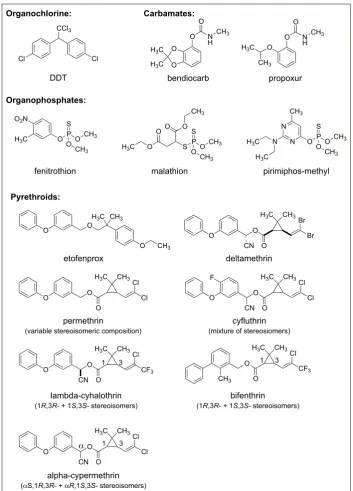
The ITN and IRS vector control meth-odologies are ultimately dependent upon the availability of a varied group of effec-tive insecticide tools. Ideally, there would be a selection of chemicals to choose from, each of which would belong to a different class of chemistry and function through a unique mechanism of action at the bio-molecular level within the mosquito. But the current situation for chemical malaria vector control is far from ideal. Currently, thirteen insecticides are recommended for IRS use for malaria vector control by the World Health Organisation Pesticide Evaluation Scheme (WHOPES).[6] But these thirteen insecticides belong to only four unique chemical classes, organochlo-rines, organophosphates, carbamates, and pyrethroids (Fig. 1), and function through only two distinct mechanisms of action: inhibition of acetylcholinesterase (organ-ophosphates, carbamates) and disruption of voltage-gated sodium channels (DDT, pyrethroids).[7]The situation is even more critical for ITN uses: there are only six WHOPES-recommended insecticides for ITN, all of which are members of a single class of chemistry (pyrethroids) and there-fore share a common target site of action.[8] To emphasise further the issue of avail-able chemical tools, no new WHOPES-recommended insecticide has been devel-oped for use in public health for malaria vector control in over 30 years.
of-action for vector control. The availabili-ty of such novel materials is deemed critical for the prevention of wide-spread insecti-cide resistance, particularly in ITN uses.[9] To help guide and direct this discovery and development effort, the IVCC has prepared a detailed set of specifications, known as the New Active Ingredient Target Product Profile (TPP),[16,17] for new chemical en-tities intended for use as vector control agents in either IRS or ITN. The TPP de-tails the necessary features of a new vector control insecticide, including its expected performance characteristics (e.g. potency, spectrum, speed of action), durability (re-siduality on multiple surfaces), human and environmental safety profile, acceptability to the purchaser (cost-effectiveness) and the end user.
In this report we provide an outline of a program for the discovery of new pub-lic health insecticides for malaria vector control. The IVCC New Active Ingredient TPP serves as the basis for development of a discovery cascade and describes the essential attributes for a successful new malaria vector control agent. The cascade addresses these attributes experimentally at each stage of the discovery process – from design and assembly of a collection of chemicals for screening, through de-velopment of testing protocols to sort and rank candidates, into the detailed profil-ing of advanced development candidates against TPP requirements. In addition, this program defines a staged development system to provide intermediate guidance to the insecticide explorer regarding the pro-gress of their discovery program towards the ultimate product goal.
Discovery Approaches
Since its inception, the pesticide in-dustry has made successful use of in vivo assays as the primary tool for discovery of bioactivity and identification of ‘lead’ classes of chemistry. The long-time strate-gy of the industry has been to conduct the primary bioactivity screen directly against the actual target organism, or a closely-re-lated surrogate when the target is unavail-able.[18]To understand the rationale for this reliance on the in vivo approach, it is in-structive to consider the discovery models used by both the agricultural and pharma-ceutical industries.
First, appropriate in vivo models of hu-man diseases are rarely available in a sim-ple, inexpensive format that would allow for direct screening and sorting of the tens (or hundreds) of thousands of available chemical inputs. Instead, potential target sites (enzymes, receptors) believed to be associated with a desired therapeutic out-come are identified and significant effort resistance within the wild Anopheles
mos-quito population and points to an expected relationship between such resistance and the effective level of control of the ITN.[10] The Bill and Melinda Gates Foundation have initiated an ambitious effort to erad-icate malaria, a goal widely supported within the international malaria communi-ty and by WHO.[11,12,13]One consequence of this initiative was the establishment of the Innovative Vector Control Consortium (IVCC), a public-private product develop-ment partnership with a mission to “im-prove the tools and technologies available for malaria … vector control”.[14,15]A key component of this mission is the discovery and development of new malaria vector control agents which would represent both novel classes of chemistry and new modes-a single insecticide or clmodes-ass of insecticides
on a local mosquito population results in selection for resistance via a genetic change within the mosquito population which can (a) render the insecticide less effective at interaction with the biomolecu-lar target site (target site resistance) or (b) enhance the mosquito’s ability to metabol-ically detoxify the insecticide (metabolic resistance). Indeed, both types of resist-ance, as well as combinations of the two, have been widely documented against a number of classes of insecticides, includ-ing pyrethroids, organophosphates, car-bamates, DDT and dieldrin, within wild mosquito populations.[4,9] Furthermore, a recent review and meta-analysis on the use of pyrethroids in ITN documents the presence of both target site and metabolic
Cl CCl3
Cl
DDT
O N
H O
CH3
O
O H3C
H3C
bendiocarb
CH3
O P S
OCH
3
O H3C
O2N
fenitrothion
CH3
H3C
CH3
O CH3
O S P S O
OO O
malathion
CH3
O CH3
O S P O N N
N CH3
H3C
H3C
pirimiphos-methyl
O N
H O
CH3
O CH3
H3C
propoxur
Organochlorine: Carbamates:
Organophosphates:
CH3
O
O O
H3C CH3
etofenprox
O O
O Cl
Cl CH3
H3C
permethrin
(variable stereoisomeric composition)
O O O
F
Cl Cl CH3
H3C
CN cyfluthrin (mixture of stereosiomers)
O O
O Br
Br CH3
H3C
CN deltamethrin
O O
CN O H3C CH3
CF3
Cl
lambda-cyhalothrin
(1R,3R- + 1S,3S- stereoisomers) (1R,3R- + 1bifenthrinS,3S- stereoisomers) O
O CH3
CH3
H3C
CF3
Cl
O O
O Cl
Cl CH3
H3C
CN alpha-cypermethrin (αS,1R,3R- +αR,1S,3S- stereoisomers)
Pyrethroids:
1 3 1 3
1 3
α
against indoor-biting mosquitoes, i.e. once they have entered dwellings. While there is the potential, and need, for novel tech-niques to address outdoor biting mosqui-toes, these may well utilise products devel-oped for either ITN or IRS. An alternative strategy for malaria vector control is the use of toxic baits, such as attractive toxic sugar baits (ATSB); these consist of a mos-quito attractant combined with an appro-priate, orally-active insecticide.[20] In this case the toxicant can probably be based on one of the many existing classes of stom-ach-acting insecticides that are commonly used for control of agronomically impor-tant insects. This paper concentrates solely on discovery of novel chemistry for ITN and IRS use.
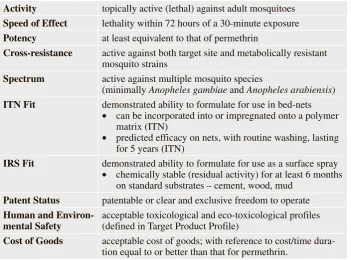
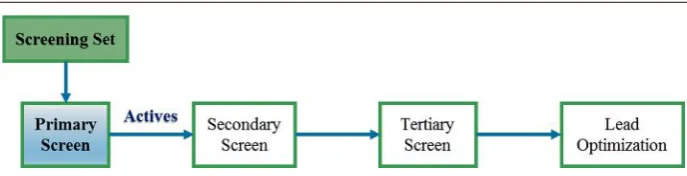
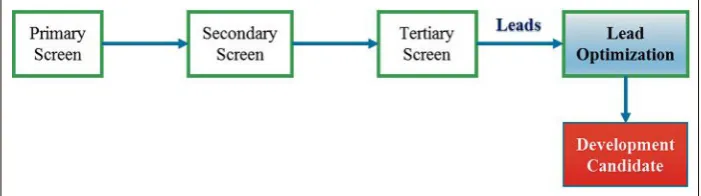
The ITN/IRS New Active Ingredient Target Product Profile[16]provides defini-tions for the Essential Attributes (extracted in a simple format in Table 1) needed in a successful new product; all these proper-ties must be met in order for a candidate to advance into development. These Essential Attributes therefore provide direct guid-ance for the types of properties that must be considered and evaluated during the discovery process and for the design of the screening cascade itself. Furthermore, the TPP provides the context for a staging sys-tem (Active, Hit, Lead) with well-defined gates that allow a measure of progress against the TPP at intermediate stages of the discovery effort. The combination of these Essential Attributes and the stag-ing system can then be used to develop a screening cascade for insecticide can-didates (Fig. 2). The balance of this dis-ing a measure of intrinsic activity and an
indication of potential for redistribution. In contrast to the pharmaceutical industry discovery model, ‘actives’ from these sim-plified in vivo assays are relatively rare, but those identified are sure to be addressing a ‘validated’ (i.e. potentially lethal) target, and have at least some molecular proper-ties consistent with those required for ther-apeutic control. Finally, it is worth noting that assaying directly against the therapeu-tic outcome maximises the opportunity for serendipitous discovery.
Binding assays do nonetheless serve important roles in the pesticide discovery process. Such assays are valuable in the lead optimisation process where an under-standing of the intrinsic activity of a chem-ical can play a critchem-ical role in structure-ac-tivity relationship (SAR) development of a lead series and in the identification of the factors limiting expression of bioactivity against the target organism. In addition, a high-throughput in vitro assay can serve as an initial sorting tool for selection of chemicals for inclusion in a primary in
vivo assay.
Discovery Cascade
Malaria vector control insecticides tar-geting adult mosquitoes are generally uti-lised either in the form of insecticide treat-ed nets (ITN) or as indoor residual sprays (IRS). The latter are applied to the walls of buildings, to leave a deposit of insecticide that will kill insects resting on the treated surface. These two techniques are targeted is then made to establish the therapeutic
validity of these targets. An appropriate
in vitro binding assay is developed for the
target, typically in high throughput format, and a screening set is designed and assem-bled to find and sort potential leads. The most promising leads from this assay are then optimised for binding activity against the target protein and the best (most ac-tive and most “drug-like”) candidate(s) ultimately tested in an in vivo system. The main limitation of this strategy is that these simple target-based assays have not prov-en to be reliable predictors of activity on the whole organism, since – at least for a novel target – the importance of the target to the disease (‘target validation’) can be uncertain, and furthermore the primary assays do not take into account additional attributes, beyond intrinsic activity, which are essential for whole organism activity (e.g. oral availability, metabolic potential, ability to cross membranes and distribute within the organism). While this is a very simplified analysis of an enormously more complex process, identification of the fac-tors that can limit therapeutic potential may be uncovered only late in the discov-ery process and only following extensive and expensive activity optimisation efforts. The challenge of translating in vitro activity to in vivo is magnified in pesticide discovery, where many additional compli-cating factors exist. Among the more sig-nificant of these are delivery mechanism challenges, host/pest interactions, envi-ronmental influences (UV degradation, exposure to elements, e.g. air oxidation), and surface interactions (soil, plant, insec-ticide-treated net, wall). But ‘phenotypic’ screening directly against a target organ-ism, for example an aphid on a plant or an insect larva eating an artificial diet, in a laboratory or greenhouse environment, poses its own set of issues. Such a system requires a significant quantity of often pre-cious screening chemicals, is labour inten-sive, and is difficult to miniaturise or scale to the vast numbers of screening candidates often available or required to develop suffi-cient numbers of quality leads. Thus most primary pesticide discovery is now con-ducted via low-barrier, high-throughput in
vivo assays, using target pests or indicator
organisms as models for the actual target-ed pests.[19]In the case of insecticide dis-covery, this primary screen frequently in-cludes measuring the kill of Aedes aegypti larvae, which are bathed in an aqueous solution of the chemical. A manageable number of ‘actives’ are thus identified and challenged against the target organisms themselves (adult mosquitoes in this case) in secondary assays. In this particular ex-ample, continuous exposure of the insect to the chemical minimises the effects of both metabolism and uptake, while still
provid-Table 1. Essential attributes of a novel insecticide development candidate for malaria vector control.
Activity topically active (lethal) against adult mosquitoes
Speed of Effect lethality within 72 hours of a 30-minute exposure
Potency at least equivalent to that of permethrin
Cross-resistance active against both target site and metabolically resistant mosquito strains
Spectrum active against multiple mosquito species
(minimally Anopheles gambiae and Anopheles arabiensis)
ITN Fit demonstrated ability to formulate for use in bed-nets
· can be incorporated into or impregnated onto a polymer matrix (ITN)
· predicted efficacy on nets, with routine washing, lasting for 5 years (ITN)
IRS Fit demonstrated ability to formulate for use as a surface spray
· chemically stable (residual activity) for at least 6 months on standard substrates – cement, wood, mud
Patent Status patentable or clear and exclusive freedom to operate
Human and
Environ-mental Safety acceptable toxicological and eco-toxicological profiles(defined in Target Product Profile)
probability-based rules for selection of ‘agrochemical-like’ screening inputs for pesticide discovery (Table 3). An agro-chemical probability predictor introduced by Briggs[25] of Bayer (‘Briggs Rule of 3’ or ‘ground rules of three’) is included alongside the Tice and Clarke-Delaney guidelines, although details of Briggs’ analysis that led to these conclusions have not been published. The selected proper-ties differ within each approach, but they all include molecular weight, a calculated log P value and number of hydrogen-bond donors in the molecule. Some other prop-erties included in these guidelines, such as melting point, water solubility and∆log P, undoubtedly play important roles in the inherent bioavailability of a chemical yet are difficult to calculate and thus of limited value as predictive tools.
Interestingly, despite the enormous differences in activity barriers, applica-tion methodologies, target organisms and therapeutic outcomes between the various classes of bioactive materials, there is a similarity across the published guidelines for most properties, even across therapeu-tic areas. Perhaps this is not surprising as a combination of these properties is required to strike an optimal balance between pha-macokinetics/biokinetics and biochemical recognition. In other words, the guidelines do indeed provide a good, if very general, predictor of bioavailability. The striking difference between the Lipinksi guidelines and the agrochemical predictors is the rec-ommended number of H-bond donors; the guideline for maximum number of such functionalities is 40–60% lower for agro-chemicals than for pharmaceuticals.
Heading the list of Essential Attributes in the ITN/IRS TPP (Table 1) is ‘contact activity’ against an adult mosquito. Thus the mosquito must pick the chemical up from a surface (wall or bed net) and the chemical must then cross the insect cuti-cle, distribute within the insect to the target tissue(s) and bind with a protein(s) at the to select compounds for screening or
com-binatorial/parallel synthesis.
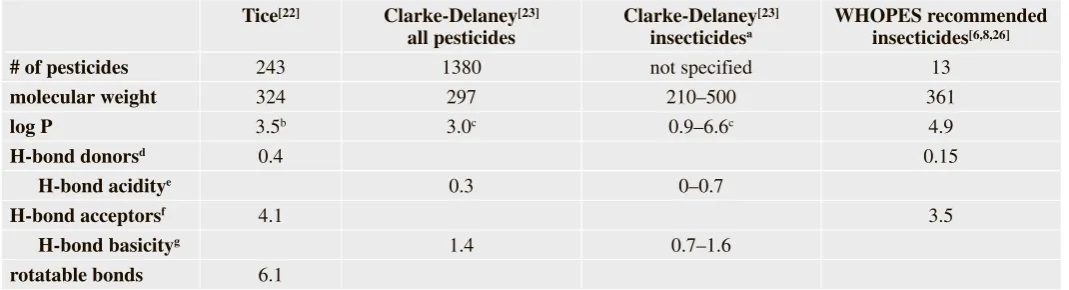
Similar molecular property analyses have been conducted on pesticides, with the ultimate goal of providing analogous ‘agrochemical-like’ rule-based guidance for selection of screening inputs. The sum-mary conclusions from two of these analy-ses are compiled in Table 2. The more com-prehensive of these studies was reported by Tice[22]of Rohm and Haas, who examined the physical property and functional group distribution of a collection of commercial insecticides and herbicides. This analysis is somewhat dated, and as a result does not include some important newer class-es of insecticidclass-es (e.g. diamidclass-es and most neonicotinoids), but nonetheless does pro-vide an extensive compilation of selected physical properties of commercial insec-ticides. A similar property analysis was performed on the entire collection of com-mercial pesticides by Clarke and Delaney of Syngenta.[23,24]The latter report is inter-esting to review since it includes a property analysis not only of commercial pesticides, but also of proprietary sets of screening in-puts, in vivo actives, and pesticide leads.
In a manner analogous to the Lipinski approach, these physical property anal-yses were then used to develop sets of cussion is directed towards the activities
and assays associated with each of these discovery stages for a novel insecticide in-tended for the control of mosquitoes acting as vectors for human diseases.
Designing the Screening Collection
Physical Properties of Insecticides: Bioavailability Predictors
The importance of the in vitro – in vivo translation problem discussed above was recognised by Lipinksi[21] in his seminal paper on the physical properties of phar-maceuticals. From an analysis of pharma-ceutical databases, Lipinski introduced the concept of ‘drug-like’ molecules and developed what has become known as the ‘Lipinski Rule of 5’ as a guideline for selecting compounds for pharmaceutical screens. The ultimate goal was to enrich the screening set with molecules whose ‘drug-like’ properties would increase the likelihood that lead materials would have both high levels of intrinsic activity and be bioavailable. The rules are particularly use-ful as the properties identified by Lipinski can be easily calculated with acceptable levels of precision – for real or virtual mol-ecules – on the often massive scale needed Fig. 2. Screening cascade for a new insecticide.
Table 2. Selected physical properties of commercial insecticides (mean values unless noted)
Tice[22] Clarke-Delaney[23]
all pesticides Clarke-Delaney
[23]
insecticidesa WHOPES recommendedinsecticides[6,8,26]
# of pesticides 243 1380 not specified 13
molecular weight 324 297 210–500 361
log P 3.5b 3.0c 0.9–6.6c 4.9
H-bond donorsd 0.4 0.15
H-bond aciditye 0.3 0–0.7
H-bond acceptorsf 4.1 3.5
H-bond basicityg 1.4 0.7–1.6
rotatable bonds 6.1
target site. The discussion above regarding physical properties of chemicals generally addresses the distribution, mobility, and binding of a chemical within a biological system. Yet specific physical requirements for cuticular penetration into an insect are not well understood nor well modelled. The situation is further complicated as a number of so-called ‘residual’ insecticides are not actually active through cuticular penetration but rather through ingestion, a route not appropriate for adult mosqui-to control via either IRS or ITN. The cu-ticular structure is quite complex, with a waxy lipophilic exterior transitioning to a polar interior. The waxy layer is the critical barrier to chemical penetration and, as an apparent consequence, polar insecticides such as the neonicotinoids (e.g. imidaclo-prid, log P = 0.57[26]) are rarely effective as contact treatments. In contrast, the highly lipophilic pyrethroids (permethrin, log P = 6.1[26]), which readily partition into the cu-ticular wax, are potent topical insecticides. Beyond this rather generic requirement for
lipophilicity, it is difficult to provide fur-ther guidance regarding properties associ-ated with cuticular penetration.
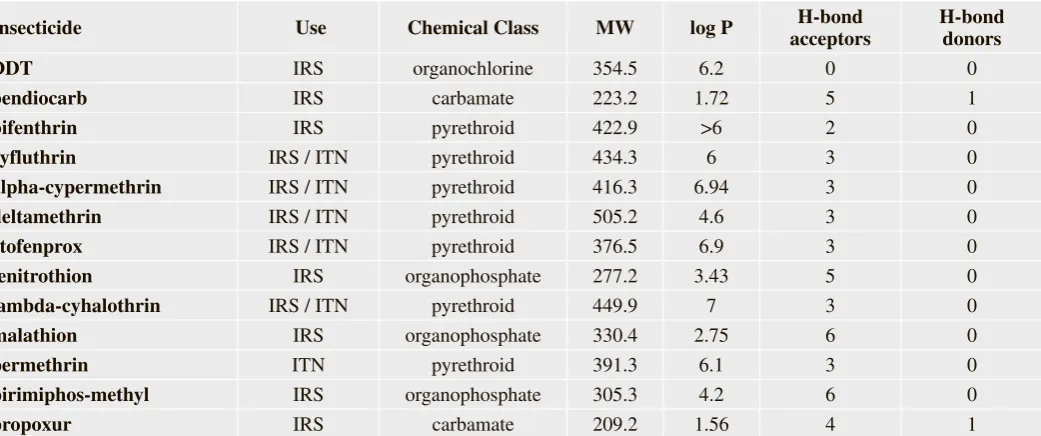
Finally, it is informative for this discus-sion of bioavailability predictors to com-pare the physical property analyses and guidelines described above with the actual property values of the WHOPES recom-mended insecticides for IRS[6] and ITN[8] (Table 2, Table 4).[26]This dataset is limited to only 13 compounds, and dominated by pyrethroids, yet it is clear from this com-parison that the physical properties (both mean and range) of the WHOPES insecti-cides fall squarely within the guidelines of the predictors.
Recommended Guidelines for Screening Candidates for Discovery of IRS / ITN Insecticides
The ‘bioavailability predictors’ de-scribed above have proven useful as pri-mary filtering tools for potential screening sets in pesticide discovery and, thus, we have adapted these to a set of
recommenda-tions for vector-control insecticide discov-ery (Table 5). It is important to emphasise that these guidelines are intended solely for discovery of leads, and not products, from sets of chemical screening inputs.
That there should be a preferred molec-ularweightrangeisinteresting.Insecticides with higher molecular weights than those proposed in the guidelines are known (e.g. certain pyrethroids, spinosyns, diamides), but, as said, these guidelines are intended for selection of materials as potential leads, not products. Oprea at AstraZeneca has in-troduced the concept of ‘lead-like’ space and its use as an opportunity predictor in drug discovery.[27,28]A total of 96 pharma-ceutical lead-product couplets were exam-ined to determine the effect on molecular properties during the optimisation process. The analysis showed that, on average, the molecular weight increased by 79 Da dur-ing optimisation of a lead to a product (mo-lecular weight increases as large as 200 Da were noted), and, even more dramatically, optimisation resulted in a mean increase in Table 3. Probability-based (‘drug-like’) bioavailability predictors
Lipinski[21] Tice[22](insecticides) Briggs – Rules of 3[25] Clarke- Delaney[24]
molecular weight <500 >150–<500 300 ± 100 200–400
log P or alog P <5 ≥0–≤6.5 3 ± 2 ≤4
H-bond donorsa <5 <2 <3 ≤2
H-bond acceptorsb <10 ≥1–8
rotatable bonds ≤12
melting point <200oC <200oC
∆log P <3 ≤2
log water solubility 2±1
pKa 7±2
aSum of N-H and O-H;bSum of N and O atoms
Table 4. WHOPES recommended insecticides for malaria vector control[6,8](MW and log P values fromThe Pesticide Manual[26])
Insecticide Use Chemical Class MW log P acceptorsH-bond H-bonddonors
DDT IRS organochlorine 354.5 6.2 0 0
bendiocarb IRS carbamate 223.2 1.72 5 1
bifenthrin IRS pyrethroid 422.9 >6 2 0
cyfluthrin IRS / ITN pyrethroid 434.3 6 3 0
alpha-cypermethrin IRS / ITN pyrethroid 416.3 6.94 3 0
deltamethrin IRS / ITN pyrethroid 505.2 4.6 3 0
etofenprox IRS / ITN pyrethroid 376.5 6.9 3 0
fenitrothion IRS organophosphate 277.2 3.43 5 0
lambda-cyhalothrin IRS / ITN pyrethroid 449.9 7 3 0
malathion IRS organophosphate 330.4 2.75 6 0
permethrin ITN pyrethroid 391.3 6.1 3 0
pirimiphos-methyl IRS organophosphate 305.3 4.2 6 0
Other Potential Screening Candidate Filters
In addition to physical property fil-ters, additional strategies can be used to enhance the quality of a potential screen-ing set for a vector-control insecticide. Foremost among these is prior evidence of activity in an analogous in vivo assay and, specifically, activity against insect species (e.g. dipteran). In addition, as discussed above, hits from a biochemically-relevant high-throughput in vitro assay would be good candidates for the primary in vivo assay.
Primary Assay (Identification of Actives, Fig. 3)
The primary assay is intended to give the test chemical the best chance of show-ing activity (i.e. maximal contact, minimal metabolic potential) against a single insect species. The exact nature of the assay will depend largely on the number of com-pounds available for testing. The two most typical options are a mosquito larval assay or a simplified contact adult mosquito as-say (see Secondary Asas-say below).
Mosquito larval assay features:
· Aedes aegypti larvae contained in a
mi-crotiter plate and bathed in an aqueous solution of the screening candidate
· Chemical added as a concentrated solu-tion in an organic solvent (acetone or DMSO) and diluted with water to the desired concentration (5–30 ppm)
· Single dose of the chemical, dose cho-sen to ensure an acceptably small num-ber of false negatives
· Appropriate doses of relevant stand-ards (positive controls – minimally per-methrin and bendiocarb) and negative controls must be included
· Graded as pass/fail, based on num-ber of dead or affected insects in each replicate as compared to controls and standards
· Sufficient number of insects per treat-ment to ensure statistically reliable re-sults (minimum 5, preferably 10)
· It is important to confirm positive results by repeat tests with the com-pounds concerned, usually with 2–3 replicates
tirely clear but the undesirable nature of basic amines within insecticides probably reflects both a bioavailability requirement, which dictates that materials must not be ionised at physiological and environmental pH, and the high potential for amines to be metabolically oxidised. This is an impor-tant attribute to consider when purchasing/ assembling insecticide screening libraries, as commercial offerings have been largely designed to meet the needs of the pharma-ceutical industry. Thus one can expect such libraries will contain a disproportionate number of amine-containing compounds that are unacceptable for insecticide dis-covery purposes.
Finally, while the recommended guide-lines may initially appear to be rather re-strictive and limiting, we would point out that there are >35 million commercial chemicals available[29] for screening and a near incalculable number of additional materials which could be prepared from typical organic elements (C, H, N, O, P, S, halogens) via either conventional or combinatorial organic synthesis. Rather, we view the guidelines as liberating, as they allow the insecticide prospector to focus on the region of chemical space that offers the greatest opportunity to uncover novel bioactivity. Probably some leads will be missed by using these property filters to design screening sets; but with finite resources, leads always will be missed re-gardless of the screening approach. log P of 1.25 units (range = +0.5-4). His
rationale for such significant differences was that the typical goal of optimisation is to increase potency; this usually means addition of binding recognition elements thus increasing complexity, which in turn increases both molecular weight and lipo-philicity. Furthermore, he points out that if one starts with leads that are already towards the upper limit of the ‘drug-like’ properties (Lipinski, Tice, etc.) then the optimisation process may result in mate-rials whose log P and molecular weight fall outside of the drug-like range. Finally, from a pragmatic standpoint, molecular weight might be considered to be a very crude indicator of molecular complex-ity and thus, indirectly, the ultimate cost of the active ingredient, which should be minimised for a vector-control insecticide. The remaining guidelines reflect the lipophilic requirement to enable insect cu-ticular penetration, the need to purge the screening set of undesirable functionalities (metals, reactive chemicals), and a desire to enrich the screening pool with meta-bolically robust materials. Most of these properties can be calculated from the mo-lecular structure, but others, such as chem-ical reactivity, are more difficult to define and eliminate. In these instances, it may be more practical to purge such materials from the ‘active’ list following the primary assay.
The exclusion of basic amines from the screening pool is also worthy of further discussion. Of the 243 commercial insecti-cides examined by Tice[22]only 2.8% were found to contain an aromatic amine and
none contained a 1o, 2o, 3oaliphatic amine
or a 3oaromatic amine. This is in marked
contrast to the Lipinski[21]set where >60% of the 6454 pharmaceuticals contained a 1o, 2o, or 3o aliphatic or aromatic amine.
The reason for this striking difference in functional group distribution is not
en-Table 5. Guidelines for selection of screening candidates for insecticide discovery
Property Guideline
molecular weight 200–400
alog P 3–6
H-bond donors ≤1
H-bond acceptors ≤8
pka 7 ± 2
undesirable elements no metals or boron
reactive functionalities eliminate alkylating and arylating agents, aldehydes
basic moieties eliminate 1o, 2oor 3oaliphatic or aromatic amines
acidic moieties eliminate carboxylic acids, electron deficient phenols
ionized molecules eliminate salts
metabolizable
functionalities minimize alcohols, phenols, electron-rich aromatics
collaboration with an external partner,
e.g. the LITE (Liverpool Insect Testing
Establishment) at the Liverpool School of Tropical Medicine[30]or the MR4 program (Malaria Research and Reference Reagent Resource Center).[31]
Assay Format
· Contact from surface as described above
· Multiple susceptible mosquito species (must include Anopheles gambiae and
Anopheles arabiensis)
· Multiple resistant mosquito strains (e.g. Kisumu RDL,Akron, Fumoz, Cayman, Tiassale); this selection will be based on the latest judgements regarding im-portance of these strains to field resist-ance mechanisms, and advice on this should be obtained from the IVCC
· Appropriate doses of relevant stand-ards (positive controls – minimally per-methrin and bendiocarb) and negative controls must be included
· Sufficient number of replicates to en-sure statistically significant results (minimum 3)
· Dose responses must be generated
· End-point for each chemical reported as a breakpoint (LD90) and referenced
to that of the standards and the controls A thorough analysis of the attributes of the chemistry Hit class should be initiated at this stage to fully characterise potential for advancement to Lead status.
Chemical Properties
· Chemical integrity; purity of sample; isomers and isomeric ratios; isomer in-terconversions
· Assessment of potential intellectual property position; ability to obtain sub-stance and/or use patents for members of the class
· Physical property measurements (log P, aqueous and organic solubility)
· Chemical stability (hydrolytic, photol-ytic) evaluated using analytical tools (HPLC, LC/MS) instead of bioassay
Chemistry Breadth
· Evaluated through procurement (pur-chase or synthesis) and bioassay of ad-ditional analogues of Hit class The intent is to provide a clear indica-tion that development of SAR is feasible (i.e. there are multiple examples of poten-cy within the series) and to provide initial guidance for possible downstream lead op-timisation. This should not be construed as an effort to optimise the series at this stage.
Synthetic Accessibility:
· Do viable routes exist to generate req-uisite quantities of multiple, diverse analogues in an optimisation program?
· Any expensive reagents or starting
ma-· At conclusion of assay the number of dead/affected/live insects counted to determine % lethality for each replicate
· Appropriate doses of relevant stand-ards (positive controls – minimally per-methrin and bendiocarb) and negative controls must be included
· Dose responses must be generated at this phase
· End-point for each chemical reported as an LD90and referenced to that of the
standards and the controls
The approximate speed of action for each confirmed adult active should be de-termined by varying contact time with the chemical and/or by evaluation at various time points post contact (30 sec.–30 min). Non-lethal affects and symptomology should be noted – these could provide im-portant information regarding knockdown or repellent potential, possible clues to the mechanism of action (MOA) of the chem-istry, or may suggest novel control mech-anisms.
Note that activity via ingestion or injec-tion of the mosquito is not relevant to the intended uses (ITN, IRS). However, such information may be of value to a particular research program as a means to understand the biokinetic properties of a particular chemical or class of chemicals.
Tertiary Assays (Lead Identification, Fig. 5)
Spectrum of Mosquito Control, and Activity Against Resistant Strains
A primary goal at this stage is to de-termine the activity of the chemical class against a broader set of mosquito species/ strains. The selection may include rep-resentative susceptible Aedes and Culex species but must include Anopheles
gam-biae and Anopheles arabiensis. The
ma-terials must also be tested against a panel of available and well-characterised insec-ticide resistant mosquito strains chosen to represent the range of critical field re-sistance mechanisms (kdr, rdl, metabo-lism...). Assays against the resistant strains may need to be accomplished through The mosquito larval assay is a useful
tool to sift through large screening sets, but a significant number of false positives can be anticipated. There are multiple po-tential mechanisms for lethality in such a low barrier larval assay, many of which are not relevant to adult mosquitoes and others are inconsistent with the requisite topical activity. For these reasons it is essential to regard the larval assay as a simple prog-nosticative tool and avoid the temptation to optimise activity against larvae.
Secondary Assay (Hit Identification, Fig. 4)
The primary purpose of the secondary assay is to uncover relevant lethal activity against a susceptible strain of female adult mosquitoes. The initial assay may be run by topically dosing each individual insect with a solution of the chemical. However, at this stage, an assessment must be made of the lethality resulting from direct pick-up (tarsal contact) of the chemical by the mos-quito from an inert surface (glass, plastic, glased tile). Activity in topical tests does not necessarily correlate with that in direct ‘pick-up’ contact tests; the latter is more relevant to the use pattern in practice (i.e. tarsal contact with ITN or IRS surfaces).
Contact mosquito assay features:
· Susceptible Aedes strain acceptable, but Anopheles species preferred
· Assay conducted in a confined space (bottle, petri dish, tube, WHO cone
etc.), to maximise contact of the insects
with the treated surface
· A portion or preferably all of the sur-face is coated with a solution of the chemical and dried to a film
· Female adult mosquitoes added to con-tainer and remain in contact with the chemical for a defined period of time – 30 minutes preferred
· The insects are then monitored for the duration of the assay (minimum 24, preferably 72 h)
· Sufficient number of replicates to en-sure statistically significant results (minimum 3)
Fig. 4. Characterisation of ‘active’ chemistries for advancement to ‘Hit’ status.
projected use rate, will determine a cost/ treatment. Software is available to assist in such analyses; potential development collaborators will need to have expertise in these studies.
Biological assays, beyond the routine contact assays needed to support the SAR development, should be directed towards demonstration of potential efficacy under a ‘real world’ scenario. As before, all assays must generate dose-responses and include appropriate product standards (WHOPES and commercial). Such studies will re-quire the development of well-defined, commercially-viable formulations for IRS and/or ITN. For ITN uses, the ability to in-corporate a lead chemical into and onto a polymeric matrix should also be assessed. Demonstration of residual activity will be required for IRS and/or ITN applica-tions using methods described in WHO guidelines[32] e.g. ‘Cone’ or, preferably, ‘Cylinder’ tests and optionally, ‘Tunnel’ tests for bioassay. Residual effect, suitable for use in ITN, is assessed through simulat-ed bsimulat-ed-net washings using both bioassay of nets, and chemical analyses of washings. IRS residual stability is determined by treatments of a number of representative surface types (mud, concrete, plywood, thatch, bamboo, etc.)[32] with the formu-lated chemical and assessed again through both biological and chemical endpoints. WHOPES provides well-defined testing protocols for evaluation of insecticide per-sistence on nets and on substrates typical of those found in the walls and roofs of village residences.[32–34]
Toxicological studies should continue to focus on probe, single-dose acute oral rodent assays to help guide the optimisa-tion program and to characterise promising candidates. Initial planning should com-mence (logistics, resource commitments) to conduct the early-stage toxicological studies (acute oral, acute dermal, muta-genicity, carcinomuta-genicity, reproductive tox-icology, 90-day chronic) needed to support a registration package for a development candidate. Probe eco-toxicological studies should be initiated against aquatic organ-isms (fish, algae, Daphnia).
leaders consult with members of IVCC for guidance regarding the assays that are re-quired, sources of expertise, and potential collaborative strategy and resources.
The goal of this stage will be optimi-sation of the lead chemistry against the TPP attributes. Chemical synthesis and SAR development will be a primary ac-tivity and would ideally be supported with appropriate binding assays, biokinetic studies, and computational chemistry ef-forts. Obviously the discussion regarding preferred physical property values and structural features for screening compound selection is still of importance during the optimisation process. The optimisation will undoubtedly include many trade-offs and in many cases potency will not be the sole or most important driver for selection or advancement of a development candi-date. It is thus critical to define and focus on the limiting attributes of the lead class and design synthetic analogues and appro-priate assays (biological or chemical), and for toxicity to non-target organisms (in-cluding man) accordingly. For example, in some series the ability to design and pre-pare analogues that block insect metabo-lism may result in higher levels of potency and/or a greater degree of control of meta-bolically-resistant mosquitoes. In contrast, in other areas of chemistry, the addition of a metabolically-labile functionality might result in selective mammalian detoxifica-tion and an improved safety profile.
The synthetic program should also be designed towards ensuring that freedom to operate (FTO) exists for the development candidate. Patent applications (if relevant) should be filed early in this stage and ena-bling materials prepared and tested to sup-port the claims of the application. At the end of this phase there should be clear ev-idence that FTO will be attained. The dis-covery program will undoubtedly neces-sitate synthesis of quantities of materials for formulation development, toxicologi-cal studies, and specialised and intensive biological testing, including field trials. The chemical synthesis program should begin to suggest potential manufacturing routes for ultimate commercial prepara-tion. These should be subjected to ‘cost of goods’ analyses which, coupled with a terials; complex and difficult to
sepa-rate reaction mixtures/isomers?
Mammalian Toxicology
· Probe with a single dose (≥50 mg/kg) acute oral assay in either mice or rats (typically three animals are sufficient for an initial test)
· Assessment of mutagenicity potential of Hit class (Ames test)
Broad-Spectrum Insect Control · Agricultural pests – representative
chewing (Lepidoptera) and sucking (aphids, whiteflies, hoppers) insects
· Public health pests – houseflies and cockroaches
· Animal health pests – flies, ticks The scope of the analysis should be sufficient to give an indication of the com-mercial potential for insect control beyond mosquitoes; testing should be done in a way (presentation, rates) that allows com-parison of activity with relevant commer-cial standards for these pests. A broader spectrum, which raises commercial attrac-tiveness and the potential for development cost-sharing, is valuable to the IVCC in order to stimulate the interest of possible development partners.
Biochemistry
· Directed toward determination of MOA of Hit class
· Corroborate and support bioassay re-sults with resistant mosquito strains
· Include assays to identify compounds with unacceptable/potentially prob-lematic MOA’s:
o non-specific or reactive chemistry o non-selective AChE inhibitors o uncouplers of oxidative
phospho-rylation
Probe Formulations
· Simple formulations, e.g. EC (emul-sifiable concentrate) or WP (wettable powder), prepared and evaluated via bioassay
Molecular properties analyses may provide important clues regarding effec-tive formulation types or point to potential bioavailability issues (e.g. solubility, crys-tallinity, polarity) within the class.
Development Candidate Selection Phase (Lead Optimisation, Fig. 6)
Many of the activities and assays asso-ciated with this stage of the discovery ef-fort will be specific to a particular class of chemistry. The discussion below is intend-ed to provide general guidance of the types of efforts and information needed in this phase. At this stage, and preferably earli-er, it is essential that the research project
cides for use in IRS or ITN if they have been evaluated through the WHOPES Phase system described above. Note that the WHOPES guidelines are intended to evaluate the efficacy of the products against “a fully susceptible Anopheles vec-tor species” and, thus, do not directly ad-dress the efficacy of ITN products against
resistant mosquitoes. For this purpose,
the WHO Vector Control Advisory Group (VCAG) has published separate guidelines for evaluation of new ITN products against pyrethroid resistant mosquitoes.[35]
It should be noted that a new process for evaluation and adoption of novel vec-tor control products by WHO is currently under development. Under this procedure, responsibility for such evaluation will be transferred from WHOPES to a vector control products WHO Prequalification Team.[36] The Prequalification process, which has not yet been fully defined, will be implemented in 2017.[37]
It should be clear that the discovery to development process for a new vector trol insecticide is multifaceted, time con-suming and expensive. The complexity of the overall process demands the collective expertise of individuals from a number of disciplines including chemistry (synthesis, computational, process), biology (ento-mology, field biology, genetics), biochem-istry, toxicology, patent law, environmental science, and formulation science, to name a few. Only the largest industrial organi-sations will have both the level of expe-rience and the breadth of expertise neces-sary to successfully navigate the complete path from identification of the conceptual target product profile through delivery of an effective vector control agent to the consumer. It is therefore imperative that the early-stage discovery scientist make a clear and honest assessment of both the on a variety of substrates. These activities
are similar to those described under the ‘Development Candidate Selection Phase’ section above.
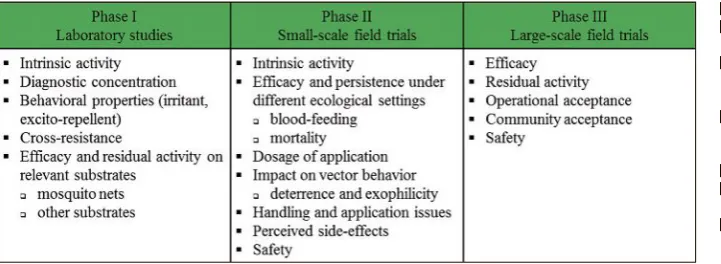
The second and third stages (Phase II and III)[32,33]of the WHOPES scheme ad-dress the issues of translation of laboratory results into real world situations; these tri-als must be conducted in a region where the malaria vector is endemic. In each phase, the insecticide is either incorporated into, or coated onto, bed nets or sprayed onto the walls of human-occupied residences; the residences are accessible to free-fly-ing native mosquito populations. Phase II field trials are small-scale in nature and are conducted in individual, experimental huts under very carefully controlled conditions; the intent is to validate the laboratory-de-termined efficacy and residuality of the treatment and to establish the appropriate dose rate. Efficacy, at this stage, is eval-uated using the cone bioassay, employing susceptible, laboratory-reared mosquitoes of the local vector species. Phase III field trials are much larger in scope, are directed at determining the effect of the treatment at the whole community level rather than individual residences, and the experimen-tal variables of the trial are, of necessity, much less well-controlled than those of the Phase II trials. The purpose, as in Phase II, is primarily to confirm efficacy and residu-ality of the product but this phase will also assess the acceptance and ease of use of the net or formulation by the occupants of the community and the applicators as well as document any perceived side effects to the community. The design of the Phase II and Phase III studies is critical, in order to provide statistically significant proof of the efficacy and duration of activity of the insecticide.
WHO will only recommend insecti-Discussion
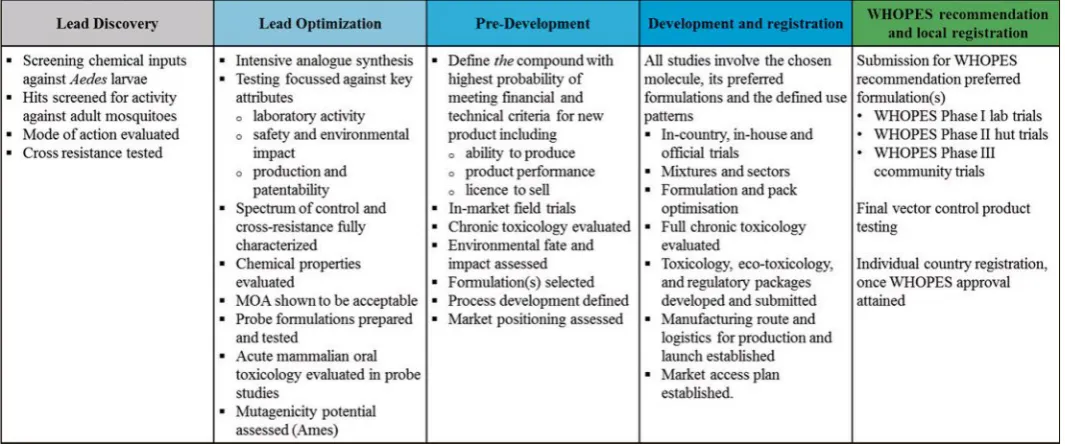
In this report we have described a screening cascade that can be used for sorting and evaluation of sets of chemi-cals in order to select a viable candidate for further development for use as a ma-laria vector control agent. Identification of such a candidate represents only the first step in the rigorous and complex de-velopment process leading to successful registration, commercialisation and pub-lic acceptance of an insecticide for use in vector control. Many of these development activities are typical of any new pesticide active ingredient and will include such de-tails as the selection and characterisation of final formulation(s), full toxicological and eco-toxicological testing, intellectu-al property protection, identification of a cost-acceptable process route along with logistics for manufacture of the active in-gredient, a final risk assessment, assembly of a data package for submission to reg-ulatory authorities, and preparation of a market access plan (Fig. 7).
An essential step in the development process for a malaria vector control agent is the evaluation of the formulated active ingredient under field conditions. For this purpose, WHOPES describes a detailed three-phased program (Fig. 8) for evalu-ation of IRS or ITN targeted insecticides using defined and standardised testing procedures.[32,33]In the initial stage of this WHOPES protocol, Phase I, the biological activity of the development candidate is fully characterised under laboratory
con-ditions. The candidate is profiled against
mosquitoes that are representative of the region where the product is likely to be em-ployed and the efficacy and residuality of the formulated active ingredient, and wash resistance in the case of ITN, determined
[11] R. Feachem, O. Sabot, Lancet 2008, 371, 1633. [12] http://www.gatesfoundation.org/What-We-Do/
Global-Health/Malaria
[13] B. Gates, R. Chambers, ‘From Aspiration to Action: What will it take to end malaria?’,
http://endmalaria2040.org/
[14] J. Hemingway, B. J. Beaty, M. Rowland, T. W. Scott, B. L. Sharp, Trends Parasitol. 2006, 22, 308.
[15] http://www.ivcc.com/
[16]
http://www.ivcc.com/creating-solutions/our-work/achievements/active-ingredient-portfolio
[17] J. Vontas, S. Moore, I. Kleinschmidt, H. Ranson, S. Lindsay, C. Lengeler, N. Hamon, T. McLean, J. Hemingway, Trends Parasitol. 2014, DOI: 10.1016/j.pt.2014.02.005.
[18] For an excellent review of the history and current status of insecticide discovery see: T. C. Sparks, Pestic. Biochem. Phys. 2013, 107, 8. [19] M. Drewes, K. Tiejen, T. C. Sparks, ‘High
throughput screening in agricultural research’, in: Modern ‘Methods in Crop Protection Research’, Eds. P. Jeschke, W. Kramer, U. Schirmer, M. Witschel, Wiley VCH, Weinheim, GR, 2012, 3–20.
[20] Z. P. Stewart, R. M. Oxborough, P. K. Tungu, M. J. Kirby, M. W. Rowland, S. R. Irish, PloS One 2013, DOI: 10.1371/journal.pone.0084168. [21] C. A. Lipinski, F. Lombardo, B. W. Dominy, P.
J. Feeney, Adv. Drug Deliv. Rev. 1997, 23, 3. [22] C. M. Tice, Pest Manag. Sci. 2001, 57, 3. [23] E. D. Clarke, J. S. Delaney, Chimia 2003, 57,
731.
[24] E. D. Clarke, J. S. Delaney, 10th IUPAC Congress on the Chemistry of Crop Protection, Basle, August, 2002.
[25] G. Briggs, 10th IUPAC Congress on the Chemistry of Crop Protection, Basle, August, 2002.
[26] Physical property values taken from ‘The Pesticide Manual: 17th Edition’, Ed. J. Turner, British Crop Production Council, Hampshire, UK, 2015.
[27] S. J. Teague, A. M. Davis, P. D. Leeson, T. Oprea, Angew. Chem. Int. Ed. 1999, 38, 3743. [28] T. I. Oprea, A. M. Davis, S. J. Teague, P. D.
Leeson, J. Chem. Inf. Comput. Sci. 2001, 41, 1308.
[29] The ZINC database is a list of commercially available compounds: https://docking.org/. [30] http://www.lite-testing-facility.com/
[31] h t t p s : / / w w w . b e i r e s o u r c e s . o r g /
ProgramInformation.aspx
[32] WHO, ‘Guidelines for testing mosquito adulticides for indoor residual spraying and treatment of mosquito nets’, 2006, WHO/ CDS/NTD/WHOPES/GCDPP/2006.3 http:// whqlibdoc.who.int/hq/2006/WHO_CDS_NTD_ WHOPES_GCDPP_2006.3_eng.pdf
[33] WHO, ‘Guidelines for laboratory and field-testing of long-lasting insecticidal nets’, 2013, WHO/HTM/NTD/ WHOPES/2013.1 http://apps.who.int/iris/ bitstream/10665/80270/1/9789241505277_ eng.pdf?ua=1
[34] http://www.who.int/whopes/en/
[35] WHO, ‘Guidelines for testing new LLINs to substantiate claims of efficacy in areas of high insecticide resistance’ in ‘Report on the Third Meeting of the WHO Vector Control Advisory Group’, 2014, ISBN 978 92 4 150867 4. [36] http://apps.who.int/prequal/vcp.htm.
[37] http://apps.who.int/prequal/vector_control/
about_vcp.htm.
2020 and 2024. The new active ingredients for vector control will need to be managed by using mixtures of chemistries and/or well-designed rotation plans to optimise their field performance and to delay the evolution of resistant mosquito strains.
Acknowledgement
We would like to thank David Malone, Dr. Nick Hamon and Prof. John Pickett for their review of the manuscript and thoughtful sug-gestions.
Received: May 15, 2016
[1] WHO. World Malaria Report: 2015, http://
apps.who.int/iris/bitstream/10665/200018/1/ 9789241565158_eng.pdf?ua=1
[2] WHO, ‘Malaria - Fact Sheet’, 2016, http://www.
who.int/mediacentre/factsheets/fs094/en/
[3] WHO, ‘Global Technical Strategy for Malaria 2016-2030’, http://apps.who.int/iris/
bitstream/10665/176712/1/9789241564991_ eng.pdf?ua=1
[4] A. Enayati, J. Hemingway, Annu. Rev. Entomol. 2010, 55, 569.
[5] S. Bhatt, D. J. Weiss, E. Cameron, D. Bisanzio, B. Mappin, U. Dalrymple, K. E. Battle, C. L. Moyes, A. Henry, P. A. Eckhoff, E. A. Wenger, O. Briët, M. A. Penny, T. A. Smith, A. Bennett, J.Yukich, T. P. Eisele, J. T. Griffin, C. A. Fergus, M. Lynch, F. Lindgren, J. M. Cohen, C. L. J. Murray, D. L. Smith, S. I. Hay, R. E. Cibulskis, P.W. Gething, Nature 2015, 576, 207. [6] WHO, ‘WHO recommended insecticides
for indoor residual spraying against malaria vectors’, 2015, http://www.who.int/whopes/
Insecticides_IRS_2_March_2015.pdf?ua=1
[7] IRAC, ‘IRAC MoA Classification Scheme, Version 8.1’, 2016, http://www.irac-online.org/
documents/moa-classification/?ext=pdf
[8] WHO, ‘WHO recommended insecticide products for treatment of mosquito nets for malaria vector control’, 2016, http://www.
who.int/whopes/Insecticides_ITN_Malaria_ Feb2016.pdf?ua=1
[9] WHO, ‘Global plan for insecticide resistance management in malaria vectors’, 2012, http://apps.who.int/iris/ bitstream/10665/44846/1/9789241564472_ eng.pdf?ua=1
[10] C. Strode, S. Donegan, P. Garner, A. Ali Enayati, J. Hemingway, PLOS Med. 2014, 11, e1001619.
strengths and the limitations of their organ-isations’ research and development capa-bilities as it relates to the overall goal of delivery of a novel vector control insecti-cide. This will then allow the discovery sci-entist to identify missing capabilities and seek appropriate collaborator(s) who have access to the level and types of expertise needed to ensure timely progress along the discovery to development pathway. The IVCC can assist the discovery scientist in conducting the expertise gap analysis as well as in the identification of appropriate discovery and development partners.
In conclusion, the current lack of a sufficient number of unique classes of in-secticides for use in IRS and ITN, i.e. ma-terials which function by a diversity of bio-chemical mechanisms, represents a critical threat to the malaria eradication goal. The Innovative Vector Control Consortium (IVCC), funded by donors including the UK and US governments and the Bill and Melinda Gates Foundation, is working with a broad range of partners around the world to develop a new generation of in-secticide treated bed nets, indoor residual sprays and tools to manage outdoor disease transmission for use against malaria in de-veloping countries. The IVCC New Active Ingredient TPP describes the essential at-tributes required for such insecticides and the TPP, in turn, serves as the basis for a discovery cascade that can be used to se-lect a candidate for further development for use as a malaria vector control agent. Discovery scientists are strongly encour-aged to maintain a focus on the TPP attrib-utes and use these as a continuous guide in the decision making and compound selec-tion processes.
At the time of going to press, three IVCC-funded novel public health insecti-cide projects with modes of action that are new to public health are in the pre-develop-ment stage, with launch expected between