Improved Iterative Parallel Interference Cancellation
Receiver for Future Wireless DS-CDMA Systems
Simone Morosi
Electronics and Telecommunication Department, University of Florence, Via di S. Marta 3, Firenze 50139, Italy Email:[email protected]
Romano Fantacci
Electronics and Telecommunication Department, University of Florence, Via di S. Marta 3, Firenze 50139, Italy Email:[email protected]
Andrea Bernacchioni
Electronics and Telecommunication Department, University of Florence, Via di S. Marta 3, Firenze 50139, Italy Email:[email protected]
Received 1 August 2003
We present a new turbo multiuser detector for turbo-coded direct sequence code division multiple access (DS-CDMA) systems. The proposed detector is based on the utilization of a parallel interference cancellation (PIC) and a bank of turbo decoders. The PIC is broken up in order to perform interference cancellation after each constituent decoder of the turbo decoding scheme. Moreover, in the paper we propose a new enhanced algorithm that provides a more accurate estimation of the signal-to-noise-plus-interference-ratio used in the tentative decision device and in the MAP decoding algorithm. The performance of the proposed receiver is evaluated by means of computer simulations for medium to very high system loads, in AWGN and multipath fading channel, and compared to recently proposed interference-cancellation-based iterative MUD, by taking into account the number of iterations and the complexity involved. We will see that the proposed receiver outperforms the others especially for highly loaded systems.
Keywords and phrases:code division multiple access, parallel interference cancellation, turbo multiuser detection, iterative de-tection and decoding, nonlinear MMSE soft decision.
1. INTRODUCTION
One of the main shortages of the code division multiple access (CDMA) communication systems can be identified in their vulnerability to multiple access interference (MAI): hence, during the 90s, great attention has been devoted to multiuser detection strategies that constitute the natural an-swer to this problem; the receivers based on this technique aim to exploit the interference as an additional information source but, generally, are characterized by a very high com-plexity. Firstly, multiuser detection researches have been fo-cused on uncoded systems; however, practical CDMA com-munications rely on the utilization of error control cod-ing and interleavcod-ing so that, recently, more and more at-tention has been addressed to coded systems. Optimal joint decoding/detection is an excellent solution to this problem, as shown in [1]. However, this scheme results in a pro-hibitive computational complexity for actual
implementa-tion. In contrast, suboptimal solutions, which separate the operations of symbol detection and channel decoding, ap-pear more attractive for practical applications.
r(t)
s1(−t)
MF 1
sk(−t)
MFN
y1
. . .
yk
SISO MUD
Lap
c1(m)
· · · Lap
ck(m)
˜ y1(m)
˜ yk(m)
Turbo decoder .
. .
Turbo decoder
L1(u1)
Lex(c1(m−1))
. . .
Lk(uk)
Lex(ck(m−1))
ˆ u1
ˆ uk
Figure1: The general iterative IC receiver.
In this paper, we propose a new iterative multiuser de-tector based on the utilization of a parallel interference cancellation(PIC) and a bank of turbo decoders. In the pro-posed structure the PIC detector is broken up so that it is possible to perform interference cancellation after each con-stituent convolutional decoder. Due to the tight relationship between the proposed receiver and the MAP decoders, we de-fined it asMAP decoder aided PIC (MPIC): this solution aims to profit by IC introduction from the first iterations. More-over, in the paper the variance of the noise-plus-(residual-)interference is determined by a new algorithm: particularly, only the most reliable symbols are used in variance determi-nation, neglecting all the others. This solution affords perfor-mance improvement for all the considered systems.
2. SYSTEM MODEL
We consider an uplink DS-CDMA communication system withKsynchronous turbo-coded users. Timing, amplitudes, carrier phases, and spreading sequences of all the users are assumed to be perfectly known at the receiving end in the base station. Each user encodes blocks of information bits
uk,iwith a parallel concatenated convolutional code (PCCC) and transmits the resulting codewords composed ofIcoded bits over a common AWGN channel with BPSK modulation. The equivalent baseband received signal can be written as
r(t)= K
k=1
Ebk
I−1
i=0
ck,ip
t−iTb
sk
t−iTb
+n(t), (1)
where
(i) Tbis the bit interval;
(ii) Ebkis thekth user received energy;
(iii) ck,i ∈ {+1,−1}is the bit transmitted bykth user dur-ing theith bit period;
(iv) p(t) is the unit-power rectangular pulse shape with durationTb;
(v) sk(t) is thekth user unit-power spreading sequence;
(vi) n(t) is an additive white gaussian noise (AWGN) pro-cess with double-sided spectrum densityσ2 = N
0/2 (W/Hz).
In the receiver a bank of matched filter is used for despread-ing. Without loss of generality, we can assume that the first bit interval is observed: therefore, the index i in all the these variables is dropped. As a result, the output of thekth matched filter is given by
yk= 1
Tb
Tb
0 r(t)sk(t)dt=
Ebkck+ N
j=1 j=k
Ebjcjρjk+nk, (2)
whereρjkis the normalized cross-correlation coefficient be-tween thejth andkth users andnkis the noise Gaussian sam-ple of the kth user with distributionN(0,σ2). The second term in (2) represents the MAI that has to be cancelled.
3. A NEW IC ITERATIVE RECEIVER
An iterative cancellator consists of an interference-cancel-lation (IC)-based multiuser detector (MUD) followed byK
single-user turbo decoders. Each constituent block iteratively provides soft information to the others, as shown inFigure 1. In the first multiuser detection iteration, the a priori in-formation of the coded bits is not available, that is,Lap(ck)= 0, k = 1, 2,. . .,K. The IC stage delivers interference-cancelled soft outputs ˜ykto the input of the turbo decoders. After a fixed number of turbo decoder iterations, the extrin-sic information of the coded bits at the output of turbo de-coders are fed back to the input of the IC detector as the a priori information for the next receiver iteration.
MAP 1 MAP 2
PIC (syst.)
PIC (syst.) PIC
(par.1)
PIC (par.2) Interleaver
Interleaver
Deinterleaver
Deinterleaver · · ·
· · ·
· · ·
· · · .
. .
. . .
. . .
. . .
. . .
. . .
. . .
. . . ˜
y1s
˜ yk,s
yk,s
y1,s
y1,p1
y1,p2
yk,p1
˜ y1,p1
˜ yk,p1
yk,s
˜ y1,s
˜ yk,s
yk,p2
˜ y1,p2 ˜ yk,p2 Lap(c1,s)
Lex(c1,s)
Lex(c1,p1)
Lap(c1,s) Lex(c1,s)
Lex(c1,p2) L(u1)
Figure2: Block diagram of the proposed iterative MUD.
to produce also extrinsic information about the latter [11]. At each new iteration, the iterative structure permits the mul-tiuser receiver to have a more reliable a priori information and the decoders to operate on the soft inputs, in which a greater amount of interference has been cancelled.
3.1. The conventional iterative PIC receiver
In the conventional iterative parallel interference cancellation (PIC) receiver [12], at each IC stage, MAI is to be removed si-multaneously from each user. Therefore, at themth receiver iteration, the PIC soft output, that is, the turbo decoders in-put, can be expressed as
˜
yk(m)=yk− N
j=1 j=k
Ebjρk jcˆj(m)
=Ebkck+ N
j=1 j=k
Ebjρk j
cj−cˆj(m)
+nk,
(3)
where ˆcj(m) is the estimate at the mth iteration of the bit
cj transmitted byjth user. Note that the second summation represents the residual MAI after cancellation.
The data estimates ˆck(m) have been chosen in [12] as the expectation of coded bits, that is equal to
ˆ
ck(m)=E
ck(m)
=tanh
1 2Lap
ck(m) , (4)
in order to take advantage of the turbo decoders output. The termLap(ck(m)) is the a priorilog-likelihood ratioof bitckat themth iteration, which is defined as
Lap
ck(m)
∆
=logP
ck(m)=+1
Pck(m)= −1
. (5)
In the first receiver iteration no a priori information is avail-able from the decoder output. Hence, as an initializing con-dition, it is assumed that Lap(ck(0)) = 0,k = 1, 2,. . .,K.
Instead, in the successive iterations the extrinsic informa-tion coming from the decoders can be used, leading to
Lap(ck(m))=Lex(ck(m−1)).
3.2. The proposed iterative MPIC receiver
As it is known, as the number of decoding iterations in-creases, the coding gain offered by a turbo decoder becomes larger. However, the performance improvement obtained by the turbo codes is remarkable in the first iterations, and more and more negligible in the successive ones. This remark sug-gests to concentrate the significant part of interference can-cellation in the first iterations: for this reason many IC-based iterative receivers with a first linear stage have been proposed [7,8,13]. Nevertheless, a linear MUD has the drawback of extremely high computational complexity.
In this paper we present an iterative PIC receiver, which exploits most interference-cancellation in the first iterations: a conventional iterative receiver tries to cancel the MAI from all the parity and the systematic bits only once at the end of each decoding iteration. Note that in turbo decoding itera-tion, the first MAP decoder provides extrinsic information about all the systematic and half of the parity bits while the second decoder gives the extrinsic information about the in-terleaved systematic bits and the second half of the parity bits; as a consequence, in the proposed receiver the interference-cancellation is performed after each decoding iteration and the systematic bits are cancelled twice. Because of the tight connection between the proposed receiver and the MAP de-coders, we have named it asMAP decoder aided PIC (MPIC). The structure of this receiver is shown inFigure 2. Note that the subscripts s, p1, and p have been added in this figure to describe thoroughly the performance cancellation oper-ation.
is better than the conventional one even with equal complex-ity. This goal has been reached by removing from the last it-erations so many cancellation stages equal to the ones added in the first iterations.
3.3. An improved nonlinear MMSE estimator
The tentative decision device (4), which is used to estimate the data bits and to reconstruct and cancel the MAI, ex-ploits only the extrinsic information from the decoders but not channel outputs; hence, only a fraction of available in-formation sources is used in the decision. An improved data estimator can be obtained by exploiting jointly decoders and channel outputs, as in [6], where an ML estimator is used, producing tentative hard decisions [14]. Unlike [6], we derive
anonlinear MMSE estimator, that can also provide the
relia-bility value of each estimated bit. The decision ˆck(m), forkth user at themth receiver iteration, is taken as the expectation ofck, given the channel output, that is,
ˆ
ck(m)=E
ck(m)|y˜k(m)
. (6)
Under the assumption that the interference can be modelled as a Gaussian process, it can be demonstrated that
ˆ
ck(m)=tanh
1 2
2
Ebky˜k(m) σk2
+Lap
ck(m) , (7)
where σ2
k is the thermal noise-plus-interference variance, given by σ2
k = σ2+σk2,MAI. The proof of (7) can be found in the appendix. As it is shown in [15], the combination of the channel output and the extrinsic information in the deci-sion statistic yields a biased residual interference term which tends to cancel the useful signal. However, the computer sim-ulations confirm that a better performance is achieved by us-ing all the information sources and that the mitigation of the bias effect is obtained after few iterations.
3.4. Variance estimation
The tentative decision device needs to know the noise-plus-(residual-)interference variance, such as the channel reliabil-ity value used in the MAP decoding [2]; hence, an appro-priate estimation method has to be used. In [5,16] a sim-ple algorithm based on the data samsim-ples has been proposed; particularly, therein the variance is calculated as
ˆ
σ2 k(m)=
1
I
I−1
i=0
˜
yk,i(m)
2
−y˜k,i(m) 2
, (8)
where the mean ˜yk,i(m) has been either derived by the sam-ples [16] or assumed equal to the square root of the received energyEbk [5]. As it will be confirmed by the simulation
results, this algorithm leads to the underestimation the vari-ance in the case of a low signal-to-interference-plus-noise ra-tio (SINR). The motivara-tion of this behaviour is the follow-ing: assuming that the (residual-)interference is Gaussian, the conditional probability density functions (pdf) of the
−Ebk +
Ebk
˜ yk(m)
Figure3: Decision variable probability density function.
variable ˜yk,i(m), that is,p( ˜yk,i(m)|ck= ±1), are also Gaus-sian. As a consequence, the unconditional pdf of ˜yk,i(m) is given by
p˜yk,i(m)
=Pck=+1
py˜k,i(m)|ck,i=+1
+Pck,i= −1
py˜k,i(m)|ck,i= −1
=1
2
py˜k,i(m)|ck,i=+1
+py˜k,i(m)|ck,i= −1
,
(9)
where the last equality follows from the assumption that the transmitted bits are independent and identically distributed (i.i.d.). As it can be seen from Figure 3, the values ˜yk,i(m), satisfying the inequality |˜yk,i(m)| <
Ebk, are ambiguous,
in the sense that they belong to the region of maximum superposition of the conditional pdfs. For this reason we have chosen to evaluate the variance only by the values satisfying
|˜yk,i(m)| ≥ Ebk. This original variance definition can be
used to improve the variance estimation through the formula
ˆ
σ2 k,m=
1
I1 I1−1
i=0 |˜yk,i(m)|≥√Ebk
˜
yk,i(m)−
Ebk
2
, (10)
whereI1 ≤Iindicates the number of such values in a code-word.
4. ITERATIVE MPIC FOR MULTIPATH SLOWLY FADING CHANNELS
Wireless CDMA systems usually have to cope with multipath fading environments. The multipath fading channel is often assumed to be wide-sense stationary with uncorrelated scat-tering [17]. Based on this assumption, the received baseband DS-CDMA signal can be written as
r(t)= K
k=1 I−1
i=0 L
l=1
Ebkck,iαlk(t)sk
t−iTb−τkl
+n(t), (11)
whereLis the number of propagation paths andαlk(t) and
4 3 2 1 0 −1 −2 −3 −4
Matched filters normalized outputs 0
0.1 0.2 0.3 0.4 0.5 0.6 0.7
MF output histogram
Gaussian approx. through SINR estimation Gaussian approx. through basic SINR estimation
(a)
4 3 2 1 0 −1 −2 −3 −4
PIC normalized outputs 0
0.1 0.2 0.3 0.4 0.5 0.6 0.7
PIC output histogram
Gaussian approx. through SINR estimation
(b)
4 3 2 1 0 −1 −2 −3 −4
PIC normalized outputs 0
0.1 0.2 0.3 0.4 0.5 0.6 0.7
PIC output histogram
Gaussian approx. through SINR estimation (c)
4 3 2 1 0 −1 −2 −3 −4
PIC normalized outputs 0
0.1 0.2 0.3 0.4 0.5 0.6 0.7
PIC output histogram
Gaussian approx. through SINR estimation (d)
Figure4: Histograms and Gaussian approximations of matched filters and PIC output for different iterations:Eb/N0 = 10 dB. (b) One
iteration. (c) Two iterations. (d) Six iterations.
signal. Besides, we assume that E{L
l=1αlk2} = 1/Tb, so that Ebk is the received averaged energy of the kth user,
and that the channel fading is so slow that αl
k(t) does not change in a chip interval and thus can be denoted asαl
k(h), where hrefers to chip position in the codeword. The chip matched filter output for thelth path of thekth user is then given by
ylk,i,h= 1
Tc
hTc+τl
k
(h−1)Tc+τlk r(t)sk
t−τkl−
h G
Tb
dt,
h=0, 1,. . ., (I−1)G, (12)
where Tc is the chip interval that is tied to the bit interval through the processing gainG=Tb/Tc.
If a maximal ratio combiner (MRC) RAKE receiver is used, the decision statistic can be expressed as
yk,i= L
l=1 (i+1)G−1
h=iG
αlk(h)
∗
ykl(h), i=0, 1,. . .,I−1. (13)
In the mth iteration of the iterative PIC receiver, the kth received signal after the MAI subtraction is given by
rk(m)(t)
=r(t)− K
j=1 j=k
I−1
i=0 L
l=1 (i+1)G−1
h=iG
Ebjcˆj,i(m)αlk(h)sj
t−iTb−τlj
,
where the bit tentative decision ˆcj,i(m) is given by (7), while the variance estimation formula has to be modified to take into account the fading attenuation. The conditional pdfs
p( ˜yk,i(m) | ck,i = ±1, αlk) are Gaussian and (10) can be rewritten as
ˆ
σ2 k(m)=
1
I1
I1−1
i=0 |˜yk,i(m)|≥αk(i)√Ebk
˜
yk,i(m)−αk(i)
Ebk
2
,
(15) where αk(i) is the bit-averaged fading attenuation after re-combination and it is computed as
αk(i)= 1
G
G
h=1
L
l=1
αl
k(iG+h) 2
. (16)
5. SIMULATION RESULTS
In this section we investigate the effectiveness of the proposed receiver through computer simulations. In order to mitigate the complexity burden due to the implementation of a non-linear decision device, the tanh(·) function has been approxi-mated by an eight-value look-up table. For all simulations we use a rateRc=1/2 turbo code, composed of two 8-state RSC codes with generator polynomialsG0 = (13)8 G1 = (15)8, and the block interleaver recommended by the UMTS stan-dard [18]. We compare the proposed iterative MPIC receiver with the conventional PIC [6] and the iterative partial PIC (PPIC) receiver proposed in [6] and derived from [14].
First, we analyze the performance in a synchronous AWGN channel. The system has 10 equal-power users with pseudonoise short codes, processing gainG=16, and frame length 800. The quantized log-MAP algorithm is used for the decoding [10].Figure 4shows the decision variables his-togram at the output of the MF bank and of the PIC re-ceiver after 1, 2, 3, and 6 iterations for a signal-to-noise-ratio
Eb/N0 = 10 dB, compared with the Gaussian distribution with variance calculated through (10). We can remark the interference reduction through iterations and the accuracy of enhanced variance estimation, while a bias is evident just in the first iteration. In Figure 5the performance improve-ment obtained using the enhanced variance estimator in comparison with the basic one, derived from (8), is shown.
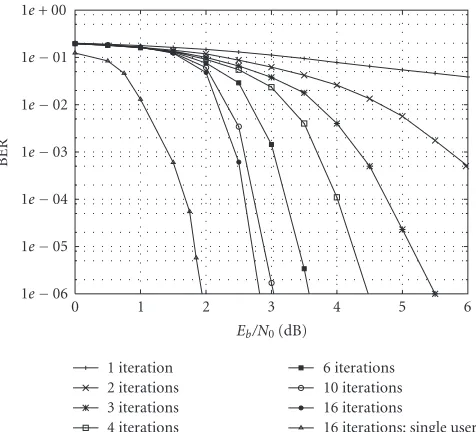
Figure 6 shows the performance gain achieved by the pro-posed receiver by increasing the number of iterations. At a BER of 10−4and with 16 iterations the loss from the single-user bound is about 0.8 dB. A comparison of performance versus iterations between the iterative PIC, MPIC, and PPIC is made inFigure 7atEb/N0=3 dB. The cancellation weights for PPIC have been found by a trial-and-error searching method, as p0 = 0.55, p1 = 0.65, p2 = 0.75, p3 = 0.85,
p4=0.92,p5=0.97,pi≥6=1.0.
Then, we illustrate the performance of the proposed re-ceiver in an asynchronous 3-path fading channel with per-fect power control: the replica amplitudes are assumed to be Rayleigh distributed, with relative attenuations equal to 0, −1,−9 dB. Processing gain is G = 15 and the
spread-6 5 4 3 2 1 0
Eb/N0(dB)
1e−07 1e−06 1e−05 1e−04 1e−03 1e−02 1e−01 1e+ 00
BER
Basic estimation Enhanced estimation
Figure 5: Performance comparison of the iterative PIC receiver with basic and enhanced variance estimator in a synchronous AWGN channel, with 10 equal-power users and processing gain equal to 16.
6 5 4 3 2 1 0
Eb/N0(dB)
1e−06 1e−05 1e−04 1e−03 1e−02 1e−01 1e+ 00
BER
1 iteration 2 iterations 3 iterations 4 iterations
6 iterations 10 iterations 16 iterations
16 iterations: single user
Figure6: BER versusEb/N0 for the iterative MPIC in an AWGN
channel, with processing gain equal to 16 and a variable number of iterations.
20 18 16 14 12 10 8 6 4 2
Number of iterations 1e−06
1e−05 1e−04 1e−03 1e−02 1e−01 1e+ 00
BER
Iterative PPIC with enhanced SINR estimation Iterative PIC with enhanced SINR estimation Iterative MPIC with enhanced SINR estimation
Figure7: Performance of the different iterative IC receivers versus iterations in an AWGN channel with processing gain equal to 15.
Eb/N0=3 dB.
16 14 12 10 8 6 4 2 0
AverageEb/N0(dB)
1e−06 1e−05 1e−04 1e−03 1e−02 1e−01 1e+ 00
BER
RAKE receiver
Iterative PIC with perfect knowledge of SNR Iterative PIC with enhanced SINR estimation Iterative MPIC with perfect knowledge of SNR Iterative MPIC with enhanced SINR estimation Single user
Figure8: Performance of the iterative IC receivers in a multipath fading channel with 20 equal-power users.
greater than one (β=1.33), the MPIC outperforms the con-ventional PIC: a gain of 3.5 dB for the MPIC versus the PIC receiver at a BER of 10−3is observed. In this figure, the great benefit obtained for both the receivers is shown by using a correct estimate of the noise-plus-(residual-)interference variance rather than approximating it by the ambient noise, assumed perfectly known, as in [6]. Figure 9 shows that
25 20
15 10
5
Number of users 1e−03
1e−02 1e−01 1e+ 00
BER
20 40 60 80 100 120 140 160
System load (%)
Iterative PIC with perfect knowledge of SNR Iterative MPIC with perfect knowledge of SNR Iterative MPIC with enhanced SINR estimation
Figure9: BER versus system load for the iterative IC receivers in a multipath fading channel.
12 10 8
6 4 2 0
AverageEb/N0(dB)
1e−05 1e−04 1e−03 1e−02 1e−01 1e+ 00
BER
RAKE receiver
Iterative MPIC with enhanced SINR estimation Single user
Figure10: Performance of the iterative MPIC receiver in a mul-tipath fading channel with 31 equal-power users using Gold31 spreading sequences.
6. CONCLUSION
In this paper, a new turbo multiuser detector for turbo-coded DS-CDMA systems has been presented. In the pro-posed detector a parallel interference cancellation (PIC) has been divided in order to perform interference cancella-tion after each MAP constituent decoder. Moreover, an im-proved algorithm to estimate the variance of the noise-plus-residual-interference has been derived. Performance results of computer simulations for different system loads, in AWGN and multipath fading channel, confirm the excellent be-haviour of the proposed receiver. It is shown that it out-performs recently proposed alternative IC-based turbo MUD with the same complexity.
APPENDIX
As stated inSection 3.3, the decision ˆck(m), forkth user at themth receiver iteration, is taken as the expectation ofck, given the channel output, that is equal to
ˆ
ck(m)=
ck∈{+1,−1} ckp
ck(m)=ck|˜yk(m)
=pck(m)=+1|y˜k(m)
−pck(m)= −1|y˜k(m)
=p
ck(m)=+1|y˜k(m)
−pck(m)= −1|y˜k(m)
Pck(m)=+1|y˜k(m)
+ pck(m)= −1|˜yk(m)
.
(A.1)
By invoking Bayes theorem, the decision variable is equal to
py˜k(m)|ck(m)=+1
Pck(m)=+1
−p˜yk(m)|ck(m)= −1
Pck(m)= −1
p˜yk(m)|ck(m)=+1
Pck(m)=+1
+ p˜yk(m)|ck(m)= −1
Pck(m)= −1
. (A.2)
By taking into account that
p˜yk(m)|ck(m)
= 1
2πσk2
exp y˜k(m)−
Ebkck(m)
2
2σk2
= 1
2πσk2
exp y˜k(m)
2
+Ebk
2σk2
exp
˜
yk(m)
Ebkck(m)
σk2
,
(A.3)
and, that1
Pck(m)=ck
= exp
ckLap
ck(m)
1 + expckLap
ck(m)
= exp
ckLap
ck(m)
/2 exp−ckLap
ck(m)
/2+ expckLap
ck(m)
/2,
(A.4)
(A.2) can be rewritten as
exp2Ebk˜yk(m)/σ
2 k
+Lap
ck(m)
−exp−2Ebk˜yk(m)/σ
2 k
−Lap
ck(m)
exp2Ebky˜k(m)/σ
2 k
+Lap
ck(m)
+ exp−2Ebky˜k(m)/σ
2 k
−Lap
ck(m)
. (A.5)
Hence, the decision rule for the nonlinear MMSE estimator is
ˆ
ck(m)=tanh
1 2
2
Ebk˜yk(m) σ2
k
+Lap
ck(m) .
(A.6)
1The proof of (A.4) can be found in [11, equation (27), page 1050].
REFERENCES
[1] T. R. Giallorenzi and S. G. Wilson, “Multiuser ML se-quence estimator for convolutionally coded asynchronous DS-CDMA systems,” IEEE Trans. Commun., vol. 44, no. 8, pp. 997–1008, 1996.
[2] C. Berrou, A. Glavieux, and P. Thitimajshima, “Near shan-non limit error-correcting coding and decoding: turbo-codes. 1,” inProc. IEEE International Conference on Communications (ICC ’93), vol. 2, pp. 1064–1070, Geneva, Switzerland, May 1993.
near-single-user performance,”IEEE Trans. Commun., vol. 46, no. 12, pp. 1693–1699, 1998.
[4] M. Moher, “An iterative multiuser decoder for near-capacity communications,” IEEE Trans. Commun., vol. 46, no. 7, pp. 870–880, 1998.
[5] M. Kobayashi, J. Boutros, and G. Caire, “Iterative soft-SIC joint decoding and parameter estimation,” inProc. 7th Inter-national Workshop on Digital Signal Processing Techniques for Space Communications, Sesimbra, Portugal, October 2001. [6] K.-M. Wu and C.-L. Wang, “An iterative multiuser receiver
us-ing partial parallel interference cancellation for turbo-coded DS-CDMA systems,” inProc. IEEE Global Telecommunica-tions Conference (GLOBECOM ’01), vol. 1, pp. 244–248, San Antonio, Tex, USA, November 2001.
[7] Z. Qin and K. C. Teh, “Iterative multiuser detection with Gauss-Seidel soft detector as first stage for asynchronous coded CDMA,” Electronics Letters, vol. 36, no. 23, pp. 1939– 1940, 2000.
[8] J.-M. Hsu and C.-L. Wang, “A low-complexity iterative mul-tiuser receiver for turbo-coded DS-CDMA systems,” IEEE J. Select. Areas Commun., vol. 19, no. 9, pp. 1775–1783, 2001. [9] H. El Gamal and E. Geraniotis, “Iterative multiuser
detec-tion for coded CDMA signals in AWGN and fading channels,” IEEE J. Select. Areas Commun., vol. 18, no. 1, pp. 30–41, 2000. [10] P. Robertson, E. Villebrun, and P. Hoeher, “A comparison of optimal and sub-optimal MAP decoding algorithms operat-ing in the log domain,” inProc. IEEE International Conference on Communications (ICC ’95), vol. 2, pp. 1009–1013, Seattle, Wash, USA, June 1995.
[11] X. Wang and H. V. Poor, “Iterative (turbo) soft interference cancellation and decoding for coded CDMA,” IEEE Trans. Commun., vol. 47, no. 7, pp. 1046–1061, 1999.
[12] S. Kim and J. H. Lee, “Performance of iterative multiuser de-tection with a partial PIC detector and serially concatenated codes,” inProc. IEEE VTS 54th Vehicular Technology Con-ference, vol. 1, pp. 487–491, Atlantic City, NJ, USA, October 2001.
[13] A. Tarable, G. Montorsi, and S. Benedetto, “A linear front end for iterative soft interference cancellation and decoding in coded CDMA,” inProc. IEEE International Conference on Communications, vol. 1, pp. 1–5, Helsinki, Finland, June 2001. [14] D. Divsalar, M. K. Simon, and D. Raphaeli, “Improved parallel interference cancellation for CDMA,”IEEE Trans. Commun., vol. 46, no. 2, pp. 258–268, 1998.
[15] S. Marinkovic, B. S. Vucetic, and J. Evans, “Improved iterative parallel interference cancellation for coded CDMA,” inProc. IEEE International Symposium on Information Theory, p. 34, Washington DC, USA, June 2001.
[16] K. Kettunen, “Iterative multiuser receiver/decoders with en-hanced variance estimation,” inProc. IEEE 49th Vehicular Technology Conference, vol. 3, pp. 2318–2322, Houston, Tex, USA, May 1999.
[17] J. G. Proakis, Digital Communications, McGraw-Hill, New York, NY, USA, 3rd edition, 1995.
[18] 3GPP, “TR 25.221 multiplexing and channel coding,” Tech. Rep., 3GPP, Sophia Antipolis, France, 2001.
Simone Morosiwas born in Firenze, Italy, in 1968. He received the Dr.-Ing. degree in electronics engineering in 1996 and the Ph.D. degree in information and telecom-munication engineering in 2000 from the University of Firenze, Firenze. Since 1999 he has been a Researcher at the Italian In-teruniversity Consortium for Telecommu-nications (CNIT). Since 2000 he has been with the Department of Electronics and
Telecommunications, the University of Firenze, as a Research As-sistant. His present research interests involve code division multi-ple access communications, multiuser detection and turbo MUD techniques, adaptive antenna array systems, and B3G mobile com-munications. He has participated in several national research pro-grams and in European projects COST 252 and COST 262; he is currently participating in the EU COST Action 273 “Towards Mo-bile Broadband Multimedia Networks.” He is currently participat-ing in the European Network of Excellence NEXWAY (Network of EXcellence in Wireless Application and Technology, 5th European Framework Program) and NEWCOM (Network of Excellence in Wireless COMmunications, 6th European Framework Program).
Romano Fantacciwas born in Pistoia, Italy, and graduated from the Engineering School of the University of Firenze, Florence, Italy, with a degree in electronics in 1982. He re-ceived his Doctorate degree in telecommu-nications in 1987. After joining the Depart-ment of Electronics and Telecommunica-tions as a Research Fellow, he was appointed Associate Professor in 1991 and a Full Pro-fessor in 1999. His current research interests
are in digital communications, computer communications, queu-ing theory, power-line communications, and mobile communica-tion networks. He has been involved in several European Space Agency (ESA) and INTELSAT advanced research projects. He is the author of numerous articles published in prestigious communica-tion science journals. He received the IEE IERE Benefactor Pre-mium in 1990 and IEEE COMSOC Award Distinguished Contri-butions to Satellite Communications in 2002. Professor Fantacci is currently serving as an Editor for Telecommunication Systems, IEEE Transactions on Communications, and for IEEE Transactions on Wireless Communications.