AND THEIR APPLICATIONS Thesis by
X X Newhall
In Partial Fulfillment of the Requirements for the Degree of
Doctor of Philosophy
California Institute of Technology Pasadena, California
1972
ACKNOWLEDGMENTS
The author expresses his gratitude and appreciation to his advisor, Professor DonaldS. Cohen, for suggesting the problems and directing the research. His encouragement and patient
guidance were invaluable throughout the author's graduate studies. The opportunity to carry out this research was provided by California Institute of Technology Graduate Teaching and Research Assistantships, a National Science Foundation Graduate Fellowship, and a California State Scholarship, for which the author extends his appreciation.
He also wishes to thank Mrs. Linda Palmrose, Mrs. Marian Salzberg, and Mrs. Alrae Tingley for their expert typing of a
ABSTRACT
This thesis is in two parts. In Part I the independent variable 8 in the trigonometric form of Legendre's equation is
extended to the range ( -oo, oo). The associated spectral representation i.s an infinite integral transform whose kernel is the analytic continuation of the associated Legendre function of the second kind into the complex 8 -plane. This new transform is applied to the problems of waves on a spherical shell, heat flow on a spherical shell, and the gravitational potential of a sphere. In each case the resulting alternative representation of the solution is more suited to direct physical interpretation than the standard forms.
In Part I I separation of variables is applied to the initial-value problem of the pre>pagation of acoustic waves in an underwater sound channel. The Epstein symmetric profile is taken to describe the variation of sound with depth. The spectral
representation associated with the separated depth equation is found to contain an integral and a series. A point source is assumed to be located in the channel. The nature of the
TABLE OF CONTENTS TITLE
INTRODUCTION PART I.
PART II.
AN INFINITE-ANGLE GENERALIZED MEHLER TRANSFORM AND ITS APPLICATION
1. Introduction
2. Interpretation of the Infinite Range of 8
3. The Analytic Continuation of Legendre Functions
4. Derivation of the Transform 5. Application to Waves on a Sphere 6. The Flow of Heat on a Spherical Shell 7. The Potential of a Sphere
SOUND WAVES IN THE OCEAN
PAGE 1
3 3
5
8 15 20 36
42
50
8. Introduction 50
9. Derivation of the Spectral Representation 51 10. Application to Sound Waves in the Ocean 59
APPENDICES 66
INTRODUCTION
Series and integral transforms are a powerful and widely used method of solving differential equations. The appropriate ones to apply to a given separable PDE are determined by the separated ODE's. Each of those transforms is called the
spectral representation associated with the corresponding ODE. Given a PDE in n variables we may apply successively any n-1 of the n associated spectral representations. The resulting ODE may be solved by any of the usual techniques. The ultimate form of the solution of the PDE is determined by which n-l representations are applied. These different (but equivalent) forms are called alternative representations. The alternative representation most suitable for a given PDE is often not obvious beforehand.
The spectral representation associated with an ODE is found by a contour integration of the Green's function. We exploit that method in both parts of this thesis. In Part I we .extend the domain of the angle
e
in the trigonometric formof Legendre's equation to -oo < 8 < oo. The resulting spectral representation is a new integral transform that provides
concise alternative representations for the solutions of a variety of well-known problems.
·variables. Two of the three associated spectral representations are the familiar Fourier and Hankel transforms, which lead to an alternative representation that can be analyzed only with
difficulty. We derive the spectral representation associated with the third separated ODE and apply it to get a more useful form of the solution.
PART I
An Infinite-Angle Generalized Mehler Transform and its Application.
Section 1. Introduction.
We shall need the spectral representation associated with
the DE
1
sinS < 00.
( l. 1)
This equation arises from expressing the equation for electrostatic potential in spherical coordinates. The special case with !.J.
=
0 results from the equations for linear waves and heat flow on a spherical shell. Equation ( 1. 1) is Legendre's equation of degree v - ~ and order !.J.. The important feature here is that theindependent variable
e
in ( 1. 1) is defined on the fully infinite interval ( -oo, oo); the usual range for 8 is confined to [ 0,,.].In the first three of the following sections we derive the spectral representation for ( 1. 1). Section 2 interprets the infinite angle 8. We define the solutions of ( 1. 1) in Section 3 and derive
some of their properties. Finally in Section 4 we obtain two forms of the spectral representation along with the useful special case
for !.J. = 0.
The remainder of Part I is devoted to the application of
Section 2. Interpretation of the Infinite Range of 8.
Throughout nature a vast assortment of problem s relate to
the propagation of waves. One class of wave phenomena is that of long waves on the surface of a sphere. In the case of the earth
itself seismic sea waves and extreme acoustical disturbances in the atmosphere are prominent examples.
For axisymmetric sphere surface waves initially confined close to one pole the qualitative behavior is easy to guess. The wave
front will proceed symmetrically toward the opposite pole, reflect or run through itself there, and continue on toward the starting pole. It will again meet itself and continue on to the opposite pole,
repeating this process indefinitely.
The fact that the wave front evidently proceeds forever
suggests that we choose as our polar coordinate the total arc length
or latitude 8 over which the disturbance travels. For reasons of symmetry in the spectral representation, we define the physical surface of the sphere to be defined by the variables:
physical latitude, physical azimuth,
- ; r <t'1 < iT 0 <
¢
< iT( 2. 1) ( 2. 2)
I I I I I I I I I
~Pole
I I I I I I
I
I I
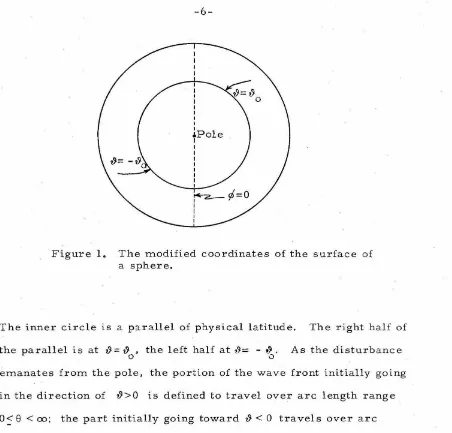
Figure 1. The modified coordinates of the surface of a sphere.
The inner circle is a parallel of physical latitude. The right half of
the parallel is at ~ = ~ 0 , the left half at ·'1= .
-
•?0 . As the disturbanceemanates from the pole, the portion of the wave front initially going
in the direction of ~>0 is defined to travel over arc length range
0~ 8 < oo; the part initially going toward ~ < 0 travels over arc
length 0 > 8 > -en.
Using this convention, an observer situated at physical
latitude ~> 0 sees the first pass of the wave front when 8= .J.
The other half of the wave passes him on its first return trip to the
starting pole, at 8 = -2rr
+
~. When the front passes the observeron its second journey toward the opposite pole, he sees the portion
the other half meets him at 8= -41T
+
t9-. Clearly, the total disturbance at physical latitude ??- is the sum of the individual contributions at arc length t9+ 2n1T, n=
0, ± 1, ±2, . . . Thisfact is of great importance in the analysis of the problems in the following sections. It should be noted that ??-
=
8 in the intervalSection 3. The Analytic Continuation of Legendre Functions.
In this section we examine the nature of the solutions of
Legendre's equation (1. 1) defined on the infinite 8-interval. When
this equation is restricted to the customary range 0<
e
< 1T, thetwo usual notations for the solutions are
w
=
pf-L 1 (cos 8)\)-2 and ( 3. 1)
They are called the associated Legendre functions of the first and
second kinds, respectively. We choose degree \) -~ because
pf-L 1 (cos 8)
\)-z
Qf-L 1 (cos 8) -\)-2
1s an even function of \)1 ( [ 1], p. 140, (1) ), and
is a solution independent from Qf-L 1 (cos 8). \)-2
To extend these solutions to an infinite 8 interval, one
might be tempted to observe that cos ( 8
+
2n1T)=
cos 8 and hencehold that
and
QfJ.
\)-z
1 (cos (8+
2n1T)) =pf-L J._ (cos ( 8
+
2n1T))\)-2
=
pf-L \)-2 1 (cos 8) .However, such a direct extension of the solutions is in error. The
notation (3. 1) for the solutions is intended only for the range
[ 0, 1T]. It is well established (see [ 1
J ,
pp. 163-4) that theLegendre functions have branch points at 8
=
0 and 8=
1r. Wemust use another device to bypass the branch points and continue
We let 8 be an unrestricted complex variable and
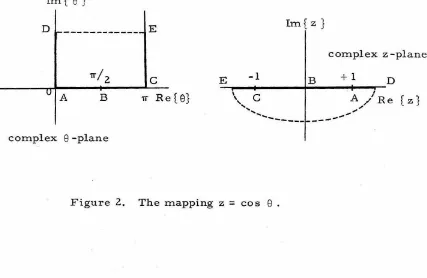
consider the mapping z
=
cos 8, shown in Figure 2.Im { 8}
--- E Im{ z}
complex z-plane
c
E -1 B+
1B rr· Re{e}
'\.,, c
... ...
_____ _
{z}
complex 8 -plane
Figure 2. The mapping z
=
cos 8 .From this illustration it is apparent that the lower half of the
z-plane ..P m { z}-:: 0 maps onto the upper semi-infinite strip
in the 8-plane: O~Re { 8}-:: 1r; ..Pm {8}:;: 0.
By making the substitution z
=
cos 8 in ( 1. 1), we get thealgebraic form of Legendre's equation:
(3. 2)
This equation is of hypergeometric type. Of the many
choose ( [ 1], pp. 136-137):
. zF 1
[t
+ f.l,
t
+ \) + f.L;
1+
\)j z -z+
where 1( C) is the gamma function and
2F 1 [a, b;c;
C
J
=
1+
ac •. bf
+
a(a~f~~l~+l) ~
+ .
.
.
is the hypergeometric series.
Expression (3. 3) has branch points at z
=
± 1. We must ( 3. 3)(3. 4)
define the branches so that when .,Pm [z} < 0 {3. 3) converges for
..;m [
e}
>0 under the substitution z=
cose.
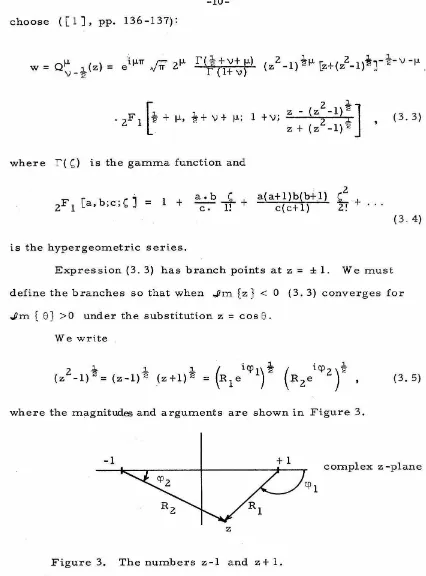
We write
2
~
1.. 1.. (.icp1)~
(
i
cpz)t
(z -1)=
(z-1) 2 (z+l) 2=
R1e R2e , (3. 5)
where the magnitudes and arguments are shown in Figure 3.
-1
+
1 complex z -planez
2
As z-0 from any point in the lower half plane, (z -1)--1,
Therefore
( 3. 6)
'lri
1
--z-
2];.and ( z 2 - 1) 2
=
e ( 1 -z ) 2 • ( 3. 7)Then if we choose the principal branch of the square root, the
substitution z = cos 8 gives, from (3. 7)'
(z2
-1)~
-- -1 · s1n · 8 • ( 3. 8)Making these substitutions in {3. 3) we see that the entire expression
will be a function of 8. Emphasizing that we wish to consider 8
and not cos 8 as the independent variable, the result is
'lrij.L
r<~
+
v
+
p.)r (l+v)
"""r (
.
8)1-L i(~+v+p.)8e stn e .
[
1 l. . . 2i8l
. 2F 1 2
+
p., 2+
v
+
p., 1+
v
,
eJ
( 3. 9)
The quantity El-L 1 ( 8) is of course equal to Q!-L 1 (cos 8) for 8
v-2 v-~
on the real axis between 0 and 1r. ~'<
*The notation
E~-i
(
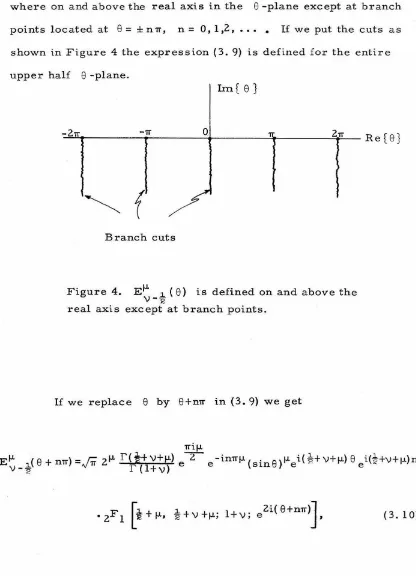
8) is an extension of that used by Clemmow [2 ],The hypergeometric series in (3. 9) conv.erges every-where on and above the real axis in the 8 -plane except at branch points located at
e
=
± n 1T. n=
0. 1,2. • • • • If we put the cuts as shown in Figure 4 the expression (3. 9) is defined for the entire upper halfe
-plane.Im{ 8}
-~2~1T4r---~1T ________ 0~,~---~~~---2~1T~-Re{8}
Branch cuts
Figure 4. El-L 1 ( 8) is defined on and above the
\1-z
real axis except at branch points.
If we replace
e
by 8+n1T in (3. 9) we getfrom which we get the important result
E l-l. .(e+n.,.)=l... " ·neinlT\1 El-l. :L (8) , n = ' 0 ±1 ±2 ' , . . . •
\1-z
\1-
z
(3.11)Equation (3. 11) is the addition formula. It shows directly that the analytic continuation of
oi-L
~(cos e) in the 8-plane isnon-\}-z
periodic. Equation (3. 11) is crucial in the evaluation of integrals occurring later.
One may ask why we chose to extend
oi-L
~(cos 8) rather\)-2
than the more common solution pl-l. ~(cos 8). The reason is that
\1-z
the hypergeometric representations for pl-l. ~(cos e) do not yield
\)
-z-the convenient form of -z-the addition formula (3. 11).
However, it is of interest to examine some form of the continuation of pl-l. 1c (cos 8). There are a number of identities
\1-z
relating the two standard solutions. In particular, from [ 1], p. 140, we have
The substitution z = cos 8, J1rn [z} "'::: 0, and \! _, \!-~ in the above form gives the continuation of the left-hand side and consequently the right side. Thus, we can define
to be the continuation of pf.i. ~(cos 8). Similarly, using V--z
Q~v-1
(z) -Q~
(z)we get
e -if.I.TT [
E~
_~
( 8) -E~
V _t (
8)J
sinTTV I'(;+v+ f.!.) r(-~ -V +f.!.)Another fundamental definition is
(3.13)
E r- (8)-~'IT i e pr- ,(cos8)+
11 eif.i.TT [ iTTV u
V-t
--z
COS'Ir(V+f.i.) V-~P~ -~
(-cos8)]
( 3. 14)for
o-:;
Rer
8}-:: TT. From this expression and the additionformula (3. 11) we get the identity
cos VTT pf.i. ~(cos 8), cos TT(V+f.L) v--2
(3. 15)
O<Re [ 8} ":: 1r.
These relationships are useful for the evaluation of certain integrals. It should be mentioned that while (3. 12) does give the analytic continuation of pf.i. ~(cos 8), it is not especially useful
v
--z
Section 4. Derivation of the Transform.
In this section we derive two forms of the spectral representation associated with (1. 1). Appendix B outlines the theory of constructing the spectral representation associated with an ODE. (For a full treatment of the subject, see Titchmarsh [ 3].)
Starting from (B. 7), we define A.
=
v
2-%.
Then ourfundamental formula is the contour integral expansion theorem for Dirac's a-function:
=
~
J~(
8, 8 , v)'ITl 0 v dv
cl
where .1>-(8, 8
0 , v) is the Green's function for (1.1) and
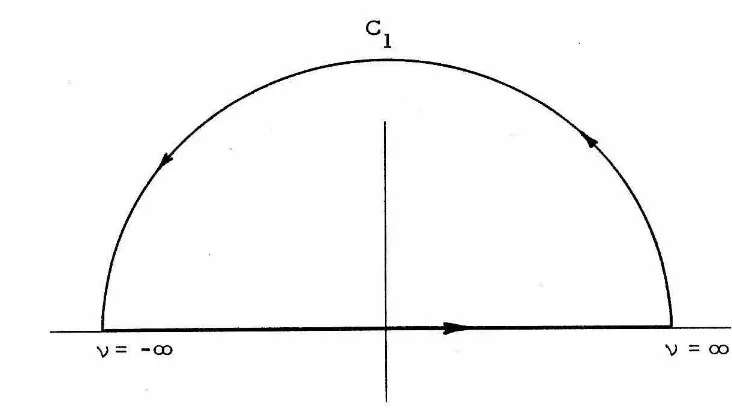
c
1 isthe infinite semicircle shown in Figure 5.
( 4. 1)
v
=
-oov
= 00In Appendix C one form of the Green's function for (1. 1) is
shown to be
where
,.Bi(8,
e
,v)=
0 .
Ef-1. :L ( 8 ) Ef-1. 1( 8 ) sin 8 e -2if-l.1T
v-z > -v -2 < o ( 4. 2)
are the greater and lesser of 8 and 8 ' respectively.
0
We note that 6( 8 - 8 ) is the value of the integral in (4. 1)
0
taken along the arc
c
1 itself. To get an equivalent representation
for the right -hand side of ( 4. 1), we close the contour
c
1 along the
real axis (Figure 5) and apply Cauchy's integral theorem.
The spectral expansion ( 4. l) becomes
6(8- 8 )=
0 l / 00
- . - ${8, 8 , v) v dv
+
Residues.1T 1 0 ( 4. 3)
-oo
By comparing (4. 2) with (3. 9), we observe that the I'-functions in
the denominator of (4. 2) cancel those contributed to the numerator
by the E' s. The factor I' ( l
+
v) l ( 1-v) which will appear in thedenominator obeys the identity
l ( l
+
v) l ( l -v)=
1r v c s c 1r vand is canceled by the remaining factors in v$( 8 I 8 ' v). Therefore
0
the integrand in ( 4. 3) has no singularities, and we get the 6-function
6 (8-8 )
0
i -2ij.L1T
= --
1T eEach side is symmetric in 8 and 8 •
0 Therefore, we can set
8 = 8 and 9> = 9. Multiply each side by f( 8 ) and integrate
< 0 0
from -oo to oo to get the transform pair:
00
£( 9)
=I
f(
v)-oo
..., i
f(v)=--1T
00
e-2ij.L1T
f
f(9)-oo
El-L ~ ( 8) sin 9 d 9 .
-v-~
(4. 4)
( 4. 5)
( 4. 6)
These last two expressions are called the infinite-angle generalized
Mehler transform, after F •. Mehler [ 4] who constructed a
some-what similar transform in connection with the conical functions
P. ~(cos 9).
lV-
z-We can set the order j.L = 0 in (4. 5) and (4. 6). If we define
E0
~
( 9)=
E~
( 9) as the conti:Uuation of Q~
(cos 9), thev-~ v-2 v-2
transform pair reduces to
00
f(9) = ;
J
f(V)Ev-
~
(
9
)
v cot lTV dv, -oof(v)= -
.i_
J
00
f(9)E
~(
9
)
sin 9 d8.1T -v-z
-00
( 4. 7)
This special case was derived by Clemmow [2 ] . In some of the
examples that follow it will turn out that ( 4. 7) -( 4. 8) is the
appropriate transform pair to use.
In the special case of the reduced transform, the expansion
of the a-function becomes
6(8- 8 ) =
0
i
- --z
E ~ ( 8) sin 8 v cot rr v d vv--z o
Tf
( 4. 9)
We will offer an alternate form of (4. 4)-(4. 6). We can
choose Ef.l
d
8)v -2 and E-f.l - \)- 2 ~ ( 8) as our independent solutions to
( 1. 1). Appendix C shows that with this pair the Green's function
is
1
=
-sin rr v
( 4. 1 0)
Definition ( 3. 9) implies that the numerator of ( 4. 1 0) contains the
factor
( 4. 11)
and the demoninator contains
1(1
+
v) 1(1- v)=
rrv esc rrv ( 4. 12)These factors cancel with others in (4. 10), so there will be no
get the expansion of the 6 -function:
6(8- 8 )=
-~
/00
EIJ.
:~J8)
E-IJ.~
(8) sin8 V COS1r(V+t-L) dvo 1r"' v-~ -v-2 o o sin n v
-oo
The resulting transform pair is
1
100,...,
£(
e
>= -
1T . £ < v) El-L v-2~
( 8) v -oocos 1T ( V+IJ.) sinrrv
f
(v) = -.L
fa;(
8) E-IJ... .l..( 8) sin 8 d8 .rr -v-~
-oo
( 4. 13)
dv, ( 4. 14)
Section 5. Application to Waves on a Sphere.
An elegant use of the infinite-angle transform is its
applica-tion to axisymmetric waves on a sphere. The physical problem
selected for study is long free-surface water waves on a shallow
spherical ocean. In Appendix A we show that the linearized
equation for such waves is
si~
e 888 (sine 888 4;(8, t)) - cl28~~
lj:l(e, t)=
0 ' ( 5. 1)where (8, t) is the elevation of the free surface above the eq
uilib-rium position. As explained in Section 2, the variable 9 in (5.1)
can be regarded as the total arc length covered by the wave front,
so -oo
<
8<
oo. The radius of the sphere has been normalized to 1.Equation (5.1) with 0 ~ 9 ~ or has no doubt been solved in
-numerable times using the standard Legendre polynomial expansion.
However, this form of the solution is difficult to analyze or inter
-pret physically. We seek a more transparent expression.
shall examine ( 5.1) with initial conditions
ljJ(S, 0)
=
0 ,v0 ,
jej
<80lj;t(8,0)
=
0 , 80<
jej
<
or-80-v 0 ' 1r- 8o
<
\
ej
<
orWe
(5. 2) (5. 3a)
(5. 3b)
(5. 3c)
These conditions correspond to the sphere's being given an initial
outward velocity throughout a zone at one pole and an identical
inward velocity around the other pole. (This balanced initial
From the pr~nciple of superposition we can treat (5. 3a) and (5. 3c) separately. To illustrate the use of our transform, we will solve the problem with condition (5. 3a) only, stressing that the case with (5. 3c) follows in the identical manner. The conventional form of the solution of (5.1)-(5. 3a) is
~(9, t) = iv0t(l-cos90 ) +
Vo oo 1
~ n+ 7
c n=l ..fn(n+I)
9o
J
Pn(cos~) sin~ d~
0
• P(cos9)sin{n(n+I)ct.
n ( 5. 5)
It is difficult to interpret (5. 5) directly. For example, it is not at all clear that, for sufficiently small t, ~(9, t)
=
0 for any 9>
90 • The difficulty is that (5. 5) represents the entire sphere by its physical latitude range. The first term in (5. 5) is the average disturbance over the whole domain and the remaining terms are the "correction" terms.then ( 5. 3) implies that the entire sphere is given an initial outward
velocity. It is easily shown that
TT
/Pn(coss) sins ds = 0
0
for n
=
1, 2, In such a case ( 5. 5) shows that'¥(8,t)
=
v t.0
The entire sphere expands uniformly into space forever. Such
behavior may be at odds with one's intuition, but the result is
( 5. 6)
correct for the very simple physical system which equation (5. 1)
describes. )
We will now extract the solution of (5.1)-(5. 3a) using the
infinite-angle transform. From ( 4. 9) and ( 4. 1 0), define
and
1(8,t)
=+
~~
(v,t) Ev-t (B) v cot rrv dv-oo
'l' ( v' t) = sin
e
d e.{ 5. 7)
( 5. 8)
Multiply (5. 1) by i E l ( 8) sin 8 and integrate from
rr
-v-
2The first integral in ( 5. 9) can be integrated by parts:
1
00_!...ae
00
. 00
(sin8~~)
E_'V_i(8) d8=sine~@
E_'V_i(8)1--co
00
-
f
- s 1 no'¥ .
ae
e
-00
We assume '¥(8,t) and '¥
8(8,t)-0 as 8-±CD. Therefore, the boundary term in (5. 10) vanishes and we get
CD
f
~ ~
sin 8 0°
8 E _'V-~(
8) d 8=- '¥sine 0°
8 E_'V-~(8)1
00
+
-CD
-CD
( 5. 9)
(5. 10)
(5.11)
Now E -v -2 1 ( 8) is a solution to Legendre's equation (1. 1) with f-1.=0, so (5. 12) becomes
(5.13)
Appealing to (5. 8), this becomes
( 5. 14)
Transforming the initial conditions (5. 2) and (5. 3) gives
·~(v,O)=O
. Je
1 0- - v E
d£)
-rr o -v-2
- 8 0
It follows that
~(v,t) = sin£d£· ( 5. 15)
and the inverse transform (4. 7) yields the solution
v cot -rr v d v .
This solves (5. 1) - (5. 3) for -oo < 8 < oo. Interchange the order of integration and rearrange terms to get
8 00 _ _ _..,
v o
i
0 ( i ) /sinV} -
i
ct'!' (
e
,
t)=
- cds·
- L
- 8 rr -oo ~I 2 1
0
"v
-
4E _
v
_
~(
s)
Ev
_
~(
8) sins
v
cot rrv
dv.
( 5. 1 7)
As stated before, the variable 8 in (5. 17) represents total arc length, measured from the starting pole, covered by the wave. In Section 2 we showed that the disturbance ~ ( ~?, t) observed at physical latitude
(} is the sum of the individual disturbances at arc lengths (}
+ 2nrr,
n
=
0, ±1,±2., •.• o Thus we get00
qi ( (}, t) x
2:
'l' ( t?+
2nrr, t) n=-ooor
qi ( (} ' t)
OJ
J
8 00 .. f 2 I=
vo " " "0
dsf
sin~
v
-i
ctc n-
~
-oo - 8 -oov
v2
-.1.0 ' 4•
( 5. 18)
oo
je
H~.
t)=
vcoL (
-l)n -e
0d~
~
,-..---..
. 2 ~ 2.
s1n \1 - 4 ct 1nrrv e
n= -oo o
(5.19)
The \1 -integral in (5. 19) has the structure of a Fourier transform.
We will evaluate it using the convolution theorem for Fourier
integrals. Let F(\1) be the Fourier transform of f(a.):
1/
00 .-1 \)a.
F(v)= 2rr f(a.) e do..
-<X>
If G( \1) is the Fourier transform of g( a.), then the convolution
theorem states that
00 00
I
eiva. F(v) G(v) dv=
2
~
j
f(C) g(a.-C) dC-oo -oo
(5. 20)
Define F( \1)
-.•
r;-;_
smlv""-i ct.
~
\)
2
-i
(5. 21)
Then, from [ 6] , p. 26. (30). we find that
(5.22)
where I (z) is the modified Bessel function of the first kind, order
zero, and H(x) is the Heaviside unit function' H(x)
=
~~:
~;~
Define G( v) - - (
1
> )
E -v-2 1 (~) E v -2 dt?) sin~ v cotrrv dv (5. 23)
Fror:n the ()-function expansion (4.13) and the addition formula (3.11)
we get the representation
i/
006(??
+
4nrr -~) = - --z-rr -oo(5. 24)
Let a.= 4nrr and each side of (5. 24) is a function of a.. We get the
Fourier formula
1
00eia.v
.I-~)
E1
(~)
E~(??)sin~
vcotrrv dv=o(t?+cx.-~).
00 \" rr - v-2 v -2
(5. 25)
From the results in (5. 22) and (5. 25) we will use the convolution
formula (5. 20) to determine the v-integral in (5. 19).
00
1
ei2nrrv00
Evaluating the integrand at the zero of the a-function argument yields
'H~.
t)
=~
[2;
-l)nf
8
\
0
[~~t
2
-
(,Hz:;-S>zJ
H(ct-
J
~+Zntt-5!)
df;.
0
(5. 26)
For any finite t this expression contains only a finite number
of terms, each one representing a separate passage of the wave front
around the sphere. We shall analyze the behavior of the wave.
From the symmetry of the physical problem the solution
must be symmetric in rJ. Therefore, we will consider the
behavior seen by an observer at latitude rJ >0.
Case 1. rJ > 8 .
0
In this situation the observer is located outside the zone
of initial velocity. We examine H ( ct -
I
rJ+
2nrr -g
I)
in ( 5. 26).The argument first becomes positive in the n
=
0 term, if ( {}, t).0
The integration variable ~ is confined to (-8 , 8 ) , and hence
0 0
il>(.,,t) - 0 for t<
"-8
0 cThis fact shows directly that the initial wavefront travels with speed
c into a quiescent medium and that there is no advance disturbance.
After the wave front first arrives the expression (5. 26)becornes
rJ-8
0
- -
c < t <2rr- rJ-8
0
c
where A is the algebraically lesser of -8 and {)- ct. This
0 0
expression represents the first passage of the initial wave front.
Now, I {z) is bounded near the origin. Its appearance in the
0
integrand of {5. 27) implies that the surface level rises continuously
and monotonically from zero for the time interval specified
in {5. 27).
This behavior shows that the wave propagation on the
sphere is not "clean-cut" but leaves an infinitely long wake.
At time
t
=
2rr-{)-8
0
c
the n=-1 term q>_
1{{), t) in {5. 26) appears. It represents the first
return trip of the wave front to the starting pole. In the interval
<
t<
c
the total disturbance is
v q> { {). t)=
2~
2rr+{)-8
0
c
I
0
~ ~t
2
_(.?-:~-")Jd"
{5.28)Here A 0 is defined as for { 5. 2 7), and A _
1 is the algebraically
smaller of 8
0 and {)+ct -2rr. The disturbance obeys this formulation
until
2rr + {) - 8
t= _ _ _ _ _ -o
c at which time the n= 1 term q>l { {), t) appears
(5.29)
where Al l S the algebraically lesser of - eo and {)-
+
2rr -ct.The next two terms to enter are then= -2 and n = 2 terms,
respectively. From the factor ( -l)n in (5. 26) it is evident that
successive pairs of terms are alternately positive and negative.
This fact has the remarkable interpretation of a phase reversal
occurring at the far pole but not at the starting pole. ~ , the
. 0
initial wave coming from the starting pole, is positive. The
contribution from ~-l, the first return from the far pole, is
negative. The term \P
1, representing the second pass from the
starting pole, is also negative, indicating no change of sign.
The second return wave ~ ~
2
is positive, exhibiting another changeof sign at the far pole.
Case 2. {)- < 8 .
0
The observer here is situated within the zone of initial
velocity. Rather than evaluate ( 5. 26) directly we make the
following observation. The single initial condition ( 5. 3) can be
written as the swn of the two conditions
·where
(5.30)
and f2(
e
>= -
v ,e
<
l·.e I
<
'IT.0 0 . - (5. 32)
This corresponds physically to our combining the solutions to separate initial-value problems: one in which the entire sphere
receives an initial outward velocity, and one where the zone now under consideration is initially quiet while the remainder of the sphere is given an inward velocity -v .
0
It follows either from (5, 5) or directly from (5. 1) and (5. 2)
that, with condition (5. 31) as the initial velocity,
q> (t?,t)
=
v t.0 ( 5. 33)
When we include (5. 32) as our initial velocity distribution,
the~; except for a change in coordinate limits, we have precisely the physical problem of Ca~e 1 above. Making the necessary adjustments in the notation of (5. 26), we can combine the separate solutions to the problems using (5. 31) and (5. 32) individually to get
211"-8
<!(-' •
t):
v 0t'
~~ ~:(
- l ) t
\
[
~
t
2
_(-'+Z:n-g)
2
]H(ct-1
-'+2nn-g
~
0as the solution to our original problem (5. 1)-(5. 3) with t?< 8 •
0
( 5. 34)
We shall analyze (5. 34) for the first few moments of wave travel. For
8 -t?
t
<
_...;o _ _the series contributes nothing, and
= v t
0 •
a uniform outward motion. At
8 -{}
t = 0 c
the n=O term <P ({},t) entersandweget
0
<P ( {} • t) = v t
0
8 -{} 8 +?'J _o __ < t < _o _ _
c c
(5.35)
where A is the lesser of ~
+
ct and 21r - 8 . The integral in (5. 35)0 0
represents the propagation of the effects of initial quiescence from
the nearer boundary of the initial disturbance inward to the observer's
latitude.
t
=
At
8 +{}
0
c
the n = 1 term appears. It can be interpreted as the arrival of
quiescence effects from the far boundary of the initial disturbance.
As in Case 1, (5. 34) admits more and more terms as t
increases. However, we must make the distinction that (5. 34)
describes the disturbance in terms of the propagation of quiescence
effects, whereas (5. 26) represents the acutal disturbance itself.
Thus, we find that while the physical wave undergoes a phase reversal
at the far pole, the quiescence terms encounter such a change only
Propagation Of An Explosion.
Of particular interest is a special case of the above problem representing the behavior of the sphere following a point explosion at one pole. We reduce the size of the zone
I
e
I
<e
in (5. 3) and0
increase the velocity v
0 in such a way that the total initial energy
remains constant as
e
.... o.
0
We define the initial energy per unit area to be the total energy E: exhibited by initial condition (5. 3) is
0
so,
2
e
0
=
1r v o < 1 -cose
>,
v
=
0
1
- cos
e
0
Substitute (5. 36) into the solution (5. 26) to get
q, ( t<i ' t) =
rc
1 ...
1 -;;-J
re;;
-==1====->: ( -1)
,:.
nf
e·
.
o
1 -cos
e
0 n= -oo . -e
0Applying the mean value theorem for integrals and expanding
"h
-cose
0
in a power series for
e
gives0
Then
(5.36)
1
~
r;:
g)( t?' t)
=
2c"-f
where - 8 < 8 < 8 .
0 1 0
Take the limit of (5. 38) as 8 -+ 0 to yield
0
( t?+2mr -
8
1
~
. 2 8 .
0
c
( 5. 3 8)
It? +2mr
1)
(5. 39)as the representation for the disturbance at any physical latitude t?
resulting from an explosion at the starting pole at t = 0. It· reveals
quite clearly the behavior of the wave.
The first contribution again comes from the n
=
0 term. Thefactor H(ct-t?) shows that there is no disturbance at t? before
t
=
t?, the first arrival time of the wave front.c
Now I (0)
=
1, so when the front passes the observer the0
surface elevation jumps abruptly to height
t?
1~
~(t?. - )
= -
___£__ •c c 1T
As the wave proceeds, the surface at t? continues to rise
2•rr- !?-In the interval
c
q>(t?-,t)
<
t<
2rr+t?-, the total disturbance is ct?-+2rr
The n
=
1 term appears at t=
- c - and represents the passage ofthe wave on its second trip toward the far pole.
Because of the infinite initial velocity at one pole it is
worthwhile to examine the wave for possible subsequent singularities
at either pole. From (5. 39), there is no disturbance for t < ~ .
The first wave contributes
'lr 3rr
c
<
t<
cWe see that, although the radial velocity of the wave front changes
abruptly with the arrival of the wave, the amplitude remains bounded
and has no physical singularity. From (5 .. 39) we deduce that similar
Section 6. The Flow of Heat on a Spherical Shell.
In this section we derive an alternative representation for
an axisymmetric initial-value heat-flow problem on a spherical
shell. The standard form of the heat diffusion equation is
2
k'V u - u = O t
We consider an initial distribution of temperature over a zone. Equation (6. 1) becomes
si~
8 :8 (sin 8~~)
- at
au
=
0,with initial condition u( 8,
o>
= u0 ,
I
8I
<
eoClassically, the eigenfunction expression in terms of Legendre
polynomials yields
00
u( 8, t)
=L
c (t) P (cos 8)n n
n=O
with the result
( 6. 1)
(6. 2)
(6. 3)
P(cos8)· n
-n(n+l) kt
e .
This equation is useful for large kt. The total heat remains constant, and the temperature tends to a uniform distribution over the entire sphere.
For small kt the series in (6. 4) is· slowly convergent. To get a more rapidly convergent form, we define 8 to be arc length on the sphere and hence -oo
<
8<
oo in (6. 2). The flowof heat in an initial-value problem resembles an infinitely fast,
exponentially weak wave. Therefore, we follow Section 2 and note that the temperature U { t?, t) at physical latitude {1 is
00
U( '!?, t)
=L.:
u ( t?+2mr, t) . ( 6. 5) n=-ooNow we shall solve {6. 2)-{6. 3). Multiply
(6.
2) by -i.._
E 1.( 8) sin 81T -\)-2
and integrate from - oo to oo.
( 6. 6)
From the exponential decay of the solution to the heat
equation in an infinite domain we assume u{ 8, t) _,Q for 8--+ ± oo.
Therefore when we integrate the first term in (6. 6) by parts twice
-
~
k1:
u( 8, t) 338 (sinS 88e
E-v -}( 8?d8+
~~= ~~
E-v-'!:(8) sin 8 d 8=
0.( 6.
7)E ~( 8) satisfies (1. 1) with tJ.
=
0, so (6. 7) becomes-\)-2
<X>
8 d 8
+
l_l
au Ed
8) sin 8 d 8 1T -en at -v--z= 0.
(6. 8)
Each term here has the form of the infinite-angle transform ( 4. 15 ),
so (6. 8) becomes
'"" 2~,..., )
ut(v, t)
+
k (v-·:d
u(v,t=
0.Transforming the initial condition (6. 3) solves (6. 9):
I
e
,..., i 1-.kt 0
u (
v,
t)= - -
u e 4 .f
E~
(~)
1T 0 \ )
--
e
20
sin ; d ;
~
The inverse transform (4. 14) gives
2
-\) kt
e
(6. 9)
Equation ( 6. 9) gives the temperature at any arc length 8. To
calculate the result at physical latitude iJ, we appeal to (6. 5);
this expression, together with the addition formula (3. 11) and
interchanging the order of integration, gives
It is well known that
f
ro ia v-v~
t
de e v
=
-(X)
E \J _
t
(
8) sin s v cot TT v d v .2
a
- 4kt
e
(6. 1 0)
(6. 11)
Incorporating (6. 11) and (5. 25) into the convolution theorem, we
get
2
ei2nTTV e -v kt E ~ (s) Ev_.1.(iJ) sins v cot TTV dv =
-v-2 :;>
(2 - 4kt
e 0 ( ?.?+ 2nTT -
C
.., S)
dC
ikt co
le
u e o
U(
~,
t)=
~
"'""' (
-l)n2 'ITkt ~
n=-co -
e
0
e
2
(!~+2n'IT -~)
4 kt
We shall analyze the behavior of the temperature U{ {}, t).
Case 1. {} >8 .
0
( 6. 12)
For kt sufficiently small the n=-0 term dominates all others because of the rapid decay of the exponential in the integrand. (It also dominates the factor
~
. ) We have'ITkt
or
U( {}, t) ~
u
0
U(t'l,t) ~
-
,;;-We can write this as
u
u (-{},
t) ~-f
{}+ 8
0
l,_ktf
2Jkt
e4 .
19-e
0d ~ '
ei kt
(E
rf({}+ 80 ) -E
rf( {} -fh)) .
Case 2. {)< 8 . 0
In this case the observer is situated within the zone of
initial temperature u • As with the wave problem of the previous
0
section we treat this case as the superposition of separate
problems, one with initial condition
and the other with initial condition
u
2 ( 8, O)
=
-u 0 8 0<
I
8I<
'IT'.The solution to
(6.
2) and (6. 14) is easily seen to beu
0
( 6.
14)(6.15)
(6. 16)
We can solve (6. 2) and (6. 15) by a change in the integral limits
in
(6.
12), and so our complete solution for this case isU( .,'), t)
=
u0
u e
0
%k.t
0021T'-8
L
(-l)nfe on= -co o
e
Here again, for sufficiently small kt, the n=O term dominates, and
(
.;hkt 21T'-8 o
U(.,'}, t)
~
u 1 - e4
-
r
eo
2..,r;kt.J
e
0
2 - (£-.,'))
Section 7. The Potential of a Sphere.
In this section we apply the generalized transform to obtain an alternative representation for the electrostatic or gravitational potential of a sphere.
We solve Laplace's equation in spherical coordinates:
+
si~
e aae (sine~~)
+
1v
=
0,cpq> (7. 1)
0 2
8 s1n
with boundary conditions
V(a, 8, lfl) = f(8,qJ), 0 < 8 < rr, 0 <CD < 2rr ( 7 0 2)
lim r
v (
r, e , cp) < 00 • ( 7. 3)r-+OO
We specify that -oo <8,q> <oo in (?.!).Laplace's equation is one of static equilibriUJ;n, so we cannot interpret the solution as the contribution from a traveling disturbance. Because lfl as well as
e occupies an infinite range, we must now distinguish between the extended azimuth
cp
and physical azimuthc/
J
exactly as between e and ?J in Section 2.cj
is the physical azimuth of anobserver. The total potential at physical point (r, {},
¢)
is the algebraic sum of the individual contributions at the extended coordinates (r, ?J+
2nrr,¢
+
2mrr), where n, m=
0, ± 1, ±2, . . . (Note that 0-:; ?J ".: 1T •. )1 !2'11"
:('IT
~
V(r,
8
,q>)=
2
'1T(~)
d~
.
d
C
sinCf(
C
,~L
· o o n=O
n
m=-n
a n
For r> >a the factor ( -) implies that the series is rapidly
r
(7. 4)
convergent. The first few terms give a good approximation to the
actual potential.
For r ~a we would require an inconvenient number of
terms for accurate d~scription of the potential, since ( ~ )~ 1s
no longer dominant. This fact,for instance, hampers concise
calculation of the gravity force on a spacecraft orbiting a planet.
We will use the Mehler transform to derive a representation useful
for r~ a.
We define the Fourier transform
g
(f.L) of g( cp) asTake the Fourier transform of (7. 1). The boundary terms arising
from the integration by parts of the last term vanish, leaving
2- - 1
a
r
v
(r,8,f.1)+2rV (r, 8,f.L) + -.-8
<=>
e
rr r s1n u
(
.
.
e
oV
(r, 8,f.L~
__L
-V(e
)
Sln (}
e
.
2 r , ,f.! s1ne
Multiply ( 7. 6) by i E-JJ. de) sine
'IT - v-~ and integrate over e
from -oo to oo. We integrate the third term by parts. The boundary terms again vanish and we get
f
oo"'i 2 -jJ.
- - r · V ( r, e, JJ.) E ~ ( e)
'IT _
00
rr -v-2 sin ede - i . 2 r {00
v(r,e,JJ.).
'IT r
-oo
sin e d 8
-n:-
i j o o ,.... -oo V(r, e,JJ.)as
a (
sin 8aeE-~-
a _
~
(
8
)
)
./00
+
.!..'IT
-oo
2
iJ. V( r 8 n) E-JJ. " ( 8) d 8 = 0 .
sine ' ...
-v-t
( 7. 7)
With the aid of Legendre's equation (1. 1) we can simplify the third and fourth integrals; combining terms in the resulting expression gives
= 0 •
(7. 8)
From the Mehler transform formula (4. 15) we define
. /00
'l'(r, v, JJ.)
=-
~V
(r, e, JJ.) E-JJ. ~ (e)-oo . -v-2 sin e de. ( 7. 9)
whose solution is
'¥ = A( v, !J.) r
v
-
.J..
2+
B(v,
!J.) r-v-
i
• From (7. 5) we have,..._ / c o i!J.cp
V(r, 8, !J.)
=
V(r, 8, cp) e dcp .-oo
Boundary condition (7. 3) implies
lim ra V(r, 8, q>)
=
0 for a < 1 ,r--eo
which together with (7. 12) gives
lim ra V(r, S,iJ.)
=
0 for a< 1. r->cohnposing (7.13) on (7.9), we get.
lim ra'l:'(r, v, !J.) = 0 for a < 1 • r->oo
Therefore, the solution (7. 11) becomes
'¥ ( r, v, !J.)
=
A(
v,
1-L) 0 B(v,
1-L)v
-.J..
r 2
r -v-~
-~ <v<~
(7.10)
(7.11)
(7.12)
(7. 13)
By transforming initial condition (7. 3) and inverting (7. 12) and
(7. 9) we find the result
sin r ~ v ---:---'----!..."'-cosrr(v+f.L) H (
I I
v -
~) \
)
sin rr v C
'(7. 15)
where H(x) is the Heaviside unit function.
This expression is the potential at the extended coordinates 8 and
cp. The total physical potential iJ.i(r,,9,¢') is given by
(X) (X)
iJ.i(r,?J,¢')
=L
L
V(r,?_H2nrr,p+2mrr).m= -co n= -co
From the addition formula (3. 11} we get
S l n r ~\) cosrr( . Vl-f.L)
s ln 1T \)
(7.16)
We first evaluate the v -integral in (7. 16). Recalling the
i E-1-1 (r) El-L (")sin r \) cos'l!" ('V+IJ.)
- -z -
'V - ~ "' 'V -i
"'
sin 'II" 'V'II"
=
2i1? 2F 1 [ . . . e
J.
(7.17)
Integrate both sides of (7. 1 7) over \) from -oo to co. The left-hand side is just the 6 -function expansion (4. 13). Therefore
( 7. 18)
where C( 8, C ,IJ., 'V} represents the remaining factors on the right-hand side of (7. 17).
Another well-known expansion is i'V("-C) 1 d e
""""2ir
'V( Subtracting (7. 19} from (7. 18) we obtain that
1
C(1?, C ,IJ., 'V)
=
2'iT
and hence
(7. 20)
N as
or
Let N standforthe v-integralin(7.16). Wecanwri.te
N= 2 \ J
(~)l
v
l
eiV(?Jt2nrr-C)H[jvl--tJdv-oo
1 00 \)
N=-J
(~)
cosv(?Jt2nor-<:)dv .or ~ r .
2
The result is
N=..!__/i(-l}n or~r
log(~) cos i (?J-C)- (?Jt2nrr-i.:)sin-t(?J-C)
2 2
[log(~)] + [~ + 2nor-CJ
There is no f.L-dependence in this integral, so we can do the
f.L-integral in (7. 16} to give
foodf.Le-if.l(~
+2mor-s) = 2or6(¢' + 2mor-s)-ro
(7.21)
Now O<s< 2or, so the only contribution to (7. 16) from (7. 21) is for
m= 0. Therefore ourfinal result is
00
rr . !log(2:.)cos-t(tJ-C)-(?.?+2nrr-C)sini(?J-C)
~
(r,?.?,¢')=-1 (~)""-"
J
f(C,¢') a .rr
rL.J
o r 2 2n=-oo [log (a)
J
+ [~H2nrr-<;::J
d (
This representation for the potential is superior to the
usual expression (7. 4). In modern applications (7. 4) has been
used extensively in the calculation of the gravitational force of a
celestial body on a nearby spacecraft. Not only do we have to
calculate a double integral numerically, but also for r ~ a several
dozen terms in the double series are required for a good
approx-imation to the potential. Unfortunately, the calculation of such a
large number of associated Legendre functions poses serious
num-erical problems.
In (7.22) we have the advantage of having to evaluate only
a single integral and series. Even more significantly, we need
only sines and cosines and avoid completely the computation of
PART II
Sound Waves in the Ocean
Section 8. Introduction.
We shall derive the spectral representation associated with the DE
w _,,
+ [ "'
22 (
1
+
.
M ) -A]
w =0
(
8.1)c. cosh2 (tmz)
00
and apply it to solve the PDE modeling the propagation of sound waves in the ocean. The spectrum is found to be mixed, requiring both an integral and a series to constitute the complete
representation.
Equation (8.1) arises from the separation of variables method applied to the linear wave equation with variable sound speed. In Section 9 we start with the PDE and derive the
Section 9. Derivation of the Spectral Representation.
A problem of interest is the propagation of small-amplitude
sound waves in the ocean. It has been widely determined
experimentally that the speed of sound in the oceans of the earth
is non-uniform. There is a decided minimum speed at a depth
of roughly 1200 meters, with a sharp increase above and below it.
The depth of minimum speed is called the sound channel.
The far field in the vicinity of the channel shows prominently the
trapping and focusing effects caused by the non-uniform sound
speed when a point source is located in the channel.
There has been substantial investigation of the steady- state
case of this problem, using a variety of models for the variation of
sound speed with depth. (For an extensive bibliography, see the
paper by Deavenport [9].) Blum and Cohen [8] investigated the
initial-value problem, where the source begins emitting sound at
time t
=
0. Their analysis converts the Fourier and Hankelrepresentation to an asymptotically more convenient form by a
Watson contour integration. One of our aims is to derive the
exact expression for this form using a new spectral representation.
For simplicity we consider an ocean of infinite extent in all
directions with a vertical variation of sound speed. Because of the
horizontal uniformity we express our problem in cylindrical
coordinates, with the origin in the channel and the z -axis directed
speed c(z):
c(z)
=
c 00-Yz
[
1+ M
cosh2 (tmz)
]
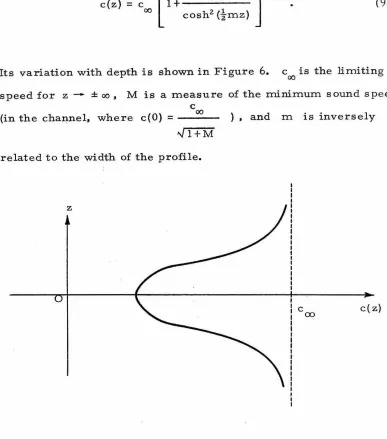
Its variation with depth is shown in Figure 6.
( 9.1)
c is the limiting 00
speed for z - ± oo, M is a measure of the minimum sound speed
c
00 (in the charmel, where c(O) =
---Jl+M
related to the width of the profile.
z
) , and m is inversely
c c( z)
(X)
The initial-value problem we study using speed (9.1) is
p (r,z,t)+-p (r,z,t)+p 1 (r,z,t) 1 [ 1+--~;__ M __
J
rr r r zz c: cosh2 H·mz)
= -
/Tr
o~r)
o(z-z0) f(t)H(t) ,(9.2)
-oo
<
z<
oo , 0 _::: r<
oo , -oo<
t<
oop(r, z, 0)
=
0 (9.3)(9.4)
p(r, z, t) - 0 and outgoing waves
(9.5)
as r-oo, z - ± oo.
The quantity p(r, z, t) is the observed deviation at point (r, z) from
the ambient pressure. This problem represents a point source at
radius r
=
0 and height z=
z0 that emits an acoustical disturbanceaccording to f(t) beginning at time t
=
0.We separate variables in the homogeneous form of (9. 2):
_R"
R+l-R\~"-
rR Z _l.[l +--::.:.M=---]
2 1
c
00 cosh2 (-zmz)
T"
Til
Define
T
= -
w2 , and we see that the t-representation is theFourier transform. Equation (9.6) becomes
R 11 1 R 1 Z 11 w2
- + - - + - + -
R r R Z z c0()
[
1+
M
J
cosh2 (-~mz)
=
0 •The terms are separately functions of r and z. Define
and the equation for Z yields
z
=
0 •Z"
+
- 'X.[
1
+
M ]coshz (tmz)
It can be easily shown that two solutions of (9.8) are
(9.7)
(9.8)
Z
=
p-fJ-1 ; (tanh tmz) and Z=
P- 1\ ; (-tanh t m z), (9.9)V-72 V-72
where
V"'(t+4
2M)
~
w
cZmZ
0()
(9.10)
and
~"'~(\
wZ)
~
(Principal Branch)
--cZ
0()
By imposing the outgoing wave condition (9.5) we construct the Green's function
{j
(z,z0 • fJ.{> .. )) in Appendix D. to getq
1 -jJ. 1 -jJ. 1(z, z0 , f.l(\))
= -
m P v-12 11 (tanhzmz> )P v-,z 11 ( -tanhz mz<) •· r
(t
+
v
+
f.l)r
<i -
v
+
f.l)where z> and z< are the greater and lesser of z and z0 ,
respectively.
(9.12)
Now we can apply the fundamental spectral formula (B.7):
o(z - z0 )
=
2
~
s
q
(z, z0 , f.l(A.)) d\+
l
(Residues inCB A. -plane). (9.13)
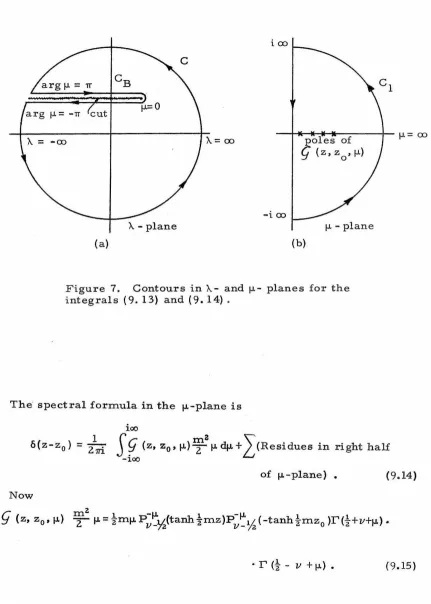
From (9.11) and (9.12) we see that the point fJ.
=
0 is a branch point of {j(z, z0, jJ.(\)) in the >..-plane. In Appendix D it is shown thatconvergence of the solutions at z
=
± oo demands that Re{J.L} > 0 •m2 w2
Therefore we make the change of variable A. =
4
fJ-2+-cz
00
ioo
>--=
00>-.-plane f.L- plane
(a) (b)
Figure 7. Contours in>-.- and f.L- planes for the
integrals (9. 13) and (9. 14).
The· spectral formula in the f.L-plane is
ioo
O(z-zo)
=
}rri
s
~
(z, z0 ,f.L)~
2
f.LdJJ.+ l(Residues in right half
-100
of f.L -plane) • (9.14)
Now
The function p-IJ.1 ; {~) is an entire function of IJ.. In
V-72.
Appendix E we show that
v
is real in the w-range of interest, andthat there are simple poles from the r-functions at 1-L =
1
v 1-~-
n.n = 0 , 1 , ••• , N , where N is the largest integer less than
lv 1-
~.
The o-function expansion (9.14) becomes
· r
{21v
I-n) •
{9.16)Multiply each side of (9.16) by f{z0 ) and integrate over z0 from
-oci to oo. The resulting transform pair is ioo
f{ z)
=
S
f
{!J.)P;:Yz (tanh~z)
IJ.r{t+v
+ !J.)r(t-v
+ !J.) d!J. -ioon*l-!
+
L
f
(~~)n P;!~~-~)+n
(tanh~z)
{I
vi-~
-n) • n=owhere 00
f
(f.L)=
4:S
f{z)P;~
Yz
(-tanh~z)
dz (9.18)-oo
and
00
- ms
fn
=
T
f(z)P-(l~j-Yz)+n(-tanh
ll- lZ mz) dz. 2 (9. 19) -ooFor any fixed ll this spectral representation contains an integral
Section 10. Application to Sound Waves in the Ocean.
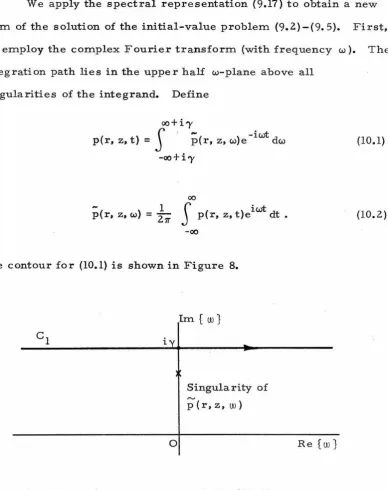
We apply the spectral representation (9.17) to obtain a new form of the solution of the initial-value problem (9.2)-(9.5). First, we employ the complex Fourier transform (with frequency w ). The integration path lies in the upper half w-plane above all
singularities of the integrand. Define
oo+i'Y
S
'
-
-iwt p(r, z, t)=
p(r, z, w)e dw-oo
+
i "Y00
- 1
p(r, z, w)
=
271'
S
iwt p(r, z, t)e dt •
-oo
The contour for (10.1) is shown in Figure 8.
i
0
Im [ w}
Singularity of p(r,z, w)
Figure 8. Integration path for (10. 1).
Re[w}
(10.1)
00
We define F(w)
= -
i1T
S
f(t) eiwt dt. Then in the usual way (9.2)0
transforms to
[
1+ M
coshz (imz) ]
- ..§J.!l
p = Z1rr c5{z-z0 )F(w).
{10.3)
Now we apply the transform (9.17)-{9.19). Multiply {10.3) by
P~~Yz
(-tanh~z)
and integrate over z from -oo to oo.Equation {10. 3) becomes
[ 1+ coshz (imz) M p-IJ.ll/
v-
;z (-tanh mzz) dz( -tanh
~zo
) {10.4)From {9.5) it follows that p, pz' - 0 as z - ± oo.
Therefore, we can integrate the third term on the left in {10.4) by parts twice and the boundary terms vanish. Combining this result with the fact that
P;~Vz
(-tanh~z)
satisfies{9.8),
we can simplify (10.4) to( (
~rr +~ ~r
+
(~
2
- ..§itl.
F(w) p-f.L1; (-tanh m2z 0 )
- 27Tr v-72 (10. 5)
From (9.18) we define
00
~
S
p
(r, z,w)~"!Yz
(-tanh~z
)dz=
1/J{r, f.L, w) (10.6) -oowhich yields from (10.5)
1 (mZ wZ ) im -f.L (
mzo)
t/J
+-1/J
-
f.Lz+-t/J
= - F(w)P 1; t a n h-rr r r 4 z
8 z v-72 2
c 1T
00
.2J.!.l
r . (10. 7)
We recognize (10. 7) as the zero-order Bessel equation. Its solution obeying the outgoing wave condition with time factor
-iwt
H~
1)
(z) is the Hankel function of the first kind, and
sgn (x)
=
1
1,-1,
x<O
x>O
To get the full representation for p(r, z, w) (and consequently for
p(r, z, t) ), (9.17) implies that we must have a contribution lf; (r, w)
n
from the discrete spectrum. It is derived precisely as lf; (r, f.L, w).
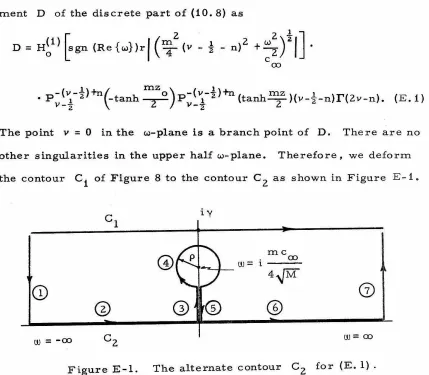
It is shown in Appendix E that we can translate the w-contour down
to the real axis in the discrete spectrum. The variable v is real
for real w, so the inverse transforms (9.17) and (10.1) give the final
result
oo+i"Y
S
-iwtp(r, z, t)
=
dw e F(w)-oo+ i "Y
oo
nivi-Yz
[
im -iwt -1 n 1
+s
S_:we
F(w)n=o~
H~
) sgn(w)rYz
• p-(!v!-Yz)+n (-tanh mzo)
v-Yz
2p-(!v!-
v-Yz
Yz)+n ( tanh~z
) (!v
1-t-n} •· r
(2I
v
1-
n} ( 10. 8}This expression represents the complete disturbance observed at any point (r, z} with the source located at (0, z0 }. We shall analyze certain aspects of this result.
When the source and receiver are both far above the channel it is apparent from Figure 6 that the surrounding speed is nearly uniform. Therefore, the corresponding solution will not differ significantly from a pure spherical wave.
The behavior of the solution in the vicinity of the channel is more complex. (The variation of sound speed throughout the actual oceans of the earth compares quite favorably with the central portion of the Epstein profile.} By performing a Watson transformation on the Hankel representation of p(r, z, t) ,
Blum and Cohen ( 8] obtained an expression for the case
z = z0 = 0 (source and receiver in the channel) asymptotically valid for r - oo. We can reduce expression (10.8) to theirs i f
we ignore the continuous spectrum , set z
=
z0=
0 , and replace the Hankel function by its asymptotic form for r - oo. It was found that the strongest signals arriving at a receiver in the channel arenot n clean-cut"- they have tails or wakes that tend to obscure
It is known [8] that the continuous spectrum in (10.8) is
0 (
~
) as r - oo. for all z, and that the discrete part iso(;.. )
for z=
z0=
0. When the source is in the channel(10.8) becomes
· <!vi -
t-
n)r (
2 lv 1-n) , r__.oo. (10. 9)From
[1],
p. 143, (6), we obtainfJ. _ 1 ( 1
+
X)Yz
fJ. • . •p
v
(x) -r
(1-1..1.) 1 -X z F 1( 1+v,
-
v'
1-1..1. 't -t
x) 'from which (10. 9) becomes, after interchanging summation and
integration,
00 00
p(r,z,t) ....
,i~
l S
e-iwt F(w)H~
1)[••••]P~~~~-l/z)+n(O)·
1
r<t
+
lv!-n> e 2•F(!+v,!-v;!+lvl-n; 1 )
_!!!, (
lvl-~-
n)zI
l+emz {10.10)
For mz << 1 , each of the integrals in the series is reduced by a factor
-
~ <!vi-~-
n)z (1-0{mz) ) •e Because of the exponential the
high-frequency components of F{w) will be drastically attenuated,
even at a small distance from the channel. The implication is that if
the forcing function f{t) at the source is a sharp pulse, the
dominant behavior just outside the channel will be a smooth rise and
long decay. Thus, long distance, high frequency communication is
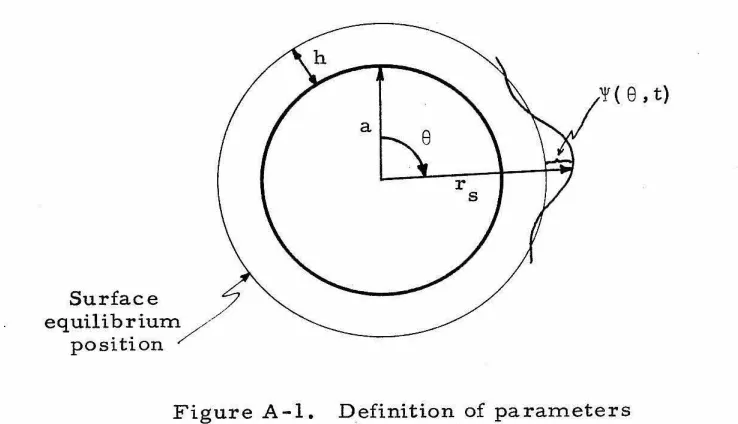
APPENDIX A
Derivation of the Equation for Waves on a Sphere
We shall derive the equation for the axisymmetric free-surface
water waves on a shallow ocean covering a solid sphere. For
in-viscid, incompressible, irrotational fluids the fundamental equations
are
Continuity:
\1·
u=O (A. 1)Momentum: "'i'\7'"t
au
or;+
u • \lu -=
-F - - \lp 1 p (A. 2)where u
=
urr+
uee+
u~cf> is the instantaneous velocity of a particleof fluid, F is the vector sum of external forces, p is the constant
density, and p is the local pressure. The symbol
\1
is the gradientoperator, and \lu is a dyadic appropriate to spherical coordinates.
In the simplest approximation we ignore the non-linear term
u • \lu. For axisymmetric waves there is no azimuth dependence and
a - o
aq;
= •
The spherical form of the continuity equation (A.1) is(A. 3)
which can be written as
(A. 4)
In the momentum equation we assume that the only external force is
gravity and that it is constant throughout the depth of the ocean. Then
and (A. 2) reduces to the pair of equations
au
ra t
=-g-p8r
1ap
1
ap
p;a-e
(A. 6)