Volume 2007, Article ID 45842,15pages doi:10.1155/2007/45842
Research Article
Combining Global and Local Information for
Knowledge-Assisted Image Analysis and Classification
G. Th. Papadopoulos,1, 2V. Mezaris,2I. Kompatsiaris,2and M. G. Strintzis1, 2
1Department of Electrical and Computer Engineering, Aristotle University of Thessaloniki, Thessaloniki 54006, Greece 2Centre for Research and Technology Hellas (CERTH), Informatics and Telematics Institute, Thermi 57001, Greece
Received 8 September 2006; Revised 23 February 2007; Accepted 2 April 2007
Recommended by Ebroul Izquierdo
A learning approach to knowledge-assisted image analysis and classification is proposed that combines global and local informa-tion with explicitly defined knowledge in the form of an ontology. The ontology specifies the domain of interest, its subdomains, the concepts related to each subdomain as well as contextual information. Support vector machines (SVMs) are employed in or-der to provide image classification to the ontology subdomains based on global image descriptions. In parallel, a segmentation algorithm is applied to segment the image into regions and SVMs are again employed, this time for performing an initial mapping between region low-level visual features and the concepts in the ontology. Then, adecision function, that receives as input the com-puted region-concept associations together with contextual information in the form of concept frequency of appearance, realizes image classification based on local information. A fusion mechanism subsequently combines the intermediate classification results, provided by the local- and global-level information processing, to decide on the final image classification. Once the image sub-domain is selected, final region-concept association is performed using again SVMs and a genetic algorithm (GA) for optimizing the mapping between the image regions and the selected subdomain concepts taking into account contextual information in the form of spatial relations. Application of the proposed approach to images of the selected domain results in their classification (i.e., their assignment to one of the defined subdomains) and the generation of a fine granularity semantic representation of them (i.e., a segmentation map with semantic concepts attached to each segment). Experiments with images from the personal collection domain, as well as comparative evaluation with other approaches of the literature, demonstrate the performance of the proposed approach.
Copyright © 2007 G. Th. Papadopoulos et al. This is an open access article distributed under the Creative Commons Attribution License, which permits unrestricted use, distribution, and reproduction in any medium, provided the original work is properly cited.
1. INTRODUCTION
Recent advances in both hardware and software technolo-gies have resulted in an enormous increase of the num-ber of images that are available in multimedia databases or over the internet. As a consequence, the need for techniques and tools supporting their effective and efficient manipula-tion has emerged. To this end, several approaches have been proposed in the literature regarding the tasks of indexing, searching, classification, and retrieval of images [1,2].
The very first attempts to address these issues concen-trated on visual similarity assessment via the definition of appropriate quantitative image descriptions, which could be automatically extracted, and suitable metrics in the result-ing feature space [1]. Whilst low-level descriptors and met-rics are fundamental building blocks of any image manipu-lation technique, they evidently fail to fully capture by them-selves the semantics of the visual medium. Achieving the
lat-ter is a prerequisite for reaching the desired level of efficiency in image manipulation tasks. To this end, research efforts have concentrated on the semantic analysis and classifica-tion of images, often combining the aforemenclassifica-tioned tech-niques witha prioridomain specific knowledge, so as to re-sult in a high-level representation of them [2]. Domain spe-cific knowledge, when utilized, guides low-level feature ex-traction, higher-level descriptor derivation, and symbolic in-ference.
Global image classification
Region-based image classification
Information fusion
Final image classification
Region reclassification
Final region-concept
association
Figure1: General system architecture.
based on an employed parametric mixture model (PMM), which is adopted from the corresponding multicategory text-classification task, and the exploitation of the image color histogram. In [6], classification of images is performed on the basis of maximum cross correlation estimations and re-trieval of images from an existing database against a given query image.
The aforementioned methods are based on global visual descriptions that are automatically extracted for every im-age. However, image manipulation based solely on global de-scriptors does not always lead to the best results [7]. Coming one step closer to treating images the way humans do, im-age analysis tasks (including classification) shifted to treat-ing images at a finer level of granularity, that is, at the re-gion or local level, taking advantage of image segmentation techniques. More specifically, in [8], an image classification method is proposed, which uses a set of computed multiple-level association rules based on the detected image objects. In [9], it is demonstrated through several applications how segmentation and object-based methods improve on pixel-based image analysis/classification methods, while in [10], a region-based binary tree representation incorporating with adaptive processing of data structures is proposed to address the problem of image classification.
Incorporating knowledge into classification techniques emerges as a promising approach for improving classifica-tion efficiency. Such an approach provides a coherent se-mantic domain model to support “visual” inference in the specified context [11,12]. In [13], a framework for learning intermediate-level visual descriptors of objects organized in an ontology is presented to support the detection of them. In [14], a priori knowledge representation models are used as a knowledge base that assists semantic-based classification and clustering. Moreover, in [15], semantic entities, in the con-text of the MPEG-7 standard, are used for knowledge assisted multimedia analysis and object detection, thus allowing for semantic level indexing.
In this paper, a learning approach to knowledge-assisted image analysis and classification is proposed that combines global and local information with explicitly defined knowl-edge in the form of an ontology. The ontology specifies the domain of interest, its subdomains, the concepts related to each subdomain as well as contextual information. SVMs are employed in order to provide image classification to the on-tology subdomains based on global image descriptions. In parallel, a segmentation algorithm is applied to segment the image into regions and SVMs are again employed, this time for performing an initial mapping between region low-level visual features and the concepts in the ontology. Then, a de-cision function, that receives as input the computed region to concepts associations together with contextual informa-tion in the form of frequency of appearance of each con-cept, realizes image classification based on local informa-tion. A fusion mechanism combines the intermediate clas-sification results, provided by the local- and global-level in-formation processing, and decides on the final classifica-tion. Once the image subdomain is selected, final region-concept association is performed using again SVMs and a genetic algorithm (GA) for optimizing the mapping between the image regions and the selected subdomain concepts tak-ing into account contextual information in the form of spa-tial relations. The values of the parameters used in the fi-nal image classification and fifi-nal region-concept associa-tion processes are computed according to a parameter op-timization procedure. The general architecture of the pro-posed system for semantic image analysis and classification is illustrated in Figure 1. Application of the proposed ap-proach to images of the selected domain results in their clas-sification (i.e., their assignment to one of the defined sub-domains) and the generation of a fine granularity seman-tic representation of them (i.e., a segmentation map with semantic concepts attached to each segment). Experiments with images from the personal collection domain, as well as comparative evaluation with other approaches of the lit-erature, demonstrate the performance of the proposed ap-proach.
As will be seen by the experimental evaluation of the pro-posed approach, the elegant combination of global and lo-cal information as well as contextual and ontology informa-tion leads to improved image classificainforma-tion performance, as compared to classification based solely on either global or lo-cal information. Furthermore, this image to subdomain as-sociation is used to further improve the accuracy of region to concept association, as compared to region-concept asso-ciation performed without using knowledge about the for-mer.
2. SYSTEM OVERVIEW
The first step in the development of the proposed knowledge-assisted image analysis and classification architecture is the definition of an appropriate knowledge infrastructure. This is defined in the form of an ontology suitable for describing the semantics of the selected domain. The proposed ontology comprises of a set of subdomains, to which images of the do-main can be classified, and a set of concepts, each associated with at least one of the aforementioned subdomains. The lat-ter represent objects of inlat-terest that may be depicted in the images. In addition to the above, the proposed ontology also defines contextual information in the form of the frequency of appearance of each concept in the images of each sub-domain, as well as in the form of spatial relations between the defined concepts. The defined ontology is discussed in Section 4and the subdomains and concepts it includes are shown inFigure 4.
At the signal level, low-level global image descriptors are extracted for every image and form animage feature vector. This is utilized for performing image classification to one of the defined subdomains based on global-level descriptions. More specifically, the computed vector is supplied as input to a set of SVMs, each trained to detect images that belong to a certain subdomain. Every SVM returns a numerical value which denotes the degree of confidence to which the corre-sponding image is assigned to the subdomain associated with the particular SVM; the maximum of the degrees of confi-dence over all subdomains indicates the image classification using global-level information.
In parallel to this process, a segmentation algorithm is applied to the image in order to divide it into regions, which are likely to represent meaningful semantic objects. Then, for every resulting segment, low-level descriptions and spa-tial relations are estimated, the latter according to the rela-tions supported by the ontology. The estimated low-level de-scriptions for each region are employed for generating initial hypotheses regarding the region’s association to an ontology concept. This is realized by evaluating the respective low-level
region feature vectorand using a second set of SVMs, where each SVM is trained to identify instances of a single concept defined in the ontology. SVMs were selected for the afore-mentioned tasks due to their reported generalization abil-ity and their efficiency in solving high-dimensionality pat-tern recognition problems [16,17]. Subsequently, adecision function, that receives as input the computed region to con-cept association hypothesis sets together with the ontology-provided contextual information in the form of frequency of concept appearance, realizes image classification based on local-level information. The domain ontology drives this process by controlling which concepts are associated with a specific subdomain.
The computed hypothesis sets for the image-subdomain association based on both global- and local-level informa-tion are subsequently introduced to a fusion mechanism, which combines the supplied intermediate global- and local-based classification information and decides on the final im-age classification. Fusion is introduced since, depending on
the nature of the examined subdomain, global-level descrip-tions may represent more efficiently the semantics of the im-age or local-level information may be advantim-ageous. Thus, the fusion mechanism is used for adjusting the weight of the global features against the local ones for every individual sub-domain to reach a final image classification decision.
After the image subdomain is selected, generation of re-fined region-concept association hypotheses is performed. The procedure is similar to the one described at the previous stage, the difference being that at this stage only the SVMs that correspond to concepts of the estimated subdomain are employed and thus subdomain-specific hypothesis sets are computed. The refined hypothesis sets for every image region along with the spatial relations computed for each region, are subsequently employed for estimating a globally optimal region-concept assignment by introducing them to a genetic algorithm. The GA is employed in order to decide upon the most plausible image interpretation and compute the final region semantic annotation. The choice of a GA for these tasks is based on its extensive use in a wide variety of global optimization problems [18], where they have been shown to outperform other traditional methods, and is further en-dorsed by the authors’ previous experience [19,20], which showed promising results. The values of the proposed sys-tem parameters used in the aforementioned final image clas-sification and final region-concept association processes are computed according to a parameter optimization procedure. The detailed architecture of the proposed system for seman-tic image analysis and classification is illustrated inFigure 2. Regarding the tasks of SVMs training, computation of the required contextual information, parameter optimiza-tion and evaluaoptimiza-tion of the proposed system performance, a number of image sets needs to be formed. More specif-ically, a collection of images, B, belonging to the domain of interest was assembled. Each image in this collection was manually annotated (i.e., assigned to a subdomain and, af-ter segmentation is applied, each of the resulting image re-gions associated with a concept in the ontology). The collec-tion was initially divided into two sets:Btr, which is made of approximately 30% of the images ofB, andBte, which com-prises the remaining 70%.Btris used for training the SVMs framework and computing the required contextual informa-tion. On the other hand,Bteis used for evaluating the pro-posed system performance. For the case of the parameter op-timization procedure,Btris equally divided into two subsets, namelyB2
trandBv2.Btr2is again used for training the SVMs framework and computing the required contextual informa-tion, whileB2
v serves in estimating the optimal values of the aforementioned parameters. The usage and the notation of all image sets utilized in this work are illustrated inTable 1. The main symbols used in the remainder of the manuscript are outlined inTable 2.
3. LOW-LEVEL VISUAL INFORMATION PROCESSING
3.1. Global features extraction
Multimedia content
Segmentation
Knowledge infrastructure
Domain ontology
Global-level descriptors
Global classification
Global-features Based classification Region-level
descriptors
Region-based classification
Local-features Based classification Contextual information
(Frequency of concept appearance)
Information fusion
Parameter optimization Region-level
descriptors
Hypothesis refinement Subdomain-specific
hypothesis sets
Final image classification Contextual information
(Fuzzy spatial relations)
Spatial context utilization
Final region-concept association
Parameter optimization
Figure2: Detailed system architecture.
Table1: Table of training and test sets.
B Entire image set used for training and evaluation.
Btr Subset ofcontextual information. Subdivided toB, used for training the SVMs and computingB2 trandBv2.
Bte Subset ofB, used for evaluation.
B2
tr
Subset ofBtr, used for training the SVMs and computing contextual information during the parameter
optimization procedure.
B2
v
Subset ofBtr, used for estimating the parameter values during parameter optimization.
appropriate low-level descriptions are extracted at the image level for every examined image and form animage feature vector. The image feature vector employed in this work com-prises of three different descriptors of the MPEG-7 standard, namely theScalable Color,Homogeneous Texture, and Edge Histogramdescriptors. Their extraction is performed accord-ing to the guidelines provided by the MPEG-7 experimenta-tion model (XM) [21]. Following their extraction, the image feature vector is produced by stacking all extracted MPEG-7 descriptors in a single vector. This vector constitutes the in-put to the SVMs structure which realizes the global image classification, as described inSection 5.1.
3.2. Segmentation and local features extraction
In order to implement the initial hypothesis generation pro-cedure, the examined image has to be segmented into regions and suitable low-level descriptions have to be extracted for every resulting segment. In the current implementation, an
N NW
dx/4
NE
d y
W E
d y/4
SW
dx S
SE y
x
Figure3: Fuzzy directional relations definition.
extension of the recursive shortest spanning tree (RSST) al-gorithm has been used for segmenting the image [22]. Out-put of this segmentation algorithm is a segmentation maskS,
S= {si, i=1,. . .,N}, wheresi,i=1,. . .,N, are the created spatial regions.
For every generated image segment, the following MPEG-7 descriptors are extracted, according to the guide-lines provided by the MPEG-7 experimentation model (XM) [21]:Scalable Color,Homogeneous Texture,Region Shape, and
Table2: Legend of main symbols.
Symbol Description
si,S= {si, i=1,. . .,N} Image regions after segmentation, set of regions for an image
cj,C= {cj, j=1,. . .,J} Concept defined in the ontology, the set of all concepts
Dl,l=1,. . .,L Subdomains defined in the ontology
rk,R= {rk,k=1,. . .,K} Spatial relation, set of all spatial relations defined in the ontology
HD= {hD
l,l=1,. . .,L} Hypothesis set for global image classification
HC
i = {hCi j, j=1,. . .,J} Hypothesis set for region-concept association, for regionsi
g(Dl) Result of local-based image classification for subdomainDl
G(Dl) Result of final image classification for subdomainDl
freq(cj,Dl) Frequency of appearance of conceptcjwith respect to subdomainDl
gi j Assignment of conceptcjto regionsi
IM(gi j) Degree of confidence, based on visual similarity, forgi jassignment
Q Genetic algorithm’s chromosome
f(Q) Genetic algorithm’s fitness function area(si) Area of regionsi
v Region compactness value
Irk(si,sj) Degree to which relationrkis satisfied for the (si,sj) pair of regions
IS(gi j,gpq) Degree to which the spatial constraint between thegi j,gpqconcept to region mappings is satisfied
3.3. Fuzzy spatial relations extraction
Exploiting domain-specific spatial knowledge in image anal-ysis constitutes an elegant way for removing ambiguities in region-concept associations. More specifically, it is generally observed that objects tend to be present in a scene within a particular spatial context and thus spatial information can substantially assist in discriminating between concepts ex-hibiting similar visual characteristics. Among the most com-monly adopted spatial relations, directional ones have re-ceived particular interest. They are used to denote the or-der of objects in space. In the present analysis framework, eight fuzzy directional relations are supported, namelyNorth
(N),East (E),South(S),West(W),South-East(SE), South-West (SW),North-East(NE), andNorth-West (NW). These relations are utilized for computing part of the contextual in-formation stored in the ontology, as described in detail in Section 4, and further used for the final region-concept asso-ciation ofSection 6.
Fuzzy directional relations extraction in the proposed analysis approach builds on the principles of projection-and angle-based methodologies [23,24] and consists of the following steps. First, a reduced boxis computed from the
groundregion’s (the region used as reference and is painted in dark grey inFigure 3) minimum bounding rectangle (MBR), so as to include the region in a more representative way. The computation of thisreduced boxis performed in terms of the MBR compactness valuev, which is defined as the fraction of the region’s area to the area of the respective MBR: if the initially computedvis below a thresholdT, the ground re-gion’s MBR is reduced repeatedly until the desired threshold is satisfied. Then, eight cone-shaped regions are formed on top of this reduced box, as illustrated inFigure 3, each cor-responding to one of the defined directional relations. The
percentage of thefigureregion (whose relative position is to be estimated and is painted in light grey inFigure 3) points that are included in each of the cone-shaped regions deter-mines the degree to which the corresponding directional re-lation is satisfied. After extensive experimentations, the value of thresholdTwas set equal to 0.85.
4. KNOWLEDGE INFRASTRUCTURE
Personal collection
images
Subdomains
Concepts
Buildings Forest Rockyside Seaside Roadside Sports
Building Roof
Tree Stone
Grass
Ground
Dried-plant Trunk
Vegetation Rock Sky Person
Road Road-line
Car
Boat Sand Sea Wave
Court Court-line
Net Board Gradin
Figure4: Subdomains and concepts of the ontology developed for the personal collection domain.
this work are presented inFigure 4, where can be seen that the developed ontology includes 6 subdomains and 24 indi-vidual concepts. It must be noted that the employed ontology can easily be extended so as to include additional concepts and subdomains, as well as any additional information that could be used for the analysis.
The values of the spatial relations (spatial-related contex-tual information) between the concepts for every particular subdomain, as opposed to the concepts themselves that are manually defined, are estimated according to the following ontology population procedure.
LetR,
R=rk, k=1,. . .,K
= {N, NW, NE, S, SW, SE, W, E}, (1)
denote the set of the supported spatial relations. Then, the degree to which regionsisatisfies relationrkwith respect to regionsjcan be denoted asIrk(si,sj). The values of function
Irk, for a specific couple of regions, are estimated according to
the procedure ofSection 3.3and belong to [0, 1]. To populate the ontology, this function needs to be evaluated over a set of segmented images with ground truth classification and an-notations, that serves as a training set. For that purpose, the subsetBtris employed as discussed inSection 2. Then, using this training set the ontology population procedure is per-formed by estimating the mean values,Irkmean, ofIrkfor every
kover all pairs of regions assigned to concepts (ci,cj),i= j, and storing them in the ontology. These constitute the con-straints input to the optimization problem which is solved by the genetic algorithm, as will be described inSection 6.
Regarding the contextual information in the form of fre-quency of appearance, the reported frefre-quency of each con-ceptcjwith respect to the subdomainDl, freq(cj,Dl), is de-fined as the fraction of the number of appearances of con-ceptcjin images of the training set that belong to subdomain
Dlto the total number of the images of the afore-mentioned training set that belong to subdomainDl.
5. IMAGE CLASSIFICATION AND INITIAL REGION-CONCEPT ASSOCIATION
5.1. Image classification using global features
In order to perform the classification of the examined im-ages to one of the subdomains defined in the ontology using global image descriptions, a compound image feature vec-tor is initially formed, as described inSection 3.1. Then, an SVMs structure is utilized to compute the class to which ev-ery image belongs. This comprisesLSVMs, one for every de-fined subdomainDl, each trained under the “one-against-all” approach. For the purpose of training the SVMs, the subdo-main membership of the images belonging to the training set
Btr, assembled inSection 2, is employed. The image feature vector discussed inSection 3.1constitutes the input to each SVM, which at the evaluation stage returns for every image of unknown subdomain membership a numerical value in the range [0, 1]. This value denotes the degree of confidence to which the corresponding image is assigned to the subdomain associated with the particular SVM. The metric adopted is defined as follows: for every input feature vector the distance
zl from the corresponding SVM’s separating hyperplane is initially calculated. This distance is positive in case of correct classification and negative otherwise. Then, a sigmoid func-tion [26] is employed to compute the respective degree of confidence,hDl , as follows:
hD l =
1
1 +e−t·zl, (2)
where the slope parametertis experimentally set. For each image, the maximum of theLcalculated degrees of member-ship indicates its classification based on global-level features, whereas all degrees of confidence,hD
l, constitute its subdo-main hypotheses set HD, whereHD = {hD
5.2. Image classification using local features and initial region-concept association
As already described inSection 2, the SVMs structure used in the previous section for global image classification is also utilized to compute an initial region-concept association for every image segment. Similarly to the global case, at this finer level of granularity an individual SVM is introduced for every conceptcj of the employed ontology, in order to detect the corresponding association. Each SVM is again trained under the “one-against-all” approach. For that purpose, the train-ing set Btr, assembled in Section 2, is again employed and theregion feature vector, as defined inSection 3.2, constitutes the input to each SVM. For the purpose of initial region-concept association, every SVM again returns a numerical value in the range [0, 1], which in this case denotes the degree of confidence to which the corresponding region is assigned to the concept associated with the particular SVM. The met-ric adopted for expressing the aforementioned degree of con-fidence is similar to the one adopted for the global image classification case, defined in the previous section. Specifi-cally, lethC
i j =IM(gi j) denote the degree to which the visual descriptors extracted for regionsimatch the ones of concept
cj, wheregi j represents the particular assignment ofcj tosi. Then,IM(gi j) is defined as
IM
gi j
= 1
1 +e−t·zi j, (3)
wherezi jis the distance from the corresponding SVM’s sepa-rating hyperplane for the input feature vector used for evalu-ating thegi jassignment. The pairs of all supported concepts and their respective degree of confidencehC
i j computed for segmentsicomprise the region’s concept hypothesis setHiC, whereHiC= {hCi j, j=1,. . .,J}.
The estimated concept hypotheses sets,HiC, generated for every image regionsi, can provide valuable cues for perform-ing image classification based on local-level information. To this end, a decision function for estimating the subdomain membership of the examined image on the basis of the ccept hypotheses sets of its constituent regions and the on-tology provided contextual information in the form of fre-quency of concept appearance (i.e., effecting image classifica-tion based on local-level informaclassifica-tion) is defined as follows:
gDl
=
si, wherecj∈Dl
IM
gi j
·Esi,cj,al,Dl
Esi,cj,al,Dl
=al·freq
cj,Dl
+1−al
·areasi
, (4)
where freq(cj,Dl) is the concept frequency of appearance de-fined in Section 4and area(si) is the percentage of the to-tal image area captured by regionsi. Parametersal, where
al[0, 1], are introduced for adjusting the importance of the aforementioned frequencies against the regions’ areas for ev-ery supported subdomain. Their values are estimated accord-ing to the parameter optimization procedure described in Section 7.1. As can be seen in (4), the constructed domain ontology drives the estimation of the respective subdomain membership of the image by controlling which concepts are
associated with a specific subdomain and thus can contribute to the summation of (4). The latter is essentially a weighted summation of region-concept association degrees of confi-dence, the weights being controlled by both contextual infor-mation (concept frequency of appearance) as well as region visual importance, here approximated by the relative region area.
5.3. Information fusion for image classification
After image classification has been performed using solely global and solely local information, respectively, a fusion mechanism is employed for deciding upon the final image classification. Fusion is introduced since, depending on the nature of the examined subdomain, global-level descriptions may represent more efficiently the semantics of the image or local-level information may be advantageous. Thus, adjust-ing the weights of both image classification results leads to more accurate final classification decisions. More specifically, the computed hypothesis sets for the image-subdomain as-sociation based on both global-(hDl) and local-(g(Dl)) level information are introduced to a mechanism which has the form of a weighted summation, based on the following equa-tion:
GDl
=μl·g
Dl
+1−μl
·hDl , (5)
whereμl,l = 1,. . .,Landμl[0, 1], are subdomain-specific normalization parameters, which adjust the magnitude of the global features against the local ones upon the final out-come and their values are estimated according to the proce-dure described inSection 7.1. The subdomain with the high-estG(Dl) value constitutes the final image classification deci-sion.
6. FINAL REGION-CONCEPT ASSOCIATION
6.1. Hypotheses refinement and fuzzy spatial constraints verification factor
After the final image classification decision is made, a re-fined region-concept association procedure is performed. This procedure is similar to the one described inSection 5.2, the difference being that only the SVMs that correspond to concepts associated with the estimated subdomain are em-ployed at this stage and thus subdomain-specific concept hy-pothesis sets are computed for every image segment. Sub-sequently, a genetic algorithm is introduced to decide on the optimal image interpretation, as outlined in Section 2. The GA is employed to solve a global optimization prob-lem, while exploiting the available subdomain-specific spa-tial knowledge, thus overcoming the inherent visual infor-mation ambiguity. Spatial knowledge is obtained for every subdomain as described inSection 4and the resulting learnt fuzzy spatial relations serve as constraints denoting the “al-lowed” subdomain concepts spatial topology.
receive values in the interval [0, 1], where “1” denotes an al-lowable relation and “0” denotes an unacceptable one, based on the learnt spatial constraints. To calculate this value the following procedure is used: let Irk(si,sp) denote the
de-grees to which each spatial relation is verified for a certain pair of regionssi,sp of the examined image (as defined in Section 4) andcj,cqdenote the subdomain defined concepts assigned to them, respectively. A normalized Euclidean dis-tanced(gi j,gpq) is calculated, with respect to the correspond-ing spatial constraint, as introduced inSection 4, based on the following equation:
dgi j,gpq
=
8
k=1
Irkmean
cj,cq
−Irk
si,sp
2
√
8 , (6)
which receives values in the interval [0, 1]. The function
IS(gi j,gpq) is then defined as
IS
gi j,gpq
=1−dgi j,gpq
(7)
and takes values in the interval [0, 1] as well.
6.2. Implementation of genetic algorithm
As already described, the employed genetic algorithm uses as input the refined hypotheses sets (i.e., the subdomain-specific hypothesis sets), which are generated by the same SVMs structure as the initial hypotheses sets, the fuzzy spa-tial relations extracted between the examined image regions, and the spatial-related subdomain-specific contextual infor-mation as produced by the particular training process. Under the proposed approach, each chromosome represents a pos-sible solution. Consequently, the number of the genes com-prising each chromosome equals the numberN of the re-gionssi produced by the segmentation algorithm and each gene assigns a defined subdomain concept to an image seg-ment.
A population of 200 randomly generated chromosomes is employed. An appropriatefitness functionis introduced to provide a quantitative measure of each solution fitness for the estimated subdomain, that is, to determine the degree to which each interpretation is plausible:
f(Q)=λl·FSnorm+
1−λl
·SCnorm, (8)
where Q denotes a particular chromosome, FSnorm refers to the degree of low-level descriptors matching, andSCnorm stands for the degree of consistency with respect to the pro-vided spatial subdomain-specific knowledge. The set of vari-ablesλl,l=1,. . .,L, andλl[0, 1], are introduced to adjust the degree to which visual feature matching and spatial re-lation consistency should affect the final outcome for every particular subdomain. Their values are estimated according to an optimization procedure, as described inSection 7.2.
The values ofSCnormandFSnormare computed as follows:
FSnorm=
N
i=1IM
gi j
−Imin
Imax−Imin
, (9)
whereImin =
N
i=1minjIm(gi j) is the sum of the minimum degrees of confidence assigned to each region hypotheses set andImax =
N
i=1maxjIm(gi j) is the sum of the maximum degrees of confidence values, respectively,
SCnorm=
W
l=1ISl
gi j,gpq
W , (10)
whereW denotes the number of the constraints that had to be examined.
After the population initialization, new generations are iteratively produced until the optimal solution is reached. Each generation results from the current one through the ap-plication of the following operators:
(i) selection: a pair of chromosomes from the current generation are selected to serve as parents for the next generation. In the proposed framework, the tourna-ment selection operator [28] with replacement is used; (ii) crossover: two selected chromosomes serve as parents for the computation of two new offsprings. Uniform crossover with probability of 0.7 is used;
(iii) mutation: every gene of the processed offspring chro-mosome is likely to be mutated with probability of 0.008. If mutation occurs for a particular gene, then its corresponding value is modified, while updating the respective degree of confidence to the one of the new concept that is associated to it.
To ensure that chromosomes with high fitness will con-tribute to the next generation, the overlapping populations approach was adopted. More specifically, assuming a popu-lation ofmchromosomes,mschromosomes are selected ac-cording to the employed selection method, and by applica-tion of the crossover and mutaapplica-tion operators,msnew chro-mosomes are produced. Upon the resultingm+ms chromo-somes, the selection operator is applied once again in order to select themchromosomes that will comprise the new gen-eration. After experimentation, it was shown that choosing
ms=0.4 m resulted in higher performance and faster conver-gence. The above iterative procedure continues until the di-versity of the current generation is equal to/less than 0.001 or the number of generations exceeds 50. The above GA-based final region-concept association procedure was realized us-ing the GA software libraries of [29].
7. PARAMETER OPTIMIZATION
previously introduced for final region-concept association (Section 6.2). For the purpose of parameter value optimiza-tion, the chromosomes and the respective fitness function are defined accordingly.
Subject to the problem of concern is the computation of the values of
(i) parametersal andμl that lead to the highest correct image classification rate,
(ii) parametersλlthat lead to the highest correct concept association rate.
For that purpose,Classification Accuracy,CiA, is used as a quantitative performance measure and is defined as the frac-tion of the number of the correctly classified images to the to-tal number of images to be classified, for the first case. More-over,Concept Accuracy,CoA, which is defined as the fraction of the number of the correctly assigned concepts to the total number of image regions to be examined, is used for the sec-ond case. Then, for each problem the GA’s chromosome,Q, is suitably formed, so as to represent a corresponding pos-sible solution, and is further provided with an appropriate fitness function, f(Q), for estimating each solution fitness, as described in the sequel.
7.1. Optimization of image classification parameters
For the case of optimizing parametersalandμl, each chro-mosomeQrepresents a possible solution, that is, a candidate set of values for the parameters. In the current implementa-tion, the number of genes of each chromosome is set equal to 2·l·2=4·l. The genes represent the decimal coded values of parametersalandμlassigned to the respective chromosome, according to the following equation:
Q= q1 q2 · · · q4·l
= μ1
1 μ21 · · · μ1l μ2l a11 a21 · · · a1l a2l
, (11)
whereqi{0, 1,. . ., 9}represents the value of gene iandμt l,
atl represent thetth decimal digits of parametersμl,al, re-spectively. Furthermore, the genetic algorithm is provided with an appropriatefitness function, which is used for eval-uating the suitability of each solution. In this case, the fit-ness function is defined as equal to theCiAmetric already defined, whereCiAis calculated over all images that com-prise the validation setB2
v, after applying the fusion mecha-nism (Section 5.3) using for parametersalandμlthe values denoted by the genes of chromosomeQ.
Regarding the GA’s implementation details, an initial population of 100 randomly generated chromosomes is em-ployed. New generations are successively produced based on the same evolution mechanism as described inSection 6.2. The differences are that the maximum number of genera-tions is set equal to 30 and the probabilities of mutation and crossover are set equal to 0.4 and 0.2, respectively. The diver-gence in the value of the probability of the mutation operator denotes its increased importance in this particular optimiza-tion problem. The final outcome of this optimizaoptimiza-tion
proce-dure are the optimal values of parametersalandμl, used in (4) and (5).
7.2. Optimization of region-concept association parameters
For the case of optimizing parametersλl, the methodology described in this section is followed for every individual sub-domain defined in the ontology. More specifically, under the proposed approach, each chromosomeQrepresents a pos-sible solution, that is, a candidateλl value. The number of genes of each chromosome is set equal to 5. The genes rep-resent the binary coded value of parameterλlassigned to the respective chromosome, according to the following equation:
Q= q1 q2 · · · q5
where 5
i=1
qi·2−i=λl, (12)
where qi{0, 1} represents the value of gene i. The corre-sponding fitness function is defined as equal to theCoA met-ric already defined, whereCoAis calculated over all images that belong to the Dl subdomain and are included in the validation set B2
v, after applying the genetic algorithm of Section 6.2withλl=
5
i=1qi·2−i. Regarding the GA’s imple-mentation details, these are identical to the ones discussed in Section 7.1.
8. EXPERIMENTAL RESULTS
In this section, experimental results of the application of the proposed approach to images belonging to the personal collection domain, as well as comparative evaluation results with other approaches of the literature, are presented. The first step to the experimental evaluation was the develop-ment of an appropriate ontology in order to represent the selected domain, that is, the personal image collection do-main, defining its subdomains, the concepts of interest asso-ciated with every subdomain and the supported contextual information. The developed ontology was described in detail inSection 4and the subdomains and concepts of it can be seen inFigure 4.
Input image
Global image classification
Buildings: 0.44 Buildings:0.62 Buildings: 0.22 Buildings: 0.21 Rockyside:0.58 Rockyside: 0.33 Rockyside: 0.29 Rockyside: 0.34 Forest: 0.56 Forest: 0.32 Forest:0.84 Forest:0.54
Seaside: 0.30 Seaside: 0.21 Seaside: 0.31 Seaside: 0.12 Roadside: 0.51 Roadside: 0.27 Roadside: 0.27 Roadside: 0.37 Sports: 0.22 Sports: 0.14 Sports: 0.05 Sports: 0.11
Local (i.e., region-based) image classification
Buildings:0.64 Buildings: 0.23 Buildings: 0.32 Buildings: 0.24 Rockyside: 0.32 Rockyside: 0.29 Rockyside: 0.29 Rockyside: 0.28 Forest: 0.24 Forest: 0.12 Forest: 0.31 Forest: 0.33 Seaside: 0.18 Seaside: 0.14 Seaside:0.39 Seaside: 0.27 Roadside: 0.34 Roadside:0.34 Roadside: 0.24 Roadside:0.39
Sports: 0.21 Sports: 0.11 Sports: 0.18 Sports: 0.11 Final image classification
using information fusion Buildings Roadside Forest Forest
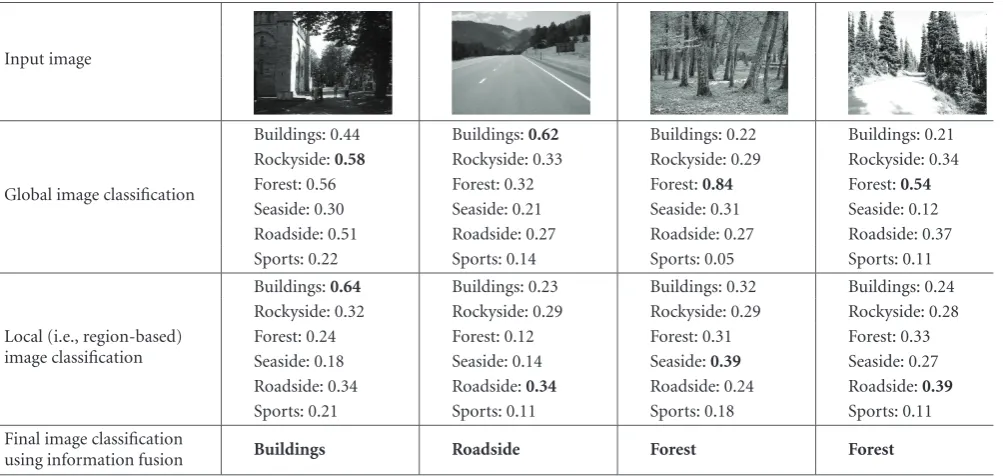
Figure5: Indicative image-subdomain association results.
developed ontology concepts are compatible with concepts that are defined by a large number of users, which renders the whole evaluation framework more realistic.
Following the creation of the image sets, image setBtr was utilized for SVMs training. The training procedure for both the global image classification and the region-concept association cases was performed as described in Sections5.1 and5.2. The Gaussian radial basis function was used as a ker-nel function by each SVM, to allow for nonlinear discrimi-nation of the samples. The low-levelimage feature vector, as described in detail inSection 3.1, is composed of 398 values, while the low-levelregion feature vector is composed of 433 values, calculated as described inSection 3.2. The values of both vectors are normalized in the interval [−1, 1]. On the other hand, for the acquisition of the required contextual in-formation, the procedure described inSection 4was followed for every subdomain.
Based on the trained SVMs structure, global image classi-fication is performed as described inSection 5.1. Then, after the segmentation algorithm is applied and initial hypotheses are generated for every resulting image segment, the decision function is introduced that realizes image classification based on local-level as well as contextual information in the form of concept frequency of appearance, as outlined inSection 5.2. Afterwards, the fusion mechanism is employed which im-plements the fusion of the intermediate classification results based solely on global- and solely on local-level information and computes the final image classification (Section 5.3). In Figures5and6indicative classification results are presented, showing the input image, the image classification effected using only global (row 2) and only local (row 3) informa-tion, as indicated by the maximum of thehDl and ofg(Dl),
l=1,. . .,L, respectively, and the final classification after the
evaluation of the fusion mechanism,G(Dl). It can be seen in these figures that the final classification result, produced by the fusion mechanism, may differ from the one that is im-plied by the overall maximum ofhDl andg(Dl) (e.g., second image ofFigure 5).
InTable 3, quantitative performance measures of the im-age classification algorithms are given in terms of accuracy for each subdomain and overall. Accuracy is defined as the percentage of the images, belonging to a particular subdo-main, that are correctly classified. The results presented in Table 3show that the global classification method generally leads to better results than the local one. For the image clas-sification based on local information, (4) is used to com-bine region-concept associations and contextual information in an ontology-driven manner as discussed inSection 5.2. It must be noted that the performance of both algorithms is subdomain dependent, that is, some subdomains are more suitable for classification based on global features (e.g., Rock-ysideandForest), whereas for other subdomains the applica-tion of a region-based image classificaapplica-tion approach is ad-vantageous. For example, in the Rockyside subdomain the presented color distribution and texture characteristics are very similar among the corresponding images. Thus, image classification based on global features performs better than the local-level case. On the other hand, for subdomains like
Input image
Global image classification
Buildings: 0.31 Buildings: 0.17 Buildings: 0.38 Buildings: 0.12 Rockyside:0.84 Rockyside: 0.32 Rockyside: 0.18 Rockyside: 0.21 Forest: 0.41 Forest:0.56 Forest:0.61 Forest: 0.25 Seaside: 0.37 Seaside: 0.45 Seaside: 0.22 Seaside: 0.28 Roadside: 0.21 Roadside: 0.31 Roadside: 0.17 Roadside: 0.21 Sports: 0.19 Sports: 0.22 Sports: 0.12 Sports:0.91
local (i.e., region-based) image classification
Buildings: 0.21 Buildings: 0.22 Buildings:0.81 Buildings: 0.14 Rockyside: 0.19 Rockyside: 0.19 Rockyside: 0.19 Rockyside: 0.12 Forest:0.22 Forest: 0.27 Forest: 0.29 Forest: 0.12 Seaside: 0.17 Seaside:0.52 Seaside: 0.24 Seaside: 0.21 Roadside: 0.12 Roadside: 0.19 Roadside: 0.12 Roadside: 0.11 Sports: 0.09 Sports: 0.17 Sports: 0.09 Sports:0.37
Final image classification
using information fusion Rockyside Seaside Building Sports
Figure6: Indicative image-subdomain association results.
Table3: Subdomain detection accuracy.
Accuracy
Method Buildings Rockyside Forest Seaside Roadside Sports Overall Global image classification 38.00% 68.63% 76.67% 85.71% 68.42% 92.00% 71.91% Local (i.e., region-based) image classification 78.00% 50.98% 35.00% 60.71% 47.01% 94.00% 58.77% Final image classification using information fusion 84.00% 72.55% 70.00% 85.71% 68.15% 95.00% 78.70%
SVM classifier proposed in [31] 56.00% 72.05% 73.33% 82.14% 63.15% 98.50% 74.07% K-NN classifier proposed in [32] 62.00% 58.83% 81.67% 73.21% 42.85% 97.50% 69.13%
performance of the proposed approach is compared with the algorithms presented in [31], where an SVM-based multi-class multi-classifier is used for image multi-classification based on global features, and in [32], where a K-NN classifier combined with an appropriately trained feed-forward neural network real-izes image categorization based on global-level descriptions. It can be easily observed that the proposed approach outper-forms the aforementioned algorithms in most subdomains as well as in overall classification accuracy.
Using the final image classification decision, a concept hypothesis refinement procedure is performed (Section 6.1). The results are then passed to a genetic algorithm along with the subdomain-specific contextual knowledge in the form of spatial relations, in order to determine the globally op-timal image interpretation (Section 6.2). In Figures7and8 representative concept detection results are illustrated show-ing the original image, the annotation resultshow-ing from the initial hypotheses set, considering for each image segment
si the hypothesis with the highest degree of confidencehCi j,
j=1,. . .,J, and the final interpretation after the subdomain specification and the exploitation of the provided spatial related information. InTable 4, performance measures are
Sky
Vegetation
Vegetation
Vegetation Vegetation Building
Sand
Sky
Vegetation
Building
Building Vegetation Building
Grass
Sky
Vegetation Building
Roof
Ground
Sky Trunk
Vegetation
Sky
Vegetation Building
Building
Building
Sky Building
Vegetation
Wave
Rock
Building
Sky
Rock
Rock
Input image
Tree
Person Person
Rock
Ground Grass
Initial region-concept association
Tree
Person Person
Vegetation
Ground Vegetation
Final region-concept association Figure7: Indicative region-concept association results.
a genetic algorithm to reach an optimal image interpretation given degrees of confidence for visual similarity and spatial consistency against the domain definitions. The values of the parameters used in the final image classification and region-concept association process are computed according to the parameter optimization procedure described inSection 7.
Regarding the computational complexity of the proposed system, the times along the sequential steps of the algorithm for a 600×800 pixels image are illustrated in Table 5. For the experimental evaluation we used a Pentium IV PC with 3 GHz CPU and 1 GB RAM. It must be noted that during the global classification step, the time needed for global descrip-tions extraction was considered. Similarly, for the region-based classification case, the time needed for segmentation and region-level descriptions extraction was also taken into account.
9. CONCLUSIONS
Sky
Sea
Trunk
Grass
Sky
Sea
Vegetation
Vegetation
Sky Sky
Dried-plant
Dried-plant
Dried-plant Sand Tree
Stone
Sky Sky
Dried-plant
Ground
Dried-plant Dried-plant
Ground
Road
Sky
Wave
Vegetation
Tree Grass
Road
Sky
Sky
Vegetation
Vegetation Grass
Road
Input image
Roof
Person Road-line
Court
Roof
Initial region-concept association
Court
Person Court-line
Court
Court
Final region-concept association Figure8: Indicative region-concept association results.
Table4: Concept detection accuracy.
Accuracy
Algorithm stage Buildings Rockyside Forest Seaside Roadside Sports Overall Initial region-concept association 48.55% 47.45% 47.66% 63.33% 50.18% 74.55% 55.05% Refined region-concept association 50.92% 49.68% 51.46% 65.19% 50.18% 79.04% 57.60% Final region-concept association 50.39% 50.00% 52.33% 67.77% 54.44% 76.94% 58.33%
Table5: Processing time for 800×600 pixels image.
Global classification Region-based classification Information fusion Final region-concept association
on either global or local information. Furthermore, this im-age to subdomain association is used to further improve the accuracy of region to concept association, as compared to re-gion to concept association performed without using knowl-edge about the former. The proposed framework is not re-stricted to the domain used in this work for evaluation pur-poses, but can easily be extended by including additional sub-domains and concepts, providing that the employed knowl-edge representation is appropriately extended so as to ac-count for these additional subdomains and concepts, and that the employed training set is enriched with suitable train-ing samples.
ACKNOWLEDGMENT
This work was supported by the European Commission un-der contracts FP6-001765 aceMedia, FP6-027685 MESH, and FP6-027026 K-Space, and by the GSRT under project DEL-TIO.
REFERENCES
[1] A. W. M. Smeulders, M. Worring, S. Santini, A. Gupta, and R. Jain, “Content-based image retrieval at the end of the early years,”IEEE Transactions on Pattern Analysis and Machine In-telligence, vol. 22, no. 12, pp. 1349–1380, 2000.
[2] S. Bloehdorn, K. Petridis, C. Saathoff, et al., “Semantic annota-tion of images and videos for multimedia analysis,” in Proceed-ings of the 2nd European Semantic Web Conference (ESWC ’05), pp. 592–607, Herakleion, Greece, May-June 2005.
[3] A. Barla, F. Odone, and A. Verri, “Old fashioned state-of-the-art image classification,” inProceedings of the 12th Interna-tional Conference on Image Analysis and Processing (ICIAP ’03), pp. 566–571, Mantova, Italy, September 2003.
[4] J. Tang, C.-Y. Zhang, and B. Luo, “A graph and PNN-based ap-proach to image classification,” inProceedings of International Conference on Machine Learning and Cybernetics (ICMLC ’05), vol. 8, pp. 5122–5126, Guangzhou, China, August 2005. [5] H. Tanaka, H. Sakano, and S. Ohtsuka, “Retrieval method for
multi-category images,” inProceedings of the 17th International Conference on Pattern Recognition (ICPR ’04), vol. 2, pp. 965– 968, Cambridge, UK, August 2004.
[6] I. Ahmad and M. T. Ibrahim, “Image classification and re-trieval using correlation,” inProccedings of the 3rd Canadian Conference on Computer and Robot Vision (CRV ’06), p. 60, Quebec City, Canada, June 2006.
[7] S. Papadopoulos, V. Mezaris, I. Kompatsiaris, and M. G. Strintzis, “A region-based approach to conceptual image clas-sification,” inProceedings of IEE International Conference on Visual Information Engineering (VIE ’05), pp. 141–147, Glas-gow, UK, April 2005.
[8] V. S. Tseng, M.-H. Wang, and J.-H. Su, “A new method for image classification by using multilevel association rules,” in Proceedings of the 21st International Conference on Data En-gineering Workshops (ICDE ’05), p. 1180, Tokyo, Japan, April 2005.
[9] T. Blaschke, “Object-based contextual image classification built on image segmentation,” inProceedings of IEEE Workshop
on Advances in Techniques for Analysis of Remotely Sensed Data (WARSD ’03), pp. 113–119, Washington, DC, USA, October 2003.
[10] Z. Wang, D. Feng, and Z. Chi, “Region-based binary tree rep-resentation for image classification,” inProceedings of Inter-national Conference on Neural Networks and Signal Processing (ICNNSP ’03), vol. 1, pp. 232–235, Nanjing, China, December 2003.
[11] S. Dasiopoulou, V. Mezaris, I. Kompatsiaris, V.-K. Papastathis, and M. G. Strintzis, “Knowledge-assisted semantic video ob-ject detection,”IEEE Transactions on Circuits and Systems for Video Technology, vol. 15, no. 10, pp. 1210–1224, 2005. [12] L. Hollink, S. Little, and J. Hunter, “Evaluating the application
of semantic inferencing rules to image annotation,” in Proceed-ings of the 3rd International Conference on Knowledge Capture (K-CAP ’05), pp. 91–98, Banff, Canada, October 2005. [13] N. Maillot, M. Thonnat, and C. Hudelot, “Ontology based
ob-ject learning and recognition : application to image retrieval,” in Proceedings of the 16th IEEE International Conference on Tools with Artificial Intelligence (ICTAI ’04), pp. 620–625, Boca Raton, Fla, USA, November 2004.
[14] I. Kompatsiaris, V. Mezaris, and M. G. Strintzis, “Multime-dia content indexing and retrieval using an object ontology,” inMultimedia Content and Semantic Web-Methods, Standards and Tools, pp. 339–371, John Wiley & Sons, New York, NY, USA, 2004.
[15] R. Tansley, C. Bird, W. Hall, P. Lewis, and M. Weal, “Automat-ing the link“Automat-ing of content and concept,” inProceedings of the 8th ACM International Multimedia Conference and Exhibition (MULTIMEDIA ’00), pp. 445–447, Los Angeles, Calif, USA, October-November 2000.
[16] K. I. Kim, K. Jung, S. H. Park, and H. J. Kim, “Support vec-tor machines for texture classification,”IEEE Transactions on Pattern Analysis and Machine Intelligence, vol. 24, no. 11, pp. 1542–1550, 2002.
[17] O. Chapelle, P. Haffner, and V. N. Vapnik, “Support vector ma-chines for histogram-based image classification,”IEEE Trans-actions on Neural Networks, vol. 10, no. 5, pp. 1055–1064, 1999. [18] M. Mitchell,An Introduction to Genetic Algorithms, MIT Press,
Cambridge, Mass, USA, 1995.
[19] N. Voisine, S. Dasiopoulou, F. Precioso, V. Mezaris, I. Kom-patsiaris, and M. G. Strintzis, “A genetic algorithm-based ap-proach to knowledge-assisted video analysis,” inProceedings of IEEE International Conference on Image Processing (ICIP ’05), vol. 3, pp. 441–444, Genova, Italy, September 2005.
[20] G. Th. Papadopoulos, P. Panagi, S. Dasiopoulou, V. Mezaris, and I. Kompatsiaris, “A learning approach to semantic image analysis,” inProceedings of the 2nd International Mobile Multi-media Communications Conference (MobiMedia ’06), Alghero, Italy, September 2006.
[21] “MPEG-7 Visual Experimentation Model (XM),” Version 10.0, ISO/IEC/JTC1/SC29/WG11, Doc. N4062, March 2001. [22] T. Adamek, N. O’Connor, and N. Murphy, “Region-based
seg-mentation of images using syntactic visual features,” in Pro-ceedings of the 6th International Workshop on Image Analysis for Multimedia Interactive Services (WIAMIS ’05), Montreux, Switzerland, April 2005.
[23] S. Skiadopoulos, C. Giannoukos, N. Sarkas, P. Vassiliadis, T. Sellis, and M. Koubarakis, “Computing and managing cardi-nal direction relations,”IEEE Transactions on Knowledge and Data Engineering, vol. 17, no. 12, pp. 1610–1623, 2005. [24] Y. Wang, F. Makedon, J. Ford, L. Shen, and D. Goldin,
from images using the R-Histogram,” in Proceedings of the 4th ACM/IEEE-CS Joint Conference on Digital Libraries (JCDL ’04), pp. 202–211, Tucson, Ariz, USA, June 2004. [25] S. Staab and R. Studer, Eds.,Handbook on Ontologies,
Interna-tional Handbooks on Information Systems, Springer, Berlin, Germany, 2004.
[26] D. M. J. Tax and R. P. W. Duin, “Using two-class classifiers for multiclass classification,” inProceedings of the 16th Inter-national Conference on Pattern Recognition (ICPR ’02), vol. 2, pp. 124–127, Quebec City, Canada, August 2002.
[27] C.-C. Chang and C.-J. Lin, “LIBSVM: a library for sup-port vector machines,” 2001, http://www.csie.ntu.edu.tw/ ∼cjlin/libsvm/.
[28] D. E. Goldberg and K. Deb, “A comparative analysis of selec-tion schemes used in genetic algorithms,” inFoundations of Genetic Algorithms, G. Rawlins, Ed., pp. 69–93, Morgan Kauf-mann Publishers, San Mateo, Calif, USA, 1991.
[29] M. Wall, “GAlib: A C++ Genetic Algorithm Library,” MIT, 2005,http://lancet.mit.edu/ga/.
[30] Flickr,http://www.flickr.com/.
[31] J. Ren, Y. Shen, S. Ma, and L. Guo, “Applying multi-class SVMs into scene image classification,” inProceedings of the 17th ternational Conference on Innovations in Applied Artificial In-telligence, pp. 924–934, Ottawa, Canada, May 2004.
[32] E. Spyrou, H. Le Borgne, T. Mailis, E. Cooke, Y. Avrithis, and N. O’Connor, “Fusing MPEG-7 visual descriptors for image classification,” inProceedings of International Conference on Ar-tificial Neural Networks (ICANN ’05), pp. 847–852, Warsaw, Poland, September 2005.
G. Th. Papadopouloswas born in
Thes-saloniki, Greece in 1982. He received the Diploma degree in electrical and com-puter engineering from Aristotle Univer-sity of Thessaloniki (AUTH), Thessaloniki, Greece in 2005. Currently he is pursuing his Ph.D. degree at the former University and he is a Postgraduate Research Fellow with the Informatics and Telematics Insti-tute (ITI)/Centre for Research and
Technol-ogy Hellas (CERTH), Thessaloniki, Greece. His research interests include still image segmentation, knowledge-assisted multimedia analysis, content-based and semantic multimedia indexing and re-trieval, information extraction from multimedia, multimodal anal-ysis, and adaptive learning techniques. He has published 2 interna-tional journals and he is the coauthor of 5 papers in internainterna-tional conferences. He is a member of the Technical Chamber of Greece.
V. Mezarisreceived the Diploma degree and Ph.D. degree in electrical and computer en-gineering from the Aristotle University of Thessaloniki, Thessaloniki, Greece, in 2001 and 2005, respectively. He is a postdoc-toral research fellow with the Informat-ics and TelematInformat-ics Institute/Centre for Re-search and Technology Hellas, Thessaloniki, Greece. His research interests include im-age and video analysis, content-based and
semantic image and video retrieval, ontologies, multimedia stan-dards, knowledge-assisted multimedia analysis, knowledge extrac-tion from multimedia, medical image analysis. He is a Member of the IEEE and the Technical Chamber of Greece.
I. Kompatsiarisreceived the Diploma de-gree in electrical engineering and the Ph.D. degree in 3D model-based image sequence coding from Aristotle University of Thes-saloniki (AUTH), ThesThes-saloniki, Greece in 1996 and 2001, respectively. He is a Senior Researcher with the Informatics and Telem-atics Institute, Thessaloniki and currently he is leading the Multimedia Knowledge Group. His research interests include
multi-media content processing, multimodal techniques, multimulti-media and the semantic web, multimedia ontologies, knowledge-based analy-sis, context aware inference for semantic multimedia analyanaly-sis, per-sonalization and retrieval. He is the coauthor of 6 book chapters, 18 papers in refereed journals, and more than 60 papers in interna-tional conferences. He has served as a regular reviewer for a number of international journals and conferences. He is a Member of IEEE and of the IEE VIE TAP.
M. G. Strintzis received the Diploma in electrical engineering from the National Technical University of Athens, Athens, Greece, in 1967 and the M.A. and Ph.D. de-grees in electrical engineering from Prince-ton University, PrincePrince-ton, NJ, in 1969 and 1970, respectively. He joined the Electri-cal Engineering Department, University of Pittsburgh, Pittsburgh, Pa, where he served as an Assistant Professor from 1970 to 1976