Zolt´an Gy¨ongyi
Hector Garcia-Molina
Jan Pedersen
Stanford University Stanford University Yahoo! Inc.
Computer Science Department Computer Science Department 701 First Avenue
Stanford, CA 94305 Stanford, CA 94305 Sunnyvale, CA 94089
[email protected] [email protected] [email protected]
Abstract
Web spam pages use various techniques to achieve higher-than-deserved rankings in a search en-gine’s results. While human experts can identify spam, it is too expensive to manually evaluate a large number of pages. Instead, we propose tech-niques to semi-automatically separate reputable, good pages from spam. We first select a small set of seed pages to be evaluated by an expert. Once we manually identify the reputable seed pages, we use the link structure of the web to discover other pages that are likely to be good. In this paper we discuss possible ways to implement the seed selection and the discovery of good pages. We present results of experiments run on the World Wide Web indexed by AltaVista and evaluate the performance of our techniques. Our results show that we can effectively filter out spam from a sig-nificant fraction of the web, based on a good seed set of less than 200 sites.
1
Introduction
The term web spam refers to hyperlinked pages on the World Wide Web that are created with the intention of mis-leading search engines. For example, a pornography site may spam the web by adding thousands of keywords to its home page, often making the text invisible to humans through ingenious use of color schemes. A search engine will then index the extra keywords, and return the pornog-raphy page as an answer to queries that contain some of the keywords. As the added keywords are typically not of strictly adult nature, people searching for other topics will be led to the page. Another web spamming technique is the
Permission to copy without fee all or part of this material is granted pro-vided that the copies are not made or distributed for direct commercial advantage, the VLDB copyright notice and the title of the publication and its date appear, and notice is given that copying is by permission of the Very Large Data Base Endowment. To copy otherwise, or to republish, requires a fee and/or special permission from the Endowment.
Proceedings of the 30th VLDB Conference, Toronto, Canada, 2004
creation of a large number of bogus web pages, all pointing to a single target page. Since many search engines take into account the number of incoming links in ranking pages, the rank of the target page is likely to increase, and appear ear-lier in query result sets.
Just as with email spam, determining if a page or group of pages is spam is subjective. For instance, consider a cluster of web sites that link to each other’s pages repeat-edly. These links may represent useful relationships be-tween the sites, or they may have been created with the ex-press intention of boosting the rank of each other’s pages. In general, it is hard to distinguish between these two sce-narios.
However, just as with email spam, most people can eas-ily identify the blatant and brazen instances of web spam. For example, most would agree that if much of the text on a page is made invisible to humans (as noted above), and is irrelevant to the main topic of the page, then it was added with the intention to mislead. Similarly, if one finds a page with thousands of URLs referring to hosts like
buy-canon-rebel-300d-lens-case.camerasx.com, buy-nikon-d100-d70-lens-case.camerasx.com, ...,
and notices that all host names map to the same IP address, then one would conclude that the page was created to mis-lead search engines. (The motivation behind URL spam-ming is that many search engines pay special attention to words in host names and give these words a higher weight than if they had occurred in plain text.)
While most humans would agree on the blatant web spam cases, this does not mean that it is easy for a com-puter to detect such instances. Search engine companies typically employ staff members who specialize in the de-tection of web spam, constantly scanning the web looking for offenders. When a spam page is identified, a search en-gine stops crawling it, and its content is no longer indexed. This spam detection process is very expensive and slow, but is critical to the success of search engines: without the re-moval of the blatant offenders, the quality of search results would degrade significantly.
2 3
1 4
2 3
1
4
5 6
7
*
good bad
2
1 β 3
β
β
β2 β2
good seed
t(1)=1 t(2)=β t(3)=β2
1
2
3
good seed t(2)=1
t(3)= good seed
t(1)=1
12
13 5
6
13 13 1
2
512
5 12
2 1
6 5 4
3
7
Figure 1: A simple web graph.
and sites that are likely to be spam or that are likely to be reputable. The methods that we present in this paper could be used in two ways: (1) either as helpers in an ini-tial screening process, suggesting pages that should be ex-amined more closely by an expert, or (2) as a counter-bias to be applied when results are ranked, in order to discount possible boosts achieved by spam.
Since the algorithmic identification of spam is very dif-ficult, our schemes do not operate entirely without human assistance. As we will see, the main algorithm we propose receives human assistance as follows. The algorithm first selects a small seed set of pages whose “spam status” needs to be determined. A human expert then examines the seed pages, and tells the algorithm if they are spam (bad pages) or not (good pages). Finally, the algorithm identifies other pages that are likely to be good based on their connectivity with the good seed pages.
In summary, the contributions of this paper are:
1. We formalize the problem of web spam and spam de-tection algorithms.
2. We define metrics for assessing the efficacy of detec-tion algorithms.
3. We present schemes for selecting seed sets of pages to be manually evaluated.
4. We introduce the TrustRank algorithm for determin-ing the likelihood that pages are reputable.
5. We discuss the results of an extensive evaluation, based on 31 million sites crawled by the AltaVista search engine, and a manual examination of over 2,000 sites. We provide some interesting statistics on the type and frequency of encountered web contents, and we use our data for evaluating the proposed algo-rithms.
2
Preliminaries
2.1 Web Model
We model the web as a graphG= (V,E)consisting of a setV of N pages (vertices) and a set Eof directed links (edges) that connect pages. In practice, a web page p may have multiple HTML hyperlinks to some other page q. In this case we collapse these multiple hyperlinks into a single link(p,q)∈E. We also remove self hyperlinks. Figure 1 presents a very simple web graph of four pages and four links. (For our experiments in Section 6, we will deal with web sites, as opposed to individual web pages. However, our model and algorithms carry through to the case where graph vertices are entire sites.)
Each page has some incoming links, or inlinks, and some outgoing links, or outlinks. The number of inlinks
of a page p is its indegreeι(p), whereas the number of out-links is its outdegreeω(p). For instance, the indegree of page 3 in Figure 1 is one, while its outdegree is two.
Pages that have no inlinks are called unreferenced pages. Pages without outlinks are referred to as non-referencing pages. Pages that are both unreferenced and non-referencing at the same time are isolated pages. Page 1 in Figure 1 is an unreferenced page, while page 4 is non-referencing.
We introduce two matrix representations of a web graph, which will have important roles in the following sections. One of them is the transition matrix T:
T(p,q) = (
0 if(q,p)∈/E, 1/ω(q) if(q,p)∈E.
The transition matrix corresponding to the graph in Fig-ure 1 is:
T=
0 0 0 0
1 0 12 0
0 1 0 0
0 0 12 0
.
We also define the inverse transition matrix U:
U(p,q) = (
0 if(p,q)∈/E, 1/ι(q) if(p,q)∈E.
Note that U6=TT. For the example in Figure 1 the inverse transition matrix is:
U=
0 12 0 0
0 0 1 0
0 12 0 1
0 0 0 0
.
2.2 PageRank
PageRank is a well known algorithm that uses link informa-tion to assign global importance scores to all pages on the web. Because our proposed algorithms rely on PageRank, this section offers a short overview.
The intuition behind PageRank is that a web page is important if several other important web pages point to it. Correspondingly, PageRank is based on a mutual reinforce-ment between pages: the importance of a certain page in-fluences and is being influenced by the importance of some other pages.
The PageRank score r(p)of a page p is defined as:
r(p) =α·
∑
q:(q,p)∈E r(q)
ω(q)+ (1−α)·
1 N ,
whereαis a decay factor.1The equivalent matrix equation
1Note that there are a number of equivalent definitions of
3 4
2 3
1
4
5 6
7
*
good bad
2 3
1 known
good
t1=1 t2=0.8 t3=0.64 c=0.8 c=0.8
1
2
3
4
5
6
7
Figure 2: A web of good (white) and bad (black) nodes.
form is:
r=α·T·r+ (1−α)· 1 N·1N.
Hence, the score of some page p is a sum of two compo-nents: one part of the score comes from pages that point to p, and the other (static) part of the score is equal for all web pages.
PageRank scores can be computed iteratively, for in-stance, by applying the Jacobi method [3]. While in a strict mathematical sense, iterations should be run to con-vergence, it is more common to use only a fixed number of M iterations in practice.
It is important to note that while the regular PageRank algorithm assigns the same static score to each page, a bi-ased PageRank version may break this rule. In the matrix equation
r=α·T·r+ (1−α)·d,
vector d is a static score distribution vector of arbitrary, non-negative entries summing up to one. Vector d can be used to assign a non-zero static score to a set of special pages only; the score of such special pages is then spread during the iterations to the pages they point to.
3
Assessing Trust
3.1 Oracle and Trust Functions
As discussed in Section 1, determining if a page is spam is subjective and requires human evaluation. We formalize the notion of a human checking a page for spam by a binary oracle functionOover all pages p∈V:
O(p) = (
0 if p is bad, 1 if p is good.
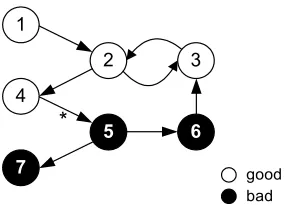
Figure 2 represents a small seven-page web where good pages are shown as white, and bad pages as black. For this example, calling the oracle on pages 1 through 4 would yield the return value of 1.
Oracle invocations are expensive and time consuming. Thus, we obviously do not want to call the oracle function for all pages. Instead, our objective is to be selective, i.e., to ask a human expert to evaluate only some of the web pages.
To discover good pages without invoking the oracle function on the entire web, we will rely on an important empirical observation we call the approximate isolation of the good set: good pages seldom point to bad ones. This notion is fairly intuitive—bad pages are built to mislead search engines, not to provide useful information. There-fore, people creating good pages have little reason to point to bad pages.
However, the creators of good pages can sometimes be “tricked,” so we do find some good-to-bad links on the web. (In Figure 2 we show one such good-to-bad link, from page 4 to page 5, marked with an asterisk.) Consider the fol-lowing example. Given a good, but unmoderated message board, spammers may include URLs to their spam pages as part of the seemingly innocent messages they post. Con-sequently, good pages of the message board would link to bad pages. Also, sometimes spam sites offer what is called a honey pot: a set of pages that provide some useful re-source (e.g., copies of some Unix documentation pages), but that also have hidden links to their spam pages. The honey pot then attracts people to point to it, boosting the ranking of the spam pages.
Note that the converse to approximate isolation does not necessarily hold: spam pages can, and in fact often do, link to good pages. For instance, creators of spam pages point to important good pages either to create a honey pot, or hop-ing that many good outlinks would boost their hub-score-based ranking [10].
To evaluate pages without relying onO, we will estimate the likelihood that a given page p is good. More formally, we define a trust functionT that yields a range of values between 0 (bad) and 1 (good). Ideally, for any page p,T(p)
should give us the probability that p is good:
Ideal Trust Property
T(p) =Pr[O(p) =1].
To illustrate, let us consider a set of 100 pages and say that the trust score of each of these pages happens to be 0.7. Let us suppose that we also evaluate all the 100 pages with the oracle function. Then, ifTworks properly, for 70 of the pages the oracle score should be 1, and for the remaining 30 pages the oracle score should be 0.
Ordered Trust Property
T(p)<T(q)⇔Pr[O(p) =1]<Pr[O(q) =1],
T(p) =T(q)⇔Pr[O(p) =1] =Pr[O(q) =1].
Another way to relax the requirements forTis to intro-duce a threshold valueδ:
Threshold Trust Property
T(p)>δ⇔O(p) =1.
That is, if a page p receives a score aboveδ, we know that it is good. Otherwise, we cannot tell anything about p. Such a functionTwould at least be capable of telling us that some subset of pages with a trust score aboveδis good. Note that a functionTwith the threshold property does not necessar-ily provide an ordering of pages based on their likelihood of being good.
3.2 Evaluation Metrics
This section introduces three metrics that help us evaluate whether a particular function T has some of the desired properties.
We assume that we have a sample setXof web pages for which we can invoke bothTandO. Then, we can evaluate how well a desired property is achieved for this set. In Section 6 we discuss how a meaningful sample setXcan be selected, but for now, we can simply assume thatXis a set of random web pages.
Our first metric, pairwise orderedness, is related to the ordered trust property. We introduce a binary function I(T,O,p,q)to signal if a bad page received an equal or higher trust score than a good page (a violation of the or-dered trust property):
I(T,O,p,q) =
1 ifT(p)≥T(q)andO(p)<O(q), 1 ifT(p)≤T(q)andO(p)>O(q), 0 otherwise.
Next, we generate from our sampleXa set Pof ordered pairs of pages(p,q), p6=q, and we compute the fraction of the pairs for whichTdid not make a mistake:
Pairwise Orderedness
pairord(T,O,P) =|P| −∑(p,q)∈PI(T,O,p,q)
|P| .
Hence, ifpairordequals 1, there are no cases whenT mis-rated a pair. Conversely, ifpairordequals zero, thenT mis-rated all the pairs. In Section 6 we discuss how to select a setPof sample page pairs for evaluation.
Our next two metrics are related to the threshold trust property. It is natural to think of the performance of func-tionTin terms of the commonly used precision and recall metrics [1] for a certain threshold valueδ. We define preci-sion as the fraction of good among all pages inXthat have a trust score aboveδ:
Precision
prec(T,O) =|{p∈X|T(p)>δandO(p) =1}|
|{q∈X|T(q)>δ}| .
Similarly, we define recall as the ratio between the num-ber of good pages with a trust score aboveδand the total number of good pages inX:
Recall
rec(T,O) =|{p∈X|T(p)>δandO(p) =1}|
|{q∈X|O(q) =1}| .
4
Computing Trust
Let us begin our quest for a proper trust function by start-ing with some simple approaches. We will then combine the gathered observations and construct the TrustRank al-gorithm in Section 4.3.
Given a limited budget L ofO-invocations, it is straight-forward to select at random a seed setSof L pages and call the oracle on its elements. (In Section 5 we discuss how to select a better seed set.) We denote the subsets of good and bad seed pages byS+andS−, respectively. Since the
remaining pages are not checked by the human expert, we assign them a trust score of 1/2 to signal our lack of infor-mation. Therefore, we call this scheme the ignorant trust functionT0, defined for any p∈Vas follows:
Ignorant Trust Function
T0(p) =
(
O(p) if p∈S,
1/2 otherwise.
For example, we can set L to 3 and apply our method to the example in Figure 2. A randomly selected seed set could then beS={1,3,6}. Let o and t0denote the vectors of oracle and trust scores for each page, respectively. In this case,
o = [1, 1, 1, 1, 0, 0, 0],
t0 = [1, 12, 1, 12, 12, 0, 12].
To evaluate the performance of the ignorant trust function, let us suppose that our sampleXconsists of all 7 pages, and that we consider all possible 7·6=42 ordered pairs. Then, the pairwise orderedness score ofT0is 17/21. Similarly, for a thresholdδ=1/2, the precision is 1 while the recall is 1/2.
4.1 Trust Propagation
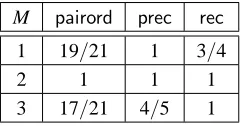
M pairord prec rec
1 19/21 1 3/4
2 1 1 1
3 17/21 4/5 1
Table 1: Performance of the M-step trust functionTM for
M∈ {1,2,3}.
M-Step Trust Function
TM(p) =
O(p) if p∈S,
1 if p∈/Sand∃q∈S+: q
M p,
1/2 otherwise,
where q M p denotes the existence of a path of a
maxi-mum length of M from page q to page p. Such a path must not include bad seed pages.
Using the example in Figure 2 and the seed set S=
{1,3,6}, we present the trust score assignments for three different values of M:
M=1 : t1 = [1, 1, 1, 12, 12, 0, 12],
M=2 : t2 = [1, 1, 1, 1, 12, 0, 12],
M=3 : t3 = [1, 1, 1, 1, 1, 0, 12].
We would expect thatTMperforms better thanT0with re-spect to some of our metrics. Indeed, Table 1 shows that for M=1 and M=2, both pairwise orderedness and recall increase, and precision remains 1. However, there is a drop in performance when we go to M=3. The reason is that page 5 receives a score of 1 due to the link from good page 4 to bad page 5 (marked with an asterisk on Figure 2).
As we saw in the previous example, the problem with M-step trust is that we are not absolutely sure that pages reachable from good seeds are indeed good. As a matter of fact, the further away we are from good seed pages, the less certain we are that a page is good. For instance, in Figure 2 there are 2 pages (namely, pages 2 and 4) that are at most 2 links away from the good seed pages. As both of them are good, the probability that we reach a good page in at most 2 steps is 1. Similarly, the number of pages reachable from the good seed in at most 3 steps is 3. Only two of these (pages 2 and 4) are good, while page 5 is bad. Thus, the probability of finding a good page drops to 2/3.
4.2 Trust Attenuation
These observations suggest that we reduce trust as we move further and further away from the good seed pages. There are many ways to achieve this attenuation of trust. Here we describe two possible schemes.
Figure 3 illustrates the first idea, which we call trust dampening. Since page 2 is one link away from the good seed page 1, we assign it a dampened trust score ofβ, where
β<1. Since page 3 is reachable in one step from page 2 with scoreβ, it gets a dampened score ofβ·β.
3 4 2 3 1 4 5 6 7
*
good bad 21 β 3
β
β
β2 β2 good seed
t(1)=1 t(2)=β t(3)=β2
1 2 3 good seed t(2)=1 t(3)= good seed t(1)=1 12
13 5
6 13 13 1 2 512 512 2 1 6 5 4 3 7 Figure 3: Trust dampening.
2 3 1 4 2 3 1 4 5 6 7
*
good bad 21 β 3
β
β
β2
β2 good seed
t(1)=1 t(2)=β t(3)=β2
1 2 3 good seed t(2)=1 t(3)= good seed t(1)=1 1 2 1
3 56
1 3 1 3 1 2 5 12 5 12 2 1 6 5 4 3 7
Figure 4: Trust splitting.
We also need to decide how to assign trust to pages with multiple inlinks. For instance, in Figure 3, assume page 1 also links to page 3. We could assign page 3 the maximum trust score, in this caseβ, or the average score, in this case
(β+β·β)/2.
The second technique for trust attenuation, which we call trust splitting, is based on the following observation: the care with which people add links to their pages is often inversely proportional to the number of links on the page. That is, if a good page has only a handful of outlinks, then it is likely that the pointed pages are also good. However, if a good page has hundreds of outlinks, it is more probable that some of them will point to bad pages.
This observation leads us to splitting trust as it propa-gates to other pages: if page p has a trust score ofT(p)and it points toω(p)pages, each of theω(p)pages will receive a score fractionT(p)/ω(p)from p. In this case, the actual score of a page will be the sum of the score fractions re-ceived through its inlinks. Intuitively, the more “credit” a page accumulates from some other pages, the more prob-able that it is good. (We can normalize summed scores to our standard range of[0,1].)
Figure 4 illustrates trust splitting. Good seed page 1 has two outlinks, so it distributes half of its score of 1 to both pages it points to. Similarly, good seed page 2 has three outlinks, so each page it points to receives one third of its score. The score of page 3 will then be 1/2+1/3=5/6.
Notice that we can also combine trust splitting with dampening. In Figure 4, for instance, page 3 could receive a score ofβ·(1/2+1/3).
advan-functionTrustRank input
T transition matrix
N number of pages
L limit of oracle invocations
αB decay factor for biased PageRank
MB number of biased PageRank iterations
output
t∗ TrustRank scores begin
// evaluate seed-desirability of pages (1) s=SelectSeed(. . .)
// generate corresponding ordering (2) σ=Rank({1, . . . ,N},s)
// select good seeds (3) d=0N
for i=1 to L do
ifO(σ(i)) ==1 then
d(σ(i)) =1
// normalize static score distribution vector (4) d=d/|d|
// compute TrustRank scores (5) t∗=d
for i=1 to MBdo
t∗=αB·T·t∗+ (1−αB)·d
return t∗ end
Figure 5: The TrustRank algorithm.
tage is important since substantial effort has been spent on making PakeRank computations efficient with very large data sets (for instance, see [5, 8]).
4.3 The TrustRank Algorithm
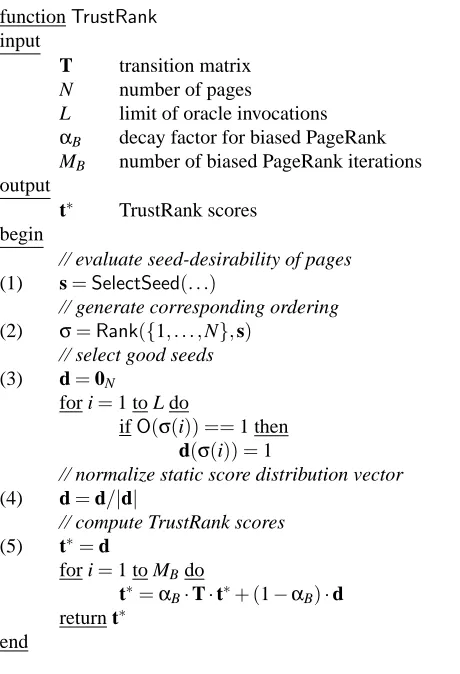
Function TrustRank, shown in Figure 5, computes trust scores for a web graph. We explain the algorithm by walk-ing through its execution on Figure 2.
The input to the algorithm is the graph (the transition matrix T and the number N of web pages) and parameters that control execution (L, MB,αB, see below).
As a first step, the algorithm calls functionSelectSeed, which returns a vector s. The entry s(p)in this vector gives the “desirability” of page p as a seed page. (Please refer to Section 5 for details.) As we will see in Section 5.1, one version of SelectSeedreturns the following vector on the example of Figure 2:
s=
0.08, 0.13, 0.08, 0.10, 0.09, 0.06, 0.02 .
In step(2)functionRank(x,s)generates a permutation x0 of the vector x, with elements x0(i)in decreasing order of
s(x0(i)). In other words,Rankreorders the elements of x in decreasing order of their s-scores. For our example, we
get:
σ=2, 4, 5, 1, 3, 6, 7.
That is, page 2 is the most desirable seed page, followed by page 4, and so on.
Step (3) invokes the oracle function on the L most desir-able seed pages. The entries of the static score distribution vector d that correspond to good seed pages are set to 1.
Step (4) normalizes vector d so that its entries sum up to 1. Assuming that L=3, the seed set is{2,4,5}. Pages 2 and 4 are the good seeds, and we get the following static score distribution vector for our example:
d=
0, 12, 0, 21, 0, 0, 0,
Finally, step (5) evaluates TrustRank scores using a biased PageRank computation with d replacing the uniform distri-bution. Note that step (5) implements a particular version of trust dampening and splitting: in each iteration, the trust score of a node is split among its neighbors and dampened by a factorαB.
Assuming thatαB=0.85 and MB=20, the algorithm
computes the following result:
t∗=
0, 0.18, 0.12, 0.15, 0.13, 0.05, 0.05 .
Notice that because of the way we iteratively propagate trust scores, the good seed pages (namely, 2 and 4) no longer have a score of 1. However, they still have the highest scores. Also notice that good seed page 4 has a lower score than good seed page 2. This is due to the link structure in this example: page 2 has an inlink from a high scoring page (page 3), while page 4 does not. Thus, our TrustRank algorithm “refines” the original scores given by the oracle, determining that there is even more evidence that page 2 is good as compared to 4. If desired, one can normalize the resulting vector by dividing all scores by the highest score (making the score of page 2 equal to one), but this operation does not change the relative ordering of the pages.
We see in this example that the TrustRank algorithm usually gives good pages a higher score. In particular, three of the four good pages (namely, pages 2, 3, and 4) got high scores and two of the three bad pages (pages 6 and 7) got low scores. However, the algorithm failed to assign pages 1 and 5 adequate scores. Page 1 was not among the seeds, and it did not have any inlinks through which to accumu-late score, so its score remained at 0. All good unreferenced web pages receive a similar treatment, unless they are se-lected as seeds. Bad page 5 received a high score because it is the direct target of one of the rare good-to-bad links. As we will see in Section 6, in spite of errors like these, on a real web graph the TrustRank algorithm is still able to correctly identify a significant number of good pages.
5
Selecting Seeds
functionSelectSeed input
U inverse transition matrix
N number of pages
αI decay factor
MI number of iterations
output
s inverse PageRank scores begin
s=1N
for i=1 to M do
s=α·U·s+ (1−α)·1
N·1N
return s end
Figure 6: The inverse PageRank algorithm.
that will be the most useful in identifying additional good pages. At the same time, we want to keep the seed set rea-sonably small to limit the number of oracle invocations. In this section we discuss two strategies forSelectSeed, in ad-dition to the random selection strategy that was mentioned earlier.
5.1 Inverse PageRank
Since trust flows out of the good seed pages, one approach is to give preference to pages from which we can reach many other pages. In particular, we could select seed pages based on the number of outlinks. For instance, considering our example in Figure 2, the appropriate seed set of L=2 pages would beS={2,5}, since pages 2 and 5 have the largest number of outlinks (namely two).
Following a similar reasoning, the coverage can be im-proved even further. We can build the seed set from those pages that point to many pages that in turn point to many pages and so on. Interestingly, this approach leads us to a scheme closely related PageRank—the difference is that in our case the importance of a page depends on its outlinks, not its inlinks. Therefore, to compute the desirability of a page, we perform a PageRank computation on the graph
G0= (V,E0), where
(p,q)∈E0⇔(q,p)∈E.
Since we inverted the links, we call our algorithm inverse PageRank.
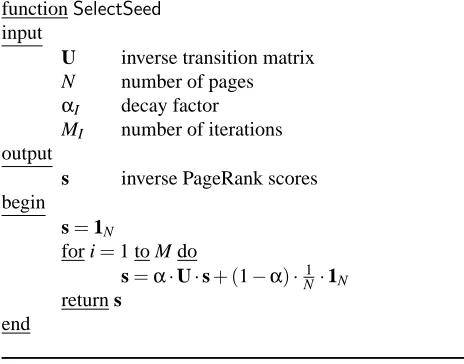
Figure 6 shows aSelectSeedalgorithm that performs the inverse PageRank computation. Note that the decay factor
αIand the number of iterations MIcan be different from the
valuesαB and MB used by the TrustRank algorithm. The
computation is identical to that in the traditional PageRank algorithm (Section 2.2), except that the inverse transition matrix U is used instead of the regular transition matrix T. For our example from Figure 2, the inverse PageRank algorithm (αI=0.85,MI=20) yields the following scores
3 4
2 3
1
4
5 6
7
*
good bad
2 4
1
good seed
t(1)=1
t(2)=c t(4)=c2
c c
3
t(3)=c c
2 1
6 5 4
3
7
Figure 7: A graph for which inverse PageRank does not yield maximum coverage.
(already shown in Section 4.3):
s=
0.08, 0.13, 0.08, 0.10, 0.09, 0.06, 0.02 .
For a value of L=3, the seed set isS={2,4,5}. Corre-spondingly, the good seed set isS+={2,4}, so pages 2 and 4 are used as starting points for score distribution.
It is important to note that inverse PageRank is a heuris-tic (that works well in pracheuris-tice, as we will see in Section 6). First, inverse PageRank does not guarantee maximum cov-erage. For instance, in the example in Figure 7 and for L=2, maximum coverage is achieved through the seed set {1,3}or{2,3}. However, the inverse PageRank computa-tion yields the score vector:
s=0.05, 0.05, 0.04, 0.02, 0.02, 0.02, 0.02,
which leads to the seed setS={1,2}.
Nevertheless, inverse PageRank is appealing because its execution time is polynomial in the number of pages, while determining the maximum coverage is an
N P
-complete problem.2A second reason why inverse PageRank is a heuristic is that maximizing coverage may not always be the best strategy. To illustrate, let us propagate trust via splitting, without any dampening. Returning to Figure 7, say we only select page 2 as seed and it turns out to be good. Then pages 4, 5, and 6 each receive a score of 1/3. Now, assume we only select page 3 as seed and it also happens to be good. Then page 7 gets a score of 1. Depending on our ultimate goal, it may be preferable to use page 3, since we can be more certain about the page it identifies, even if the set is smaller. However, if we are only using trusts scores for comparing against other trust scores, it may still be better to learn about more pages, even if with less absolute accuracy.
5.2 High PageRank
So far we have assumed that the value of identifying a page as good or bad is the same for all web pages. Yet, it may be
2The general problem of identifying the minimal set of pages that
yields maximum coverage is equivalent to the independent set problem [7] on directed graphs as shown next. The web graph can be transformed in
a directed graphG00= (V,E00), where an edge(p,q)∈E00 signals that
page q can be reached from page p. We argue that such transformation does not change the complexity class of the algorithm, since it involves breadth-first search that has polynomial execution time. Then, finding a minimal set that provides maximum coverage is the same as finding the
more important to ascertain the goodness of pages that will appear high in query result sets. For example, say we have four pages p, q, r, and s, whose contents match a given set of query terms equally well. If the search engine uses PageRank to order the results, the page with highest rank, say p, will be displayed first, followed by the page with next highest rank, say q, and so on. Since it is more likely the user will be interested in pages p and q, as opposed to pages r and s (pages r and s may even appear on later result pages and may not even be seen by the user), it seems more useful to obtain accurate trust scores for pages p and q rather than for r and s. For instance, if page p turns out to be spam, the user may rather visit page q instead.
Thus, a second heuristic for selecting a seed set is to give preference to pages with high PageRank. Since high-PageRank pages are likely to point to other high-high-PageRank pages, then good trust scores will also be propagated to pages that are likely to be at the top of result sets. Thus, with PageRank selection of seeds, we may identify the goodness of fewer pages (as compared to inverse Page-Rank), but they may be more important pages to know about.
6
Experiments
6.1 Data Set
To evaluate our algorithms, we performed experiments us-ing the complete set of pages crawled and indexed by the AltaVista search engine as of August 2003.
In order to reduce computational demands, we decided to work at the level of web sites instead of individual pages. (Note that all presented methods work equally well for ei-ther pages or sites.) We grouped the several billion pages into 31,003,946 sites, using a proprietary algorithm that is part of the AltaVista engine. Although the algorithm re-lies on several heuristics to fine-tune its decisions, roughly speaking, all individual pages that share a common fully qualified host name3become part of the same site. Once we decided on the sites, we added a single link from site a to site b if in the original web graph there were one or more links from pages of site a pointing to pages of site b.
One interesting fact that we have noticed from the very beginning was that more than one third of the sites (13,197,046) were unreferenced. Trust propagation algo-rithms rely on inlink information, so are unable to differ-entiate among these sites without inlinks. Fortunately, the unreferenced sites are ranked low in query results (receive an identical, minimal static PageRank score), so it is not critical to separate good and bad sites among them.
For our evaluations, the first author of this paper played the role of the oracle, examining pages of various sites, de-termining if they are spam, and performing additional
clas-3The fully qualified host name is the portion of the URL between
thehttp://prefix, called the scheme, and the first slash character that
usually follows the top level domain, such as .com, or the server’s
TCP port number. For instance, the fully qualified host name for
the URLhttp://www-db.stanford.edu/db pages/members.html
iswww-db.stanford.edu.
sification, as we will see. Of course, using an author as an evaluator raises the issue of bias in the results. How-ever, this was our only choice. Our manual evaluations took weeks: checking a site involves looking at many of its pages and also the linked sites to determine if there is an intention to deceive search engines. Finding an expert working at one of the very competitive search engine com-panies who was knowledgeable enough and had time for this work was next to impossible. Instead, the first author spent time looking over the shoulder of the experts, learn-ing how they identified spam sites. Then, he made every effort to be unbiased and to apply the experts’ spam detec-tion techniques.
6.2 Seed Set
As a first step, we conducted experiments to compare the inverse PageRank and the high PageRank seed selection schemes described in Sections 5.1 and 5.2, respectively. In order to be able to perform the comparison quickly, we ran our experiments on synthetic web graphs that capture the essential spam-related features of the web. We describe these experiments in [4]. Due to space limitations, here we just note that inverse PageRank turned out to be slightly better at identifying useful seed sets. Thus, for the rest of our experiments on the full, real web, we relied on the in-verse PageRank method.
In implementing seed selection using inverse PageRank, we fine-tuned the process in order to streamline the oracle evaluations. First, we performed a full inverse PageRank computation on the site-level web graph, using parameters
αI=0.85 and MI =20. (The decay factor of 0.85 was
first reported in [12] and has been regarded as the standard in PageRank literature ever since. Our tests showed that 20 iterations were enough to achieve convergence on the relative ordering of the sites.)
After ordering the sites based on their inverse PageRank scores (step (2) in Figure 5), we focused our attention on the top 25,000. Instead of a full oracle evaluation of these sites, we first did a cursory evaluation to eliminate some problematic ones. In particular, we noticed that sites with highest inverse PageRank scores showed a heavy bias to-ward spam, due to the presence of Open Directory clones: some spammers duplicate the entire content of the DMOZ Open Directory either in the hope of increasing their hub score [10] or with the intention of creating honey pots, as discussed in Section 3.1. In order to get rid of the spam quickly, we removed from our list of 25,000 sites all that were not listed in any of the major web directories, reduc-ing the initial set to roughly 7,900. By sampling the sites that were filtered out, we found that insignificantly few rep-utable ones were removed by the process.
personal page host 2.2% alias 3.5%
reputable 56.3%
web organization 3.7%
advertisement 1.3%
spam 13.5%
Figure 8: Composition of the evaluation sample.
spam, but we also applied a second filter—we only selected sites with a clearly identifiable authority (such as a gov-ernmental or educational institution or company) that con-trolled the contents of the site. The extra filter was added to guarantee the longevity of the good seed set, since the presence of physical authorities decreases the chance that the sites would degrade in the short run.
6.3 Evaluation Sample
In order to evaluate the metrics presented in Section 3.2, we needed a setXof sample sites with known oracle scores. (Note that this is different from the seed set and it is only used for assessing the performance of our algorithms.) We settled on a sample of 1000 sites, a number that gave us enough data points, and was still manageable in terms of oracle evaluation time.
We decided not to select the 1000 sample sites ofXat random. With a random sample, a great number of the sites would be very small (with few pages) and/or have very low PageRank. (Both size and PageRank follow power-law dis-tributions, with many sites at the tail end of the distribu-tion.) As we discussed in Section 5.2, it is more important for us to correctly detect spam in high PageRank sites, since they will more often appear high in query result sets. Fur-thermore, it is hard for the oracle to evaluate small sites due to the reduced body of evidence, so it also does not make sense to consider many small sites in our sample.
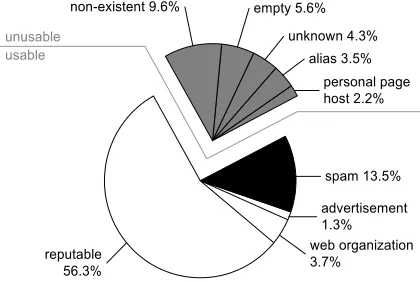
In order to assure diversity, we adopted the following sampling method. We generated the list of sites in decreas-ing order of their PageRank scores, and we segmented it into 20 buckets. Each of the buckets contained a different number of sites, with scores summing up to 5 percent of the total PageRank score. Therefore, the first bucket contained the 86 sites with the highest PageRank scores, bucket 2 the next 665, while the 20th bucket contained 5 million sites that were assigned the lowest PageRank scores.
We constructed our sample set of 1000 sites by selecting 50 sites at random from each bucket. Then, we performed a manual (oracle) evaluation of the sample sites, determining if they were spam or not. The outcome of the evaluation process is presented in Figure 8, a pie-chart that shows the
TrustRank:
• Reputable. 563 sites featured quality contents with zero or a statistically insignificant number of links pointing to spam sites.
• Web organization. 37 sites belonged to organizations that either have a role in the maintenance of the World Wide Web or perform business related to Internet ser-vices. While all of them were good sites, most of their links were automatic (e.g., “Site hosted by Provider X”). Therefore, we decided to give them a distinct la-bel to be able to follow their features separately.
• Advertisement. 13 of the sites were ones acting as targets for banner ads. These sites lack real useful content and their high PageRank scores are due ex-clusively to the large number of automatic links that they receive. Nevertheless, they still qualify as good sites without any sign of spamming activity.
• Spam. 135 sites featured various forms of spam. We considered these sites as bad ones.
These 748 sites formed our sample setX. The remaining 252 sites were deemed unusable for the evaluation of Trust-Rank for various reasons:
• Personal page host. 22 of the sites hosted personal web pages. The large, uncontrolled body of editors contributing to the wide variety of contents for each of these sites made it impossible to categorize them as either bad or good. Note that this issue would not appear in a page-level evaluation.
• Alias. 35 sites were simple aliases of sites better known under a different name. We decided to drop these aliases because the importance of the alias could not reflect the importance of the original site appropri-ately.
• Empty. 56 sites were empty, consisting of a single page that provided no useful information.
• Non-existent. 96 sites were non-existent—either the DNS lookup failed, or our systems were not able to establish a TCP/IP connection with the corresponding computers.
• Unknown. We were unable to properly evaluate 43 sites based on the available information. These sites were mainly East Asian ones, which represented a challenge because of the lack of English translation.
6.4 Results
In Section 4 we described a number of strategies for propa-gating trust from a set of good seeds. In this section we fo-cus on three of the alternatives, TrustRank and two baseline strategies, and evaluate their performance using our sample
1 2 3 4 5 6 7 8 9 10 11 12 13 14 15 16 17-20
Bucket 20
40 60 80 100
% Good PageRank
1 2 3 4 5 6 7 8 9 10 11 12 13 14 15 16 17-20
Bucket 20
40 60 80 100
% Good TrustRank
Figure 9: Good sites in PageRank and TrustRank buckets.
1 2 3 4 5 6 7 8 9 10 11 12 13 14 15 16 17-20
Bucket 10
20 30 40 50
% Bad PageRank
1 2 3 4 5 6 7 8 9 10 11 12 13 14 15 16 17-20
Bucket 10
20 30 40 50
% Bad TrustRank
Figure 10: Bad sites in PageRank and TrustRank buckets.
1. TrustRank. We used the algorithm in Figure 5 (MB=
20 iterations and decay factor ofαB=0.85) and our
selected 178 good seeds.
2. PageRank. PageRank was originally considered highly resilient to spamming because it measures global importance (limited, local changes to the link structure have low impact on the scores). Thus, it is natural to ask how well PageRank can cope with spam in today’s world. Thus, for this alternative we simply used the PageRank of site a as the value ofT(a). We again performed M=20 iterations, with a decay fac-tor ofα=0.85.
3. Ignorant Trust. As another baseline, we generated the ignorant trust scores of sites. All sites were assigned an ignorant trust score of 1/2, except for the 1250 seeds, which received scores of 0 or 1.
6.4.1 PageRank versus TrustRank
Let us discuss the difference between PageRank and Trust-Rank first. Remember, the PageTrust-Rank algorithm does not incorporate any knowledge about the quality of a site, nor does it explicitly penalize badness. In fact, we will see that it is not very uncommon that some site created by a skilled spammer receives high PageRank score. In contrast, our TrustRank is meant to differentiate good and bad sites: we expect that spam sites were not assigned high TrustRank scores.
Figures 9 and 10 provide a side-by-side comparison of PageRank and TrustRank with respect to the ratio of good
and bad sites in each bucket. PageRank buckets were in-troduced in Section 6.3; we defined TrustRank buckets as containing the same number of sites as PageRank buckets. Note that we merged buckets 17 through 20 both for Page-Rank and TrustPage-Rank. (These last 4 buckets contained the more than 13 million sites that were unreferenced. All such sites received the same minimal static PageRank score and a zero TrustRank score, making it impossible to set up an ordering among them.)
The horizontal axes of Figures 9 and 10 mark the Page-Rank and TrustPage-Rank bucket numbers, respectively. The vertical axis of the first figure corresponds to the percentage of good within a specific bucket, i.e., the number of good sample sites divided by the total number of sample sites in that bucket. Note that reputable, advertisement, and web organization sites all qualify as good ones; their relative contributions are shown by white, middle gray, and dark gray segments, respectively. The vertical axis of the sec-ond figure correspsec-onds to the percentage of bad within a specific bucket. For instance, we can derive from Figure 10 that 31% of the usable sample sites in TrustRank bucket 11 are bad ones.
1 2 3 4 5 6 7 8 9 10 11 12 13 14 15
16 17-20
PageRank Bucket
2 4
Figure 11: Bucket-level demotion in TrustRank.
could push their sites.
Figure 11 offers another view on the relationship be-tween PageRank and TrustRank. It introduces the notion of demotion, the phenomenon that a certain site from a higher PageRank bucket appears in a lower TrustRank bucket. Negative demotion is promotion, the case when a site from a lower PageRank bucket shows up in a higher TrustRank bucket. The average demotion of bad sites is an important way to evaluate TrustRank as it shows its success (or lack thereof) to cut the importance of bad sites.
The horizontal axis of Figure 11 stands for PageRank buckets. The vertical axis shows the number of buckets by which sites from a specific PageRank bucket got de-moted in TrustRank on average. White bars represent the reputable sites, while black ones denote spam. (Note that we do not show advertisement and web organization sites in the figure.)
As an illustration, we can derive from Figure 11 that spam sites in PageRank bucket 2 got demoted seven buck-ets on average, thus landing somewhere around TrustRank bucket 9. An example of promotion can be seen in Page-Rank bucket 16, where good sites appear on average one bucket higher in the TrustRank ordering.
This figure again shows well that TrustRank effectively removes most of the spam from among the top-scored sites. Furthermore, it also reveals that good sites retain their orig-inal bucket position in most of the cases. Consequently, we argue that (opposed to PageRank) TrustRank guaran-tees that top-scored sites are good ones. We also assert that TrustRank is unable to effectively separate low-scored good sites from bad ones, due to the lack of distinguishing features (inlinks) of the sites.
6.4.2 Pairwise Orderedness
We used the pairwise orderedness metric presented in Sec-tion 3.2 to evaluate TrustRank with respect to the ordered trust property. For this experiment, we built the set Pof all possible pairs of sites for several subsets of our evalua-tion sampleX. We started by using the subset ofXof the 100 sites with highest PageRank scores, in order to check TrustRank for the most important sites. Then, we gradually added more and more sites to our subset, in their decreasing
100 200 300 400 500 600 700 748 Top-PageRank Sample Sites
0.75 0.8 0.85 0.9
Pairwise
Orderedness
Ignorant PageRank
Figure 12: Pairwise orderedness.
order of PageRank scores. Finally, we used all pairs of all the 748 sample sites to compute the pairwise orderedness score.
Figure 12 displays the results of this experiment. The horizontal axis shows the number of sample sites used for evaluation, while the vertical axis represents the pairwise orderedness scores for the specific sample sizes. For in-stance, we can conclude that for the 500 top-PageRank sample sites TrustRank receives a pairwise orderedness score of about 0.95.
Figure 12 also shows the pairwise orderedness scores for the ignorant trust function and PageRank. The overlap between our seed setSand sample setXis of 5 good sites, so all but five sample sites received a score of 1/2 from the ignorant trust function. Hence, the pairwise ordered-ness scores for the ignorant function represent the case when we have almost no information about the quality of the sites. Similarly, pairwise orderedness scores for Page-Rank illustrate how much the knowledge of importance can help in distinguishing good and bad. As we can see, TrustRank constantly outperforms both the ignorant func-tion and PageRank.
6.4.3 Precision and Recall
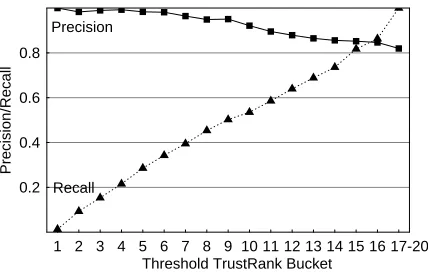
Our last set of experimental results, shown in Figure 13, present the performance of TrustRank with respect to the metrics of precision and recall. We used as threshold val-uesδthe borderline TrustRank scores that separated the 17 TrustRank buckets, discussed in Section 6.4.1. The low-est buckets corresponding to each threshold value are pre-sented on the horizontal axis of the figure; we display the precision and recall scores on the vertical. For instance, if the thresholdδis set so that all and only sample sites in TrustRank buckets 1 through 10 are above it, then precision is 0.86 and recall is 0.55.
informa-1 2 3 4 5 6 7 8 9 informa-10 informa-1informa-1 informa-12 informa-13 informa-14 informa-15 informa-16 informa-17-20
Threshold TrustRank Bucket
0.2 0.4 0.6 0.8
Precisio
n
/
Recall
Recall Precision
Figure 13: Precision and recall.
tion retrieval problems, where it is usual to have a large corpus of documents, with only a few of those documents being relevant for a specific query. In contrast, our sam-ple set consists most of good documents, all of which are “relevant.” This is why the baseline precision score for the sampleXis 613/(613+135) =0.82.
7
Related Work
Our work builds on existing PageRank research. The idea of biasing PageRank to combat spam was introduced in [12]. The use of custom static score distribution vec-tors has been studied in the context of topic-sensitive Page-Rank [6]. Recent analyses of (biased) PagePage-Rank are pro-vided by [2, 11].
The problem of trust has also been addressed in the con-text of peer-to-peer systems. For instance, [9] presents an algorithm similar to PageRank for computing the reputa-tion or dependability of a node in a peer-to-peer network.
The data mining and machine learning communities also explored the topic of web and email spam detection (for in-stance, see [13]). However, this research is oriented toward the analysis of individual documents. The analysis typi-cally looks for telltale signs of spamming techniques based on statistics derived from examples.
8
Conclusions
As the web grows in size and value, search engines play an increasingly critical role, allowing users to find information of interest. However, today’s search engines are seriously threatened by malicious web spam that attempts to subvert the unbiased searching and ranking services provided by the engines. Search engines are today combating web spam with a variety of ad hoc, often proprietary techniques. We believe that our work is a first attempt at formalizing the problem and at introducing a comprehensive solution to as-sist in the detection of web spam. Our experimental results show that we can effectively identify a significant number of strongly reputable (non-spam) pages. In a search engine, TrustRank can be used either separately to filter the index, or in combination with PageRank and other metrics to rank search results.
We believe that there are still a number of interesting ex-periments that need to be carried out. For instance, it would be desirable to further explore the interplay between damp-ening and splitting for trust propagation. In addition, there are a number of ways to refine our methods. For example, instead of selecting the entire seed set at once, one could think of an iterative process: after the oracle has evaluated some pages, we could reconsider what pages it should eval-uate next, based on the previous outcome. Such issues are a challenge for future research.
Acknowledgement
The authors would like to thank David Cossock and Farzin Maghoul for the inspiring discussions and valuable com-ments.
References
[1] R. Baeza-Yates and B. Ribeiro-Neto. Modern Infor-mation Retrieval. Addison-Wesley, 1999.
[2] M. Bianchini, M. Gori, and F. Scarselli. Inside Page-Rank. Tech. rep., University of Siena, 2003.
[3] G. Golub and C. Van Loan. Matrix Computations. The Johns Hopkins University Press, 1996.
[4] Z. Gy¨ongyi and H. Garcia-Molina. Seed selection in TrustRank. Tech. rep., Stanford University, 2004.
[5] T. Haveliwala. Efficient computation of PageRank. Tech. rep., Stanford University, 1999.
[6] T. Haveliwala. Topic-sensitive PageRank. In Pro-ceedings of the Eleventh International Conference on World Wide Web, 2002.
[7] J. Hopcroft, R. Motwani, and J. Ullman. Introduction to Automata Theory, Languages, and Computation. Addison-Wesley, 2001.
[8] S. Kamvar, T. Haveliwala, C. Manning, and G. Golub. Extrapolation methods for accelerating PageRank computations. In Proceedings of the Twelfth Inter-national Conference on World Wide Web, 2003. [9] S. Kamvar, M. Schlosser, and H. Garcia-Molina. The
EigenTrust algorithm for reputation management in P2P networks. In Proceedings of the Twelfth Interna-tional Conference on World Wide Web, 2003.
[10] J. M. Kleinberg. Authoritative sources in a hyper-linked environment. Journal of the ACM, 46(5):604– 632, 1999.
[11] A. Langville and C. Meyer. Deeper inside PageRank. Tech. rep., North Carolina State University, 2003. [12] L. Page, S. Brin, R. Motwani, and T. Winograd. The
PageRank citation ranking: Bringing order to the web. Tech. rep., Stanford University, 1998.
[13] M. Sahami, S. Dumais, D. Heckerman, and