Building Trustworthy e-Commerce Website
Ab Razak Che Hussin
Faculty of Computer Science and Information System,
University Technology of Malaysia, 81310, UTM Skudai, Johor, Malaysia Email: [email protected]
Abstract - The process of building consumer trust in E-Commerce is based on the presence of trust features or trust attributes in the websites. Consumer may examine e-Commerce websites for the existence of trust attributes. However, to date, which trust attributes contribute to the website’s trustworthiness and which trust attributes give more value to consumer has not been adequately explored. Therefore, the purpose of the paper is to look for the relevant trust attributes for e-Commerce websites and to identify the importance ranking of trust attributes that contribute significantly to the trustworthiness of e-Commerce website. Various journal papers and articles related to e-Commerce field have been referred in order to identify the trust attributes. An online survey that received 1230 respondents was carried out to investigate the importance ranking of ten trust attributes. The paper contributes to the discussion on how to build trust in e-Commerce.
Keyword: e-Commerce, internet, online, trust
1. Introduction
Recent statistical data indicates that the number of consumers that shop via the Internet has increased [1, 2, 10]. However, the speed of the increase is impeded by the lack of trust in today’s E-Commerce websites [3, 5, 10]. Lack of trust between business and consumer is considered the main obstacle in the uptake of E-Commerce [3].
The most important step in establishing consumer trust is providing assurances that the consumer’s personal information will be protected [2]. This can be achieved by incorporating features of trust or trust attributes in E-Commerce websites. However, there is lack of knowledge which trust attributes should be include in e-Commerce website that can contribute significantly in building consumer trust. Therefore the aim of the paper is to identify the importance ranking of trust according to consumer perceptions. In this paper, the authors firstly review and explore the concept of trust in E-Commerce in order to understand and to identify trust attributes. Based on the reviewed literature, the author then propopsed ten trust attributes that can be considered the most important attribute that should be included into a website. The study is followed
by conducting an online survey and suggestion for future work.
2. Trust in e-Commerce
The term ‘trust’ has been studied in many domains including sociology, philosophy, economics, and marketing [1, 8], and recently in E-Commerce. Trust in E-Commerce has primarily an impersonal nature compared to the traditional view of interpersonal trust [2, 6, 7]. In impersonal trust, the competence and calculative processes arise that build trust through signals and incentives [5].
According to Riegelsberger et al. [10], the three dimensions of trustworthiness that can be applied to E-Commerce: they are ability, integrity, and benevolence. Ability is belief in the skills and competence of the trusted party. Integrity is the belief that the trusted party adheres to accepted rules of conduct, such as honesty and keeping promises. Benevolence is the belief that the trusted party, aside from wanting to make a legitimate profit, wants to do good to the customer.
In e-Commerce environment, users are influenced by the reputation and size of the business, recommendations of friends, published testimonials of other users, and advertising. In other words, while accessing E-Commerce websites, consumers are looking for ‘good signs’ and ‘bad signs’ as a method to develop trust [5]. These ‘good signs’ and ‘bad signs’ refer to the features of trust or trust attributes that exist in the E-Commerce website. According to some studies, trust attributes can be presented as trusted third party, privacy policy, company address, contact person, and ease of navigation [2, 6, 7, 8, 9]
3. Method
The study consist of two main activities i.e conducting literature review and online survey. The purpose of reviewing existing literature on trust in E-Commerce is to identify the most relevant trust attributes. This was done by examining five models of trust in E-Commerce [2, 6, 7, 8, 9]. An online survey was carried out using an online questionnaire to collect information from the user. This survey requires the respondents to visit an e-Commerce website and from this website they will be given a set of questions.
4. Trust Attributes in e-Commerce
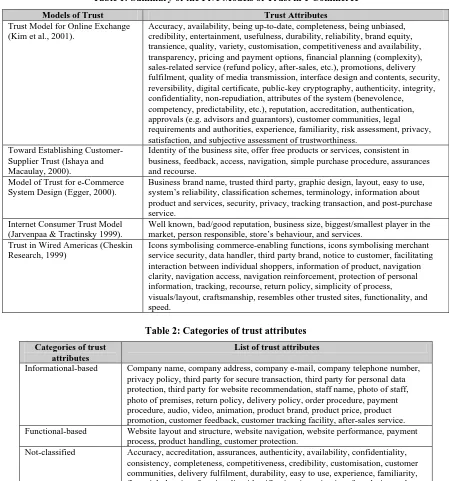
The author explored five models of trust in e-Commerce in order to understand more details about trust attributes. These models have been selected in this study because they specifically focus on the how website design can build consumer trust in e-Commerce. From the study, it is clear that those five models of trust in e-Commerce emphasised the need to provide a website that can communicate trust to consumers. Therefore, a list of trust attributes that is derived from those models is summarised in Table 1.
There are two features of trust attributes that influence consumer to trust to e-Commerce website i.e. can be seen in the website and can be understood by the consumer [4]. Based on these two features, therefore, trust attributes that are listed in Table 1 have been separated into three categories i.e. information-based (IB), function-based (FB), and not-classified (NC). IB refers to the text or image that appears in websites, such as company address, privacy policy and trust marks. FB refers to the process that appears in websites for performing instructions or tasks such as navigation and data encryption. NC refers to the trust attributes that are not included in the study because they appear as features of trust attributes such as accuracy, completeness, and competency. Therefore, trust attributes from NC will not included for further study.
Table 2 shows the reproduction of trust attributes that have been presented in Table 1. In Table 2, it is clear that trust attributes that are grouped as IB can be viewed and understood by the consumers when they explore the websites. Trust attributes in this category are more about online merchants and can also be easily designed by the systems developer. Trust attributes that are grouped as FB are more for website development that focuses on website content.
In order to identify the most important attributes in Table 2, the author select only ten trust attributes
from IB that represent two factors i.e company identifcation and privacy protection. These ten attributes will be used for further analysis which is identifying their importance ranking. Those ten attributes include company address, company e-mail, company telephone number, privacy policy, third party for secure transaction, third party for personal data protection, third party for website recommendation, customer feedback, staff name,and photo of Staff.
5. Online Survey
The survey comprises four stages which include setting up a survey, questionnaire design, survey implementation, and data analysis and result.
5.1 Setting up the Survey
The purpose of this survey is to identify the importance ranking of trust attributes. Before asking respondents to rank them, they should be given experience of looking for trust attributes in e-Commerce websites. This will help respondents get some idea and understand better about the role and presentation of trust attributes in the website.
Six real e-Commerce websites from three different domains have been selected. The domains are based on low-priced and small products (CD: http://www.thehut.com and http://www.cdjungle. com), medium-priced and medium-sized products (computer: http://www.simply.co.uk and http://www. idealcomputing.co.uk), and high-priced and large products (furniture: http://www.furniture247.co.uk
and http://www.sofaclassics.co.uk). The presence of trust attributes in the website and how easy it is to find them were used as guidelines in selecting the six websites. All of them represented small or medium businesses based in the UK featuring a relatively unknown brand.
Table 1: Summary of the Five Models of Trust in e-Commerce
Models of Trust Trust Attributes
Trust Model for Online Exchange (Kim et al., 2001).
Accuracy, availability, being up-to-date, completeness, being unbiased, credibility, entertainment, usefulness, durability, reliability, brand equity, transience, quality, variety, customisation, competitiveness and availability, transparency, pricing and payment options, financial planning (complexity), sales-related service (refund policy, after-sales, etc.), promotions, delivery fulfilment, quality of media transmission, interface design and contents, security, reversibility, digital certificate, public-key cryptography, authenticity, integrity, confidentiality, non-repudiation, attributes of the system (benevolence, competency, predictability, etc.), reputation, accreditation, authentication, approvals (e.g. advisors and guarantors), customer communities, legal requirements and authorities, experience, familiarity, risk assessment, privacy, satisfaction, and subjective assessment of trustworthiness.
Toward Establishing Customer-Supplier Trust (Ishaya and Macaulay, 2000).
Identity of the business site, offer free products or services, consistent in business, feedback, access, navigation, simple purchase procedure, assurances and recourse.
Model of Trust for e-Commerce System Design (Egger, 2000).
Business brand name, trusted third party, graphic design, layout, easy to use, system’s reliability, classification schemes, terminology, information about product and services, security, privacy, tracking transaction, and post-purchase service.
Internet Consumer Trust Model (Jarvenpaa & Tractinsky 1999).
Well known, bad/good reputation, business size, biggest/smallest player in the market, person responsible, store’s behaviour, and services.
Trust in Wired Americas (Cheskin Research, 1999)
Icons symbolising commerce-enabling functions, icons symbolising merchant service security, data handler, third party brand, notice to customer, facilitating interaction between individual shoppers, information of product, navigation clarity, navigation access, navigation reinforcement, protection of personal information, tracking, recourse, return policy, simplicity of process,
visuals/layout, craftsmanship, resembles other trusted sites, functionality, and speed.
Table 2: Categories of trust attributes
Categories of trust attributes
List of trust attributes
Informational-based Company name, company address, company e-mail, company telephone number,
privacy policy, third party for secure transaction, third party for personal data protection, third party for website recommendation, staff name, photo of staff, photo of premises, return policy, delivery policy, order procedure, payment procedure, audio, video, animation, product brand, product price, product promotion, customer feedback, customer tracking facility, after-sales service.
Functional-based Website layout and structure, website navigation, website performance, payment
process, product handling, customer protection.
Not-classified Accuracy, accreditation, assurances, authenticity, availability, confidentiality,
consistency, completeness, competitiveness, credibility, customisation, customer communities, delivery fulfilment, durability, easy to use, experience, familiarity, financial planning, functionality, identification, integrity, interface design and contents, legal requirements, non-repudiation, quality of media transmission, reliability, reversibility, reputation, risk assessment, sales-related services, security, satisfaction, transparency, transience, unbiased, up-to-date, usefulness, and variety.
5.2 Design of the Questionnaire
There are three parts to the questionnaire: demographic questions, questions about the website, and questions about the importance ranking of trust attributes.
Demographic Questions
The purpose of the demographic questionnaire is to provide a profile of the respondent. Common
Questions about the Website
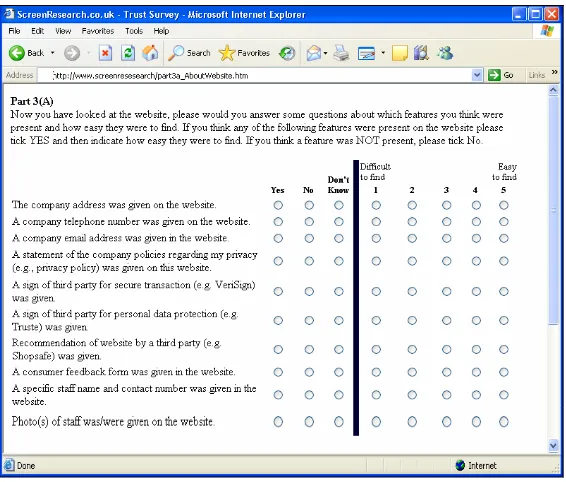
A set of questions is given to the respondents after they have visited the website, grouped into two sections i.e. Section 1 and Section 2. Section 1 (see Figure 1) focuses on the question about the presence of trust attributes in the website and how easy it is to find those attributes. Ten questions are put to the respondent, with three response alternatives provided to each question: YES, NO and DON’T KNOW. Response to how easy the trust attributes are to find are based on five Likert-scale points (1 to 5). 1 indicates a negative response to the question, i.e. very difficult to find, and 5 indicates a positive response, very easy to find.
Section 2 (see Figure 2) provides eight questions. The first five are about the degree of the respondent’s trust in the website, and the last three are about the nature of trust attributes such as ‘I found the privacy policy content easy to understand’. The response alternative is also based on Likert-scale points (1 to 5); 1 represents a negative response to the question, i.e. strongly disagree, and 5 indicates a positive response, strongly agree. For the last three questions, the option NOT AVAILABLE is provided, together with the five-scale level.
Questions about the Importance Ranking
The questions in this part provides ten questions concerning to what extent respondents think each trust attribute can build user trust in the website. Five Likert-scale points (1 to 5) were used; 1 indicates a negative response, not important, and 5 indicates a positive response, very important. The quetsions about the importance ranking of trust attributes is shown in Figure 3.
5.3 Data Analysis
The survey was open to the public for ten days from 9 to 18 December 2004. About 7,760 people were contacted via e-mail to invite them to take part in the survey, and after one day the survey had 869 respondents. This figure showed that it would be possible to achieve the target number, 1,200. In this survey, a prize of £500 in cash was offered. For the data analysis, the structure of the analysis follows the structure of the questionnaire used. The next three sub-sections provide descriptions of each part of the analysis.
Analysis of Demographic Questions
The total number of respondents taking part in this survey was 1,230, with a majority (62%) of
females. 90% of respondents were below fifty-five years of age. The distribution of the respondents seems standard for each age group except for the age group above 55. For the analysis of where the respondents come from, more than half (56%, 696) are from North America. The second largest group is from the United Kingdom, which received 204 respondents. The distribution of the respondents is not standard for each part of the world. 55 were from other EU countries, 11 from South America, 161 from Oceania, 98 from Asia, and only 5 from Africa.
For the analysis of years of experience using the Internet, most of the participants (89%) have more than four years’ experience, and only 25 have less than one year. 110 respondents fall into the group 2-3 years, 239 4-5 years, 356 6-7 years, 206 respondents fall in group 8-9 years, and 294 said that they have used the Internet for more than 10 years. This indicates that most respondents are familiar with the Internet and most likely they are familiar with the term Internet privacy and security. This background is helpful to the survey because it need respondents who are familiar with Internet technology.
In the analysis of years of online buying experience, 96% of respondents have been involved in buying online. Only 41 respondents said they never buy online. It is therefore not difficult for the respondents to understand the purpose and instructions of this survey.
For the analysis of frequency of buying online, categories ‘once a month’ and ‘once a week’ received a high response, respectively 402 and 148 respondents. 97% of respondents have experienced buying over the Internet. Only 39 respondents said that they have no experience in online buying. This distribution is advantageous to the survey because majority of the respondents have been exposed to the process of Internet transaction and most likely to related issues.
Figure 1: Section 1 of the questionnaire
Figure 2: Section 2 of the questionnaire
Figure 3: Questions about the importance ranking
Analysis of the Importance Ranking
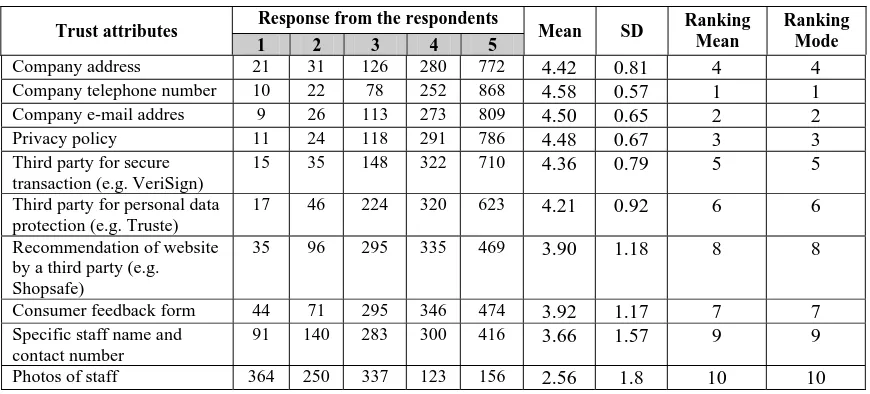
This section is to rank trust attributes according to the user opinion. Mean, standard deviation (SD), and mode are the statistical measurements used in the analysis. Mean and SD have been derived from the scale used in the questionnaire: positive response represented by 5 and negative response by 1. The higher the mean value, the more significant are the trust attributes, and the lower the mean, the less important are they. If two trust attributes have the same mean value, the SD will be used to determine which one is more important. The higher the SD, the less important is the trust attribute, and the lower the SD the more important is the trust attribute. The mode is the most frequently occurring value in the set of data. In the analysis, the mode value is determined by looking at the positive response represented by 5. The higher the
6. Conclusion
Trust is considered a key factor for the continued growth and success of E-Commerce. However, the process of building consumer trust in E-Commerce is still in its infancy, although some previous studies have provided significant insights into the nature and structure of this field. This paper contributes to the previous study by providing list of trust attributes that are grouped into four trust dimensions and also provides the importance ranking of ten trust attributes. These ten attributes can be include at the first page of e-Commerce website in order to communicate the trustworthiness of e-Commerce website. Furthermore, further studies also can be carried out based on these ten trust attributes such as (1) develop a tool to help consumer in look for the existance or otherwise of these attributes in e-Commerce website, and (2) investigate the quality of the content of each trust attribute in building consumer trust.
References
[1] Basso, B., Goldberg, G., Greenspan, S., and Weimer, D. (2001). First Impressions: Emotional and Cognitive Factors Underlying Judgments of Trust Ecommerce. In
Proceedings of the 3rd ACM conference on Electronic Commerce, Tampa, Florida, USA, Pages: 137–143.
[2] Cheskin Research and Studio
Archetype/Sapient. (1999). eCommerce Trust Study.
http://www.studioarchetype.com/cheskin/asse ts/images/etrust.pdf, Retrieved Sept. 9, 2002. [3] Che-Hussin, A. R. and Macaulay, L. (2005).
Trust Agent for E-Commerce: Looking for
Clues. IEEE International Conference on e-Technology, e-Commerce, e-Service, Hong Kong, pp: 286-289.
[4] Che-Hussin, A. R., and Macaulay, L. (2003), Personal Trust Agent for Ecommerce. Proceeding of CollECTer (Europe), Galway, Pages: 168-177.
[5] Doherty, J., Keeling, K., Newholme, T. (2002). HiSPEC: Human Issues of Security and Privacy in ECommerce, Technical Report, Deliverable 4.3 Rules of Trust, UMIST.
[6] Egger, F.N. (2000). Towards a Model of Trust for E-Commerce System Design. In
Proceedings of the CHI 2000 Workshop Designing Interactive Systems for 1-to-1 E-commerce, Zurich.
[7] Ishaya, T. and Macaulay, L. (2000). Towards Establishing Customer-Supplier Trust. Electronic Commerce: 13th Bled Electronic Commerce Conference Slovenia.
[8] Jarvenpaa, S.L. and Tractinsky, N. (1999). Consumer Trust in an Internet Store: A Cross-Cultural Validation. In Journal of Computer Mediated Communication, Vol. 5, No. 2, Pages: 1-35.
[9] Kim D., Song, Y., Braynov, S., Rao, H. (2001). A B-to-C Trust Model for On-line Exchange. Americas Conference on Information Systems, Boston, Pages: 784-787.
[10] Riegelsberger, J., Sasse, M. A. and McCarthy, J. D. (2005). The Mechanics of Trust: A Framework for Research and Design. International Journal of Human-Computer Studies, Vol. 62(3), pp. 381-422.
Table 3: Importance ranking of trust attributes
Response from the respondents Trust attributes
1 2 3 4 5 Mean SD
Ranking Mean
Ranking Mode
Company address 21 31 126 280 772 4.42 0.81 4 4
Company telephone number 10 22 78 252 868 4.58 0.57 1 1
Company e-mail addres 9 26 113 273 809 4.50 0.65 2 2
Privacy policy 11 24 118 291 786 4.48 0.67 3 3
Third party for secure transaction (e.g. VeriSign)
15 35 148 322 710 4.36 0.79 5 5
Third party for personal data protection (e.g. Truste)
17 46 224 320 623 4.21 0.92 6 6
Recommendation of website by a third party (e.g. Shopsafe)
35 96 295 335 469 3.90 1.18 8 8
Consumer feedback form 44 71 295 346 474 3.92 1.17 7 7
Specific staff name and contact number
91 140 283 300 416 3.66 1.57 9 9