LOST IN TRANSLATION: PROBLEMS IN INTERPRETING BUSINESS
ATTITUDES TO TRANSPORT
Geoff Dudley, Phil Goodwin, Glenn Lyons, Charles Musselwhite, Peter Wiltshire
Centre for Transport & Society, University of the West of England
Abstract
This paper reviews available UK evidence on (private sector) business attitudes to transport. It follows a 2008 review of public attitudes to transport, and provides an important frame of reference for considering business attitudes. Accordingly, the current paper includes comparisons between public and business attitudes. There are some prima facie similarities between public and business attitudes in relation to congestion, the order of importance of transport attributes (especially reliability), stated conditions for support of road pricing, public transport, travel plans, telecommunications, and some issues of reducing travel. There are, however, some differences also: transport concerns are less ubiquitous; less attention is given to the environmental concerns associated with road building; and there is less attention to wider government goals such as equity, health, social welfare, and the environment. However, both similarities and differences may be misleading, as research on business attitudes is less disciplined, and there are no well-established theoretical frameworks (such as exist for individual attitudes) for understanding attitudes, when applied to the corporate views of a commercial body. In essence, many of the business attitudes reports are framed as lobbying material yet, paradoxically, there can be considerable ambiguity attached to the meanings of business attitudes, that in turn can be partially attributed to doubts as to whether responses represent individual or corporate attitudes. As a result, it is very difficult, from the existing evidence, to interpret a clear and coherent view or set of views of business on transport issues. The authors suggest some protocols, with the aim of improving research methods that, if implemented, could help improve the credibility and clarity of claims to represent the ‘voice (or, more realistically, voices) of business.’
Keywords: business; attitudes; methodology; interpretation
1. Business Attitudes and the ‘Lost in Translation’ Paradox
In 2008-09, we undertook a review for the UK Department for Transport (DfT) of UK evidence on private business attitudes to transport (Lyons et al, 2009). This was intended as a follow up study to a similar review of evidence on public attitudes to transport, which was published by the DfT in June 2008 (Lyons et al, 2008). Business attitudes to transport demonstrate their own highly distinctive economic, political and social contexts and functions, that in turn produce particularly difficult problems of definition and interpretation. A crucial difference between public and business attitudes is that the latter are frequently articulated and presented in a political context, where both individual businesses and representative business groups participate in networks that may lobby intensively at different levels of governance, including EU, national and local. This lobbying is particularly evident in the case of national representative business associations, such as the Confederation of British Industry, The British Chambers of Commerce, and the Institute of Directors. Each of these has the responsibility of representing the views of its members, which may be complex and multi faceted. It is therefore not easy to identify a business attitude as an unambiguous expression of opinion, as we might find in the case of public attitudes.
business remains politically weak, making it difficult for government to enter into a partnership relationship, even if it wanted to. He concludes that it is not easy for business in Britain either to define its interests, or to select the best political strategy for pursuing them, in part because there are important divisions of interest between different sectors of business, and in part because the optimal strategy to secure a defined end is not always readily apparent (Grant, 1993, 18). The heart of the paradox is therefore that, when businesses and representative associations act predominantly as lobbying organizations, they may squander their potential asset as credible conveyors of business attitudes and information (Grant, 1993, 20).
The significance of transport issues to business can of course vary greatly across the various sectors. Nevertheless, transport logistics and costs are likely to be at least of some significance for the large majority of manufacturing and commercial businesses. In their analysis of British transport policy, Glaister et al. (1998) acknowledge that business has special power, given that its main interest of economic growth is regarded generally as coinciding with the public interest, so that governments automatically take its views into account. At the same time, they concede that the evidence for and against the influence of ‘big business’ in transport is equivocal (Glaister et al, 1998 113). Thus they provide support for Grant’s analysis in concluding that transport policy networks are a source of policy inertia, not innovation (Glaister et al., 1998: 117). In other words, rather than business setting the policy agenda, politicians provide their own version of what business needs (Grant, 1993, 19). Whereas business appears to comply with a deferential or passive political tradition in the UK (Bevir and Rhodes, 2003, 102), Mazey and Richardson argue (in the case of lobbying in the EU) that this is likely to favour actors who can ‘massage’ the ‘framing’ of policies (Mazey and Richardson, 1996, 214). In analyzing and assessing the available material on business attitudes to transport, this paper therefore addresses the heart of the paradox that lies in the gap between the potential influence of business in ‘framing’ the policy debate, and its actual current impact. Consequently, in providing a critique of the methodological quality of the surveys, a major aim of the paper is to suggest ways in which business can enhance its reputation as a source of authoritative evidence, that can more accurately convey the often complex messages coming from business on key transport issues. An improvement in the methodological quality and presentation of business attitudes reports cannot in itself of course guarantee better decision making, but it can at least improve the chances that government can base its decisions more on authoritative data that conveys messages that are not ‘lost in translation.’
The next section addresses these difficulties for business when compared with the material on public attitudes. The following section briefly summarizes the methodological approach to the business attitudes survey. This is followed by identifying some of the principal similarities and differences in the results obtained by the public and business attitude surveys. From this analytical and comparative base, the following three sections then examine in more detail the problems, outlined above, in identifying, defining and interpreting business attitudes to transport. In the Conclusion, the paper suggests some protocols, largely with the aim of improving research methods, and hence the quality of the messages conveyed by business.
2. Problems in Defining and Interpreting Business Attitudes
Given the relative paucity of research into business attitudes to transport, and the consequent lack of a theoretical framework for analysis and interpretation, the more established and substantive research into public attitudes to transport can provide both a frame of reference and a comparative context for a business attitudes study. This paper therefore complements, and extends from, a recent paper that analysed and interpreted the evidence from the 2008 review of public attitudes to transport (Goodwin and Lyons, 2010). It should be noted that the review exclusively concerns UK evidence. However, especially in terms of issues of definition and interpretation (as opposed to specific empirical findings), it is almost certain that these will have a universal relevance.
issues which may be compared. However, some crucial differences emerge. For example, there are basic functional differences in obtaining business and public attitudes that in the case of the former present significant (almost endemic) difficulties. Goodwin and Lyons highlight that in terms of public attitudes there is virtually never a single public view: on every issue of importance there is a range of different views, and this remains true even within quite small and well-defined groups of age, gender, socio-economic group, car ownership or region (Goodwin and Lyons, 2010, 4). As such it is misleading to suggest or imply that a single, unifying ‘public attitude’ exists regarding any issue. Nevertheless, it is possible to attribute an attitude to a single individual at a given time. The same proposition becomes much more problematic when considering business attitudes. Again it would be misleading to suggest a single view exists reflective of all businesses. However, the greater difficulty emerges in the proposition that an attitude can be attributed to a single business. In the case of all but the smallest of businesses, an individual business view is in fact some type of corporate view that is an (implied) synthesis of opinion across a number of individuals comprising that organisation’s interests.
Thus we suggest there is a major problem in identifying, or even defining, a business attitude. By whatever process a business responds to exercises gathering business attitudes, there is a tendency for the process and exercise together to result in an apparent single view from the business: As a result, it is almost certain that a systematic underestimate of the range of different attitudes that may exist within a given business will arise. Similarly, the process of reporting meant that systematic patterns that might exist between business types or sectors could also be obscured. Even if a single corporate view could, in principle, exist, it was difficult to judge from the evidence on business attitudes how accurately this was conveyed by the specific individuals responding to a survey on behalf of their employer. Mostly, there is no record of the seniority or responsibilities of the respondents. As a result of these ambiguities, there appears to be no well-established theory, such as exists in the study of individual attitudes, for analysing what attitude means in the case of a corporate body with primarily commercial objectives.
This fundamental contrast in the identification of business and public attitudes in turn reveals the serious comparative difficulties of interpretation with regard to business attitudes, particularly in connecting these to wider attitudes and values. As Goodwin and Lyons argue in the case of public attitudes, just as transport and travel choices are rooted in the structure of activities undertaken by individuals and families, it follows sensibly that attitudes to transport must also be rooted in deeper values and aspirations of how people want to live their lives. These include not only economic motivations, but also a wider set of influences, including stress, tranquility, feelings of control and independence, social obligations and desires for both excitement and calm (Goodwin and Lyons, 2010, 16). In contrast, the difficulties in interpreting a corporate view mean that it can be virtually impossible to know (particularly in policy terms) what business actually wants, such as in the case of regulatory and environmental issues where business itself may have complex economic and social motivations, arising from its relationships with the attitudes of people who constitute its markets. Overall, the question must be asked, can a business have attitudes towards transport?
In addition to these problems of definition and interpretation (and perhaps partly because of them), there were also significant methodological difficulties with many of the business attitudes surveys, compared with those for public attitudes. For example, examined reports had often omitted a (thorough) account of the type of contextual information that is routinely included in studies of individual attitudes, including survey design, precise wording of questions, framing, sampling, and analytical methods. In a number of cases, the trail connecting the evidence collected with the conclusions and reported headlines was not altogether clear, with the latter sometimes reduced to overly simplified statements of the form ‘Business thinks that…’
Overall, therefore, these problems were considered to have reduced the transparency, clarity and robustness of results presented in the review, with the result that in many cases significant caveats had to be applied to the evidence presented.
key features of the review, therefore, this paper seeks to identify some of the chief ways in which business can improve the quality of communicating its point of view to government, and to the wider public.
3. Business Attitudes Review Methodology
The business attitudes review sought specifically to provide insights into: how transport was perceived, in relation to other factors, to impact upon business decisions; the business priority requirements from transport; and the main tradeoffs, opportunities and barriers. In this context, it must be emphasised that the current paper represents a further interrogation and analysis of existing evidence that was identified and reviewed in the study undertaken for the DfT (see Lyons et al., 2009). As such, the paper is a synthesis of the DfT report, but with its own focus and emphases. In methodological terms, the review initially distinguished between ‘easy to reach’ and ‘harder to find’ evidence. The former was identified principally from a process of bibliographic searching and online search engines. Search terms included ‘business survey transport’; ‘business views on transport’; ‘transport concerns of businesses’; ‘survey of business attitudes’; ‘UK business opinion on transport issues’; ‘supply chain efficiency’; ‘UK employee parking’; ‘logistics survey UK’; and ‘business location difficulties UK.’ The latter involved making direct approaches to organisations that might be gatekeepers for further evidence inaccessible or less apparent in the public domain. The latter resulted in contact with 32 organisations, including national representative bodies such as the Confederation of British Industry, the Federation of Small Businesses, the British Chambers of Commerce, the Institute of Directors, and the British Retail Consortium, together with a range of regional bodies. It should be noted that each of the agencies contacted in some sense represents, or collates, a group of businesses, and not a single organisation, nor the range of individuals within an organisation. They are not research bodies per se, but have other representative functions often including public relations and lobbying on behalf of their members, and the expression of a united coherent view can often have advantages over the discovery of diversity or dissent: they are more likely to express ‘the voice of business’ than ‘the voices of business’. The body of literature examining business attitudes to transport is substantially smaller than the corresponding literature on public attitudes to transport. Overall, 166 articles were identified (compared with more than twice this number, even at the first level of cursory search, for public attitudes). Nearly all the reported studies used structured questionnaires analysed quantitatively, with little evidence employing qualitative social research methods, such as focus groups and depth interviewing. To establish the framework for reviewing, a Microsoft Access ‘Research Compendium’ was set up using a standard template to record details, together with a synthesis of information relating to each item reviewed. In all, 97 articles were reviewed and included in the Compendium. The large majority of these were from the past ten years, although one or two earlier items were included where considered of particular relevance. Of the 97 items, only 26 were specifically transport surveys, and several of these were quite narrowly based, in terms of location and subject. It was found that only a relatively small number of the studies contained substantial relevant evidence, and the review consequently drew more heavily on these, notably studies published by the British Chambers of Commerce (BCC, 2006, 2007, 2008) and by the Institute of Directors (IoD, 2004, 2006, 2007). We had to discount some studies that had been reported in the media, but for which it was impossible to track down any more detailed information than a press release.
In terms of division into categories, the 97 items could be classified as: general business surveys – 29; transport surveys – 26; organizational views on transport issues – 16; parking and travel plans – 9; business location – 8; logistics – 5; ICT – 2; road pricing – 2.
4. Comparisons of Business and Public Attitudes
findings from our earlier review of the evidence related to public attitudes (Lyons et al., 2008). It is important to emphasize that in this section we are using these comparisons in order to highlight salient characteristics of business attitudes and the associated surveys, rather than to make comparisons between public and business attitudes per se.
With regard to traffic congestion, firstly, rather similar proportions of businesses saw congestion as a significant problem as did the public as a whole, namely around half or less. Secondly, similar to the finding that on the whole the public believes congestion is more of a problem to society than it is for them personally, congestion is seen as a bigger problem for ‘business as a whole’ than for the individual company responding, though the latter evidence is less conclusive. There was a very similar public and business view overall that reliability should be seen as more important than journey time per se, on roads, rail and air.
There was a similar conflict of evidence about the importance of fares and other money costs, with both public and business surveys finding that these are highly important, or that they are rather unimportant, depending on the form of question asked. In the case of road pricing, support was conditional on other improvements in the cases of both business and public attitudes, with the same primary emphasis on improvements to public transport, and also a tendency to approve of reductions in other taxes, with an apparent ambivalence in choosing between these.
In contrast, road construction was a subject that indicated different motivations and perspectives between public and business attitudes. Thus in the case of public attitude surveys, road construction was seen as a topic marked by a divisive split of opinion, with large, strong minorities both for and against, and an equally large group not putting itself on either side. The business evidence was also complex, but for a different reason. Thus some surveys reported very strong support for expanded road infrastructure, while others showed it as much less preferred than other policies (for example public transport improvements), though not necessarily opposed.
It might be expected that in the case of private sector business, the criteria for assessing road building would be based chiefly on the economic gains to be made, with less weight given to environmental criteria than would be the case with significant sections of the public. The problem is that, with this in mind, there is a very marked difference in the degree of attention which has been given to eliciting company views on matters relating to transport such as health, environmental conditions, equity, and climate change, compared with that given to public attitudes. This may derive from a view that these topics are less of a concern to businesses, or to the sponsors of studies. However, in a few cases where business views had been sought, reported attitudes may appear similar in sentiment to those expressed in public attitude studies, for example a degree of willingness to accept, in principle, higher air prices for reasons of carbon reduction.
In total, in some (but not all) of the evidence, transport played a less dominant part in the concerns of businesses than it did for individuals, especially in studies where businesses were not prompted specifically to focus on transport. This may be because the framework within which private businesses operate as profit-making entities primarily legitimizes attitudes that are concerned with the profitability of their undertakings, whether in the short or longer term, and that transport is not perceived to be as major an influencing factor on profit-making as other considerations.
A good example of the apparently low priority spontaneously attached to transport by business is provided by the (formerly) Department of Trade and Industry’s Annual Small Business Survey, covering nearly 10,000 businesses (BERR, 2008). The biggest ‘obstacles to business success’ that were reported amongst employers with 250 or fewer employees were: competition in the market (15%); regulations (14%); and taxation, including Value Added Tax (VAT), Pay As You Earn (PAYE), national insurance and business rates (12%). In contrast, transport was mentioned just 24 times as the biggest obstacle to success - i.e. by less than 1% of respondents, and did not even merit an entry in the summary table (BERR, 2008, Table 5.1).
organisations (including public sector), and suggested transport may play some role in determining business competitiveness and growth. When presented with a pre-determined list of factors, contributing most to the organisation’s competitiveness, ‘Good transport infrastructure’ ranked eighth out of fifteen, being mentioned by about 16% of firms. In addition, respondents were also presented with a list of 24 potential key factors ‘inhibiting further growth in your region.’ These included ‘Transport cost’ and ‘Inadequate transport infrastructure.’ ‘Transport cost’ ranked fourth overall, at 20%, while ‘Inadequate transport infrastructure’ was named by 12% (Yorkshire Forward, 2007, Table 16).
These examples suggest that survey design has a significant influence on responses and reported findings. In this context, no studies were identified where the response options had clearly been constructed by a formal process of preliminary open-ended research or a full literature review (though this may have happened without being noted in the reports). Given the influence of which issues are included in a list of response options, it is likely that the terminology used to describe those issues is also important, e.g. using words like ‘inadequate’. Consequently, overall there is one very big difference between the two studies. In the public attitudes case, there was reasonable confidence that the results found were robust and consistent, and where they were not it was often possible to explain the likely reasons from internal evidence or reference to sources. On the other hand, in the business attitudes case most or all of the points above are stated with less confidence that they are well supported by the research. Notwithstanding the number of important similarities and differences between business and public attitudes, we are more confident that this expresses ‘true’ public attitudes than ‘true’ business attitudes, in part because of the conceptual difficulties in defining the latter. Problems of definition and interpretation therefore run like a thread through business attitude surveys, and in the next three sections we examine in more detail some of the chief ambiguities and weaknesses, that condition the quality and credibility of these studies.
5. Ambiguities Related to the Meanings of ‘Business Attitudes’
The classic economic approach would be based on a view that the primary function of a business is to make a profit for its shareholders, and an ‘attitude’ might therefore be considered as a more or less informed judgment about how best to achieve this. With this view, managers or advisers might be the custodians of such attitudes, but they operate as agents and employees of the shareholders, whose viewpoint they are often supposedly representing. In this context it is an extraordinary observation that we have found no study at all aiming to discover the transport attitudes of shareholders, collectively or individually. For some companies, of course, transport may not be a major factor in determining its share value, but even in these cases there would be value in understanding better the views and perceptions held by shareholders, and how these may vary across a range of companies.
The notion of a straightforward economic approach is complicated by the fact that companies will have corporate views on relations with customers, employees, public opinion and government, and these will have been influenced by compliance to legal requirements on, for example, health and safety or environmental standards. An organisation that is alert to the needs of its customers may well be influenced by its customers’ attitudes on a range of matters, and similarly those of its workforce. In expressing views in public, it will also be aware of potential implications of supporting, or contradicting, prevailing orthodoxy. In essence, therefore, complex motivations may underlie the expression of a business attitude, with profit maximization just one element in the mix.
The further one departs from the view that the core organization interest is its own bottom line, the more likely it is that there will be a confusion between business attitudes, and the expression of personal attitudes by those individual employees (who are themselves a section of the public) whose job includes replying to business questionnaires.
bodies, which do not exist for a primary business function but as representatives. These bodies themselves have a tradition of informed interest in transport policy, and may even have transport specialists who have been recruited from a background that is closer to their professional colleagues than their business constituents.
An example of this complexity is seen in successive surveys produced by the British Chambers of Commerce in 2006, 2007, and 2008 (BCC 2006, 2007, 2008). Table 1 shows the detailed breakdown of responses to giving conditional support to the principle of road pricing.
Table1. “The Government's road pricing initiatives include toll roads, congestion
charging, pay per mile, etc. Which of the following, if any, do you consider to be the main circumstances under which you would support the principle of road pricing? (PLEASE TICK NO MORE THAN 3)”1(% of respondents selecting each circumstance)
2006 2007 2008
If significant improvements are made to public transport prior to the introduction of road pricing
41 42 39
If it replaces fuel duty 46 32 36
If money raised from road pricing is put directly into improving
public transport 34 34 35
If it replaces road tax 42 31 32
If road capacity is significantly improved as a result 35 29 31
If it is used to reduce congestion 39 32 29
If it does not add administrative burdens to businesses 29 18 22
Would not support under any circumstances 13 22 22
Base: 1348 2568 2442
Sources: (BCC, 2006), (BCC, 2007) and (BCC, 2008) - BCC Transport Survey reports
It may be seen that 22% (for 2007 and 2008) said they would not support road pricing under any circumstances, implying that nearly 80% would accept road pricing if their conditions were fulfilled. Two of the listed circumstances for respondents were that significant improvements should be made to public transport, and the related requirement that the money raised should be spent on public transport. To vote for both of these would have used up two votes, and if there had only been one public transport condition it would almost certainly have got more than either got separately, but probably less than the two added together. This can be compared to only one listed circumstance addressing road capacity (i.e. if this had been divided into two, it is very unlikely that each would have received fewer votes). Another listed circumstance was the requirement of reducing fuel duty or road tax. Clearly any revenue that is used for this would not be available to spend on public transport or
road capacity. Thus while the results may well be consistent in the sense of what people would like, they may not be based on an internally consistent and feasible policy option. In other words, nearly 80% of businesses, or their representatives, may well give conditional support to road pricing, but it does not follow that such conditions can be met. Very stark evidence of this problem is seen in the report of an IoD 2004 study (IoD, 2004) which suggested that 56% “would support the introduction of
1 Only the 2006 BCC survey report included the questionnaire from which the wording in the table is
widespread road pricing on motorways and major routes, on a revenue-neutral basis2 with the
revenues raised being used for extra transport capacity”.
6. Corporate or Individual Responses?
The BCC questionnaire reported above did not explicitly define to the respondents (or therefore to the readers) whether the ‘you’ in the phrase ‘you would support’ represents an agreed company view or a personal one. A 2004 review of public and business attitudes to road pricing (Lyons et al, 2004) also concluded that more needed to be known about the structure and dynamics of national and local business networks, including such basic facts as who represented business when responding to surveys.
It appears that in most cases a single individual seems typically to be providing the information, and the survey reports presume (implicitly) that they do so as a spokesman not for themselves, but for their employer. The business that employs them is a legal entity, not an individual3. At one extreme,
an individual who operates as a one-person business may not show any difference between the role of ‘person’ and the role of ‘business,’ and expressed opinions may simply be those of a particular sort of member of the public, whose attitudes will be influenced by their life-style and work, similar to the way that another member of the public may be influenced by their role as an employee.
However, one-person businesses are a very special case. At the other extreme, very large businesses have several different departments who do not necessarily share the same view about transport, for example supplies, dispatch, personnel, and public relations. We have not found a single case where businesses have said, for example ‘our dispatch department wants better roads but our personnel department wants better public transport’, though this must exist.
In all cases other than one-person firms, a business is a collection of more than one individual. The individual whose role it is to answer a questionnaire, nominally as the collective corporate view of the legal entity that employs them, does so at the same time as being an individual with their own individual set of attitudes. Occasionally these might be explicitly recognised: ‘well, personally I think this, but the organisation view is that,’ but more often no such distinction is made, or indeed may be suppressed. In a few cases of big public consultations on matters of high profile importance, it is quite likely that there will have been some discussion within the organisation on how to answer a question (or the respondent will ‘ask the boss’). In other cases, however, it is quite unrealistic to think that Boards of Directors spend time on the detail of subtle distinctions and rankings of importance. Consequently, it is logical to assume that filling in a questionnaire is not a task which necessarily attracts the attention of the most senior management levels – especially where such a questionnaire concerns business views on rather abstract or distant aspects (such as future national transport policy possibilities) as opposed to concrete, tangible more immediate aspects (such as a specific proposed transport project in their local area).
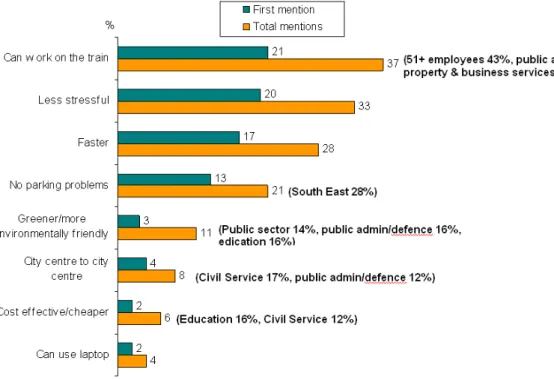
These ambiguities are well illustrated in a rail travel context in a survey of 500 businesses with a significant travel need (defined as necessitating the use of travel in their business, and at least one employee being required to travel at least 20 miles each way per month) undertaken by the rail group Passenger Focus (Passenger Focus, 2009). Use of mode for business trips was assessed, and from this views were sought on the advantages and disadvantages of rail travel. As an example, the responses on the advantages of rail travel are shown in Figure 1. Crucially, in considering such results it must be borne in mind that it was not known the extent to which the respondent to the survey
2 The phrase ‘revenue neutral’ is usually taken to mean that an equivalent reduction of other taxation
occurs. Hence it is by definition an alternative to full hypothecation of revenue to transport spending, not a supplement to it. This statement amounts to spending the same money twice, an error that one would expect any individual business rapidly to understand, but appears as the collective view of the majority. The apparent majority is an artefact of adding together incompatible conditions.
3 It may sometimes be treated as a legal ‘person,’ but this is a metaphor, not a description of a human
had an informed view on their organisation’s collective opinion of rail travel, or indeed whether they were in fact answering based on their own, rather than their company’s, attitudes.
Figure 1. “What would/do you see as the main advantages of travelling by rail on business.”
Source: (Passenger Focus, 2009) – Passenger Focus - from Chart 5 in original report
Note: First mention was the individual’s unprompted initial response to the question. They were
then probed for if there were other reasons, leading to the ‘total mentions’ figure.
In our review of such subjects as congestion and public transport quality, and in relation to travel mode choices, the evidence may well have been reflective largely of the individual respondent’s view based on their own experience, as distinct from an informed view on behalf of their business as a whole.
In just a few cases, the limitations of the methodology in relation to respondents were acknowledged. For example, an unpublished Institute of Directors 2007 (IoD, 2007) report on a road pricing survey identified concerns about the robustness of its own findings on the grounds of both the small sample size (142 responses) and the self-selecting nature of the respondents. In other cases, it could be said that particular attention had been given to who actually responded. In this category, qualitative evidence in a pilot study from the East Midlands on congestion management (Integrated Transport Planning, 2008) most unusually ensured that, for each of the five in-depth interviews, the person interviewed was the one chiefly responsible for transport at the relevant business. This gave a distinctive, salient and presumably ‘hands-on’ perspective. The in-depth character of the interviews also allowed the respondents to give considered answers on how congestion affected each individual business.
sometimes even on the largest of several minorities, or the viewpoint most forcefully expressed in the councils of the organisation.
Consequently, there can be a (subtle) disconnection between their dual role as attitude and information gatherers from their members, but also lobbyists to government. This need cause no problems when the detailed quantitative results and background information of surveys are available to the interested reader, but is very opaque if only short press releases are issued.
7. Other Concerns of Interpretation and Information
Another concern with business attitudes surveys, particularly when compared with those for public attitudes, is that questions can be framed in an ambiguous way, which in turn can lead to conclusions that superficially or misleadingly reflect the evidence obtained. For example, one headline finding from the British Chambers of Commerce 2006 transport survey was that: “[o]ver 80% of businesses feel there is a problem with road congestion” (BCC, 2006). In fact, this headline was derived from a question which asked: “How significant do you think the problem of road congestion is for your business locally, regionally and nationally?” with the response options being: ‘Not a problem at all; ‘Somewhat of a problem’; and ‘A significant problem.’ As the results in Table 2 show, an equally, if not more appropriate headline could have been: “over 40% of businesses feel there is a significant problem with road congestion” or indeed “the majority of businesses do not consider congestion to be a significant problem for their business.” This highlights the problem of how influential both the wording of questions and response options, as well as the subsequent interpretation of results, can be on portraying an apparent understanding of business attitudes. In the event, the equivalent headline finding in the 2007 report was slightly more nuanced: “85% or more claim that road congestion locally, regionally and nationally is a problem to their business. Overall, nearly half of all respondents rate it as a significant problem, which represents an 8% rise on last year’s results.” (BCC, 2007). Note also that there is no clarification on the nature of “the problem” for businesses in these questions. In addition, there is the question of whether businesses would be answering in the affirmative only if they agreed road congestion is a problem locally AND regionally AND nationally, as the question implies. For example, what would be the response if business found congestion was a problem nationally and not locally? Consequently, care needs to be taken when wording and subsequently reporting such questions, where disagreement would not necessarily mean the opposite of agreement.
A comparable example was found from a survey of Institute of Directors’ members in 2006 which reported that 30% of respondents considered traffic congestion cost their organisation ‘a great deal’ or ‘quite a lot’; 38% suggesting ‘a moderate amount’; and 23% ‘very little’ (IoD, 2006). Once again, it is the middling phrase ‘a moderate amount’ that causes the difficulty in interpretation. If ‘moderate’ is taken to mean ‘noticeable but ‘acceptable’ then the interpretation is reversed. In this case, the phrases were not tangibly defined in terms of money or proportions of total costs. These ambiguities can of course be placed in the context of the lobbying role of the business associations concerned, with the result that phrases such as ‘a moderate amount’ can be open to interpretation in several different ways, and so a message can be tailored to suit the situation. At the same time, it can also be argued that these types of ambiguities represent classic examples of messages being ‘lost in translation,’ and undermine the credibility of the groups concerned in terms of the quality of the research.
Table 2. “How significant do you think the problem of road congestion is for your business locally, regionally and nationally?”
Locally congestion for my business is…
2006 2007 2008
Not a problem at all 16 15 15
Somewhat of a problem 42 37 40
A significant problem 42 48 45
Regionally congestion for my business is…
2006 2007 2008
Not a problem at all 10 9 10
Somewhat of a problem 50 43 46
A significant problem 40 48 44
Nationally congestion for my business is…
2006 2007 2008
Not a problem at all 15 14 15
Somewhat of a problem 41 38 39
A significant problem 44 48 46
Base: 1262-1335 2444-2550 2322-2435
Sources: BCC Transport Survey reports (BCC, 2006), (BCC, 2007) and (BCC, 2008)
Perhaps most basic of all, with a few exceptions even the questionnaires are not routinely included in a report appendix. These omissions seriously reduce transparency.
should seek to make a significant impact as lobbyists, it could also be said that this represents an example of the paradox, whereby immediate impact takes precedence over building a long-term credibility as sources of authoritative data on business attitudes.
8. Conclusions
At present there is an absence of a theoretical framework for understanding or underpinning the concept of ‘business attitudes’. At the heart of the matter is defining the meaning of an ‘attitude’ as the expression of a corporate body, put into words by one individual within the body, in a context where there is no established protocol for ensuring that the voice is truly corporate or even for defining what ‘truly corporate’ means.
New research on this would need to include: direct exploratory discussion with individuals performing various different functions within the company; a recording of what happens in practice when a company is in receipt of a request to fill in surveys and questionnaires; and the practices within the higher tier of representative bodies, such as trade associations and campaigning groups, by which they determine their collective view in expression to government. Such a study would include examination of the way that attitudes may change over time, in the context of the relationship between businesses and the consumers of their products and services, together with expectations of company life and profitability over time, and expectations of the speed of transport policy formulation and project implementation. It would also include considering how such issues can be translated into well-defined and robust questions and statements. Such a task may ultimately involve lengthy research over some years, not necessarily founded in transport studies, but at least an initial approach to this question seems to offer chances of improving understanding of the results of this study of business attitudes, and interpretation of the results of future surveys.
In addition, in order to improve the quality of capturing business attitudes, the crucial question of distinguishing corporate from individual response is needed, and all surveys should ask for details of who has actually answered, and what their role is within the firm, together with whether there has been any endorsement of the answers at a higher level. They should either contain explicit instructions concerning the person, or type of person, who is appropriate as the respondent, or record that this has not been done. Questions need to be framed in such a way that it is clear to the respondents that the answer required is based on a business not an individual attitude. In the context of disaggregation, information sought from each firm should routinely include (standardised) key indicators such as its size, sector, region, and industry. It would be appropriate, also, if business gave more attention to the importance of qualitative research, in being able to inform survey design, and offer explanatory insight to quantitative findings.
There are also several important points with regard to improving the quality of analysis and reporting. In particular, the exact wording of questions used should always be included in all tables of results. In addition, the full text of questionnaires should be included in an Annex, together with any interviewer instructions, or clarifications. In the case of the survey itself, the sampling design, number of questionnaires issued, response rate and consequent sample sizes should be reported, together with a breakdown of variation in sample sizes, if this differs markedly in different questions. There should also be a report of what analysis has been undertaken, if any, to check for the representative quality of the sample, and potential non-response bias.
In addition, given the particular concerns with regard to the quality of business attitudes research, some type of peer review process, such as by informed experts who are independent of the sponsoring body, can make an important contribution to improving this quality.
All the above points reveal weaknesses in the business attitude reports that largely highlight contrasts with comparable work on public attitudes. However, there is one area where it could be said that there are similar weaknesses. Goodwin and Lyons note the almost complete lack of evidence on how individual attitudes change over time. They therefore conclude that longitudinal analysis of individual attitudes seems to be the most important evidence gap, both for understanding and for the practical application of policy development (Goodwin and Lyons, 2010, 16). Similarly, there have been powerful economic and environmental forces at work over the past two decades that have altered the structure and needs of business, including the absolute and relative importance of specific transport issues to businesses. For example, McKinnon (2007) summarised the results of an exploratory analysis of the ‘decoupling’ of Gross Domestic Product and road freight transport growth in the UK, due to a diminishing rate of geographical centralization; the displacement of production activity to other countries; and the accelerated growth of the service sector. At a time of rapid change, surveys showing a snapshot of opinion may already be out of date, or swiftly become so. In this context, for example, nearly all the work reported here was carried out before the full ramifications of the current economic climate became apparent.
All of the above recommendations do not, of course, preclude the hard political fact that businesses and business groups will continue to lobby governments about their special needs, and to represent what they consider to be their particular interests on a wide variety of transport issues. The great advantage to be won by business, however, is to enhance its reputation as a conveyor of high quality research that is transparent in its methodology. In doing so, it can go a significant way towards finding a solution to the paradox of the inverse relationship between lobbying intensity and effective impact.
Acknowledgments
The authors are grateful for the engagement in, and critical feedback concerning, the study and its reporting from the Social Research and Evaluation Division in the UK Department for Transport (DfT). The views in this paper are those of the authors only, and do not necessarily represent the views of the DfT or any other Government department.
References
Bevir, M. and Rhodes, R.A.W. (2003) Interpreting British Governance, London: Routledge.
BCC (2006) Waiting in Line. A Transport Survey by the British Chambers of Commerce, London: The British Chambers of Commerce.
BCC (2007) Running on Empty: A Transport Survey by the British Chambers of Commerce, London: British Chambers of Commerce.
BCC (2008) The Congestion Question: A Business Transport Survey, London: The British Chambers of Commerce.
BERR (2008) Annual Small Business Survey 2006-7, London: Department for Business Enterprise & Regulatory Reform.
Glaister, S., Burnham, J., Stevens, H., Travers, T. (1998) Transport Policy in Britain, Basingstoke: Macmillan.
Goodwin, P. and Lyons, G. (2010) ‘Public Attitudes to Transport: Interpreting the Evidence,’ Journal of Transportation Planning and Technology, 33, 1, 3-17.
Integrated Transport Planning (2008) 6Cs TIF Congestion Management Study, Business Impacts Case Studies.
IoD (2004). Transport Matters: Making the Transport System Work for British Business. London: Institute of Directors.
IoD (2006) Transport Matters. Directors’ Views on Some Topical Transport Issues. A Survey of IoD Members, London: Institute of Directors.
IoD (2007) IoD Road Pricing Survey Results, London: Institute of Directors.
Lyons, G, Dudley, G, Slater, E, Parkhurst, G. (2004) Evidence-Base Review – Attitudes to Road Pricing, Final Report to the Department for Transport.
Lyons, G, Goodwin, P, Hanly, M, Dudley, G, Chatterjee, K, Anable, J, Wiltshire, P, Susilo, Y, (2008) Public Attitudes to Transport: Knowledge Review of Existing Evidence, Final Report to the Department for Transport.
Lyons, G, Musselwhite, C, Dudley, G, Goodwin, P, Wiltshire, P (2009) Business Attitudes to Transport: Knowledge Review of Existing Evidence, Final Report to the Department for Transport. McKinnon, A.C., (2007) ‘Decoupling of Road Freight Transport and Economic Growth Trends in the UK: An Exploratory Analysis’, Transport Reviews, 27(1), 37-64.
Mazey, S. and Richardson, J. (1996) ‘The Logic of Organization: Interest Groups’ in J. Richardson (ed.) European Union. Power and Policy-Making, London: Routledge, 200-15.
Passenger Focus (2009) Employers’ Travel Business Needs from Rail, London: Passenger Focus. Yorkshire and Humber Chambers of Commerce (2007) Waiting in Line: Yorkshire and Humber Transport Survey, Barnsley: Yorkshire and Humber Chambers of Commerce.