Human Language Technologies: The 2010 Annual Conference of the North American Chapter of the ACL, pages 546–554,
Online Learning for Interactive Statistical Machine Translation
Daniel Ortiz-Mart´ınez
Dpto. de Sist. Inf. y Comp. Univ. Polit´ec. de Valencia
46071 Valencia, Spain [email protected]
Ismael Garc´ıa-Varea
Dpto. de Inform´atica Univ. de Castilla-La Mancha
02071 Albacete, Spain [email protected]
Francisco Casacuberta
Dpto. de Sist. Inf. y Comp. Univ. Polit´ec. de Valencia
46071 Valencia, Spain [email protected]
Abstract
State-of-the-art Machine Translation (MT) systems are still far from being perfect. An al-ternative is the so-called Interactive Machine Translation (IMT) framework. In this frame-work, the knowledge of a human translator is combined with a MT system. The vast ma-jority of the existing work on IMT makes use of the well-known batch learning paradigm. In the batch learning paradigm, the training of the IMT system and the interactive translation process are carried out in separate stages. This paradigm is not able to take advantage of the new knowledge produced by the user of the IMT system. In this paper, we present an ap-plication of the online learningparadigm to the IMT framework. In the online learning paradigm, the training and prediction stages are no longer separated. This feature is par-ticularly useful in IMT since it allows the user feedback to be taken into account. The online learning techniques proposed here incremen-tally update the statistical models involved in the translation process. Empirical results show the great potential of online learning in the IMT framework.
1 Introduction
Information technology advances have led to the need for more efficient translation methods. Current MT systems are not able to produce ready-to-use texts. Indeed, MT systems usually require human post-editing to achieve high-quality translations.
One way of taking advantage of MT systems is to combine them with the knowledge of a human trans-lator in the IMT paradigm, which is a special type of the computer-assisted translation paradigm (Isabelle and Church, 1997). An important contribution to IMT technology was pioneered by the TransType
project (Foster et al., 1997; Langlais et al., 2002) where data driven MT techniques were adapted for their use in an interactive translation environment.
Following the TransType ideas, Barrachina et al. (2009) proposed a new approach to IMT, in which fully-fledged statistical MT (SMT) systems are used to produce full target sentence hypotheses, or por-tions thereof, which can be partially or completely accepted and amended by a human translator. Each partial, correct text segment is then used by the SMT system as additional information to achieve improved suggestions. Figure 1 illustrates a typical IMT session.
source(f): Para ver la lista de recursos reference(ˆe): To view a listing of resources
inter.-0 eep
s To view the resources list
inter.-1
ep To view
k a
es list of resources
inter.-2
ep To view a list
k listi
es listing resources
inter.-3
ep To view a listing
k o
es o f resources
[image:1.612.319.534.322.461.2]accept ep To view a listing of resources
Figure 1: IMT session to translate a Spanish sen-tence into English. In interaction-0, the system sug-gests a translation (es). In interaction-1, the user
moves the mouse to accept the first eight characters ”To view ” and presses the a key (k), then the sys-tem suggests completing the sentence with ”list of resources” (a newes). Interactions 2 and 3 are
sim-ilar. In the final interaction, the user accepts the cur-rent suggestion.
In this paper, we also focus on the IMT frame-work. Specifically, we present an IMT system that is able to learn from user feedback. For this purpose, we apply the online learningparadigm to the IMT framework. The online learning techniques that we propose here allow the statistical models involved in the translation process to be incrementally updated.
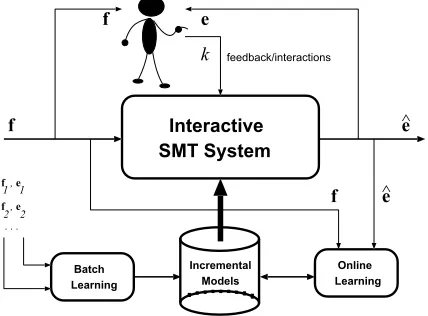
Figure 2 (inspired from (Vidal et al., 2007)) shows a schematic view of these ideas. Here, f is the
in-put sentence andeis the output derived by the IMT
system fromf. By observingfande, the user
inter-acts with the IMT system until the desired outputeˆis
produced. The input sentencefand its desired
trans-lationˆecan be used to refine the models used by the
system. In general, the model is initially obtained through a classical batch training process from a pre-viously given training sequence of pairs (fi,ei) from
the task being considered. Now, the models can be extended with the use of valuable user feedback.
e
f e
k f
Interactive SMT System
Batch Learning
Online Learning
. . .
f , e
2 2
f , e
1 1
feedback/interactions
e
f ^
^
Incremental Models
Figure 2: An Online Interactive SMT system
2 Interactive machine translation
IMT can be seen as an evolution of the SMT frame-work. Given a sentence f from a source
lan-guage F to be translated into a target sentence e
of a target languageE, the fundamental equation of SMT (Brown et al., 1993) is the following:
ˆ
e=argmax
e
{P r(e|f)} (1)
=argmax e
{P r(f|e)P r(e)} (2)
where P r(f|e) is approximated by a translation model that represents the correlation between the source and the target sentence and where P r(e) is
approximated by alanguage modelrepresenting the well-formedness of the candidate translatione.
State-of-the-art statistical machine translation systems follow a loglinear approach (Och and Ney,
2002), where direct modelling of the posterior prob-abilityP r(e|f)of Equation (1) is used. In this case,
the decision rule is given by the expression:
ˆ
e=argmax
e
( M
X
m=1
λmhm(e,f) )
(3)
where eachhm(e,f)is a feature function
represent-ing a statistical model andλmits weight.
Current MT systems are based on the use of phrase-based models (Koehn et al., 2003) as transla-tion models. The basic idea of Phrase-based Trans-lation (PBT) is to segment the source sentence into phrases, then to translate each source phrase into a target phrase, and finally to reorder the translated target phrases in order to compose the target sen-tence. If we summarize all the decisions made dur-ing the phrase-based translation process by means of the hidden variable˜aK
1 , we obtain the expression:
P r(f|e) = X K,˜aK1
P r( ˜f1K,˜aK1 |˜eK1 ) (4)
where each˜ak∈ {1. . . K}denotes the index of the
target phrase ˜ethat is aligned with thek-th source phrasef˜k, assuming a segmentation of lengthK.
According to Equation (4), and following a max-imum approximation, the problem stated in Equa-tion (2) can be reframed as:
ˆ
e≈arg max
e,a
p(e)·p(f,a|e) (5)
In the IMT scenario, we have to find an extension
es for a given prefixep. To do this we reformulate
Equation (5) as follows:
ˆ
es≈arg max
es,a
p(es|ep)·p(f,a|ep,es) (6)
where the termp(ep)has been dropped since it does
depend neither onesnor ona.
Thus, the search is restricted to those sentencese
which containepas prefix. It is also worth
mention-ing that the similarities between Equation (6) and Equation (5) (note thatepes ≡ e) allow us to use
the same models whenever the search procedures are adequately modified (Barrachina et al., 2009).
Following the loglinear approach stated in Equa-tion (3), EquaEqua-tion (6) can be rewriten as:
ˆ
es=argmax
es,a
( M
X
m=1
λmhm(e,a,f) )
[image:2.612.80.294.236.394.2]which is the approach that we follow in this work. A common problem in IMT arises when the user sets a prefix (ep) which cannot be found in the
phrase-based statistical translation model. Differ-ent solutions have been proposed to deal with this problem. The use of word translation graphs, as a compact representation of all possible translations of a source sentence, is proposed in (Barrachina et al., 2009). In (Ortiz-Mart´ınez et al., 2009), a technique based on the generation of partial phrase-based alignments is described. This last proposal has also been adopted in this work.
3 Related work
In this paper we present an application of the online learning paradigm to the IMT framework. In the on-line learning setting, models are trained sample by sample. Our work is also related to model adapta-tion, although model adaptation and online learning are not exactly the same thing.
The online learning paradigm has been previ-ously applied to train discriminative models in SMT (Liang et al., 2006; Arun and Koehn, 2007; Watanabe et al., 2007; Chiang et al., 2008). These works differ from the one presented here in that we apply online learning techniques to train generative models instead of discriminative models.
In (Nepveu et al., 2004), dynamic adaptation of an IMT system via cache-based model extensions to language and translation models is proposed. The work by Nepveu et al. (2004) constitutes a domain adaptation technique and not an online learning technique, since the proposed cache components re-quire pre-existent models estimated in batch mode. In addition to this, their IMT system does not use state-of-the-art models.
To our knowledge, the only previous work on on-line learning for IMT is (Cesa-Bianchi et al., 2008), where a very constrained version of online learn-ing is presented. This constrained version of online learning is not able to extend the translation models due to technical problems with the efficiency of the learning process. In this paper, we present a purely statistical IMT system which is able to incrementally update the parameters of all of the different models that are used in the system, including the transla-tion model, breaking with the above mentransla-tioned
con-straints. What is more, our system is able to learn from scratch, that is, without any preexisting model stored in the system. This is demonstrated empiri-cally in section 5.
4 Online IMT
In this section we propose an online IMT system. First, we describe the basic IMT system involved in the interactive translation process. Then we in-troduce the required techniques to incrementally up-date the statistical models used by the system.
4.1 Basic IMT system
The basic IMT system that we propose uses a log-linear model to generate its translations. According to Equation (7), we introduce a set of seven feature functions (fromh1toh7):
• n-gram language model (h1) h1(e) = log(Q|
e|+1
i=1 p(ei|eii−−1n+1)), 1 where p(ei|eii−−1n+1)is defined as follows:
p(ei|eii−−1n+1) =
max{cX(eii−n+1)−Dn,0}
cX(eii−−1n+1)
+
Dn
cX(eii−−1n+1)
N1+(eii−−1n+1•)·p(ei|eii−−1n+2) (8)
whereDn = cn,1c+2n,1cn,2 is a fixed discount (cn,1
and cn,2 are the number of n-grams with one
and two counts respectively),N1+(eii−−1n+1•)is the
number of unique words that follows the history
eii−−1n+1andcX(eii−n+1)is the count of then-gram eii−n+1, where cX(·) can represent true counts
cT(·) or modified counts cM(·). True counts are
used for the higher order n-grams and modified counts for the lower ordern-grams. Given a cer-tain n-gram, its modified count consists in the number of different words that precede this n -gram in the training corpus.
Equation (8) corresponds to the probability given by ann-gram language model with an interpolated version of the Kneser-Ney smoothing (Chen and Goodman, 1996).
1|e|is the length ofe,
e0denotes thebegin-of-sentence
sym-bol,e|e|+1denotes theend-of-sentencesymbol,ej
• target sentence-length model (h2)
h2(e,f) = log(p(|f| | |e|)) = log(φ|e|(|f|+0.5)−
φ|e|(|f| −0.5)), whereφ|e|(·)denotes the cumula-tive distribution function (cdf) for the normal dis-tribution (the cdf is used here to integrate the nor-mal density function over an interval of length1). We use a specific normal distribution with mean
µ|e|and standard deviation σ|e| for each possible target sentence length|e|.
• inverse and direct phrase-based models (h3, h4) h3(e,a,f) = log(QKk=1p( ˜fk|e˜a˜k)), where
p( ˜fk|˜e˜ak)is defined as follows:
p( ˜fk|e˜˜ak) =β·pphr( ˜fk|e˜˜ak) +
(1−β).phmm( ˜fk|e˜˜ak) (9)
In Equation (9), pphr( ˜fk|˜ea˜k) denotes the
proba-bility given by a statistical phrase-based dictionary used in regular phrase-based models (see (Koehn et al., 2003) for more details). phmm( ˜fk|˜ea˜k) is
the probability given by an HMM-based (intra-phrase) alignment model (see (Vogel et al., 1996)):
phmm( ˜f|˜e) =ǫ X
a|1f˜|
|f˜|
Y
j=1
p( ˜fj|˜eaj)·p(aj|aj−1,|e˜|)
(10) The HMM-based alignment model probability is used here for smoothing purposes as described in (Ortiz-Mart´ınez et al., 2009).
Analogouslyh4is defined as: h4(e,a,f) = log(QKk=1p(˜ea˜k|f˜k))
• target phrase-length model (h5)
h5(e,a,f) = log(QKk=1p(|˜ek|)), wherep(|˜ek|) =
δ(1−δ)|˜ek|.h
5implements a target phrase-length
model by means of a geometric distribution with probability of success on each trialδ. The use of a geometric distribution penalizes the length of tar-get phrases.
• source phrase-length model (h6) h6(e,a,f) = log(QKk=1p(|f˜k| | |˜ea˜k|)),
wherep(|f˜k| | |e˜˜ak|) =δ(1−δ)
abs(|f˜k|−|˜e˜ak|)and
abs(·)is the absolute value function. A geometric distribution is used to model this feature (it penal-izes the difference between the source and target phrase lengths).
• distortion model (h7)
h7(a) = log(QKk=1p(˜ak|˜ak−1)), where p(˜ak|˜ak−1) = δ(1 − δ)abs(b˜ak−l˜ak−1), b˜ak
denotes the beginning position of the source phrase covered by ˜ak and l˜ak−1 denotes the last
position of the source phrase covered by a˜k−1.
A geometric distribution is used to model this feature (it penalizes the reorderings).
The log-linear model, which includes the above described feature functions, is used to generate the suffixesgiven the user-validated prefixep.
Specif-ically, the IMT system generates a partial phrase-based alignment between the user prefix ep and a
portion of the source sentencef, and returns the
suf-fixesas the translation of the remaining portion of f(see (Ortiz-Mart´ınez et al., 2009)).
4.2 Extending the IMT system from user feedback
After translating a source sentence f, a new
sen-tence pair(f,e)is available to feed the IMT system
(see Figure 1). In this section we describe how the log-linear model described in section 4.1 is updated given the new sentence pair. To do this, a set of suf-ficient statisticsthat can be incrementally updated is maintained for each feature functionhi(·). A
suffi-cient statistic for a statistical model is a statistic that captures all the information that is relevant to esti-mate this model.
Regarding feature function h1 and according to
equation (8), we need to maintain the following data:
ck,1 andck,2 given any orderk,N1+(·), andcX(·)
(see section 4.1 for the meaning of each symbol). Given a new sentencee, and for eachk-gramei
i−k+1
ofewhere1≤k≤nand1≤i≤ |e|+ 1, we
mod-ify the set of sufficient statistics as it is shown in Al-gorithm 1. The alAl-gorithm checks the changes in the counts of thek-grams to update the set of sufficient statistics. Sufficient statistics forDkare updated
fol-lowing the auxiliar procedure shown in Algorithm 2. Feature functionh2 requires the incremental
cal-culation of the meanµ|e|and the standard deviation
σ|e|of the normal distribution associated to a target sentence length|e|. For this purpose the procedure
input :n(higher order),ei
i−k+1(k-gram),
S={∀j(cj,1, cj,2), N1+(·), cX(·)}
(current set of sufficient statistics) output :S(updated set of sufficient statistics) begin
ifcT(ei
i−k+1) = 0then
ifk−1≥1then updD(S,k-1,cM(ei−1
i−k+2),cM(e
i−1
i−k+2)+1)
ifcM(ei−1
i−k+2) = 0then
N1+(eii−1
−k+2) =N1+(eii−1
−k+2) + 1
cM(ei−1
i−k+2) =cM(e
i−1
i−k+2) + 1
cM(ei
i−k+2) =cM(e
i
i−k+2) + 1
ifk=nthen
N1+(ei−
1
i−k+1) =N1+(ei− 1
i−k+1) + 1
ifk=nthen updD(S,k,cT(ei
i−k+1),cT(e
i
i−k+1) + 1)
cT(ei−1
i−k+1)=cT(e
i−1
i−k+1) + 1
cT(ei
i−k+1)=cT(e
i
i−k+1) + 1
end
Algorithm 1: Pseudocode for updating the suf-ficient statistics of a givenk-gram
input :S(current set of sufficient statistics),k
(order),c(current count),c′(new count)
output :(ck,1, ck,2)(updated sufficient statistics)
begin
ifc= 0then
ifc′ = 1thenck,1=ck,1+ 1
ifc′ = 2thenck,2=ck,2+ 1
ifc= 1then
ck,1=ck,1−1
ifc′ = 2thenck,2=ck,2+ 1
ifc= 2thenck,2=ck,2−1
end
Algorithm 2: Pseudocode for theupdD proce-dure
pair(f,e), the two quantities are updated using a
re-currence relation:
µ|e|=µ
′
|e|+ (|f| −µ
′
|e|)/c(|e|) (11)
S|e|=S
′
|e|+ (|f| −µ
′
|e|)(|f| −µ|e|) (12)
wherec(|e|)is the count of the number of sentences
of length|e|that have been seen so far, andµ′
|e|and
S|′e| are the quantities previously stored (µ|e| is ini-tialized to the source sentence length of the first sam-ple andS|e|is initialized to zero). Finally, the
stan-dard deviation can be obtained from S as follows:
σ|e|=
q
S|e|/(c(|e|)−1).
Feature functions h3 and h4 implement inverse
and direct smoothed phrase-based models respec-tively. Since phrase-based models are symmetric models, only an inverse phrase-based model is main-tained (direct probabilities can be efficiently ob-tained using appropriate data structures, see (Ortiz-Mart´ınez et al., 2008)). The inverse phrase model probabilities are estimated from the phrase counts:
p( ˜f|e) =˜ Pc( ˜f ,e)˜ ˜
f′c( ˜f′,˜e)
(13)
According to Equation (13), the set of suffi-cient statistics to be stored for the inverse phrase model consists of a set of phrase counts (c( ˜f ,e)˜ and
P ˜
f′c( ˜f′,˜e) must be stored separately). Given a
new sentence pair(f,e), the standard phrase-based
model estimation method uses a word alignment ma-trix betweenfandeto extract the set of phrase pairs
that are consistent with the word alignment ma-trix (see (Koehn et al., 2003) for more details). Once the consistent phrase pairs have been extracted, the phrase counts are updated. The word alignment ma-trices required for the extraction of phrase pairs are generated by means of the HMM-based models used in the feature functionsh3andh4.
Inverse and direct HMM-based models are used here for two purposes: to smooth the phrase-based models via linear interpolation and to generate word alignment matrices. The weights of the interpola-tion can be estimated from a development corpus. Equation (10) shows the expression of the probabil-ity given by an inverse HMM-based model. The probability includes lexical probabilities p(fj|ei)
and alignment probabilitiesp(aj|aj−1, l). Since the
pair of words is given by the expression:
p(f|e) = Pc(f|e) f′c(f′|e)
(14)
where c(f|e) is the expected number of times that the wordeis aligned to the wordf. The alignment probability is defined in a similar way:
p(aj|aj−1, l) =
c(aj|aj−1, l) P
a′jc(a′j|aj−1, l)
(15)
wherec(aj|aj−1, l)denotes the expected number of
times that the alignment aj has been seen after the
previous alignment aj−1 given a source sentence
composed oflwords.
Given the equations (14) and (15), the set of suf-ficient statistics for the inverse HMM-based model consists of a set of expected counts (numerator and denominator values are stored separately). Given a new sentence pair(f,e), we execute a new iteration
of the incremental EM algorithm on the new sample and collect the contributions to the expected counts. The parameters of the direct HMM-based model are estimated analogously to those of the inverse HMM-based model. Once the direct and the inverse HMM-based model parameters have been modified due to the presentation of a new sentence pair to the IMT system, both models are used to obtain word alignments for the new sentence pair. The resulting direct and inverse word alignment matrices are com-bined by means of thesymmetrizationalignment op-eration (Och and Ney, 2003) before extracting the set of consistent phrase pairs.
HMM-based alignment models are used here because, according to (Och and Ney, 2003) and (Toutanova et al., 2002), they outperform IBM 1 to IBM 4 alignment models while still allowing the exact calculation of the likelihood for a given sen-tence pair.
The δ parameters of the geometric distributions associated to the feature functionsh5,h6andh7are
left fixed. Because of this, there are no sufficient statistics to store for these feature functions.
Finally, the weights of the log-linear combination are not modified due to the presentation of a new sentence pair to the system. These weights can be adjusted off-line by means of a development corpus and well-known optimization techniques.
5 Experiments
This section describes the experiments that we car-ried out to test our online IMT system.
5.1 Experimental setup
The experiments were performed using the XE
-ROX XRCE corpus (SchlumbergerSema S.A. et al., 2001), which consists of translations of Xe-rox printer manuals involving three different pairs of languages: French-English, Spanish-English, and German-English. The main features of these cor-pora are shown in Table 1. Partitions into training, development and test were performed. This corpus is used here because it has been extensively used in the literature on IMT to report results.
IMT experiments were carried out from English to the other three languages.
5.2 Assessment criteria
The evaluation of the techniques presented in this paper were carried out using the Key-stroke and mouse-action ratio (KSMR) measure (Barrachina et al., 2009). This is calculated as the number of keystrokes plus the number of mouse movements
plus one more count per sentence (aimed at simulat-ing the user action needed to accept the final transla-tion), the sum of which is divided by the total num-ber of reference characters. In addition to this, we also used the well-known BLEU score (Papineni et al., 2001) to measure the translation quality of the first translation hypothesis produced by the IMT sys-tem for each source sentence (which is automatically generated without user intervention).
5.3 Online IMT results
addi-En Sp En Fr En Ge
Train
Sent. pairs 55761 52844 49376
Running words 571960 657172 542762 573170 506877 440682 Vocabulary 25627 29565 24958 27399 24899 37338
Dev.
Sent. pairs 1012 994 964
Running words 12111 13808 9480 9801 9162 8283 Perplexity (3-grams) 46.2 34.0 96.2 74.1 68.4 124.3
Sent. pairs 1125 984 996
Test
Running words 7634 9358 9572 9805 10792 9823 Perplexity (3-grams) 107.0 59.6 192.6 135.4 92.8 169.2
Table 1: XEROX corpus statistics for three different language pairs (from English (En) to Spanish (Sp), French (Fr) and German (Ge))
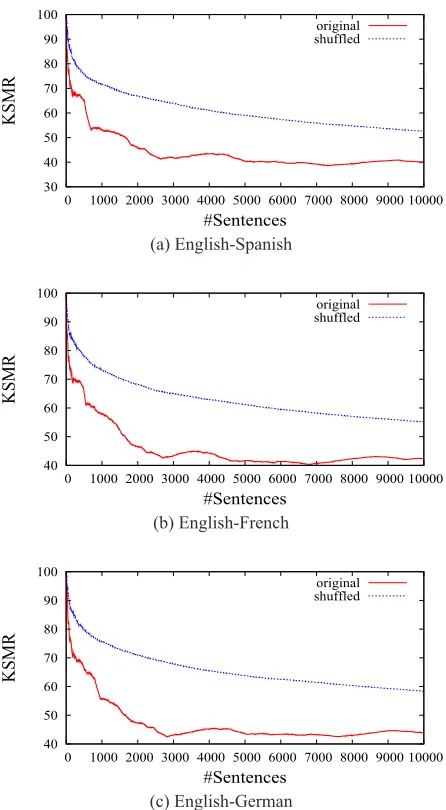
tion, for each language pair we interactively trans-lated the original portion of the training corpus and the same portion of the original corpus after being randomly shuffled.
As these figures show, the results clearly demon-strate that the IMT system is able to learn from scratch. The results were similar for the three lan-guages. It is also worthy of note that the obtained results were better in all cases for the original cor-pora than for the shuffled ones. This is because, in the original corpora, similar sentences appear more or less contiguosly (due to the organization of the contents of the printer manuals). This circum-stance increases the accuracy of the online learning, since with the original corpora the number of lat-eral effectsocurred between the translation of sim-ilar sentences is decreased. The online learning of a new sentence pair produces a lateral effect when the changes in the probability given by the models not only affect the newly trained sentence pair but also other sentence pairs. A lateral effect can cause that the system generates a wrong translation for a given source sentence due to undesired changes in the statistical models.
The accuracy were worse for shuffled corpora, since shuffling increases the number of lateral ef-fects that may occur between the translation of sim-ilar sentences (because they no longer appear con-tiguously). A good way to compare the quality of different online IMT systems is to determine their robustness in relation to sentence ordering. How-ever, it can generally be expected that the sentences to be translated in an interactive translation session will be in a non-random order.
Alternatively, we carried out experiments in a dif-ferent learning scenario. Specifically, the XEROX
30 40 50 60 70 80 90 100
0 1000 2000 3000 4000 5000 6000 7000 8000 9000 10000
KSMR
#Sentences
original shuffled
(a) English-Spanish
40 50 60 70 80 90 100
0 1000 2000 3000 4000 5000 6000 7000 8000 9000 10000
KSMR
#Sentences
original shuffled
(b) English-French
40 50 60 70 80 90 100
0 1000 2000 3000 4000 5000 6000 7000 8000 9000 10000
KSMR
#Sentences
original shuffled
[image:7.612.139.473.61.158.2](c) English-German
Figure 3: KSMR evolution translating a portion of the training corpora
[image:7.612.316.539.215.620.2]that of an online IMT system. The batch IMT sys-tem is a conventional IMT syssys-tem which is not able to take advantage of user feedback after each transla-tion while the online IMT system uses the new sen-tence pairs provided by the user to revise the sta-tistical models. Both systems were initialized with a log-linear model trained in batch mode by means of the XEROX training corpora. The weights of the
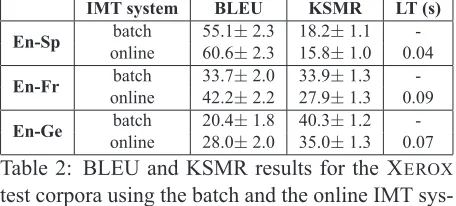
[image:8.612.72.300.374.477.2]log-linear combination were adjusted for the devel-opment corpora by means of the downhill-simplex algorithm. Table 2 shows the obtained results. The table shows the BLEU score and the KSMR for the batch and the online IMT systems (95%confidence intervals are shown). The BLEU score was calcu-lated from the first translation hypothesis produced by the IMT system for each source sentence. The ta-ble also shows the average online learning time (LT) for each new sample presented to the system2. All the improvements obtained with the online IMT sys-tem were statistically significant. Also, the average learning times clearly allow the system to be used in a real-time scenario.
IMT system BLEU KSMR LT (s)
En-Sp batch 55.1±2.3 18.2±1.1
-online 60.6±2.3 15.8±1.0 0.04
En-Fr batch 33.7±2.0 33.9±1.3
-online 42.2±2.2 27.9±1.3 0.09
En-Ge batch 20.4±1.8 40.3±1.2
-online 28.0±2.0 35.0±1.3 0.07
Table 2: BLEU and KSMR results for the XEROX
test corpora using the batch and the online IMT sys-tems. The average online learning time (LT) in sec-onds is shown for the online system
Finally, in Table 3 a comparison of the KSMR re-sults obtained by the online IMT system with state-of-the-art IMT systems is reported (95% confidence intervals are shown). We compared our system with those presented in (Barrachina et al., 2009): the alignment templates (AT), the stochastic finite-state transducer (SFST), and the phrase-based (PB) ap-proaches to IMT. The results were obtained using the same Xerox training and test sets (see Table 1) for the four different IMT systems. Our system out-performed the results obtained by these systems.
2All the experiments were executed on a PC with a 2.40 Ghz
Intel Xeon processor with 1GB of memory.
AT PB SFST Online
En-Sp 23.2±1.3 16.7±1.2 21.8±1.4 15.8±1.0
En-Fr 40.4±1.4 35.8±1.3 43.8±1.6 27.9±1.3
En-Ge 44.7±1.2 40.1±1.2 45.7±1.4 35.0±1.3
Table 3: KSMR results comparison of our system and three different state-of-the-art batch systems
6 Conclusions
We have presented an online IMT system. The pro-posed system is able to incrementally extend the sta-tistical models involved in the translation process, breaking technical limitations encountered in other works. Empirical results show that our techniques allow the IMT system to learn from scratch or from previously estimated models.
One key aspect of the proposed system is the use of HMM-based alignment models trained by means of the incremental EM algorithm.
The incremental adjustment of the weights of the log-linear models and other parameters have not been tackled here. For the future we plan to incor-porate this functionality into our IMT system.
The incremental techniques proposed here can also be exploited to extend SMT systems (in fact, our proposed IMT system is based on an incremen-tally updateable SMT system). For the near future we plan to study possible aplications of our tech-niques in a fully automatic translation scenario.
Finally, it is worthy of note that the main ideas presented here can be used in other interactive ap-plications such as Computer Assisted Speech Tran-scription, Interactive Image Retrieval, etc (see (Vi-dal et al., 2007) for more information). In conclu-sion, we think that the online learning techniques proposed here can be the starting point for a new generation of interactive pattern recognition systems that are able to take advantage of user feedback.
Acknowledgments
References
A. Arun and P. Koehn. 2007. Online learning methods for discriminative training of phrase based statistical machine translation. In Proc. of the MT Summit XI, pages 15–20, Copenhagen, Denmark, September. S. Barrachina, O. Bender, F. Casacuberta, J. Civera,
E. Cubel, S. Khadivi, A. Lagarda, H. Ney, J. Tom´as, and E. Vidal. 2009. Statistical approaches to computer-assisted translation. Computational Lin-guistics, 35(1):3–28.
Peter F. Brown, Stephen A. Della Pietra, Vincent J. Della Pietra, and R. L. Mercer. 1993. The mathematics of statistical machine translation: Parameter estimation.
Computational Linguistics, 19(2):263–311.
N. Cesa-Bianchi, G. Reverberi, and S. Szedmak. 2008. Online learning algorithms for computer-assisted translation. Deliverable D4.2, SMART: Stat. Multi-lingual Analysis for Retrieval and Translation, Mar. S.F. Chen and J. Goodman. 1996. An empirical study of
smoothing techniques for language modeling. InProc. of the ACL, pages 310–318, San Francisco.
D. Chiang, Y. Marton, and P. Resnik. 2008. Online large-margin training of syntactic and structural translation features. InProc. of EMNLP.
George Foster, Pierre Isabelle, and Pierre Plamondon. 1997. Target-text mediated interactive machine trans-lation.Machine Translation, 12(1):175–194.
P. Isabelle and K. Church. 1997. Special issue on new tools for human translators.Machine Translation, 12(1–2).
D.E. Knuth. 1981. Seminumerical Algorithms, volume 2
of The Art of Computer Programming.
Addison-Wesley, Massachusetts, 2nd edition.
P. Koehn, F. J. Och, and D. Marcu. 2003. Statistical phrase-based translation. InProc. of the HLT/NAACL, pages 48–54, Edmonton, Canada, May.
P. Langlais, G. Lapalme, and M. Loranger. 2002. Transtype: Development-evaluation cycles to boost translator’s productivity. Machine Translation, 15(4):77–98.
P. Liang, A. Bouchard-Cˆot´e, D. Klein, and B. Taskar. 2006. An end-to-end discriminative approach to ma-chine translation. InProc. of the 44th ACL, pages 761– 768, Morristown, NJ, USA.
R.M. Neal and G.E. Hinton. 1998. A view of the EM algorithm that justifies incremental, sparse, and other variants. InProceedings of the NATO-ASI on Learning in graphical models, pages 355–368, Norwell, MA, USA.
L. Nepveu, G. Lapalme, P. Langlais, and G. Foster. 2004. Adaptive language and translation models for interac-tive machine translation. In Proc. of EMNLP, pages 190–197, Barcelona, Spain, July.
Franz Josef Och and Hermann Ney. 2002. Discrimina-tive Training and Maximum Entropy Models for Sta-tistical Machine Translation. InProc. of the 40th ACL, pages 295–302, Philadelphia, PA, July.
Franz Josef Och and Hermann Ney. 2003. A system-atic comparison of various statistical alignment mod-els. Computational Linguistics, 29(1):19–51, March. D. Ortiz-Mart´ınez, I. Garc´ıa-Varea, and Casacuberta F.
2008. The scaling problem in the pattern recognition approach to machine translation. Pattern Recognition Letters, 29:1145–1153.
Daniel Ortiz-Mart´ınez, Ismael Garc´ıa-Varea, and Fran-cisco Casacuberta. 2009. Interactive machine trans-lation based on partial statistical phrase-based align-ments. InProc. of RANLP, Borovets, Bulgaria, sep. Kishore A. Papineni, Salim Roukos, Todd Ward, and
Wei-Jing Zhu. 2001. Bleu: a method for auto-matic evaluation of machine translation. Technical Report RC22176 (W0109-022), IBM Research Divi-sion, Thomas J. Watson Research Center, Yorktown Heights, NY, September.
SchlumbergerSema S.A., ITI Valencia, RWTH Aachen, RALI Montreal, Celer Soluciones, Soci´et´e Gamma, and XRCE. 2001. TT2. TransType2 - computer as-sisted translation. Project Tech. Rep.
Kristina Toutanova, H. Tolga Ilhan, and Christopher Manning. 2002. Extensions to hmm-based statistical word alignment models. InProc. of EMNLP.
E. Vidal, L. Rodr´ıguez, F. Casacuberta, and I. Garc´ıa-Varea. 2007. Interactive pattern recognition. InProc. of the 4th MLMI, pages 60–71. Brno, Czech Republic, 28-30 June.
Stephan Vogel, Hermann Ney, and Christoph Tillmann. 1996. HMM-based word alignment in statistical trans-lation. InProc. of COLING, pages 836–841, Copen-hagen, Denmark, August.