HEINEMANN SENIOR MATHEMATICS
_)! __
tieinemann Educational Australia
'
r
i
i·
I \ ,,,, ·,,
,·
II
i
(
l
branches and representatives throughout the world. ©J.B. Fitzpatrick and P. L. Galbraith 1990 First published 1990
Reprinted 1991
All rights reserved. No part of this publication may be reproduced, stored in a retrieval system or transmitted in any form by any means whatsoever without the prior permission of the c_opyright owner. Apply in writing to the publishers.
Edited by Scharlaine Cairns, Charlie C. Editorial Pty Ltd Designed by Tom Kurema
Illustrations by Gavin Mount
Keying and preparation of disks by Tricia Randle Typeset in Times Roman by Savage Type Pty Ltd, Brisbane Printed in Singapore by Chong Moh Offset Printing National Library of Australia
Cataloguing-in-publication data: Fitzpatrick, J. B. (John Bernard).
Reasoning and data Includes index. ISBN O 85859 527 3.
l . Mathematics. I. Galbraith, P. (Peter). II. Henry, Bruce. Ill. Title. (Series: Heinemann senior mathematics).
Contents
(Projects and Investigations are identified by
[;J
and
U
respectively.)
Acknowledgements (x)
Preface [xi)
Chapter 1 Statistics 1
1.1
Graphical representation of data 2
(;I
1.2
Limited-over cricket 9
1.3
Continuous and discrete data 10
1.4
Frequency distribution 10
1.5
Histograms 12
1.6
Frequency polygons 14
1. 7
Measures of central tendency 17
1.8
Measurement of dispersion 22
(;I
1.9
Multi-lingual 'Scrabble' 30
Chapter 2 Probability 31
2.1
Complementary events 35
2.2
Life tables (1984) 36
2.3
Finite sample space 40
2.4
Mutually exclusive events 41
2.5
Successive outcomes 45
2.6
Independent events 50
2.7
Conditional probability: a reduced sample space 61
2.8
Baye·s• Theorem 70
Chapter 3 Permutations and combinations 77
3.1
Permutations 78
3.2
The multiplication principle 79
3.3
Mutually exclusive operations: addition principle 81
3.4
Definition of permutation 81
3.5
The symbol npr
83
3;6
Arrangements with restriction� 85
3. 7
Arrangements in a circle 88
3.8
Number of arrangements of n objects
in a row, when they are not all different 89
(v)
3.9
Combinations 92
3.10
The symbol (;) or
ncr93
3.11
Probability associated with permutations and combinations 100
Chapter 4 Binomial distribution
111
4.1
Binomial theorem
112-4.2
Binomial probability distribution 117
4.3
Mean and v�riance of a discrete random variable 127
4.4
Mean and variance of a binomial distribution 129
l];I
4.5
Coin tossing 133
l];I
4.6
Computer simulation of binomial experiments 134
Chapter 5 Other discrete probability distributions
137
5.1
� Hypergeometric distribution: sampling without replacement 138
5.2
Mean and variance of a hypergeometric distribution 143
5.3
Geometric distribution 146
5.4
Poisson distribution 149
5.5
Exponential distribution 157
l];I
5.6
Poisson distribution project 157
5.7
Probability and matrices: Markov chains 159
Chapter 6 Normal distribution
167
6.1
The normal distribution 168
6.2
Standard normal curve 169
6.3
Normal approximation to binomial distribution 179
6.4
Probability limits for a single value of the normal variable 182
6.5
Probability limits for the sample mean of
n
values of the variable 186
6.6
Confidence limits 188
Revision exercises (Chapters 1 to 6)
197
Chapter 7 Problem-solving and investigations 20s
7.1
Problems 206
D
7 .2
Investigations 214
Chapter 8 Related variables
219
8.1
Scatter diagrams 220
8.2
Regression of
yon x
221
8.3
Method of least squares 222
8.4
Bivariate distributions: two regression lines 224
8.5
Correlation 231
8.6
Correlation and causation 237
D
8. 7
Correlation investigation 239
8.8
Non-linear relationships 240
8.9
Time series -245
8.12
Measurement of seasonal variations 253
8.13
Forecasting using single moving average 256
Chapter 9 Non-parametric statistical tests
9.1
Hypothesis testing: stating the hypotheses 264
9.2
The sign test 265
9.3
Significance level 266
9.4
The steps in performing a statistical test 266
9.5
Binomial test of percentiles 267
9.6
Wilcoxon test for two independent samples 270
9. 7
Dealing with ties 272
9.8
Dealing with large samples 272
9.9
Permutation test 273
9.10
Statistical project 277
9.11
; . The Chi-square test 277
9.12
Degrees of freedom, v 279
9.13
x
2test for a Poisson distribution 281
9.14
x
2test for a normal distribution 282
9.15
x
2test for a binomial distribution 284
9.16
Contingency tables 287
(;J
9.17
Newspaper poll 293
9.18
Die-tossing program 293
9.19
Tables 295
Chapter 10 Graphs arid optimisation
297
10.1
Graph theory 298
10.2
Basic definitions and properties 299
10.3
The handshaking lemma 301
10.4
Isomorphic graphs 302
10.5
Cycles and trees 307
10.6
Applications to network problems 308
10. 7
Planar graphs 310
10.8
Eulerian paths 313
10.9
Fleury's Algorithm 316
10.10
Network inspection problems 317
10.11
Shortest path problems 318
10.12
Hamiltonian graphs 320
10.13
The travelling sales representative problem 320
(;J
10.14
Road network 326
D
10.15
Chemical molecules 327
10.16
Digraphs (directed graphs) 328
10.17
Matrix representation 328
10.18-.
:Applications of digraphs 331
(;J
10.19
Graphing projects 339
(vii)
263
Chapter 11 Logic and reasoning
341
11.1
Propositions 342
11.2
Negation, -
p
342
11.3
Set notation 343
11.4
Conjunctionp /\ q
344
11.5
Disjunctionp v q
345
11.6
Conditional statements
p � q
349
11. 7
Converse, inverse and contrapositive 350
11.8
Equivalencep
+-+q
351
11.9
Tautologies 358
11.10
Negation of compound sentences 361
11.11
Validity of arguments 363
11.12
Use of tautologies 366
11.13
Quantifiers 368
Chapter 12 Methods of proof
373
12.1
Mathematical proof 374
12.2
Necessary and sufficient conditions 375
12.3
Proof patterns in mathematics 375
12.4
Indirect proof 378
12.5
Proof by counter-example 379
12.6
Famous proofs from antiquity 381
12. 7
Mathematical induction 384
12.8
Problem solving and investigations 390
D
12.9
Logic investigations 392
(;I
12.10
Logic projects 394
12.11
Finite differences 395
D
12.12
Cheese slicing 398
D
12.13
Pizza party 398
D
12.14
The twelve days of Christmas 398
(;I
12.15
Number patterns 399
Chapter 13 Boolean algebra
401
13.1
Laws of set algebra 403
13.2
Boolean algebra 404
13.3
Principle of Duality 405
13.4
Theorems in Boolean algebra 405
13.5
De Morgan's laws 407
D
13.6
Boolean algebra investigation 409
13.7
Examples of Boolean algebras 410
13.8
Electrical circuits 412
13.9
Simplification of circuits 413
13.10
Boolean functions 415
13.11
Disjunctive form 415
13.12
Conjunctive form 417
13.13
Functions of three variables 417
14.2
Antidifferentiation by parts 427
14.3
Other density functions 429
14.4
Measures of location for probability distributions 438
14.5
The mean (expected value) of
g(X)
444
14.6
Variance and standard deviation 444
Chapter 15 Euclidean geometry (extension)
449
15.1
Assumptions 450
15.2
Angle properties of atriangle 451
15.3
Congruent triangles 456
15.4
Similar triangles 464
15.5
Theorem of Pythagoras 468
15.6
Circle theorems 473
15.7
Cyclic quadrilaterals 478
15.8
Tangents to a circle 482
15.9
Alternate segment 484
15.10
Intersecting chords of a circle 488
15.11
Concurrency theorems 490
Summary
495
Answers
503
Index
531
The authors with to express their thanks to Mr Ted Byrt, formerly of State College Rusden
Campus, for his contribution and helpful suggestions in the area of statistics.
The authors and publisher would like to thank the following individuals and organisations
for their assistance in providing photographs and for their permission to reproduce
copyright material:
Charles Ciurleo, pp. 77 (a, b, c), 137 (b) and 219; D. A. Heffernan, p. 401; The
Herald
&
Weekly Times Ltd,
Melbourne, pp. 77 (d), 263 and 423; Tattersall Sweep Consultation,
pp. 205; Tubemakers of Australia Ltd, p. 167.
Every effort has been made to trace and acknowledge copyright material and the authors
and publisher would welcome any information from people who believe they own copyright
material used in this book.
Reasoning and Data provides a comprehensive coverage of the compulsory sections of the
unit, together with detailed coverage of eight of the content clusters. The book also provides
for study of Reasoning and Data at the extension level, with coverage of the probability,
statistics, and algebra requirements together with two selections (calculus and geometry)
from the additional study areas.
With respect to the work requirements, essential content in the area of probability is
contained within Chapters 2, 4, 5 and 6. The compulsory statistics material is contained in
Chapters 1, 4, 5 and 6. Chapter 1 is an introduction, consolidating aspects of data
representation that will have been studied to varying degrees in past years. The other
chapters systematically introduce discrete and continuous distributions together with their
special features, and related calculations of statistical measures and estimates of parameters.
The logic requirements are provided for within Chapters 2, 10, 12 and 13. Set diagrams are
utilised in probability work (Chapter 2) and also in the chapters on logic and reasoning
(Chapter 11) and Boolean algebra (Chapter 13). The concept and application of proof
appears in the chapters on logic and reasoning (Chapter 11), graphs and optimisation
(Chapter 10), methods of proof (Chapter 12) and Boolean algebra (Chapter 13). 'Graphs
and optimisation' (Chapter 10) contains all the material necessary for the study of
undirected graphs.
The algebra section is well covered. Chapter 3 contains applications of combinations; basic
equation solving and formula manipulation is required regularly throughout almost all
chapters; set algebra is used widely in Chapters 3, 11 and 13; sequences and series are
applied in Chapters 8 and 12, and Chapter 8 also includes work on non-linear relationships.
The companion volumes Space and Number and Change and Approximation contain
additional material that systematically addresses analytical and numerical methods for
solving equations and inequations.
Clusters of content
The following chapters contain material that enables comprehensive coverage of the
nominated clusters.
Combinations
Chapters 3 and 4
Sampling processes
Chapter 4
Probability distributions -
geometric, Poisson and exponential
Chapter 5
Time series analysis and economic statistics
Chapter 8
Correlation and regression
Chapter 8
Non-parametric statistics
Chapter 9
Logic and proof
Chapters 11 and 12
Boolean Algebra
Chapter 13
In addition, substantial amounts of material pertaining to the Clusters (Random sampling,
Estimation and confidence intervals, and Directed graphs) are also included.
For the extension course, Chapters 2, 3, 4 and 6 contain extension material for
probability;
Chapter 6 provides extension material for
statistics;
and Chapter 3 provides extension
material for
algebra.
Within the additional area of study, two options are provided; 'Calculus extension'
(Chapter 14) and 'Euclidean geometry extension' (Chapter 15).
The treatment of the subject matter emphasises coherence so that, where relevant, extension
material appears as a natural development bf the core material. Chapter 7 'Problem solving
and investigations' provides material particularly geared to problem solving, modelling, and
project work.
Features of the presentation include:
• a systematic and thorough introduction to, and consolidation of, content material to
promote concept understanding and facility in skills and standard applications. Numerous
worked examples and sets of exercises are included to this end, including sets of revision
exercises.
• provision of problem-solving examples, modelling situations, investigations and project
material integrated through the chapters, in addition to those provided in Chapter 7.
• integration of the electronic calculator throughout, and provision of computer-based
learning tasks for concept learning, applications and investigation and project work.
Project material is defined in terms of its nature rather than its length. School projects of
varying lengths may be obtained by combining one or more text-based projects. Text-based
Projects
and
Investigations
are frequently presented in a sequential fashion so that
variations between students can be provided for, e.g. not every student may be required to
complete every part of such an activity. A computer application often forms the final section
of a Project I Investigation and can be retained or omitted without otherwise affecting the
structure.
The authors endorse the spirit and intent of the general course structure and its work
requirements.
It is expected that many effective modelling s_ituatfons, investigations and
projects will be designed with the local school environment in mind. This book provides a
supporting base upon which such local emphasis can be built, while at the same time
containing more than sufficient material to meet the work requirements in all areas.
Computer Policy Statement
Throughout this text and its companion volumes there are a number of short programs for
carrying out specific mathematical tasks. Students are also given the opportunity to write
their own programs to help in some of the exercises, applications and models.
It is not the place in a text such as this to teach the elements of computing. These will have
been mastered already by anyone wishing to use a computer productively with this book.
We are aware that there is a degree of debate about programming languages such as BASIC,
LOGO and PASCAL, and each has its supporters. We have chosen to use the BASIC
language, not because it is the best, but because it is the most universally available on the
facilities available to most students. Those who wish to work in another language have the
opportunity to do so, by converting the coding that is provided or by working directly from
the verbal context of the exercises, applications and models.
We do not favour the blind, uncritical use of computer programs in a mathematics course
and have endeavoured at all times to provoke productive thinking in the use of such
programs. This has been done, for example, by encouraging the interpretation of lines of
coding, the amending of programs and the optional use of computers in work dealing with
applications and modelling, where appropriate. In providing coding alone we indicate our
recognition that the matter of flow-charting is one of debate. We have chosen not to make
flow-charting a necessary step in creating programs. The use of flow charts (or not) is,
therefore, at the discretion of the user.
1
Statistics
2 STATISTICS
'Statistics', in a broad sense, deals with scientific methods of collecting, recording and
summarising data from which future trends can be predicted, or which can be used as a
basis for making decisions and drawing valid conclusions.
Government departments use data collected by statisticians to observe trends in such areas
as population growth, urban development and employment, so that provision can be made
for public transport, schools, hospitals, playgrounds, and so on. Can you think of other
uses by government departments of statistical data?
Sporting commentators use statistics to compare the performances of individuals and teams,
for example cricketers' batting and bowling averages.
The school uses statistics in the form of class lists and student subject choices to help
determine the number of teachers needed, classroom allocations, number of desks and
lockers required, and so on. Your teachers are using statistics when they analyse and
interpret your assessment results to determine your progress or to obtain the class average
in various subjects.
Industry and commerce use statistics, for example, to help reduce the number of defective
items produced by machines. If records show that a particular machine is constantly
producing inferior quality articles, management uses this information to decide if the
machine should be repaired or replaced. Can you think of other uses of statistics in industry
and commerce?
1.1 Graphical representation of data
Statistical data are frequently presented in the form of graphs and charts and it is useful
to be able to:
a provide a pictorial representation of the data
b interpret data from a pictorial representation.
Example 1
In 1987, 705 people died on Victorian roads. These people were either drivers, passengers,
pedestrians, motorcyclists (and pillion passengers) or bicyclists as shown in the following
table:
Road user
Drivers
Passengers
Pedestrians
Motorcyclists
Bicyclists
Total
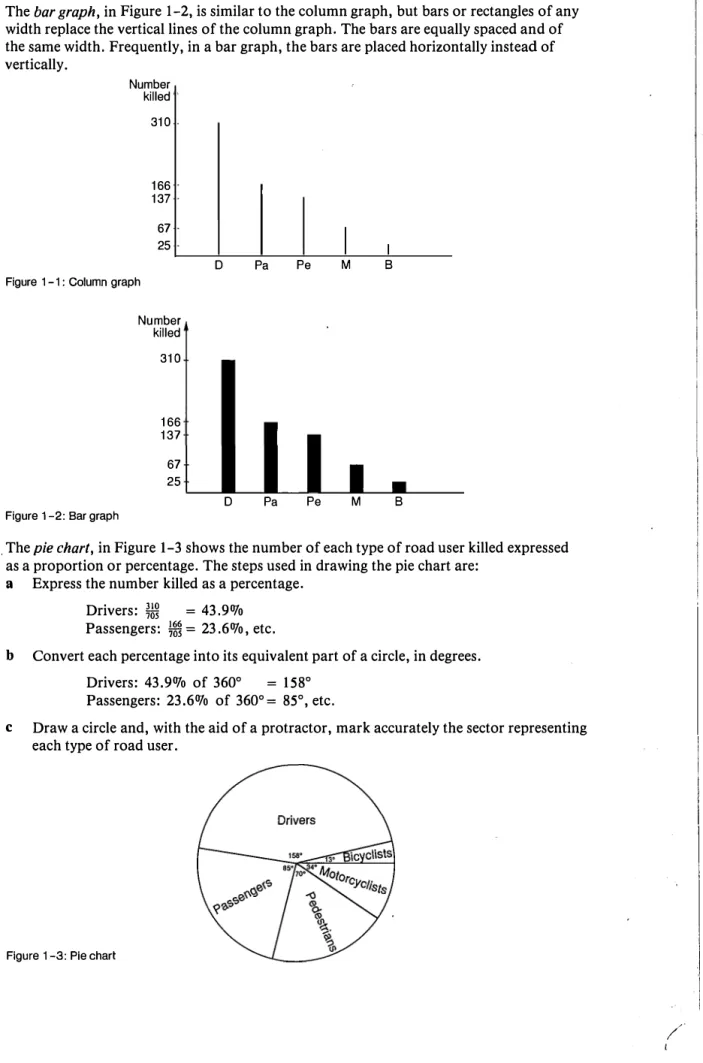
We can illustrate this data by means of:
(i) a column graph
(ii) a bar graph
(iii) a pie chart.
Number killed
Percentage
310
43.9
166
23.6
137
19.5
67
9.4
25
3.6
705
100%
The bar graph, in Figure 1-2, is similar to the column graph, but bars or rectangles of any
width replace the vertical lines of the column graph. The bars are equally spaced and of
the same width. Frequently, in a bar graph, the bars are placed horizontally instead of
vertically.
Number killed
310
166
137
67
25
Figure 1 -1 : Column graph
Figure 1-2: Bar graph
Number killed
310
166
137
6725
D
D
I
IPa Pe M B
Pa Pe M B
. The pie chart, in Figure 1-3 shows the number of each type of road user killed expressed
as a proportion or percentage. The steps used in drawing the pie chart are:
a Express the number killed as a percentage.
Drivers: ���
= 43.9%
Passengers:
�i�
= 23 .6%, etc.
b Convert each percentage into its equivalent part of a circle, in degrees.
Drivers: 43.9% of 360
°= 158
°Passengers: 23.6% of 360
°= 85
°, etc.
c Draw a circle and, with the aid of a protractor, mark accurately the sector representing
each type of road user.
Figure 1-3: Pie chart
Example 2
The bar graph in Figure 1-4 shows the profit, before and after tax was paid, of a chain store
operating throughout Australia. The information is given in the table below.
Year
1984
1985
1986
1987
1988
Profit before tax in $ million
20
30
40
45
55
Profit after tax in $ million
12
17
25
30
35
The full height of each rectangle in Figure 1-4 represents the profit before tax.
The information given in Example 2 can also be illustrated by means of a
line graph,
as
in Figure 1-5. It should be noted that only the position of the dots represents the
information given. The steepness of the lines joining these dots indicates the degree of
increase or decrease. For exampie, the profit after tax rose more sharply from 1985 to 1986
than in any other year.
Figure 1-4
Figure 1-5
Profit
$ million
t:·:·:·:·I Tax
60
- Profit after tax
50
40
30
20
10
1984 1985 1986 1987 1988
Profit
$ million 60
50
40
30
20
-- Profit before tax
--- Profit after tax
--.. ----
--- ---k
''
---
--10
1984
1985
1986
...
.....
--1987
_
...
Exercises 1a
(Most of these questions are based on data supplied by the Australian Bureau of Statistics.)
1 The table on the right shows the
percentage of imports into Victoria
from various countries, and the
exports from Victoria to other
countries, in 1986-87.
Represent the data by means of bar
graphs and make any comments you
consider to be relevant.
Country
USA
Japan
Germany
UK
China
NZItaly
Hong Kong
Singapore
Other
Imports
Exports
25.7
14.2
19.2
14.6
9.7
4.0
7.2
-6.4
8.8
3.9
7.9
2.9
--
5.5
-
4.3
23.1
40.8
2 The following table shows the rainfall (mm) and the number of days of rain in
Melbourne for each of the twelve months in 1987.
Month
Jan Feb Mar Apr
MayJune July Aug Sept Oct
NovDec
Rainfall mm
57
57
50
19
85
51
69
23
38
39
82
85
Days of rain
9
7
10
8
17
16
11
16
14
10
13
10
Represent the data by means of line graphs and make any comments you consider to
be relevant.
3 The following table shows the number of divorces (to the nearest thousand) granted in
Australia in the years 1973 to 1983.
Year
1973 1974 1975 1976 1977 1978 1979 1980 1981 1982 1983Petitions granted
('000)
16
18
24
63
45
40
38
39
41
44
44
Represent the data:
a using a bar graph b using a line graph.
4 The following table shows the number of people injured (to the nearest thousand), and
the number of vehicles registered (to the nearest one hundred thousand), in Victoria in
four-yearly intervals from 1962 to 1986.
Year
1962 1966 1970 1974 1978 1982 1986Injured ('000)
17
20
24
18
20
20
23
Vehicles registered ('00 000)
9
11
13
16
19
22
25
a Using the same scale and axes, draw line graphs to represent the data.
b In December 1970, legislation requiring compulsory wearing of seat belts was
introduced. Explain how your graphs illustrate the effectiveness of this legislation.
c Express the number of people injured as a percentage of the number of registered
6 STATISTICS
5
The bar graphs below show the average number of fatal accidents in 1986-1987 on
Victorian roads for different times of day and different days of the week. Comment on
the data provided.
100
D
4AM-4PM 90• 4PM-4AM 80 AVERAGE 1986 -1987 70
a:
60 50 40 30 20 10 0SUN
MON
TUES WED THURS FRI SAT6
The three bar graphs below show the Federal Government revenue from company tax,
PA YE tax and sales tax for each financial year ending June 1984 to 1988.
COMPANY TAX
PAYE TAX
$
billion
$bllllon
10 35 10
8 6 4 2 0
SALES TAX
$ billion
'84 '85 '86 '87 '88
a
Draw a single bar graph to represent the total tax collected from the three sources.
b
Use the bar graphs to estimate the likely revenue from each source for 1989.
7 The following table shows the working days lost per thousand employees due to
industrial disputes in each of the Australian States in 1983 and 1984.
NSW
Vic
Qld
SA WA1983
290
160
170
11 0
580
1984
360
120
300
50
250
Tas
480
360
8
The number of thousands of people working on building jobs in New South Wales in
a particular year was:
Carpenters
Painters
Plumbers
Others
10.0
2.6
4.0
7.2
Bricklayers
4.4
Electricians
3.0
Builders' labourers 4.8
Represent this information on a pie chart.
9
The pie chart on the right shows the percentage
of world production of tin from selected
countries in a particular year. In that year,
Australia produced 10 200 tonnes. How many
tonnes were produced by each of the other
countries in the chart?
Malaysia
38%
10
The bar graphs below show the income and overhead expenses of a mining company
in the years 1984 to 1988. Assume that profit = income - expenses.
$ million
14
D
Income
12
• Overhead expenses
10
8
6
4
2
1984
1985
1986
1987
a Draw a bar graph to show profit in each of the five years.
b During what year did the company show a loss?
1989
c In what year did income e�_ceed expenses by the greatest amount?
d What was the profit in 1986?
8 STATISTICS
11 a Study the following graphs and state how they tend to misrepresent the data.
(i)
(ii)
30
20
10
0
(iv)
a:
z
Sales $million
I
1987(/) Ql .c
0
ai
.c Ez
100
90
80
70
60
50
40
0 4AM-4 PM • 4 PM-4AM AVERAGE 1986 -1987
SUN MON TUES WED THURS FRI SAT
(iii)
Profit 115 $'000
110
105
100
0
1988 '85
1950's 1960's 1970's 1980's
b Compare
(i)
above with the diagram in Question 5.
� 1.2 Limited-over cricket
On December 15, 1988, Australia competed against the West Indies in a limited
over (maximum 50 overs) cricket match at the Melbourne Cricket Ground. Study
the details below carefully, and write a full report of the game.
WEST INDIES
G. GREENIDGE, c Boon, b Taylor 57
D. HAYNES, c Alderman, b McDermott .. 8
R. RICHARDSON, b McDermott .... .. .... .. . 5
A. LOGIE, c and b Border .... ... . ... .. ... ... . 44
V. RICHARDS, c Healy, b Waugh ... 58
C. HOOPER, c Boon, b Waugh ... 17
J. DUJON, c Healy, b Waugh ... 3
M. MARSHALL, c Healy, b McDermott ... 19
W. BENJAMIN, lbw b McDermott . . . . .. . .... 0
C. AMBROSE, not out . . . .. . . .. . . 1 2 C. WALSH, run out ... 1
Sundries (5Ib 2nb 5w) .. .. ... ... ... .. ... . .. . 12
TOTAL ... 236
Fall: 33, 45, 89, 162, 194, 202, 203, 203, 235, 236. BOWLING: T Alderman 7-1-22-0, M Hughes 8-0-39-0 (4w), C McDermott 9.2-2-38-4 (1 nb 1w). S Waugh 10-0-57-3 (1nb). P Taylor 10-0-52-1, A Border 5-0-23-1. Batting time: 210 mins. Overs: 49.2.
AUSTRALIA
G. MARSH, c Hooper, b Ambrose 6 D. BOON, c Dujon, b Benjamin . . ... ... . 20D. JONES, lbw b Richards . .... ... . ... ... . 43
S. WAUGH, run out ... 54
M. WAUGH, b Ambrose .. ... ... ... ... . 32
A. BORDER, run out . . . .. . . .. . . 12
I. HEALY, c Ambrose, b Benjamin ... 3
P. TAYLOR, b Ambrose ... 4
C. McDERMOTT, c Dujon, b Ambrose ... 2
M. HUGHES, not out .. .... ... ... ... .. .... 4
T. ALDERMAN, b Ambrose ... ... .. ... .. ... . 0
Sundries (4b 7Ib 1 nb 1 Ow) ... 22
TOTAL ... 202 Fall: 25, 53, 110, 168, 184, 190, 192, 197, 202, 202.
BOWLING: M Marshall 10-0-39-0 (1nb 1w), C Ambrose 8.2-1-17-5 (6w). C Walsh 10-0-45-0 (2w). W Benjamin 9-0-35-2 (1w), V Richards 10-0-55-1.
Batting time: 205 mins. Overs: 4 7 .2.
The fall of wickets occurred during the following overs:
West Indies innings: 9.3, 11.5, 20.2, 35.5, 42.2, 44.2, 44.5, 45.1, 49.1, 49.2
Australian innings: 9.2, 16.3, 29.3, 39.4, 42.1, 42.6, 43.6, 45.5, 47.1, 47.2
Note: 9.3 means the third ball of the tenth over.
The runs scored per over, in order, are as follows:
West Indies innings: 1, 6, 0, 8, 2, 6, 7, 0, 4, 3, 6, 4, 3, 1, 5, 0, 10, 3, 9,
13, 3, 4, 4, 2, 10, 1, 6, 5, 5, 5, 7, 6, 1, 4, 6, 3, 3, 5, 8, 4, 4, 7, 2, 7, 1,
7,3,8,13,1
Australian innings: 6, 2, 5, 2, 1, 2, 4, 3, 2, 0, 2, 10, 2, 1, 2, 7, 1, 5, 3, 4,
3, 4, 6, 9, 2, 9, 4, 5, 3, 2, 8, 5, 5, 6, 5, 4, 9, 5, 4, 5, 8, 6, 7, 3, 3, 5, 3, 0
'
An important aspect of limited-over matches is the run-rate, i.e. the average
number of runs per over for any number of overs. For example, Australia's run
rate after the first four overs was (6
+
2
+
5
+
2) + 4, i.e. 3.75.
Include in your report:
a line graphs, showing the runs for each team. The number of overs bowled
should be on the horizontal axis, and the cumulative runs scored should be on
the vertical axis. Use the same scale and axes for each team so you can make
comparisons.
b line graphs showing the runs per over for each team. The number of overs
bowled should be on the horizontal axis and the runs per over should be on
the vertical axis.
c aspects of the game which cannot be obtained from the data above.
\
10 STATISTICS
1.3 Continuous and discrete data
In the study of statistics we are concerned with a collection of data possessing some common
characteristic that can be measured.
We can, for instance,
measure the heights or weights of children, the lengths of the lives
of electric light bulbs, the diameters of metal rods, and so on.
We can, for instance, count the number of goals scored by a football team, the number
of tonnes of wheat grown in Victoria each year, the number of students in a class, and so on.
There are two kinds of statistical data:
a
Continuous data. These are usually obtained by measurement and can include all values
within a certain range. For example, the height of a student may be 150 cm, 156.4 cm,
162.85 cm, depending on the accuracy of measurement.
b
Discrete data. These are usually obtained by counting and can assume only whole
number values. Examples are the number of peas in a pod, the number of goals scored
by a football team, the number of heads that can turn up if a coin is tossed a given
number of times. (There could not be, for example, 5½ peas in a pod or 3.2 goals scored
by a football team.)
1.4 Frequency distribution
When statistical data are collected, they are usually arranged in a haphazard manner. It is
often necessary and useful to distribute the data into
classes and determine the number of
observations belonging to each class, called the class frequency. A tabular form of the data,
arranged in class intervals and showing the corresponding class frequencies is called a
frequency distribution
or
frequency table.
Example 3
The heights, to the nearest cm, of 80 VCE students were measured and recorded as follows:
153 160 165 183 171 161167 184161173 167 154 174169 156164
163 169 170 175 172 160 167 166 162174 163 180 165 168 160 169
182 167 170 169 155· 176159178 179162 159 169 165 159166164
168 157 165 168 171 174163 165 169 163 167 162 169 164166171
161 184 172 170155 168172177 174175168 166165 158169160
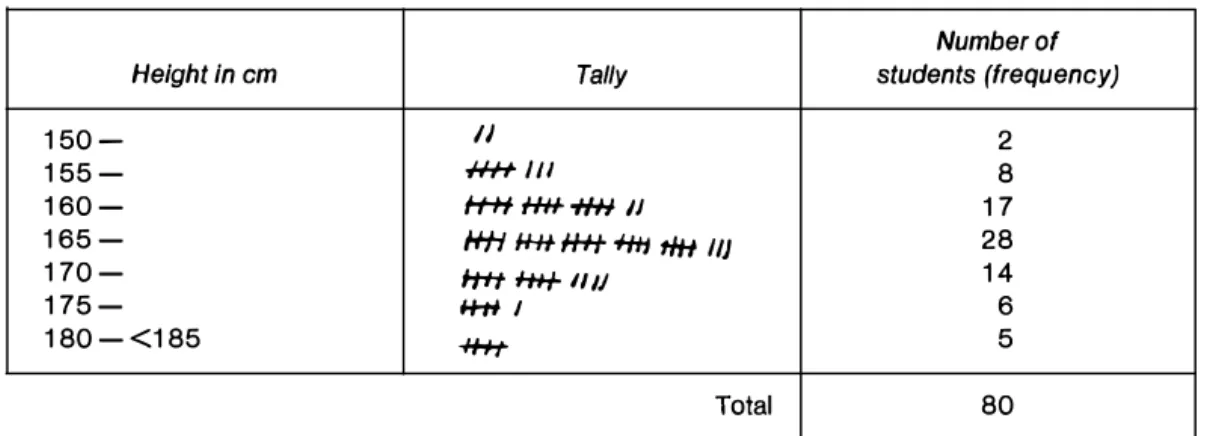
The heights range from 150 to 185 cm. This range is called the sample range. This range
is divided into intervals of 5 cm, called the class intervals. There are two students whose
heights range from 150 cm up to, but less than, 155 cm; eight students with heights ranging
from 155 cm up to, but less than, 160 cm; and so on.
To allocate the heights into their various classes, it is advisable to mark them off
Table 1.1: Frequency distribution
Number of
Height in cm Tally students (frequency)
150-
II
2155- HH//1 8
160- HH fH++fH II 17
165-
HH fH+ H+r +Ht rlH Ill
28170- rt+f f+H- I/ IJ 14
175- H-HI 6
180-<185
+l+t
5Total
80Alternatively, we may use the
stem and
/ea/technique to classify the data. Each number
may be considered as consisting of two parts, the stem and the leaf. In the data in Example
3, in which the heights range from 150 to 185 cm, we may consider the first two digits of
each measurement as the stem and the units digit as the leaf. For example, for the first
observation (153), we may consider 15 as the stem and 3 as the leaf. However, this would
provide us with only four stems, namely, 15, 16, 17 and 18. Since we are dividing the data
into class intervals of 5 cm, it would be better to consider two stems fo! each of 15, 16,
17 and 18 and attach the units 0 to 4 with the first 15 and the units 5 to 9 with the second
15, and so on as follows:
Stem
15
15
16
16
17
17
18
Leaf
34
65999758
011 4302302433241 0
5779976589799568585979688659
1 3402401 41 2024
568975
34024
We may now place the leaves in ascending order, if desired. This then arranges the 80
observations in ascending order.
Stem Leaf
15
3 4
15
5 5 6 7 8 9 9 9
16
000011 1 2223333444
16 5555556666777778888899999999
17
000111 22234444
17
556789
18
02344
Total
2
8
17
28
1 4
6
5
80
The above frequency distribution shows the distribution of heights of a
sample
of 80
students. This sample may or may not be representative of the
population
of students of
this particular age group. We cannot generalise from the result of this sample, that two out
of
every
80 students of this age group would have a height in the range 150 - . The number
will vary from sample to sample.
12 STATISTICS
in this age group have heights from 150 cm up to, but less than, 155 cm or that the
probability of any student, randomly selected from this age group, having a height in this
range is 0.025. The probability of a student having a height of less than 160 cm is:
10
80 = 0.125.
In Table 1.2, the actual frequencies are expressed as percentage frequencies and
proportionate frequencies. For example, in the 150- class range, there are two students out
of 80, i.e. 2.50Jo or 0.025.
Table 1.2: Proportionate frequency distribution
Percentage
Proportionate
Height in cm
frequency
frequency
150- 2.5 0.025
155- 10 0.1
160- 21.25 0.2125
165- 35 0.35
170- 17.5 0.175
175- 7.5 0.075
180-<185 6.25 0.0625
Total
100 1Frequency distributions, then, are sometimes of importance in themselves but they are
mainly important in providing information about the
population
from which the sample is
drawn.
Note:
The word 'population' does not necessarily refer to the entire population of a country or
even a State. It could refer to the population in a certain area or even in a particular school.
Furthermore, it does not necessarily refer to a population of people. We speak of, say, the
population of mass-produced electric light globes having varying lengths of life, or the
population of metal rods having varying diameters.
1.5 Histograms
A histogram is a diagram
representing the frequency
distribution of a continuous
variable.
The class limits are marked off
on a horizontal axis, and a
rectangle is constructed on each
class interval so that the
area
of
the rectangle is proportional to
the corresponding class
frequency. If the class intervals·
are equal, the heights of the
rectangles are proportional to
the frequencies.
Figure 1-6: Histogram
30
25
20
15
10
5
In the histogram in Figure 1-6, the height (and also the area) of each rectangle is
proportional to the frequency, because each class interval is the same.
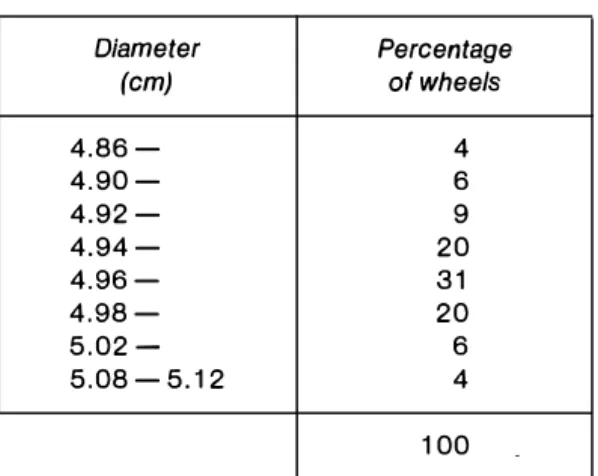
However, consider the following example. Table 1.3 gives the distribution of the diameters
of a large number of mass-produced wheels. Draw a histogram for these data.
Table 1.3: Percentage frequency distribution
Diameter Percentage
(cm) of wheels
4.86- 4
4.90- 6
4.92- 9
4.94- 20
4.96- 31
4.98- 20
5.02- 6
5.08-5.12 4
100
In Table 1.3 we notice that the class intervals are unequal. The most common class interval
is 0.02 cm. Taking this as the unit, and remembering that the area of each rectangle is
proportional to its corresponding class frequency, we notice that the 4. 86 - range has an
interval of 0.04, and so the height for this rectangle will be halved. Similarly for the 4.98
-and 5.08 - 5.12 ranges. The range 5.02- has a class interval of 0.06, -and therefore
we will have to take½ of the height of this rectangle (Figure 1-7).
32
28
24
Q)
20
'16
Q) Q)12
8
4
4.90 4.92 4.94 4.96 4.98 5.02 5.08 5.12 Diameter (centimetres)
1.6 Frequency polygons
In Figure 1-8, the polygon
ABCDEFGHI,
whose sides are straight lines joining the
midpoints of the tops of the rectangles of the histogram, is called
afrequency polygon.
Points
A
and
I
are the midpoints of the class ranges 145 - and 185 - respectively, which
have frequencies of zero. When the class intervals are equal, as they are in this case, the
frequency polygon encloses the same area as the histogram, but has a smoother form, and
so is sometimes considered to better depict the distribution in the population from which
the sample has been drawn.
30
25
(5'
20
Ql ::::, CT � 1510 5 147.5 ' B,,,' ' ' '
c/
' ' ' 157.5Figure 1-8: Histogram and frequency polygon
Exercises 1 b
E " '' ' ' ' ' ' ' ' ' ' '
,/'
\
\
�/
\
,,/
\:\
167.5 H ' '177.5 187.5
1 State which of the following are discrete variables (D) and which are continuous
variables (C)
a
The ages of the students in your class.
b
The number of goals scored by a soccer team.
c The lengths of the lives of electric light globes.
d
The number of accidents in a factory per month.
e
The number of errors per page in a book.
f The speed of a car in km I h.
g
The diameter of mass-produced metal rods.
2 The following numbers represent the heights, in cm, of 50 students.
152, 160, 168, 163, 170, 173, 151, 162, 166, 174, 165, 155, 166, 170, 169, 179,
165, 166, 176, 167, 167, 172, 169, 162, 156, 169, 169, 163, 166, 168, 160, 165,
171, 161, 167, 165, 157, 168, 175, 155, 171, 159, 158, 172, 163, 182, 162, 167,
168,164
a
Construct a frequency table using 5 cm as the class interval.
b Represent the data by means of:
3 The following are the marks scored by 40 candidates in an examination.
a Construct a frequency table with class intervals of 10 marks.
4
38 69 58 51 62 72 56 74 64 63
40 78 46 84 50 90 37 57 35 88
40 87 52 69 46 63 54 69 60 92
56 66 36 93 50 60 42 84 44 72
b
Depict the distribution by means of a histogram.
In estimating the value of a plantation of pine trees, the girths of the trees in a sample
area of 500 trees were measured, in cm, and the results were as shown.
Girth (cm) 30- 50- 70-
90-Number of trees 25 30 135 160
a
Convert the actual frequencies into relative frequencies.
b
Draw a histogram to represent the relative frequencies.
110-
130-100 40
150<170
10
c In a plantation of 800 trees, how many would be expected to have a girth of less than
70cm?
5
The frequency polygon on the right
shows the distribution of marks for
70 students in an examination.
�
20
18
16
6
Use it to construct a frequency
table.
Length of life
(hours) Frequency
300- 28
400- 60
500- 72
600- 92
700- 76
800- 50
900-<1000 22
Total
400C
14
12
10
8
6
4
2
15 25 35 45 55 65 75 85 95
Marks
Percentage Relative frequency frequency
100 1
The frequency table above gives the lengths of the lives of 400 electric light bulbs tested
in a factory.
Answer the following questions:
7
c What percentage of bulbs failed in the first 500 hours?
d What proportion of bulbs had a life of at least 500 hours but less than 800 hours?
e If a similar batch of 600 bulbs were tested, how many would you expect to last for
at least 500 hours?
Frequently, for purposes of
comparison, histograms
Males(and bar graphs) are set out
horizontally, as shown on
the right in the age/ sex
pyramid of the population
of Victoria in 1986.
State any relevant
comparisons you can see
between the age
distributions of males and
females.
10
5Age
75
and over70 74
65 69
60 64
55 59
50 54
45 49
40 44
35 39
30 34
25 29
20 24
15 19
10 14
5 9
0 4
0 Per centFemales
5
10
8 Draw histograms for the population of Victoria in 1959 and 1982, as tabulated below,
and make some relevant comments. Populations are given to the nearest thousand. (Set
out your histograms horizontally as in Question 7 .)
Age group
0-9
10-19 20-29
30-39 40-49
50-69 70-89
Population 1 959
574
453
368
426
359
490
145
Population 1 982
612
706
674
598
427
716
260
9 Use a histogram and a frequency polygon to represent the following data relating to
the civilian labour force, by age, in Victoria in 1987. The number of people is expressed
to the nearest thousand in this table:
Age group
15-17 18-19 20-24 25-34 35-44 45-54
55-59
60-64 �65
Persons
1. 7 Measures of central tendency
So far we have been concerned only with the graphical representation of statistical data.
Frequently we use the
average
of a set of data to represent the data. For example, we talk
of the average height of a group of students, the average mark of the class in an
examination, or the average wage of workers.
This magical word 'average' is not the smallest or the largest value of a variable but tends
to lie centrally in the set of observations and so is called a measure of
central tendency.
The
three most commonly used measures of central tendency are:
a the
mode
b
the
median
c
the
arithmetic mean
or, simply, the
mean
The mode
The mode of a distribution is the most frequent or most popular value of the variable.
For the observations 6, 7, 7, 5, 8, 6, 7, 9, 7, 4, 7, the mode is 7 because this number occurs
more frequently than any other number.
In Table 1.1, the mode of the distribution lies approximately in the middle of the class
interval 165 - , i.e. at the value 167 .5 cm. The 165 - class is called the
modal class.
In Table 1.2, the mode is 4.97 cm approximately, and the 4.96 - class is the
modal class.
Some distributions may have more than one mode. If their histograms have two well defined
humps, the distribution is said to be
bimodal.
If the histogram has one hump only, as in
Figures 1-6 and 1-7, the distribution is
unimodal.
The median
Discrete data
The median of a set of observations is the middle number when the numbers are arranged
in order of magnitude, or is halfway between the two middle numbers if there is an even
number of observations.
Example 4
Find the median of
a 6, 7, 7,5,8,6, 7,9, 7,4, 7
b 8,4, 10,2,6,9, 8,5
a Arranging the numbers in order, we get:
4, 5, 6, 6, 7, 7, 7, 7, 7, 8, 9
I
The median is 7
b
Arranging the numbers in order, we get:
2, 4, 5,�8, 9, 10
The two middle numbers are 6 and 8.
Continuous data
The frequency distribution in Table 1.1 can be converted to a
cumulative frequency
distribution
by adding each frequency to the total of its predecessors.
Table 1.4: Cumulative frequency distribution
Height in
Cumulative
cm
frequency
< 150 0
< 155 2
< 160 10
< 165 27
< 1 70 55
<175 69
< 180 75
< 185 80
Table 1.4 shows, for example, that: 55 out of the 80 students have heights less than 170 cm;
11 have heights equal to or greater than 175 cm; and so on.
80
70
60
� 50
Q)
>
:;::, ca ::i
40
---0 3---0
20
10
167.5
0--'-=---'--_i_--L-...L__L __ L_ _ _J_ __ ...1_ _ __..
150 155 160 165 170 175 180 185 Height (cm)
Figure 1-9: Cumulative frequency curve
The graph of a cumulative frequency distribution is called a
cumulative frequency curve
or
ogive.
The 0.5 quantile, for example, is the value of the variable below which½ of the distribution
falls.
The 0.5 quantile is called the
median.
The median can be found from the cumulative frequency curve. Its value is approximately
167.5 cm. So one half of the 80 students has a height of l_ess than 167 .5 cm.
Quantiles,
when expressed as a percentage, are called
percentiles.
The 0.8 quantile is the
80th percentile and, from the cumulative curve, its value is 173 cm. So 80 per cent of the
students have heights less than 173 cm. It is advisable to draw the cumulative curve on graph
paper so that the quantiles may be read with reasonable accuracy. The 25th percentile or
0.25 quantile is called the
lower quartile,
below which¼ of the observations lie. The 75th
percentile or 0. 75 quantile is called the
upper quartile,
below which¾ of the observations
lie.
Box plots
A useful method of illustrating the range, the median and the upper and lower quartiles
is by means of a
box plot,
sometimes called a
box-and-whisker
diagram.
In Example 4a, the 11 observations range in value from 4 to 9. The median, m, is 7, below
which there are five observations, namely:
4 5 6 6 7
The middle of this set is 6. This is the lower quartile,
L.
The upper quartile,
U,
is the middle
of the upper five observations:
7 7 7 8 9
The upper quartile is, therefore, 7. The interquartile range is from 6 to 7.
In Example 4b the eight observations range in value from 2 to 10. The median is 7, below
which there are four observations: 2, 4, 5 and 6. The middle of this set is 4.5. This is the
lower quartile,
L.
The upper quartile,
U,
is the middle of the upper four observations: 8,
8, 9 and 10. The upper quartile is 8.5.
The interquartile range is from 4.5 to 8.5. In a box plot, the interquartile range is boxed
as shown in Figure 1-10. The lines drawn from the box to the extreme values are the
whiskers.
a
b
L
2 3 4 5 6
Figure 1-1 O
L U
M M
7
u
8 9 10
The two distributions can be compared and contrasted by.drawing their box plots together
and noting the comparative lengths of the boxes and the whiskers. What conclusions can
you draw from box plots a and b in Figure 1-10?
In Example 3, the heights, to the nearest centimetre, of 80 VCE students were given. Their
heights ranged from 153 cm to 184 cm, �s shown in the stem and leaf method of arranging
the data in ascending order. The lower and upper quartiles are 162 and 171 respectively,
and the median is 167. Check these from the cumulative frequency curve (Figure 1-9) or
from the stem and leaf presentation of the data. The box plot is shown in Figure 1-11.
L M
150
155
160
165
Figure 1-11
u
170
Height (cm)
175
180
185
190
The whiskers appear to be long compared with the length of the box. What conclusions can
be drawn?
Arithmetic mean
The mode and quantiles are
typical values
of a distribution. Some of these typical values,
e.g. the mode and the median, are measures of
central tendency.
Another measure of central
tendency is the
arithmetic mean.
The arithmetic mean, or simply the mean, is the average of a set of observations.
Ungrouped data
The mean of a set of n observations x
1,x2, ... x
11is denoted by x (read 'x bar') and is
defined by:
X = X1
+
X2 + X3 + , , ,
n
+
X11
Ex
n
Ex (called sigma x) is the sum of the values of the statistical variable.
Example 5
The mean of the numbers 3, 4, 8, 9, 11 is:
x=3+4+8+9+11
5
= 35 = 7
5
Grouped data
If the numbers x,, x2, X3, ... , Xk occur J,,h,h,
. . . ,
/k times respectively, the arithmetic
mean is:
-
xif, + Xz/2 + Xy3 + , , , + Xk/k
x=�--�- -
J,
+
h
+
h
-"---=--+ ... -"---=--+
/k
= Exf
Ef
Exf
Example 6
Calculate the mean height of the 80 students in Table 1.1.
Since two students have heights in the range from 150 cm up to, but less than,
155 cm, we take the middle of this class range, 152.5, as representing the average
height of the two students, and so on for the others, as shown in Table 1. 5 below.
Table 1.5
Height in Number of cm,x students,/
152.5 2
157.5 8
162.5 17
167.5 28
172.5 14
177.5 6
182.5 5
'f:.f
= 80xf
305 1260 2762.5 4690 2415 1065 912.5Exf = 13 410
- -M
X
-f,f
13410
80
=
167.6 (cm)
It is obvious from the symmetry of this distribution that the mean is around 167.5,
in which case, the arithmetical calculation can be simplified by making 167 .5 the
origin and creating a new variable,
V.
The relation between
x
and Vis given by
the equation
x
=
a
+
kV,
where
a
is the origin, 167 .5, and
k
the class interval, 5.
Table 1.6
V
f
-3 2 -2 8 -1 17 0 28 1 14 2 6 3 5 80 VJ - 6 -15 -17 0 14 12 15 2
x =a+ kV
2
=
167.5 + 5 X 80
= 167.5 + 0.1
=
167.6(cm)
Example 7
The marks out of 10 gained by the two top students, Gwen and Nick, for a series of ten
maths tests throughout the year are as follows:
Test
1
23
4
56
7
8
910
Gwen
910
910
7
10
910
210
Nick
9 910
8
8
98
7
910
Who should receive the maths prize for the best maths student of the class?
Arranging their scores in order we get:
Gwen: 2, 7, 9, 9, 9, 10, 10, 10, 10, 10.
Nick: 7, 8, 8, 8, 9, 9, 9, 9, 10, 10.
Total 86
Total 87
Table 1. 7 shows their mean, mode and median scores.
Table1.7
Gwen
Nick
Mean
8.6
8.7
Mode
10
9Median
9.5 9Total
86
87
Nick argues that he should receive the prize because his total score, and therefore his mean
score, for the ten tests is higher than Gwen's.
Gwen argues that she should receive the prize because both her mode score and her median
score are higher. Furthermore her score is equal to or greater than Nick's in seven out of
the ten tests - equal in two tests and greater in five tests. Why should she lose the prize
because of a mark of 2 in the ninth test?
The
mean
is the most commonly used measure of central tendency because it takes all of
the observations into account. However, it can be seriously influenced by any extreme values
such as Gwen's score of 2 in the ninth test. The mode and median are not altered by any
extreme values and in some situations are better measures of central tendency. A
manufacturer, for example, would consider the
mode
to be the most important. Why?
In a survey of incomes, for example, the
median
income would give a clearer indication of
the situation than the
mean
because of the few people who would have very high incomes
compared with the majority. In situations like this, it is a common practice to eliminate the
upper and lower quarter of the distribution and calculate the mean for the inter-quartile
range.
1.8 Measurement of dispersion
The mean, median and mode give one aspect of frequency distributions, namely
central
tendency,
and are often called
measures of location
because they locate some central value
of the distribution. However, they give no information about how the observations in a
sample are spread about their central values. The two sets of observations:
both have the same mean, 9, but the second set has more spread.
It
is important, then, to
have some method (or methods) of measuring spread or dispersion.
1 The range
The range is the difference between the greatest and least values in a distribution.
It
has a
limited usefulness, since it takes into account only the two extreme observations and ignores
a possible concentration of values around a typical value.
2 The inter-quartile range
The inter-quartile range is the difference between the upper and lower quartiles. It is used
to indicate the spread of the middle half of the observations and is useful in many situations
which wish to ignore extreme values.
3 Variance and standard deviation
The variance and standard deviation are the measures of dispersion most frequently used.
(i) Ungrouped data
The variance of a set of n observations x1, x2, X3 .•. X
nis denoted by s2 and is defined by:
The standard deviation is the positive square root of the variance and is defined by:
s = �E(x - x)
n - I
2where E(x - x)
2represents the sum of the squares of the deviations of the n observations
from the mean, x.
(ii)
Grouped data
If the numbers
xi,
X2, X3, ••• , Xk occur with frequenciesfi,f2,h, ... ,fk, the variance
is defined by:
s
2= E(x -
x>
2
f, where n = Ef
n
- I
The standard deviation is defined by:
Example 8
Calculate the standard deviation of the observations 1, 2, 6, 7, 9.
The following steps are followed:
a calculate the mean of the set of observations.
b calculate the deviation of each observation from the mean.
c square these deviations and find the sum of the squares.
d calculate the square root of the sum of these squares divided by
n
- 1.
X
x-x
1
-4
2
-3
6
1
7
2
9
4
Total
25
M
ean,x = 5 =
-
25 5
The standard deviation, s,
is given by:
s
= .
/E(x
- x)
2'Y
n
- 1
=ii
.I=
-./TIT
= 3.391
The variance, s
2= 11.5
Example 9
(x
-
x)
216
9
1
4
16
46
Calculate the standard deviation of the following frequency distribution.
· '
0
1
X
f
12
29
X
f
0
12
1
29
2
26
3
18
4
10
5
5
Total
100
x =
Exf
n
= 200 = 2
100
2
34
5
26
18 10
5
xf
x-x
(x
-
x)'f
0
-2
48
29
-1
29
52
0
0
54
1
18
40
2
40
25
345
Note:
The standard deviation, s is given by:
s
= _ /I;(x
- x)
2f
'V
n
-, 1
=
�180
99
= .JT]Ts
The variance, s
2=
1.818
The divisor in the formula for the standard deviation is
n
- 1 and not
n.
The reason for
this could, perhaps, be given at this stage by stating that the first observation clearly tells
us nothing about the variability in the sample, so that only
n
- 1 of the
n
observations
are available for estimation of this variability. Furthermore, only
n
-
1 of the
n
deviations
from the mean are independent.
Many distributions are approximately of the
normal
type with a fairly well defined
symmetrical tendency with:
(i)
practically all of the observations in the range x ± 3s.
(ii)
about 95 per cent of the observations in the range x
±
2s.
(iii)
about� of the observations in the range
x
±
s.
Exercises 1c
1 A survey of the number of children per family of 20 families in a particular area
produced the following results:
0, 4, 1, 0, 2, 5, 3, 3, 2, 1, 4, 6, 2, 3, 1, 3, 4, 3, 1, 3
a Calculate the mean, mode and median.
b Draw a box plot of the data.
2 A proofreader recorded the number of errors per page in a 40-page document as
follows:
Number of errors
0
1
Number of pages
"12
10
a Calculate the mean, mode and median.
b Draw a box plot of the data.
2
3
4
7
5
4
5
2
3 A survey of the rent paid per week by 100 tenants in a Melbourne suburb recorded the
following data:
Weekly rent($)
60-
65-
70-
75-
80-Frequency
6
8
9
20
30
a Estimate the mean rental.
b Draw a cumulative frequency curve, and from it estimate:
(i)
the median rental
85-15
(ii)
the proportion of tenants paying more than $76 per week.
c Draw a box plot of the data.
90-
95-100
4 The following table shows the age distribution of 60 female workers in a clothing
factory.
Age
20-
25-
30-
35-
40-
45-
\
50<55
Frequency
4
8
13
11
a Estimate the mean age.
b
Draw a cumulative frequency curve and from it estimate:
(i)
the median age
(ii)
the 0.8 quantile
(iii)
the number of workers aged less than 32.
10
9 II
5
5 Over the past year, there were 120 accidents in a manufacturing company with
subsequent loss of production time. The number of worker-hours lost per accident is
shown in the following table:
Number of hours
lost per accident
0-
5-
10-
15-
20-
25-
30<35
Number of
accidents
17
25
38
20
9
7
4
a Estimate the mean number of hours lost per accident.
b For what percentage of the accidents was the number of hours lost per accident
between 5 and 25 hours?
6 Transistors are sold to customers in cartons containing 10 transistors. The following
table shows the number of defective transistors per carton in a sample of 100 cartons.
Number defective per carton
--iNumber of cartons
Calculate:
, .
0
57
a the mean number defective per carton
b
the mode
c
the median
1
2
3
4
30
10
2
1
7 The table below shows the percentage distribution of deaths from scarlet fever among
the various age groups:
Age in years
0-
1-
2-
3-
4-
5-Percentage of deaths
6
14
17
20
12
8
Age in years
6-
7-
8-
9-10-
15-20
Percentage of deaths
7
7
2
2
4
1
a Construct a cumulative percentage frequency distribution and draw the cumulative
curve.
8
The following table gives the distribution of the diameters of a large number of mass
produced wheels.
Diameter (cm)
4.86-
4.90-
4.92-
4.94-Percentage of wheels
2
6
9
20
Diameter (cm)
4.96-
4.98-
5.02-
5.08-5.12
Percentage of wheels
31
20
8
4
Construct a cumulative percentage frequency distribution and draw the cumulative
curve. Use the curve to estimate:
a the median diameter.
b the 0.9 quantile.
c the proportion of wheels expected to have a diameter of not less than 4.95 cm.
9 The following table shows the frequency distribution of the marks of 600 candidates
in an examination.
Marks
1-10
11-20
21-30
31-40
41-50
Number of
candidates
5
30
60
105
130
Marks
51-60
61-70
71-80
81-90
91-100
Number of
candidates
100
75
50
30
15
Construct a cumulative percentage frequency curve and answer the following questions:
a
What is the interquartile range?
b
If the pass mark is 45, what percentage of the candidates passed?
c
If honour passes were given to the top 20 per cent of candidates, what would be the
lowest mark required to obtain an honour?
10
For the following set of observations, calculate:
a
the mean
b the standard deviation:
9,6,8,6, 7, 7,6,4, 7, 7,8,9.
11
Calculate the
standard deviation
of these observations:
45,40,42,40, 38
12
In testing two modifications of an existing eyepiece design in a microscope, an observer
took 10 readings of a fixed length with each eyepiece. The results were as follows:
Design A: 295,278,289,304,293,307,293,290,296,300.
Design B: 276, 266, 273, 286, 276, 268, 238, 252, 290, 242.
It is required to know whether:
a
readings with one design are more consistent than with the other.
b
one eyepiece produces readings that are generally lower than those obtained by using
the other.
13
The egg production from two pens of fowls, taken from a total hatching of 1000 fowls,
was recorded over a period of 90 days. The first pen contained 50 birds and produced
an average of 36.4 eggs per day. The birds in the second pen, which numbered 80,
produced an average of 69.3 eggs each in the period. Estimate the total production from
the 1000 birds over the period.
Under what conditions is this estimate justified?
14
Each of 26 students in a class measured