When to include clinical study reports and regulatory documents in
systematic reviews
Jefferson T1, Doshi P2, Boutron I3, Golder S4, Heneghan C1, Hodkinson A5,
Jones M6, Lefebvre C7, Stewart LA8.
1. Centre for Evidence Based Medicine, Nuffield Department of Primary Care Health Sciences, Primary Sciences Division, University of Oxford, Oxford, UK; Editor for the Cochrane Acute Respiratory Infections Group.
2. Department of Pharmaceutical Health Services Research, University of Maryland School of Pharmacy, Maryland, U.S.A. Member of the Cochrane Acute Respiratory Infections Group. 3. Professor of Epidemiology, METHODs team, Centre of Research in Epidemiology and Statistics
Sorbonne Paris Cité, INSERM UMR 1153, University Paris Descartes, Paris, France; Co-Convenor for the Cochrane Risk of Bias Methods group.
4. Department of Health Sciences, University of York, York, UK; Co-convenor of the Cochrane Adverse Effects Methods Group.
5. Centre for Primary Care, Division of Population Health, Health Services Research & Primary Care, Oxford Road, Manchester, UK; Centre for Reviews and Dissemination, University of York, York, YO10 5DD, UK.
6. School of Public Health, University of Queensland, Brisbane, Australia; Editor for the Cochrane Acute Respiratory Infections Group
7. Independent Information Consultant, Lefebvre Associates Ltd, Oxford, UK; Co-Convenor, Cochrane Information Retrieval Methods Group.
8. Centre for Reviews and Dissemination, University of York, York, UK; Co-Convenor of the Cochrane IPD meta-analysis group.
Abstract
Reporting bias is a major threat to the validity and credibility of systematic reviews. This article outlines the rationale for accessing clinical study reports and other regulatory documents (regulatory data) as a means of addressing reporting bias, and identifies factors that may help decide whether (or not) to include regulatory data in systematic reviews. The article also describes the origins and current state of regulatory data access, and summarizes a survey of current systematic reviewers’ practices in considering
Introduction
There has been a gradual realisation that sources of evidence historically considered to be reliable (such as peer-reviewed literature) are affected by reporting bias. Reporting bias generally refers to selective reporting of research depending on the nature and direction of research results. Reporting bias includes publication bias1-3 and outcome reporting bias,1-5 among many others.6
Systematic reviews of randomised controlled trials play an important role in health decision-making. Most of these analyse data extracted from journal publications despite there being good evidence that reporting bias is widespread. As trials with unfavorable results are less likely to be published and unfavourable outcomes less likely to be reported within publications, the evidence base is often incomplete and skewed towards a positive spin. Systematic reviews that use only published data perpetuate such bias and possibly compound the issue through the credibility afforded by the systematic review, particularly if carried out by a trusted source such as Cochrane.
In a survey of 348 systematic reviews published in 2014, around three-quarters relied solely on data published in peer reviewed journals.7 Of those that accessed other sources, data from trials registries
(such as ClinicalTrials.gov), conference proceedings or contacting authors were the most used. No reviews reported using or attempting to obtain regulatory information even though the majority of the reviews evaluated drug interventions.7 A survey of 2184 Cochrane authors also found that contacting
‘trialists/investigators,’ was one of the most common methods for accessing unpublished data and that data from manufacturers or from regulatory agencies were rarely obtained.8
Clinical study reports (CSRs) are documents prepared and submitted to regulators to obtain a marketing licence for a pharmaceutical. They represent the most complete account of the planning, execution, and results of such trials.CSRs contain some of the same information as journal papers (i.e. rationale, objectives, methods, results, discussion/conclusion), but are substantially more detailed with numerous large tables and figures, and datasets not constrained by page limits. A CSR for a single trial may be hundreds, thousands, or even tens of thousands of pages in length but they are generally relatively straightforward to navigate owing to their standardised and structured format. CSRs generally contain, as appendices, important study documents including the study protocol and any amendments, statistical analysis plan and any amendments, blank case report forms (CRFs), patient information sheet, blank informed consent forms, and individual patient listings.9
There are indications that CSRs may be incomplete and in some cases may be internally inconsistent between different sections of the same CSR.10 However when comparing different data sources for the
same trial, CSRs provide the greatest breadth and depth of information compared to journal articles, trial register data and grey literature. Aggregate data on subpopulations are often found in CSRs and can provide a source of further analysis. Such a wealth of information gives a fuller and more reliable picture of a trial’s strengths and weaknesses, as well as a more reliable assessment of the benefits and harms of the studied interventions.
Clinical study reports and other regulatory documents generally only exist for drugs and biologics. Non-pharmaceutical interventions (such as implantable devices, surgery, rehabilitation, behavioural
In late 2010, the European Medicines Agency (EMA) began releasing CSRs of drugs and biologics on request under its Policy 0043.11 In October 2016, the EMA began to release CSRs prospectively under
Policy 0070 (https://clinicaldata.ema.europa.eu).11,12 This policy applies only to documents received after
1 January 2015. Documents available from the EMA under Policy 0070 normally include the clinical overview, clinical summary, and clinical study reports (CSRs) of individual trials.12 In 2017, Health Canada
published a report announcing an initiative to publicly release clinical information concerning drugs and devices under an eventual EMA Policy 0070-like mechanism.13 In March 2018, the FDA publicly released
a CSR in a pilot program that will eventually include nine new drug approvals.14 Some manufacturers are
making CSRs available to reviewers (https://restoringtrials.org/insitutions-offering-data-access/). GlaxoSmithKline, for example, allows CSRs to be freely downloaded from its clinical study register although the documents may be heavily redacted and incomplete. Other manufacturers are making CSRs available to researchers on request and after review and approval of their project proposal.
Rationale for the consideration of regulatory documents (including clinical study reports) as sources of data for inclusion in systematic reviews
Reporting biases can generally only be detected when two or more reports of the same trial are compared: for example, peer-reviewed publications compared with relevant regulatory documents. In addition to reporting bias, lack of transparency and lack of detail in journal publications may prevent or hinder detailed analyses of data which could be relevant to specific subpopulations potentially benefiting from or being harmed by the intervention.15 This situation is likely to be the consequence of compressing
thousands of pages of text and tables into the historically restricted confines of a printed journal article.15
Table 1 contains a selected and illustrative list of studies that have compared different sources of data for the same trial, such as publication versus CSR or publication versus trial register entries. Although this is not an exhaustive list of all such studies, it covers more than 50 different interventions and offers insights into the ways in which reporting bias affects the biomedical literature.
[Insert Table 1 here]
The studies in Table 1 strongly suggest that discrepancies in the reporting of trials across different sources of data are common. There are, however, limitations when interpreting discrepancies. First, different types of trial documents may have very different objectives. CSRs, for example, inform regulators and, by law, provide a comprehensive record of a study. Trials registers, in contrast, are primarily a visible collection of trial data, yet their reporting can be either absent or incomplete. Under some circumstances (such as for non-phase I trials of FDA-regulated drugs, devices, or biologics), reporting of trials within ClinicalTrials.Gov, including the submission of results, is compulsory.33 There are
also requirements for clinical trials funded by the US National Institutes of Health (NIH) such as registration and reporting of results on ClinicalTrials.Gov,34 but these requirements are not always
adhered to nor adequately policed.35
The generalisability of each finding of the studies in Table 1 to the larger population of trials or topic areas that exist is debatable, and it is unclear whether reporting biases are lessening over time. Some journals have taken steps to limit the bias introduced by the current format of trial reporting, by requiring
adherence to CONSORT36, by publishing the trial protocol, statistical analysis plan, or supplementary data
as an online appendix or by requiring data sharing as a condition of publication.37–39 As it is impossible to
We are currently aware of four systematic reviews (a Cochrane review of neuraminidase inhibitors40, twin
reviews of recombinant human bone morphogenetic protein 2 (rhBMP-2),23,24 and a review of reboxetine41)
allowing an assessment of the contribution of regulatory data compared to the same trial data from published journal articles.
In the case of rhBMP-2, both CSRs and individual participant data (supplied separately by the
manufacturer via the Yale Open Data Access (YODA) Project) were included in the twin reviews,23,24 while
the Cochrane review of neuraminidase inhibitors and the review of reboxetine were based on CSRs.40,41 In
all cases the conclusions were that important aspects of the reviews were changed with access to the more complete data available in the CSRs. Access to the CSRs also provided a deeper understanding of the strengths and limitations of the trial evidence. In the case of the review of reboxetine, the inclusion of CSR data changed the conclusions of the review and allowed quantification of the exaggeration in favour of the effects of reboxetine compared to placebo and other SSRIs.41 The Cochrane review of
neuraminidase inhibitors for influenza also found FDA drug approval packages (medical and statistical officer reviews) to be an important source of data and detail.
As systematic reviews are considered to be a gold standard of reliable research synthesis, we need to pay attention to the issue of reporting bias and to address whether, and how to decide when, accessing regulatory data, including CSRs, might offer a solution. The approach, however, is new and unfamiliar to most systematic reviewers and at the time of writing, regulatory data are not always immediately
available. When available, using such documents can involve reviewing very large quantities of information, which may be time-consuming and resource intensive. Alternatively, it may be less time consuming than trying to assemble complete study data from information that is fragmented across several publications and unpublished sources such as trials registers. Thus, a framework to help identify where using data from regulatory documents is likely to matter most, and prioritising those reviews which should adopt such an approach, will be helpful for groups grappling with how to respond to the increasing availability of these new sources of information.
Current practice
To raise awareness of the above issues and to assess the level of familiarity with and experiences of using data from CSRs and other regulatory documents within systematic reviews, we surveyed Cochrane and non-Cochrane authors to gauge how many had considered using regulatory data and how many had actually included such data in their reviews. There were 160 respondents with results mostly showing a lack of familiarity with regulatory sources of data, barriers to access and lack of resources to do so. The main rationale for authors seeking regulatory data, however, was minimisation of bias.42
The circumstances under which clinical study reports and / or other regulatory documents should be considered for inclusion in systematic reviews
We therefore created an initial list of reasons (or triggers) for seeking and using such data through discussion amongst our author group. Our list was a product of our opinion and experience. We then carried out a follow-up targeted survey in which we asked respondents to rate the importance of each criterion in our list. This survey was sent to the 21 (of 27) systematic review authors who had used, requested, or considered using regulatory data in their review and had agreed to participate in a follow-up survey. Fourteen of 21 (66%) provided a response.42
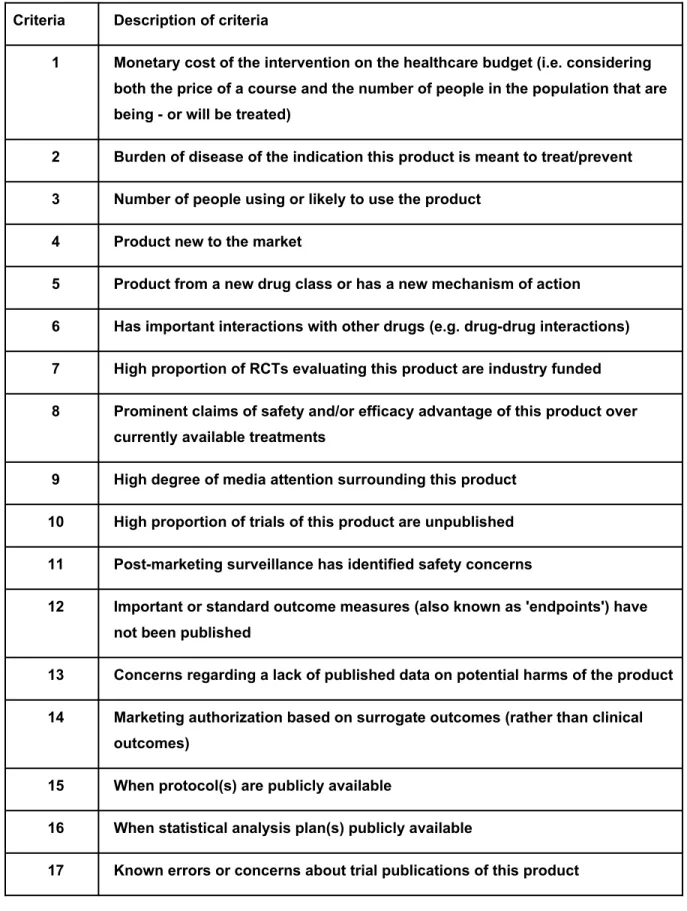
Table 2 shows our final list of criteria (after addressing review authors feedback) for assessing whether to include regulatory data of a drug or biologic in a systematic review.The variables are self-explanatory, reflecting either known or suspected bias in published results or the potential for greatest impact in terms of public health - e.g., what are the human costs of acting on biased estimates of effectiveness or harm? [Insert Table 2 here]
There is no proposed scoring or algorithm for combining criteria to identify priority topics or topic areas. The relative importance of criteria listed in Table 2 will depend very much on context, and prioritisation is inevitably a somewhat subjective process. The list is not meant to be onerous. Systematic and formal evaluation of each of the 18 criteria is not required. We suggest reviewers instead focus on the items in the list that are most relevant to their research area of interest. The list is subject to revision and may even become obsolete over time as we learn more about the added value of using CSRs for systematic review, and if the ease of accessing CSRs becomes less problematic and burdensome in the future.
Limitations when using CSRs
There are potential limitations when using CSRs as the data source for systematic reviews. First, CSRs are written for regulators and may contain sensitive information that needs to be redacted. Redactions may delay the time it takes to obtain CSRs and the applied redactions may be extensive, masking important information for inclusion in systematic reviews. Second, although data on adverse events are required to be included in CSRs at the individual participant level, these data may not be fully provided to regulators (although regulators can request these data) or to systematic reviewers who request CSRs directly from manufacturers. For example, completed case report forms are not always held by the EMA and serious adverse event narratives are redacted from CSRs on GSK’s clinical trial register. Third, complete CSRs may not be held by the EMA, and some CSRs may not be held at all, although a
complete list of all clinical trials conducted by a manufacturer does form part of the regulatory submission. Fourth, a CSR is a compiled report of a study and not the study’s underlying raw data. Despite all their strengths as a rich source of data, some investigators have identified deficiencies in the reporting in CSRs, specifically the completeness and consistency of reporting of adverse events43-46.
Conclusion
Regulatory documents are a complex and underutilised source of highly detailed data that could be included in systematic reviews. Although the steps to identify and extract and analyse data are broadly the same as for other sources of data, the resource implications of their use may not be. The results of our surveys and our own experience indicate that the use of regulatory documents should be considered, especially when the intervention in question is of high importance and when risk of reporting bias is great.
We are grateful for helpful comments on an earlier version of the draft from the following; Rene Allard, Chris Champion, Kay Dickersin, Kristina Charlotte Dietz, Jean-Mac Ferran, Mark Helfand, Toby Lasserson, Sherry Meeh, Kim Musgrave, Sarah Nevitt, Erick Turner and Beate Wieseler.
We are very grateful to those who responded to calls for feedback and we endeavoured to incorporate their comments. Incorporation of feedback comments and/or listing of names above does not infer respondents’ endorsement of our work.
Funding
This research was supported by funds provided by Cochrane Methods Innovation Fund. The views expressed in this final report are those of the authors and not necessarily those of Cochrane or its registered entities, committees or working groups.
Competing interests
All authors have completed the ICMJE uniform disclosure form at www.icmje.org/coi_disclosure.pdf and declare:
All authors except AH report funding from the Cochrane Methods Innovation Fund to undertake this project. In addition:
TJ was a co-recipient of a UK National Institute for Health Research grant (HTA – 10/80/01 Update and amalgamation of two Cochrane reviews: neuraminidase inhibitors for preventing and treating
influenza in healthy adults and children; https://www.journalslibrary.nihr.ac.uk/programmes/hta/108001#/). TJ is occasionally interviewed by market research companies about phase I or II pharmaceutical
products. In 2011–2014, TJ acted as an expert witness in a litigation case related to the antiviral
oseltamivir, in two litigation cases on potential vaccine-related damage and in a labour case on influenza vaccines in healthcare workers in Canada. He has acted as a consultant for Roche 1997–1999),
GSK (2001–2002), Sanofi-Synthelabo (2003) and IMS Health (2013). In 2014–2016, TJ was a member of three advisory boards for Boehringer Ingelheim. TJ was a member of an independent data monitoring committee for a Sanofi Pasteur clinical trial on an influenza vaccine. TJ has a potential financial conflict of interest on the drug oseltamivir. TJ was a cosignatory of a complaint to the European Ombudsman on maladministration in relation to the EMA investigation of possible harms from HPV vaccines.
PD reports reimbursement from the European Respiratory Society, grants from UK NIHR, the American Association of Colleges of Pharmacy, and the Laura and John Arnold Foundation, all outside the
submitted work. PD is also an associate editor of The BMJ and an unpaid member of the IMEDS steering committee at the Reagan-Udall Foundation for the FDA, which focuses on drug safety research.
international partners which are based on a non-profit making model. He is Editor in Chief of BMJ Evidence-Based Medicine.
References
1. Dickersin K, Min YI. Publication bias: the problem that won’t go away. Ann N Y Acad Sci. 1993 Dec 31;703:135–46; discussion 146–8.
2. Dwan K, Altman DG, Arnaiz JA, Bloom J, Chan A-W, Cronin E, et al. Systematic review of the empirical evidence of study publication bias and outcome reporting bias. PLoS One. 2008 Aug 28;3(8):e3081.
3. Hopewell S, Loudon K, Clarke MJ, Oxman AD, Dickersin K. Publication bias in clinical trials due to statistical significance or direction of trial results. Cochrane Database Syst Rev. 2009 Jan 21; (1):MR000006.
4. Ross JS, Tse T, Zarin DA, Xu H, Zhou L, Krumholz HM. Publication of NIH funded trials registered in ClinicalTrials.gov: cross sectional analysis. BMJ. 2012 Jan 3;344:d7292.
5. Vedula SS, Bero L, Scherer RW, Dickersin K. Outcome reporting in industry-sponsored trials of gabapentin for off-label use. N Engl J Med. 2009 Nov 12;361(20):1963–71.
6. McGauran N, Wieseler B, Kreis J, Schüler Y-B, Kölsch H, Kaiser T. Reporting bias in medical research - a narrative review. Trials. 2010 Apr 13;11:37.
7. Golder S, Loke YK, Wright K, Sterrantino C. Most systematic reviews of adverse effects did not include unpublished data. J Clin Epidemiol. 2016 Sep;77:125–33.
8. Schroll JB, Bero L, Gøtzsche PC. Searching for unpublished data for Cochrane reviews: cross sectional study. BMJ. 2013 Apr 23;346:f2231.
9. Doshi P, Jefferson T. Clinical study reports of randomised controlled trials: an exploratory review of previously confidential industry reports. BMJ Open 2013;3:e002496. doi: 10.1136/bmjopen-2012-002496
10. Maund E, Tendal B, Hróbjartsson A, Jørgensen KJ, Lundh A, Schroll J, et al. Benefits and harms in clinical trials of duloxetine for treatment of major depressive disorder: comparison of clinical study reports, trial registries, and publications. BMJ. 2014 Jun 4;348:g3510.
11. European Medicines Agency. Clinical data publication [Internet]. 2017 [cited 2017 Oct 2]. Available from:
http://www.ema.europa.eu/ema/?curl=pages/special_topics/general/general_content_000555.jsp 12. European Medicines Agency. European Medicines Agency policy on publication of clinical data for medicinal products for human use (POLICY/0070; EMA/240810/2013). 2014 Oct. 13. Health Canada. Public Release of Clinical Information in Drug Submissions and Medical Device Applications [Internet]. 2017 [cited 2018 Feb 8]. Available from: https://www.canada.ca/en/health-
canada/programs/public-release-clinical-information-drug-submissions-medical-device-applications.html
14. Food and Drug Administration. Clinical data summary pilot program. 2018. Available from: http:// www.fda.gov/Drugs/DevelopmentApprovalProcess/ucm589210.htm
15. Wieseler B, Kerekes MF, Vervoelgyi V, McGauran N, Kaiser T. Impact of document type on reporting quality of clinical drug trials: a comparison of registry reports, clinical study reports, and journal publications. BMJ. 2012 Jan 3;344:d8141.
from: http://dx.doi.org/10.1136/bmjopen-2012-002496
17. Chan A-W, Hróbjartsson A, Haahr MT, Gøtzsche PC, Altman DG. Empirical evidence for selective reporting of outcomes in randomized trials: comparison of protocols to published articles. JAMA. 2004 May 26;291(20):2457–65.
18. Turner EH, Matthews AM, Linardatos E, Tell RA, Rosenthal R. Selective publication of
antidepressant trials and its influence on apparent efficacy. N Engl J Med. 2008 Jan 17;358(3):252– 60.
19. Eyding D, Lelgemann M, Grouven U, Härter M, Kromp M, Kaiser T, et al. Reboxetine for acute treatment of major depression: systematic review and meta-analysis of published and unpublished placebo and selective serotonin reuptake inhibitor controlled trials. BMJ. 2010 Oct 12;341:c4737. 20. Jefferson T, Jones MA, Doshi P, Del Mar CB, Heneghan CJ, Hama R, et al. Neuraminidase inhibitors
for preventing and treating influenza in healthy adults and children. Cochrane Database Syst Rev. 2012 Jan 18;1:CD008965.
21. Coyne DW. The health-related quality of life was not improved by targeting higher hemoglobin in the Normal Hematocrit Trial. Kidney Int. 2012 Jul;82(2):235–41.
22. Wieseler B, Wolfram N, McGauran N, Kerekes MF, Vervölgyi V, Kohlepp P, et al. Completeness of reporting of patient-relevant clinical trial outcomes: comparison of unpublished clinical study reports with publicly available data. PLoS Med. 2013 Oct;10(10):e1001526.
23. Rodgers MA, Brown JVE, Heirs MK, Higgins JPT, Mannion RJ, Simmonds MC, et al. Reporting of industry funded study outcome data: comparison of confidential and published data on the safety and effectiveness of rhBMP-2 for spinal fusion. BMJ. 2013 Jun 20;346:f3981.
24. Fu R, Selph S, McDonagh M, Peterson K, Tiwari A, Chou R, et al. Effectiveness and harms of recombinant human bone morphogenetic protein-2 in spine fusion: a systematic review and meta-analysis. Ann Intern Med. 2013 Jun 18;158(12):890–902.
25. Le Noury J, Nardo JM, Healy D, Jureidini J, Raven M, Tufanaru C, et al. Restoring Study 329: efficacy and harms of paroxetine and imipramine in treatment of major depression in adolescence. BMJ. 2015 Sep 16;351:h4320.
26. Köhler M, Haag S, Biester K, Brockhaus AC, McGauran N, Grouven U, et al. Information on new drugs at market entry: retrospective analysis of health technology assessment reports versus regulatory reports, journal publications, and registry reports. BMJ. 2015 Feb 26;350:h796.
27. Beaumier J, Lawrence K, Puil L, Mintzes B, Wright J, Perry T, et al. Olanzapine for schizophrenia: what do the unpublished clinical trials reveal? 23rd Cochrane Colloquium; 2015 Oct; Vienna, Austria. 28. Cosgrove L, Vannoy S, Mintzes B, Shaughnessy AF. Under the Influence: The Interplay among
Industry, Publishing, and Drug Regulation. Account Res. 2016;23(5):257–79.
29. Hodkinson A, Gamble C, Smith CT. Reporting of harms outcomes: a comparison of journal publications with unpublished clinical study reports of orlistat trials. Trials. 2016 Apr 22;17(1):207. 30. Jureidini JN, Amsterdam JD, McHenry LB. The citalopram CIT-MD-18 pediatric depression trial:
Deconstruction of medical ghostwriting, data mischaracterisation and academic malfeasance. Int J Risk Saf Med. 2016 Mar 16;28(1):33–43.
32. Mayo-Wilson E, Li T, Fusco N, Bertizzolo L, Canner JK, Cowley T, et al. Cherry-picking by trialists and meta-analysts can drive conclusions about intervention efficacy. J Clin Epidemiol [Internet]. 2017 Aug 24; Available from: http://dx.doi.org/10.1016/j.jclinepi.2017.07.014
33. Anderson ML, Chiswell K, Peterson ED, Tasneem A, Topping J, Califf RM. Compliance with results reporting at ClinicalTrials.gov. N Engl J Med. 2015 Mar 12;372(11):1031–9.
34. National Institutes of Health, U.S. Department of Health and Human Services. NIH Policy on dissemination of NIH-funded clinical trial information. NOT-OD-16-149. 2016; Available from: https://grants.nih.gov/grants/guide/notice-files/NOT-OD-16-149.html
35. Ross JS, Tse T, Zarin DA, Xu H, Zhou L, Krumholz HM. Publication of NIH funded trials registered in ClinicalTrials.gov: cross sectional analysis. BMJ. 2012;344:d7292.
36. Schulz KF, Altman DG, Moher D. CONSORT 2010 Statement: updated guidelines for reporting parallel group randomised trials. BMC Medicine. 2010;8:18.
37. Hopewell S, Dutton S, Yu L-M, Chan A-W, Altman DG. The quality of reports of randomised trials in 2000 and 2006: comparative study of articles indexed in PubMed. BMJ. 2010 Mar 23;340:c723.
38. Plint AC, Moher D, Morrison A, Schulz K, Altman DG, Hill C, et al. Does the CONSORT checklist improve the quality of reports of randomised controlled trials? A systematic review. Med J Aust. 2006 Sep 4;185(5):263–7.
39. Loder E, Groves T. The BMJ requires data sharing on request for all trials. BMJ. 2015 May 7;350:h2373.
40. Jefferson T, Jones MA, Doshi P, Del Mar CB, Hama R, Thompson MJ, et al. Neuraminidase inhibitors for preventing and treating influenza in healthy adults and children. Cochrane Database Syst Rev. 2014 Apr 10;(4):CD008965.
41. Eyding D, Lelgemann M, Grouven U, Härter M, Kromp M, Kaiser T, et al. Reboxetine for acute treatment of major depression: systematic review and meta-analysis of published and
unpublished placebo and selective serotonin reuptake inhibitor controlled trials. BMJ. 2010 Oct 12;341:c4737.
42. Hodkinson A, Dietz KC, Lefebvre C, Golder S, Jones M, Doshi P, et al. The use of clinical study reports to enhance the quality of systematic reviews: a survey of systematic review authors.
Systematic Reviews. 2018 Aug 8; 7:117.
43. Sharma T, Schow Guski L, Freund N, Gøtzsche PC. Suicidality and aggression during
antidepressant treatment: systematic review and meta-analyses based on clinical study reports. BMJ 2016 Jan 27;352:i65
44. Le Noury J, Nardo JM, Healy D, Jureidini J, Raven M, Tufanaru C, Abi-Jaoude E. Restoring Study 329: efficacy and harms of paroxetine and imipramine in treatment of major depression in adolescence. BMJ 2015 Sep 16;351:h4320
45. Hodkinson A, Gamble C, Tudur Smith C. Reporting of harms outcomes: a comparison of journal publications with unpublished clinical study reports of orlistat trials. Trials 2016 Apr 22;17:207
46. Vedula SS, Li T, Dickersin K. Differences in Reporting of Analyses in Internal Company
Table 2. Criteria for assessing whether to include regulatory data of a drug or biologic in a Cochrane review (not in order of priority)
Criteria Description of criteria
1 Monetary cost of the intervention on the healthcare budget (i.e. considering
both the price of a course and the number of people in the population that are being - or will be treated)
2 Burden of disease of the indication this product is meant to treat/prevent
3 Number of people using or likely to use the product
4 Product new to the market
5 Product from a new drug class or has a new mechanism of action
6 Has important interactions with other drugs (e.g. drug-drug interactions)
7 High proportion of RCTs evaluating this product are industry funded
8 Prominent claims of safety and/or efficacy advantage of this product over
currently available treatments
9 High degree of media attention surrounding this product
10 High proportion of trials of this product are unpublished
11 Post-marketing surveillance has identified safety concerns
12 Important or standard outcome measures (also known as 'endpoints') have
not been published
13 Concerns regarding a lack of published data on potential harms of the product
14 Marketing authorization based on surrogate outcomes (rather than clinical
outcomes)
15 When protocol(s) are publicly available
16 When statistical analysis plan(s) publicly available