Volume 2007, Article ID 12140,7pages doi:10.1155/2007/12140
Research Article
A Heuristic Optimal Discrete Bit Allocation Algorithm for
Margin Maximization in DMT Systems
Li-Ping Zhu,1Yan Yao,1Shi-Dong Zhou,1and Shi-Wei Dong2
1Department of Electronic Engineering, School of Information Science and Technology, Tsinghua University, Beijing 100084, China 2National Key Laboratory of Space Microwave Technology, Xi’an Institute of Space Radio Technology, Xi’an 710100, China
Received 14 July 2006; Revised 24 December 2006; Accepted 25 December 2006
Recommended by Erchin Serpedin
A heuristic optimal discrete bit allocation algorithm is proposed for solving the margin maximization problem in discrete titone (DMT) systems. Starting from an initial equal power assignment bit distribution, the proposed algorithm employs a mul-tistaged bit rate allocation scheme to meet the target rate. If the total bit rate is far from the target rate, a multiple-bits loading procedure is used to obtain a bit allocation close to the target rate. When close to the target rate, a parallel bit-loading procedure is used to achieve the target rate and this is computationally more efficient than conventional greedy bit-loading algorithm. Finally, the target bit rate distribution is checked, if it is efficient, then it is also the optimal solution; else, optimal bit distribution can be obtained only by few bit swaps. Simulation results using the standard asymmetric digital subscriber line (ADSL) test loops show that the proposed algorithm is efficient for practical DMT transmissions.
Copyright © 2007 Li-Ping Zhu et al. This is an open access article distributed under the Creative Commons Attribution License, which permits unrestricted use, distribution, and reproduction in any medium, provided the original work is properly cited.
1. INTRODUCTION
Discrete multitone (DMT) is a modulation technique that has been widely used in various digital subscriber lines (xDSL), such as asymmetric digital subscriber line (ADSL) and very-high-speed digital subscriber line (VDSL), per-mitting reliable high rate data transmission over hostile frequency-selective channels [1,2]. Recently, it is proposed for broadband downstream power-line communications due to its high flexibility in resources management [3]. A cru-cial aspect in the design of a DMT system is to allocate bits and power to the subchannels in an optimal way under var-ious constraints. One of the problems that are of practical interest is margin maximization or transmission power min-imization, also known as margin adaptive (MA) [4].
Many optimal or suboptimal discrete bit-loading algo-rithms are proposed for solving the problem. Among the al-gorithms in which the constraint of a target bit rate is consid-ered, the computational complexity of the Hughes-Hartogs algorithm [5] and Chow’s algorithm [6] is relatively high. There are also a lot of computationally efficient algorithms, including the algorithms proposed by Piazzo [7,8], the algo-rithm of Krongold et al. [9], and the Levin-Campello (LC) algorithms [4,10,11]. Researchers afterwards take into ac-count more constraints including the transmission power
spectral density (PSD) mask and the maximum allowable size of the QAM constellations [12,13], and a common fea-ture of these algorithms is that they all use greedy bit-loading, either during the whole allocation process or after the initial allocation. To achieve the target rate, greedy bit-filling adds one bit at a time to the subchannel that requires the smallest additional power, while greedy bit-removal removes one bit at a time from the subchannel that requires the largest addi-tional power. If the initial bit rate is far from the target rate, the computation load of these algorithms is heavy. In [14], a multiple-bits loading procedure is introduced that converges faster to the optimal solution. Initially, the algorithm calcu-lates two bit allocations, that is, loop-representative bit allo-cation and maximum bit rate alloallo-cation, to obtain the ini-tial bit distribution, and then it performs multiple-bits load-ing for achievload-ing the target rate. However, the extra cost paid in calculating the loop-representative bit allocation is not al-ways helpful. When the target rate is high enough, the per-formance of the algorithm degrades compared to greedy bit-removal algorithm [14].
the total bit rate is far from the target rate, a multiple-bits loading procedure is used to obtain a bit allocation close to the target rate. When close to the target rate, a parallel bit-loading procedure is used to achieve the target rate. This par-allel bit-loading step is computationally more efficient than the conventional greedy bit-loading algorithm. The resulting bit distribution is not guaranteed to be optimal so it is nec-essary to perform a clean-up operation using the LC effi ci-entizing (EF) algorithm [4] to obtain the optimal solution. The algorithm achieves exactly the same optimal solutions as the algorithm in [14], but the computation load is on average much lower and this can be attributed to the speed up from the parallel bit-loading step.
The new bit-loading algorithm is explained in detail in Section 2. Simulation results and analysis are given in
Section 3. Finally, conclusion is drawn inSection 4.
2. THE NEW BIT-LOADING ALGORITHM
Assume a DMT system consisting of M subcarriers. The transmission power and bit rate (in bits/symbol) of subchan-nel n(n=1, 2,. . .,M) arePn andbn, respectively. Assume
that each subchannelnhas the pulse-response gainHnand
the noise consisting of crosstalk and thermal noise modeled as additive white Gaussian noise (AWGN) with power σ2
n,
thenPnis related tobnby
Pn=Pn
bn
=2bn−1 Γ
CNRn, (1) where CNRn= |Hn|2/σn2is the subchannel gain-to-noise
ra-tio (CNR) of subchanneln, andΓis the signal-to-noise ratio (SNR) gap (in dB) [4], which is given by
Γ=10 log10+ Q
−1P
e/2
2
3
+γm−γc, (2)
where Pe is the given target probability of symbol error
(PSE),γm andγc are the SNR margin and the coding gain,
respectively, and Q−1(x) represents the inverse function of Q(x) which is given by
Q(x)= √1
2π ∞
x e
−t2/2
dt. (3)
The MA problem considered can be stated as follows:
min
M
n=1
Pn subject to M
n=1
bn=BT, M
n=1
Pn≤PT,
0≤bn≤bn, bn∈Z+,n=1, 2,. . .,M,
(4)
whereBT andPT are the target bit rate and the total power
budget,1respectively,b
nis the maximum bit rate of
subchan-neln, andZ+ represents the set of nonnegative integer. The
1If the power used for maximum bit rate allocation exceedsP
T, then the most power-expensive bits have to be removed to meet the power budget constraint and the new bit distributionbndetermines the maximum bit rate allocation, as has been indicated in [14]. In practical situations, the power used for maximum bit rate allocation is usually less thanPT.
maximum bit ratebnis given by
bn=min
bmax,bn
, n=1, 2,. . .,M, (5) wherebmaxis the maximum allowable size of the QAM
con-stellations andbnis the bit rate determined by the maximum
allowable powerPnimposed by the system PSD. In
practi-cal systems, the maximum PSD of the system is typipracti-cally flat over the region of the transmission bandwidth, soPnis some
constant given by
Pn=Φ·F, n=1, 2,. . .,M, (6)
where Φis the maximum PSD of the system andF is the subchannel bandwidth. The bit ratebnis given by
bn=
log2
1 +Pn·CNRn Γ
, (7)
wherexdenotes the greatest integer that is smaller thanx. The new bit-loading algorithm consists of four steps. Ini-tially, the algorithm calculates the maximum rate bit-loading distribution. Then based on this bit distribution, the diff er-ence between the total bit rateBand the target bit rateBT
is used to calculate a loading parametera. If the difference
|B−BT|is large, the loading parameter is used in a
multiple-bits loading procedure to add or remove the same number of bits to or from all the subcarries in a designated set to ac-celerate allocation. Next, when the bit difference |B−BT|
is small and nonzero, a parallel bit-filling or bit-removal is used to meet the target rate. Specially, parallel bit-filling compares the transmission power increment ΔPn(bn+ 1)
(0≤bn< bmax) of all the subcarries in a designated set, and
adds one bit to each of the|B−BT|least power-consumptive
subcarriers, while parallel bit-removal compares the trans-mission power incrementΔPn(bn) (0< bn≤bmax) of all the
subcarriers in a designated set, and removes one bit from each of the|B−BT|largest power-consumptive subcarriers.
The transmission power incrementΔPn(bn) of subcarriern
is given by
ΔPn
bn
=Pn
bn
−Pn
bn−1
=2(bn−1) Γ
CNRn.
(8)
Finally, since the resulting distribution is not guaranteed to be optimum, the last step is to use the EF algorithm to check whether the target rate bit distribution is efficient. If there is no movement of a bit from one subchannel to another that reduces the total transmission power, then the resulting bit distribution is efficient. If the target rate bit distribution is efficient, it is also the optimal bit distribution; else, the opti-mal bit distribution can be obtained by several bit swaps. The following is the detailed algorithm.
(A) Initial maximum bit rate allocation.
(1) Compute the equal power assignment discrete bit dis-tributionb =[b1b2···bM] in whichbn(n=1, 2,. . .,M) is
calculated by (6) and (7).
(2) Let bit ratebnbe the maximum bit rate calculated by
(5).
The total number of bits loaded in maximum bit rate al-location isB=M
step (D). IfB > BT, then the number of bits to be removed is Bdiff =B−BT, and the algorithm enters the target bit rate
allocation.
(B) Multibit loading allocation. Let
∼
N=n:bn> bmax,n=1, 2,. . .,M
,
N∼=n: 0< bn≤bmax, n=1, 2,. . .,M
(9)
represent the index set of the subcarriers that carry more bits and no more bits thanbmax, respectively, during
initializa-tion. The cardinality ofN∼ andN
∼ is ∼
L = |N|∼ andL∼ = |N
∼|,
respectively. Generally ∼L = 0 as ∼L = 0 holds only when
bmax < bnorbn = 0 for allnwhich is unrealistic for xDSL
applications. Consider the complex case of ∼L = 0.2 The
maximum and the minimum of the difference betweenbn
(n∈N∼) andbmaxis
v=max
n∈∼N
bn−bmax
, v=min
n∈∼N
bn−bmax
, (10)
respectively.
Define loading parametera= Bdiff/L∼. Multibit load-ing allocation, which is upper-bounded bybmax and
lower-bounded by zero, is performed in such a way that the re-sulting bit distribution is the shift version of the initial bit distribution b. Therefore, if a (a >1) bits were to be re-moved from subcarriern(n∈N∼), thena−(bn−bmax) bits
must be removed from subcarriern(n∈N∼s), where ∼
Ns = {n:bmax< bn< bmax+a,n∈
∼
N}, or the number of bits car-ried by subcarriern(n∈N∼s) should be reduced tobn−a.
Following are the notations of subsets and their cardinalities that will be used below
∼
Ns1=
n:bn=bmax+v,n∈ ∼
N, ∼Ls1= ∼
Ns1; ∼
Ns2=
n:bmax+v <bn<bmax+v+a,n∈ ∼
N, ∼Ls2= ∼
Ns2; ∼
Ns3=
n:bn=bmax+v+a, n∈ ∼
N, ∼Ls3= ∼
Ns3; ∼
Ns4=
n:bmax< bn< bmax+v,n∈ ∼
N, ∼Ls4= ∼
Ns4, N=n:bn>0, n=1, 2,. . .,M
, L= |N|.
(11)
According to the value ofaand the relation amonga,v, andv, several different bit allocation schemes can be deter-mined.
(1)a=0.
Go to (1) of step (C).
2For the case of∼L =0, target bit rate allocation is performed by repeated
multiple-bits loading until the value of loading parametera, wherea= Bdiff/ L
∼, is zero, and then parallel bit-loading is executed for achieving
the target bit rate.
(2)a=v.
(i) Removeabits from all the subcarriers inN∼, and up-dateBdiff.
(ii) Go to (2) of step (C). (3)v < a < v.
(i) Removevbits from all the subcarriers inN∼and update
Bdiff.
(ii) Calculate new loading parametera = Bdiff/(∼L+
∼
Ls1), removeabits from all the subcarriers inN∼∪ ∼
Ns1,
re-duce the number of bits carried by the subcarriers inN∼s2to bn−v−a, and updateBdiff.
(iii) Go to (3) of step (C). (4)a=v.
(i) Removea bits from all the subcarriers inN∼, reduce the number of bits carried by the subcarriers inN∼s4tobn−a,
and updateBdiff.
(ii) Calculate new loading parametera = |Bdiff|/(∼L+
∼
Ls4), addabits to all the subcarriers inN∼∪ ∼
Ns4, and update Bdiff.
(iii) Go to (4) of step (C). (5)v < a.
(i) Removevbits from all the subcarriers inN∼, reduce the number of bits carried by the subcarriers inN∼s4tobn−v
and updateBdiff.
(ii) Do the following loop.
Calculate new loading parametera= Bdiff/L. Ifa <0, add|a|bits to all the subcarriers inN, upper-boundbnwith bmax, and updateBdiff; else ifa > 0, removeabits from all
the subcarriers inN, lower-boundbnwith zero and update Bdiff; else ifa=0, break the loop and go to (5) of step (C).
(C) Parallel-bit loading allocation. (1)a=0.
Remove one bit from each of theBdiff largest power-consumptive subcarriers inN∼.
(2)a=v.
IfBdiff = 0, go to step (D); else, remove one bit from each of theBdiff largest power-consumptive subcarriers in
N∼∪N∼s1.
(3)v < a < v.
IfBdiff=0, go to step (D); else ifBdiff<0, add one bit to each of the|Bdiff|least power-consumptive subcarriers in
N∼ ∪N∼s1∪ ∼
Ns2; else, remove one bit from each of theBdiff
largest power-consumptive subcarriers inN∼∪N∼s1∪ ∼
Ns2∪ ∼
Ns3.
(4)a=v.
If Bdiff < 0, add one bit to each of the |Bdiff| least power-consumptive subcarriers inN∼∪N∼s4; else, remove one
bit from each of theBdiff largest power-consumptive sub-carriers inN= {n:bn>0, n=1, 2,. . .,M}.
(5)v < a.
Table1: Simulation results for ADSL loop T1.601#9 showing different allocation phases of the proposed algorithm.
Target rate Loading parameter Maximum rate allocation
Target rate allocation
Final allocation adjustment Multiple-bits loading Parallel bit-filling/
bit-removal
Bdiff Number of subtractions Bdiff L Number of bit swaps
2864 a=0 151 0 151 216 0
2714 a=v 301 216 85 224 0
2563 v < a < v 452 224 12 236 0
2111 a=v 904 242 14 242 0
1809 v < a 1206 491 39 249 0
N; else, remove one bit from each of theBdifflargest power-consumptive subcarriers inN.
(D) Final efficient adjustment of bit allocation.
As the initial bit distribution is not guaranteed to be opti-mal without incorporating the minimum power constraint, the target rate bit distribution is not guaranteed to be effi -cient, so EF algorithm is employed and the following steps are executed.
(1) Find the least power-consumptive subcarrier n+ in ∼
Np= {n: 0≤bn< bmax,n=1, 2,. . .,M}.
(2) Find the largest power-consumptive subcarriern− in
N∼
p= {n: 0< bn≤bmax,n=1, 2,. . .,M}.
(3) If ΔPn+(bn++ 1) < ΔPn−(bn−), letbn+ = bn++ 1 and bn− = bn− −1, updateΔPn+(bn++ 1) and ΔPn−(bn−),
and go back to step (1); else, the algorithm ends. In this way, the optimal bit distribution can be obtained after very few bit swaps. In many practical situations where the PSD is flat, the optimal bit distribution is obtained af-ter parallel bit-loading due to the discretization nature of the task. Hence, in most cases, this procedure only plays the role of checking whether the target rate bit distribution is optimal or not, and bit swaps procedure can be omitted.
3. SIMULATION RESULTS AND ANALYSIS
Using the new bit-loading algorithm given in the previous section, we present extensive simulation results for various standard ADSL test loops and target rates. The ADSL loops employ a duplex transmission strategy with echo cancel-ing and the ADSL downlinks with subcarriers 7 through 255 loaded are tested. An AWGN floor of −135 dBm/Hz is assumed. For ADSL test loop T1.601#7, T1.601#9, and T1.601#13, the operating environment with 50 high bit rate DSL (HDSL) and 50 integrated services digital network (ISDN) crosstalkers is assumed. For other ADSL test loops, the environment with 1 ADSL crosstalker is assumed. The total power budget is 100 mW, the PSD mask is -40 dBm/Hz, the SNR margin is 4 dB, the coding gain is 4 dB, and the tar-get PSE isPe=10−7. The maximum size of the QAM
con-stellations is set atbmax=15.
Table 1gives the numerical results of corresponding pa-rameters in a different allocation phase for ADSL test loop T1.601#9 [15]. The target rates 2864, 2714, 2563, 2111, and
1 2 3 4 5 6 7
Bitdist ribution
number
0 50
100 150
200 250
300
Subchannels
0 5 10 15 20
N
u
mber
of
bits
per
subc
h
annel
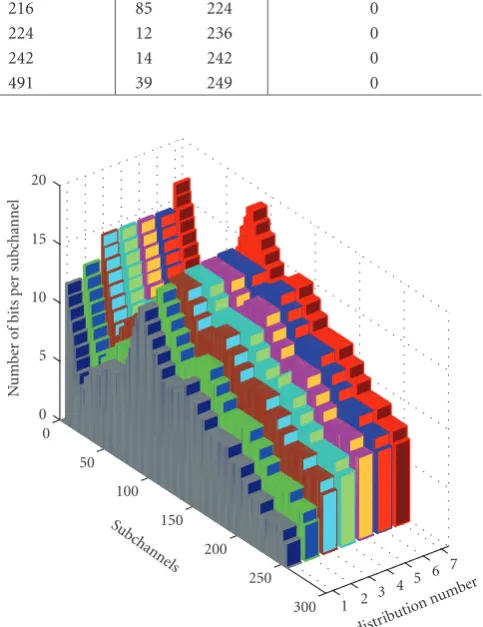
Figure1: Bar chart of seven different bit distributions for ADSL loop T1.601#9.
1809 correspond to allocation schemea=0,a=v,v < a < v,a=v, andv < a, respectively. Parameters given inTable 1
include the bit differenceBdiffafter maximum bit rate allo-cation, number of subtractions in performing the multiple-bits loading, number of multiple-bitsBdiff allocated by parallel bit-filling or bit-removal, the cardinalityLof the designated sub-channel set in which parallel bit-filling or bit-removal is per-formed, and the number of bit swaps in final bit allocation adjustment. As shown inTable 1, the number of bit swaps in each case is zero. Simulation on other ADSL test loops under various target rates also shows that the number of bit swaps is at most 3, and in most cases the number of bit swaps is zero, meaning that the bit distribution is optimal after paral-lel bit-loading.
Table2: Simulation results showing the computation load of the proposed algorithm and that of existing algorithms.
Test loop
Target rate
Algorithm in [14] Proposed algorithm Computation load comparison Multiple
allocation
Greedy bit-loading
Multiple allocation
Parallel bit-loading
Algorithm in [14]
Proposed algorithm
Ratios of the two algorithms Subtraction/
addition Bdiff L
Subtraction/
addition Bdiff L A C A C A C
T1.601#7
2262 248 70 238 232 19 244 387 16 590 251 4446 1.54 3.73
1759 0 185 244 493 29 237 369 44 955 522 6438 0.71 6.98
1257 244 212 218 493 71 210 667 46 004 564 12 354 1.18 3.72
754 437 99 182 493 166 186 634 17 919 659 17 015 0.96 1.05
251 413 93 118 784 18 98 598 10 881 802 1593 0.75 6.83
T1.601#13
2628 249 196 231 216 76 228 640 45 080 292 14 402 2.19 3.13
2044 249 99 248 246 52 246 446 24 453 298 11 414 4.55 2.14
1460 0 13 249 495 34 243 25 3224 529 7667 0.05 0.42
876 240 115 204 495 154 206 469 23 345 649 19 789 0.72 1.18
292 413 127 132 818 12 102 866 16 637 830 1146 1.04 14.5
CSA#4
2620 249 55 248 243 48 249 358 13 585 291 10 776 1.23 1.26
2038 249 220 249 492 132 249 688 54 560 624 24 090 1.10 2.26
1456 0 136 249 492 216 249 271 33 728 708 30 348 0.38 1.11
873 245 202 241 492 60 239 648 48 480 552 12 510 1.17 3.88
291 245 73 156 492 168 188 390 11 315 660 17 388 0.59 0.65
CSA#6
2606 249 50 248 244 45 249 348 12 350 289 10 170 1.20 1.21
2027 249 196 249 493 145 249 640 48 608 638 25 520 1.00 1.90
1448 0 137 249 493 207 249 273 33 976 700 30 015 0.39 1.13
869 246 196 240 493 45 237 637 46 844 538 9630 1.18 4.86
290 246 70 154 493 154 183 385 10 710 647 16 247 0.60 0.66
CSA#7
2567 249 228 249 248 37 249 704 56 544 285 8510 2.47 6.64
1996 249 155 249 497 110 249 558 38 440 607 21 285 0.92 1.81
1426 249 83 249 497 182 249 414 20 584 679 28 665 0.61 0.72
856 0 238 248 497 5 243 475 58 786 502 1200 0.95 48.99
285 248 84 158 497 92 162 415 13 188 589 10 626 0.70 1.24
CSA#8
2546 249 217 249 248 35 249 682 53 816 283 8085 2.41 6.66
1980 249 149 249 497 103 249 546 36 952 600 20 291 0.91 1.82
1415 249 82 249 497 170 249 412 20 336 667 27 795 0.62 0.73
849 0 235 246 497 238 246 469 57 575 735 30 107 0.64 1.91
283 246 82 157 497 84 157 409 12 792 581 9618 0.70 1.33
Mid-CSA
2795 249 174 248 235 75 248 596 42 978 310 15 750 1.92 2.73
2174 249 51 249 497 199 249 350 12 648 696 29 651 0.50 0.43
1553 249 177 249 497 73 249 602 43 896 570 15 476 1.06 2.84
932 249 54 249 497 196 249 356 13 392 693 29 498 0.51 0.45
311 245 73 164 497 74 164 390 11 899 571 9361 0.68 1.27
respectively. Bit distributions number 7 and number 6 cor-respond to initial equal power assignment bit distributionb
and maximum bit rate distribution, respectively.
To evaluate the computational efficiency of the pro-posed algorithm, we compare the main computation load of the proposed algorithm with that of the algorithm in [14] for ADSL test loop T1.601#7, T1.601#13, CSA#4, CSA#6, CSA#7, CSA#8, and Mid-CSA [15], with target bit rate cor-responding to 90%, 70%, 50%, 30%, and 10% of the loop’s maximum bit rate. The computation load of the proposed algorithm is mainly determined by the operations in per-forming multiple-bits loading and parallel bit-loading, while
that of the algorithm in [14] is mainly determined by the operations in performing multiple-bits loading and greedy bit-loading. For the same number of bits Bdiff to be al-located in the subchannel set with the same number of subchannels L, parallel bit-loading performs Bdiff adjust-ment inone step compared to theBdiffgreedy bit-loading steps, thus is computationally more efficient. Assume that the transmission power increment of each subchannel is obtained beforehand. Parallel bit-loading requires L−1 +
extra of Bdiff−1 multiplications or divisions in updating the transmission power increment. The number of com-parisons, the basic operation, of the parallel bit-loading is (Bdiff−1)·Bdiff/2 less than that of the greedy bit-loading.
Table 2shows the experimental results of the number of subtraction and/or addition in performing the multiple-bits loading, the number of bitsBdiff allocated by parallel bit-loading or greedy bit-bit-loading, and the cardinality Lof the designated subchannel set in which parallel bit-loading or greedy bit-loading is performed. The main computation load of the two algorithms, which is calculated based on these re-sults, depends on two kinds of operations, that is, arithmetic operation and comparison, which are represented by sym-bols “A” and “C” inTable 2, respectively. The computation load of minor adjustment using the EF algorithm is low as it obtains the optimal solution with the minimum number of bit swaps. Specially, the number of bit swaps for each sce-nario of Table 2is zero. The number of “A” operations for the proposed algorithm is the sum of two parts: the num-ber of subtraction or addition for multiple-bits loading and the number of subtraction or additionBdifffor parallel bit-loading. The number of “A” operations for the algorithm in [14] is the sum of three parts: the number of subtraction or addition for multiple-bits loading, the number of subtrac-tion or addisubtrac-tionBdifffor greedy bit-loading, and the num-ber of multiplication or divisionBdiff−1 for updating the transmission power increment. The number of “C” opera-tions for the proposed algorithm isL−1 +L−2 +· · ·+L− Bdiff, while that of “C” operations for the algorithm in [14] is (L−1)·Bdiff. To facilitate comparison of the computation load of the two algorithms, the ratios of the number of opera-tions for the algorithm in [14] to the number of correspond-ing operations for the proposed algorithm are also provided. As can be seen fromTable 2, the number of “C” opera-tions is much more than that of “A” operaopera-tions, meaning that parallel bit-loading and greedy bit-loading play the most im-portant part in determining the computation load of the pro-posed algorithm and the algorithm in [14], respectively, and the basic operation of the two algorithms is compared. The smaller the value ofBdiff andLis, the lighter the compu-tation load is. Obviously, the main compucompu-tation load of the proposed algorithm, that is, the number of “C” operations, is much lower than that of the algorithm in [14] in most cases. So it can be expected that the proposed algorithm is faster than the algorithm in [14] except when the algorithm in [14] ends up with a low value ofBdiff.
Using order-statistic selection algorithm [16], parallel bit-loading can be performed inO(L) time. AsL ≤M, the proposed algorithm is as efficient as the LC algorithms which has the computational complexity of O(M), and more ef-ficient than the algorithms of Piazzo [8] and Krongold et al. [9], both of which have the computational complexity of
O(M·logM).
4. CONCLUSION
In this paper, a heuristic optimal discrete bit allocation al-gorithm for margin maximization in DMT systems is pre-sented. Compared to existing multiple-bits-loading-based
algorithm which calculates an initial efficient bit calculation whatever the target bit rate is, the proposed algorithm is more flexible in that it performs bit swaps only when the target bit allocation is not efficient. Compared to conventional greedy bit-loading algorithm, the introduced parallel bit-loading al-gorithm is computationally more efficient. Numerical results on the standard ADSL test loops show the reduced compu-tational load of our algorithm in comparison with existing multiple-bits-loading-based algorithm. The idea of our al-gorithm can also be applied to bit allocation in other DMT transmission systems.
ACKNOWLEDGMENTS
The authors wish to thank the anonymous reviewers for their constructive and detailed comments and suggestions which help to improve the quality of the paper. This work was sup-ported by the China Postdoctoral Science Foundation under Grant no. 2006039083.
REFERENCES
[1] J. M. Cioffi, V. Oksman, J.-J. Werner, et al., “Very-high-speed digital subscriber lines,”IEEE Communications Maga-zine, vol. 37, no. 4, pp. 72–79, 1999.
[2] J. A. C. Bingham,ADSL, VDSL, and Multicarrier Modulation, John Wiley & Sons, New York, NY, USA, 2000.
[3] E. Del Re, R. Fantacci, S. Morosi, and R. Seravalle, “Compari-son of CDMA and OFDM techniques for downstream power-line communications on low voltage grid,”IEEE Transactions on Power Delivery, vol. 18, no. 4, pp. 1104–1109, 2003. [4] J. M. Cioffi, “Advanced Digital Communication,” EE379C
Course Textbook, Stanford University, 2002.
[5] D. Hughes-Hartogs, “Ensemble modem structure for imper-fect transmission media,” U.S. Patents, 4,679,227 (July 1987), 4,731,816 (March 1988), and 4,833,706 (May 1989).
[6] P. S. Chow, J. M. Cioffi, and J. A. C. Bingham, “A practical dis-crete multitone transceiver loading algorithm for data trans-mission over spectrally shaped channels,”IEEE Transactions on Communications, vol. 43, no. 2–4, pp. 773–775, 1995. [7] L. Piazzo, “Fast algorithm for power and bit allocation in
OFDM systems,”Electronics Letters, vol. 35, no. 25, pp. 2173– 2174, 1999.
[8] L. Piazzo, “Fast optimal bit-loading algorithm for adaptive OFDM systems,” Internal Report 002-04-03, INFOCOM De-partment, University of Rome, Rome, Italy, 2003.
[9] B. S. Krongold, K. Ramchandran, and D. L. Jones, “Computa-tionally efficient optimal power allocation algorithms for mul-ticarrier communication systems,”IEEE Transactions on Com-munications, vol. 48, no. 1, pp. 23–27, 2000.
[10] J. Campello, “Optimal discrete bit loading for multicarrier modulation systems,” in Proceedings of IEEE International Symposium on Information Theory, p. 193, Cambridge, Mass, USA, August 1998.
[11] H. E. Levin, “A complete and optimal data allocation method for practical discrete multitone systems,” in Pro-ceedings of IEEE Global Telecommunications Conference (GLOBECOM ’01), vol. 1, pp. 369–374, San Antonio, Tex, USA, November 2001.
[13] A. Fasano, “On the optimal discrete bit loading for multicar-rier systems with constraints,” inProceedings of the 57th IEEE Semiannual Vehicular Technology Conference (VTC ’03), vol. 2, pp. 915–919, Jeju, South Korea, April 2003.
[14] N. Papandreou and T. Antonakopoulos, “A new computation-ally efficient discrete bit-loading algorithm for DMT applica-tions,”IEEE Transactions on Communications, vol. 53, no. 5, pp. 785–789, 2005.
[15] T. Long, J. M. Cioffi, and F. Liu,XDSL Technology and Ap-plications, Publishing House of Electronics Industry, Beijing, China, 2002.
[16] U. Manber,Introduction to Algorithms: A Creative Approach, Pearson Education Asia Limited and Publishing House of Electronics Industry, Beijing, China, 2005.
Li-Ping Zhu received the B.S. degree in communications engineering in 1992, the M.S. degree in communications and elec-tronics system in 1995, both from Dalian Maritime University, Dalian, China, and the Ph.D. degree in circuits and systems in 2004 from Shanghai Jiao Tong University, Shang-hai, China. She has been with the State Key Laboratory on Microwave & Digital Com-munications in the Department of
Elec-tronic Engineering at Tsinghua University since April 2005. Her main research interests lie in the area of signal processing for communications, with particular emphasis on antijam spread-spectrum communications, wavelet theory and applications, per-formance analysis, and resource allocation for communication sys-tems.
Yan Yaograduated from Tsinghua Univer-sity, Beijing, China, in 1962, and joined De-partment of Electronic Engineering as As-sistant Professor, Associate Professor, and Professor. He was Director of State Key Laboratory on Microwave & Digital Com-munications and Vice Chairman of Radio-Electronic Research Institute at Tsinghua University. He has been teaching and re-searching in the field of wireless and
digi-tal communications for more than 40 years. The present academic field is communication and electronic systems; research directions include broadband transmission, personal communication systems and networks, software radio technology, antifading and antijam-ming techniques in wireless communications. He is also Fellow of CIC, Senior Member of CIE, and Senior Member of IEEE.
Shi-Dong Zhouis a Professor at Tsinghua University, China. He received the Ph.D. degree in communication and information systems from Tsinghua University in 1998. His B.S. and M.S. degrees in wireless com-munication were received from Southeast University, Nanjing, China, in 1991 and 1994, respectively. From 1999 to 2001, he was in charge of several projects in the China 3G Mobile Communication R and D
Program. He is now a Member of China’s FuTURE Project. His re-search interests are in the area of wireless and mobile communica-tions.