Volume 2009, Article ID 531213,20pages doi:10.1155/2009/531213
Research Article
Signal Processing Strategies for Cochlear Implants Using
Current Steering
Waldo Nogueira, Leonid Litvak, Bernd Edler, J¨orn Ostermann, and Andreas B¨
uchner
Laboratorium f¨ur Informationstechnologie, Leibniz Universit¨at Hannover, Schneiderberg 32, 30167 Hannove, Germany
Correspondence should be addressed to Waldo Nogueira,[email protected]
Received 29 November 2008; Revised 19 April 2009; Accepted 22 September 2009
Recommended by Torsten Dau
In contemporary cochlear implant systems, the audio signal is decomposed into different frequency bands, each assigned to one electrode. Thus, pitch perception is limited by the number of physical electrodes implanted into the cochlea and by the wide bandwidth assigned to each electrode. The Harmony HiResolution bionic ear (Advanced Bionics LLC, Valencia, CA, USA) has the capability of creating virtual spectral channels through simultaneous delivery of current to pairs of adjacent electrodes. By steering the locus of stimulation to sites between the electrodes, additional pitch percepts can be generated. Two new sound processing strategies based on current steering have been designed, SpecRes and SineEx. In a chronic trial, speech intelligibility, pitch perception, and subjective appreciation of sound were compared between the two current steering strategies and standard HiRes strategy in 9 adult Harmony users. There was considerable variability in benefit, and the mean results show similar performance with all three strategies.
Copyright © 2009 Waldo Nogueira et al. This is an open access article distributed under the Creative Commons Attribution License, which permits unrestricted use, distribution, and reproduction in any medium, provided the original work is properly cited.
1. Introduction
Cochlear implants are an accepted and effective treatment
for restoring hearing sensation to people with severe-to-profound hearing loss. Contemporary cochlear implants consist of a microphone, a sound processor, a transmitter, a receiver, and an electrode array that is positioned inside the cochlea. The sound processor is responsible for decomposing
the input audio signal into different frequency bands and
delivering information about each frequency band to the appropriate electrode in a base-to-apex tonotopic pattern. The bandwidths of the frequency bands are approximately equal to the critical bands, where low-frequency bands have higher frequency resolution than high-frequency bands. The actual stimulation to each electrode consists of nonoverlap-ping biphasic charge-balanced pulses that are modulated by the lowpass-filtered output of each analysis filter.
Most contemporary cochlear implants deliver interleaved pulses to the electrodes so that no electrodes are stimulated simultaneously. If electrodes are stimulated simultaneously, thereby overlapping in time, their electrical fields add and create undesirable interactions. Interleaved stimulation
partially eliminates these undesired interactions. Research shows that strategies using nonsimultaneous stimulation achieve better performance than strategies using
simultane-ous stimulation of all electrodes [1].
Most cochlear implant users have limited pitch reso-lution. There are two mechanisms that can underlie pitch perception in cochlear implant recipients, temporal/rate
pitch and place pitch [2]. Rate pitch is related to the
temporal pattern of stimulation. The higher the frequency of the stimulating pulses, the higher the perceived pitch. Typically, most patients do not perceive pitch changes when
the stimulation rate exceeds 300 pulses per second [3].
Nonetheless, temporal pitch cues have shown to provide
some fundamental frequency discrimination [4] and limited
melody recognition [2]. The fundamental frequency is
important for speaker recognition and speech intelligibil-ity. For speakers of tone languages (e.g., Cantonese or
Mandarin), differences in fundamental frequency within a
phonemic segment determine the lexical meaning of a word. It is not surprising, then, that cochlear implant users in countries with tone languages may not derive the same
Speech intelligibility in noise environments might be limited for cochlear implant users because of the poor perception of temporal cues. It has been shown that normal hearing listeners benefit from temporal cues to improve speech
intelligibility in noise environments [6].
The place pitch mechanism is related to the spatial pat-tern of stimulation. Stimulation of electrodes located towards the base of the cochlea produces higher pitch sensations than stimulation of electrodes located towards the apex. The resolution of pitch derived from a place mechanism is limited by the few number of electrodes and the current spread produced in the cochlea when each electrode is activated. Pitch or spectral resolution is important when the listening environment becomes challenging in order to separate speech from noise or to distinguish multiple talkers
[7]. The ability to differentiate place-pitch information also
contributes to the perception of the fundamental frequency
[4]. Increased spectral resolution also is required to perceive
fundamental pitch and to identify melodies and instruments
[8]. As many as 100 bands of spectral resolution are required
for music perception in normal hearing subjects [7].
Newer sound-processing strategies like HiRes are designed to increase the spectral and temporal resolution provided by a cochlear implant in order to improve the hearing abilities of cochlear implant recipients. HiRes analyzes the acoustic signal with high temporal resolution
and delivers high stimulation rates [9]. However, spectral
resolution is still not optimal because of the limited number of electrodes. Therefore, a challenge for new signal processing strategies is to improve the representation of frequency information given the limited number of fixed electrodes. Recently, researchers have demonstrated a way to enhance place pitch perception through simultaneous
stimulation of electrode pairs [3, 10–12]. This causes a
summation of the electrical field producing a peak of the overall field located in the middle of both electrodes. It has been reported that additional pitch sensations can be created by adjusting the proportion of current delivered
simultaneously to two electrodes [13]. This technique is
known as current steering [7]. As the implant can represent
information with finer spectral resolution, it becomes necessary to improve the spectral analysis of the audio signal performed by classical strategies like HiRes.
In addition to simultaneous stimulation of electrodes, multiple intermediate pitch percepts also can be created using by sequential stimulation of adjacent electrodes in
quick succession [14]. Electrical models of the human
cochlea and psychoacoustic experiments have shown that simultaneous stimulation generally is able to produce a single, gradually shifting intermediate pitch. On the other hand, sequential stimulation often produces two regions of excitation. Thus, sequential stimulation often requires an increase in the total amount of current needed to reach comfortable loudness, and may lead to the perception of two pitches or a broader pitch as the electrical field separates into
two regions [15].
The main goal of this work was to improve speech and music perception in cochlear implant recipients through the development of new signal processing strategies that
take advantage of the current-steering capabilities of the Advanced Bionics device. These new strategies were designed to improve the spectral analysis of the audio signal and to deliver the signal with greater place precision using current steering. The challenge was to implement the experimental strategies in commercial speech processors so that they could be evaluated by actual implanted subjects. Thus a significant
effort was put into executing the real-time applications in
commercial low power processors. After implementation, the strategies were assessed using standardized tests of pitch perception and speech intelligibility and through subjective ratings of music appreciation and speech quality.
The paper is organized as follows. Section 2 describes
the commercial HiRes and two research strategies using
current steering. Section 3 details the methods for
evalu-ating speech intelligibility and frequency discrimination in cochlear implant recipients using the new strategies. Sections
4,5, and6present the results, discussion, and conclusions.
2. Methods
2.1. The High Resolution Strategy (HiRes). The HiRes strat-egy is implemented in the Auria and Harmony sound processors from Advanced Bionics LLC. These devices can be used with the Harmony implant (CII and the HiRes90k). In HiRes, an audio signal sampled at 17400 Hz is pre-emphasized by the microphone and then digitized. Adaptive gain control (AGC) is performed digitally using a
dual-loop AGC [16]. Afterwards the signal is broken up into
frequency bands using infinite impulse response (IIR) sixth-order Butterworth filters. The center frequencies of the filters are logarithmically spaced between 350 Hz and 5500 Hz. The last filter is a high-pass filter whose bandwidth extends up to the Nyquist frequency. The bandwidth covered by the filters will be referred to as subbands or frequency bands. In HiRes, each frequency band is associated with one electrode.
In HiRes, the subband outputs of the filter bank are used to derive the information that is sent to the electrodes. Specifically, the filter outputs are half-wave rectified and averaged. Half-wave rectification is accomplished by setting to 0 the negative amplitudes at the output of each filter band. The outputs of the half-wave rectifier are averaged for the
duration Ts of a stimulation cycle. Finally, the “Mapping”
block maps the acoustic values obtained for each frequency band into current amplitudes that are used to modulate biphasic pulses. A logarithmic compression function is used to ensure that the envelope outputs fit the patient’s dynamic range. This function is defined for each frequency band or
electrodez(z=1,. . .,M) and is of the form presented in the
following equation:
Yz
XFiltz
=(MCL(z)−THL(z))
IDR
×XFiltz−msatdB+ 12 + IDR
+ THL(z)
z=1,. . .,M, (1)
whereYzis the (compressed) electrical amplitude,XFiltzis the
the input dynamic range set by the clinician. A typical value for the IDR is 60 dB. The mapping function used in HiRes
maps the MCL at 12 dB below the saturation levelmsatdB. The
saturation level in HiRes is set to 20 log10(215−1).
In each stimulation cycle, HiRes stimulates allMimplant
electrodes sequentially to partially avoid channel interac-tions. The number of electrodes for the HiRes90k implant
isM=16, and all electrodes are stimulated at the same fixed
rate. The maximum channel stimulation rate (CSR) used in the HiRes90k is 2899 Hz.
2.2. The Spectral Resolution Strategy (SpecRes). The spectral resolution (SpecRes) strategy is a research version of the commercial HiRes with Fidelity 120 strategy and, like HiRes can be used with the Harmony implant. This strategy was designed to increase the frequency resolution so as to
optimize use of the current steering technique. In [10],
it was shown that cochlear implant subjects are able to perceive several distinct pitches between two electrodes when they are stimulated simultaneously. In HiRes each center frequency and bandwidth of a filter band is associated with one electrode.
However, when more stimulation sites are created using current steering, a more accurate spectral analysis of the incoming sound is required. For this reason, the filter bank used in HiRes is not adequate and a new signal processing strategy that enables higher spectral resolution
analysis is required. Figure 1 shows the main processing
blocks of the new strategy designed by Advanced Bionics LLC.
In SpecRes, the signal from the microphone is first
pre-emphasized and digitized atFs=17400 Hz as in HiRes. Next
the front-end implements the same adaptive-gain control (AGC) as used in HiRes. The resulting signal is sent through a filter bank based on a Fast Fourier Transform (FFT).
The length of the FFT is set to L = 256 samples; this
value gives a good compromise between spectral resolution (related to place pitch) and temporal resolution (related to temporal pitch). The longer the FFT, the higher the frequency resolution and thus, the lower the temporal resolution.
The linearly spaced FFT bins then are grouped into analysis bands. An analysis band is defined as spectral information contained in a range allocated to two electrodes. For each analysis band, the Hilbert envelope is computed from FFT bins. In order to improve the spectral resolution of the audio signal analysis, an interpolation based on a spectral
peak locator [17] inside each analysis band is performed.
The spectral peaks are an estimation of the most important frequencies. The frequency estimated by the spectral peak locator is used by the frequency weight map and the carrier synthesis. The carrier synthesis generates a pulse train with the frequency determined by the spectral peak locator in order to deliver temporal pitch information. The frequency weight map converts the frequency determined by the spectral peak locator into a current weighting proportion that is applied to the electrode pair associated with the analysis band.
All this information is combined and nonlinearly mapped to convert the acoustical amplitudes into electrical
current amplitudes. For each stimulation cycle, pairs of electrodes associated with one analysis band are stimulated simultaneously, but the pairs of channels are stimulated sequentially in order to reduce undesired channel interac-tion. Furthermore, the order of stimulation is selected to maximize the distance between consecutive analysis bands being stimulated. This approach reduces further channel interaction between stimulation sites. The next section presents each block of SpecRes in detail.
2.2.1. FFT and Hilbert Envelope. The FFT is performed on
input blocks ofL=256 samples of the previously windowed
audio signal:
xw(l)=x(l)w(l), l=0,. . .,L−1, (2)
where x(l) is the input signal andw(l) is a 256-blackman
hanning window:
w(l)=1
2
0.42−0.5 cos
2πl
L
+ 0.08 cos
4πl L
+1
2
0.5−0.5 cos
2πl
L
l=0,. . .,L−1. (3)
The FFT of the windowed input signal can be decomposed into its real and imaginary components as follows:
X(n)=FFT(xw(l))
=Re{X(n)}+jIm{X(n)}, n=0,. . .,L−1, (4)
where
Re{X(n)}Xr(n)=
1 L
L−1
l=0
xw(l) cos
2πn
Ll
,
Im{X(n)}Xi(n)= 1
L
L−1
l=0
xw(l) sin
2πn
Ll
. (5)
The linearly spaced FFT bins are then combined to provide
the required number of analysis bands N. Because the
number of electrodes in Harmony implant is M = 16
electrodes, the total number of analysis bands isN=M−1=
15.Table 1presents the number of FFT bins assigned to each analysis band and its associated center frequency.
The Hilbert envelope is computed for each analysis band.
The Hilbert envelope for the analysis bandzis denoted by
HEzand is computed from the FFT bins as follows:
Hrz(τ)=
nendz−1
n=nstartz
Xr(n) cos
2πnτ
L
−Xi(n) sin
2πnτ
L
,
Hiz(τ)=
nendz−1
n=nstartz
Xr(n) sin
2πnτ
L
−Xi(n) cos
2πnτ
L
, (6)
whereHrz andHiz are the real and imaginary parts of the
Hilbert transform, τ is the delay within the window and
Audio
in Front
end A/D
L-fast Fourier transform
(FFT) 1 2
L/2
Analysis band 1 Envelope
detection Spectral peak locator
Envelope detection Spectral peak locator
Envelope detection Spectral peak locator
Frequency weight map
Carrier synthesis
Frequency weight map
Carrier synthesis
Frequency weight map
Carrier synthesis
Mapping
Mapping Mapping
Ts
E1 E2
E2 E3
EM−1 EM
Analysis band 2
Analysis bandN .
. .
. . .
. . .
. . .
Figure1: Block diagram illustrating SpecRes.
Table1: Number of FFT bins related to each analysis band and its associated center frequencies in Hz. The FFT bins have been grouped in order to match the center frequencies of the standard HiRes filterbank used in clinical routine practice.
Analysis band
z 1 2 3 4 5 6 7 8 9 10 11 12 13 14 15
Number of
binsNz 2 2 1 2 2 2 3 4 4 5 6 7 8 10 55
Start bin nstartz
5 7 9 10 12 14 16 19 23 27 32 38 45 53 63
Center freqs
fcenter(Hz) 408 544 646 748 884 1020 1190 1427 1700 2005 2379 2821 3330 3942 6491
Specifically, for τ = L/2, the Hilbert transform is
calculated in the middle of the analysis window:
Hrz=
nendz
n=nstartz
Xr(n)(−1)n,
Hiz=
nendz
n=nstartz
Xi(n)(−1)n.
(7)
the Hilbert envelope HE(τ) is obtained from the Hilbert
transform as follows:
HE(τ)=Hrz(τ)
2
+Hiz(τ)
2
. (8)
To implement stimulation at different positions between two
electrodes, each analysis channel can create multiple virtual channels by varying the proportion of current delivered to adjacent electrodes simultaneously. The weighting applied to each electrode is controlled by the spectral peak locator and the frequency weight map.
2.2.2. Spectral Peak Locator. Peak location is determined
within each analysis bandz. For a pure tone within a channel,
spectral peak location should estimate the frequency of the tone. The frequency resolution obtained with the FFT is
half a bin. A bin represents a frequency interval ofFs/LHz.
The maximum resolution that can be achieved is therefore
67.96 Hz. However, it has been shown in [12] that patients
are able to perceive a maximum of around 30 distinct pitch percepts between pairs of the most apical electrodes. Because the bandwidth associated with the most apical electrode pair is around 300 Hz and the maximum resolution is 30 pitch percepts, the spectral resolution required for the analysis should be around 10 Hz. This resolution is accomplished by using a spectral peak locator. Spectral peak location is computed in two steps. The first step is to determine the FFT bin within an analysis band with the most energy. The power e(n) in each bin equals the sum of the squared real and the imaginary parts of that bin:
e(n)=X2
r(n) +Xi2(n). (9)
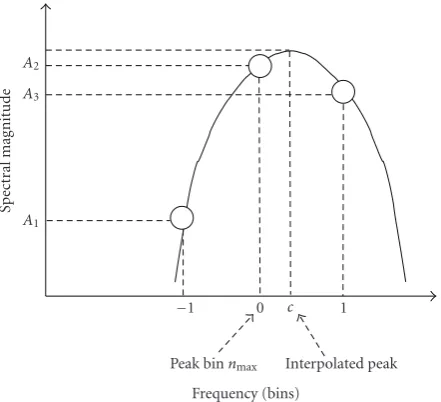
The second step consists of fitting a parabola around the bin
nmaxzcontaining maximum energy in an analysis bandz, that
is, e(nmaxz) ≥ e(n) for alln /=nmaxz in that analysis band.
A1 A3 A2
Spect
ral
mag
nitude
−1 0 c 1
Peak binnmax Interpolated peak Frequency (bins)
Figure2: Parabolic fitting between three FFT bins.
system centered atnmaxis defined.e(nmax−1) ande(nmax+1)
represent the energy of the two adjacent bins. By taking the energies in dB, we have
A1=20 log10
enmaxz−1
,
A2=20 log10
enmaxz
,
A3=20 log10
enmaxz+ 1
.
(10)
The optimal location is computed by fitting a generic parabola
yf=af −c2+b, (11)
to the amplitude of the binnmax and the amplitude of the
two adjacent bins and taking its maximum.a,b, andcare
variables andf indicates frequency in Hz.
Figure 2illustrates the parabolic interpolation [17,18].
The center point or vertex c gives the interpolated peak
location (in bins). The parabola is evaluated at the three bins
nearest to the center pointc:
y(−1)=A1,
y(0)=A2,
y(1)=A3.
(12)
The three samples can be substituted in the parabola defined
in (11). This yields the frequency difference in FFT bins:
c=1
2
A1−A3
A1−2A2+A3 ∈
−1
2,
1
2 , (13)
and the estimate of the peak location (in bins) is
n∗maxz =nmaxz+c. (14)
If the maximum bin within the channel is not the local maximum, this can only occur near the boundary of the channel, the spectral peak locator is placed at the boundary of the channel.
2.2.3. Frequency-Weight-Map. The purpose of the fre-quency-weight-map is to translate the spectral peak into
cochlear location. For each analysis band z two weights
are calculatedwz1 andwz2 that will be applied to the two
electrodes forming that analysis band. This can be achieved
using the cochlear frequency-position function [19]
f =A(10ax), (15)
f represents the frequency in Hz andxthe position in (mm)
along the cochlea. A and a were set to 350 Hz and 0.07,
respectively, considering the known dimensions of the CII
and HiRes90k [20]. The locations associated to the electrodes
were calculated by substitution of its corresponding frequen-cies in the above equation. The location of each electrode is
denoted byxz(z=1,. . .,M).
The peak frequencies are also translated to positions
using (15). The location corresponding to a peak frequency
in the analysis band z is denoted by xzp. To translate a
cochlear location to weights that will be applied to individual currents of each electrode, the peak location is substracted
from the location of the first electrodexzin a pair (xz,xz+1).
The weight applied to the second electrode xz+1 (higher
frequency) of the pair is calculated using the following equation:
wz2= xzp−xz
dz , (16)
and the weight applied to first electrodexzof the pair is
wz1=
xz+1−xzp
dz
, (17)
wheredzis the distance in (mm) between the two electrodes
forming an analysis band, that is,
dz= |xz+1−xz|. (18)
2.2.4. Carrier Synthesis. The carrier synthesis attempts to compensate for the low temporal resolution given by the FFT-based approach. The goal is to enhance temporal pitch perception by representing the temporal structure of the frequency corresponding to the spectral peak in each analysis band. Note that the electrodes are stimulated with a current determined by the HE at a constant rate determined by the CSR. The carrier synthesis modulates the Hilbert envelope of each analysis band with a frequency coinciding with the frequency of the spectral peak.
Furthermore, the modulation depth (relative amount of oscillation from peak to valley) is reduced with increasing
frequency as shown inFigure 3.
The carrier synthesis defines the phase variablephh,z for
each analysis bandzand frameh, where 0≤phh,z≤CSR−1.
During each frameh,phh,z is increased by the minimum of
the estimated frequency fmaxzand CSR:
phh,z=
phh−1,z+ min
fmaxz, CSR
mod (CSR), (19)
where fmaxz =n∗maxz(Fs/L),hindicates the actual frame, and
0 0.5 1
M
o
dulation
depth
M
D(
f
)
0 FR/2 FR
Frequency (f)
Figure 3: Modulation depth as a function of frequency. FR is a constant of the algorithm equal to 2320 Hz which is the maximum channel stimulation rate that can be delivered with the implant using the current steering technique.
The parameters is defined for each analysis bandz as
follows:
sz= ⎧ ⎪ ⎨ ⎪ ⎩
1, phh,z≤CSR
2 ,
0, otherwise.
(20)
Then, the final carrier for each analysis bandzis defined as
cz=1−szMD
fmaxz
, (21)
where MD(fmaxz) is the modulation depth function defined
inFigure 3.
2.2.5. Mapping. The final step of the SpecRes strategy is to convert the envelope, weight, and carrier into the current magnitude to apply to each electrode pair associated with each analysis band. The mapping function is defined as in
HiRes (1). For the two electrodes in the pair that comprise
the analysis band; the current delivered is given by
Iz=Yz(max(HEz))wz1cz, (22)
Iz+1=Yz+1(max(HEz))wz2cz, (23)
wherez=1,. . .,M−1.
In the above equation, Yz and Yz+1 are the mapping
functions for the two electrodes forming an analysis band,
wz1 and wz2 are the weights, max(HEz) is the largest
Hilbert envelope value that was computed since the previous
mapping operation for the analysis band z, andcz is the
carrier.
2.3. The Sinusoid Extraction Strategy (SineEx). The new sinusoid extraction (SineEx) strategy is based on the general structure of the SpecRes strategy but incorporates a robust method for estimating spectral components of audio signals with high accuracy. A block diagram illustrating SineEx is
shown inFigure 4.
The front-end, the filterbank, the envelope detector, and the mapping are identical to those used in SpecRes strategy. However, in contrast to the spectral-peak-picking algorithm performed by SpecRes, a frequency estimator that uses an iterative analysis/synthesis algorithm selects the most important spectral components in a given frame of the audio signal. The analysis/synthesis algorithm models the frequency spectrum as a sum of sinusoids. Only the perceptually most important sinusoids are selected using a psychoacoustic masking model.
The analysis/synthesis loop first defines a source model to represent the audio signal. The model’s parameters are adjusted to best match the audio signal. Because of the few
number of analysis bands in the Harmony system (N=15),
only a small number of parameters of the source model can be estimated. Therefore, the most complex task in SineEx is determining the few parameters that describe the input signal. The selection of the most relevant components is controlled by a psychoacoustic masking model in the
analysis/synthesis loop. The model simulates the effect of
simultaneous masking that occurs at the level of the basilar membrane in normal hearing.
The model estimates which sinusoids are masked the least to drive the stimulation to the electrodes. The idea behind this model is to deliver only those signal components that are most clearly perceived by normal-hearing listeners to the cochlear implant. A psychoacoustic masking model used to control the selection of sinusoids in an analysis/synthesis loop has been shown to provide improved sound quality with
respect to other methods in normal hearing [21].
For example, other applications of this technique, where stimulation was restricted to the number of physical elec-trodes, demonstrated that the interaction between chan-nels could be reduced by selecting fewer electrodes for stimulation. Therefore, because current steering will allow stimulation of significantly more cochlear sites compared to nonsimultaneous stimulation strategies, the masking model may contribute even further to the reduction of channel interaction and therefore improve sound perception.
In [22] a psychoacoustic masking model was also used
to select the perceptually most important components
for cochlear implants. One aspect assumed in [22] was
that the negative effects of channel interaction on speech
understanding could be reduced by selecting less bands for stimulation.
The parameters extracted for the source model are then used by the frequency weight map and the carrier synthesis to code place pitch through current steering and to code temporal pitch by modulating the Hilbert envelopes, just as in SpecRes. Note that a high-accuracy estimation of frequency components is required in order to take advantage of the potential frequency resolution that can be delivered using current steering.
For parametric representations of sound signals, as in SineEx, the definition of the source model, the method used to select the model’s parameters, and the accuracy in the extraction of these parameters play a very important
role in increasing sound perception performance [21]. The
Audio in
Front end A/D
L-fast Fourier transform
(FFT) 1 2
L/2
Analysis band 1 Envelope detection
Envelope detection
Envelope detection
Frequency weight map Frequency
estimator
Carrier synthesis
Nonlinear map
Nonlinear map
Nonlinear map
Ts
E1 E2
E2 E3
EM−1 EM
Analysis band 2
Analysis bandM .
. .
. . .
. . .
. . .
. . .
. . . . . . Analysis/synthesis
Psychoacoustic masking model X(n)
Figure4: Block diagram illustrating SineEx.
used to estimate the model’s parameters based on an analysis/synthesis procedure.
2.3.1. Source Model. Advanced models of the audio source are advantageous for modeling audio signals with the fewest number of parameters. To develop the SineEx strategy, the source model had to be related to the current-steering capabilities of the implant. In SineEx, the source model decomposes the input signal into sinusoidal components. A source model based on sinusoids provides an accurate estimation of the spectral components that can be delivered through current steering. Individual sinusoids are described by their frequencies, amplitudes, and phases. The incoming
sound x(l) is modeled as a summation of N sinusoids as
follows:
x(l)≈x(l)=
N
i=1
ciej(2πmil/L+φi), (24)
wherex(l) is the input signal,x(l) is the model of the signal,
ciis the amplitude,miis the frequency, andφiis the phase of
theith sinusoid.
2.3.2. Parameter Estimation for the Source Model. The param-eters of individual sinusoids are extracted iteratively in an
analysis/synthesis loop [23]. The algorithm uses a dictionary
of complex exponentials sm(l) = ej2πml/L(l−(L−1)/2)(l =
1,. . .,L) with P elements (m = 1,. . .,P) [24] as source
model. The analysis/synthesis loop is started with the
windowed segment of the input signalx(l) as first residual
r1(l):
r1(l)=x(l)w(l), l=0,. . .,L−1, (25)
where x(l) is the input audio signal and w(l) is the same
blackman-hanning window as in SpecRes (3).
The window w(l) is also applied to the dictionary
elements:
gm(l)=w(l)sm(l)=w(l)e(j2πm/L)(l−(L−1)/2). (26)
It is assumed thatgm(l) has unity norm, that is,gm(l) =1
forl=0,. . .,L−1.
For the next stage, sincex(l) andri(l) are real values, the
next residual can be calculated as follows:
ri+1(l)=ri(l)−cigmi(l)−c
∗
i gm∗i(l). (27)
The estimation consists of determining the optimal element
gmi(l) and a corresponding weight ci that minimizes the
norm of the residual:
For a givenmthe optimal real and imaginary component of
ci(ci=ai+jbi) according to (28) can be found by setting the
partial derivatives ofri+1(l)with respect toaiandbito 0:
Δri+1(l)
Δai =
0,
Δri+1(l)
Δbi =0.
(29)
This leads the following equation system: ⎛ ⎜ ⎜ ⎜ ⎝ l
Regm(l)
Regm(l)
l
Regm(l)
Imgm(l)
l
Regm(l)
Imgm(l)
l
Imgm(l)
Imgm(l)
⎞ ⎟ ⎟ ⎟ ⎠ × ⎛ ⎝ 2a −2b ⎞ ⎠= ⎛ ⎜ ⎜ ⎜ ⎝ l
Regm(l)
ri(l)
l
Regm(l)
ri(l)
⎞ ⎟ ⎟ ⎟ ⎠. (30)
As the window used is symmetricw(l)=w(−l), Re{gm(l)},
and Im{gm(l)}become orthogonal, that is, the scalar product
between them is 0:
l
Regm(l)
Imgm(l)
=0, ∀l, (31)
and the previous Equations can be simplified as follows:
a= 1
2
lRe
gm(l)
ri(l)
lRe
gm(l)
Regm(l)
,
b= −1
2
lIm
gm(l)
ri(l)
lIm
gm(l)
Imgm(l)
.
(32)
The elementgmiof the dictionary selected for theith iteration
is obtained by minimizing ri+1(l). This is equivalent to
maximizing ci as can be observed in (27). Therefore, the
element selectedgmicorresponds to the one having the largest
scalar product with the signalri(l) forl=0,. . .,L−1.
Finally, the amplitudeci, frequency fmaxi, and phaseφifor
theith sinusoid are
ci=
a2i +b2i,
fmaxi =nmaxi
2π L ,
φi=arctan
bi ai . (33)
2.3.3. Analysis/Synthesis Loop Implementation. The
analy-sis/synthesis algorithm can be efficiently implemented in the
frequency domain [25]. The frequency domain
implementa-tion was used to incorporate the algorithm into the Harmony system. A block diagram illustrating the implementation is
presented inFigure 5.
The iterative procedure uses as input the FFT spectrum
of an audio signal X(n). The magnitude spectrum |X(n)|
then is calculated. It is assumed that in the ith iteration
i −1 sinusoids already have been extracted and a signal
Si−1(n) containing all sinusoids has been synthesized. The
magnitude spectrum|Si−1(n)|is calculated.
The synthesized spectrum is subtracted from the original spectrum and then weighted by the magnitude masking
threshold Iwi−1(n) caused by the sinusoids already
synthe-sized. The detection of the maximum ratioEnmaxis calculated
as follows:
Enmaxi =max
0,|X(n)| − |Si−1(n)| Iwi−1(n)
, n=0,. . .,L−1,
nmaxi=arg max
0,|X(n)| − |Si−1(n)| Iwi−1(n)
, n=0,. . .,L−1,
(34)
whereIwi(n) is the psychoacoustic masking model at theith
iteration of the analysis/synthesis loop. The frequencynmaxi
is used as a coarse frequency estimate of each sinusoid. Its accuracy corresponds to the FFT frequency resolution.
The spectral resolution of the frequency estimated is improved using a high accuracy parameter estimation on
the neighboring frequencies ofnmaxi. The high accuracy
esti-mator implements (30) iteratively in the frequency domain.
The algorithm takes first, the positive part of the spectrum X(n), that is, the analytical signal ofx(l). As the algorithm is implemented in the frequency domain, the dictionary
elementsgm(l) are transformed into the frequency domain.
IfG0(n) denotes the Fast Fourier Transform ofg0(n)=w(l),
the frequency domain representation of the other dictionary elements can be derived by simple displacement of the
frequency axisGm(n)=G0(n−m). For this reason,G0(n) is
also referred to as “prototype.” Note that as the windoww(l)
is known (3), the frequency resolution of the prototype can
be increased just by increasing the length of the FFT used to
transformg0(n). Because most of the energy of the prototype
G0(l) concentrates in a small number of samples around the
frequencyn =0, a small section of the prototype is stored.
By reducing the length of the prototype, the complexity of the algorithm drops significantly in comparison to the time
domain implementation presented inSection 2.3.2.
The solution to (30) is solved iteratively as follows.
In the first iteration (r = 1), the prototype is centered
on the nmaxi,r = nmaxi coarse frequency. A displacement
variable δr is set to 1/2r, where r indicates the iteration
index. The correlation is calculated atnmaxi,r−δr,nmaxi,r, and
nmaxi,r +δr. The position leading to maximum correlation
at these three locations is denoted bynmaxi,r+1. For the next
iteration (r+ 1) the valueδr+1is halved (δr+1 =1/2(r+ 1))
and the prototype is centered on nmaxi,r+1. The correlation
is calculated at nmaxi,r+1 −δr+1,nmaxi,r+1, and nmaxi,r+1 +δr+1
and the maximum correlation is picked up. This procedure is repeated several times, and the final iteration gives the
estimated frequency denoted byn∗maxi.
2.3.4. Psychoacoustic Masking Model. The analysis/synthesis
loop of [25] is extended by a simple psychoacoustic model
X(n)
| · | | · |
+−
+− / max(| · |) argmax nmax
i
fi
Frequency, amplitude, and phase estimation
fi,ci,φi
Synthesis Psychoacoustic masking model
Mi−1(n) Si−1(n)
|Si−1(n)| |X(n)|
Figure5: Frequency domain implementation of the analysis/synthesis loop including a psychoacoustic masking model for extraction and parameter estimation of individual sinusoids.
is a simplified implementation of the masking model used
in [22]. The effect of masking is modeled using a spreading
masking function L(z). This function has been modeled
using a triangular shape with left slopesl, right slopesr, and
peak offsetavas follows:
Li(z)= ⎧ ⎨ ⎩
HEdBi−av−sl·(zi−z), z < zi,
HEdBi−av−sr·(z−zi), z≥zi.
(35)
The amplitude of the spreading function is derived from
the Hilbert Envelope in decibels HEdBi = 20 log10(HE(z))
associated to the analysis band containing the sinusoid
extracted at the iterationiof the analysis/synthesis loop. The
sound intensityIi(z) is calculated as
Ii(z)=10Li(z)/20, z=1,. . .,M. (36)
The superposition of thresholds is simplified as a linear
addition of thresholds (37) in order to reduce the number
of calculations
ITi(z)=
i
k=0
Ik(z), z=1,. . .,M. (37)
The spreading function has been defined in the nonlinear
frequency domain, that is, in the analysis band domainz. As
the sinusoids are extracted in the uniformly spaced frequency
domain of the L-FFT, the masking threshold must be
unwarped from the analysis band domain into the uniformly spaced frequency domain. The unwarping is accomplished by linearly interpolating the spreading function without
considering that the two scales have different energy densities
as follows:
Iwi(n)=ITi(z−1) + (n−ncenter(z−1))
× ITi(z)−ITi(z−1)
ncenter(z)−ncenter(z−1),
z=1,. . .,M, i=1,. . .,N,
(38)
where M denotes the number of analysis bands, N gives
the number of sinusoids selected, andncenter(z) is the center
frequency for the analysis bandzin bins (seeTable 1):
ncenter(z)= nstartz+1−nstartz
2 . (39)
In normal hearing, simultaneous masking occurs at the level of the basilar membrane. The parameters that define the spread of masking can be estimated empirically with normal
hearing listeners. Simultaneous masking effects can be used
in cochlear implant processing to reduce the amount of
data that is sent through the electrode nerve interface [22].
However, because simultaneous masking data is not readily available from cochlear implant users, the data from normal hearing listeners were incorporated into SineEx. The choice of the parameters that define the spread of masking require more investigation, and probably should be adapted in the future based upon the electrical spread of masking for each individual.
The parameters that define the spreading function were
configured to match the masking effect produced by tonal
components [26,27] in normal hearing listeners, since the
maskers are the sinusoids extracted by the analysis/synthesis
loop. The left slope was set to sl = 40 dB/band, the
right slope to sr = 30 dB/band, and the attenuation to
av=15 dB.
SineEx is an N-of-M strategy because only those bands containing a sinusoid are selected for stimulation. The
analysis/synthesis loop chooses N sinusoids iteratively in
order of their “significance.” The number of virtual channels activated in a stimulation cycle is controlled by increasing or
decreasing the number of extracted sinusoidsN. It should
be noted that the sinusoids are extracted over the entire spectrum and are not restricted to each analysis band as in SpecRes. Therefore, in some cases, more than one sinusoid may be assigned to the same analysis band and electrode pair. In those situations, only the most significant sinusoid is selected for stimulation because only one virtual channel can be created in each analysis band during one stimulation cycle.
2.4. Objective Analysis: HiRes, SpecRes, and SineEx. Objective experiments have been performed to test the three strategies: HiRes, SpecRes, and SineEx. The strategies have been eval-uated analyzing the stimulation patterns produced by each strategy for synthetic and natural signals. The stimulation patterns represent the current level applied to each location
lexcalong the electrode array in each time interval or frame
this analysis. The number of locations associated with each
electrodenlocis
nloc=Lsect
M , (40)
M indicates the number of electrodes. The location of
each electrode is lelz = (z − 1)nloc, z = 1,. . .,M. The
stimulation pattern is obtained as follows. First the total
current produced by two electrodes at the frame h is
calculated
YTz(h)=Yz(h) +Yz+1(h), z=1,. . .,M−1, (41)
whereYz(h) andYz+1(h) denote the current applied to the
first and second electrode pairs forming an analysis channel
(22). Then, the location of excitation is obtained as follows:
lexc=lelz
Yz(h)
YTz(h)
+lelz+1
Yz+1(h)
YTz(h)
, (42)
wherelelz andlelz+1 denote the location of the first and the
second electrode in a pair forming an analysis channel. Note that for sequential nonsimultaneous stimulation strategies
Yz+1(h) is set to 0 and therefore, the location of excitationlexc
coincides with the location of the electrodelelz. For sequential
stimulation strategiesz=1,. . .,M. Finally,lexcis rounded to
the first integer, that is,lexc=[lexc] and the excitation pattern
Sexcat framehand locationlexcis expressed as
Sexc(lexc,h)=YTz(h). (43)
The first signal used to analyze the strategies was a sweep tone of constant amplitude and varying frequency from 300 Hz to 8700 Hz during 1 second. The spectrogram of
this signal is shown in Figure 6(a). The sweep tone has
been processed with HiRes, SpecRes, and SineEx and the stimulation patterns produced by each strategy are presented
in Figures6(b),6(c), and6(d), respectively.
In HiRes, the location of excitation always coincides with the position of the electrodes. However, in SpecRes and SineEx, the location of excitation can be steered between two electrodes using simultaneous stimulation.
Moreover, it should be remarked that the frequency estimation performed by SineEx is more distinct than with
SpecRes. It can be observed from Figure 6(d) that during
the whole signal almost only two neighboring electrodes (1 virtual channel) are being selected for stimulation. This fact causes that only one virtual channel is used to represent the unique frequency presented at the input. In the case
of SpecRes (Figure 6(c)), it is shown that more than one
virtual channel is generated to represent a unique sinusoid in the input signal. This is caused by the simple modeling approach performed by SpecRes to represent sinusoids. This fact should cause smearing in pitch perception because
different virtual channels are combined to represent a unique
frequency. White Gaussian noise was added to the same sweep signal with at total SNR of 10 dB. The stimulation
patterns obtained in noise are presented in Figures 7(b),
7(c), and 7(d). Figure 7(b) shows the stimulation pattern
generated by HiRes for the noisy sweep tone. It can be observed that HiRes mixes both, the noise and the sweep tone, in terms of place of excitation, as the location of excitation coincides with the electrodes. This fact should
cause difficulties to separate the tone from the noise.
Figures7(c)and7(d)present the stimulation patterns when
processing the noisy sweep tone with SpecRes and SineEx, respectively. It can be observed that when noise is added, SpecRes stimulates more times the electrodes than SineEx. As white Gaussian noise is added, frequency components are distributed along the whole frequency domain. SpecRes selects peaks of the spectrum without performing any model assumption of the input signal, therefore noise components are treated as if they were pure tone components. This fact should lead to the perception of tonal signal when in reality the signal is noisy. SineEx, however, is able to estimate and track the frequency of the sweep tone as it matches the sinusoidal model. In contrast, the added white Gaussian noise does not match the sinusoidal model and those parts of the spectrum containing noise components are not selected for stimulation. On the one hand, this test presents the potential robustness of SineEx in noise situations to represent tonal or sine-like components. On the other hand, the experiment shows the limitations of SineEx to model noisy-like signals noisy-like some consonants.
A natural speech signal consisting of a speech token, where “asa” is uttered by a male voice, has also been
processed with HiRes, SineEx, and SpecRes. Figures 8(b),
8(c), and8(d)present the stimulation patterns obtained for
each strategy.
In HiRes, the location of excitation coincides with the position of the electrodes. This fact causes a limitation to code accurately formant frequencies because the spec-tral resolution with HiRes is limited by the number of implanted electrodes. It is known that formants play a key role in speech recognition. The poor representation of formants with HiRes can be observed comparing the
stimulation pattern generated by HiRes (Figure 8(b)) and
the spectrogram presented in Figure 8(a). Using SpecRes,
the formants can be represented with improved spectral resolution compared to HiRes as the location of excitation
can be varied between two electrodes (Figure 8(c)). However,
the lower accuracy of the method used by SpecRes to extract the most meaningful frequencies, based on a peak detector, makes the formants less distinguishable than with
SineEx (Figure 8(d)). SpecRes selects frequency components
without making a model assumption of the incoming sound; therefore noise and frequency components are mixed causing possible confusions between them. In SineEx, both “a” vowels can be properly represented as a sum of sinusoids. However, the consonant “s” which is a noise-like component is not properly represented using just a sinusoidal model.
1000 2000 3000 4000 5000 6000 7000 8000
Fre
q
u
en
cy
(H
z)
0 0.2 0.4 0.6 0.8 Time (s)
−60
−40
−20 0 20
(dB)
Spectrogram
(a)
1 2 3 4 5 6 7 8 9 10 11 12 13 14 15 16
Elect
rode
0.1 0.2 0.3 0.4 0.5 0.6 0.7 0.8 0.9 1 Time (s)
0 50 100 150
CL
HiRes
(b)
1 2 3 4 5 6 7 8 9 10 11 12 13 14 15 16
Elect
rode
0.1 0.2 0.3 0.4 0.5 0.6 0.7 0.8 0.9 1 Time (s)
0 50 100 150
CL
SpecRes
(c)
1 2 3 4 5 6 7 8 9 10 11 12 13 14 15 16
Elect
rode
0.1 0.2 0.3 0.4 0.5 0.6 0.7 0.8 0.9 1 Time (s)
0 50 100 150
CL
SineEx
(d)
Figure6: Stimulation patterns obtained with (b) HiRes, (c) SpecRes, and (d) SineEx in quiet when the input signal is a sweep tone of 1 millisecond of constant amplitude (70 dB) and frequency varying from 300 Hz until 8700 kHz shown in (a). The horizontal axis represents time in seconds, and the vertical axis represents the electrode location. The level applied in current level (CL) is coded with the colors given in the color bars. The location of excitation is obtained as presented inSection 2.4.
reason, we assume that a hypothetical improvement of pitch perception provided by SineEx or SpecRes might be caused by the current steering technique rather than by the temporal enhancement technique.
With one final comment from the objective analysis, as SineEx generally selects less frequencies than SpecRes, this strategy has the potential to reduce interaction between channels and significantly reduce power consumption in comparison to SpecRes. This feature can be confirmed by an experiment that involves counting the number of channels being stimulated by HiRes, SpecRes, and SineEx during the presentation of 50 sentences from a standardized sentence
test [28]. The CSR was set to 2320 stimulations/second for all
three strategies.Table 2presents the total number of channels
stimulated by each strategy.
As it can be observed from Table 2, the number of
stimulations by SpecRes doubles the number of stimulations performed by HiRes. However, as SpecRes divides the current
Table 2: Number of stimulations for 50 sentences of the HSM sentence test [28] with HiRes, SpecRes, and SineEx.
HiRes SpecREs SineEx
Number of
stimulations 464,895 1,087,790 536,878
between two electrodes, both strategies would lead to a similar power consumption. In SineEx however, less channels are stimulated and this could lead to an improvement in power consumption.
3. Study Design
1000 2000 3000 4000 5000 6000 7000 8000
Fre
q
u
en
cy
(H
z)
0 0.2 0.4 0.6 0.8 Time (s)
−50
−40
−30
−20
−10 0 10 20
(dB)
Spectrogram
(a)
1 2 3 4 5 6 7 8 9 10 11 12 13 14 15 16
Elect
rode
0.1 0.2 0.3 0.4 0.5 0.6 0.7 0.8 0.9 1 Time (s)
0 50 100 150
CL
HiRes
(b)
1 2 3 4 5 6 7 8 9 10 11 12 13 14 15 16
Elect
rode
0.1 0.2 0.3 0.4 0.5 0.6 0.7 0.8 0.9 1 Time (s)
0 50 100 150
CL
SpecRes
(c)
1 2 3 4 5 6 7 8 9 10 11 12 13 14 15 16
Elect
rode
0.1 0.2 0.3 0.4 0.5 0.6 0.7 0.8 0.9 1 Time (s)
0 50 100 150
CL
SineEx
(d)
Figure7: Stimulation patterns obtained with (b) HiRes, (c) SpecRes, and (d) SineEx in noise (SNR=10 dB) when the input signal is a sweep tone of 1 millisecond of constant amplitude (70 dB) and frequency varying from 300 Hz until 8700 kHz added with white Gaussian noise (SNR=10 dB) shown in (a). The horizontal axis represents time in seconds, and the vertical axis represents the electrode location. The level applied in current level (CL) is coded by the colors given in the color bars. The location of excitation is obtained as presented inSection 2.4.
a chronic trial was conducted at the hearing center of the Medical University of Hannover with 9 Harmony implant users. The SPAF and the three strategies were implemented in the Advanced Bionics bodyworn Platinum series processor (PSP). The aim of the study was to further investigate the benefits of virtual channels or current steering after a familiarization period. Subjects were tested with all three strategies (HiRes, SpecRes, and SineEx). The study was divided into two symmetrical phases. In the first phase, each strategy was given to each study participant during four weeks and then evaluated. The order in which the strategies were given to each patient was randomized. In the second stage of the study, the strategies were given in reverse order with respect to the first phase. Again after 4 weeks each strategy was evaluated. Therefore, the total length of the study for each subject was 24 weeks. The study participants were selected because of their good hearing abilities in quiet and noisy environments and for their motivation to listen to
music with their own clinical program. The participants were not informed about the strategy they were using.
Frequency Discrimination. The aim of this task was to determine if current steering strategies could deliver better pitch perception than classical sequential stimulation strate-gies. Frequency discrimination was evaluated with a three alternative-forced-choice task (3AFC) using an adaptive
method test [29]. Audio signals were delivered to the
cochlear implant recipient via the direct audio input of the PSP. Stimuli were generated and controlled by the Psycho-Acoustic Test Suite (PACTS) software developed by Advanced Bionics. The stimuli consisted of 500 milliseconds pure
tones sampled at 17.4 kHz and ramped on and offover 10
1000 2000 3000 4000 5000 6000 7000 8000
Fre
q
u
en
cy
(H
z)
0 0.1 0.2 0.3 0.4 0.5 0.6 0.7 0.8 0.9 Time (s)
−60
−40
−20 0 20
(dB)
Spectrogram
0 0.2 0.4 0.6 0.8 1
−1 0 1
A
m
plitude
(a)
1 2 3 4 5 6 7 8 9 10 11 12 13 14 15 16
Elect
rode
0.1 0.2 0.3 0.4 0.5 0.6 0.7 0.8 0.9 Time (s)
0 50 100 150
CL
HiRes
(b)
1 2 3 4 5 6 7 8 9 10 11 12 13 14 15 16
Elect
rode
0.1 0.2 0.3 0.4 0.5 0.6 0.7 0.8 0.9 Time (s)
0 50 100 150
CL
SpecRes
(c)
1 2 3 4 5 6 7 8 9 10 11 12 13 14 15 16
Elect
rode
0.1 0.2 0.3 0.4 0.5 0.6 0.7 0.8 0.9 Time (s)
0 50 100 150
CL
SineEx
(d)
Figure8: (a) Speech token “asa” uttered by a male voice and its spectrogram. (b) Stimulation pattern obtained with HiRes. (c) Stimulation pattern obtained with SpecRes. (d) Stimulation pattern obtained with SineEx. The horizontal axis represents time in seconds, and the vertical axis represents the electrode location. The level applied in current level (CL) is coded by the colors given in the color bars. The location of excitation is obtained by linearly interpolating the electrical amplitude applied to the pairs of simultaneous stimulated electrodes.
burst at the reference frequency. This frequency was fixed during the whole run. The third stimulus consisted of a tone burst at two times the reference frequency (probe frequency). The presentation order of the stimulus was randomized in the three intervals. The subject was asked to identify the interval containing the stimulus that was higher in pitch. After two consecutive correct answers, the frequency of the
probe stimulus was decreased by a factor of 21/12. After each
incorrect answer, the frequency of the probe stimulus was increased by two times this factor, leading to an asymptotic
average of 71% correct responses [29]. The procedure was
continued until 8 reversals were obtained and the mean of the probe frequency of the last four reversals was taken as the result for that particular run. This result is termed the
frequency difference limen (FDL). Intensity was roved by
randomly varying the electrical output gain from 85% to 110% of the dynamic range, to minimize loudness cues. The experiment was performed twice for each subject and the mean value of both runs was calculated.
Speech Recognition Tests. Speech recognition was evaluated
using the HSM sentence test [28]. The HSM test was
administered in quiet, in noise, and with background speech interference (competing talker).
The aim of the speech-in-noise condition was to eval-uate if current-steering strategies could improve speech intelligibility in noisy situations. For the noise condition, telephone noise was added to the HSM test according to the Committee Communication International Telephone
and Telegram recommendation 227 [30]. The
signal-to-noise-ratio was 10 dB. The aim of the speech-in-competing speech condition was to evaluate if current steering strategies could provide better speech intelligibility in the presence of multiple talkers. For the evaluation of speech recognition with background speech interference, a second German voice was added to the HSM sentence test. This was accomplished by mixing the HSM test with the Oldenburger sentence test
(OLSA) [31]. Every word of the HSM sentence test was
signal-interference ratio was 5 dB. The patients were asked to repeat only those sentences corresponding to the HSM sentence test and the number of correct words was counted.
For each condition (quiet, noise, and competing talker) 2 lists of 20 sentences were presented in each stage of the study. The subjects had to repeat each sentence, and results were based on the number of correct words repeated correctly. All tests were conducted by connecting a CD player directly to the audio input of the speech processor.
Music and Speech Subjective Appreciation Tests. Subjective sound perception with each strategy was evaluated using questionnaires that assessed the overall benefits of the implant in daily life. The questionnaires supplemented the data available from conventional tests of speech perception
[32].
The questionnaires asked subjects to rate music and
speech quality [33]. At each stage of the study, the
question-naire was completed by the patient such that for each strategy the same questionnaire was filled out two times.
The music questionnaire asked subjects to rate the pleasantness, distinctness, naturalness, and overall percep-tion of music on a scale from 0 (extremely unpleasant, extremely indistinct, extremely unnatural, extremely bad) to 10 (extremely pleasant, extremely distinct, extremely natural, extremely good).
For the speech questionnaire asked subjects to rate
different characteristics of speech on a 10-point scale.
Char-acteristics included background interference; naturalness of female voices, male voices, own voice; clarity of speech; pleasantness of speech; overall quality of speech. Listeners were provided with definitions of each dimension for each scale.
3.1. Subjects. All subjects had clinical experience with the HiRes strategy and were users of the Harmony (HiRes 90k or CII) implant. This strategy can only be configured in monopolar stimulation mode. Demographic information for
all test subjects is presented in Table 3. P7 completed only
the first phase of the study protocol. For all strategies, the stimulation rate was derived from the HiRes clinical program and was kept constant throughout the conditions. Threshold and most comfortable levels also were kept constant. Only global modifications of the these levels were allowed to accommodate loudness requests of the subjects, meaning that the THL or MCL levels were changed by the same amount for all the electrodes.
4. Results
All subjects reported that speech experienced using SpecRes and SineEx was understandable immediately. However, the sound perceived with the new strategies was significantly
different from HiRes for some users. For example, SineEx was
immediately described as brighter than the other strategies.
Despite the sound quality differences, all subjects were
willing to take part in the chronic phase of the study even though they were not allowed to change the strategy
during the study period. All subjects immediately reported that speech experienced using SpecRes and SineEx was understandable. For some users, the sound perceived with
the new strategies was, however, significantly different from
HiRes. For example, the sound with SineEx was immediately described as brighter than with any other strategy.
Frequency Discrimination Results. Frequency discrimination results are presented for the two reference frequencies
(1280 Hz and 2904 Hz) in Figures 9(a)and9(b). In mean
value, all current steering strategies obtained an improve-ment in frequency discrimination with respect to HiRes. SpecRes produced slightly better frequency discrimination than SineEx for the 1280 Hz reference frequency.
Results were subject to the pairedt-test significance test.
No significant difference was found between HiRes, SpecRes,
and SineEx for the two reference frequencies due to the large inter- and intrasubject variability. Particularly, the results were dominated by the large variability observed in P2 for both reference frequencies.
4.1. Speech Intelligibility Results
Speech Intelligibility in Quiet. Figure 10(a)presents the
aver-aged scores for each subject for the HSM sentence test in quiet. All subjects, except P2, scored 90% or higher for all three strategies, thus demonstrating that they were good performers with all strategies.
Speech Intelligibility in Noise. Figure 10(b)presents the
aver-aged results for each subject for the HSM sentence test in
noise (SNR=10 dB). The mean results show that, in general,
SpecRes produced the highest scores. Three patients out of 9 (P2, P7, and P8) attained better speech recognition scores with HiRes than with SpecRes.
Speech Intelligibility with Competing Talker. The mean scores for each patient using the HSM sentence test with competing
talker are presented inFigure 10(c). SpecRes produced the
highest word recognition scores in this condition. P7 was not able to understand speech in this condition with any strategy. Although SineEx produced the best frequency discrim-ination scores, this strategy was not able to improve word recognition with competing talker in most of the patients. Only patient 4 obtained better speech understanding with SineEx.
All the results were subject to the paired samples
t-test. No significant difference were found between HiRes,
SpecRes, and SineEx.
Subjective Music Appreciation Questionnaire. Figure 11
presents the results for the items clarity, naturalness, pleasantness, and overall music perception. No significant
differences were found between the three strategies (paired
Table3: Subject demographics for the current steering study.
Patient id Age
Duration of deafness in years
Cause of deafness
Implant experience in years
Electrode type
Usual strategy
P1 54 0 Sudden
hearing loss 3 HiRes90k
HiRes 1080 pps
P2 70 0 Unknown 8 HiRes90k HiRes
1080 pps
P3 51 4 After heard
operation 6 Clarion CII
HiRes 900 pps
P4 26 1 Unknown 7 Clarion CII HiRes
500 pps
P5 43 0 Sudden
hearing loss 7 Clarion CII
HiRes 900 pps
P6 62 0 Genetic 4 Clarion CII HiRes900 pps
P7 53 0 Unknown 9 HiRes90k HiRes
1200 pps
P8 49 16 Unknown 5 Clarion CII HiRes
900 pps
P9 60 0 Ototoxika 7 Clarion CII HiRes
1200 pps
P1 P2 P3 P4 P5 P6 P7 P8 P9 Mean
HiRes 5.8
6.1 24.4 12.9 7.5
12.7 7.3 20.6 2.6 18.3 5.8 2.9 27.8 17.1
4.8 21.8 2.7 5.3 3.8 3.4 20.7 3.8 8.8
12
5 4.5 19.5 8.4 4.8 10.3 SpecRes
SineEx 0 3.9 7.81 15.62 19.53 23.43 27.34 27.34 31.25 35.16
FDL
(%)
1280 Hz
Bett
er
(a)
P1 P2 P3 P4 P5 P6 P7 P8 P9 Mean
HiRes
16.7 90.7 3.6 28.7 8 3.2 27.3 6.5 6.3 20.5 10.4
6.7 60.5 1.8 21 17 2.3 1.5
6.2 80 0.9 21.2 8.2 3.4 10.3 40.1 16.2
18.7 1.6 18.5 SpecRes
SineEx 0 17.2 34.4 51.6 68.9 86 103.3 120.5 137.7 154.9
FDL
(%)
2904 Hz
Bett
er
(b)
Figure9: Frequency discrimination limen by subject (average and standard deviation) for the frequency discrimination test at different reference frequencies (a) 1280 Hz and (b) 2904 Hz with HiRes, SpecRes, and SineEx. The frequency discrimination limen is presented as percentage of the reference frequency.
Subjective Speech Appreciation Questionnaire. Figure 12
shows the results for the items speech quality with back-ground interference, natural female voice, natural male voice, own voice, clarity, pleasantness, and overall speech quality.
There were no significant differences in the ratings of
these speech characteristics. However, SpecRes produced better scores in perceived pleasantness, voice in back-ground interference, and overall quality than HiRes and SineEx.
On the other hand, the naturalness of their own voice and male voice was rated higher with HiRes. Many patients reported that low frequency sounds were better perceived with HiRes, while the sound with the current steering strategies (especially with SineEx) was described as brighter. It is likely that the perception of female voices was rated
higher with SineEx, and male voices were rated higher with HiRes.
SineEx was rated higher for the perception of voice in background interference. These scores do not correlate with the speech intelligibility scores obtained by SineEx in the competing talker condition, which were lower than with SpecRes and equal to HiRes.
Clarity of voice was rated highly for all strategies. However SpecRes was rated slightly higher SineEx and HiRes.
5. Discussion
P1 P2 P3 P4 P5 P6 P7 P8 P9 Mean SineEx 100 100 100 99 100 100
100 100 100 100
100 100 94 96 98 97 92 98 99 99 73 77 92 95 92 92 99 99 99 99 SpecRes
HiRes 0 20 40 60 80 100 W o rd s co rre ct (% ) HSM (quiet) (a)
P1 P2 P3 P4 P5 P6 P7 P8 P9 Mean
4 91
16 SpecRes
HiRes 52 44 77 79 66 SineEx
33 48
23 31 9 42 42 44 28 25 35 59 76 62 52 61 50 24 62 29 85 92 0 10 20 30 40 50 60 70 80 90 100 W o rd s co rre ct (% )
HSM (SNR=10 dB)
(b)
P1 P2 P3 P4 P5 P6 P7 P8 P9 Mean
HiRes SpecRes
32 37 26 3 2 1 63 71 63 15 33 39 54 44 34 52 65 52 0 0 0 12 16 11 7 14 10 26 31 26 SineEx 0 10 20 30 40 50 60 70 80 W o rd s co rre ct (% )
HSM (CT=5 dB)
(c)
Figure10: Percent of correct word by subject (average and standard deviation) for the HSM sentence test in (a) quiet, (b) with 10 dB SNR, and (c) 5 dB competing talker.
Harmony cochlear implant. Current steering stimulates pairs of electrodes simultaneously so that virtual channels are created intermediate to the physical electrodes. In SpecRes an FFT is used together with a spectral peak locator to extract the most dominant frequencies. In SineEx, the audio signal is modeled with sinusoids and the frequencies of those sinusoids are delivered to the implant using current steering and a psychoacoustic masking model.
SpecRes and SineEx are the first signal processing strategies implemented in a commercial device using the current steering technique. These strategies were evaluated in a chronic study comparing them to the standard HiRes strategy that does not use current steering. All patients were able to use the new strategies during a long-term test protocol. In the chronic study, frequency discrimination, speech intelligibility, and subjective ratings of music and speech were evaluated. Overall, the sound performance achieved with the three strategies evaluated in this study was similar and the results exhibited large inter- and intrasubject variability.
For frequency discrimination, there were nonsignificant improvements for the SineEx strategy over the HiRes strategy from 12% to 10.3% and from 20.5% to 16.7%, when the reference frequencies were 1280 Hz and 2904 Hz, respec-tively. These improvements are assumed to be the result
of using the current steering technique. A 1.8 percentage points improvement in frequency discrimination for SineEx compared to the SpecRes strategy was observed only for the 2904 Hz reference frequency. That improvement can be attributable to the robust method for modeling the audio signal with sinusoids and the use of a perceptual model to select the sinusoidal components.
There are several reasons why we could not demonstrate
a significant improvement in frequency difference limen