Associate Professor
Dr.
Mohammad
J
unaebur
R
ashid (
JR
)
ICT3207: Cellular and Mobile Communication (3.0 Cr)
Course Teacher
Bangladesh University of Professionals
Lecture 15
ICT3207: CMC• HO decision algorithms can be divided into three categories.
• The first algorithm is only based on RSS. This method decides handoff when the RSS from the serving BS is smaller than that from another station. This kind of method is simple but
will cause repeated or unnecessary handoff.
• The second algorithm is based on RSS with a threshold. In this approach, handoff is initiated when the RSS of the serving BS falls below a certain threshold value and is smaller than the
RSS from another station. This method avoids unnecessary handoff when the serving BS’s signal is still satisfactory.
• The third algorithm is RSS with hysteresis. In this approach, handoff is initiated if the new BS’s RSS is sufficiently stronger by a hysteresis margin than that of the serving BS’s. This method can reduce unnecessary handoff and prevent the ping-pong effect
• Ping-pong effect: It is the scenario of repeated handoff between two adjacent stations caused by rapid fluctuations in the RSS from both of the stations.
Lecture 15
ICT3207: CMCLecture 15
ICT3207: CMCLecture 15
ICT3207: CMCLecture 15
ICT3207: CMCGSM Architecture
• GSM: Global System for Mobile Communication
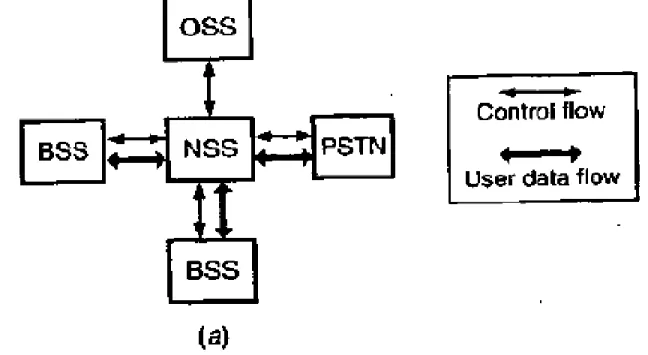
• GSM consists of many subsystems, such as
- the mobile station (MS),
- the base station subsystem (BSS),
- the network and switching subsystem (NSS), and
- the operation subsystem (OSS).
Lecture 15
ICT3207: CMCGSM Architecture
Lecture 15
ICT3207: CMCGSM Architecture
• The MS may be a stand-alone piece of equipment for certain services. It offers - common functions used by all services the MSC offers
- corresponds to the network termination (NT) of an ISDN access - end-point of the radio interface (Um)
• The MS includes mobile equipment (ME) and a subscriber identity module (SIM).
• ME does not need to be personal1y assigned to one subscriber.
• The SIM is a subscriber module which stores all the subscriber-related information. When a subscriber's SIM is inserted into the ME of an MS that MS belongs to the subscriber, and the call is delivered to that MS.
• The ME is not associated with a called number—it is linked to the SIM. In this case, any ME can be used by a subscriber when the SIM is inserted in the ME.
Lecture 15
ICT3207: CMCGSM Architecture
Base Station Subsystem (BSS)
• The BSS connects to the MS through a radio interface and also connects to the NSS.
• The BSS consists of a base transceiver station (BTS) located at the antenna site and a base station controller (BSC) which may control several BTSs.
• Base Transceiver Station (BTS): radio components including sender, receiver, antenna - if directed antennas are used one BTS can cover several cells .
• Base Station Controller (BSC): switching between BTSs, controlling BTSs, managing of network resources, mapping of radio channels (Um) onto terrestrial channels (A interface)
• BSS = BSC + sum (BTS) + interconnection
Lecture 15
ICT3207: CMCGSM Architecture
• GSM uses the open system interconnection (OSI). There are three common interfaces based on OSI (see figure of next slide):
- a common radio interfaces called air interface, between the MS and BTS,
- an interface A between the MSC and BSC, and
- an A-bis interface between the BTS and BSC.
• The difference between interface and protocol is that an interface represents the point of contact between two adjacent entities (equipment or systems) and a protocol provides
information flows through the interface.
Lecture 15
ICT3207: CMCLecture 15
ICT3207: CMCGSM Architecture
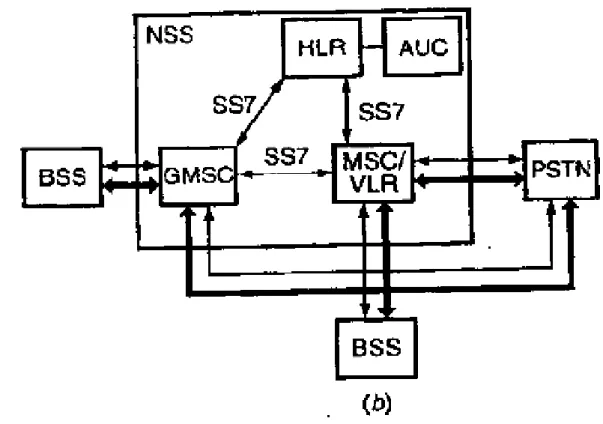
• NSS is the main component of the GSM. It uses intelligent network (IN).
- perform switching, mobility management, interconnection to other networks, system control
- NSS manages the communication between GSM users and other telecommunications users.
Network and Switching Subsystem (NSS)
Lecture 15
ICT3207: CMCGSM Architecture
Lecture 15
ICT3207: CMCGSM Architecture
-Interworking function (IWF):
A gateway for MSC to interface with external networks for communication with users outside
GSM, such as packet-switched public data network (PSPDN) or circuit-switched public data network (CSPDN). The role of the IWF depends on the type of user data and the network to
which it interfaces.
- Home Location Register (HLR):
Consists of a stand-alone computer without switching capabilities, a database which contains
subscriber information, and information related to the subscriber's current location, but not the actual location of the subscriber.
A subdivision of HLR is the authentication center (AUC). The AUC manages the security data for subscriber authentication.
Another sub-division of HLR is the equipment identity register (EIR) which stores the data of
Lecture 15
ICT3207: CMCGSM Architecture
-Visitor location register (VLR):
Links to one or more MSCs, temporarily storing subscription data currently served by its
corresponding MSC, and holding more detailed data than the HLR.
For example, the VLR holds more current subscriber location information than the location
information at the HLR. Gateway MSC (GMSC):
In order to set up a requested call, the call is initially routed to a gateway MSC, which finds
the correct HLR by knowing the directory number of the GSM subscriber.
The GMSC has an interface with the external network for gatewaying, and the network also
Lecture 15
ICT3207: CMCGSM Architecture
- Signaling transfer point (STP):
Is an aspect of the NSS function as a stand-alone node or in the same equipment as the MSC.
STP optimizes the cost of the signaling transport among MSC/VLR, GMSC, and HLR.
NSS uses an intelligent network. It separates the central data base (HLR) from the switches
(MSC) and uses STP to transport signaling among MSC and HLR.
In short the functions of MSC
• Mobile Services Switching Center (MSC) controls all connections via a separated network to/from a mobile terminal within the domain of the MSC - several BSC can belong to a MSC
• Databases (important: scalability, high capacity, low delay)
- Home Location Register (HLR) central master database containing user data, permanent and semi-permanent data of all subscribers assigned to the HLR (one provider can have
several HLRs)
Lecture 15
ICT3207: CMCGSM Architecture
Operation Subsystem (OSS)
• There are three areas of OSS: (1) network operation and maintenance functions, (2)
subscription management, including charging and billing, and (3) mobile equipment