Version 3.1
Consciousness: A Simple Information
Theory Global Workspace Model
Rodrick Wallace
Division of Epidemiology
The New York State Psychiatric Institute
∗April 15, 2011
Abstract
The asymptotic limit theorems of information theory permit a concise formulation of Bernard Baars’ global workspace/global broadcast picture of consciousness, focusing on how networks of unconscious cognitive modules are driven by the classic ‘no free lunch’ argument into shifting, tunable, alliances having variable thresholds for signal detection. The model directly accounts for the punctuated characteristics of many conscious phenomena, and derives the inherent necessity of inattentional blindness and related effects.
Key Words: asymptotic limit theorem, ergodic, network topology, no free lunch, phase transition
1
Introduction: Cognition as ‘language’
A perhaps oversuccinct summary of Baars’ global workspace model of conscious-ness attributes the phenomenon to a shifting array of unconscious cognitive modules that unite to become a global broadcast having a tunable perception threshold not unlike a theater spotlight (e.g., Baars, 1988, 2005; Baars and Franklin, 2003). We can uncover much of this basic mechanism from a remark-ably simple application of the asymptotic limit theorems of information theory, once a broad range of cognitive processes is recognized as inherently character-ized by ergodic information sources – generalcharacter-ized languages, if you will (Wallace, 2000). This allows mapping physiological unconscious cognitive modules onto an abstract network of interacting information sources, permitting a simplified mathematical attack based on phase transitions in network topology.
Atlan and Cohen (1998) argue, in the context of a cognitive paradigm for the immune system, that the essence of cognitive function involves comparison of a perceived signal with an internal, learned or inherited picture of the world, and then, upon that comparison, choice of one response from a much larger reper-toire of possible responses. That is, cognitive pattern recognition-and-response proceeds by an algorithmic combination of an incoming external sensory sig-nal with an intersig-nal ongoing activity – incorporating the intersig-nalized picture of the world – and triggering an appropriate action based on a decision that the pattern of sensory activity requires a response.
More formally, incoming sensory input is mixed in an unspecified but sys-tematic algorithmic manner with a pattern of internal ongoing activity to create a path of combined signalsx= (a0, a1, ..., an, ...). Eachakthus represents some
functional composition of the internal and the external. An application of this perspective to a standard neural network is given in Wallace (2005, p. 34).
This path is fed into a highly nonlinear, but otherwise similarly unspecified, decision oscillator,h, which generates an outputh(x) that is an element of one of two disjoint setsB0andB1of possible system responses. Let
B0≡ {b0, ..., bk},
B1≡ {bk+1, ..., bm}.
Assume a graded response, supposing that if
h(x)∈B0,
the pattern is not recognized, and if
h(x)∈B1,
the pattern is recognized, and some actionbj, k+ 1≤j ≤mtakes place.
The principal objects of formal interest are paths x which trigger pattern recognition-and-response. That is, given a fixed initial state a0, we examine all possible subsequent paths x beginning with a0 and leading to the event
h(x)∈B1. Thush(a0, ..., aj)∈B0for all 0< j < m, buth(a0, ..., am)∈B1.
For each positive integer n, let N(n) be the number of high probability grammatical and syntactical paths of lengthnwhich begin with some particular
a0and lead to the conditionh(x)∈B1. Call such paths ‘meaningful’, assuming,
not unreasonably, that N(n) will be considerably less than the number of all possible paths of lengthnleading froma0 to the conditionh(x)∈B1.
H ≡ lim
n→∞
log[N(n)]
n
(1)
both exists and is independent of the pathx.
Call such a pattern recognition-and-response cognitive processergodic. Not all cognitive processes are likely to be ergodic, implying that H, if it indeed exists at all, is path dependent, although extension to nearly ergodic processes, in a certain sense, seems possible (e.g., Wallace, 2005, pp. 31-32).
Invoking the spirit of the Shannon-McMillan Theorem, it is possible to de-fine an adiabatically, piecewise stationary, ergodic information source X asso-ciated with stochastic variates Xj having joint and conditional probabilities
P(a0, ..., an) andP(an|a0, ..., an−1) such that appropriate joint and conditional
Shannon uncertainties satisfy the classic relations
H[X] = lim
n→∞
log[N(n)]
n =
lim
n→∞H(Xn|X0, ..., Xn−1) =
lim
n→∞
H(X0, ..., Xn)
n .
This information source is defined asdualto the underlying ergodic cognitive process, in the sense of Wallace (2000, 2005).
The essence of ‘adiabatic’ is that, when the information source is param-eterized according to some appropriate scheme, within continuous ‘pieces’ of that parameterization, changes in parameter values take place slowly enough so that the information source remains as close to stationary and ergodic as needed to make the fundamental limit theorems work. By ‘stationary’ we mean that probabilities do not change in time, and by ‘ergodic’ (roughly) that cross-sectional means converge to long-time averages. Between ‘pieces’ one invokes various kinds of phase change formalism, for example renormalization theory in cases where a mean field approximation holds (Wallace, 2005), or variants of random network theory where a mean number approximation is applied. More will be said of this latter approach below.
Recall that the Shannon uncertaintiesH(...) are cross-sectional law-of-large-numbers sums of the form−P
kPklog[Pk], where thePkconstitute a probability
2
No free lunch: a little information theory
Messages from an information source, seen as symbolsxj from some alphabet,
each having probabilitiesPjassociated with a random variableX, are ‘encoded’
into the language of a ‘transmission channel’, a random variableY with symbols
yk, having probabilities Pk, possibly with error. Someone receiving the symbol
yk then retranslates it (without error) into some xk, which may or may not be
the same as thexj that was sent.
More formally, the message sent along the channel is characterized by a random variableX having the distribution
P(X =xj) =Pj, j= 1, ..., M.
The channel through which the message is sent is characterized by a second random variableY having the distribution
P(Y =yk) =Pk, k= 1, ..., L.
Let the joint probability distribution ofX andY be defined as
P(X =xj, Y =yk) =P(xj, yk) =Pj,k
and the conditional probability ofY givenX as
P(Y =yk|X =xj) =P(yk|xj).
Then the Shannon uncertainty of X and Y independently and the joint uncertainty ofX andY together are defined respectively as
H(X) =−
M
X
j=1
Pjlog(Pj)
H(Y) =−
L
X
k=1
Pklog(Pk)
H(X, Y) =−
M
X
j=1
L
X
k=1
Pj,klog(Pj,k).
Theconditional uncertainty ofY givenX is defined as
H(Y|X) =−
M
X
j=1
L
X
k=1
Pj,klog[P(yk|xj)]
(3)
For any two stochastic variatesX andY, H(Y)≥H(Y|X), as knowledge ofX generally gives some knowledge ofY. Equality occurs only in the case of stochastic independence.
SinceP(xj, yk) =P(xj)P(yk|xj), we have
H(X|Y) =H(X, Y)−H(Y)
The information transmitted by translating the variableX into the channel transmission variableY – possibly with error – and then retranslating without error the transmittedY back intoX is defined as
I(X|Y)≡H(X)−H(X|Y) =H(X) +H(Y)−H(X, Y)
(4)
Again, see Ash (1990), Cover and Thomas (2006) or Khinchin (1957) for details. The essential point is that if there is no uncertainty in X given the channelY, then there is no loss of information through transmission. In general this will not be true, and herein lies the essence of the theory.
Given a fixed vocabulary for the transmitted variableX, and a fixed vocabu-lary and probability distribution for the channelY, we may vary the probability distribution ofX in such a way as to maximize the information sent. The ca-pacity of the channel is defined as
C≡max
P(X)
I(X|Y)
subject to the subsidiary condition thatP
P(X) = 1.
The critical trick of the Shannon Coding Theorem for sending a message with arbitrarily small error along the channelY at any rateR < Cis to encode it in longer and longer ‘typical’ sequences of the variableX; that is, those sequences whose distribution of symbols approximates the probability distributionP(X) above which maximizesC.
IfS(n) is the number of such ‘typical’ sequences of lengthn, then
log[S(n)]≈nH(X)
whereH(X) is the uncertainty of the stochastic variable defined above. Some consideration shows thatS(n) is much less than the total number of possible messages of length n. Thus, as n → ∞, only a vanishingly small fraction of all possible messages is meaningful in this sense. This observation, after some considerable development, is what allows the Coding Theorem to work so well. In sum, the prescription is to encode messages in typical sequences, which are sent at very nearly the capacity of the channel. As the encoded messages become longer and longer, their maximum possible rate of transmission without error approaches channel capacity as a limit. Again, the standard references provide details.
This approach can be, in a sense, inverted to give a ‘tuning theorem’ variant of the coding theorem.
Telephone lines, optical wave guides and the tenuous plasma through which a planetary probe transmits data to earth may all be viewed in traditional information-theoretic terms as anoisy channel around which we must structure a message so as to attain an optimal error-free transmission rate.
Telephone lines, wave guides and interplanetary plasmas are, relatively speak-ing, fixed on the timescale of most messages, as are most sociogeographic net-works. Indeed, the capacity of a channel, is defined by varying the probability distribution of the ‘message’ processX so as to maximizeI(X|Y).
Suppose there is some messageX so critical that its probability distribution must remain fixed. The trick is to fix the distribution P(x) but modify the channel – i.e., tune it – so as to maximize I(X|Y). Thedual channel capacity
C∗ can be defined as
C∗≡ max
P(Y),P(Y|X)
I(X|Y)
(6)
But
C∗= max
since
I(X|Y) =H(X) +H(Y)−H(X, Y) =I(Y|X).
Thus, in a purely formal mathematical sense, the message transmits the channel, and there will indeed be, according to the Coding Theorem, a channel distributionP(Y) which maximizesC∗.
One may do better than this, however, by modifying the channel matrix
P(Y|X). Since
P(yj) = M
X
i=1
P(xi)P(yj|xi),
P(Y) is entirely defined by the channel matrixP(Y|X) for fixedP(X) and
C∗= max
P(Y),P(Y|X)I(Y|X) = maxP(Y|X)I(Y|X).
CalculatingC∗requires maximizing the complicated expression
I(X|Y) =H(X) +H(Y)−H(X, Y)
which contains products of terms and their logs, subject to constraints that the sums of probabilities are 1 and each probability is itself between 0 and 1. Maximization is done by varying the channel matrix termsP(yj|xi) within the
constraints. This is a difficult problem in nonlinear optimization. However, for the special caseM =L,C∗ may be found by inspection:
IfM =L, then choose
P(yj|xi) =δj,i
whereδi,j is 1 ifi=j and 0 otherwise. For this special case
C∗≡H(X)
with P(yk) = P(xk) for all k. Information is thus transmitted without error
when the channel becomes ‘typical’ with respect to the fixed message distribution P(X).
IfM < L matters reduce to this case, but forL < M information must be lost, leading to Rate Distortion limitations.
Thus modifying the channel may be a far more efficient means of ensuring transmission of an important message than encoding that message in a ‘natural’ language which maximizes the rate of transmission of information on a fixed channel.
...Wolpert and Macready... have established that there exists no generally superior function optimizer. There is no ‘free lunch’ in the sense that an optimizer ‘pays’ for superior performance on some functions with inferior performance on others... if the distribution of functions is uniform, then gains and losses balance precisely, and all optimizers have identical average performance... The formal demon-stration depends primarily upon a theorem that describes how in-formation is conserved in optimization. This Conservation Lemma states that when an optimizer evaluates points, the posterior joint distribution of values for those points is exactly the prior joint dis-tribution. Put simply, observing the values of a randomly selected function does not change the distribution...
[A]n optimizer has to ‘pay’ for its superiority on one subset of functions with inferiority on the complementary subset...
Anyone slightly familiar with the [evolutionary computing] liter-ature recognizes the paper template ‘AlgorithmX was treated with modificationY to obtain the best known results for problemsP1and
P2.’ Anyone who has tried to find subsequent reports on ‘promising’ algorithms knows that they are extremely rare. Why should this be? A claim that an algorithm is the very best for two functions is a claim that it is the very worst, on average, for all but two functions.... It is due to the diversity of the benchmark set [of test problems] that the ‘promise’ is rarely realized. Boosting performance for one subset of the problems usually detracts from performance for the complement...
Hammers contain information about the distribution of nail-driving problems. Screwdrivers contain information about the distri-bution of screw-driving problems. Swiss army knives contain infor-mation about a broad distribution of survival problems. Swiss army knives do many jobs, but none particularly well. When the many jobs must be done under primitive conditions, Swiss army knives are ideal.
The tool literally carries information about the task... optimizers are literally tools-an algorithm implemented by a computing device is a physical entity...
algorithm for any given set.
3
Dynamic networks of unconscious cognitive
modules
Based on the no free lunch argument of the previous section, it is clear that dif-ferent challenges facing a conscious entity must be met be difdif-ferent arrangements of basic cognitive faculties. It is now possible to make a very abstract picture of the brain, not based on its anatomy, but rather on the linkages between the information sources dual to the basic physiological and learned unconscious cognitive modules (UCM) that form Baars’ global workspace/global broadcast. That is,the remapped brain network is reexpressed in terms of the information sources dual to the UCM. Given two distinct problems classes (e.g., playing ten-nis vs. interacting with a significant other), there must be two different ‘wirings’ of the information sources dual to the physiological UCM, as in figure 1, with the network graph edges measured by the amount of information crosstalk be-tween sets of nodes representing the dual information sources. A more formal treatment of such coupling can be given in terms of network information theory (Cover and Thomas, 2006), as done in Wallace (2011).
The emergence of a closely linked set of information sources dual to the UCM into a global workspace/broadcast system itself depends on the underly-ing network topology of the dual information sources and on the strength of the couplings between the individual components of that network. For random net-works the results are well known, based on the work of Erdos and Renyi (1960). Following the review by Spenser (2010) closely (see, e.g., Boccaletti et al., 2006, for more detail), assume there arennetwork nodes andeedges connecting the nodes, distributed with uniform probability – no nonrandom clustering. Let
G[n, e] be the state when there are eedges. The central question is the typical behavior of G[n, e] as e changes from 0 to (n−2)!/2. The latter expression is the number of possible pair contacts in a population having n individuals. Another way to say this is to letG(n, p) be the probability space over graphs onnvertices where each pair is adjacent with independent probabilityp. The behaviors ofG[n, e] and G(n, p) wheree=p(n−2)!/2 are asymptotically the same.
For ‘real world’ biological and social structures, one can have p =f(e, n), wheref may not be simple or even monotonic. For example, while lowewould almost always be associated with lowp, beyond some threshold, highemight drive individuals or nodal groups into isolation, decreasingpand producing an ‘inverted-U’ signal transduction relation akin to stochastic resonance. Some-thing like this would account for Fechner’s law which states that perception of sensory signals often scales as the log of the signal intensity.
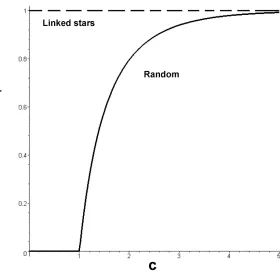
subnetworks are very small, and no global broadcast can take place. If c = 1 there is a single large interlinked component of a size ≈ n2/3. If c > 1 then there is a single large component of sizeyn – a global broadcast – where y is the positive solution to the equation
exp(−cy) = 1−y.
(7)
Then
y=W(−c/exp(c)) +c
c ,
(8)
whereW is the LambertW function.
The solid line in figure 2 showsy as a function ofc, representing the fraction of network nodes that are incorporated into the interlinked giant component – the global broadcast for interacting UCM. To the left ofc= 1 there is no giant component, and large scale – i.e., conscious – cognitive process is not possible.
The dotted line, however, represents the fraction of nodes in the giant com-ponent for a highly nonrandom network, a star-of-stars-of-stars (SoS) in which every node is directly or indirectly connected with every other one. For such a topology there is no threshold, only a single giant component, showing that the emergence of a giant component in a network of information sources dual to the UCM – the emergence of consciousness – is dependent on a network topology that may itself be tunable.
According to this argument, if the network topology becomes tuned, then a sensory input parameterized byc withc <1 can trigger a global broadcast.
One imagines a set of sensory inputs, C = {c1, ..., cj} affecting a highly
multidimensional structure of interacting UCM, represented abstractly here by the network of their dual information sources. If the set is tuned by the no free lunch theorem to maximize response to the ‘problem’ defined by a particularci,
so thatci1 can trigger a global broadcast, then the other sensory inputs will
4
Discussion and conclusions
An elementary tuning theorem variant of the Shannon Coding Theorem that expresses the no free lunch argument allows construction of a simple version of Bernard Baars’ global workspace/global broadcast model of consciousness. Punctuated accession to consciousness, via sudden onset of a giant component, and inattentional blindness, via the no free lunch restriction, emerge directly. More complicated models are required to explore the nature of the phase tran-sition implied by the solid line in figure 2 (Wallace, 2005), the effects of em-bedding culture on inattentional blindness (Wallace, 2007), and the conundrum presented by institutional or machine versions of consciousness that can support multiple, interacting, global broadcasts (Wallace and Fullilove, 2008; Wallace, 2008, 2009, 2010).
5
References
Ash, R., 1990, Information Theory, Dover, New York.
Atlan, H., I. Cohen, 1998, Immune information, self organization, and mean-ing, International Immunology, 10:711-717.
Baars, B., 1988, A Cognitive Theory of Consciousness, Cambridge University Press, New York.
Baars, B., 2005, Global workspace theory of consciousness: toward a cogni-tive neuroscience of human experience, Progress in Brain Research, 150:45-53.
Baars, B., S. Franklin, 2003, How conscious experience and working memory interact, Trends in Cognitive Science, 7:166-172.
Boccaletti, S., V. Latora, Y. Moreno, M. Chavez, D. Hwang, 2006, Complex networks: structure and dynamics, Physics Reports, 424:175-208.
Cover, T., J. Thomas, 2006, Elements of Information Theory, Second Edi-tion, Wiley, New York.
English, T., 1996, Evaluation of evolutionary and genetic optimizers: no free lunch. In Evolutionary Programming V: Proceedings of the Fifth Annual Con-ference on Evolutionary Programming, Fogel, L., P. Angeline, T. Back (eds.): 163-169, MIT Press, Cambridge, MA.
Erdos, P., A. Renyi, 1960, On the evolution of random graphs, Magyar Tud. Akad. Mat. Kutato Int. Kozl, 5:17-61.
Glazebrook, J.F., R. Wallace, 2009, Rate distortion manifolds as model spaces for cognitive information, Informatica, 33:309-346.
Khinchin, A., 1957, The Mathematical Foundations of Information Theory, Dover, New York.
Spenser, J., 2010, The giant component: the golden anniversary, Notices of the AMS, 57:720-724.
Wallace, R., 2005, Consciousness: A Mathematical Treatment of the Global Neuronal Workspace Model, Springer, New York.
Wallace, R., 2007, Culture and inattentional blindenss: a global workspace perspective, Journal of Theoretical Biology, 245:378-390.
Wallace, R., 2008, Toward formal models of biologically inspired, highly parallel machine cognition, International Journal of Parallel, Emergent, and Distributed Systems, 23:367-408.
Wallace, R., 2009, Programming coevolutionary machines: the emerging co-nundrum, International Journal of Parallel, Emergent, and Distributed Systems, 24:443-453.
Wallace, R., 2010, Tunable epigenetic catalysis: programming real-time cog-nitive machines, International Journal of Parallel, Emergent, and Distributed Systems, 25:209-222.
Wallace, R., 2011, Hunter-gatherers in a howling wilderness: neoliberal cap-italism as a language that speaks itself,
http://precedings.nature.com/documents/5650/version/1
Wallace, R., M. Fullilove, 2008, Collective Consciousness and its Discontents, Springer, New York.
Wolpert, D., W. MacReady, 1995, No free lunch theorems for search, Santa Fe Institute, SFI-TR-02-010.