Aryabhatta Journal of Mathematics & Informatics Vol. 5, No. 2, July-Dec., 2013, ISSN : 0975-7139 Journal Impact Factor (2012) : 0.293
A HEURISTIC ALGORITHM FOR GENERAL WEIGHTAGE JOB
SCHEDULING UNDER UNCERTAIN ENVIRONMENT
INCLUDING TRANSPORTATION TIME
Meenu Mittal
*, T.P. Singh
**and Deepak Gupta
*** *Research Scholar, M.M.University, Mullana**Professor of Mathematics, Yamuna Institute of Engg. &Technology,Gadholi ***Professor & Head of Mathematics, M.M.University, Mullana
ABSTRACT
Scheduling is an important tool in production and project management and is very useful in increasing the productivity, improving quality of products, fulfilling the demands of market in time and to minimize the flow time, idle time of machines ,cost etc. This paper describes a simple algorithm for the solution of very large sequencing problem under uncertain environment without the use of a computer. It has been observed practically, the values of all the jobs are not equi-important in a workshop or manufacturing concern may be because of market demand or different inventory cost associated with job other technological & economical constraints.
Weightage job concept along with transportation time is being included in the paper.The algorithm produces optimal or approximate solutions to the general machine sequencing problem where no passing is considered and the criteria is minimum total elapsed time(or make span)in uncertain environment.
Key words: weightage in jobs, transportation time, make span.
INTRODUCTION:
The search for a solution to the problem of finding optimal or near optical sequence of jobs being scheduled in a
flow shop type situation has given considerable attention to both exact and approximate techniques of solution .Exact techniques, which usually require an electronic computer have been developed to minimize some well defined criterion on problem involving a limited no. of jobs.
Motivated by the work of Johnson (1954) and developing further study by Ignall (1965), Campbell ,Dudek &Smith (1970), Maggu and T.P. Singh (1984), Singh T.P.(1985) and further Singh T. P. and Gupta Deepak(2005,2008) upto the present decade, a lot of work has been done in flow shop scheduling mainly in deterministic situations. Sisson (1961) has pointed out that the researcher must be concerned not only with obtaining an optimal solution but also with the practical and economical application of the solution technique which has led to the consideration of approximate methods (Giglio etal. 1964),Through approximate methods ,the procedural steps can be kept simple enough so that problem solver does not lose the sight of overall view of the problem, thus enabling scheduler to make the optimal use of his intuition and judgement.
Meenu Mittal, T.P. Singh and Deepak Gupta
to take care of the job provider and the weightage is necessary which gives an idea of relative importance of jobs i.e. higher the weights, greater the importance of the job in comparison to other jobs.
In this paper we have extended the study made by Singh T. P., Sunita (2008) and Parveen Kumar etal (2011) by including the concept of transportation time and making the problem more general for n jobs and m machines using generalized mean value(GMV) of fuzzy number proposed by Lee and Li (1998)and CDS Heuristic algorithm.The objective of the paper is to find the weightage mean flow time and optimal schedule which has the smallest generalized mean value (GMV) under uncertain environment.
PRELIMINARIES: 1. FUZZY SET:
A fuzzy set is defined by 𝐴 = 𝑥, 𝜇𝐴 𝑥 : 𝑥 ∈ 0,1 .In the pair 𝑥, 𝜇𝐴 𝑥 , the first element x belongs to the
classical set A, the second element 𝜇𝐴 𝑥 belongs to the interval[0,1],called membership function or grade of
membership.The membership function is also a degree of truth of x in 𝐴 . Fuzzy sets have been introduced by Zadeh(1965) as an extention of the classical notation of set. Classical set theory allows the membership of the
element in the set in binary terms, a bivalent condition an element either belongs to or does not belongs to the set.
2.1 TRAPEZOIDAL FUZZY NUMBER: A fuzzy number 𝐴 =(𝑎, 𝑏; 𝛽, 𝛾) is said to be Trapezoidal fuzzy number
if its membership function has two linear functions f(x) & g(x) and defined as follows
𝑓 𝑥 ≅ 1 −
𝑎 − 𝑥
𝛽
𝑓𝑜𝑟 𝑥 𝜖 𝑎 − 𝛽, 𝑎
𝜇
𝐴= 1 𝑓𝑜𝑟 𝑥 𝜖 𝑎, 𝑏
𝑔 𝑥 ≅ 1 −
𝑥 − 𝑏
𝛾
𝑓𝑜𝑟 𝑥 𝜖 𝑏, 𝑏 + 𝛾
Where𝛽 ≥ 0, 𝛾 ≥ 0. , 𝑎𝑠 shown as in Fig-1.
1.3 GENERLIZED MEAN VALUE (GMV) OF TRAPEZOIDAL FUZZY NUMBER
The generalized mean value (GMV) proposed by Li &Lee,is centroid point of a fuzzy number by 𝑥 , defined as-
𝑥(
𝐴 ) = 𝑥𝑓 𝑥 𝑑𝑥 + 𝑥𝑑𝑥 + 𝑥𝑔 𝑥 𝑑𝑥
𝑏+𝛾 𝑏 𝑏
𝑎 𝑎
𝑎−𝛽
𝑓 𝑥 𝑑𝑥 + 𝑑𝑥 + 𝑎𝑏 𝑏𝑏+𝛾𝑔 𝑥 𝑑𝑥
𝑎 𝑎−𝛽
Hence ,the generalized mean value will be a crisp value 𝑥 and it is used to compare fuzzy numbers i.e.GMV(𝐴 ) = 𝑥.
f(x)
(a- β) a b (b + 𝛾) g(x)
𝜇
𝐴(𝑥)
A Heuristic Algorithm For General Weightage Job Shop Scheduling Under Uncertain Environment Including Transportation Time Suppose 𝐴 & 𝐵 are two Trapezoidal fuzzy numbers then, 𝐴 ≥ 𝐵 iff GMV(𝐴 ) ≥ GMV(𝐵 ).
2.ASSUMPTIONS AND NOTATIONS: 2.1 Assumption:
Each job consists of n tasks to be executed in sequence on m machine.
Each process on one machine started must perform till completion.
Every machine can process one job at a time.
Each jobs completed in the order M1, M2,M3,M4...,Mm with no passing allowed.
Each jobs is assingned weights wi according to its importance.
The transportation time includes,loadind ,unloading and moving time.
The performance measure is weights mean flow time defined by
𝐸 =𝑤 𝑤𝑖𝐶𝑖
𝑛 𝑖=1
𝑤𝑖 𝑛 𝑖=1
Where Ci completion time of jobs i on machine j counted from start of job 1st .
# 𝐸𝑤 express the total weighted mean flow time.
# n𝐸𝑤 express the total weighted flow time.
# 𝐶𝑖 expresses fuzzy completion time of ith job on mth machine. 2.2 Notations:
J = Set of jobs to be processed (𝑗1,𝑗2, 𝑗3… … 𝑗𝑛).
Mj = Jth machine on which jobs have to processed.
𝑝𝑖𝑗 = Fuzzy processing time for ith job on mth machine and 𝑝𝑖𝑗= GMV(𝑝 ) 𝑖𝑗 𝑟𝑀𝑗 = jth pseudo machine for the ith auxillary problem,r=1,2,3,4,...,(m-1).
𝑡𝑖 = transportation time from 1st machine to 2nd . 𝑔𝑖= transportation time from 2nd machine to 3rd . 𝑖= transportation time from 3rd machine to 4th .
𝑟𝑃 𝑖𝑗 = Processing time for the ith job on machine j (1,2) for rth auxiliary problem. 𝐶𝑖𝑗 = Completion time for the ith job on machine j .
r
Gij= GMV of fuzzy processing time rPij
𝑈𝑟 =Optimal sequence obtained by Johnson Algorithm for rth auxilary problem is (T1, T2,T3,...,Tn) such that
Ti=Tj for all i, j 𝜖 (1,2,3,....,n) i.e. (T1, T2,T3,...,Tn) ≅ (𝑗1, 𝑗2, 𝑗3… … 𝑗𝑛).
𝐶 𝑖= the completion time for ith job in the system. 𝐶 = the completion time for all the jobs in the system.
3.PROPOSED ALGORITHM:
Meenu Mittal, T.P. Singh and Deepak Gupta
3.2 Algorithm:
Step 1: Create (m-1) auxiliary n-jobs 2-pseudo machine problems on the line of CDS algorithm[5].
Step 2: For each of (m-1) auxiliary nx2 problem finds GMV for each task with fuzzy execution time 𝑝 , 𝑖. 𝑒.𝑖𝑗 𝐺𝑖𝑗 =GMV(𝑝 )𝑖𝑗 .
Step 3: Adding transportation time as 𝐺𝑖𝑗′ =𝐺𝑖𝑗 + 𝑡𝑖 + 𝑔𝑖+ 𝑖.
Step 4: Find the minimum 𝐺𝑖𝑗′ from n x m matrices. i.e g = min(𝐺𝑖𝑗′ ).
Step 5: Then the revised processing time for n x2 problem with processing time (𝐺𝑖𝑗′′) in the form of crisp number
will be
(1) If min(𝐺𝑖𝑗′ ) = 𝐺𝑖1′
Then 𝐺𝑖1′′=𝐺𝑖1′ -𝑤𝑖 & 𝐺𝑖2′′ = 𝐺𝑖2′
(2) If min(𝐺𝑖𝑗′ ) = 𝐺𝑖2′
Then 𝐺𝑖1′′=𝐺𝑖1′ & 𝐺𝑖2′′ = 𝐺𝑖2′ +𝑤𝑖
Step 6: Formulate each of (m-1) auxiliary problem with modified prossesing time in the form revised crisp value
𝐺𝑖𝑗 =𝐺𝑖𝑗
′′
𝑤𝑖
Step 7: Apply Johnson procedure for each of (m-1) auxiliary nx 2 problem, to find optimal sequence and then find out optimal make span time for each sequence of (m-1) optimal sequences and evaluate completion time of the original n x m problem for this sequence by using Johnson algorithm as follows
𝐶11 =𝑝11 , 𝐶 = 𝑃12 + 𝑃11 , 𝐶12 = 𝐶1𝑗 + 𝑃1,𝑗 −1 1𝑗 , 𝐶 = 𝐶𝑖1 + 𝑃𝑖−1,1 , 𝐶𝑖1 = max 𝐶𝑖𝑗 , 𝐶𝑖−1,𝑗 + 𝑃𝑖,𝑗 −1 𝑖𝑗
Where 𝐶 11 is the fuzzy completion time of ih job on jth machine.
For i=1,2,3,....,n;j=1,2,3,....,m.
Step 8: Find the sequence which has least completion time i.e. the optimal sequence and find its Make span time from Step7.
Step 9: Find out the weighted mean flow time 𝐸 𝑤 for the optimal schedule.
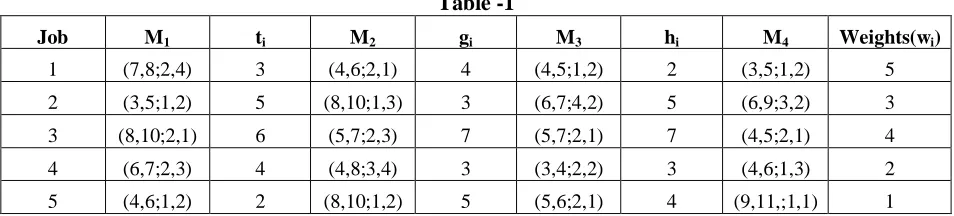
Numerical Example:Suppose we have 4x5 flow-shop scheduling with consideration of priority level (weight of jobs) for jobs ,i.e. 5,3,4,2,1 for the jobs 1,2,3,4,5 respectively. The transportation time from one machine to other is given, then we have to find out optimum completion time for the fuzzy shop programming problem with the above given priority level to the jobs.
The problem is as follows:
Table -1
Job M1 ti M2 gi M3 hi M4 Weights(wi)
1 (7,8;2,4) 3 (4,6;2,1) 4 (4,5;1,2) 2 (3,5;1,2) 5
2 (3,5;1,2) 5 (8,10;1,3) 3 (6,7;4,2) 5 (6,9;3,2) 3
3 (8,10;2,1) 6 (5,7;2,3) 7 (5,7;2,1) 7 (4,5;2,1) 4
4 (6,7;2,3) 4 (4,8;3,4) 3 (3,4;2,2) 3 (4,6;1,3) 2
5 (4,6;1,2) 2 (8,10;1,2) 5 (5,6;2,1) 4 (9,11,;1,1) 1
A Heuristic Algorithm For General Weightage Job Shop Scheduling Under Uncertain Environment Including Transportation Time
Table-2(for r=1)
Job 1M1 GMV(1M1) 1M2 GMV(1M2)
1 (7,8;2,4) 8.125 (3,5;1,2) 18
2 (3,5;1,2) 18 (6,9;3,2) 7.21
3 (8,10;2,1) 8.71 (4,5;2,1) 4.20
4 (6,7;2,3) 5.09 (4,6;1,3) 5.11
5 (4,6;1,2) 5.28 (9,11,;1,1) 10.00
Table-3( for r=2)
Job 2M1 GMV(2M1) 2M2 GMV(2M2)
1 (11,14;4,5) 27.6 (7,10;2,4) 9.08
2 (11,15;2,5) 13.91 (12,16;7,4) 13.11
3 (13,17;4,4) 73.78 (9,12;4,2) 9.92
4 (10,15;5,7) 13.09 (7,10;3,5) 9.10
5 (12,16;2,4) 12.66 (14,17;3,2) 15.21
Table-4 (for r=3)
Job 3M1 GMV(3M1) 3M2 GMV(3M2)
1 (15,19;5,7) 17.6 (11,16;4,5) 13.79
2 (17,22;6,7) 19.80 (20,26;8,7) 22.70
3 (18,24;6,5) 20.71 (14,19;6,5) 16.21
4 (13,19;7,9) 16.59 (11,18;6,9) 15.37
5 (17,22;4,5) 11.23 (22,27;4,4) 24.5
Consider the transportation times as in table 5:
r
Gij’= r
Gij + ti + gi + hi
Table-5
Job For r =1 For r = 2 For r = 3
1
Gi1’
1
Gi2’
2
Gi1’
2
Gi2’
3
Gi1’
3
Gi2’
1 17.125 27 36.6 18.08 26.6 22.79
2 31 20.21 26.91 26.11 32.80 35.70
Meenu Mittal, T.P. Singh and Deepak Gupta
4 15.09 15.11 23.09 19.10 26.59 25.37
5 16.28 21.23 23.6 26.21 22.23 35.5
Now introduce the effect of priority level as step 4 in Table -6 & 7.
Table-6
Job For r =1 For r = 2 For r = 3
1
Gi1”= 1
Pi1 1
Gi2”= 1
Pi2 2
Gi1’’= 2
Pi1 2
Gi2’’= 2
Pi2 3
Gi1”= 3
Pi1 3
Gi2”= 3
Pi2
1 17.125 32 36.6 23.08 21.6 22.79
2 31 23.21 26.91 29.11 29.80 35.70
3 28.71 28.20 93.78 33.92 36.71 36.21
4 15.09 17.11 23.09 21.10 24.59 25.37
5 16.28 22.23 23.6 27.21 21.23 35.5
Table-7
Job For r =1 For r = 2 For r = 3
1
Pi1/wi 1Pi2/wi 2Pi1/wi 2Pi2/wi 3Pi1/wi 3Pi2/wi
1 3.425 6.4 7.32 4.616 4.32 4.558
2 10.33 7.736 8.97 9.70 9.93 11.9
3 7.177 7.05 23.445 8.48 9.177 9.05
4 7.545 8.55 11.545 10.55 12.29 12.685
5 16.28 22.23 23.66 27.21 21.23 35.5
Applying Johnson algorithm, the optimal sequences are U1=14523,U2=25431 and U3=14523 Hence,the completion time for U1=14523=U3 and U2=25431 in the table 8 & table 9
Table -8
Job M1 ti Ri1 M2 gi Ri2 M3 hi Ri3 M4
1 (7,8;2,4) 3 (10,11;5,7) (14,17;7,8) 4 (18,21;11,12) (22,26;12,14) 2 (24,28;14,16) (27,33;15,18)
4 (13,15;4,7) 4 (17,19;8,11) (21,27;11,15) 3 (23,30;14,18) (26,34;16,20) 3 (29,37;19,23) (33,43;20,26)
5 (17,21;5,9) 2 (19,23;7,11) (29,37;12,17) 5 (34,42;17,22) (39,48;19,23) 4 (43,52;23,27) (52,63;24,28)
2 (20,26;6,11) 5 (23,31;11,16) (37,47;13,20) 3 (40,50;16,23) (46,57;23,25) 5 (51,62;28,30) (58,72;31,32) 3 (28,36;8,12) 6 (34,42;14,18) (42,54;15,23) 7 (49,61;22,30) (54,68;25,31) 7 (61,75;32,38) (65,80;34,39)
Table-9
Job M1 ti Ri1 M2 gi Ri2 M3 hi Ri3 M4
2 (3,5;1,2) 5 (8,10;6,7) (16,20;7,10) 3 (19,23;10,13) (25,30;14,15) 2 (27,32;16,17) (33,41;19,19)
5 (7,11;2,4) 2 (9,13;4,6) (24,30;8,12) 5 (29,35;13,17) (34,39;16,18) 4 (38,43;20,22) (47,54;21,23)
4 (13,18;4,7) 4 (17,22;8,11) (28,38;11,16) 3 (31,41;14,19) (37,45;18,21) 3 (40,48;21,24) (51,60;22,27)
A Heuristic Algorithm For General Weightage Job Shop Scheduling Under Uncertain Environment Including Transportation Time
1 (28,36;8,12) 3 (31,39;11,15) (37,50;15,21) 4 (41,54;19,25) (49,64;24,29) 2 (51,66;26,31) (59,76;3337)
Comparing the above sequences as follows:
S. No. Value of r Sequence Ur Make span time 𝐶 GMV
1 r = 1,3 1-4-5-2-3 (65,80;34,39) 74.04
2 r = 2 2-5-4-3-1 (59,76;33,37) 67.11
Optimal sequence is therefore (2-5-4-3-1) since it has the smallest fuzzy make span time(59,76;33,37) with defuzzified value 67.11 unit in crisp set.
The minimum waiting time 𝐸𝑤 as defined in Step 9 can be obtained by the formula
𝐸 =𝑤 𝑤𝑖𝐶𝑖
𝑛 𝑖=1
𝑤𝑖 𝑛 𝑖=1
The completion times of jobs are
𝐶 1 =(59,76;33,37) 𝐶 2=(33,41;19,19) 𝐶 3=(56,71;32,35) 𝐶 4=(51,60;22,27) 𝐶 5=(47,54;21,23)
and therefore
𝐸 =𝑤
5 59,76;33,37 +3. 33,41;19,19 +4. 56,71;32,35 +2. 51,60;22,27 +1(47,54;21,23)
5+4+3+2+1 .
𝐸𝑤 =(51.13,64.06;27.66,30.6)
and the defuzzified value or GMV(𝐸𝑤 ) is 92.87 unit.
Hence the optimal schedule is (2-5-4-3-1) since it has the smallest GMV(67.11) of fuzzy make span time (59,76;33,37) and minimum total waiting time with minimum total waiting time of jobs i.e. 𝐸𝑤
=(51.13,64.06;27.66,30.6) with defuzzified value 92.87 unit.
Using Campbell algorithm(CDS) we find that there is an optimal sequence to this problem with total processing time 67.11 units with the sequence(2-5-4-3-1)and if the same problem is solved by Johnson algorithm directly ,we get the total processing time (74.04) with the sequence (1-4-5-2-3).
The error calculation adopted is based on the % deviation of algorithm best sequence time from the optimal solution time.
In this numerical,the % error is
(74.04−67.11)
67.11 ∗ 100 = 10.32%
CONCLUDING REMARKS AND ECONOMIC CONSIDERATION:
Meenu Mittal, T.P. Singh and Deepak Gupta
processor are developed , approximate methods must be used. The two factors ,computional cost and cost of non optimal solution appear to give primary importance when choosing between approximate and exact sequence method . Sinc each situation will be unique and economical analysis of the cost involved should be made before procedure is selected . On availability of computer,the expected error could be reduced by finding all of the sequences.
REFERENCES:
1. Johnson S. M. [1954], “Optimal two-and three-stage production schedules with setup times included”,Naval
Research Logistics Quarterly 1,pp(61-68).
2. Sisson,R.L.[1961], “Sequencing theory”, Chapter-7,Progress in Operation Research,vol.1,John wiley &sons,Newyork,pp(295-325).
3. Gigilo R.J. & Wagner[1964], “Approximate solutions to the three machine sequencing problem,Operation Research,vol-12,pp(305-324).
4. Zadah L.A. [1965],“fuzzy sets and systems”, System theory Brooklyn N.Y.pp(29-37).
5. Campbell, Dudek & Smith[1970],“A Heuristic algorithm for the n-job ,m-machine sequencing problem,”Management Science, vol.16,pp(630-637).
6. Ignall. E. and Scharge, I. (1965) “Application of branch and bound technique to some flow shop scheduling problems”, operation research 13 pp 400-412.
7. Maggu P.L., Singh T. P. etal (1984), “Flow Shop Scheduling involving Job weight and Transportation time.” PAMS volume XX (1-2) pp 153-158.
8. Singh T. P. [1985] , “On 2xn flow shop problems involving job block transportation time, arbitrary time and break down machine time”, PAMS, Vol.21, (1-2)
9. McCohan, C.S. and Lee,E.S.[1992], “Fuzzy job sequencing for a flow shop”, European journal of operation
research,62.pp(294-301).
10. Fortemps, P.&Roubens,M.[1996], “Ranking and defuzzification methods based on area comensation” ,Fuzzy sets and system82,pp(319-325)
11. Singh T. P., Kumar R. & Gupta Deepak.[2005], “Optimal three stage production schedule, the processing and setup times associated with probabilities including job block criterion”,Proceeding of National Conference on FACM, pp(463-470).
12. Gupta Deepak [2008],“On Biserial Queues & Scheduling Network Problems”,Ph.D. thesis, C.C.S. University, Meerut.
13. Lee, E. S. and Li, R. J. (1998), “Comparison of fuzzy numbers based on probability measure of fuzzy event”, Computer and Mathematics with applications, vol. 15, pp (887-896).
14. Sunita Gupta & T. P. Singh [2010], “Bi-objective in Fuzzy scheduling on the parallel machines.” ”, Arya
Bhatta Journal of Mathematics & Informatics, Vol.2,No.1, pp(149-152).
15. Sunita Gupta , T.P. Singh &Parveen Ailawalia[2009], “Fuzzy flow shop problems on 2-machines with single transport facility- An Heuristic Approach”, Arya Bhatta Journal of Mathematics & Informatics, Vol.1,No.1-2,
pp(38-46).