IJEDR1602190
International Journal of Engineering Development and Research (www.ijedr.org)1095
Handover Latency Reducing Techniques in
LTE-Advanced High Speed Rail Networks
1Manoj C K, 2 T Chandhini
1 Final Year Student, ME Communication Systems, 2.Assistant Professor
EASA College of Engineering & Technology, Navakkarai-641115
Abstract - Handover is a technique that shifts an on-going call from one cell to another as the user moves the coverage area of a cellular system. Handover mechanism needs to be designed according to the nature of the network. Nowadays, mobile relay technique has been playing an important role in LTE-Advanced (LTE-A) high-speed rail networks. In the system there are a number of mobile relays deployed in a train. Mobile relays coordinate control of User Equipment (UE) devices in the train. UE devices connect to the mobile relays rather than the outside evolved NodeBs (eNBs).In very high mobility scenarios, where the train travels at high speed, the mobile relays undergo frequent handovers between serving donor eNBS (DeNBs). This unavoidable handovers may seriously affect the performance of the network. This paper suggests an enhanced handover scheme, which contains an enhanced measurement procedure and a group in-network handover procedure. The enhanced measurement procedure can accelerate the measurement procedure when the mobile relay predicts their moving direction. In the core network, the similar in-network handover procedure can be aggregated by the group in-network handover procedure.
Index Terms - High-speed rail, handover, mobile relay, LTE-Advanced.
I. INTRODUCTION
LTE-Advanced is a wireless mobile communication standard and a major enhancement of the LTE standard. LTE-A meets the requirement of IMT-Advanced standard on 4G networks. The advantage of LTE-A over LTE networks are increased spectrum efficiency, improved capacity, higher throughput, lower latency and better coverage. OFDMA and SC-OFDMA are the two radio access schemes used in LTE networks for uplink and downlink. OFDMA is very immune to interference, which offer high speed spectral efficiency and decrease the computational complexity. SC-OFDMA provides lower peak to average ratio, which enhances larger radio coverage well as longer battery life.
The wireless communication system for current railways is the GSM for Rail (GSM-R). GSM-R supports a maximum data rate of less than 200kbps, and is mainly used for train control instead of passenger communication. GSM-R cannot meet the requirement of high data rate transmission. For long distance travelling, many countries have built their high-speed rail systems. Many challenges arise when designing high speed railway communication system. First of all LTE system have smaller cell size compared to GSM-R due to the deployment of high carrier frequency. High velocity of the train and the smaller size of the cell lead to frequent handover. This will increase the network load and also degrade the system performance.
Nowadays, the mobile relay technique has been explored widely for enhancing the communication services in LTE-A high-speed rail networks. According to this, several mobile relays are deployed in a train. Each mobile relay provides the following services: 1) It acts as an eNB for UE devices. 2) It represents those UE devices to perform handover procedures. 3) It transfers the uplink data of the UE device to the donor ENB installed along the train routes. 4) It dispatches downlink data for UE devices from the network. The mobile relays also undergo frequent handover because the mobile relay in the train only assisted by the DeNB for a short time. In LTE-A Specification, the mobile relays has to execute the measurement procedure before the handover. The measurement procedure makes sure that the quality of the signal of the neighbor DeNB is good enough. According to the measurement results from the mobile relays, the serving DeNB take the decision for handover. When the serving DeNB decides that a mobile relay has to handover then the core network starts the in-network handover procedure. In the current specification, the above mentioned procedure may take long period of time and, thus affect the trigger timing of the handovers.
II. PROPOSED SCHEME
IJEDR1602190
International Journal of Engineering Development and Research (www.ijedr.org)1096
Fig.1A. ENHANCED MEASUREMENT PROCEDURE
The proposed enhanced measurement procedure can help reduce Tmeas by inferring if the train is moving toward some neighbor DeNBs. If so, the cMR can quickly report the measured results to its serving DeNB. When reducing Tmeas (which implies that mobile relays can quickly handover to target DeNBs), the overlap area of two adjacent DeNBs can be reduced. As a result, the operators can save their capital expenditure (CAPEX) when deploying DeNBs. Second, the LTE-A network only supports hard handover. When handover, the data services will be suspended for a time period, for instance, handover interrupt time. During this time interval, the radio resources are wasted.
The first design consideration is, in most areas, a DeNB is not specially deployed for high-speed trains, and the DeNB can also be taken as an eNB for other UE devices (that are not in the train). When deploying eNBs, the network operator performs a field test to determine the measurement-related parameters (e.g., neighbour cell information, event threshold, reporting types, and so on), which affect the handover decision and network performance. These parameters will be sent to UE devices through measurement control commands. This paper proposes that the network operator does not need to re-perform field tests to refine network settings for high-speed trains. The DeNBs can simply send unified measurement control commands to UE devices and to mobile relays. When making a handover decision for the cMR, the network can also apply the same decision algorithm as for UE devices (that are not in the train). Second design consideration is that, in a railway system, trains travel in fixed trajectories. When a train is approaching to a DeNB, the detected signal quality of that DeNB is supposed to become stronger and stronger. Based on this observation, a cMR can trigger a measurement report earlier if it finds that it is moving toward a neighbour DeNB. In the following, the proposed enhance measurement procedure, which contains three parts.
1) Sending measurement control: The proposed procedure is started by the serving DeNB sending a measurement control command to the cMR.
2) Performing measurement: When performing measurement, the cMR uses the designed Quality-Based Scheme or Doppler-Based Scheme to infer if it is moving toward some neighbour DeNBs. In Quality-Based Scheme, a cMR judges if it is moving toward a neighbour DeNB by utilizing the signal quality values refined by the physical layer of the cMR. In Doppler-Based Scheme, a cMR judges if it is moving toward a neighbour DeNB by observing the frequency vibrations of the received signals from that DeNB. In a mobile environment, the observed signal frequency may be varied due to the Doppler Effect.
3) Processing measurement report: When receiving a group measurement report, the serving DeNB decides that if the cMR needs to handover. If so, the serving DeNB triggers the proposed group in-network handover procedure.
B. GROUP IN-NETWORK HANDOVER PROCEDURE
IJEDR1602190
International Journal of Engineering Development and Research (www.ijedr.org)1097
First, before deploying the DeNB, the network operator evaluates the maximum traffic demands of the network. Hence, it may be a rare case that a DeNB will lack resources to accept all mobile relays. Second, if the target DeNB denies a mobile relay to handover, the mobile relay has to deal with the radio link failure.Fig.2 Proposed group in-network handover procedure.
Since the train is moving in high speed, this mobile relay will spend a lot of time to camp on a new DeNB, and the throughput will be greatly degraded. Third, if the target DeNB does not have enough resources after accepting a mobile relay, it can buffer or drop downlink data packets for that mobile relay.
IJEDR1602190
International Journal of Engineering Development and Research (www.ijedr.org)1098
Then, the target DeNB starts a timer Ttar with length Tc + Tg, where Tg is the estimated processing time of the group handover request ACK at the serving DeNB. Moreover, when the serving DeNB receives the group handover request ACK, it starts a timerTser with length Tc. Then, the serving DeNB follows the LTE-A specification to perform the handover procedure for the cMR. Since the cMR does not serve UE devices in the train, the target DeNB will not perform path switch procedures for it.
2) Procedure of General Mobile Relays:After the handover procedure of the cMR, the handover procedures of general mobile relays will be started by the group link switch controland group path switch controlmodules when the timers Tser and Ttar expire when the timer Tser expires, the group link switch control module restarts a new Tser timer with length Tc+ΔT, where ΔT is used to advance or postpone the handover start time of the next mobile relay. Then, this module demands the serving DeNB to configure the mobile relay to handover by sending the RRC connection reconfiguration command its measurement results, and thus, the Tmeas time can be saved. Moreover, note that the serving DeNB does not need to make a handover decision, and the Tnwk time can also be reduced.
III. SYSTEM REQUIREMENTS
Operating System: Ubuntu 10 or later Tool needed: Network Simulator 2 (NS2) Packages Needed: NS Allinone -2.35
Languages: Tool Command Language (TCL), C++
NS is an object oriented discrete event simulator targeted at network researching. It provides substantial support for routing and multicast traffic.
IV. SIMULATIONS AND RESULTS
Develop an event-based simulator (in NS2) to verify the proposed enhanced measurement scheme. In our simulations, the railway is considered as a straight line, and DeNBs are deployed along the railway. The velocity of the train is 300 km/h. When traveling, a cMR can observe, at most, three DeNBs, i.e., the serving DeNB, the previous serving DeNB, and the target DeNB. The data transmissions between the DeNB and cMR are controlled by a simplified LTE-A L2 protocol, where a message is considered to be correctly received if the signal quality is better than a threshold. When packet loss occurs, the transmitter simply retransmits. Moreover, in our implementation, both of DeNBs and the cMR have a physical layer module and an RRC-layer module. For a DeNB, its physical-layer module emits signals by a fixed power and controls the transmissions/reception to/from the cMR.
Fig.3. Communications between Different Types of Nodes
The RRC module of the DeNB prepares measurement control messages, handles measurement reports from the cMR, and maintains connections. Moreover, for the cMR, its physical-layer module periodically detects signals from nearby DeNBs every 10ms.
After executing layer-1 filtering, the cMR’s physical layer reports the filtered signal strength values to the RRC module every 50ms. The train is an observer, and the emitted radio frequency f0 of the DeNB is 1.9 GHz. The train is horizontally 1 km away from the DeNB and travels from left to right. The trajectory of the train is 0, 100, and 500 m vertically shifted from that DeNB.
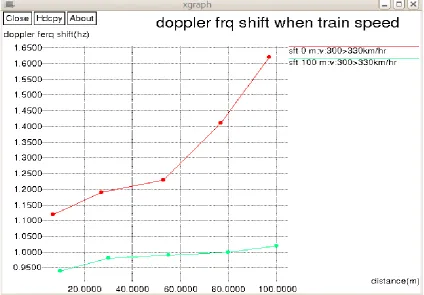
(We use sft = 0, 100, 500 to represent the vertical shift distances). In our experiment, we record the Doppler frequency shifts, i.e.,
IJEDR1602190
International Journal of Engineering Development and Research (www.ijedr.org)1099
Fig. 4. Doppler frequency shift when train speedFigure 4 shows the results when the train’s velocity v is fixed to 100 or 360 km/h. In summarize three cases. First, when the train is approaching to that DeNB, the relationship f > f0 holds, f slightly decreases (respectively, remains the same) when sft = 100, 500 (respectively, when sft = 0). Second, when the horizontal distance to the DeNB is zero, f is equal to f0. Third, when the train passes through the DeNB, we can see that f < f0. Since a high-speed train usually travels in a steady speed, the given results are representative for most of the time.
V. CONCLUSION
We observe that the LTE-A handover procedure is not suitable for high speed scenario and may lengthen the handover time. There is a risk of the handover fail which may result in a radio link failure in LTE networks, because it adopts a hard handover scheme. System performance is being aggravated by unnecessary handovers. It leads to transmission delay, packet loss, and signal overhead, which may seriously affect the performance of a real-time application. The proposed scheme contains two procedures: One is an enhanced measurement procedure, and the other is a group in-network handover procedure. The results show that the proposed scheme can effectively reduce mobile relays’ handover times and messages.
VI. REFERENCES
[1] 3GPP TS 36.133: Evolved Universal Terrestrial Radio Access (E-UTRA); Requirements for Support of Radio Resource Management, 3rd Generation Partnership Project (3GPP), Sophia-Antipolis, France, Jan. 2013.
[2]3GPP TS 36.331: Evolved Universal Terrestrial Radio Access (E-UTRA); Radio Resource Control (RRC); Protocol Specification, 3rd Generation Partnership Project (3GPP), Sophia-Antipolis, France, Jul. 2012.
[4] 3GPP TS 36.413: Evolved Universal Terrestrial Radio Access Network (E-UTRAN); s1 Application Protocol, 3rd Generation Partnership Project (3GPP), Sophia-Antipolis, France, Mar. 2012.
[5] 3GPP TR 36.836: Technical Specification Group Radio Access Network; Mobile Relay for E-UTRA, 3rd Generation Partnership Project (3GPP), Sophia-Antipolis, France, Sep. 2012.
[6] 3GPP Contribution R3-100046: Architecture Options Comparison: UE Mobility Support, 3rd Generation Partnership Project (3GPP), Sophia- Antipolis, France, Jan. 2010.
[7] 3GPP Contribution R3-120233: Performance Analysis for Candidate Architectures Supporting Mobile Relay, 3rd Generation Partnership Project (3GPP), Sophia-Antipolis, France, Jan. 2012.
[8] Doppler Effect. [Online]. Available: http://en.wikipedia.org/wiki/ Doppler effect.
[9] Taiwan High Speed Rail 700t Train. [Online]. Available: http://en. wikipedia.org/wiki/THSR_700T