CD CD
0 c) 0 0
CD n
0 CD 0
'-1 CD CD Ct CI-)
B
CD U) C-)
ABSTRACT
This study's purpose is to locate, select and separate out from the wider India Office Records, the extensive archives of the East India Company and its supervisory state body, the Board of Control, those classes, series, volumes and documents which contain sources on the history of the southern African region. 'Southern Africa' is taken to be the region including those countries which form modern South Africa, Namibia, Lesotho, Botswana, Swaziland, Zambia, Zimbabwe, Malawi, Angola and Mozambique.
An extensive survey of the archives was undertaken to address the previous lack of investigation of these sources. The analysis and synthesis of the survey seeks to explain why the sources are there, their extent, and what they are about. The study aims to draw
researchers' attention to the range and depth of the sources in these archives, spanning the period of the combined existence of the East India Company (1600-1858) and the Board of Control (1784-1858). The finding aid produced from the survey results aims to improve accessibility to and facilitate greater use of these archives.
The thesis begins with a brief description of the context - the history and organisation of the East India Company and the Board of Control. It then focuses on the Company's interest in southern Africa, particularly its agencies at the Cape of Good Hope
(1793-1858). A general presentation of the evolution, arrangement and extent of the India Office Records follows. This leads into a core discussion of sources contained within the relevant classes of the archives.
The appendix comprises a detailed descriptive listing of the East India Company's archives on southern Africa. The listing presents the results of the survey of these disparate records in an
3 CONTENTS
Abstract 2
Contents...3 Listof illustrations ... Acknowledgements...6 INTRODUCTION...7 CHAPTER 1 1.1. 1.2. 1.3. 1.4. CHAPTER 2 2.1. 2.2. 2.3. 2.4. 2.5. CHAPTER 3 3.1. 3.2. 3.3. 3.4. 3.5. CHAPTER 4
AN ADMINISTRATIVE HISTORY OF THE EAST INDIA COMPANY AND THE
BOARD OF CONTROL (1600-1858) ...32 A brief history of the East India Company,
1600-1858 ...32 East India Company structure and
organisation(1600-1858) ...41 The organisation of East India Company
business...58 TheBoard of Control ...63 THE EAST INDIA COMPANY'S INTEREST IN
SOUTHERNAFRICA 1600-1858 ...74 Security, supply and servicing ...74 East India Company trade with
southernAfrica ...92 Slavery and labour: Mozambique, Angola
andSouth Africa ...101 Military support and administrative
interchangibility: India and the
Capeof Good Hope ...104 Other more peripheral examples of East India
Company involvement in southern Africa ...107 THE EAST INDIA COMPANY'S AGENCIES AT
THE CAPE OF GOOD HOPE:
AN ADMINISTRATIVE HISTORY ...130 The Company's own Agency at the Cape,
1793-1804; 1807-1836 ...131 The nature of the Cape Agency business ...145 The Company's Cape Agency establishment,
1793-1836 ...150 Local commercial agents at the Cape
acting for the Company, 1836-1858 ...153 The London agents for the Cape of Good Hope ... 154 THE INDIA OFFICE RECORDS:
A CUSTODIAL HISTORY 1600-1997 ...166 4.1. Extent and scope ...167 4.2. Custody, care and control of the
India Office Records, 1600-1997 ...168 4.3. Intellectual control and the
CHAPTER 5 SOURCES FOR THE HISTORY OF SOUTHERN AFRICA IN THE EAST INDIA COMPANY AND
BOARDOF CONTROL ARCHIVES ...203
5.1. The legal framework of the East India Company and the Board of Control ...212
5.2. The East India Company's interests in southern Africa from 1600 until the establishment of the Agency at the Capeof Good Hope in 1793 ...218
5.3. Consultation between the East India Company and the British Government (cl700-l784) and the Board of Control's supervision of the East India Company (1784-1858) ...240
5.4. The Company's management of its own Agency at the Cape (1793-1804; 1807-1836) and commercial agents at the Cape (1836-1858) fromLondon ...251
5.5. The records of operations of the Agencies at the Cape of Good Hope, 1793-1858 ...263
5.6. Other Company/Board interests in southern Africa initiated in London, India or at St Helena which fell outside the operations of the Company's agencies at the Cape, or in which the Agencies were only indirectly involved, 1793-1858 ...272
5.7. Reference collections of the East India Company and the Board of Control ...283
CONCLUSION...294
BIBLIOGRAPHY...299
PUBLISHED ARTICLES BASED ON THIS STUDY ...305
Jill Geber, 'The English East India Company at the Cape and the Cape of Good Hope Factory Records', in South African Archives
Journal 36 (1994), pp. 54-64
Jill Geber 'Southern African sources in the Oriental and India Office Collections (OIOC) of the British Library' in
African Research and Documentation 70 (1996), pp. 1-35 Jill Geber, 'Sources for southern Africa in the Oriental and India Office Collections', in Africa Quarterly 36, 1 (1996), pp. 55-82.
LIST OF ILLUSTRATIONS
Facing title page: The Cape of Good Hope, cl73l, by George
Lambert and Samuel Scott, IOL: F35. The painting was hung in the Court Room of the East India Company from about 1798 to 1858. Reproduced by permission of the British Library.
Chapter 2, facing page 74: Map: The East India Company and southern Africa, 1600-1858.
Chapter 3, facing page 145: The first page of instructions from the East India Company to their Agent at the Cape, 1807.
Correspondence of the Company's Accountant General's department: paragraphs for letters to the Cape Agent, IOR:L/AG/29/l/14, p. 219. Reproduced by permission of the British Library.
Chapter 3, between pages 152 and 153: Panorama of Cape Town section 5, by Lady Anne Barnard, c. 1803. The buildings on the bay front include the East India Company's warehouse, the Custom House and the Commissariat. Reproduced with permission of the owner, Lord Crawford of Balcarres and from the plate between
pages 56 and 57 in The Letters of Lady Anne Barnard to Henry
Dundas from the Cape and elsewhere, 1793-1803,A.M. Lewin-Robinson
ed. (Cape Town, 1973), with permission of Balkema Publishers, Rotterdam.
Chapter 3, facing page 153: Plan of Cape Town, 1833, showing the East India Company Agency's offices and warehouses. From Greig's
Cape of Good Hope Directory and Almanac, KAB:Ml/l382. Reproduced
with permission of the Cape Archives Repository, Cape Town. Chapter 4, page 182: Table 4.1. India Office Records
classification scheme 1967-97.
Chapter 4, page 194: Table 4.2. A complete list of India Office Records classes showing the division and overlap between the East India Company and India Office archives
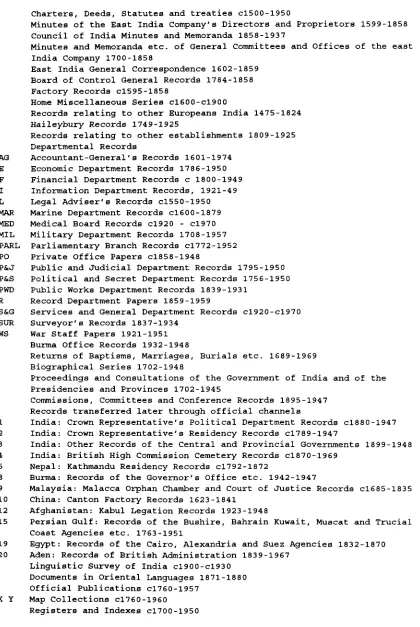
Chapter 5, page 205: Table 5.1. A list of East India Company and Board of Control archives within the India Office Records group Chapter 5, pages 206-211: Table 5.2. East India Company and Board of Control archives surveyed for southern African sources Chapter 5, facing page 220: Extract from the Minutes of the Court of Directors of the East India Company, 25 November 1720,
ACKNOWLEDGEMENTS
A better supervisor than John Mcllwaine I could not have hoped f or. His calm unfailing guidance, support and
steadiness over the years have been a constant source of strength and reassurance to me. To him I owe a special debt of gratitude.
To my colleagues, present and retired at the Oriental and India Office Collections (many of whom having gone through this process before me), I am especially grateful for their encouragement and for bearing with me and my pre-occupation. Particular thanks go to Andrew Cook for his invaluable advice and for drawing on and sharing his immense knowledge of the India Office Records in response to my endless questions; and to Martin Moir for his sound advice and insightful
reminiscences on the early days of the India Office Library and Records.
My husband Barrie, my family and friends have supported and encouraged me as well as tolerated my stress and frustration, throughout this lonely time. It is difficult to express to them the depth of my appreciation. Without their love,
patience and forbearance I would not have cleared the final hurdle.
I am especially grateful to the British Library for providing financial support, resources, generous study leave,
permission to freely reproduce a number of illustrations and above all, for the direct access to the archives and other collections, without which this study could not have been completed.
INTRODUCTION
While undertaking postgraduate research in overseas
archives studies in London, I was introduced to the wealth
of archive and manuscript sources on South Africa spread
across the United Kingdom. After completing this research,
and on taking up employment as an archivist in the British
Library's India Office Library and Records, I became keen
to discover what southern African sources were held within
the national library's impressive collections.
The origins of this study lay in an ambitious project that
began in 1989, to produce a guide to various categories of
sources of southern African-related material (archives,
manuscripts, maps, official publications, newspapers,
prints, drawings, photographs, stamps and sound recordings)
in all the departments of the British Library. 'Southern
Africa' is taken to be the region including those countries
which form modern South Africa, Namibia, Lesotho, Botswana,
Swaziland, Zambia, Zimbabwe, Malawi, Angola and Mozambique.
The offshore islands are excluded.
Southern Africa has played a significant role in the
history of the British Empire and Commonwealth from the
seventeenth century. The extent of British interest in the
region is reflected in the acquisitions of the British
Library and also in the archives of the bodies involved in
the administration of British India: the East India
Company, the Board of Control and the India Office, which
became part of the British Library's collections a decade
The material on southern Africa in the India Office Library
and Records was considered largely uncharted when compared
with other British Library departments. With the recent
merger of the Oriental Collections and the India Office
Library and Records, the Oriental and India Office
Collections holdings now constitute a microcosm of the
British Library, containing a range of different sources.
Is
Amongst these sources, arguably the Library's single most
important acquisition of archives this century - the India
Office Records. For these reasons, the department seemed a
logical and challenging starting point.
Initial investigation revealed that some use has been made
by researchers of the India Office Records, who have
highlighted particular southern African themes, for example
calls at the Cape by East India Company ships in the
seventeenth century, 1 the impact of the Napoleonic
campaigns on southern Africa in the late eighteenth and
early nineteenth centuries; 2 and more recently in the
nineteenth and twentieth centuries, the emigration of
Indian labourers to southern Africa and the history of the
Indian people in South Africa. 3 Of particular relevance,
Marcus Arkin has made intensive use of the series of Cape
of Good Hope Factory Records in his examination of the
economic history of the East India Company's Agency at the
Cape of Good Hope (1793-1836) .
The perceived problem which initiated this study was that
none of the existing work that makes use of the archives of
the East India Company, the Board of Control or the India
Office linked these themes together, to unfold the wider
relationship between southern Africa and India during the
There was a strong probability that potentially useful
sources for historical study of the region lay buried,
unexplored within the mass of these archives, eluding
researchers owing to their impenetrability and
inaccessibility. The main reason for this was the
undeveloped state of finding aids to the India Office
Records at a regional, subject or even country level.
Why historical sources on southern Africa are in these
archives, how much there is and what they are about are
questions which could not be answered without in-depth
archival investigation. The answers could only emerge from
a survey of the archives and a synthesis of the survey
results into a comprehensive archives guide to whole of the
India Office Records.
After four years of survey work across the India Office
Records an overwhelming amount of relevant research
material was uncovered - too large for a Ph.D. study.
Consequently, a narrowing down of the field was imperative.
The decision was taken to limit the research to the East
India Company period (1600-1858); to the archives of the
Company and its later supervisory body - the Board of
Control (1784-1858). These are the limits of this study in
its final form. In order not to waste the data already
gathered from the later India Office archives and other
sections of the Oriental and India Office Collections, a
summary of what had been found to that point was
published.5
This research study situates itself within the field of
archive studies. The most important work that archivists
to use them through the keys which provide intellectual
access to the information contained in the archives
-finding aids. Without good -finding aids, vast amounts of
potentially useful source materials remain inaccessible to
researchers. As a result the research value of archives
will neither be utilised nor disseminated in the informing
of academic opinion.
Finding aids are produced at various levels. Archive guides
are a type of finding aid prepared by archivists to
establish physical and intellectual control over one or
more archives' holdings. Guides appear in many forms - but
their common characteristic is that they provide an
overview of the material with which they deal, and draw
together information spread across other finding aids,
either as it stands or summarised for the particular
purpose of the guide. They may be comprehensive or
selective, depending on their purpose or function.6
Subject guides are usually selective and concentrate on key
records. They bring together references to records in
different
fonds des archives
(single complex source ofarchives, which may embrace one body and archives inherited
by it from another source) or series relating to a
particular subject, and as such provide a subject-based
overview of a repository's holdings. The level of detail
varies according to the nature of the subject and archives,
the purpose of the guide and the time and quantity of the
information to be included. A narrow approach may include
item level descriptions; a broader approach will not go
below series level. The purpose of guides is to meet a real
There is a well-established practice of producing archive
guides which focus on particular regions of the world, in
an area studies-based approach. For Africa, these include
the International Council on Archives 'Guides to the
sources for the history of nations' 8 and feature archival
collections from a number of repositories around the world.
There are also country-based approaches, looking at
archives sources for a particular region, based on
repositories in one country. The most relevant of these for
this study is Matthews and Wainwright's Guide to
manuscripts and documents in the British Isles relating to
Africa, 9 which has been recently revised.'0
There are also many regional or country-focused guides to
particular archive collections. For the India Office
Records examples include Burma,' 1 Afghanistan,' 2 Tibet,
Sikkim and Bhutan,' 3 the Persian Gulf' 4 and Zanzibar.' 5 A
number of 'topical' subject-based guides to the India
Office Records also exist, for example on the Indian
Mutiny,' 6 Indian emigration' 7 and civil disobedience in
India.'8
Existing published and unpublished work on African sources
in the India Office Records and closely-related holdings in
India is presented here to provide relevant contextual
discussion for this study. The contributions which follow
include the work of India Office Records record-keepers and
archivists, other British Library staff, and archivists or
researchers outside the British Library.
Frederick Danvers' Report on the Records of the India
Office' 9 includes an overview of European contact with the
early maritime interest in the Cape. He presents an often incidental account of the Company's Cape Agency (with inaccurate details of the successive Agents) . The Report contains no general references to the Company's contacts with Mozambique or other parts of Africa, f or example, on the Guinea coast. A summarised form of Danvers'
presentation of this account forms the introduction to the Cape of Good Hope Factory Records series G/9 in his
subsequent List of Factory Records.2°
William Foster's Guide to the India Office Records21 includes a brief mention of the Cape among the Factory Records summarising Danvers, but no other references to
Africa. Martin Moir's General Guide to the India Office
Records 22 is the most comprehensive guide to the India
Office Records to date, presenting summaries of the
archives at the class and series level. Given the guide's broad scope, specific coverage for Africa is not
appropriate, but a useful appendix outlines the main sources for areas outside India, which include seven
African countries. For southern Africa, only South Africa is featured.
Richard Bingle's 'Resources for the study of the Indian Ocean region in the India Office Library and Records'23 deals with a region much larger than southern Africa, but his treatment of the African-related sources in the India Office Records is limited to a few superficial paragraphs. For southern Africa he indicates only that the Cape Factory Records and Political and Secret Records contain 'later' references for South Africa and a brief mention of
Penelope Tuson's paper to the British Library's African
Studies colloquium in January 1985, 'British Library
African resources: the India Office Records' 24 presents a
summary, illustrative overview of African sources in the
India Office Records. A major weakness of her paper is the
omission of South African sources. The omission is stated
in a footnote but not justified or explained in any way.
Had South Africa not been omitted from her paper, it would
be a more useful guide for researchers of South African
history today.
Tim Thomas' subject guide,
Indians Overseas25
includes anoverview of India Office Records holdings on Indian
emigration to Southern Africa and brief descriptive
listings of relevant files. The informative lists present
files on South Africa, Zimbabwe, Mozambique, Zambia, Malawi
and Swaziland.
Tuson's unpublished 'Zanzibar: sources in the India Office
Records' 26 includes a summary of East India Company and
the..
India Office interest in , east African region. It presents a
useful and broad discussion of sources specifically
relating to Zanzibar, together with administrative notes, a
Margaret MakepeaCe's 'English Traders on the Guinea Coast,
1657-1668: an analysis of the East India Company Archive'27
is a thorough historical account of the Company's brief
relations with west Africa which is illustrated by
extensive use of the class of East India Company
Correspondence with the East E/3.
Jill Geber's article 'The English East India Company at the
Cape and the Cape of Good Hope Factory Records l773l836,28
is an account of the Cape of Good Hope Factory Records G/9
after the listing of the series was completed for this
study. The article discusses the series from an archival
perspective and builds on Marcus Arkin's historical
analysis of the Cape Agency in order to bring the series'
contents and value to the attention of researchers
interested in the Cape during the Agency period.
Geber's subsequent article, 'Southern African sources in
the Oriental and India Office Collections of the British
Library' 29 presents a range of sources (archives, private
papers, manuscripts, printed books, serials and visual
materials) on southern Africa located during the survey
underpinning this study. It comprises the first
comprehensive overview of sources for southern Africa in
the Oriental and India Office Collections. Copies of these
two articles are bound at the end of this volume.
Ilse Sternberg's article 'The British Library's resources
of South African materials' 30 contains a short paragraph
partly on the India Office Records, which once again only
repeats the Cape of Good Hope Factory Records and material
Multi-repository African-related guides undertaken by archivists or specialists outside the British Library, which feature the India Office Records are represented by two examples. The first is Matthews and Wainwright's Guide
to Manuscripts and Documents in the British Isles relating
to Africa 31 as noted earlier. Its coverage of the India
Office Records (prior to the introduction of the archive classification scheme) is now outdated and uneven. For
example nearly two and a half pages are devoted to the Home
Miscellaneous series (for which a complete catalogue
existed) but the enormous class of Proceedings is not even
mentioned.
The recent revision32 of this guide includes Penelope Tuson's update of the India Office Records entry. 33 She uses many of the examples previously used by Matthews and Wainwright without much expansion. Her improvements are mainly in format, layout, the addition of class titles and modern references. Only a small amount of new material in a
summarised form is presented, much of which is already accessible through published catalogues, for example the Middle East and Military records.
Tuson's revised entry is insubstantial, eclectic and
disappointing after a period of twelve years. For example, her new presentation of the class of Proceedings notes its huge size but only hints at main series likely to include African references. Not even a sample description is
produced nor any hint of subject content suggested. Much detail of the old nineteenth century summary lists (for example the St Helena Factory Records G/32) is repeated as before, but no new coverage is included for larger, more
Another example of this perfunctory approach is the omission of selections from the detailed listing of the Board's Collections F/4 (current at the time of the
revision) which includes many African references and has modern and accessible indexes.
The other representative guide is Anne Thurston's Guide to Archives and Manuscripts Relating to Kenya and East Africa
in the United Kingdom. 34 Its regional approach is
geographically complementary to this study. It is rigorous, methodical and successfully achieves its aim of providing the Kenya government and scholars in Kenya and elsewhere with greater access to material, and demonstrates the great range of material available, particularly less well-known sources in a number of archives collections including the India Office Records.
Further afield are S.A.I. Tirmizi's useful guides, Indian Sources for African History 35 which indicate the existence of many sources on Africa in the national and state
archives in India (for the period of British rule in India) which are complementary to the India Office Records. There are many references to East India Company and India Office documents, which not only make Indian sources accessible, but also facilitate the tracing of relevant copies or extracts in the India Office Records sent from India to London for information.
Office Records and so given its relevance, his publications
merit discussion here. Arkin's coverage of the Agency's
history is comprehensive. He also included some useful
perceptions on the archives themselves and the difficulties
he encountered in their use (in the 1960s prior to the
introduction of the classification system). However, other
relevant and closely-related series of the Company's
archives were not examined in that process. He also
confusingly refers to the series as 'manuscripts' or
'manuscript collections' 37 and in doing so diminishes their
status as part of the archives of the Agency's parent body,
the East India Company.
Personal experience of undertaking research in the India
Office Records and other repositories, management of the
Oriental and India Office Collections reading room and
assisting researchers in understanding and locating
information in the India Office Records has made me
appreciate that the importance of good and accurate finding
aids cannot be understated. Unless finding aids bring to
light research possibilities, sources will remain forever
neglected, forgotten and unused.
Arkin illustrates the point that inaccessibility of
information in archives puts researchers off. In searching
for information on the Company's Cape Agency in the Cape of
Good Hope Factory Records, he found '...such information
lies buried beneath vast heaps of archival rubble, the
exhumation of which would involve almost a lifetime of
arduous delving. ,38
The preceding survey of existing literature relevant to
African sources in the India Office Records. Apart from the
recent published work presenting aspects of this study, no
detailed investigation or examination of the range of the
East India Company's and Board of Control's archives in
relation to southern Africa as a region has been undertaken
previously. The production of such a guide will, by making
accessible those archives, allow researchers to investigate
the under-explored relationship between the East India
Company and southern Africa during the Company's period of
administration in India.
It made sense to opt for a regional approach because the
East India Company and Board of Control were interested in
more than one part of southern Africa, and also because
Thurston's and Tuson's guides to East Africa and Zanzibar
cover the area immediately adjacent to southern Africa. To
add to those a guide for southern Africa would provide a
degree of coverage of the India Office Records for the
whole geographic block of southern and eastern Africa. A
southern African area guide would also bring to light
sources on the south western coast of Africa which have
never appeared in any guide or publication on African
sources in the India Office Records.
In relation to other archive guides, this study can be
viewed as a subject or 'topical guide' 39 to part of a
repository's holdings, with an area studies approach: it
covers the archives of two bodies (the East India Company,
1600-1858 and the Board of Control, 1784-1858) contained in
one archive repository (the India Office Records) and which
specifically focuses on those bodies' interest in a
particular region (southern Africa), during the period of
The outcome of this investigation is that for the first time the extensive sources which exist in a lesser known corner of the British Library are made easily accessible to researchers in southern Africa, the United Kingdom and
elsewhere.
From the outset, the India Office Records have been viewed archivally in this study as closely related to the wider family of archives of British departments of state, which are located in the Public Record Office (for example the Colonial Office (CO), Foreign Office (FO), War Office (WO). Although the India Office's archives are now physically
separated from its sister departments of state, they
indisputably also form part of the group of those archives of departments of state.
Although there are some differences, the archival
terminology used in this study in discussion of the India Office is the same used by the Public Record Office in the arrangement and description of the archives of state
departments. For example, the 'group' is the highest
hierarchical level designated to the archives of ministries or departments of state in the Public Record Office. Here the India Office is taken as the 'group'.
At the next level the records created for particular functions or used by a particular subdivision of the
'group' department are referred to as the record 'class' in the Public Record Office. The India Office Records
equivalent of the Public Record Office classes are the divisions of the arrangement of the Records by the
departments, runs of documents of the same type or format (for example correspondence with India, E/4) are further
divided into 'series' in the India Office Records, but not in the Public Record Office. Individual files or volumes within classes or series (e.g. E/4/3) form the lowest level
in the hierarchy, and are described as an 'item' (or 'piece' in the Public Record Office).
The data which underpins this study was collected in a number of phases. The first phase of the survey (1989 to 1991) included an examination of all the existing finding aids to the India Office Records for traces of references to southern Africa. The finding aids comprise older
catalogues compiled before the application of the modern archive classification scheme and modern handlists compiled by archivists mainly over the last thirty years. A variety of levels and styles of description were evident. Relevant material might be present in the records but was not always obvious from the mainly broad, summary descriptions in the handlists so they could not be depended on entirely. What existed outside the handlists was uncharted. Checklists of successful or unsuccessful findings were maintained
throughout the survey.
years and consequently the decision was taken to restrict
the study to only the East India Company and Board of
Control classes.
The second, re-oriented phase of the survey focused on an
intensive examination of classes and series of East India
Company and Board of Control archives. This examination
became a working archival survey (i.e. using the indexes
and registers and noting the findings as archival
descriptions) as the work progressed.
The first series to be tackled was the one most
substantive, self-contained series significantly relevant
to the study - the series of Cape of Good Hope Factory
Records G/9. The series was only accessible via the
original summary Factory Records catalogue compiled in the
1890s. Although Marcus Arkin had opened up the contents of
the Cape Factory Records for historical examination, the
contents of the volumes in the series were still impossible
to determine from the existing finding aid. Arkin's
publications were closely consulted for his invaluable
detailed examination of the history of the Agency.
The Agency was of central importance to the Company in
southern Africa and this provided the main reason for
undertaking a detailed, almost calendar level listing.
Secondly, no index to the series exists and such a detailed
listing would at least make the series more accessible. The
third reason f or undertaking such a detailed examination
was that it would suggest clues to other relevant series in
the wider Company' archives for later examination in the
survey for that period. The detailed descriptions of the
papers were completed in 1993. An added bonus to completing
the description of the series, was the discovery of G/9/15,
which had been 'missing' after 1919 was found in July 1993.
It had been incorrectly labelled and bound as one of the
volumes of the Sumatra Factory Records.
The remainder of the study concentrated on the Company and
Board classes and series which had not yet been surveyed.
Contemporary indexes and registers (created by East India
Company and Board's clerks and officials) were consulted
and systematically scrutinised for clues and leads to
relevant sources. There was no alternative means of
investigating the sources, other than to survey the
archives in this way. There was no way of estimating how
much relevant material there was or how long it would take
to go through each class or series, other than to
physically check or read through the numerous indexes and
registers, volumes with internal indexes, and where these
did not exist, to skim through individual volumes for
sources where justified. It was an extremely
time-consuming, often tedious and exhausting method, but was the
only way to systematically uncover the sources.
The constraints of time to complete the survey and produce
the guide dictated a change in approach in some areas of
the survey: for example large runs of indexes were skimmed
- generally, not minutely, to pick up most of the relevant
subjects and names. Similarly, the vast class of
Proceedings (46 500 volumes in total) could not be given
the time f or a thorough survey, but they were sampled and
representative examples presented. Existing 'hot-spots'
were taken from related classes already surveyed to
not exhaustively, but at least in a way which provided a
representative sample. Copies or duplicate material
(especially in the series of departmental correspondence)
were omitted.
A number of older published transcripts and catalogues on
series of the Company's early archives existed, which
included references to southern Africa (f or example Danvers
and Foster's six volumes of Letters Received by the East
India Company from its Servants in the East. . .1602-13 [to]
1617),° which were compiled using the old (pre-1960s
classification) references. To enable researchers to link
the published reference to the correct document in the
original volume, relevant entries included were supplied
with their new modern references.
The temptation to investigate interesting historical or
archival tangents was resisted. A major recurring example
of such temptation was the question of what the Board of
Control's real political role was and why it featured so
strongly in the archives. Frustration with the existing
imposed India Office Records classification scheme required
tolerance. Similar difficulties with the quality and
clarity of the current India Office Records finding aids
were experienced. Investigations into these problems is
needed but best left for future examination.
The questions initially posed about the extent of
information on southern Africa in these archives, their
content and reason for inclusion, could not be
satisfactorily answered until the survey was completed in
May 1996 and the results analysed. The review of the survey
emerged of the relationship between the East India Company
and southern Africa which confirmed and upheld the
proposition that a wealth of historical information of
value to researchers on southern Africa was indeed embedded
in the archives.
The data itself is an inventory of the unfolding of the
sources located, selected and separated out from those
relevant classes, series, volumes and documents which
contain the sources. The survey ultimately provided the
means of production of a complete guide which presents
accurate archival descriptions of documents and volumes
containing historical data on the relations between the
East India Company, the Board of Control and southern
Africa, covering over two and a half centuries.
The diverse nature of the sources dictated a variety of
descriptive presentations, for example: brief archival
descriptions of extensive material such as correspondence;
detailed descriptions (calendaring) of the central Cape of
Good Hope Factory Records series G/9; transcripts, such as
particular extracts from Court of Directors' B, Board of
Control F/i or Committee minutes D; chronological tabular
listing of East India Company ships' landf ails on the
southern African coast, as in Marine Records L/MAR./A-B.
Older published forms of reference are linked with new
modern references facilitating identification and
retrieval. Each class of the archives listing presented in
the Appendix (Volume 2) is preceded by introductions which
expand on the general discussion of the sources in Chapter
The survey results presented merely as archival
descriptions are flat and unconnected. Some sense had to be
made of the content. The thesis itself provides a
contextual discussion and synthesis of the data from the
survey. Chapters 1 to 3 discuss the administrative context
of the East India Company, the Board and the Cape Agency
and their involvement in southern Africa. Chapters 4 and 5
focus on the archives and sources on southern Africa
created by those bodies.
The first chapter of the thesis comprises a short history
of the East India Company and the Board of Control and a
description of their administrative history and
organisation, in order to place the discussion of the
sources in context. Continuing the contextual discussion,
the second chapter focuses on the Company's interest in
southern Africa. This chapter has largely been shaped by
the documents found in the survey of the East India
Company's archives which relate to southern Africa. It
seeks to bring together and make sense of these scattered
documents with the assistance of relevant published works,
to create a picture of the Company's historical interest in
the region.
East India Company interest in southern Africa centred on
its agency at the Cape of Good Hope (1793-1836). The
Company's trading function was officially terminated in
1834. Cape Agency operations took a further two years to
conclude. Thereafter, local merchants in Cape Town acted on
behalf of the Company until the Company's remaining
administrative operations ceased in 1858. The third chapter
comprises an administrative history of the Company's
of the work of the local non-establishment agency acting on
behalf of the Company from 1836 to 1858. Building on
Arkin's intensive use of the Company's Cape of Good Hope
Factory Records, this chapter draws on documents from the
Agency which have been made accessible since Arkin's
studies, as well as on other relevant documents widely
dispersed in the Company's archives which are not included
in Arkin's work. It also includes a brief discussion of the
London Agents for the Cape, insofar as they were concerned
with Company affairs.
Having described the history and organisation of the two
bodies whose archives are to be examined and their interest
in the southern African region, the discussion moves on to
an examination of the archives themselves. The fourth
chapter comprises a general contextual presentation of the
evolution, arrangement and extent of the whole group of the
India Office Records. This is necessary because the Company
and Board's archives cannot be easily separated from the
India Office Records group and viewed in isolation. This
chapter consequently includes the custodial history of the
archives of those two bodies in order to explain the
complications of locating some of the southern
African-related sources.
Developing the historical sketch of the Company and Board's
history and their interest in southern Africa in the first
three chapters, the fifth chapter focuses on the archives
created by those two bodies specifically as a result of
their interest in southern Africa.
Chapter 5 presents a synthesis of the results of the
and Board and examines the archives created within the
context of the Company's interests in southern Africa and
explains how and why southern African sources have come to
be incorporated into the archives of Company and Board. The
results of the survey of these widely-dispersed sources are
brought together in a way which gives balance and weight to
the findings of the survey. References to relevant sources
made in chapter 5 may be traced to full entries in the
Appendix (Volume 2). This final chapter also provides a
means of introduction to the data in the Appendix.
The Appendix constitutes an extensive body of evidence to
support the main part of the study. The data from the
survey is presented as archival descriptions in the order
of the classification of the India Office Records. The
Appendix contains its own introduction and index and this
enables it to stand alone as a detailed inventory of the
sources located.
The value of this study is that a gap in the knowledge of
the extent and content of sources for southern Africa in
the East India Company and Board of Control archives has
now been filled. This study provides the means of
determining how much documentary information in the Company
and Board of Control's archives relates to southern Africa,
what it is about and why it is there. This study presents
for the first time a comprehensive, archive subject guide
to sources during the Company period (1600-1858) with which
the history of the relationship between the East India
Company and southern Africa can be explored in more depth
It makes these archives intellectually accessible and
available to historians and researchers of southern Africa to evaluate before physically examining them. It enables advance planning of research and facilitates greater use of these sources to inform historical and other academic
opinion. The guide makes a useful addition to collections of related archives, particularly in South Africa and
Notes to Introduction
1 For example, R. Raven-Hart, Before Van Riebeeck - callers at South
Africa from 1488 to 1652, (Cape Town, 1967).
2 For example, M.V. Jackson, European Powers and South-East Africa: a study of international relations on the south-east coast of Africa,
1796-1858 (London, 1942).
One example in which India Office Records were used, is J.B. Brain,
Christian Indians in Natal 1860-1911, an historical and statistical
study (Cape Town, 1983).
M. Arkin, 'John Company at the Cape: a history of the Agency under Pringle, 1794-1815, based on a study of the "Cape of Good Hope
Factory Records"' in Archives Year Book for South African History II
(1960), pp. 176-344; 'John Company at the Cape', reprint from South African Journal of Economics 29, (30), September 1961; 'Supplies for Napoleon's Gaolers: John Company and the Cape-St. Helena trade during
the Captivity, 1815-21' in Archives Year Book for South African
History I (1964), pp. 169-230; 'Agency and Island: John Company and the twilight years of the Cape-St. Helena trade, 1822-36' in Archives
Year Book for South African History I (1965), pp. 26 9-330; Storm in a Teacup: the later years of John Company at the Cape, 1815-36, (Cape
Town, 1973)
J. Geber, 'Southern African sources in the Oriental and India Office Collections (OIOC) of the British Library', in African Research and Documentation 70, 1996, pp. 1-35.
6 • Healy, 'Guides', Unit 7, in Society of Archivists, British
Archival Practice, The Society's Training Manual, (London, 1996), p. B.7.l.
Ibid., p.B.7.4.
8
'Guides to the sources for the history of nations', Series 2: Africa
south of the Sahara (1970-)
N. Matthews and M.D. Wainwright, Guide to manuscripts and documents
in the British Isles relating to Africa (London 1971)
10 J.D. Pearson (ed.), Guide to manuscripts and documents in the
British Isles relating to Africa, 2 vols., (London, 1993).
A. Griffin, Brief Guide to Sources for the Study of Burma in the India Office Records (London, 1979)
12
L.A. Hall, A brief guide to sources for the study of Afghanistan in
the India Office Records (London, 1981).
A.K. Jasbir Singh, Guide to Source Materials in the India Office Library and Records for the history of Tibet, Sikkim and Bhutan, 1765-1950 (London, 1988).
14
15 P. Tuson, 'Zanzibar: sources in the India Office Records',
unpublished, [c.1987]
16
R.E. Seton, The Indian 'Mutiny' 1857-58: a guide to source material
in the India Office Library and Records (London, 1986). 17
T.N. Thomas, Indians overseas. A guide to source materials in the
India Office Records for the study of Indian emigration 183 0-1950
(London, 1985)
18
A.K. Jasbir Singh, Gandhi and civil disobedience: documents in the
India Office Records 1922-1946 (London, 1981). 19
F.C. Danvers, Report to the Secretary of State for India in Council
on the Records of the India Office: Records relating to Agencies, Factories and Settlements now under the Administration of the
Government of India, Part 1 (London, 1887).
20 F.C. Danvers, List of Factory Records of the Late East India Company Preserved in the Record Department of the India Office, London,
(London 1897), pp126-l27, 161-173.
21
Foster, A Guide to the India Office Records, 1600-1858 (London, 1966, reprinted from 1919 edition)
22
M. Moir, A General Guide to the India Office Records, (London, 1988)
23 R.J. Bingle, 'The resources for the study of the Indian Ocean region
in the India Office Library and Records', in India Office Library and Records Report for the year 1981, (London, 1982) pp. 6-23.
24
p Tuson, 'British Library African Sources (2) archival: the India Office Records', in I. Sternberg and P.M. Larby (eds), African
Studies: papers presented at a colloquium at the British Library, 7-9
January 1985, British Library Occasional Papers 6, (London, 1986), pp. 218-226.
25
T.N. Thomas, Indians overseas. A guide to source materials in the
India Office Records for the study of Indian emigration 183 0-1950
(London, 1985)
26
P. Tuson, 'Zanzibar: sources in the India Office Records', unpublished, [c.19871
27
M. Makepeace, 'English Traders on the Guinea Coast, 1657-1668: an analysis of the East India Company Archive', in History in Africa 16
(1989)pp. 237-284.
28
J.L. Geber, 'The English East India Company at the Cape and the Cape of Good Hope Factory Records', in South African Archives Journal 36
(1994), pp. 54-64.
29
I. Sterriberg, 'The British Library's resources of South African
materials' in SCOLMA, UK Library Resources for African Studies,
(London 1984) pp. 10-16
31
N. Matthews and M.D. Wainwright, Guide to manuscripts and documents
in the British Isles relating to Africa (London 1971), pp. 68-73.
32
J.D. Pearson (ed.), Guide to manuscripts and documents in the
British Isles relating to Africa, 2 vols., (London, 1993).
P. Tuson, 'British Library: Oriental and India Office Collections: India Office Records', in J.D. Pearson (ed.), Guide to manuscripts arid documents in the British Isles relating to Africa, Vol. 1, London,
(London, 1993) pp. 44-49.
A. Thurston, A Guide to archives and manuscripts relating to Kenya and East Africa in the United Kingdom, 2 vols., (London, 1991).
S.A.I. Tirrnizi, Indian Sources for African History, 3 Vols. (Delhi, 1988-1993)
36 M. Arkin, 'John Company at the Cape: a history of the Agency under
Pringle, 1794-1815, based on a study of the "Cape of Good Hope
Factory Records" in Archives Year Book for South African History II
(1960), pp. 176-344; 'John Company at the Cape', reprint from South African Journal of Economics 29, (30), September 1961; 'Supplies for Napoleon's Gaolers: John Company and the Cape-St. Helena trade during
the Captivity, 1815-21' in Archives Year Book for South African History I (1964), pp. 169-230; 'Agency and Island: John Company and
the twilight years of the Cape-St. Helena trade, 1822-36' in Archives Year Book for South African History I (1965), pp. 269-330; Storm in a
Teacup: the later years of John Company at the Cape, 1815-36, (Cape
Town, 1973)
37
M. Arkin, 'John Company at the Cape' pp. 179, 325.
38
M. Arkin, 'John Company at the Cape' in Archives Year Book for South African History (Cape Town, 1961) p. 179.
J. Pepler, 'Preparation of finding aids: arrangement and
description', Unit 2, Data elements and types of finding aids', in Society of Archivists, British Archival Practice, The Society's Training Manual, (London, 1996), p. B.2.4.
° F.C. Danvers and W. Foster, Letters Received by the East India Company from its Servants in the East.. .1602-13 [to] 1617, (London,
CHAPTER 1
AN ADMINISTRATIVE HISTORY OF THE EAST INDIA COMPANY
(1600-1858)
AND THE BOARD OF CONTROL
(1784-1858)
This chapter provides the context and background for the
study of sources for southern Africa in the archives of the
East India Company and the Board of Control. It briefly
examines the history, structure and organisation of both
bodies. However, it does not present an exhaustive
administrative history of the two organisations. Such a
comprehensive analysis of the East India Company and the
Board of Control has recently been completed by Martin Moir
in his General Guide to the India Office Records. Much of
this chapter draws heavily on the sections of that Guide
which relate to the East India Company period.' The
archives created as a result of the Company and Board's
interest in southern Africa will be discussed in Chapter 5
and described fully in the Appendix (Volume 2).
1.1. A brief history of the East India Company (1600-1858)
The East India Company, (or as it was originally named,
'The Governor and Company of Merchants of London Trading
into the East Indies') was formed as a trading company.
Established by a royal charter on 31 December 1600, (and
extended by subsequent charters), it was granted exclusive
rights to British trade eastwards of the Cape of Good Hope.
The charters confined the Company's activities to trade and
The formation of the Company was a response to previous
British dependence on other European traders for supplies
of eastern commodities such as spices, salt, dyes, textiles
and precious gemstones. The creation of the Company enabled
Britain to force its way into a theatre in which it lagged
behind by providing the means to obtain its own slice of
lucrative and attractive markets. 3 The Company had the
backing of the Crown and of the wealthy City of London. The
Company's early voyages to trade English goods f or eastern
goods were funded by subscribers, investors and
shareholders and organised on the basis of successive
separate voyages. Success was measured by profit yield.
The Company at first undertook seasonal visits to the Spice
Islands of Indonesia - the domain of its major rival, the
Dutch East India Company. However, Dutch resistance proved
too strong and by 1623 the English Company had shifted its
interests to India. It then had to compete with the
Portugi.iese and later the French.
It was vital for the Company's ships to stop at safe places
for repairs, water and fresh food on the voyages to India.
St. Helena, the Cape of Good Hope and Mozambique were the
stations in southern Africa which served this purpose. In
1620 two Company commanders attempted to annex the Cape to
prevent the Dutch from claiming rights to it as a
refreshment base for their ships, but failed to obtain
official sanction for their actions.
As the Company became more secure in its trading
destinations in India, permanent bases at favoured ports
were established. They were run by factors who obtained
stored them in the 'factories' (warehouses and trading
posts) to await the arrival of each season's fleet from
England.
The first factory was founded at Surat in 1613, on the
north-west coast of India, with the permission of the
Mughal Emperor (under whose control most of India fell).
Surat became the principal base of Company trade in India
between 1613 and 1687. The Company focused its trade on
cotton piece goods bought for import to England and
re-export to Europe. It also engaged in 'country trade' to and
from India with other parts of Asia and Africa. The Company
took part in important country trade to the south-eastern
coast of Africa, including Mozambique. This trade will be
discussed in some detail in Chapter 2.
After 1613 overlapping 'joint stocks' (a number of small
investors pooling the funding required to defray the cost
of the voyage and share in any profits) lasting several
years, were introduced to underpin a more stable commercial
enterprise. Charlesil's charter of 1661 confirmed the
Company's system of permanent joint-stock trading.
When hostilities with Portugal ended in 1635 the Company
was able to develop Surat as its trading headquarters in
India. Surat remained the pre-eminent Company post until
1688 when Bombay was ceded to the Company by the Crown and
assumed greater importance. The Company's trade was
extended from the Coromandel coast in 1613 to Fort St.
George (Madras) in 1640 and to the factories in Bengal
between 1633 and 1686 (which included Balasore and Hugh).
The acquisition of Bombay inaugurated the process of
which all Company trade in India was focused and profits
successfully maximised. 4 A permanent settlement was
established at Fort William at Calcutta in 1690, which
proved to be the wealthiest of the presidencies. By the
1700s Bengal had superseded Surat as the leading Indian
presidency.
As its trading influence soon extended beyond its small
factories, the new charters empowered the Company to
administer civil and criminal justice in its overseas
settlements, coin money, raise armed forces for protection
of its trade and arrest and repatriate interlopers.
After St Helena was abandoned by the Dutch for the Cape of
Good Hope in 1652, the Company established its own
settlement on the island in 1659. The Company also made
trading gains in the Persian Gulf and Red Sea in the l640s
and set up agencies at strategic points along those coasts.
At the outer limits of its area of operations the Company's
trade had reached Japan (1613-23) and China by the early
l700s.
By the end of the first century of its existence, the
Company was engaged in a struggle to protect its exclusive
trading privileges against other rival British trading
associations or companies, in particular the breakaway new
'English East India Company trading to the East Indies'
(1698-1709). The resolution of this dispute over trading
rights was resolved by merging the Old and New companies in
1702. The amalgamation was confirmed by a new charter of
1709 as 'The United Company of Merchants of England Trading
to the East Indies'. In the interim, the two bodies were
The Wars of Austrian Succession (1740-48) brought Britain
into conflict with the French in Europe. The expansion of
European trade threw the Company into collision with the
French in India during wartime. The Company's armies
successfully defeated the French and allied forces of the
Mughal Governor of Bengal in 1757. For the first time, the
Company had entered the stage as an active player in
internal trade and political relations in the most viable
part of India. 5 The trading organisation had become an
imperial power with its own armed force to support it in
that new role. 6 The Mughal Emperor Shah Alam II in
accepting the shift in power, conceded the
diwani
(revenue collection authority) of Bengal, Bihar and Orissa to theCompany in 1765, which made the Company
de
facto ruler ofBengal .
Its administration of land revenue drew the Company
increasingly into the administration of law and culminated
in the actual acquisition of territory and assumption of
political control of parts of Bengal, Madras and Bombay,
which eventually extended across India - a task which no
other trading company has ever undertaken on such a scale.
By the mid-l760s the Company had been transformed from a
purely commercial organisation to a significant territorial
administrator in south Asia. 8 This revolution in the
Company's status had a profound effect upon the essence of
its functions and operations. The consequences and
ramifications of the revolution took some time to be
understood and felt in both India and London.
Investors in Company stock had represented all classes of
society9 and the British government in particular was the
eastern goods which began to flood British markets
-especially tea.'° As a result, the Company's dealings in
India became the subject of both public and parliamentary
interest in Britain. The Company's dominance over British
trade in the east inevitably drew the government into
closer involvement in its affairs.11
The Company's military and political advances in India in
the 1760s brought the government to the conclusion that in
its new manifestation in India, this trading entity had
usurped the foreign, political and diplomatic functions
vested in the state. This new status had worrying
implications for wider British foreign relations. Because
of the importance of the Company's trading network, the
government also viewed with increasing concern the security
of the Company's eastern trading empire and its ability to
defend itself in the global conflicts of the late
eighteenth century. 12 The behaviour of the Company's
directors and its servants in India antagonised the
government to the point where it was forced to intervene
and check the Company's activities.13
Between 1759 and 1784 it gradually became accepted that the
British government should in some way assume overall
responsibility for the administration by the Company of its
territorial possessions in India. 14 Consequently,
Parliamentary investigations of the 1760s and 1770s
examined the Company's affairs and in 1773 Lord North's
Regulating Act (13 Geo. III, c. 63) brought about the first
radical state intervention in its internal affairs and in
its constitution. Copies of Indian letters had to be sent
Governor-General was empowered as the supreme authority in
India.
The consolidation of government regulation of the Company
was brought about in 1784 in the shape of William Pitt's
India Act (24 Geo. III, S. 2, C. 25) . It established the
Board of Commissioners for the Affairs of India (widely
known as the Board of Control or the India Board), which
was appointed by the Crown with power to superintend,
direct and control the Company's civil and military
government and business connected with Indian revenues. The
Act attempted to redirect the Company's ailing fortunes,
back onto the level of trade and prof it-making 15 and at the
same time transferred the formal control of politics and
diplomacy to the London government.' 6 The Company continued
to exercise trade privileges, appoint its own overseas
officers and to correspond with its subordinate authorities
in India and elsewhere - but the appointment of governors
and commanders-in-chief were subject to Crown approval.
In continuation of government scrutiny, the Company also
had to send copies of incoming Indian letters to the Board
and submit outgoing letters to India ('despatches') for the
Board's approval. The Board could also send its own highly
confidential instructions to India on matters of war, peace
and diplomacy through the medium of the special Secret
Committee of the Company's Court of Directors. The power of
the Directors was reduced and the Prime Minister reserved
the right to appoint the Governor-General.17
The India Act was designed to reform the Company's existing
structure, not to replace it with another form of
Company's independence, making it effectively a government
department which was required to execute the will of the
government in India. The Company retained the outward
trappings of power, but most of the substance was
transferred to the state.19
The Company's activities and involvement in numerous areas
outside India were influenced by overlapping plans and
motives, such as the need to safeguard and expand trade and
the dictates of British conflicts with other European
powers. The strategic defence of the expanding Indian
Empire, including the protection of the routes to India
became more important and was given increasing attention.2°
During the wars with the French for supremacy in India
(1778-83) and again during the revolutionary and Napoleonic
wars (1792-1815) the government was concerned that the
French would invade India. It was in this context that the
southern African stepping-stones to India (the Cape of Good
Hope and Mozambique) assumed greater importance in the
minds and activities of government and Company. This is
discussed in greater detail in Chapters 2 and 3. The
government took the decision to strike at the French
Caribbean empire, demolish the Dutch East Indian empire and
permanently annex the Cape of Good Hope as a linking point
to the two hemispheres. 21 It was in recognition of the
Cape's position that the Company (with the approval of the
Board) established its own Agency there in 1793 (discussed
in Chapter 3).
By 1805, the Company was no longer a viable profit-making
organisation 22 and further parliamentary enquiries of
1810-1813 revealed that the government could no longer defend or
Company. The Charter Act of 1813 (53 Geo. III, c.153)
brought to an end the Company's traditional monopoly rights
over trade with India, leaving it only fragments of its
original mandate. 23 However 1 the Company was allowed to
maintain its monopoly over the tea trade with China until
1833, in recognition of its efficient management and the
profitability of that trade. 24 The 1833 Charter Act (3 & 4
Will. IV, c.85) ended the Company monopoly over the tea
trade and forced it to wind up all its remaining commercial
and shipping activities from 1834. After this time the
Company assumed the status of trustee for the Crown in its
government of India.
The last Charter Act of 1853 (16 & 17 Vict., c.95) further
extended government intervention into the affairs of the
Company. The Sepoy Rebellion of 1857-58 against the
Company's military excesses, induced the government to
withdraw the last vestiges of Company control in India. The
Government of India Act of 1858 (21 & 22 Vict., c.106) made
the Crown directly and fully responsible for the government
of India and transferred the remaining powers of the
Company and Board of Control to a Secretary of State (for
India), assisted by a Council of India, with the India
Office as its executive arm. The Company as a purely
stockholding entity, continued in name until 1874, when
1.2. East India Company structure and organisation (1600-185 8)
1.2.1. The East India Company's administration in London
The Proprietors and the General Court of Proprietors.
A large group of investors or shareholders who were the
individual owners of the Company's stock or the 'members'
of the Company - constituted the Proprietors of the ctho
Company. After 1657 shareholders with £500/Company's stock
qualified for voting rights and an extra vote with each
additional £500. Voting rights were raised by the
Regulating Act of 1773 to £1000 of stock and additional
votes for extra stock. Collectively the shareholders formed
a General Court ('court' meaning an assembly of the
qualified members of the Company).
Until 1773 the General Court of Proprietors annually
elected twenty-four directors or 'committees' as a Court of
Committees (later named the Court of Directors) to take
responsibility for the management of the Company. They also
elected the Company's Governor and Deputy Governor until
1714 (when the restyled Chairman and Deputy Chairman were
elected by the Directors). General Courts could remove
directors for mismanagement. From 1695 the Proprietors also
appointed the members of the permanent committees which
served the Court of Directors.
The Proprietors' main function was to review or amend the
Company's operations and ratify its policies. The General
Courts fixed dividends paid on Company capital stock; made
and enforced the Company's own by-laws, rules and
regulations on Company organisation and procedure; approved
certain grants of money, salaries, pensions and gratuities
various accounts and papers on Company affairs presented to
Parliament. The Proprietors met quarterly and occasionally
held additional meetings to debate the Company's business.
The Proprietors played a significant supervisory role in
the affairs of Company until 1784. They had become more
interventionist with the Company's acquisition of territory
and with the increase in public interest in Company's
Indian affairs. In the late eighteenth century, the
Proprietors' views were frequently at odds with the
government's. The India Act of 1784 denied the Proprietors
any power to revoke orders of the Court of Directors which the
had the approval ofLBoard of Control. In this way the
political and constitutional significance of the
Proprietors was reduced. They could no longer intervene in
the administration of India. The General Courts still
discussed Directors' decisions and exercised a number of
specific functions and rights - but in practice they could
not intervene in affairs especially in the policies of the
government of India.
The Court of Co=ittees and Court of Directors
The directors of the Company were originally collectively
known as 'committees' (individual directors to whom the
business was 'committed') and constituted the Court of
Committees, headed by the Governor and Deputy Governor
(later Chairman and Deputy Chairman). After the merger of
the old and new Companies in 1709, the Court of Committees
was restyled the Court of Directors.
The 1698 Charter defined the new structure of the Company
and also reduced the number of directors to twenty-four and
reduced to eighteen, six of whom were appointed by the
Crown. The directors were elected annually by the
Proprietors to 1853 in March or April and after that
biennially. From 1714 the Court of Directors elected the
Chairman and Deputy Chairman.
To qualify as a director, a proprietor had to own a minimum
of £2000 Company stock, reduced by the 1853 Charter Act to
£1000. The Charter Act of 1853 added a new requirement that/an
directors had to have lived in India for ten years. The
directors served by rotation from 1773. A quorum of
directors was fixed at thirteen which was reduced to ten by
the Charter Act of 1853.
The directors were given the privilege of appointing their
own nominated candidates for Company writers (civil
servants) and military cadets in the Company's armies, as
well as surgeons, chaplains and advocates-general. This
patronage was distributed among directors and an extensive
network developed throughout the Company.
The Court of Directors formed the Company's executive,
conducting its routine daily business. The Court of
Directors' powers were defined in terms of acts and by-laws
and other internal rules of the General Court. The Court of
had
Directors met at least once a week but meetingsincreased
in frequency by the nineteenth century. The Court took
general responsibility for the management of the Company's
overseas trade and government; appointment and control of
employees at home and abroad; organisation of voyages;
arrangements for the provisions of shipping; scrutiny of