Generator Maintenance Scheduling of Power
System Using New Optimization Techniques
R. Anandhakumar
Assistant Professor, Department of Electrical & Electronics Engineering, Annamalai University, Annamalainagar, Tamilnadu, India
ABSTRACT : The goal of an optimal Generator Maintenance Scheduling (GMS) is to evolve an optimal preventive maintenance schedule of generating units for economical and reliable operation of a power system while satisfying system load demand and crew constraints. In this paper a new optimization technique named Water Evaporation Optimization (WEO) algorithm is applied to solve the GMS optimization problem efficiently. The efficacy of the proposed algorithm is illustrated with 19 generating units over a 25 weeks planning horizon. The simulation results are compared with existing algorithms. The simulation results indicate that WEO algorithm can efficiently be used for GMS.
KEYWORDS: Generator maintenance scheduling, optimal scheduling, water evaporation optimization algorithm.
I. INTRODUCTION
The thermal generator maintenance scheduling is a complex combinatorial optimization problem. Essential maintenance must be performed on a number of thermal generators inside a fixed planning horizon while ensuring high system reliability, reducing production cost, prolonging generator life time subject to unit and system constraints [1]. An appropriate maintenance schedule either decreases the operation cost or increases the system reliability. GMS should minimize the total operation cost and meanwhile satisfy various unit and system constraints and the problem can be mathematically formulated as a constrained nonlinear, mixed integer optimization one. Modern power system is experiencing increased demand for electricity with related expansions in system size, which has resulted in higher number of generators and lower reserve margins making the GMS more complicated. There are two categories of criteria for GMS problem; based on economic cost and reliability [2].
In the last decade, many kinds of intelligence computational methods have been applied to solve the unit maintenance scheduling problem. The GMS problem is formulated as a mixed integer programming model for the thermal generator maintenance scheduling, and it is solved by Simulated Annealing (SA) [3]. A code specific and constraint transparent coding method has been developed and is applied to the Genetic Algorithm (GA) for unit maintenance scheduling of power systems [4]. The GA optimization of the maintenance scheduling of generating units in a power system has also been proposed [9]. Tabu Search technique also been applied to determine the optimal generator maintenance schedule of thermal units [5].
power plant preventive maintenance scheduling [10]. The multiple swarms MDPSO has been proposed to solve GMS problems [11].
The hybrid solution techniques are also been applied to determine the optimal solution for GMS problems [12]. In this paper, a WEO [13] algorithm is proposed to determine the optimal solution for GMS problems.
II. PROBLEM FORMULATION
The objective function for GMS model
Y y y y Z z Y y yz y yz y yzy
A
B
P
C
P
FV
P
U
in
1 1 1 2 (2.1) Where FVy(Py) is expressed as a linear equation of production cost.F Vy(Py) = VyDy
0
1
yzD
if unit y start maintenance at week z for each time period z, z = 1,2,3,….z. The objective function of the problem is subjected to constraints as given below. a) Load Balance
Z z y zy zyP
D
U
1
(2.2) b) Generator Output Limit
max
min zy y
Y
P
P
P
(2.3)c) Spinning Reserve
Y y z y yzy
P
D
r
U
1
0 0
max
1
(2.4)d) Maintenance Window
y y y y y y y y zyl
t
e
d
S
t
S
d
l
t
e
t
U
,
1
,
0
,
0
,
,
1
(2.5)e) Maintenance Area
Y y zyU
11
(2.6)f) Crew Constraint
rZ z Y y zy
C
U
1 1III. WATER EVAPORATION OPTIMIZATION ALGORITHM
The evaporation of water is very important in biological and environmental science. The water evaporation from bulk surface such as a lake or a river is different from evaporation of water restricted on the surface of solid materials. In this WEO algorithm water molecules are considered as algorithm individuals. Solid surface or substrate with variable wettability is reflected as the search space. Decreasing the surface wettability (substrate changed from hydrophility to hydrophobicity) reforms the water aggregation from a monolayer to a sessile droplet.
Such a behavior is consistent with how the layout of individuals changes to each other as the algorithm progresses. And the decreasing wettability of surface can represent the decrease of objective function for a minimizing optimization problem. Evaporation flux rate of the water molecules is considered as the most appropriate measure for updating individuals which its pattern of change is in good agreement with the local and global search ability of the algorithm and make this algorithm have well converged behavior and simple algorithmic structure. The details of the water evaporation optimization algorithm are well presented in [13]. In the WEO algorithm, each cycle of the search consists of following three steps (i) Monolayer Evaporation Phase, this phase is considered as the global search ability of the algorithm (ii) Droplet Evaporation Phase, this phase can be considered as the local search ability of the algorithm and (iii) Updating Water Molecules, the updating mechanism of individuals.
(i) Monolayer Evaporation Phase
In the monolayer evaporation phase the objective function of the each individuals Fitit is scaled to the interval [-3.5,
-0.5] and represented by the corresponding Esub(i)t inserted to each individual (substrate energy vector), via the
following scaling function.
minmin max
E
Fit
Min
Fit
MaX
Fit
Min
Fit
E
E
i
E
t i t sub
(3.1) Where Emax and Emin are the maximum and minimum values of Esub respectively. After generating the substrateenergy vector, the Monolayer Evaporation Matrix (MEP) is constructed by the following equation.
t sub ij t sub ij t iji
E
rand
if
i
E
rand
if
MEP
exp
0
exp
1
(3.2) where MEPtij isthe updating probability for the jth variable of the ith individual or water molecule in the tth iterationof the algorithm. In this way an individual with better objective function is more likely to remain unchanged in the search space.
(ii) Droplet Evaporation Phase
In the droplet evaporation phase, the evaporation flux is calculated by the following equation.
cos
1
cos
3
cos
3
2
3
J
oP
oJ
(3.3) where Jo and Po are constant values. The evaporation flux value is depends upon the contact angle ϴ, whenever this
angle is greater and as a result will have less evaporation. The contact angle vector is represented the following scaling function.
minmin
max
Fit
Min
Fit
Max
Fit
Min
Fit
i
t i t (3.4) Where the min and max are the minimum and maximum functions. The ϴmin & ϴmax values are chosen between
t i ij
t i ij
t j i
J
rand
if
J
rand
if
DEP
0
1
(3.5) where DEPtij is the updating probability for the jth variable of the ith individual or water molecule in the tth iteration
of the algorithm.
(iii) Updating Water Molecules
In the WEO algorithm the number of algorithm individuals or number of water molecules (nWM) is considered constant in all tth iterations, where t is the number of current iterations. Considering a maximum value for algorithm iterations (tmax) is essential for this algorithm to determine the evaporation phase and for stopping criterion. When a
water molecule is evaporated it should be renewed. Updating or evaporation of the current water molecules is made with the aim of improving objective function. The best strategy for regenerating the evaporated water molecules is using the current set of water molecules (WM(t)). In this way a random permutation based step size can be considered for possible modification of individual as:
WM
permute
i
j
WM
permute
i
j
rand
S
.
t1
t2
(3.6) where rand is a random number in [0,1] range, permute1and permute 2 are different rows of permutation functions. i is the number of water molecule, j is the number of dimensions of the problem. The next set of molecules (WM(t+1)) is generated by adding this random permutation based step size multiplied by the corresponding updating probability (monolayer evaporation and droplet evaporation probability) and can be stated mathematically as:
2
/
2
/
max max 1
t
t
DEP
t
t
MEP
S
WM
WM
t t t
t
(3.7) Each water molecule is compared and replaced by the corresponding renewed molecule based on objective function. It should be noted that random permutation based step size can help in two aspects. In the first phase, water molecules are more far from each other than the second phase. In this way the generated permutation based step size will guarantee global and local capability in each phase.
IV. IMPLEMENTATION OF WEO ALGORITHM TO SOLVE GMS
The detailed algorithmic steps for proposed MWEO algorithm to solve an UC problem are presented below.
Step 1: Initialize total no of generating units, generator power limits, cost coefficients, down time, number of water molecules, maximum number of algorithm iteration (tmax), MEPmin, MEPmax, DEPmin, DEPmax.
Step 2: Randomly initialize all water molecules.
Step 3: Obtain the maintenance schedule of generating units and compute the objective function given by Eq. (2.1), subject to constraints (2.2) to (2.7) for all water molecules.
Step 4: Check whether t (current iteration) ≤ tmax/2.
Step 5: If step 4 is satisfied, then, water molecules are globally evaporated based on monolayer evaporation probability MEP using Eq. (3.2).
Step 6: For t > (1+ tmax/2)2, Based on DEP (Eq. 3.5), in the modified evaporation occurs. Step 7: Generate random permutation based step size matrix according to Eq. (3.6).
Step 8: Generate evaporated water molecules by adding the product of step size matrix and evaporation matrix to the current set of molecules MWM(t) by using Eq. (3.7) and update the matrix of water molecules.
Step 9: Compare and update the water molecules.
Step 10: Return the best water molecule
Step 11: If the number of iteration of the algorithm (t) becomes larger than the maximum number of iterations (tmax),
V. SIMULATION RESULTS AND DISCUSSION
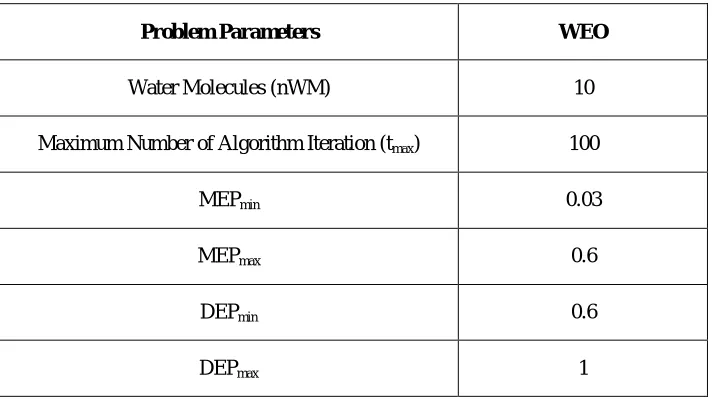
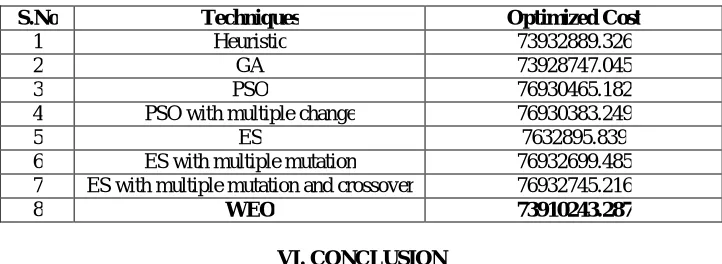
In this case, the 19-unit system over a planning horizon of 25 weeks is considered. The WEO algorithm parameters for all test systems are shown in Table 5.1.The simulation is performed for 100 trials and the obtained results for 19-unit system over 25 weeks planning horizon is presented in Table 5.2. The system particulars are presented in [12]. The optimized cost obtained by the proposed as well as existing algorithm is presented in Table 5.3. From the simulation results it is clear that the proposed algorithm obtained the better results than existing algorithms with satisfying system constraints.
TABLE 5.1 PROBLEM PARAMETERS OF WEO
Problem Parameters WEO
Water Molecules (nWM) 10 Maximum Number of Algorithm Iteration (tmax) 100
MEPmin 0.03
MEPmax 0.6
DEPmin 0.6
DEPmax 1
TABLE 5.2 SIMULATION RESULTS OF 19 GENERATING UNIT SYSTEM
Maintenance Period
Generating units index of scheduled maintenance
weeks 1 2 3 4 5 6 7 8 9 10 11 12 13 14 15 16 17 18 19
14 1 1 1 1 1 1 1 1 1 0 1 1 0 1 1 1 1 1 1 15 1 1 1 0 1 1 1 1 1 1 1 1 1 1 1 1 1 1 1 16 1 1 1 1 1 1 1 1 1 1 0 1 1 1 1 1 1 1 0 17 1 0 1 1 1 1 1 1 1 1 1 1 1 1 1 1 1 1 1 18 1 1 1 1 0 1 1 1 1 1 1 1 0 1 1 1 1 1 1 19 1 1 1 1 1 1 1 1 1 1 1 0 1 1 1 1 1 1 1 20 1 1 1 1 1 1 1 1 1 1 1 1 1 1 1 1 1 1 1 21 1 1 0 1 1 1 1 1 0 1 1 1 1 1 1 1 1 1 1 22 1 1 1 1 1 1 1 1 1 1 1 1 1 0 1 1 1 0 1 23 1 1 1 1 1 1 1 1 1 0 1 1 1 1 1 1 1 1 0 24 1 1 1 1 1 1 1 1 1 1 1 1 1 1 1 1 1 1 1 25 1 1 1 1 1 1 1 1 1 1 1 1 1 1 1 1 1 1 1
TABLE 5.3 OPTIMIZED COST OF 19 GENERATING UNIT SYSTEM
S.No Techniques Optimized Cost
1 Heuristic 73932889.326 2 GA 73928747.045 3 PSO 76930465.182 4 PSO with multiple change 76930383.249 5 ES 7632895.839 6 ES with multiple mutation 76932699.485 7 ES with multiple mutation and crossover 76932745.216
8 WEO 73910243.287
VI. CONCLUSION
The problem of generating optimal maintenance schedules of generating units for the purpose of maximizing economic benefits and improving reliable operation of a power system, subject to satisfying system constraints. In this paper, Water Evaporation Optimization (WEO) algorithm is proposed to solve a challenging power system optimization problem of generating unit maintenance schedule. The proposed algorithm uses global search and local search to select the maintenance units schedule and give the economic schedule. This new algorithm produces better results than the existing methods in addition to satisfaction of the system constraints. From the results, it is clear that the proposed method provides the quality solution with low cost and has a potential for on-line implementation.
REFERENCES
[1] A. J. Wood and B. F. Wollenberg, Power generation operation and control, New York: John Wiley & Sons, 1996.
[2] R. Mukerji, H. M. Merrill, B. W. Erickson and J. H. Parker, “Power plant maintenance scheduling: Optimizing economics and reliability”,
IEEE Trans. Power Systems, vol. 6, pp. 476-483, May 1991.
[3] T. Satoh and K. Nara, “Maintenance scheduling by using simulated annealing method”, IEEE Trans. Power Systems, vol. 6, pp. 850-857, May 1991.
[4] Y. Wang and E. Handschin, “A new genetic algorithm for preventive unit maintenance scheduling of power systems”, Electrical Power Energy Syst., vol. 22, pp. 343-348, 2000.
[5] S. Ibrahim El-Amin, Duffuaa and M. Abbas, “A Tabu search algorithm for maintenance scheduling of generating units”, Electric Power Syst. Res, vol. 54, pp. 91- 99, 2000.
[6] K. Y. Huang and H. T. Yang, “Effective algorithm for handling constraints in generator maintenance scheduling”, IEE Proc. Generation, Transmission and Distribution, vol. 149, pp. 274-282, May 2002.
[7] K. P. Dahal and N. Chakpitak, “Generator maintenance scheduling in power systems using metaheuristic-based hybrid approaches”, Electric Power Syst. Res, vol. 77, pp. 771-779, 2007.
[9] Andrija Volkanovski, Borut Mavko, Tome Boševski, Anton Čauševski, and Marko Čepin, “Genetic algorithm optimization of the
maintenance scheduling of generating units in a power system”, Reliability Eng. Syst. Safety, vol. 93, pp. 757-767, 2008.
[10] Salvador Perez Canto, “Application of Benders’ decomposition to power plant preventive maintenance scheduling”, Europ. J. Oper. Res, vol. 184, pp. 759-777, 2008.
[11] Y. Yare and G. K. Venayagamoorthy, “Optimal-maintenance scheduling of generators using multiple swarms-MDPSO framework”, Engg. App. Artifi. Intelligence, vol. 23, pp. 895-910, 2010.
[12] Suraj Kumhar and Mantosh Kumar, “Generator maintenance scheduling of power system using hybrid technique”, International Res. J. Engg and Tech, vol. 03, No. 02, pp. 418-423, 2016.