Abstract
Singh, Harmanpreet. Developing an e-learning Model for an Industrial Enterprise. (Under the guidance of Dr. Laurie Ann Williams)
Until recently, not much effort has been spent on developing e-learning courses with the intention of reuse. Generally, e-learning content developers have not used specifications or standards. As a result, every time a course needed to be developed, the course was started from scratch, even if the contents were quite similar to previously developed courses. This obviously wastes much time and effort and is inherently an inefficient technique. By the introduction of a fairly new concept of learning objects, developing and organizing learning/instructional content into small modules has enabled more organized development. Learning objects are logically demarcated units of content having at least one learning objective. They are independent of other learning objects and communicate their learning objective. Dividing the content into such learning objects and describing them through standard meta-data can make them highly reusable and portable.
Biography
Acknowledgements
There have been a lot of people who have supported me during this study. I would first like to thank my advisor Dr. Laurie Williams who trusted me and let me do work in a field that is not yet a part of much academic research. She guided me with her keen insight that helped me all the way. I would also like to thank Dr. Aldo Dagnino and Dr. Wilbur Meier who gave me the opportunity to work on the e-learning project and provided me all the resources to accomplish my goal. They helped arrange for most of the meetings with the key people involved in the study which otherwise would not have been possible. I would also like to thank my committee member, Dr. Tom Miller.
Table of Contents
List of Tables………..(vi)
List of Figures………(vii)
Acronyms………...(viii)
1 Background... 1
1.1 Introduction to e-learning ... 1
1.2 Learning objects ... 4
1.3 Learning Object Meta-data ... 6
1.4 Assets... 6
1.5 Learning Management System ... 7
1.6 Specifications and Industry Standards ... 7
1.6.1 AICC... 7
1.6.2 IMS meta-data specification ... 8
1.6.3 SCORM ... 8
1.7 Putting the pieces together: How learning objects work... 9
1.8 Research motivation and direction... 11
2 E-learning Model for an Industrial Enterprise... 13
2.1 Introduction... 13
2.2 Problem Definition ... 13
2.3 How the model was reached... 15
2.4 Elements of the model... 16
2.4.1 Instructional Design Strategy ... 16
2.4.2 Creating ALOs and CLOs ... 17
As it can be seen in Tables 2.2 through 2.4, the total number of unique ALOs created were 17:... 22
7 new ALOs for category 1... 22
2.4.3 Creating Assets ... 22
2.4.4 Job-Skills-ALO Map ... 22
2.4.5 SCORM Compliance and Customization ... 24
2.5 Summary of the e-learning model... 29
3.1 Amount of reuse... 30
3.1.1 Asset level reuse ... 30
3.1.2 SCO level reuse ... 32
3.2 E-learning Project Costs ... 34
3.3 Different skills involved in an e-learning project ... 41
3.4 Typical cost values used in E-learning Industry... 42
3.5 Comparing costs... 43
4 Conclusions
and
Future Research... 50
5 References ... 51
6 Appendices... 53
6.1 Appendix A: ... 54
6.2 Appendix B: Glossary... 55
6.3 Appendix C: Sharable Content Object Reference Model (SCORM) Version 1.2 ... 57
6.3.1 Introduction ... 57
6.3.2 The SCORM Content Aggregation Model ... 58
6.3.3 The SCORM Meta-data Information Model... 59
6.3.4 Content Packaging... 60
6.3.5 The SCORM Run-Time Environment... 60
6.4 Appendix D: Modified SCORM version 1.2 meta-data tags table for the e-learning model ... 62
6.5 Sample XML meta-data file ... 65
6.6 Flowchart explaining e-learning model behavior ... 68
List of Tables
1. Table 1: Acronym Listing………(viii)
2. Table 1.1: Typical costs of asynchronous e-learning course by Bates………..4
3.
Table 2.1: Three Categories of Personnel………184. Table 2.2: ALOs for Top managers……….18
5. Table 2.3: ALOs for Middle-Managers………...19
6. Table 2.4: ALOs for Engineers………20
7. Table 2.5: List of customized SCORM 1.2 meta-data tags……….28
8. Table 3.1: Skills and costs associated with an e-learning project………41
9. Table 3.2: Time spent by different types of personnel on e-learning project………..42
10. Table3.3: Time duration for topic 1………43
11.Table3.3: Time duration for topic 2………44
12.Table3.3: Time duration for topic 3………44
13.Table3.3: Time duration for topic 4………44
14.Table3.3: Time duration for topic 5………45
15.Table3.3: Time duration for topic 6………45
16.Table3.10: Distribution of time for static e-learning course………47
17.Table3.1l: Distribution of time for LO based e-learning course………..48
18. Table 6.1: ABB Manufacturing training needs table………..54
List of Figures
1. Figure1.1: How learning objects work………10
2. Figure 2.1: Different categories of employees base in their technical levels……...14
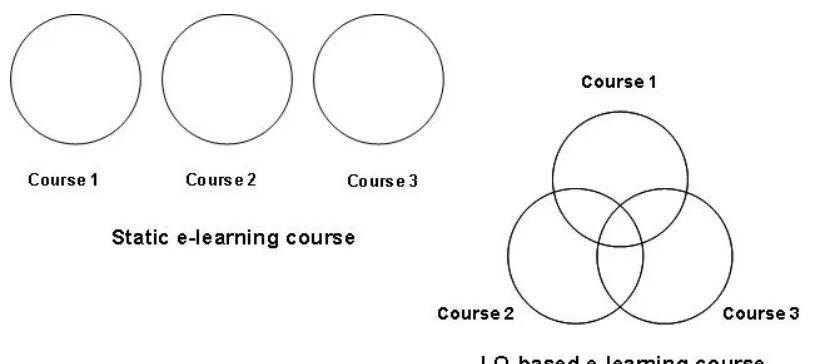
3. Figure 2.2: Effort for creating e-learning course with and without LOs……….14
4. Figure 2.3: Logical layout of ALOs……….21
5. Figure 2.4: Job-Skills-ALO database structure representation………23
6. Figure 2.5: Different layers (elements) of the e-learning model……….29
7. Figure 3.1: Cost model to estimate the difference in e-learning project costs………40
8. Figure 1: Asset Examples………58
9. Figure 2: Flowchart explaining system behavior……….68
10. Figure3: Screen shot describing how the Los are stored...……….69
11. Figure4: Screen shot showing an animation asset……. ………70
12. Figure5: Screen shot showing an ALO at work………. ………70
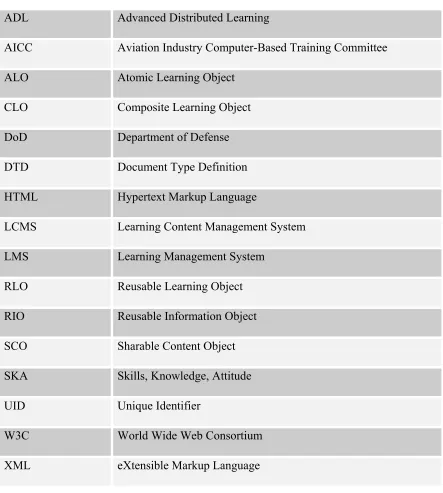
Acronym Listing
Table 1: Acronym Listing
ADL Advanced Distributed Learning
AICC Aviation Industry Computer-Based Training Committee
ALO Atomic Learning Object
CLO Composite Learning Object
DoD Department of Defense
DTD Document Type Definition
HTML Hypertext Markup Language
LCMS Learning Content Management System
LMS Learning Management System
RLO Reusable Learning Object
RIO Reusable Information Object
SCO Sharable Content Object
SKA Skills, Knowledge, Attitude
UID Unique Identifier
W3C World Wide Web Consortium
1
Background
This chapter walks through the concept of e-learning and the progress that has been made in this field. It explains different techniques used in e-learning, various concepts introduced in the industry and where learning stands today. It also discusses the e-learning standards being proposed and developed by government and other private organizations.
1.1 Introduction to e-learning
The only thing that gives an organization a competitive edge... is what it
knows, how it uses what it knows, and how fast it can know something
new.
`Laurance Prusak, IBM [1]
obviating the need for the course. Further, classroom training requires a physical location (a presentation room), not more than a limited number of learners, and a set of resources like projectors and assistants before it can be conducted. Learners and instructors may need to travel to attend the course. All this adds to the overhead of the classroom-based environments.
E-learning can demonstrate improvement and cost savings when compared with classroom training. Rosenberg defines e-learning: “E-learning refers to the use of Internet technologies to deliver a broad array of solutions that enhance knowledge and performance.” [1] As John Chambers, CEO of Cisco Systems puts it, “The two great equalizers in life are the Internet and Education.” Using the power and the reach of the Internet, e-learning has the potential to revolutionize the structure of learning. Additionally, shorter development times and the once-developed-use-anywhere attributes of e-learning cut the cost of development and the delivery time. [1]
There are two basic types of e-learning methodologies:
Synchronous e-learning
:
Learning is mainly under the guidance of an instructor, although students and the instructor might be geographically dispersed. Students have a predetermined time for such type of learning (e.g. video conferencing, web seminars etc.)Asynchronous e-learning
:
A learner can take the course at anytime and anywhere he/she has access to the Internet. Interaction between teachers and students occurs intermittently with a time delay.1. Lower cost: Although E-learning introduces new types of costs, the economies of scale come into play and with large number of students taking these courses, once developed-use-anywhere attribute of e-learning can save costs. “E-learning eliminates costs by allowing a specialist in Sacramento to train an entire group in Singapore without leaving the office” [12]
2. Up-to-date content: easier to update content as it resides at one centralized location. 3. Courses are available at anytime and anywhere the Internet is accessible.
4. Consistency of courses is maintained for all users: Because all users are taking only one common version of the course, consistency is maintained.
e-Learning also provides consistent training across an organization.
While different instructors have different approaches to teaching a
particular topic and present training of varying quality, giving students
access to e-learning ensures training is consistent from student to student.
[13]
5. Scalability in terms of number of users: Asynchronous e-learning is not restricted by the number of users learning the course at any given time.
Current state-of-the-practice methods of developing asynchronous e-learning have their own drawbacks:
1. No common standards for creating content: Authors create asynchronous e-learning courses, but they do not follow any common standard for developing and deploying courses so as to make them portable.
It makes no financial sense to spend millions of dollars producing multiple
versions of similar learning objects when single versions of the same
objects could be shared at a much lower cost per institution. [9]
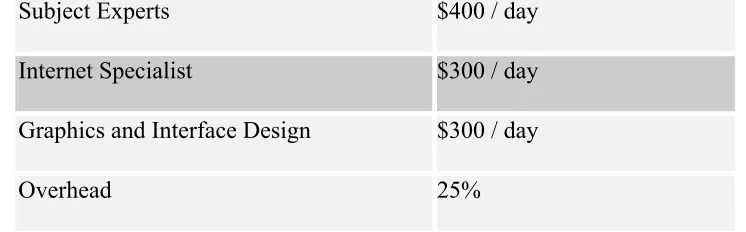
There are various skills and tools required to develop asynchronous e-learning courses that vary in costs. Typical costs in an asynchronous e-learning course, adapted from Bates [8] are listed below:
Table 1.1: Typical costs of asynchronous e-learning course by Bates
Subject Experts $400 / day
Internet Specialist $300 / day
Graphics and Interface Design $300 / day
Overhead 25%
Bates is quite conservative in estimating the costs. Nonetheless, if reuse can cut the above costs, it cannot be ignored. The new concept of learning objects has shown the possibility of revolutionizing the asynchronous e-learning industry by addressing the issues of cost, reusability and interoperability. [2]
1.2 Learning objects
entity, digital or non-digital, which can be used, re-used or referenced during technology supported learning.” [18]
In other words, a LO is a reusable instructional module deliverable through technology-supported learning. For this study, we keep the scope of deliverable technology to be only the Internet. A LO refers to a learning resource which has at least one learning objective. A LO can be a single page of text, a graphic, animation, simulation or an audio/video element with some learning objective. Alternatively, a LO can be a composition of other learning objects. For example, a LO can be a topic explaining “How to identify various parts of the car engine” or a LO could be a complete course named “Designing a car engine from scratch” which encompasses the first LO. It is to be noted that the size of both these objects could vary remarkably. Ideally, the LOs are away from the context in which they are being used. That means that they are created with a general learning objective in mind rather than for a single learning scenario.
1.3 Learning Object Meta-data
Markup languages like XML are becoming universal for data information exchange over the web. XML tags can be used to describe information. The description of information could be a specification of the type of information, its origin, its possible use, and so forth. This same technique is applied to describe LOs and thus is called learning object meta-data. “Meta-data is used to describe what the object contains, much like a label lists the ingredients and nutritional value of a box of cereal.”[7].
Meta-data is what makes the LOs reusable. An LO described with a specific meta-data can be easily searched and reused by somebody else who understands that meta-data. Thus, a standard meta-data scheme can make LOs reusable and interoperable. Cisco’s RLO strategy defines the meta-data as “RLO is tagged with meta-data that describes reusable learning object’s function and associated objects.” [6] Some of the tags defined by reusable learning object strategy are that of title, objective, strand, job task, author name and creation date.
1.4 Assets
parts of the car engine.” The image doesn’t help accomplish any learning objective all by itself but can be used in the LO to serve its (LO’s) purpose.
1.5 Learning Management System
A learning management system (LMS) is software that runs synchronous or asynchronous e-learning courses, manages users, their performance etc. Brennan et.al. define an LMS as: “An LMS takes a centralized, organizational approach to learning in that it schedules and registers students for full online and offline courses, launches e-learning courses, and tracks learner progress through these courses.” [7] An LMS is a database driven software package that takes care of the administrative tasks such as keeping
records related to learners as well as LOs.
1.6 Specifications and Industry Standards
The issue of standards arises from the need for interoperability of learning content. Two different organizations cannot use the same LOs if there is no common understanding of the information about how they are to be used. If one organization uses its own type of meta-data tags for its LOs, there is no way that another organization can use them. Many government and private organizations have tried to come up with suggestions and specifications. Some of them are listed below:
1.6.1 AICC
meta-tagging and in reusing LOs. Although their work was a good contribution to the industry, their specifications are not as widely spread as that of other organizations like IMS Global Consortium and Advanced Distributed Learning (ADL).
1.6.2 IMS meta-data specification
IMS Global Learning Consortium, Inc. (IMS) is a global consortium with members from educational, commercial, and government organizations. IMS develops and promotes open specifications for facilitating online distributed learning activities such as locating and using educational content, tracking learner progress, reporting learner performance, and exchanging student records between administrative systems [5]. It defines meta-data tagging of LOs and content packaging specifications so that content is identifiable and interoperable.
1.6.3 SCORM
Sharable Content Object Reference Model (SCORM) was started by the Department of Defense (DoD) and the White House Office of Science and Technology Policy (OSTP) and the initiative of Advanced Distributed Learning (ADL) [3]. “SCORM defines a Web-based learning Content Aggregation Model and Run-time Environment for learning objects” [2]. SCORM borrows and then modifies some of the technology developments from other standards organizations like:
1. AICC: Aviation Industry Computer-Based Training Committee 2. IMS: IMS Global Learning Consortium
4. ARIADNE: Alliance of Remote Instructional Authoring and Distribution Networks for Europe.
SCORM adds some of its own concepts and provides a specification which helps the content developers as well as the Learning Management System (LMS) vendors to develop an end product. Because SCORM is one of the most popular standards in the industry, we used SCORM version 1.2 for this study.
1.7 Putting the pieces together: How learning objects work
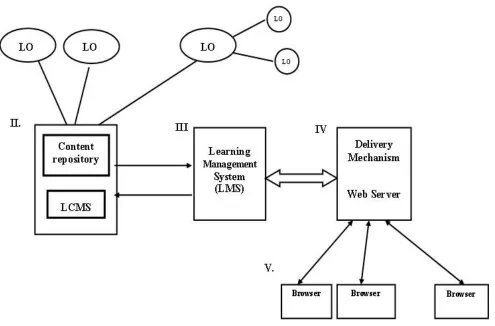
Figure1.1: How learning objects work
develop courses. The meta-data helps in easy and precise identification of the learning objects in the repository. The LMS controls the runtime environment of the system. It manages tasks like maintaining user profiles, tracking user input, and reporting results. The interface of the course (assembled from LOs) with the learner is through a Web browser served by a Web Server.
1.8 Research motivation and direction
The concept of the LO has been around since 1998, based on the work done by Spohrer and his associates on educational object economies [20]. There have been specifications for creating LO based courses for more than a year since the release of SCORM 1.1 (January 2001). However, hitherto there is no documented results of deploying a SCORM-based e-learning model that incorporates a sound instructional design strategy and a system of linking employees’ skills to LOs. One of the reasons for the lack of widespread interest in LO based e-learning model is that there are not many studies showing significant cost savings with LOs. Another reason involves the risk of investing in new technology and setting up a whole new infrastructure. This study focuses on developing a LO based, SCORM compliant model. To be more precise, this study examines the following hypotheses:
An e-learning model can be developed which both achieves its instructional design requirements and conforms to industry standards.
Utilizing an LO-based learning model can reduce project costs and make e-learning more affordable for organizations.
Creating a course based on LOs, meta-tagging the LOs to create SCORM-specific SCOs and meeting the instructional design requirements of the enterprise
Testing for SCORM compatibility Measuring reuse of content
2
E-learning Model for an Industrial Enterprise
This chapter first describes the training needs of the organization and the creation of a LO-based e-learning model specific to those needs. The model modifies some of the SCORM 1.2 meta-data tags for customization while conforming to SCORM 1.2. Two new concepts, Atomic Learning ObjectSM (ALOSM) and Composite Learning ObjectsSM (CLOSM) that were created through this research will be explained. The various elements of the model are then explained. Finally, the four levels of the SCORM-based e-learning model are graphically depicted.
2.1 Introduction
As a part of this study, a course was to be created, employing the theory of LOs which enabled content reuse. The course also had to be SCORM 1.2 compliant so that it was capable of deployment virtually over any given SCORM 1.2 compliant LMS. The experience was then used to develop the e-learning model.
2.2 Problem Definition
Figure 2.1: Three different kinds of employees with different technical levels
A traditional e-learning course development technique would develop three “hardwired”, non-portable courses for each type of learner. But there was overlapping learning content among these three categories of personnel. The question was, could we reuse the content developed? Theoretically, it was possible. We did not need to have three entirely distinct courses but instead, three different courses with some overlapping “topics”. This is where the concept of a “learning object” steps in.
2.3 How the model was reached
Two steps of this study were:
1. To develop an e-learning model that was very specific to the enterprise’s needs i.e. solving the problem defined.
2. To make the course industry standards compliant vis-à-vis SCORM. The latest version of SCORM available was SCORM version 1.2 released on October 1st 2001 [2]
First, scope of the LOs had to be very specific. Recalling from section 1.2, the definition of a LO is does not really specify the size of an LO. It does not specify the number of learning objectives an LO has. It simply says that an LO is a “chunk” of learning that has one or more learning objectives. For this study, the LO concept was further subdivided into two more precise definitions:
ALOSM: “Atomic Learning Object” refers to a learning resource, which has one and only one learning objective, for example, a topic inside a chapter which does not have more sub-topics. An ALO cannot be broken down further to get more ALOs.
CLOSM: “Composite Learning Object” is a collection of two or more ALOs and/or other CLOs. As an example, a chapter with several topics (ALOs) can be considered as a CLO. Another example could be a course consisting of chapters (CLOs) which further consists of Topics (ALOs).
2.4 Elements of the model
This section describes how the e-learning model was approached, step by step, considering the various needs of the organization. The various tasks to accomplish our first step (develop an e-learning model that was very specific to the enterprise’s needs) were identified as:
o Determine instructional design to be used
o Determine CLOs & ALOs to be created.
o Determine assets to be developed.
o Link ALOs with the job positions.
o Make ALOs and CLOs SCORM compliant but still customized to the instructional design used.
2.4.1 Instructional Design Strategy
Instructional Design is a branch of knowledge that deals with research and theory about instructional strategies and the process for developing and implementing those strategies. Instructional Design is the systematic development of instructional specifications using learning and instructional theory to ensure the quality of instruction. It is the entire process of analysis of learning needs and goals and the development of a delivery system to meet those needs. It includes development of instructional materials and activities; and tryout and evaluation of all instruction and learner activities. [17] A fairly basic but powerful instructional design strategy of pre-test, content, and assessment was used. These elements are explained further.
observed by Jerrold E. Kemp et al. “Pretests heightens the learner's awareness of the content by serving as cues to the key points.” [11]
2. Content: The piece of instruction (ALO/CLO) that the learner is exposed to. It has the following sub-elements:
Overview Objectives Subject matter
3. Assessment: A quiz that the learner takes to demonstrate the skills learnt from the content.
For creating ALOs, authors must answer the following four questions: 1. What is the topic?
2. Does this set of instructional information (content) describe the topic completely? 3. What are the objectives of the topic?
4. Does it have any dependencies?
Note: Dependencies are different from prerequisites. There should be no dependencies within the ALO. E.g. if there are two ALOs in a chapter, and an example is used to explain one ALO, then by definition, the second ALO cannot refer to the example used in the first ALO.
2.4.2 Creating ALOs and CLOs
kind of employee listed in the table was equally technically competent (e.g. there were managers as well as engineers that need to acquire similar skills but with different levels of technical background). This gave us another reason to further demarcate ALOs. Table 2.1 lists the categories of personnel for which the ALOs were produced:
Table 2.1: Three Categories of Personnel
Category # Category Name Description
1. Top-Managers BA-Division Management
2. Middle-Managers BAU-Management
Engineers and supervisors
3. Engineers
Production Associates
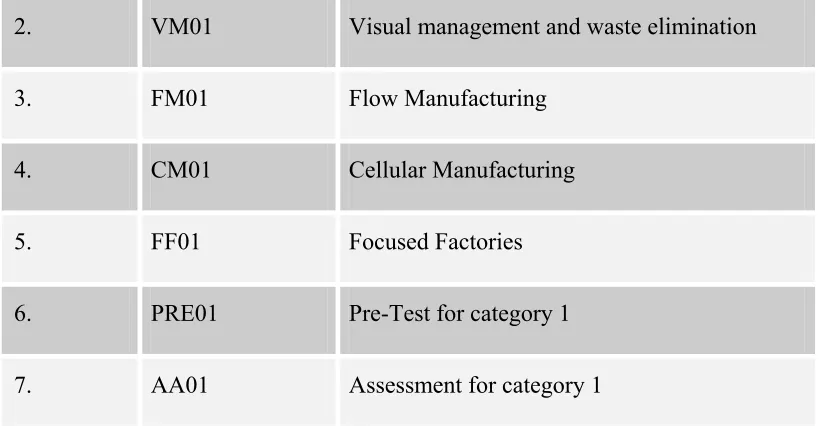
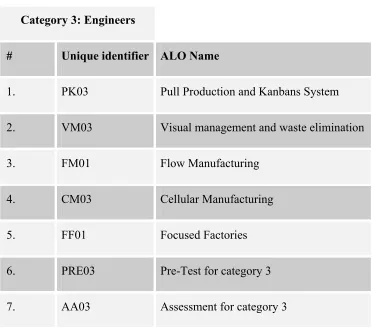
Once the personnel were categorized and the list of topics had been made, the ALOs were produced, one ALO for each topic for each category. Table 2.2 through Table 2.4 lists the ALOs that were produced:
Table 2.2: ALOs for Top managers
Category 1: Top-Managers
Category # Unique identifier ALO Name
2. VM01 Visual management and waste elimination
3. FM01 Flow Manufacturing
4. CM01 Cellular Manufacturing
5. FF01 Focused Factories
6. PRE01 Pre-Test for category 1
7. AA01 Assessment for category 1
Table 2.3: ALOs for Middle-Managers
Category 2: Middle-Managers
# Unique identifier ALO Name
1. PK02 Pull Production and Kanbans System
2. VM02 Visual Management and Waste Elimination
3. FM01 Flow Manufacturing
4. CM02 Cellular Manufacturing
5. FF01 Focused Factories
6. PRE02 Pre-Test for category 2
Table 2.4: ALOs for Engineers
Category 3: Engineers
# Unique identifier ALO Name
1. PK03 Pull Production and Kanbans System
2. VM03 Visual management and waste elimination
3. FM01 Flow Manufacturing
4. CM03 Cellular Manufacturing
5. FF01 Focused Factories
6. PRE03 Pre-Test for category 3
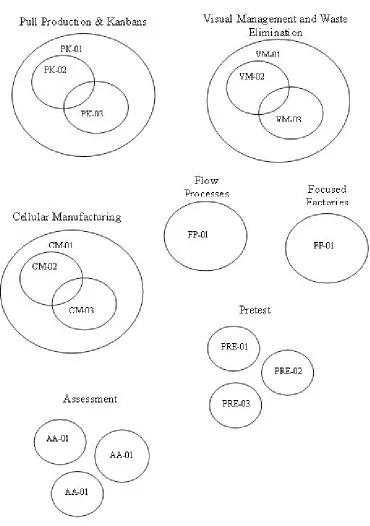
Figure 2.3: Logical layout of ALOs
As it can be seen in Tables 2.2 through 2.4, the total number of unique ALOs created were 17:
7 new ALOs for category 1
5 new ALOs for category 2 (ALOs FM01 and FF01 were reused) 5 new ALOs for category 3 (ALOs FM01 and FF01 were reused)
2.4.3 Creating Assets
As described in section 1.4, assets are simply the raw media in the digital form wrapped with meta-data. Assets include but are not limited to video, audio, image or animation files. SCORM compliant meta-data around assets makes them reusable too. For the case study of creating the course, a number of assets were created that were capable of being stored in a content repository. They were image and animation files wrapped with SCORM meta-data. These assets were reused in the course development at different levels. The next chapter studies the amount of asset reuse in detail.
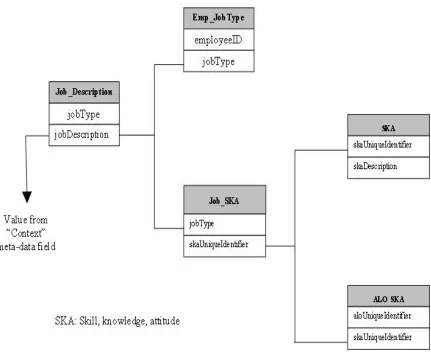
2.4.4 Job-Skills-ALO Map
Figure 2.4: Job-Skills-ALO database structure representation
Explanation of database elements in figure 2.4:
JobType: This is the value from the meta-data tag name called “Context”. SCORM Compliance and Customizatiom discusses about this element.
i. Top-Managers ii. Middle-Managers iii. Engineers
skaUniqueIdentifier: A unique Identifier for each skill listed skaDescription: Description of each skill.
aloUniqueIdentifier: Unique identifier of each ALO (which is the unique identifier of the SCO). SCORM meta-data tag used:
empId: Each employee’s unique Identification number in the company
2.4.5 SCORM Compliance and Customization
As for the first step of the research, that all content should be SCORM 1.2 compliant, assets and the ALOs created were validated through SCORM 1.2 Content Aggregation schema [2] and passed the SCORM “Meta-Data Conformance Test” [14].
was a new schema. We call it the “E-learning model schema.” Any content that had to conform to the e-learning model now had to be validated through two schemas:
1. SCORM 1.2 Content Aggregation schema
2. E-learning model. schema (see Appendix E: Schema and XML files for more details)
The assets and ALOs developed for the study were validated through both the schemas. The validation of all content (assets/ALOs/CLOs) positively tests the first hypothesis explained in section 1.8. The model now encompasses the requirements of the enterprise as well as complies with SCORM 1.2.
The Details of the meta-data tags that were made mandatory in SCORM 1.2 Content Aggregation schema are described below. These elements were optional for SCORM 1.2 Content Aggregation schema but are now mandatory for “E-learning model schema.” A table with a complete listing of all tags in both the schemas can be seen in Appendix D.
I. Meta-data tag name in SCORM 1.2 Content Aggregation: Learning Resource
Type
Location in SCORM 1.2 Content Aggregation schema: lom > educational > learningresourcetype
Occurance in SCORM Content Aggregation schema: 0 or more
Description in SCORM: Specific kind of resource, most dominant kind first.
1. “Pretest” 2. “Content” 3. “Assessment”
Description in e-learning model: The new vocabulary makes this tag mandatory for the e-learning model. This value can be used by the LMS to know whether this ALO is a pretest, content or an assessment module. Based on this value, the LMS can make a decision or can invoke a subroutine.
Occurence in e-learning model: 1 or more (mandatory)
II. Meta-data tag name in SCORM 1.2 Content Aggregation: Context
Location in SCORM 1.2 Content Aggregation schema: lom > educational > context
OccuranceOccurrence in SCORM 1.2 Content Aggregation schema: 0 or more
Description in SCORM: The principal environment within which the learning and use of this resource is intended to take place.
Added vocabulary for e-learning model: 1. “Technical Level One”
2. “Technical Level Two” 3. “Technical Level Three”
know as to which category this ALO belongs to. The three categories defined by the e-learning model were:
1. Top-managers 2. Middle-managers 3. Engineers
Based on this value, the LMS can make a decision or can invoke a subroutine.
Occurence in e-learning model: 1 or more (mandatory)
III. Meta-data tag name in SCORM 1.2 Content Aggregation: Relation
Location in SCORM 1.2 Content Aggregation schema: lom> relation Occurance in SCORM 1.2 Content Aggregation schema: 0 or more
Description in SCORM: Nature of the relationship between this resource and the target resource, identified by 7.2: Relation.Resources.
Added vocabulary for e-learning model:
1. “HasPretest”: Means that the specific ALO with this value has a pretest.
2. “IsPretestFor”: Means that the specific ALO with this value is a pretest ALO for another ALO.
3. “HasNoPretest”: Means that the specific ALO with this value has no pretest ALO at all.
5. “IsAssessmentFor”: Means that the specific ALO with this value is an Assessment ALO for another ALO.
6. “HasNoAssessment”: Means that the specific ALO with this value has no assessment ALO.
7. “IsNeutral”: Means that the specific ALO with this value no pretest or assessment ALOs.
Description in e-learning model: The new vocabulary makes this tag mandatory for the e-learning model. This value can be used by the LMS to run the pretest, if any, associated with a resource. Based on this value, the LMS can make a decision or can invoke a subroutine.
Occurance in e-learning model: 1 or more.
Following table summarizes the customization that was done to SCORM:
Table 2.5: List of customized SCORM 1.2 meta-data tags
S.No. Location in SCORM
1.2 Content
Aggregation Model
Name given by SCORM
1.2 Content Aggregation
Model
Content
Aggregation
SCO Asset
1. 5.2 learningresourcetype O (M) O (M) O
2. 5.6 Context O (M) O (M) O
3. 7.0 Relation O (M) O (M) O
O Optional
SCORM 1.2 tags
Appendix D lists the table with all the meta-data of SCORM Content Aggregation Model given by SCORM 1.2
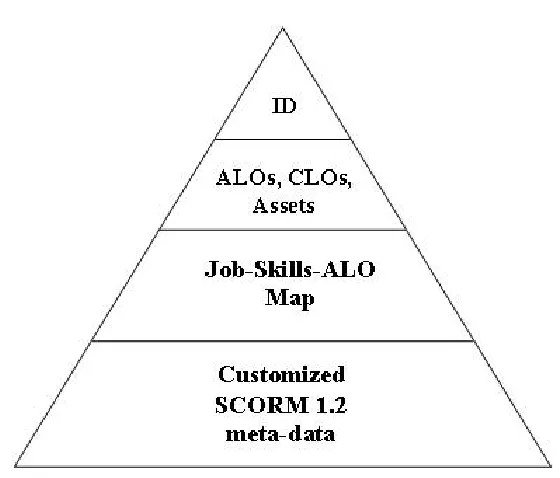
2.5 Summary of the e-learning model
Figure 2.5: Different layers (elements) of the e-learning model
map created. Layers one, two and three are independent of each other and layer four depends on all the three layers above. The e-learning model thus created proves the first hypothesis of this study to be true. There now exists an e-learning model that is customized to an enterprise’s needs and still being SCORM 1.2 compliant.
3
Reuse and E-learning Project Costs
This chapter analyzes the total e-learning project costs using cost metrics. The amount of reuse is calculated and the difference of cost between a static e-elarning project and an LO-based e-learning project. The discussion assumes that there is an infrastructure for e-learning already available inside the organization.
3.1 Amount of reuse
First, the percentage of reuse was calculated in the development of the sample course. In our case study, all the SCOs (meta-tagged ALOs) needed to be created; none could be reused from pre-existing ones because these were the first LO-based courses in this particular organization. As a result, the findings are conservative because over time organizations that are commited to creating and storing ALOs can develop an impressive repository of ALOs that can be reused.
3.1.1 Asset level reuse
Asset level reuse is the reuse of assets when the course was developed. For this study we used a term called
AssetType “X” = Type of asset X; where X could be video, audio, animation, simulation, image etc.
NTAsset = Total number of assets (new + modified + reused without modification) FModifyA[i] = Asset Modification Factor. Here A[i] denotes a specific asset as if they are stored as an array of assets. It is a measure of the amount of modification before it can be reused as an appropriate asset. Its value lies between 0 and 1.
Mathematically,
FModifyA[i] =
100
1
−
Percentage
OfAssetMod
ification
PercentageOfAssetModification is the percentage of modification in terms of development time required before it can be reused as an appropriate asset. The value of this factor is determined by the asset developer.
If FModifyA[i] = 0, the AssetType has to be re-created from scratch.
If FModifyA[i] = 1, the AssetType does not need any modification and can be reused as is.
If 0 < FModifyA[i] < 1, the higher the value of. FModifyA[i], the less the modification required.
We examined the asset reuse in our case study. Total number of = 6
new assets developed from scratch
Number of assets used to create course for: Category 1 course = 6
Total number of assets = 0 reused after modification
Therefore # of assets reused with or without modification:
NAssetReuse =
∑
=
×
n i i ModifyA i NewAF
N
1 ] [ ] [)
(
Where NNewAsset[i] = New or modified Asset A[i], e.g audio[1], video[3]
Equation 3.1
etc. E.g. If for creating some course (other than in our case study) there were 5 total assets. One audio was reused that required 50% modification, another audio that required 20% modification, a video that required 75% modification, and one animation that was reused without any modification
NAssetReuse = (0.5 + 0.8 + 0.25 +1)
= 2.55
In the case study, there was no partial reuse (modification of assets) observed, therefore FModifyA[i] = 1 for each asset..
NAssetReuse = 14 – 6 = 8
Asset level reuse reuse =
) (N used assets of # Total ) (N reused assets of # Total TAsset AssetReuse = 14 8
= 57.1%
3.1.2 SCO level reuse
NTSCO = Total number of SCOs (new + modified + reused without modification) FModifySCO[j] = SCO Modification Factor. It is a measure of the amount of modification. Its value lies between 0 and 1.
Mathematically,
FModifySCO[j] =
100
1
−
Percentage
OfSCOModif
ication
PercentageOfSCOModification is the percentage of modification in terms of development that is required in a SCO before it can be reused as an appropriate SCO. This can be determined by the author and the media developers.
If FModifySCO[j] = 0, the SCO has to be re-created from scratch.
If FModifySCO[j] = 1, the SCO does not need any modification and can be reused as it is. If 0 < FModifySCO[j] < 1, the higher the value of. FModifySCO[j], the less modification required.
We examine the SCO reuse of our case study. In our case study there was no partial reuse (modification of SCOs) observed, so FModifySCO[j] = 1 for all SCOs.
Let NNMSCO = Total number of new SCOs + Total number of modified SCOs In our case study:
SCOs required to build each course (Category 1, 2, and 3) = 7/course or 21 total. Number of new SCOs developed from scratch (i.e. FModifySCO = 0) to create course for:
Category 1 = 7
developed from scratch Total SCOs modified = 0 for reuse
Therefore # of SCOs reused (with or without modification) =
NSCOReuse =
∑
=
×
m i j ModifySCO j NewSCOF
N
1 ] [ ] [)
(
Where NNewSCO[j] = New or modified SCO e.g. SCO[1], SCO [5] etc.
Equation 3.2
In our case study, we did not modify any SCO, NSCOReuse = 21 – 17
= 4
Percentage of reuse =
) (N used SCOs of # Total ) (N reused SCOs of # Total TSCO SCOReuse = 21 4
= 19%
Considering that there was no off-the-shelf (or a pre-existing SCO repository) available, the SCO level reuse is quite significant.
3.2 E-learning Project Costs
calculations, we took one measurable unit (MU) of LO based learning to be an e-learning module that takes 15 minutes of e-learning time to complete.
To calculate the e-learning project costs, the following assumptions were made: 1. There is only one author involved in the development of a course.
2. If assets and SCOs are accessible to the author, they are available free of cost. 3. The only people involved in creating an e-learning course are listed below:
a. Author
b. Instructional designer c. Project Manager d. Web developer(s) e. Media developer (s)
4. The content is measured in terms of ALOs (meta-tagged to form SCOs) and not CLOs.
5. The infrastructure and setup costs for both LO-based and static e-learning projects is assumed to be same.
We concluded,
Cost = f (Time, SkillType)
Where, SkillType = The type of skill required to accomplish a specific task in an e-learning project. E.g. Authoring, Web-development etc.
The cost of the e-learning project is dependent on the type of people involved in the project, the cost for their time, and how much time each spends.
CNewA[i] = Asset development cost for AssetType A[i] (audio, video, etc.) in one MU of e-learning
CNewAsset = Total cost of modifying and creating new assets e.g. audio, video graphics in one MU of e-learning.
CNewAsset =
(
[])
1
i ModifyA n
i
NewA[i]
F
C
×
∑
=
Where A[1] = Asset of AssetType “A”
A[2] = Asset of AssetType “B” etc. n = total number of media elements
CAuthor = Cost of the Author CPM = Project management costs CID = Instructional design costs
CSCO-WD = Web development costs for LO-based learning project for one MU of e-learning
CStatic-WD = Web development costs for static learning project for one MU of e-learning
Note: Due to SCO reuse, we assume CALO-WD will be lower than CStatic-WD. The reason for such an assumption is that the content management systems available for LO-based e-learning projects are equipped with authoring tools that automate some of the web development tasks, thereby reducing the work for web developers.
CAssetSearch = Total costs incurred for searching and retrieving assets for one MU of e-learning
CSCOSearch = Costs incurred for searching and retrieving SCOs. These costs could be significantly high as it involves author’s time which is usually very costly.
CAsset = Total cost of all assets (new + modified + reused) for one MU of e-learning. It can be calculated from
NNMAsset = Total number of new and modified assets FModifyM[i] = Media Modification Factor
CAssetMData = Cost of meta-data tagging new and modified assets = NNMAssets x Cost of meta-data tagging one asset
C
Asset = AssetSearchn i i ModifyA i NewA
AssetMData
C
F
C
C
+
∑
×
+
=1 ] [ ] [
)
(
Similarly for SCOs,
CSCOMData = Total cost of meta-tagging and testing for SCORM 1.2. conformance for all SCOs in one MU of e-learning
CSCO = Cost of all (new + modified + reused) SCOs. It can be calculated from
NNM-SCO = Total number of new and modified SCOs FModifySCO[j] = SCO Modification Factor
CNewSCO[j] = Development cost for SCO [j]
C
SCO = SCOSearchm j j ModifySCO j NewSCO
SCOMData
C
F
C
C
+
∑
×
+
=1 ] [ ] [
)
(
CNewContent = Cost of developing new and modified content in the form of assets and SCOs. It does not include the cost of reusing pre-existing assets and/or SCOs as those costs have been taken into account separately.
NAssetReuse = Number of assets reused for creating the course from new and modified assets developed.
CAssetReuse = Costs saved due to reuse of assets. This can be measured from
NAssetReuse = The Number of assets that are being reused with and without modification.
NTasset = Total Number of assets (new + modified + reused). CNMAsset = Cost of developing new and modified assets. By a simple calculation:
NMAsset TAsset
Re
AssetReuse
C
N
C
=
N
Asset use×
Equation 3.3: Costs saved by Asset reuse
Similarly for SCOs,
CSCOReuse = Costs saved due to reuse of SCOs. This can be measured from
NSCOReuse = The Number of SCOs that are being reused with and without modification in one MU of e-learning.
SCO -NM TSCO
SCOReuse
SCOReuse
C
N
N
C
=
×
Equation 3.4: Costs saved by SCO reuse
CSaveReuse = Costs saved due to reuse of SCOs and Assets
CNewContent = Sum of all costs involved with developing assets and SCOs. = CAsset + CSCO + CAuthor + CPM + CID + CSCO-WD
CLOProject = Total costs of the LO based e-learning project. This is the difference between CSaveReuse and CNewContent
CStaticProject = Total costs of the static e-learning project.
CDifference = Difference in costs between an ALO based e-learning project and static e-learning project.
3.3 Different skills involved in an e-learning project
Table 3.1 Skills and costs associated with an e-learning project
Skill Costs
associated
Presence in LO
based e-learning
project
Presence in static
e-learning project
1. Authoring CAuthor
2. Web development CWD 3. Instructional
designing
CID
CSCOMData 4. Meta-tagging
CAssetMData `
5. Project Management
CPM
6. Media development
CMedia
3.4 Typical cost values used in E-learning Industry
Following is the data from Harvi Singh, the founder of Mindlever. Mindlever is a pioneering e-learning company in RTP, North Carolina. The numbers have not been verified with studies but they have been used for a large number of e-learning projects in the industry. These numbers are used as rule-of-thumb assumptions by most e-learning companies.
For one MU of e-learning (15 minutes of ALO based e-learning content), the total time for development is approximately 65-70 hours The time division among various personnel is listed in Table 3.2
Table 3.2 Time spent by different types of personnel on AL)-based e-learning
project
Type of personnel Time he/she contributes
for 1 MU of e-learning
Author 10 hours
Instructional designer 15 hours
Media Developer 15 hours
Web Developer 15 hours
Meta-tagging costs 2 hours
3.5 Comparing costs
To compare costs of an LO based learning project with a static (non-LO based) e-learning project, we used the numbers from section 3.4, skills-costs adjustment of table 3.1 and the cost estimation formula of figure 3.1.
We now examine the costs of our case study. The costs that were saved by reuse are listed below:
1. Authoring costs due to SCO-level reuse
2. Media Development costs due to asset-level reuse
Because these areas of work were not much affected by any kind of reuse, it was assumed that the costs listed below remained constant in both types of projects:
1. Instructional Design 2. Web development
It was assumed that meta-tagging costs were only added to LO-based e-learning projects and not to static learning project because there is no need for meta-tagging in a static e-learning project.
Tables 3.3 to Tables 3.9 lists the time duration of the ALOs in the sample course once they were developed. These numbers are from the author of the course who knows the best how long a topic would take for a learner to learn.
Topic: Pull Production and Kanbans
Table 3.3: Time duration for topic 1
Category ALO Unique Identification
Number
Time Duration
(in minutes)
Category 2 PK-02 20
Category 3 PK-03 25
Topic: Visual Management and Waste Elimination
Table 3.4: Time duration for topic 2
Category ALO Unique Identification
Number
Time Duration
(in minutes)
Category 1 VM-01 15
Category 2 VM-02 20
Category 3 VM-03 25
Topic: Cellular Manufacturing
Table 3.5: Time duration for topic 3
Category ALO Unique Identification
Number
Time Duration
(in minutes)
Category 1 CM-01 15
Category 2 CM-02 20
Category 3 CM-03 25
Topic: Introduction to Flow Manufacturing
Category ALO Unique Identification
Number
Time Duration
(in minutes)
Category 1 FM-01 20
Category 2 FM-01 20
Category 3 FM-01 20
Topic: Focused Factories
Table 3.7: Time duration for topic 5
Category ALO Unique Identification
Number
Time Duration
(in minutes)
Category 1 FF-01 15
Category 2 FF-01 15
Category 3 FF-01 15
Topic: Pretest
Table 3.8: Time duration for topic 6
Category ALO Unique Identification
Number
Time Duration
(in minutes)
Category 1 PRE-01 5
Category 2 PRE-02 5
Table 3.9: Time duration for topic 7
Category ALO Unique Identification
Number
Time Duration
(in minutes)
Category 1 AA-01 5
Category 2 AA-02 5
Category 3 AA-03 5
For our case study,, the following was observed:
1. CAssetSearch = nil, because there was no content repository was available for reuse
2. CSCOSearch = nil, because there was no content repository was available for reuse
3. FModifiyA[i] = either 0 or 1 because media were not modified. They were either created from scratch or reused without modification.
4. FModifiySCO[j] = either 0 or 1 because SCOs were not modified. They were either created from scratch or reused without modification.
Considering the above factors,
Total time for all courses for all categories = 310 minutes (from Tables 3.3 through 3.9) Therefore, number of 15 minute chunks =
15 310 of e-learning
Table 3.10: Distribution of time for static e-learning course
Table 3.10 explains the distribution of development time among various people that would be involved in the static e-learning project. Similarly, Table 3.11 explains the distribution of development time among various people that would be involved in the LO based e-learning project. It also calculates the time savings due to SCO level reuse and asset level reuse and subtracts that from the appropriate personnel’s development time.
Type of personnel Time he/she contributes
for 15 minutes of output
of e-learning
Total time for the sample
course (in hours)
(Time x 20.67)
Author 10 hours 206.7
Instructional designer 15 hours 310
Media Developer 15 hours 310
Web Developer 15 hours 310
Meta-tagging costs NA NA
Project manager 10 hours 206.7
Table 3.11: Distribution of time for LO based e-learning course Type of personnel Time he/she contributes for 15 minutes of output of e-learning ( hours) Total time for the sample course (in hours) (Time x 20.67) Reuse percentage applicabilit y (%)
Time after saving by reuse i.e. time Total 100 reuse percent ( -time Total × (hours)
Author 10 206.7 19 (SCO
reuse)
167.43
Instructional
designer
15 310 NA 310
Media
Developer
15 310 57 (Asset
reuse)
133.33
Web
Developer
15 310 NA 310
Meta-tagging
costs
2 41.34 NA 41.34
Project
manager
10 206.7 NA 206.7
Time saved = 1384.74 - 1168.8
= 215.94
= 216 hours (approx.)
Percentage of project- = 100
project learning -e static for time Total saved Time × time saved
= 100
74 . 1384 94 . 215 ×
= 15.6% (approx)
Total cost difference (CDifference) between a static learning project and an LO-based e-learning project are the costs of:
1. TAuthor = Saving of author’s time (due to reuse)
2. TMedia = Savings of media developer’s time (due to reuse) CDifference = (CAuthor x TAuthor) + (CMedia x TMedia )
We are not assuming the costs per hour of the author or the media developer. But these are usually two of the highest costs involved in the project. So it can be seen that the costs saved by LOs are too high to be ignored by an organization.
4
Conclusions and Future Research
An ALO based e-learning course was developed for an industrial enterprise to develop a model for e-learning that organizations can deploy. Following hypotheses were tested:
An e-learning model can be developed which both achieves its instructional design requirements and conforms to industry standards.
Utilizing an LO-based learning model can reduce project costs and make e-learning more affordable for organizations.
The result was an e-learning model that started from employing an instructional design strategy, creating reusable ALOs, CLOs and assets, and finally linking the reusable content to the skills that need to be acquired by the employees in the organization. Ultimately, the content was deployed with SCORM 1.2 meta-data compliance and with customization. Cost analysis demonstrated an overall project cost savings of 16% based on reuse Future research on this topic should focus on:
Measuring how reuse of ALOs increases with an increasing number of ALOs in the content repository of the organization.
Collecting and analyzing more data on development time and costs to improve on the cost measurement technique
Measuring the instructional effectiveness of ALO-based e-learning course vs. non-ALO based e-learning course based on student learning
5
References
1. Rosenberg, Marc J., E-Learning: Strategies for delivering knowledge in the digital age, McGraw-Hill, 2001
2. Advanced Distributed Learning Initiative, Sharable Content object Reference Model (SCORM) version 1.2, October 1, 2001
3. Advanced Distributed Learning Initiative: www.adlnet.org 4. Young, Michael J, Step by Step XML, 2000
5. IMS Global Learning Consortium: www.imsproject.org
6. Cisco Systems, Inc., Reusable Learning Object Strategy version 3.1, April 22, 2000
7. Brennan, Michael; Funke Susan; and Anderson Cushing, Learning Content Management System
8. Bates, Anthony, Managing Technological Change, Jossey-Bass Publishers, 2000. pp. 138, 144
9. Downe Stephen, Learning Objects, 2000.
10.Aviation Industry Computer-Based Training Committee version 3, Guidelines and Recommendations, 1999
11.Kemp Jerrold E., Morrison Gary R. and Ross Steven M. Designing Effective Instruction 2nd ed.. (1998)
12.Moore Meg Mitchell, What is E-Learning?, 2001
13.Why Investing in e-Learning Exceeds the Value of Short-Term Instructor-Led Training: Link
15.Srikanth, Hema and Brantly, Dennis; “ Metrics for Component Based Software Development” , 2001
16.Clark, Ruth Colvin, Recycling Knowledge With Learning Objects 17.Applied Research Laboratory, Penn State University ,“Training and
Instructional Design",
18.Learning Technology Standards Committee (LTSC) of the Institute of Electrical and Electronics Engineers (IEEE, 2000)
19.Mortimer Lori, (Learning) Objects of Desire: Promise and Practicality
6
Appendices
1. Appendix A: ABB manufacturing training needs table 2. Appendix B: Glossary
3. Appendix C: Sharable Content Object Reference Model (SCORM) version 1.2 4. Appendix D: Modified SCORM version 1.2 meta-data tags table for the e-learning
model.
5. Appendix D: Sample meta-data XML file
6.1 Appendix A:
Table 2: ABB manufacturing training needs table
Organization Level
Front-end Engineering (Design) Supply Management Production Planning Manufacturing Shipping After Sales
BA-Division Management
ABC/M, Front End Systems, Lean Manufacturing, Focused Factory, Manufacturing strategy&Management Concurrent Engineering, Mass customization, Focuseded Factory, Lean Manufacturing, Manufaturing Strategy&Management, Economic Analy., Delayed Differentation Supply Chain Management, Lean Manufacturing, Focused Factory, Manufacturring Strategy&Management, TOC
Focused Factory, Lean Manufacturing Strategy&Management, Supply Chain
Management, TOC
Focused Factory, Lean Manufacturing, Manufacturing Strategy&Management, ERP, Quality, TOC
Focused Factory,Lean Manufacturing, Logistics Focused Factory, Lean Manufacturing, Service, Refurbishement BAU
Management ABC/M, Focused factory, ABB Gate model, Lean Manufacturing, Front End Systems
Concurrent Engineering, Economic analysis, Mass customization, Focused Factory, Lean
Manufacturing, Delayed Differentiation, Six Sigma
Supply Chain Management, Lean Manufacturing, Focused Factory, Manufacturing Strategy&Management, TOC
ERP, Focused Factory, Lean Manufacturing, Manufacturing Strategy&Management, Supply Chain Management, TOC Lean Manufacturing, Focused Factory, Manufacturing Strategy&management, Automation, TOC, Quality
Focused Factory, Lean Manufacturing. Logistics Focused Factory, Lean Manufacturing, Refurb., Service, Teaming, Conflict Mgmt. Engineers &
Supervisors Project Mgmt., ABB Gate model, Focused factory, Teaming, Front End Systems
Concurrent Engineering, Economic analysis, Reliability, Robustness, Mass customization, Delayed Diff., Six Sigma,
Kanban, Supply Chain
Systems, TOC Scheduling, APS, JIT Production&Inventory
Control, TOC
Lean Manufacturing,TOC, Focused Factory, Manufacturing Strategy&, Automation, Quality, Supply Chain Mgmt, Finance, Teaming, Simulation Logistics, JIT Production&Inventory Control Service, Refurbishment Production Associates (Hourly)
Quality, Teaming, Six Sigma Kanban, JIT
Production&Inventory Control, 5S
Scheduling Focused Factories,
Quality, Lean Manufacturing, Maintenance, Teaming, Conflict Mgmt.
6.2 Appendix B: Glossary
1. Author: The person who compiles the subject matter/content to be presented in the ALO/CLO
2. ALOSM: “Atomic Learning Object” refers to a learning resource which has one and only one learning objective. As an example, a topic inside a chapter which cannot be granularized further into smaller ALOs.
3. CLOSM: “Composite Learning Object” is a collection of two or more ALOs and/or other CLOs. As an example, a chapter with several topics (ALOs) can be considered as a CLO. Another example could be a Course consisting of Chapters (CLOs) which further consists of Topics (ALOs).
4. SCORMTM: “Sharable Content Object Reference Model” is a specification model for standardization of e-learning conceived by Advanced Distributed Learning initiative.
5. Asset: Assets are electronic representations of media, text, images, sound, web pages, assessment objects or other pieces of data that can be delivered to a Web client.
7. LMS: “Learning Management System” refers to a suite of functionalities designed to deliver, track, report on and manage learning content, student progress and student interactions (SCORM version 1.2)
8. LCMS: “Learning Content Management System”
9. Instructional Design: Instructional Design is the systematic development of instructional specifications using learning and instructional theory to ensure the quality of instruction. It is the entire process of analysis of learning needs and goals and the development of a delivery system to meet those needs
10.Job Function: Skills and functions that an employee has to know for his job. 11.Unique Identifier: A unique number that identifies a resource e.g. SCOs and
Assets.
12.Content: The subject matter that a learner is meant to learn provided by an ALO or a CLO.
13.Pretest: A quiz that a learner takes before he studies the content provided in an ALO or a CLO.
14.Assessment: The quiz that a learner takes after he/she learns the content provided by the ALO or the CLO to determine the degree to which he/she has learnt the content.
15.Content repository:
6.3 Appendix C: Sharable Content Object Reference Model (SCORM) Version
1.2
This document is an introduction to SCORM version 1.2 [2]. It provides just enough overview of SCORM to help reader understand the concepts used for this research. Detailed document for understanding SCORM can be obtained from the Advanced Distributed Learning official website: www.adlnet.org.
6.3.1 Introduction
The Department of Defense (DoD) established the Advanced Distributed Learning (ADL) initiative in 1997 to modernize education and training and to develop e-learning standardization. ADL defines SCORM as “The Sharable Content Object Reference Model (SCORM) defines a Web-based learning Content Aggregation Model and Run-time Environment for learning objects.” [2]
SCORM was started out with the following goals in mind:
1. Accessibility: the ability to access instructional modules from any location
2. Interoperability: the ability to develop instructional modules at any location and to use them at another location on a different platform thus making them platform independent.
3. Durability: the ability to withstand technological changes without redesign, configuration and recoding.
6.3.2 The SCORM Content Aggregation Model
The SCORM Content Aggregation Model provides means to aggregate learning resources for the purpose of delivery. It involves creating, developing and gathering content and then organizing them in a desired sequence for delivery. Keeping this in mind, the SCORM Content Aggregation Model is made up of the following:
Content model: Nomenclature defining the content components of a learning experience. Meta-data: A mechanism for describing specific instances of the components of the content model.
Content Packaging: Defines how to package learning resources for movement between different environments.
The SCORM Content Model Components
Assets: Assets are electronic representations of media, text, images, sound, web pages, assessment objects or other pieces of data that can be delivered to a Web client.
Asset
Web page
Asset Image
Asset
Simulation
Asset Text
Asset
3-D Object
Asset Sound
Asset Video
An asset can be described using Asset meta-data to be called Content Packaging. Sharable Content Object (SCO)
A Sharable Content Object (SCO) represents a collection of one or more assets that include a specific launchable asset that utilizes SCORM Run-Time Environment to communicate with Learning Management Systems (LMSs).
Note: Launching an asset means that there is a meta-data file associated with that asset
that is parsed by the LMS and the meta-data values used by the LMS to run the asset.
An SCO is an equivalent of an ALO or a CLO. SCO is the smallest learning resource that can be tracked by an LMS using the SCORM Run-Time Environment. For an SCO to be reusable, it has to be independent of the learning context. For example, in the “Flow Manufacturing” course developed of this research, module “Cellular Manufacturing” is independent in itself i.e. it can be used in some other course as well without any modifications.
A SCO can be described with SCO meta-data to allow for search and discovery within repositories, thereby enhancing opportunities for reuse. This mechanism as explained later is called Content Packaging. SCORM also states that an SCO can only be invoked by an LMS and not by another SCO.
6.3.3 The SCORM Meta-data Information Model
The SCORM meta-data Information Model describes the data elements that are defined to build SCORM conformant meta-data records. There are nine major categories defined by the SCORM Information Model:
3. Meta-metadata 4. Technical 5. Educational 6. Rights 7. Relation 8. Annotation 9. Classification
6.3.4 Content Packaging
Content Packaging provides a standardized way to exchange learning resources between different systems and tools. Content Packaging can also define the structure of learning resources. Content Packaging defines a Manifest file which has elements like Meta-data about the package, an “Organization” section that defines content structure, how to create XML-based Manifest and directions for packaging the Manifest into a zip file or CD-ROM, etc.
6.3.5 The SCORM Run-Time Environment
SCORM defines three aspects of Run-Time Environment: 1. Launch
2. Application Program Interface (API) 3. Data model
The API is the communication mechanism for informing the LMS of the state of the learning resource, e.g. initialized, finished or in an error condition. API is also used for getting and setting data between the LMS and the SCO. The functions of the API are exposed by a piece of software called the API adapter. SCORM defines three basic functions of the API adapter:
1. Execution State: API functions to start and finish an SCO. 2. State management: API functions used to handle errors.
3. Data transfer: API functions used to transfer data to and from an LMS.
6.4 Appendix D: Modified SCORM version 1.2 meta-data tags table for the
e-learning model
This table is a modified version of The SCORM 1.2 Content Aggregation Model
Table 3: Complete list of SCORM 1.2 Content Aggregation meta-data tags
Name Content Aggregation SCO Asset
1.0 general M M M
1.1 identifier R R R
1.2 title M M M
1.3 catalogentry M M O
1.3.1 catalog M M O
1.3.2 entry M M O
1.4 language O O O
1.5 description M M M
1.6 keyword M M O
1.7 coverage O O O
1.8 structure O O O
1.9 aggregationlevel O O O
2.0 lifecycle M M O
2.1 version M M O
2.2 status M M O
2.3 contribute O O O
2.3.1 role O O O
2.3.2 centity O O O
2.3.3 date O O O
3.0 metametadata M M M
3.1 identifier R R R
3.2 catalogentry O O O
Table 3 continued
3.2.2 entry O O O
3.3 contribute O O O
3.3.1 role O O O
3.3.2 centity O O O
3.3.3 date O O O
3.4 metadatascheme M M M
3.5 language O O O
4.0 technical M M M
4.1 format M M M
4.2 size O O O
4.3 location M M M
4.4 requirement O O O
4.4.1 type O O O
4.4.2 name O O O
4.4.3 minimumversion O O O
4.4.4 maximumversion O O O
4.5 installationremarks O O O
4.6 otherplatformrequirements O O O
4.7 duration O O O
5.0 educational O O O
5.1 interactivitytype O O O
5.2 learningresourcetype O (M) O (M) O
5.3 interactivitylevel O O O
5.2.2 entry O O O
Table 3 continued
5.4 semanticdensity O O O
5.5 intendedenduserrole O O O
5.6 context O (M) O (M) O
5.7 typicalagerange O O O
5.8 difficulty O O O
5.9 typicallearningtime O O O
5.10 description O O O
5.11 language O O O
6.0 rights M M M
6.1 cost M M M
6.2 copyrightsandotherrestrictions M M M
6.3 description O O O
7.0 relation O (M) O (M) O
7.1 kind O O O
7.2 resource O O O
7.2.1 identifier R R R
7.2.2 description O O O
7.2.3 catalogentry O O O
7.2.3.1 catalog O O O