University of Windsor University of Windsor
Scholarship at UWindsor
Scholarship at UWindsor
Electronic Theses and Dissertations Theses, Dissertations, and Major Papers
2012
Design and Synthesis of New Hydrogen Storage Materials
Design and Synthesis of New Hydrogen Storage Materials
Functioning by Weak Chemisorption
Functioning by Weak Chemisorption
Tuan Khoa Anh Hoang University of Windsor
Follow this and additional works at: https://scholar.uwindsor.ca/etd
Recommended Citation Recommended Citation
Hoang, Tuan Khoa Anh, "Design and Synthesis of New Hydrogen Storage Materials Functioning by Weak Chemisorption" (2012). Electronic Theses and Dissertations. 5417.
https://scholar.uwindsor.ca/etd/5417
Design and Synthesis of New Hydrogen Storage
Materials Functioning by Weak Chemisorption
By
Tuan Khoa Anh Hoang
A Dissertation Submitted to the Faculty of Graduate Studies through Chemistry and
Biochemistry in Partial Fulfillment of the Requirements for the Degree of Doctor of
Philosophy at the University of Windsor
Windsor, Ontario, Canada
2012
Design and Synthesis of New Hydrogen Storage Materials Functioning by Weak Chemisorption
by
Tuan Khoa Anh Hoang
APPROVED BY:
__________________________________________________ A. Matzger, External Examiner
University of Michigan
__________________________________________________ D. Northwood
Mechanical, Automotive & Materials Engineering
__________________________________________________ S. Johnson
Department of Chemistry and Biochemistry
__________________________________________________ H. Eichhorn
Department of Chemistry and Biochemistry
__________________________________________________ D. Antonelli, Advisor
Department of Chemistry and Biochemistry
__________________________________________________ Dr. E. Maticka-Tyndale, Chair of Defense
Faculty of Graduate Studies and Research
Declaration of Co-Authorship / Previous Publication
1. Co-authorship Declaration
I hereby declare that this thesis incorporates materials that is result of joint
research, as follows:
This research incorporates the work undertaken in collaboration with Dr. Michel
L. Trudeau at Hydro-Quebec Research Institute related to X-ray Photoelectron
Spectroscopy. The collaboration with Ahmad Hamaed in Chapter 2; with Michael I.
Webb, Ahmad Hamaed, Hung V. Mai, Dr. Charles J. Waslby in Chapter 3; with Ahmad
Hamaed, Dr. Golam Moula, Dr. Ricardo Aroca in Chapter 4; with Dr. Jeremy Rawson in
Chapter 5; with Leah Morris in Chapter 5, 6, and 7 under the supervision of Dr. Antonelli.
In all cases, the key ideas, primary contributions, experimental designs, data analysis and
interpretation, were performed by the first author.
I am aware of the University of Windsor Senate Policy on Authorship and I certify
that I have properly acknowledged the contribution of other researchers to my thesis, and
have obtained written permission from each of the co-authors to include the above
materials in my thesis.
I certify that, with the above qualification, this thesis, and the research to which it
refers, is the product of my own work.
2. Declaration of Previous Publication
This thesis includes seven original papers that have been previously published or
submitted for publication in peer reviewed journals, as follows:
Thesis
Chapter Publication title/full citation
Publication
Status
Chapter 1
Introduction
Hoang, T. K. A.; Antonelli, D. M. * “Exploiting the Kubas
Chapter 2
Hoang, T. K. A.; Hamaed, A..; Trudeau, M.; Antonelli, D.
M.* “Bis(benzene) and Bis(cyclopentadienyl) V and Cr
Doped Mesoporous Silica with High Enthalpies of
Hydrogen Adsorption”. J. Phys. Chem. C 2009, 113 (39),
17240–17246.
Published
Chapter 3
Hoang, T. K. A.; Webbs, M. I.; Mai, H. V.; Hamaed, A.;
Walsby, C. J.; Trudeau, M.; Antonelli, D. M.* “Design and
synthesis of vanadium hydrazide gels for Kubas-type
hydrogen adsorption: a new class of hydrogen storage
materials”. J. Am. Chem. Soc. 2010, 132, 11792 – 11798.
Published
Chapter 4
Hoang, T. K. A.; Morris, L.; Rawson, J. M.; Trudeau, M. L.;
Antonelli, D. M.* “Multivalent Manganese Hydrazide Gels
for Kubas-type Hydrogen Storage”. Manuscript submitted to
Chem. Mater. 2012.
Submitted
Chapter 5
Hoang, T. K. A.; Morris, L.; Trudeau, M. L.; Antonelli, D.
M.* “Titanium Hydrazide Gels for Kubas-type Hydrogen
Storage”. Manuscript submitted to J. Am. Chem. Soc. 2012.
Submitted
Chapter 6
Hoang, T. K. A.; Hamaed, A.; Moula, G.; Aroca, R.;
Trudeau, M.; Antonelli, D. M.* “Kubas-type Hydrogen
Storage in V(III) Polymers Using Tri- and Tetradentate
Bridging Ligands”. J. Am. Chem. Soc. 2011, 133, 4955 –
4964.
Published
Chapter 7
Hoang, T. K. A.; Morris, L.; Trudeau, M. L.; Antonelli, D.
M.* “The role of TiH5 and TiH7 in Ti(III) hydride gels for
Kubas-type hydrogen storage”. Manuscript submitted to
Nature 2012.
Submitted
I certify that I have obtained a written permission from the copyright owner(s) to
include the above published material(s) in my thesis. I certify that the above material
I declare that, to the best of my knowledge, my thesis does not infringe upon
anyone’s copyright nor violate any proprietary rights and that any ideas, techniques,
quotations, or any other material from the work of other people included in my thesis,
published or otherwise, are fully acknowledged in accordance with the standard
referencing practices. Furthermore, to the extent that I have included copyrighted material
that surpassed the bounds of fair dealing within the meaning of the Canada Copyright
Act, I certify that I have obtained a written permission from the copyright owner(s) to
include such material(s) in my thesis.
I declare that this is a true copy of my thesis, including any final revisions, as
approved by my thesis committee and the Graduate Studies office, and that this thesis has
Abstract
In the first project, hexagonal packed mesoporous silica (HMS) was synthesized, using
dodecyl amine as neutral templating agent. Bis(benzene) and bis(cylopentadienyl) V and
Cr were treated with HMS arriving in doping level of 5 wt % for Kubas-type hydrogen
adsorption. All doped materials had higher hydrogen adsorption capacities than that of
pristine silica. Each Cr center could accommodate 2.2 H2 molecules at 77 K and 60 bar
while each V center adsorbs 1.73 H2 at the same condition. The Cr doped silica preserved
a substantial degree of its adsorption at room temperature and after three months storage
in an inert atmosphere.
The second project involved in the synthesis and hydrogen storage performance of
vanadium hydrazide gels. The third project focused on the manganese hydrazide for
hydrogen storage. The fourth project concentrated on the preparation of titanium
hydrazide gels for hydrogen storage. These materials used low-coordinate metal centers
as the principal Kubas H2 binding sites with only negligible contribution of physisorption.
Hydrazide samples were characterized by Powder X-ray diffraction (PXRD), X-ray
photoelectron spectroscopy (XPS), Infrared Spectroscopy (IR), Elemental Analysis (EA),
Electron Paramagnetic Resonance (EPR), Raman Spectroscopy, nitrogen adsorption
(BET), and hydrogen adsorption. The vanadium hydrazide gels possess an excess
reversible storage of 4.04 wt% at 77 K and 85 bar, corresponding to a true volumetric
adsorption of 80 kg/m3 and an excess volumetric adsorption of 60.01 kg/m3. These values
are in the range of the ultimate DOE goal for volumetric density (70 kg/m3) while the
manganese hydrazide gels possess 24.2 kg/m3 volumetric at 298K and 85bar.
The fifth project employed commercially available organic compounds to react with
V(Mes)3⋅THF to create vanadium-containing polymers for hydrogen storage. The sixth
project involved in the synthesis of a porous titanium(III) hydride for hydrogen storage.
Ti(III) hydride gels are a promising new hydrogen storage medium, which exploit the first
example of solid-state hypervalent hydrides. The material with the highest capacity has
an excess reversible storage of 3.49 wt % at 140 bar and 298 K, which corresponds to
H2 without saturation. At adsorption level of 3.49 wt%, TiH3 is be converted to
hypervalent TiH5 and TiH7, which contain 3.93 wt% and 7.86 wt% H2, respectively.
There are high expectations that hydrogen storage performance of hydrazide and hydride
materials might provide even higher storage capacities at higher hydrogen pressure in this
thesis so that a system contains these materials might surpass the US Department of
Acknowledgements
First of all, I would like to express my highest gratitude to Professor David M. Antonelli
for granting me the opportunity to work in his lab, which possesses an excellent working
environment. I sincerely appreciate his guidance, help, support, patience, and friendship
through my graduate study years. Without his talent in chemistry research and his
open-mind in exploring new research areas, our works about hydrogen storage materials would
never come to light and would be one of the leaders in hydrogen storage technologies.
He has been patiently teaching me how to do research, how to write, submit, correct, and
revise the manuscripts, from one to another.
I am indebted of Dr. Michel L. Trudeau for his continuous help in Xray photoelectron
spectroscopy measurements and data deconvolution.
A special thank goes to Dr. Ricarod Aroca and Dr. Golam Moula for their help in
acquiring Raman spectroscopy. The help of Dr. Jeremy Rawson in training and acquiring
EPR results is highly appreciated.
I am grateful to my committee members Professor Holger Eichhorn, Professor Samuel
Johnson, and Professor Derek Northwood, who gave me continuous support and help,
especially when my PhD supervisor is not physically available. Professor Eichhorn is
highly appreciated for his training and help with XRD, TGA, and DSC instrumentation. I
am indebted of Professor Johnson for the discussion, suggestion, and explaination about
organometallic chemistry, and his help in elemental analysis instrumentation.
I would like to thank the University of Windsor Office of Research Services, Department
of Chemistry & Biochemistry, Dr. Philip Dutton, Ms. Elizabeth Kickham, Ms. Marlene
Bezaire, and Mr. Horst Schmidt for the help in administration, funding, and managing our
group account in the last two years and one semester of this work.
The present and former members of Dr. Antonelli group Dr. Ahmad Hamaed, Dr. Sun
Jing, Dr. Junjie Kang, Dr. Yuxiang Rao, Van Hung Mai, and Leah Morris are thanked for
their help and making graduate studies a memorable times.
Save the best for last, I would like to express greatest gratitude to my parents, my family,
Table of Contents
Declaration of Co-Authorship / Previous Publication ... iii
Abstract ...vi
Acknowledgements...ix
List of Tables ... xiii
List of Figures ...xiv
List of Schemes ... xviii
List of Appendices ...xix
List of Abbreviations, Symbols, Nomenclature...xx
Chapter 1 – Introduction ...1
1.1 Introduction...1
1.2 Carbon nanotube and fullerene modified materials ...3
1.3 Bis(titanium)ethylene complex ...8
1.4 Titanium decorated polymers...11
1.5 Metal organic frameworks (MOFs) ...12
1.5.1 Hydrogen storage on novel MOF-74 ...13
1. 5. 2 Hydrogen storage on microporous metal – organic frameworks incorporating 1,4-benzeneditetrazolate (BDT2-)...14
1. 5. 3 Hydrogen storage on microporous metal – organic frameworks incorporating 1,3,5-benzenetritetrazolate (BTT3-)...17
1.6 Pure and modified mesoporous titanium oxide ...21
1.7 Surface titanium materials in hydrogen adsorption and storage ...25
1.8 Characterization techniques in solid state hydrogen storage materials...30
1.8.1 Hydrogen adsorption measurements:...30
1.8.2 Complementary Characterization Techniques ...33
1.8.3 Inelastic neutron scattering ...34
1.8.4 Vibrational Spectroscopy...35
1.8.5 Nuclear Magnetic Resonance...38
1.9 Concluding remarks ...38
1.10 References ...39
Chapter 2 - Bis(benzene) and bis(cyclopentadienyl) V and Cr doped mesoporous silica with high enthalpies of hydrogen adsorption ...46
2.1 Introduction...46
2.2 Experimental Section ...47
2.2.1 Preparation of hexagonally packed mesoporous silica ...47
2.2.2 Preparation of silica treated with sandwich compounds ...48
2.2.3 Hydrogen adsorption and storage measurements ...49
2.3 Results and Discussions ...50
2.4 Conclusions...62
2.5 References...63
Supplemental Information for Chapter 2 – Bis(benzene) and bis(cyclopentadienyl) V and Cr doped mesoporous silica with high enthalpies of hydrogen adsorption ...67
3.2.1 Preparation of V(Mes)3⋅⋅⋅⋅THF ...71
3.2.2 Preparation of anhydrous hydrazine ...71
3.2.3 Preparation of A100 and A150 vanadium hydrazide samples...71
3.2.4 Characterization ...72
3.2.5 Hydrogen adsorption measurements ...72
3.2.6 EPR experimental details ...74
3.3 Results and Discussions ...75
3.4 Conclusions...83
3.5 References...84
Supplemental Information for Chapter 3 - Design and synthesis of vanadium hydrazide gels for Kubas-type hydrogen adsorption: a new class of hydrogen storage materials ...88
Chapter 4 – Multivalent Manganese Hydrazide Gels for Kubas-type Hydrogen Storage.99 4.1 Introduction...99
4.2 Experimental Section ...101
4.2.1 Preparation of [{Mn(CH2SiMe3)2}∞] ...101
4.2.2 Preparation of 1:1 manganese hydrazide gels...102
4.2.3 Preparation of 2:1 manganese hydrazide gels...102
4.2.4 Preparation of 1:1.5 and 1:2 manganese hydrazide gels ...102
4.2.5 Characterization. ...102
4.2.6 Electron Paramagnetic Resonance (EPR) Measurements...103
4.2.7 Hydrogen adsorption measurements ...103
4.2.8 H2/Mn Calculations...105
4.3 Results and Discussions ...106
4.4 Conclusions...120
4.5 References...120
Supplemental information for Chapter 4 – Multivalent Manganese Hydrazide Gels for Kubas Type Hydrogen Storage ...125
Chapter 5 – Titanium Hydrazide Gels for Kubas-type Hydrogen Storage ...137
5.1 Introduction...137
5.2 Experimental Section ...138
5.2.1 Preparation of 1:1 titanium hydrazide gels ...138
5.2.2 Preparation of 1:1.5 titanium hydrazide gels ...139
5.2.3 Hydrogenation of titanium hydrazide gels...139
5.2.4 Characterization ...139
5.2.5 Hydrogen adsorption measurements ...139
5.2.6 H2/Ti Calculations...142
5.3 Results and Discussions ...142
5.4 Conclusions...154
5.5 References...154
Supplemental Information for Chapter 5 – Titanium Hydrazide Gels for Kubas Type Hydrogen Storage ...157
Chapter 6 – Kubas-Type Hydrogen Storage in V(III) Polymers Using Tri- and Tetradentate Bridging Ligands...170
6.1 Introduction...170
6.2.2 Preparation of V-Oxalate150, V-Glycolate150, and V-Glycolamide150...173
6.2.3 Preparation of H2-V-Oxalate and H2-V-Glycolate ...173
6.2.4 Characterization ...173
6.2.5 Hydrogen – deuterium exchange experiment ...174
6.2.6 Raman experimental details ...174
6.2.7 Hydrogen adsorption measurements ...174
6.3 Results and Discussions ...175
6.3 Conclusions...193
6.4 References...194
Supplemental Information for Chapter 6 – Kubas-Type Hydrogen Storage in V(III) Polymers Using Tri- and Tetradentate Bridging Ligands ...199
Chapter 7 – The role of TiH5 and TiH7 in Ti(III) hydride gels for Kubas-type hydrogen storage ...213
7.1 Introduction...213
7.2 Experimental Section ...214
7.2.1 Preparation of alkyl titanium hydride ...214
7.2.2 Hydrogenation of alkyl titanium hydride...215
7.2.3 Characterization ...215
7.2.3 Hydrogen adsorption measurements ...215
7.2.5 H2/Ti Calculations...216
7.3 Results and Discussions ...216
7.4 Conclusions...226
7.5 References...227
Supplemental Information for Chapter 7 – The role of TiH5 and TiH7 in Ti(III) hydride gels for Kubas type hydrogen storage...230
Chapter 8 – Conclusion and outlook...239
8.1 Brief Restatements and Conclusions ...239
8.2 Hydrogen adsorption at high pressures ...246
8.3 Research Outlook...247
8.4 References...248
Appendix...251
List of Tables
Table 1.1: Calculated consecutive binding energies of H2 molecules (in eV/H2). In the
case of bulkyballs, twelve H2 were added per calculation...4
Table 1.2: The calculated usable number of H2 molecules of titanium decorated
functional groups ...10 Table 1.3: Composition and gas sorption properties of cation-exchanged compounds 1-M. ...21 Table 1.4: Sumary of gravimetric adsorption capacities (wt%) on the 0.20 molar
equivalent tetrabenzyl titanium material after heating at 180 oC...29 Table 2.1: Nitrogen adsorption data of silica and silica treated with Cr and V sandwich compounds ...50 Table 2.2: Adsorption and storage data of silica and silica reduced by sandwich
compounds. ...57 Table 2.3: Hydrogen storage capacities of pristine and Cr-grafted mesoporous silica at different temperature...62 Table 3.1: C, H, N and V concentration of vanadium hydrazide materials. ...76 Table 3.2: Summary of excess storage results on vanadium hydrazide materials and carbon AX-21. Data recorded at 85 bar. ...78 Table 3.3: Average number of hydrogen molecule adsorbed on each vanadium site at 85 bar. ...80 Table 4.1: Summary of excess storage results on manganese hydrazide materials and carbon AX-21, MOF-5...113 Table 4.2: Average number H2 adsorbed per Mn site at 85 bar using TGA data. ...116
Table 5.1: Summary of excess storage results on titanium hydrazide materials and carbon AX-21. ...152 Table 5.2: Average number H2 adsorbed per Ti site at 85 bar using TGA data ...154
Table 6.1: Summary of excess storage data on various vanadium materials and carbon AX-21. ...182 Table 6.2: V concentration of various vanadium materials and average number of
List of Figures
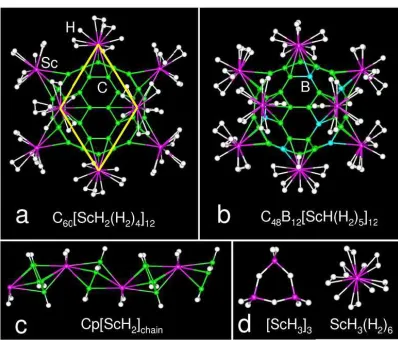
Figure 1.1: Optimized atomic structures of (a) C60[ScH2(H2)4]12, (b)C48B12[ScH(H2)5]12,
(c) Cp[ScH2] chain, and (d) [ScH3]3 (left) and ScH3(H2)6 (right). For clarity, only part of
each buckyball is shown. A close-packed vdW solid formed from C48B12[ScH(H2)5]12
would have a volumetric storage density of 43 kgH2 m-3 even without consideration of the
possibility of interlocking using the large open spaces indicated by the rhombus in (a). ...5 Figure 1.2: Energy vs reaction paths for successive dissociative and molecular adsorption of H2 over a single Ti coated (8,0) nanotube. ...6
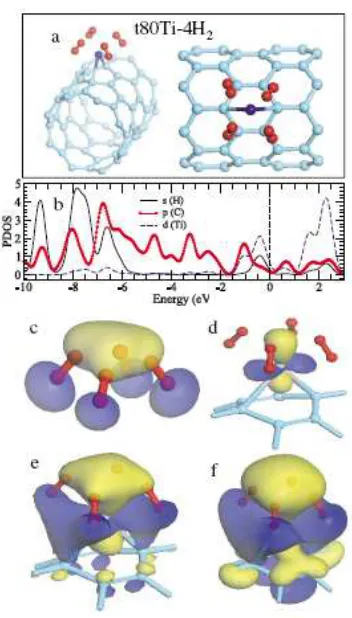
Figure 1.3: (a) Two different views of the optimized structure of t80Ti-4H2...7
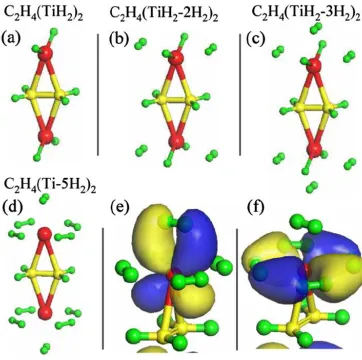
Figure 1.4: Atomic configurations of an ethylene molecule functionalized by two Ti atoms, holding (a) two dissociated H2 molecules, (b) six H2 molecules, and (c) eight H2
molecules. Panel (d) shows a configuration where ten H2 molecules are bonded all as discrete ligands...9 Figure 1.5: Atomic structures of Ti-functional group complexes with the maximum number of H2 molecules attached. White, green, grey, red, yellow, and pink dots indicate
the hydrogen, carbon, nitrogen, oxygen, sulfur, and titanium atoms, respectively. ...11 Figure 1.6: MOF-74: ball-and-stick representation of SBU (a); SBU with Zn shown as polyhedra (b); and view of crystalline framework with inorganic SBUs linked together via the benzene ring of 2,5-dihydroxybenzene-1,4-dicarboxylate (c) ...13 Figure 1.7: H2 Isotherm measurements on MOF-74. (a) The H2 adsorption/desorption
isotherms at 77 K. The inset compares the H2 adsorption isotherms for MOF-74 and
MOF-177. (b) The H2 adsorption enthalpy of MOF-74 is shown with an initial H2
adsorption enthalpy of ≈ 8.8 kJ/mol...14 Figure 1.8: Portions of the crystal structure of 3, showing the trinuclear Zn3 building
units (upper) and, upon removing the DMF and water ligands, the arrangement of
channels along the [001] direction. ...15 Figure 1.9: Portions of the crystal structure of 5, showing part of the infinite helical chains composed of Mn2+ and Cl- ions (upper) and, upon removing the DMF molecules, the one-dimensional channels formed along the [001] direction (lower). ...16 Figure 1.10: Adsorption isotherms for the H2 uptake in desolvated samples of 3 (dark
green circles), 4 (blue circles), and 5 (red circles) at 77 K ...17 Figure 1.11: Enthalpy of adsorption plots as a function of the uptake of H2 in desolvated
samples of 3 (dark green), 4 (blue), and 5 (red)...17 Figure 1.12: Crystal Structure of (1). (a) molecular structure of the tritopic ligand
H3BTT, (b) a square-planar Mn4Cl cluster surrounded by eight tetrazolate rings, (c) a
sodalite cage-like unit encasing a [Mn(DMF)6]2+ complex, and (d) a cube of eight such
units sharing square Mn4Cl faces...18
Figure 1.13: H2 adsorption isotherms (a) below 1.2 bar and (b) up to 90 bar within 1’
(red) and 1m’ (blue) at 77 K, and within 1m’ at 298 K (green)...19 Figure 1.14: Isosteric heat of adsorption curves for H2 uptake in 1’ (red) and 1m’ (blue).
...20 Figure 1.15: Schematic representation of H2 binding sites in the monolayer wall of
Figure 1.16: High-pressure H2 isotherms for pristine and reduced microporous titanium
oxides synthesized using hexylamine as the template at 77 K in gravimetric uptake. ...23 Figure 1.17: Enthalpy of H2 adsorption for pristine and reduced microporous titanium
oxides synthesized using hexylamine as the template. ...24 Figure 1.18: Enthalpy of H2 adsorption for pristine and reduced microporous titanium
oxides. ...24 Figure 1.19: Hydrogen adsorption and storage isotherms at 77 K for mesoporous silica treated with various molar equivalents of tribenzyl titanium. ...27 Figure 1.20: Hydrogen storage isotherms at 77 K for mesoporous silica treated with various molar equivalents of tetrabenzyl titanium...28 Figure 1.21: Hydrogen binding enthalpies. Pristine silica (black), the 0.2 molar equiv tetrabenzyltitanium material after heating at 180 °C (red), the 0.3 molar equiv
tetrabenzyltitanium material after heating at 180 °C (brown), and the 0.2 molar equiv tetrabenzyltitanium material before heating (pink)...28 Figure 1.22: Minimal Sieverts apparatus ...31 Figure 1.23: Schematic drawing of a Gas Reaction Controller (GRC) system supplied by Advanced Materials Corporation. ...32 Figure 1.24: INS spectra of 0.4 and 2H2/Cu measured at 4 K are shown in panels a and b, respectively. ...35 Figure 1.25: Infrared spectra of Nujol mulls of 1 (upper) and 1-d2 (lower). The ν(HH)
region was recorded for the perdeuteriophosphine species. ...36 Figure 1.26: Raman spectra of hydrogen as a free gas and in the presence of MOF-5 at room temperature and 30.3 bar ...37 Figure 2.1: Possible surface species proposed previously for bis(cyclopentadienyl)
chromium on silica dehydrated at 200 oC. ...51 Figure 2.3: Possible surface species proposed previously for bis(cyclopentadienyl)
vanadium (a) or bis(benzene) vanadium (b, c) on silica dehydrated at 200 °C. ...53 Figure 2.9: Gravimetric hydrogen adsorption isotherm at 77 K of the 5%Cr(bisCp) sample. Preparation date: July 08th, 2008. Test date: October 02nd, 2008. ...59 Figure 2.10: Hydrogen adsorption and desorption at 77 K of the 5%Cr(bisCp) sample. .59 Figure 2.11: Adsorption enthalpies of pristine silica and pristine silica treated with
sandwich compounds. ...60 Figure 3.2: Hydrogen adsorption – desorption excess storage isotherms of C-series vanadium hydrazide materials synthesized with a V:hydrazine ratio of 1:1.5. ...77 Figure 3.3: Heat of hydrogen adsorption on vanadium hydrazide materials and carbon AX-21. ...81 Figure 3.4: Room-temperature EPR spectra of vanadium hydrazide gel C150, (a) prior to exposure to hydrogen gas, and (b) after exposure to hydrogen gas...82 Figure 4.1: Powder X-ray diffraction of manganese hydrazide materials. From top to bottom: D100, C100, B100, then A100. ...107 Figure 4.2: Nitrogen adsorption – desorption isotherms of manganese hydrazide
Figure 4.5: N 1s region of XPS Spectrum of manganese hydrazide materials heated to
100 °C. ...111
Figure 4.6: Gravimetric hydrogen adsorption – desorption isotherms of B-series manganese hydrazide materials synthesized with a Mn : N2H4 ratio of 1:1. ...112
Figure 4.7: Heat of hydrogen adsorption on manganese hydrazide materials and carbon AX-21. ...117
Figure 4.8: Room-temperature EPR spectra of manganese hydrazide gel B100, (a) prior to exposure to hydrogen gas, and (b) after exposure to hydrogen gas...119
Figure 5.1: Powder X-ray diffraction of titanium hydrazide materials...143
Figure 5.2a: Nitrogen adsorption – desorption isotherms of titanium hydrazide materials heated at 100 oC and 150 oC. ...144
Figure 5.2b: Nitrogen adsorption – desorption isotherms of titanium hydrazide materials hydrogenated at 80 bar H2, 150 oC, 2 h...145
Figure 5.3: Thermo-gravimetric analysis results of titanium hydrazide materials. ...146
Figure 5.4: Valence region of XPS spectrum of titanium hydrazide materials heated to 100 °C. ...147
Figure 5.5: Titanium 2p1/2 and 2p3/2 region of XPS spectrum of titanium hydrazide materials heated to 100 °C and hydrogenated at 150 °C, 80 bar, 2 h. ...147
Figure 5.6: Nitrogen 1s region of XPS spectrum of titanium hydrazide materials heated to 100 °C and hydrogenated at 150 °C, 80 bar, 2 h...148
Figure 5.7: Gravimetric hydrogen adsorption – desorption isotherms of hydrogenated titanium hydrazide materials synthesized with a Ti:hydrazine ratio of 1:1 and 1:1.5. ....150
Figure 5.8: Heat of hydrogen adsorption on titanium hydrazide materials...153
Figure 6.1: Nitrogen adsorption – desorption isotherms of Oxamide100, V-Oxamide150. ...176
Figure 6.2: Nitrogen adsorption – desorption isotherms of Oxalate150, V-Glycolate150, H2-V-Oxalate150, H2-V-V-Glycolate150, and V-Glycolamide150...177
Figure 6.3: Excess hydrogen adsorption isotherms at 77 K, 298 K of Oxamide100, V-Oxamide150. ...183
Figure 6.4: Hydrogen adsorption properties at 77 K, 298 K of V-Oxalate150...183
Figure 6.5: Hydrogen adsorption properties at 77 K, 298 K of V-Glycolate150...184
Figure 6.6: Hydrogen adsorption properties at 77 K, 298 K of V-Glycolamide150. ...184
Figure 6.7: Hydrogen binding enthalpies of Oxamide100, Oxamide150, V-Oxalate150, V-Glycolate150, V-Glycolamide150, and carbon AX-21...187
Figure 6.8: Hydrogen adsorption properties at 77 K, 298 K of H2-V-Oxalate. ...190
Figure 6.9: Hydrogen adsorption properties at 77 K, 298 K of H2-V-Glycolate. ...190
Figure 6.10: Hydrogen binding enthalpies of H2-V-Oxalate150, H2-V-Glycolate150. 191 Figure 6.11: Raman spectra of V-Oxamide150 under H2 and D2. ...193
Figure 7.1: Powder X-ray diffraction of A100 and H150-6h materials...217
Figure 7.2a: Nitrogen adsorption – desorption isotherms of alkyl titanium hydride materials. ...218
Figure 7.2b: Nitrogen adsorption – desorption isotherms of hydrogenated alkyl titanium hydride materials...219
List of Schemes
Scheme 1.1: Schematic representation of the grafting of benzyl Ti species onto the surface of mesoporous silica and the subsequent formation of tunable low-coordinate H2
binding sites with enthalpies of 23 kJ/mol...26 Scheme 3.1: Possible mechanism for the reaction between V(Mes)3.THF and N2H4...75
Scheme 4.1: Possible mechanism for the reaction between [{Mn(CH2SiMe3)2}∞] and
N2H4, reaction ratio 1:1...106
Scheme 5.1: Synthesis of titanium hydrazide gels. ...143 Scheme 6.1: Proposed reaction between V(Mes)3.THF with various ligands. a) oxamide,
b) oxalic acid, c) glycolic acid, d) glycolamide. ...175 Scheme 6.2: Proposed hydrogenolysis reactions of (a) Oxalate150 and (b)
List of Appendices
Appendix 1: Copyright of Wiley to reproduce article Hoang, T. K. A., Antonelli, D. M.
Adv. Mater. 2009, 21, 1787 in the introduction chapter...251
Appendix 2: Permission from ACS to reproduce article in chapter 2. ...252
Appendix 3: Permission from ACS to reproduce article in chapter 3. ...253
List of Abbreviations, Symbols, Nomenclature
atm atmosphere
BET Brunauer – Emmett – Teller
BDT 1,4-benzeneditetrazolate
BTT 1,3,5-benzenetritetrazolate
o
C Degree Celsius
DOE United State Department of Energy
DSC Differential Scanning Calorimetry
EA Elemental Analysis
EPR Electron Paramagnetic Resonance
h hour
HMS hexagonally packed mesoporous silica
INS Inelastic Neutron Scattering
IR Infrared Spectroscopy
Me Methyl group
Mes Mesityl group
MOF Metal Organic Framework
NMR Nuclear Magnetic Resonance
R Gas Constant
T Temperature
TGA Thermogravimetric Analysis (or Thermal Gravimetric Analysis)
TPD Temperature Programmed Desorption
THF Tetrahydrofuran
wt% weight percent
XPS Xray Photoelectron Spectroscopy
Chapter 1 – Introduction
1.1 Introduction
The increase in crude oil consumption and the rapid exhaustion of petroleum reservoirs
has led to a boom in research in the area of alternative fuel.1 New sources of energy
should be clean, efficient, low cost, and easy to transport. Some candidates are wind,
solar, geothermal, biomass, nuclear energy, and hydrogen.2 Hydrogen is an attractive
energy source for mobile applications such as vehicles because it has the highest energy
density of any substance and produces only water as a waste product when used in a fuel
cell.3 Unfortunately hydrogen is difficult to store and transport. Therefore, to
commercialize hydrogen technology, the bottleneck represented by the storage and
delivery steps must be overcome.
Significant advances have been made in the search for suitable materials for hydrogen
storage. While compressed gas is still being explored as an option, materials that absorb
hydrogen as carriers are also being investigated. The two major technologies for
chemical storage are metal hydrides, which store hydrogen as a discrete M-H bond, and
high surface materials for cryogenic hydrogen physisorption.4 However, no material
explored to date meets the US Department of Energy (DOE) 2017 system target of 5.5 wt
% weight adsorption or 40 kg/m3.5 These system targets were established by the DOE
and its partners (FreedomCAR and United States Council for Automotive Research). A
hydrogen storage system might exhibit a much lower volumetric performance than that of
the adsorbing materials. Partial consumption of system volume for cylinder shells and
cylinder’s accessories lead to a small storage volume to hold the functioning materials,
especially in the storage system operating at high pressures or low temperatures. The
Sun
Photo-electrolysis of water
Hydrogen Storage
promising. Nevertheless, the use of DOE gravimetric and volumetric system targets is
still necessary in evaluating the adsorption performance of materials with the idea in mind
that it is not the final net performance of the hydrogen storage system employing these
materials.
New materials and concepts are currently being explored and new storage strategies are
being developed.6 One of the most overlooked features of a hydrogen storage material is
the enthalpy of adsorption. If this value is too high, as in metal hydrides which generally
have enthalpies in the 80 kJ/molrange, energy is required to drive off hydrogen for use
and enormous amounts of heat are released on recharging. If this value is too low, as in
the case of physisorption materials, expensive and cumbersome cryogenic cooling is
required to keep the hydrogen on the material. In spite of this, physisorption of hydrogen
on solid-state materials shows promising properties such as high gravimetric storage, fast
adsorption and desorption kinetics. Numerous high surface area microporous and
mesoporous materials have been studied in this application. The adsorption mechanism is
dominated by weak Van der Waals forces which have adsorption enthalpy between 4 – 10
kJ/mol. Typical materials, such as carbon nanotubes, fullerenes, and metal-organic
frameworks (MOFs) possess very high surface areas and high hydrogen physisorption at
cryogenic temperature, but their adsorption capacities at room temperature are limited due
to the limited adsorption enthalpy. For example, Zuettel et al investigated the hydrogen
storage capacities of 60 carbon samples under ambient conditions, resulting in reversible
storage capacities in the 0.04 – 0.46 wt% range.7 This is because the 4 – 10 kJ/mol
binding enthalpies are too weak to hold the hydrogen to the surface under these
conditions. Calculations have demonstrated that the ideal enthalpy for room temperature
operation of a hydrogen storage system is 20 – 30 kJ/mol. Other research has indicated
that 15-20 kJ/mol is a minimum requirement for room temperature hydrogen storage. For
this reason many researchers are pursuing strategies to strengthen the interaction between
the substrate and hydrogen. Many of these new approaches involve the use of σ-π H2
complexes (i.e. the Kubas interaction) to bind the hydrogen to the active metal sites on
the surface.8 Hydrogen spillover using Pd is also thought to increase enthalpy of binding
hydrogen storage systems designed for room temperature applications. The initial
discovery of Kubas and many of the subsequent works in this area focus on stable
dihydrogen organometallic complexes at ambient pressure and temperature, in which
vacuum must be applied to remove the dihydrogen species. For mobile vehicle
applications, hydrogen is preferred to be stored at moderate pressures of 50-100 bar. This
allows for hydrogen to be released simply by opening a valve and reducing the pressure,
rather than applying heat or vacuum. Thus compounds which possess stable dihydrogen
ligands at room temperature and pressure may not be suitable for hydrogen storage,
because these would require heat or vacuum to liberate the H2. Unsaturated coordination
metal species which exhibit Kubas interactions with multiple hydrogen molecules at
ambient temperature and higher pressures are thus preferred.
In this report, we present recent developments in hydrogen adsorption and storage. Our
focus is on new materials that exhibit higher adsorption enthalpies as well as some
theoretical research on titanium decorated bulkyballs, nanotubes, and polymers. New
MOFs containing unsaturated coordination metal sites and small pores, titanium materials
and surface titanium species that exhibit high heat of adsorption exploiting the Kubas
binding strategy will also be discussed, however a recent review focussing exclusively on
MOFs has just appeared while this report was in progress.10
1.2 Carbon nanotube and fullerene modified materials
Carbon materials have been modified with many different species to improve the
hydrogen uptake capacities. The strategy here is to decorate the surface with metal
species that either add more binding sites, improve the adsorption capacity of the surface
through electronic interactions, or both. Computational studies suggest that transition
metal atoms, especially early metals in low oxidation states, can bind to fullerene C60 or
C48B12 via the Kubas interaction to form stable media for hydrogen storage.11 Y. Zhao et
al11a proposed the formation of stable organo-scandium bulkyballs using Sc(0) as shown
in Figure 1.1 (note: Sc(0) here becomes Sc(II) after oxidative addition of one dihydrogen
to form a dihydride). In this hypothetical molecule each scandium species can bind up to
reversibly adsorb additional hydrogen, resulting in the uptake of 7.0 and 8.77 wt %
hydrogen, respectively. The binding energies of hydrogen molecules to these adsorbates
range within 0.3 – 0.4 eV (29 – 39 kJ/mol) which are suitable for ambient temperature
applications. (Note: 1 eV/molecule is equivalent to 96.5 kJ/mol)
Scandium species are stable on the fullerene surface due to the binding energy of 2.8 eV.
C60[ScH2]12 can reversibly bind four dihydrogen molecules to one scandium atom (Figure
1.1) to form C60[ScH2(H2)4]12, corresponding to 7.0 wt % hydrogen uptake capacity. The
authors propose that modification of the carbon framework of the fullerene may lead to
further storage benefits. Laser vaporization of graphite pellets containing boron nitride
powder produces fullerenes in which one or more atoms in the hollow carbon cage are
replaced by a boron atom.12 This substitution doping leads to a decrease in material
weight and enhancement of the stability. Boron atoms in the fullerene structure should
also draw more charge from the scandium, or any other transition metal, resulting in an
increase in binding energy between the Sc atom and the bulkyballs. In the case of
C48B12[ScH]12, the binding energy of Sc to the bulkyballs is 3.6 eV and each Sc can
reversibly bind up to 5 hydrogen molecules to form C48B12[ScH(H2)5]12, resulting in a
reversible hydrogen uptake capacity of 8.77 wt%. This satisfies the ultimate DOE goal.
Table 1.1: Calculated consecutive binding energies of H2 molecules (in eV/H2). In the
case of bulkyballs, twelve H2 were added per calculation. (Reprinted with permission
from [11a]. Copyright 2005, American Physical Society).
1st H2 2nd H2 3rd H2 4th H2 5th H2
Cp[ScH2]
C60[ScH2]12
C48B12[ScH2]12
0.29
0.30
0.31
0.28
0.35
0.35
0.46
0.42
0.30
0.23
0.26
Figure 1.1: Optimized atomic structures of (a) C60[ScH2(H2)4]12, (b)C48B12[ScH(H2)5]12,
(c) Cp[ScH2] chain, and (d) [ScH3]3 (left) and ScH3(H2)6 (right). For clarity, only part of
each buckyball is shown. A close-packed vdW solid formed from C48B12[ScH(H2)5]12
would have a volumetric storage density of 43 kgH2 m-3 even without consideration of the
possibility of interlocking using the large open spaces indicated by the rhombus in (a). (Reprinted with permission from [11a]. Copyright 2005, American Physical Society).
While organo-scandium bulkyballs have yet to be synthesized, fullerenes doped with
titanium, vanadium, niobium and tantalum have been synthesized via laser assisted
vaporization of metals. Titanium and vanadium are able to bind directly to the fullerene
structure via carbide bonding.13 Fullerenes doped with titanium or vanadium seem to be
stable whereas niobium and tantalum severely destabilize the fullerene structure. Mass
spectroscopy studies on the C60Vx species synthesized at low laser intensities show that
the cluster of C60V62, C60V73, and C60V86 are particularly stable. Similar species of C60Tix
and C70Tix have been observed using titanium instead of vanadium. These materials are
Figure 1.2: Energy vs reaction paths for successive dissociative and molecular adsorption of H2 over a single Ti coated (8,0) nanotube. (a) H2 + t80Ti → t80TiH2. (b) 2H2 +
t80TiH2 → t80TiH2 -2H2. (c) H2 + t80TiH2-2H2 → t80TiH2-3H2. The zero of energy is
taken as the sum of the energies of the two reactants. The relevant bond distances and binding energies (EB) are also given. (Reprinted with permission from [14]. Copyright 2005, American Physical Society).
Hydrogen adsorption on carbon nanotubes decorated with titanium atoms was studied
computationally by Yildirim et at.[14] In this approach the nanotubes act as a scaffolding
to support the Ti centers for Kubas binding of hydrogen. Calculations show a
zero-energy barrier for adsorption. The first hydrogen molecule is dissociated to two hydrides
by oxidative addition to the titanium. During this process, the H-H distance increases
from 0.75Å to 2.71Å and the binding energy of hydrogen atom to titanium atom is 0.83
Figure 1.3: (a) Two different views of the optimized structure of t80Ti-4H2. The relevant
structural parameters are H-H = 0.84 Å, Ti-H = 1.9 Å, Ti-C = 2.17Å, Ti-C = 2.40 Å. (b) The PDOS at the Γ point contributed from Ti, four H2 molecules, and the six carbons of
the hexagon on which Ti and H2 molecules are bonded. (c) The σ* antibonding orbital of
the tetra H2 complex; (d)–(f) isosurface of the state just below EF at three different values:
at ψ = 0.08 it is mainly Ti-d orbital; at ψ = 0.04 there is hybridization between the d orbital, two carbon π orbitals, and the 4H2σ* antibonding orbitals. At ψ = 0.02 it is clear
that the other four carbon atoms are also involved in the bonding. (Reprinted with permission from [14]. Copyright 2005, American Physical Society).
The second, third, and fourth hydrogen molecules bind to titanium atom without
dissociation in a Kubas type fashion. Calculations demonstrate that the system is stable
until four hydrogen molecules are adsorbed. The H-H bonds elongate to 0.81 Å in the
case of 2 adsorbed hydrogen molecules with adsorption energies of 0.45 eV/H2, and to
0.86 Å in the case of 4 adsorbed molecules with adsorption energies of 0.34 eV/H2. This
strategy is thus similar to that above described for Sc coated fullerenes in that it uses a
Experimental preparations of transition metal decorated nanotubes have been carried out
by vapor deposition, but it is not clear whether these would be ideal substrates for
hydrogen storage. Using this technique, nanowires of Ti, Ni, and Pd were fabricated with
widths of <10 nm and continuous length of up to tens of microns.15 Metals were
introduced into the nanotubes to increase the conduction properties or coated onto the
nanotubes to create a thin metallic layer. Due to the weak interactions between the metal
atoms and nanotube surface, the chemical vapour deposition technique tends to create
discrete metallic nanoclusters rather than surface atomic species. For hydrogen storage
applications, the metal centers should ideally exist on the nanotube surface in the atomic
form and not as clusters in order to maximize the available binding sites for hydrogen
adsorption.
1.3 Bis(titanium)ethylene complex
The binding abilities of metals to ethylene through σ donation have been widely
studied.[16] Since ethylene is much lighter as a substrate than fullerenes or carbon
nanotubes, it may represent an ideal support for metal binding for hydrogen storage
systems exploiting the Kubas interaction. Main group metals and especially transition
metals can bind to ethylene in several different ways. For example, calculations show
that ethylene can complex with two lithium atoms to form a stable compound with a
binding energy of 0.70 eV/Li. This complex exhibits a predicted hydrogen adsorption
capacity of 16 wt % when each lithium atom adsorbs 2 hydrogen molecules. Durgun et al.
performed calculations to show that a single ethylene molecule can form a stable complex
with 2 titanium atoms.17 This new molecule Ti2-ethylene can adsorb up to ten hydrogen
molecules according to calculation, reaching a gravimetric storage of 14 wt %. These
high predicted capacities demonstrate that ethylene may indeed be a better support than
C60 or nanotubes for this application.
The first hydrogen molecule is adsorbed dissociatively by each titanium atom to form the
complex C2H4(TiH2)2 with a binding energy of 1.18 eV/H2. Consecutive hydrogen
0.38 eV/H2 and an H-H bond length of 0.81 Å. A third hydrogen molecule is
energetically favored to bind at the top side of the TiH2 group with a binding energy of
0.40 eV and a 0.82 Å H-H bond lengths.
Figure 1.4: Atomic configurations of an ethylene molecule functionalized by two Ti atoms, holding (a) two dissociated H2 molecules, (b) six H2 molecules, and (c) eight H2
molecules. Panel (d) shows a configuration where ten H2 molecules are bonded all as discrete ligands. Spin-polarized calculations gave energies (in eV) by 1.5, 0.37, 0.16, and 0.06 for the configurations shown in (a)–(d), respectively, suggesting a magnetic ground state in all cases with a moment of µ ≈ 2µB. Panels (e) and (f ) show the bonding orbital
for the top (e) and side-on hydrogen ligands, respectively. Note that the hydrogen σ *-antibonding orbitals are hybridized with Ti-d orbitals, suggesting Kubas interaction for the H2-Ti bonding. (Reprinted with permission from [17]. Copyright 2006, American
Physical Society).
Figure 1.4(d) proposes the adsorption of 5 hydrogen molecules per titanium atom,
resulting in a hydrogen uptake capacity of 14 wt %. In all cases, the H-H bond of the
adsorbed H2 is elongated, consistent with the Kubas interaction scheme, and suggests the
reversible adsorption of hydrogen on the adsorbent. While these molecules are
encouraging from the standpoint of theory, the synthesis of such systems has remained
elusive. These studies do, however, point in the direction of using anchored alkenes as
binding sites on surfaces for low-coordinate metal species for hydrogen storage.
The binding of Ti to many other support materials other than ethylene and carbon
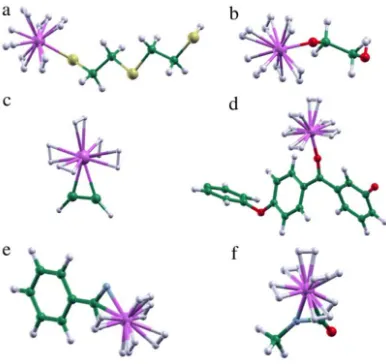
structure calculations (Table 1.2). The functional groups used were 2-mercaptoethyl
sulfide, ethane-1,2-diol, acetylene, poly ether ether ketone (PEEK), benzo-nitril, and
methyl-isocyanate. The results showed that each complex can reversibly bind up to 6
hydrogen molecules per titanium atom (figure 1.5).
Table 1.2: The calculated usable number of H2 molecules of titanium decorated
functional groups. (Reprinted with permission from [18]. Copyright 2006, Elservier).
Materials Functional
Moieties N ads N des Nuse/Nmax
2-mercaptoethyl sulfide
Ethane-1,2-diol
Acetylene
Poly ether ether ketone
Benzo-nitril
Methyl-isocyanate
Thiol
Hydroxyl
Alkynyl
Carbonyl
Nitril
Isocyanate
3.10
3.55
4.00
4.99
4.10
5.00
1.10
1.02
3.95
4.17
3.95
3.73
2.00/6
2.53/6
0.05/5
0.82/6
0.15/6
1.27/6
Nads and Ndes are the numbers of adsorbed H2 molecules per Ti under the
conditions of adsorption (30 atm and 25 oC) and desorption (3 atm and 100
o
C), respectively. Nuse is the thermodynamical usable number of H2
molecules obtained from Nads – Ndes. Nmax is the maximum number of
attachable H2 ligands.
Titanium atoms were shown to bind in a stable manner with binding energies of the Ti
atom to thiol, hydroxyl, alkynyl, carbonyl, nitrile, and isocyanate of 2.5, 3.0, 2.8, 2.1, 2.3,
and 2.4 eV, respectively. In every case, each Ti adsorbed 5 – 6 hydrogen molecules
non-dissociately with binding energies falling in the desirable range of 0.25 – 0.35 eV. This
leads to a maximum gravimetric density of 13 wt % in the case of ethane 1,2 diol, with a
reversible uptake of 5.5 wt % under ambient conditions. The non-dissociative hydrogen
molecules are elongated in H-H length from 0.75 Å to ≈ 0.83 Å consistent with a
Kubas-bonding mode. While many of these compounds may be very difficult to synthesize
alone or as encapsulated species in zeolite cavities, this work does show that Kubas type
complexes in stable ligand environments may be useful in on-board hydrogen storage
Figure 1.5: Atomic structures of Ti-functional group complexes with the maximum number of H2 molecules attached. White, green, grey, red, yellow, and pink dots indicate
the hydrogen, carbon, nitrogen, oxygen, sulfur, and titanium atoms, respectively. (a)–(f) Ti-functional group complexes with maximally adsorbed H2 molecules in
2-mercaptoethyl sulfide, ethane-1,2-diol, acetylene, PEEK, benzo-nitrile, and methyl-isocyanate, respectively. (Reprinted with permission from [18]. Copyright 2006, Elsevier).
1.4 Titanium decorated polymers
Polymers are also possible substrates for hydrogen storage. For example, a microporous
polymer based on the triptycene monomer can hold up to 2.7 % H2 by mass at 10 bar and
77 K.19 Polymers can also serve as excellent backbone materials to support active metal
sites due to their rich and diverse functional moieties and relatively light constitution.
Among the polymers considered in this application to date are trans- and
cis-polyacetylene, polyaniline, polyphenol, poly para phenylene, and poly ether ether ketone,
polypyrrole, polythiophene, polyvinyl alcohol, and carbon hydrate. Theoretical studies
by Jisoon Ihm and co-workers show that simple polymers decorated with light transition
metal atoms may be useful for hydrogen storage.20 Cis-polyacetylene decorated with
titanium atoms can adsorb up to 12 wt % of hydrogen. The formula for this material is
(C4H4⋅2Ti⋅10H2)n. In this complex, hydrogen molecules bind to titanium atoms in a
Kubas fashion with binding energies ranging from 0.42 – 0.58 eV, slightly higher than the
molecules could be desorbed reversibly, resulting in 7.6 wt % practical storage capacity
equivalent to 63 kg m-3 volumetric density. These figures are very promising and the
synthesis of this material may be more practical than some of the molecular bound Ti
systems proposed above.
1.5 Metal organic frameworks (MOFs)
Since MOF type materials were discovered, significant advances have been made in
synthesis and design to optimize them for applications in adsorption and catalysis.21 A
few hundred MOF type materials have already been prepared with different
morphologies, structures and compositions. Due to their high specific surface area, MOF
materials have been studied for use in hydrogen storage.4, 22 Promising hydrogen
adsorption capacities of 6.5 % - 7.5 % have been achieved at cryogenic temperatures.23
For example IRMOF-8 was thought to possess an adsorption capacity of 2 wt % at room
temperature and 10 bar pressure 22 but later adsorption results from this research group at
77 K and 1 bar on IRMOF-8 possessing a BET of 1466 m2 g-1 only demonstrated an
adsorption capacity of 0.74 wt %.24 Most MOF materials have adsorption capacities in
the range of 0 – 1.0 wt % at room temperature, which are too low for practical interest.25
Because of this, researchers have attempted to enhance the hydrogen adsorption
capacities of MOFs by different methods including impregnation, doping, ion exchange,
increasing hydrogen uptake by spillover, narrowing pore size, and the fabrication of new
MOF materials with unsaturated coordination metal centers.26-32 Two main ways to
significantly enhance the adsorption capacities have been pursued. The first is narrowing
the materials’ pore size to allow hydrogen molecules to interact with more than one wall
of the material and hence improves its binding. For example, the microporous
coordination solid Mg3(O2C-C10H6-CO2)3 possesses hydrogen binding energy up to 9.5
kJ/mol.29 The second method is the synthesis of MOF materials with different
coordinative unsaturated metals incorporated in the structure for use as binding centers
via metal – H2 interactions.30 - 32 An extensive review focus on hydrogen storage on
MOFs with exposed metal centers has just been published.10 According to the adsorption
close to 15.1 kJ/mol.33 This is somewhat different from the calculation results from Zhao
et al regarding the ideal adsorption enthalpy range of 20 – 30 kJ/mol.11 MOFs with Ni
and Mn in the framework have been developed for hydrogen storage because these metals
exhibit superior binding with hydrogen. The heat of adsorption increased from typically
4 – 7 kJ/mol in a standard MOF up to around 10 kJ/mol on inclusion of these metals.
Although these values still fall short of the target enthalpies for room temperature
application, these results demonstrate that modification of the MOF structure can lead to
enhanced hydrogen uptake capacities through what appears to be the Kubas interaction.
This result is also important because it shows that surface area is not the only important
factor in hydrogen binding to porous materials.
1.5.1 Hydrogen storage on novel MOF-74
Figure 1.6: MOF-74: ball-and-stick representation of SBU (a); SBU with Zn shown as polyhedra (b); and view of crystalline framework with inorganic SBUs linked together via the benzene ring of 2,5-dihydroxybenzene-1,4-dicarboxylate (c) (DMF and H2O guest
molecules have been omitted for clarity). (Reprinted with permission from [34]. Copyright 2005, American Chemical Society).
MOF-74 is included in this review because of its structure, which features open Zn2+ sites
(figure 1.6a) which enhance the hydrogen adsorbed by the framework.[34]
Figure 1.7 shows the hydrogen adsorption on MOF-74 and the isoteric heat of hydrogen
scattering studies at 4 K and 60 K suggest strong bonding between hydrogen molecules
toward the Zn2+ centers without dissociation.35 Similar inelastic neutron scattering
evidence was observed on the Cu2+ center in HKUST-1 materials,36a and the Cu+ center of
Cu-exchanged ZSM-5, which shows a maximum adsorption capacity of 0.57 H2/Cu at
298 K and 14 bar.36b-d
Figure 1.7: H2 Isotherm measurements on MOF-74. (a) The H2 adsorption/desorption
isotherms at 77 K. The inset compares the H2 adsorption isotherms for MOF-74 and
MOF-177. (b) The H2 adsorption enthalpy of MOF-74 is shown with an initial H2
adsorption enthalpy of ≈ 8.8 kJ/mol. (Reprinted with permission from [28]. Copyright 2008, American Chemical Society).
1. 5. 2 Hydrogen storage on microporous metal – organic frameworks incorporating 1,4-benzeneditetrazolate (BDT2-)
MOF materials which employ microporous frameworks along with unsaturated metal
centers for Kubas binding have also been developed.30-32, 37 Materials obtained from this
synthetic strategy enhance the hydrogen uptake capacity at room temperature not only by
increasing the interactions between hydrogen molecules and the material walls, but also
by the higher adsorption enthalpy of hydrogen on the unsaturated metal sites. Reaction
between H2BDT with hydrated salts of Mn2+, Zn2+ in the mixture of N,N –
Mn3(BDT)3(DMF)4(H2O)2⋅3CH3OH⋅2H2O⋅DMF (4),
Mn2(BDT)Cl2(DMF)2⋅1.5CH3OH⋅H2O (5). When solvent is removed under mild
conditions, these materials exhibit permanent porosity, with BET surface areas between
200 – 640 m2 g-1 and show 0.82 – 1.46 wt % of hydrogen adsorption at 77 K and 1 atm
with an H2 binding enthalpy of 6.0 – 8.8 kJ mol-1.
Figure 1.8: Portions of the crystal structure of 3, showing the trinuclear Zn3 building
units (upper) and, upon removing the DMF and water ligands, the arrangement of channels along the [001] direction. Hydrogen atoms and solvate guest molecules are omitted for clarity. Selected mean interatomic distances (Å) and angles (deg) from the isotypic structures of 3 (M ) Zn) and 4 (M ) Mn), respectively: O, 2.08(4), 2.15(4); M-N, 2.15(3), 2.25(2); M⋅⋅⋅M, 3.763, 3.951; N-N, 90(3), 89(3); O-O, 90(2), 90-(2); M-N-N, 125(3), 125(2). (Reprinted with permission from [30]. Copyright 2006, American Chemical Society).
These materials possess three dimensional structures containing metal units linked via
BDT2- bridges to form neutral materials. Compounds (3) and (4) are isomorphous and the
metals adopt a linear bonding mode with the BDT2- bridges, while in material (5), Mn2+
possesses an octahedral geometry and the structure features a 19.6 Å wide one
Figure 1.9: Portions of the crystal structure of 5, showing part of the infinite helical chains composed of Mn2+ and Cl- ions (upper) and, upon removing the DMF molecules, the one-dimensional channels formed along the [001] direction (lower). Hydrogen atoms and guest solvent molecules are also omitted for clarity. Selected mean interatomic distances (Å) and angles (deg): Mn-Cl, 2.51(1); Mn-O, 2.139(1); Mn-N, 2.29(2); Mn⋅⋅⋅Mn, 3.759-(1); Cl-Mn-N, 88(3); Mn-N-N, 117(19); Mn-Cl-Mn, 93(4). (Reprinted with permission from [30]. Copyright 2006, American Chemical Society).
At 77 K and 880 torr, the adsorption capacites are 1.46 wt % for (3) – Zn3(BDT)3; 0.97 wt
% for (4) – Mn3(BDT)3; and 0.82 wt % for (5) – Mn2(BDT)Cl2. The three adsorption
curves are steep at low pressure; reflecting the strong binding of hydrogen toward the
coordinatively unsaturated metal centers. The heats of adsorption range from 6.8 – 8.7 kJ
mol-1 for Zn3(BDT)3; 6.3 – 8.4 kJ mol-1 for Mn3(BDT)3; and 6.8 – 8.8 kJ mol-1 for
Mn2(BDT)Cl2. These values are comparable with the heat of adsorption on MOF-74 and
Figure 1.10: Adsorption isotherms for the H2 uptake in desolvated samples of 3 (dark
green circles), 4 (blue circles), and 5 (red circles) at 77 K. (Reprinted with permission from [30]. Copyright 2006, American Chemical Society).
Figure 1.11: Enthalpy of adsorption plots as a function of the uptake of H2 in desolvated
samples of 3 (dark green), 4 (blue), and 5 (red). (Reprinted with permission from [30]. Copyright 2006, American Chemical Society).
1. 5. 3 Hydrogen storage on microporous metal – organic frameworks incorporating 1,3,5-benzenetritetrazolate (BTT3-)
By using different bridging ligands, new MOF materials
[Mn(DMF)6]3[(Mn4Cl)3(BTT)8(H2O)12]2⋅42DMF⋅11H2O⋅20CH3OH (1), and
3-were obtained with the formulas of [Mn(DMF)6]3[(Mn4Cl)3(BTT)8(DMF)12]2 and
Mn3[(Mn4Cl)3(BTT)8(CH3OH)10]2 and specific surface areas of 1100 and 2100 m2/g,
respectively.
XRD studies elucidated the structure of (1) as shown below.
Figure 1.12: Crystal Structure of (1). (a) molecular structure of the tritopic ligand H3BTT, (b) a square-planar Mn4Cl cluster surrounded by eight tetrazolate rings, (c) a
sodalite cage-like unit encasing a [Mn(DMF)6]2+ complex, and (d) a cube of eight such
units sharing square Mn4Cl faces. Hydrogen atoms and solvent molecules are omitted for
Figure 1.13: H2 adsorption isotherms (a) below 1.2 bar and (b) up to 90 bar within 1’
(red) and 1m’ (blue) at 77 K, and within 1m’ at 298 K (green). Triangles and circles represent excess and total H2 adsorption, respectively, while filled and open symbols
represent adsorption and desorption data, respectively. (Reprinted with permission from [31]. Copyright 2006, American Chemical Society).
At 77 K, material (1’) exhibitted 3.9 wt % hydrogen uptake capacity at 50 bar and 6.9 wt
% for material (1’) at 90 bar, resulting in a volumetric excess adsorption of 43 kg m-3 and
total volumetric uptake of 60 kg m-3, the highest value for any physisorption material ever
reported. Unlike other MOFs,40 this material shows no hysteresis in the
adsorption-desorption cycle. At 298 K, material (1m’) adsorbs up to 0.95 wt % at 90 bar.
Kubas bonding of hydrogen molecules to the adsorption sites. Neutron powder diffraction
revealed that hydrogen molecules interact directly in a stable fashion with Mn centers in
the framework. Similar evidence has been observed on the Cu2+ active sites in the related
material HKUST-136b as well as cation-exchanged Mn2+ MOFs that will be discussed
below.
Figure 1.14: Isosteric heat of adsorption curves for H2 uptake in 1’ (red) and 1m’ (blue).
(Reprinted with permission from [31]. Copyright 2006, American Chemical Society).
The guest Mn2+ in Mn3[(Mn4Cl)3(BTT)8(CH3OH)10]2 can be exchanged by different
cations as described in table 1.3 below. Different adsorption capacities of the cation
exchanged materials reflect the role of these unsaturated metal centers in the framework.
The Co2+ exchanged material has an adsorption enthalpy up to 10.5 kJ mol-1 while
materials exchanged with later transition metals such as Ni2+, Cu2+, Zn2+ have lower
adsorption enthalpies as well as lower adsorption capacities. Late transition metals have
weaker interaction with hydrogen molecules due to the increase in effective nuclear
charge shrinking the d-orbitals and thus disrupting the back-bonding interaction toward
hydrogen and causing the (η2-H2)-metal interaction to become less favourable. This trend
very clearly illustrates the role of Kubas binding in increasing the overall binding
enthalpies as well as the adsorption capacities of these materials. New framework solids
are being synthesized every year that exploit this interaction. For example, in 2008 an
Ni2+ as binding sites and can adsorb significant amount of hydrogen at 180 K. This
demonstrates that the higher enthalpies do indeed lead to adsorption at higher
temperatures. In situ IR revealed the formation of Ni2+⋅⋅⋅H2 complex with high
intensities.
Table 1.3: Composition and gas sorption properties of cation-exchanged compounds 1-M. (Reprinted with permission from [32]. Copyright 2007, American Chemical Society).
Comp Formula M/Mn ratio
(expt/found)
N2ads
(cm3/g)c
SABET
(m2/g)
SALang
(m2/g)
H2 ads
(wt%)d
∆H ads
(kJ/mol)e
Color before/after
desolvation. 1-Mn2+ 1-Fe2+ 1-Co2+ 1-Ni2+ 1-Cu2+ 1-Zn2+ 1-Li+ 1-Cu+
Mn3[(Mn4Cl)3(BTT)8]2
Fe3[(Mn4Cl)3(BTT)8]2⋅FeCl2
Co3[(Mn4Cl)3(BTT)8]2⋅1.7CoCl2
Ni2.75Mn0.25[(Mn4Cl)3(BTT)8]2
Cu3[(Cu2.9Mn1.1Cl)3(BTT)8]2⋅2CuCl2
Zn3[(Zn0.7Mn3.3Cl)3(BTT)8]2⋅2ZnCl2
Li3.2Mn1.4[(Mn4Cl)3(BTT)8]2⋅0.4LiCl
Mn3[(Mn4Cl)3(BTT)8]2⋅0.75CuPF6
N/A 0.169/0.170 0.210/0.210 0.121/0.121 3.925/3.999 0.553/0.546 0.017/0.017 N/A 547 542 563 554 500 508 530 518 2057 2033 2096 2110 1695 1927 1904 1911 2230 2201 2268 2282 1778 2079 2057 2072 2.23 2.21 2.12 2.29 2.02 2.10 2.06 2.00 5.5-10.1 5.5-10.2 5.6-10.5 5.2-9.1 6.0-8.5 5.5-9.6 5.4-8.9 5.6-9.9 Colorless/colorless Lt.green/brown Pink/dk.blue Lt.blue/brown Dk.green/black Colorless/colorless Colorless/colorless Colorless/colorless
a Based on the relative ration of Mn+/Mn2+ as determined using ICP-AA and on C, H, and N analysis. b For simplicity, guest solvents are obmitted
from these formulas. c Obtained at 77K and 760 torr. d Obtained at 77K and 760 torr. e Determined using a virial fit to the 77 and 87K H2
adsorption isotherms.
1.6 Pure and modified mesoporous titanium oxide
Titanium materials have also been considered as hydrogen storage materials due to the
the potential for a strong interaction between hydrogen and titanium. Titanium oxide
which contains as high as 59.93 wt % of Ti can be synthesized with different structures,
morphologies, pore sizes and large surface areas. Moreover, the Ti centers on the surface
can be reduced by different chemical agents to populate d-orbitals on these centers and
thus enhance binding to hydrogen.
The hydrogen adsorption performance of titanate nanotubes were studied.42 These
materials exhibit an adsorption capacity of up to 3.8 wt % at 77 K and 6 bar. However,
large hysteresis was observed due to clatharate formation in the titanate material. The
adsorbed hydrogen is only completely released at 200 oC and it takes several hours for the
In another study, microporous and mesoporous titanium oxide with pore sizes ranging
from 12 – 26 Å were synthesized by neutral amine templating agents.43 These materials
were then studied for hydrogen adsorption.44 This material is special in that it can be
readily reduced by alkali metals or bis(toluene)titanium to leave low valent metal centers
on the vast internal surface area of up to 1200 m2/g. In the pristine micro- or mesoporous
titanium oxide, the titanium atoms have empty t2g orbitals thus they are not expected to
form a stable interaction with hydrogen. But when these centers are reduced, a Kubas
type interaction becomes possible. Thus, reduction of the 12-electron MX4L2 Ti
octahedra leads to population of the t2g set and more effective π back bonding to the H2
molecules. The different binding modes for hydrogen are shown in Figure 1.15.
Figure 1.15: Schematic representation of H2 binding sites in the monolayer wall of
micro-and mesoporous titanium materials, where 1, 2, and 3 refer to mono, bis, and tris dihydrogen complexes, respectively, and 4 represents the compressed gas phase in the porous voids in the solid. (Reprinted with permission from [44]. Copyright 2006, American Chemical Society).
Pristine microporous titanium oxide was reduced by the following reducing agents in the
liquid phase: Li-naphthalene, Na-naphthalene, and bis(toluene) titanium. XPS studies on
these reduced samples exhibit a trend in decreasing binding energies of the Ti 3p 1/2
emmission from 37.9 eV in the case of pristine material to 36.8; 36.4; and 15.1 eV,
respectively.43 The volumetric hydrogen uptake capacities increased with decreasing
surface titanium oxidation state from 29.37 kg/m3 at 77 K and 100 atm to 31.10 kg/m3,



![Figure 1.9: Portions of the crystal structure of 5, showing part of the infinite helical chains composed of Mn2+ and Cl- ions (upper) and, upon removing the DMF molecules, the one-dimensional channels formed along the [001] direction (lower)](https://thumb-us.123doks.com/thumbv2/123dok_us/1432116.1175655/37.595.220.411.99.383/portions-structure-composed-removing-molecules-dimensional-channels-direction.webp)