ISSN(Online): 2320-9801
ISSN (Print): 2320-9798
I
nternational
J
ournal of
I
nnovative
R
esearch in
C
omputer
and
C
ommunication
E
ngineering
(An ISO 3297: 2007 Certified Organization)
Vol. 4, Issue 9, September 2016
FPGA Implementation of High Speed Linear
Convolution Using Vedic Mathematics
Magdum Sneha. S1., Prof. S.C. Deshmukh 2
PG Student, Sanjay Ghodawat Institutes, Atigre, Kolhapur, (MS), India1
Assistant Professor, Department of E&TC, Sanjay Ghodawat Institutes, Atigre, Kolhapur, (MS), India2
ABSTRACT:-Convolution is a mathematical operation, just as multiplication, addition. It takes two signals and produces a third signal. Convolution has many applications in Digital Signal Processing and Image Processing. In linear time invarient systems, convolution is used for describing the relationship between three signals, the input signal, the impulse response, and the output signal. Traditionally graphical method is used for finding convolution, which is slow and very time consuming. Vedic algorithms are used since it reduces time, increases speed and is easy to implement. This paper presents an algorithm for computing 4 bit linear convolution using vedic mathematics. The algorithm urdhva triyagbhyam based on vedic mathematics is used. The algorithm is coded in VHDL and synthesized using Spartan 6 device on Xillinx ISE simulator 14.2.
KEYWORDS: Linear Convolution, Vedic Mathematics, Urdhva Triyagbhyam,, VHDL.
I. INTRODUCTION
With the advancement of VLSI technology, digital signal processing plays an important role in many areas of engineering. Discrete linear convolution is an important mathematical operation which is used in many applications of image processing and digital signal processing. Convolution operation is also used for designing of digital filters. The most traditional approach for computing convolution is a graphical method. For beginners it is difficult to perform convolution because the concept and computation requires a number of steps and slow to perform. Thus direct method of calculating convolution is introduced, which is simple and it is like a regular multiplication. The principal components required for implementation of convolution calculation are adders and multipliers. Since the execution time in most DSP operations mainly depends upon the time required for multiplication operation, so there is a need of high speed multiplier. So faster vedic multipliers are used for performing multiplication operation [1].
A. CONVOLUTION
A multiplier architecture used for convolution is based on Urdhva - Triyagbhyam Sutra of Indian Vedic Mathematics is used into proposed method of linear convolution to improve its efficiency in terms of speed , area and power . This method for discrete convolution using urdhva triyagbhyam sutra of vedic mathematics is best introduced by an example. In this example, let x(n) isthe finite length sequence (1 2 4) and h(n) is the finite length sequence (1 2 3 5). The linear convolution of x(n) and h(n) is given by y(n) as [2] :
y(n) = x(n)∗h(n) (1)
y(n) = ∑ ( )ℎ( − ) (2)
ISSN(Online): 2320-9801
ISSN (Print): 2320-9798
I
nternational
J
ournal of
I
nnovative
R
esearch in
C
omputer
and
C
ommunication
E
ngineering
(An ISO 3297: 2007 Certified Organization)
Vol. 4, Issue 9, September 2016
x(n) 1 2 3 5
h(n) 1 2 4 __________________ 04 08 12 20
+ 02 04 05 10 01 02 03 06
____________________________________ 01 04 11 19 22 20
y[1] y[2] y[3] y[4] y[5] y[6]
Fig:1: Direct method of convolution.
Fig:1 shows computation of the convolution sum, the approach is similar to a simple multiplication calculation, except here carries obtained are not forwarded to next column[2]. They are directly added in result. In this way obtained sequence is a direct result of convolution. In fig:1, y[1] to y[6] is a result of convolution operation.
B. VEDIC MULTIPLIER
Vedic mathematics is part of four Vedas. Jagadguru Shankaracharya Bharati Krishna Teerthaji Maharaja (1884-1960) comprised all this work together and gave its mathematical explanation while discussing it for various applications. They explained 16 sutras in vedic mathematics for performing different mathematical operations [4]. Out of that Urdhva tiryagbhyam sutra is used for multiplication operation.“Urdhva – Tiryagbhyam Sutra” of vedic mathematics for multiplication is used to develop multiplier architecture for convolution operation. It is similar to the popular array multiplier architecture. This Sutra showseasiest way for performing multiplication of large numbers. Use of this sutra reduces computation time and complexity. Thus, whole multiplication process is simplified.
1) Urdhva-Tiryagbhyam Sutra
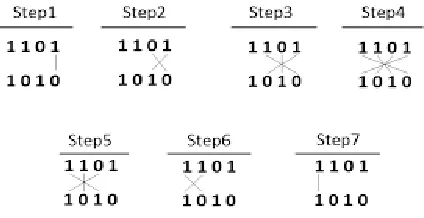
The multiplier used for performing convolution is based on an Urdhva Tiryagbhyam (Vertical & Crosswise) sutra of Indian Vedic Mathematics. Urdhva Tiryagbhyam Sutra is a general multiplication formula. The meaning of urdhva tiryagbhyam sutra is “Vertically and crosswise”. It is based on a concept in which all partial products are generated by vertical and crosswise multiplication and result is obtained by addition of these partial products.
Fig 2:Steps involved in Urdhva Tiryagbhyam Sutra
ISSN(Online): 2320-9801
ISSN (Print): 2320-9798
I
nternational
J
ournal of
I
nnovative
R
esearch in
C
omputer
and
C
ommunication
E
ngineering
(An ISO 3297: 2007 Certified Organization)
Vol. 4, Issue 9, September 2016
of four products is performed as shown in fig: 2. This operation continues till MSBs of multiplier and multiplicand are multiplied. The final sum and carry is obtained. If carry is present at last stage then it is forwarded to next column and it is written as a result. In this way for four bit vedic multiplication maximum 8 samples of result is obtained using seven steps of urdhva tiryagbhyam algorithm.
II. PROPOSED WORK
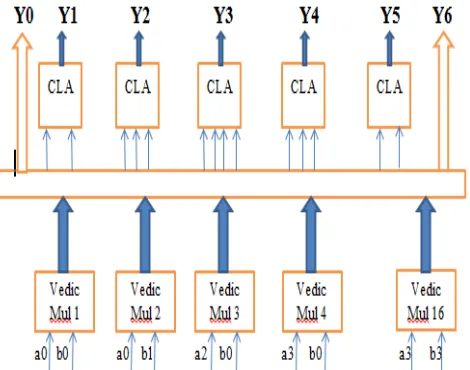
For this project work, the direct method of computing linear convolution which is discussed in earlier section is implemented. The vedic multiplier for multiplication and carry look ahead adder for addition are selected. The vedic multiplier and adder are designed. The block diagram is designed for project work and it is shown below:
Fig 3: block diagram of four bit linear convolution using vedic mathematics
Fig 3 shows block diagram of proposed algorithm of linear convolution using vedic mathematics. a and b are inputs for convolution, each is array of four samples. The sequence Y0 to Y6 is the output sequence of convolution. For obtaining 16 partial products, 16 vedic multipliers are used. The output of each 4 bit vedic multiplier is 8 bit. As partial products are obtained in parallel manner , speed of computation is increased. For additon, different adders are studied and synthesized using xillinx ISE simulator 14.2 and CLA adder is used, which is faster one. The Y0 to Y6 is an output convolution sequence. The samples Y0 and Y6 are direct partial products. The remaining output sequence is obtained by adding partial products.
III. RESULTS
ISSN(Online): 2320-9801
ISSN (Print): 2320-9798
I
nternational
J
ournal of
I
nnovative
R
esearch in
C
omputer
and
C
ommunication
E
ngineering
(An ISO 3297: 2007 Certified Organization)
Vol. 4, Issue 9, September 2016
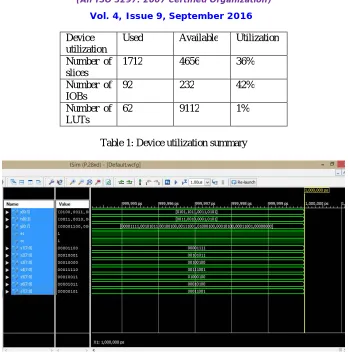
Table 1: Device utilization summary
:
Fig 4 : Simulation result of 4 bit linear convolution using vedic mathematics
Here, x = 0101, 1011, 0011, 0101 [05 11 03 05] h = 0011, 0010, 0001, 0101 [03 02 01 05]
y= 00001111, 00101011, 00100100, 00111001, 01000100, 00010100, 00011001
[15 43 36 57 68 20 25]
In fig 4, simulation results of four bit linear convolution using vedic mathematics. Here x and h are input sequence and its impulse response sequence and y is a output sequence.The result of convolution obtained in simulation and calculated result of convolution are verified and both answers are matched.
Table 2 below shows delay comparison of convolution. In [3], serial implementation of linear convolution is explained. In that algorithm, only one vedic multiplier is used. Though the hardware used is less but the delay produced is more.it is upto 183.19 ns.
In my project work, parallel implementation of linear convolution is developed using fastest adder i.e. carry look ahead adder. Though parallel implementation is used, partial products are generated in parallel manner. Due to that delay introduced is much less. It is observed as 11.727 ns
Device utilization
Used Available Utilization
Number of slices
1712 4656 36%
Number of IOBs
92 232 42%
Number of LUTs
ISSN(Online): 2320-9801
ISSN (Print): 2320-9798
I
nternational
J
ournal of
I
nnovative
R
esearch in
C
omputer
and
C
ommunication
E
ngineering
(An ISO 3297: 2007 Certified Organization)
Vol. 4, Issue 9, September 2016
Table 2: Delay comparison of convolution
IV.CONCLUSION
In This paper, an algorithm is developed for performing 4 bit high speed linear convolution with the help of urdhva tiryagbhyam sutra of vedic mathematics. The proposed algorithm is easy to learn and perform. The algorithm is coded in VHDL. The proposed method is synthesized and performed using xillinx ISE simulator 14.2 with Spartan 6 device as xc6slx16-3csg324.The advantages of the proposed architecture is efficient in speed and area. The computation time required for performing convolution operation is less as compared with the conventional method.
REFERENCES
[1] Jain, S. ; Saini S. “High Speed Convolution and Deconvolution algorithm (Based on Ancient Indian Vedic Mathematics) electrical engineering/electronics, computer, telecommunications and information technology (ecti-con), Publication Year: 2014 , Page(s): 1 – 5.IEEE 2014. [2] Pierre, John W. ”A novel method for calculating the convolution sum of two finite length sequences.” Education, IEEE Transactions on 39.1 (1996): 77-80.
[3] Lomte, Rashmi K., and P. C. Bhaskar. ”High Speed Convolution and Deconvolution Using Urdhva Triyagbhyam.” VLSI (ISVLSI), 2011 IEEE Computer Society Annual Symposium on. IEEE, 2011.
[4] Jagadguru Swami Sri Bharati Krisna Tirthaji Maharaja, “Vedic Mathematics: Sixteen Simple Mathematical Formulae from the Veda", Motilal Banarasidas Publishers,Delhi, 2009.
[5]Rudagi, J. M., Vishwanath Ambli, Vishwanath Munavalli, Ravindra Patil, and Vinaykumar Sajjan. ”Design and implementation of efficient
multiplier using Vedic mathematics.” (2011): 162-166.
[6]J.G.ProakisandD.G.Manolakis,”DigitalSignalProcessing:Principles, Algorithm, and Applications,” 2nd Edition. New York Macmillan, 1992. [7] Hanumantharaju, M. C., et al. ”A High Speed Block Convolution using Ancient Indian vedic Mathematics.” Conference on Computational Intelligence and Multimedia Applications, 2007. International Conference on. Vol. 2. IEEE, 2007.
[8] R.UMA,Vidya Vijayan, M. Mohanapriya, Sharon Paul.” Area, Delay and Power Comparison of Adder Topologies”(2012) International Journal of VLSI design & Communication Systems (VLSICS) Vol.3, No.1.
[9] Vaidya, Sumit, and Deepak Dandekar. ”Delay-Power Performance Comparison of multipliers in VLSI circuit design.” International Journal of Computer Networks & Communications (IJCNC) 2.4 (2010): 47-56.
[10] Honey Tiwari, Ganzorig ankhuyag, Chan Mo Kim,Yong Beom Cho,”Multiplier design based on ancient Indian Vedic Mathematics”,IEEE,2008 International Soc Design Conference.
[11] Pandit Ramnandan Shastri, “Vedic Mathematics”, Arihant Publications, p.V.
[12] A.P Nicholas, K.R Williams, J. Pickles-Vertically and Crosswise applications of the Vedic Mathematics Sutra, Motilal Banarsidass Publishers, Delhi, 2003
Delay of linear convolution
using conventional method
[3]
195.092ns
Delay of proposed method
of convolution