Performance Analysis of Bacterial Foraging
Based Audio Enhancement Technique
Parul Mahajan1, Randhir Singh2, Ritika3
M. Tech Scholar, Department of ECE, S.S.C.E.T, Badhani, Pathankot, India1
Associate Professor (HOD), Department of ECE, S.S.C.E.T, Badhani, Pathankot, India2
Assistant Professor, Department of ECE, S.S.C.E.T, Badhani, Pathankot, India3
ABSTRACT: Audio enhancement is located to be really critical job in the music indicate processing. Many music development techniques have developed in the present literature. The cuckoo based strategy shows greater performance as in contrast to the last techniques applying SNR. The outcomes received proved the potency of the applied method and its ability to curb sound and improve the speech signal. But due to the constraint of low convergence charge to the real world wide minimum actually at large variety of dimensions of cuckoo search it become very hard to have worldwide optimum solution. So in order to overcome the limits of the cuckoo search, the BFOA algorithm can be used rather than the cuckoo search. As BFO assures the international perfect solution therefore it has provided optimistic enhancement effects on the Cuckoo search technique. Different kind of the music signs are thought to judge the effectiveness of the applied technique. The entire studies are obviously show that the applied technique outperforms on the accessible techniques.
KEYWORDS: Audio Enhancement, Cuckoo Search, Bacterial Foraging Optimization Algorithm, Speech signal techniques.
I. INTRODUCTION
Audio Enhancement (AE) seeks to boost the efficiency of audio connection techniques in loud conditions [1]. AE used in, for instance, to a portable radio connection program, a audio to text program, a speech recognition program, a couple of poor recordings, or to boost the efficiency of products for the experiencing reduced [5, 9]. AE is just a traditional issue in signal processing. Reading support customers often have great problem knowledge audio in a loud background. They an average of require a signal-to-noise ratio SNR of approximately 5–10 dB more than regular experiencing fans to attain exactly the same level of audio knowledge. Thus, many simple and multi-microphone noise decrease methods have already been created for modern experiencing aids. Multi-microphone noise decrease techniques are able to exploit spatial as well as spectral data and are thus preferred to single-microphone techniques [2].
CUCKOO SEARCH AND AUDIO ENHANCEMENT:
A. Cuckoo Search:Cuckoo Search Algorithm Cuckoo Search (CS) is one of the newest optimization formulas and was
created from the motivation that the obligate brood parasitism of some cuckoo species set their eggs in the nests of other variety birds which is of other species. In Cuckoo Research, three idealized rules are thought which says that each cuckoo sits one egg at any given time, and eliminate its egg in randomly plumped for nest. The 2nd principle states that best nests with good quality of eggs may carry over to the next generations and the third one says that how many accessible variety nests is fixed, and the egg set by way of a cuckoo is discovered by the variety chicken with a likelihood in the range 0 to 1.
B. Audio Enhancement Techniques: There are several ways available to classify speech enhancement systems based on
available that contain reference noise signal, and noise is reduced by making use of this reference signal. Designing complexity is more in these systems. One of the powerful multichannel speech enhancement techniques is adaptive noise cancellation.
Fig.1. Block Diagram of a Single Channel Speech Enhancement System
C. Bacterial Foraging Optimization: Bacterial Foraging Optimization Algorithm (BFOA) is really a new comer to the family of character encouraged optimization algorithms. Program of group foraging technique of a swarm of E.coli microorganisms in multi-optimal function optimization is the important thing strategy of this new algorithm. Germs look for nutrients is a fashion to maximize energy obtained per model time. Specific bacterium also communicates with the others by giving signals. A bacterium takes foraging decisions after contemplating two previous factors. The process, by which a bacterium moves by using little steps while looking for nutrients, is called chemotaxis. The key notion of BFOA is mimicking chemotactic movement of electronic microorganisms in the problem search space. Foraging theory is on the basis of the prediction that animals look for and obtain nutrients in a way that boosts their energy intake Elizabeth per model 65 time T spent foraging. Thus, they try to maximize a function like E/T (or they improve their long-term average charge of energy intake). Maximization of such a function gives nutrient sources to survive and additional time for other crucial activities (e.g., fighting, fleeing, mating, reproducing, asleep, or shelter building).
II. RELATED WORK
Kevin M. Passino et al. (2006) [1] represents steps accompanied by germs to attain worldwide optimum solution: chemotactic step, replica step, elimination and dispersal step. In chemotactic step of BFOA, germs swim in journey of large vitamin floor while they slip when hazardous floor is encountered. Purpose of BFOA is definitely to cut back the price tag on bacteria's action in large vitamin surface. By the conclusion with this, all germs are established in descending obtain of the health value.
Kuldip Paliwal et al. (2010) [2] propose and investigate fusion of modulation spectral subtraction with the MMSE method. The fusion is performed in the short-time spectral domain by combining the magnitude spectra of the above speech enhancement algorithms. Subjective and objective evaluation of the speech enhancement fusion shows consistent speech quality improvements across input SNRs.
Christian D. Sigg et al. (2010) [3] the enhancement of speech degraded by non-stationary interferers is a highly relevant and difficult task of many signal processing applications. We present a monaural speech enhancement method based on sparse coding of noisy speech signals in a composite dictionary, consisting of the concatenation of a speech and interferer dictionary, both being possibly over-complete.
V. Ramakrishnan et al. (2011) [4] presented a two-stage strategy to correct the presentation progress issue in true noisy world. This method comprises of typical spectral subtraction strategy accompanied by a series of perceptually decided post processing algorithms.
Ji Ming et al. (2011) [6] introduces method to maximally extract these two features of speech for speech enhancement. We demonstrate that this can reduce the requirement for prior information about the noise, which can be difficult to estimate for fast-varying noise.
Binitha et al. (2012) [7] investigated the significance of varied bio-inspired techniques on basis of the get a grip on variables and application. But this report didn't build the precise dimension selection which numerous nature inspired techniques are evaluated. Thus, each one of these papers give constrained knowledge to the researchers and practitioners in regards to the difficulties and prospects of nature inspired algorithms.
A. Narayanan et al. (2012) [8] presented a SNR opinion method which will be established on computational verbal scene examination (CASA). It is just a binary masking scheme. This method cannot be employed for short-time SNR estimation. This method requires autocorrelation computation and package extraction at each T-F unit. Results of various studies show that the in the offing strategy increases results than different long-term SNR opinion algorithms.
Nima Yousefian et al. (2012) [9] proposed A novel dual-microphone speech enhancement technique. The technique utilizes the coherence between the target and noise signals as a criterion for noise reduction and can be generally applied to arrays with closely spaced microphones, where noise captured by the sensors is highly correlated.
N. Yousefian et al. (2013) [10] planned a coherence-based combined mike method for estimation of SNR. That method can be used for hearing aids and cochlear implant devices. Various experiments have now been done in different conditions. The outcome show that the planned method gives substantial efficiency in anechoic and moderately reverberant conditions.
N. Madhu et. al (2013) [11] experimented with establish a so named binary disguise as the objective of binary disguise estimation. Here, it's shown that practices using binary goggles can improve the intelligibility at low SNR values. For appropriate effects, a low spectral quality, patterned utilizing the Bark-spectrum range is to be used. The efficiency of IBM and IWF has compared. Intelligibility check shows the higher intelligibility values of IWF than IBM.
Nasser Mohammedhia et al. (2013) [12] Reducing the interference noise in a monaural noisy audio signal has been a challenging task for many years. Compared to traditional unsupervised audio enhancement methods, e.g., Wiener filtering, supervised approaches, such as algorithms based on hidden Markov models (HMM), lead to higher-quality enhanced audio signals.
Xugang Lu et al. (2013) [13] We previously have applied deep auto encoder (DAE) for noise reduction and audio enhancement. However, the DAE was trained using only clean audio. In this study, we further introduce an explicit denoising process in learning the DAE. In training the DAE, we still adopt greedy layer-wised pre training plus fine tuning strategy.
J. B. Crespo et al. (2014) [14] shown a method for audio support in a case where there are lots of play right back regions. In such a event, signals from region head to other leading to deterioration of audio intelligibility. An easy distortion is employed to enhance the standard or intelligibility. Results display the features of multizone control on the iterated request of simple region algorithm.
J. Jensen et al. (2014) [15] proposed a method based on common information for estimation of normal intelligibility of loud and refined presentation signal. This technique estimates the common information by evaluating the critical-band amplitude covers of loud or refined presentation signal since mmse can be viewed as an indicator for the intelligibility of loud audio. Simulation results reveal that the proposed method can anticipate the intelligibility of presentation altered by equally stationary and non-stationary noises.
D. P. K. Lun et al. (2014) [16] shown a greater presentation advancement algorithm based on a novel expectation maximization (EM) framework. The traditional TCS method is used to begin the algorithm. The strategy employs the sparsity of audios in the cepstral domain. The strategy performs effectively once the presentation is altered by the non-stationary noises. Experimental results reveal that the proposed method outperforms other methods for verbal audio. However for unvoiced situation different algorithm alongside proposed algorithm is needed.
Seon M. Kim et al. (2014) [17] shown a method for target presentation estimation by thinking about the spatial cues in loud environments. In this process, SNR is estimated utilizing the period big difference obtained from dual-microphone signals. As direction-of-arrival (DOA) of target signal is related to the period big difference between multiple mike signs, so DOA-based SNR is estimated in this method. The performance of this method is examined in terms of SDR, SIR and SAR. Results reveal that the Wiener filter using the proposed DOA based SNR estimation performs much better than other presentation advancement methods.
clean signals. Acoustic context was found to improve the continuity of audio to be separated from the background noises successfully without the annoying musical artifact commonly observed in conventional audio enhancement algorithms.
Martin Krawczyk et al. (2014) [19] the enhancement of audio which is corrupted by noise is commonly performed in the short-time discrete Fourier transform domain. In case only a single microphone signal is available, typically only the spectral amplitude is modified. However, it has recently been shown that an improved spectral phase can as well be utilized for audio enhancement, e.g., for phase-sensitive amplitude estimation.
Anil garg et al. (2015) [20] a very successful noise reduction strategy for improvement of presentation signals using enhanced disguise is proposed. Formerly, the loud presentation show is damaged in to numerous time–volume (TF) items and the functions are created by acquiring the Amplitude Magnitude Spectrogram (AMS). The signals are then marked centered on quality percentage in to numerous lessons to help make the unique number of solutions. Therefore,
the perfect disguise for each and every single form is done centered on Cuckoo search algorithm
.
III.PROPOSEDALGORITHM
A. Research Methodology:
Initialize parameters.
Elimination-dispersal loop.
Reproduction loop.
Chemotaxis loop.
Reproduction.
Elimination- dispersal.
End.
B. Description of the Proposed Algorithm:
Bacteria Foraging Optimization Algorithm, proposed by Passino, is just a new comer to the household of nature-inspired optimization algorithms. For during the lastfive decades, optimization algorithms like Genetic Algorithms, Evolutionary Programming, Evolutionary Strategies, which draw their inspiration from evolution and natural genetics, have now been dominating the realm of optimization algorithms. Recently natural swarm inspired algorithms like Particle Swarm Optimization, Ant Colony Optimization have discovered their way into this domain and proved their effectiveness. Application of group foraging strategy of a swarm of E.coli bacteria in multi-optimal function optimization is the important thing concept of the newest algorithm. Bacteria look for nutrients in a way to increase energy obtained per unit time. Individual bacterium also communicates with others by sending signals. A bacterium takes foraging decisions after considering two previous factors. The procedure, by which a bacterium moves by taking small steps while trying to find nutrients, is known as chemotaxis and key concept of BFOA is mimicking chemotactic movement of virtual bacteria in the issue search space.
IV.PSEUDOCODE
Step 1: Initialize parameters p, S, NC, NS ,Nre, Ned, Ped, C(i)(i=1,2…S), θi Algorithm.
Step 2: Elimination-dispersal loop: l=l+1 Step 3: Reproduction loop: k=k+1 Step 4:Chemotaxis loop: j=j+1
[a] For i =1,2…S take a chemotactic step for bacterium i as follows. [b] Compute fitness function, J (i, j, k, l).
Let, J (i, j, k, l) J ( i, j, k, l) +JCC(θi(j,k,l),P(j,k,l)) (i.e. add on the cell-to cell attractant–repellant profile to
simulate the swarming behavior) where, Jcc is defined in (2).
[c] Let Jlast=J (i, j, k, l) to save this value since we may find a better cost via a run.
[d] Tumble: generate a random vector p ∆ (i) ∈ℜp
with each element ∆m(i),m =1,2 ,..., p, a random number
on [- 1, 1]. [e] Move:
Let(θ(j + 1, k, l) = (θ(j, k, l) + ( )∆( )
∆ ( )∆( ) eq.(1) This results in a step of size C(i) in the direction of the tumble for bacterium i.
[f] Compute ( , + 1, , ) and let
J(i, j + 1, k, l) = J(i, j, k, l) + J (θ(j + 1, k, l), P(j + 1, k, l) eq.(2) [g] Swim i) Let m=0 (counter for swim length).
ii) While m< Ns (if have not climbed down too long).
Let m=m+1.
If J(i, j + 1, k, l) =<Jlast( if doing better), let Jlast = J(i, j + 1, k, l)and let Let(θ(j + 1, k, l) = (θ(j, k, l) + ( )∆( )
∆ ( )∆( ) eq.(3) And use this (θ(j + 1, k, l) to compute the new J(i, j + 1, k, l)as we did in [f] Else, let m= NS . This is the end of the while statement.
[h] Go to next bacterium (i+1) if i ≠ S (i.e., go to [b] to process the next bacterium)
Step 5: If j <NC, go to step 4. In this case continue chemotaxis since the life of the bacteria is not over.
Step 6: Reproduction:
=∑ ( , , , )
be the health of the bacterium i (a measure of how many nutrients it got over its lifetime and how successful it was at
avoiding noxious substances). Sort bacteria and chemotactic parameters C(i) in order of ascending cost Jhealth (higher
cost means lower health).
[b] The Sr bacteria with the highest Jhealthvalues die and the remaining Sr bacteria with the best values split
(this process is performed by the copies that are made are placed at the same location as their parent).
Step 7: If k <Nre, go to step 3. In this case, we have not reached the number of specified reproduction steps, so we
start the next generation of the chemotactic loop.
Step 8: Elimination-dispersal: For i = 1,2, ..., S with probability Ped , eliminate and disperse each bacterium (this
Keeps the number of bacteria in the population constant). To do this, if a bacterium is eliminated, simply
Disperse another one to a random location on the optimization domain. If l < Ned , then go to step 2; otherwise end.
V. SIMULATION RESULTS
This paper has designed and implemented the proposed technique in MATLAB tool u2013a. This section offers the cross validation between existing and proposed techniques. Some well-known audio performance parameters are mean error and mean square error i.e. for audios have already been selected to prove that the performance of the proposed algorithm is very much better than the existing methods.
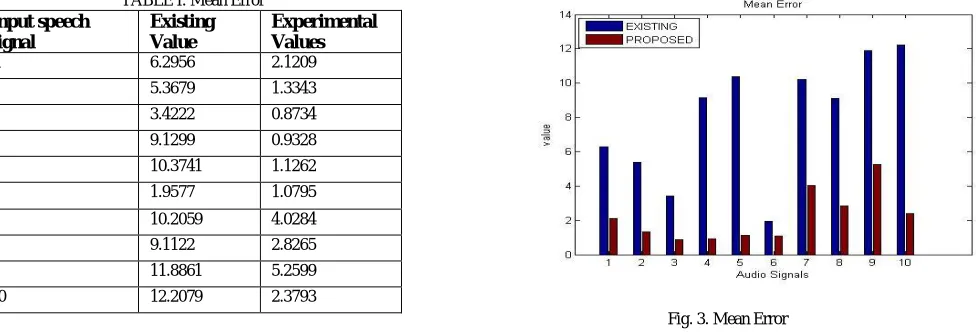
1) Mean Error: It shows the quantized analysis of the mean error. Table 1 has shown the mean error have to be reduced which means applied algorithm is showing the better results compared to the available methods as mean error is minimum in all of the cases.
TABLE I. Mean Error Input speech
signal
Existing Value
Experimental Values
1 6.2956 2.1209
2 5.3679 1.3343
3 3.4222 0.8734
4 9.1299 0.9328
5 10.3741 1.1262
6 1.9577 1.0795
7 10.2059 4.0284
8 9.1122 2.8265
9 11.8861 5.2599
10 12.2079 2.3793
Fig. 3. Mean Error
The above fig.3 indicates the quantized analysis of the mean error of various audios using BFOA by existing technique (Blue color) and BFOA by applied approach (Red Color). . This decrease represents improvement in the objective quality of the audio signal.
The above fig.4 indicates the quantized analysis of the mean square error of various audios using BFOA by Existing Technique (Blue color) and BFOA by applied approach (Red Color). It has clearly shown from the plot that there is decrease in MSE value of audios with the usage of applied method over other methods in all audios.
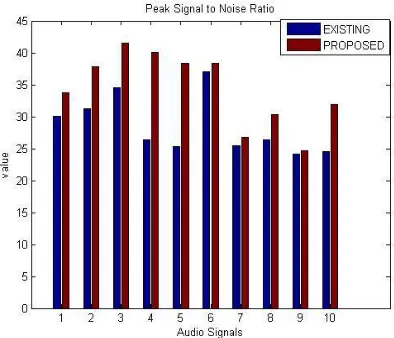
3) Peak Signal to Noise Ratio (PSNR): As PSNR have to be maximized; so the main goal is to increase the PSNR as
much as possible. Table III has clearly shown that the PSNR is maximum in the case of the applied algorithm therefore applied algorithm provides better results compared to the available methods.
TABLE III. Peak Signal to Noise Ratio Input speech signal Existing
Values
Experimental Values
1 30.0130 33.7919
2 31.2481 37.8219
3 34.5804 41.5027
4 26.4071 40.0153
5 25.3218 38.3769
6 37.0712 38.3470
7 25.4253 26.7383
8 26.4041 30.3877
9 24.1741 24.6385
10 24.5506 31.8862
Fig. 5. Peak Signal to Noise Ratio
The above fig5 has shown the quantized analysis of the peak signal to noise ratio of various audios using BFOA by Existing Technique (Blue Color) and BFOA by applied Approach (Red Color). It has clearly shown from the table that there is increase in PSNR value of audios with the usage of applied method over other methods. This increase represents improvement in the objective quality of the audio signal.
TABLE IV. Root Mean Square Error Input speech
signal
Existing Values
Experimental Values
1 8.0517 5.2113
2 6.9556 3.2768
3 4.7590 2.1449
4 12.1951 2.5455
5 13.8181 3.0740
6 3.5726 3.0845
7 13.6544 11.7388
8 12.1993 7.7118
9 15.7702 14.9491
10 15.1012 13.2616 Fig. 6. Root Mean Square Error
Fig 6 shows the quantized analysis of root mean square error of various audios using BFOA by Existing Technique (Blue color) and BFOA by applied Approach (Red Color). It has clearly shown from the plot that there's decrease in RMSE values of audios with the usage of applied method around other methods in all the audios. This decrease represents improvement in the objective quality of the audio.
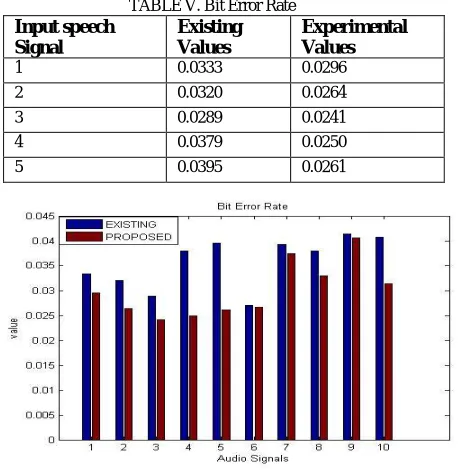
5) Bit Error Rate (BER): As bit error rate have to be reduced therefore the applied algorithm is showing the better results compared to the available methods as bit error rate is minimum in all the cases. Table V has clearly shown that the BER is minimum in the case of the proposed algorithm therefore proposed algorithm provides better results compared to the available methods.
TABLE V. Bit Error Rate Input speech
Signal
Existing Values
Experimental Values
1 0.0333 0.0296
2 0.0320 0.0264
3 0.0289 0.0241
4 0.0379 0.0250
5 0.0395 0.0261
6 0.0270 0.0267
7 0.0393 0.0374
8 0.0379 0.0329
9 0.0414 0.6406
10 0.0407 0.0314
Fig 7 shows the quantized evaluation of the bit error rate of various audios using BFOA by Existing Technique (Blue color) and BFOA by applied Approach (Red Color). It has clearly shown from the table that there is decrease in BER value of audios with the usage of applied technique around other methods in all the audios. This decrease represents improvement in the objective quality of the audio signal.
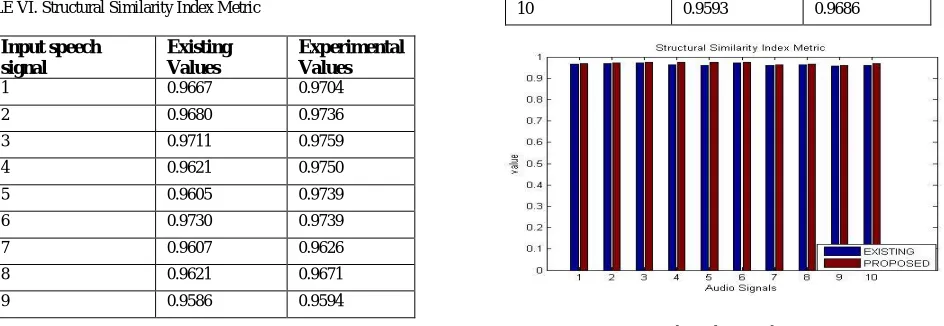
6) Structural Similarity Index Metric (SSIM): As SSIM have to be maximized; so the main aim is to increase the SSIM. Table VI has clearly shown that the SSIM is maximum in case of the applied algorithm thus applied algorithm provides better results compared to the available methods.
TABLE VI. Structural Similarity Index Metric
Input speech signal
Existing Values
Experimental Values
1 0.9667 0.9704
2 0.9680 0.9736
3 0.9711 0.9759
4 0.9621 0.9750
5 0.9605 0.9739
6 0.9730 0.9739
7 0.9607 0.9626
8 0.9621 0.9671
9 0.9586 0.9594
10 0.9593 0.9686
Fig. 8. Structural Similarity Index Metric
Fig 8 indicates the quantized analysis of the structural similarity index metric of different audios using BFOA by existing technique (Blue Color) and BFOA by applied approach (Red Color).It has clearly shown from the table that there's increase in SSIM values of audios with the usage of applied method over other methods. This increase represents the improvement in the objective quality of the audio signal.
VI.CONCLUSION AND FUTURE WORK
Audio Enhancement is just a traditional issue in signal processing. Reading support customers often have great problem knowledge audio in a loud background. This paper has proposed the BFOA algorithm is used instead of the cuckoo search. The proposed technique is designed and implemented in the MATLAB 2010a.Different parameters have been considered for experimental purpose. As BFO guarantees the global optimum solution therefore it has provided optimistic enhancement results over the Cuckoo search technique. Different kind of the audio signals are considered to evaluate the effectiveness of the proposed technique. The overall experiments are clearly indicated that the proposed technique outperforms over the available techniques.
This work has focused on BFO based enhancement only, in near future BFO will be hybridized with some other evolutionary optimization techniques. Also technique may also be used for some other signals.
REFERENCES
1. Kevin M. Passino, “Biomimicry of Bacterial Foraging for Distributed Optimization and Control”, IEEE Control Systems Magazine, pp. 52-67, 2006.
2. Kuldip Paliwal, Kamil Wójcicki, and Belinda Schwerin. "Single-channel audio enhancement using spectral subtraction in the short-time modulation domain." Audio communication 52.5,450-475, 2010.
3. Christian D. Sigg, T. Dikk and J. M. Buhmann, "Audio enhancement with sparse coding in learned dictionaries," 2010 IEEE International Conference on Acoustics, Audio and Signal Processing, Dallas, TX, pp. 4758-4761, 2010
4. Vyass Ramakrishnan, Karthik Shetty, Pawan Kumar G and Chandra Shekhar Seelamantula, “Efficient Post Proceesing Technique for Audio Enhancemnt”, in NCC, pp. 1-5, 2011.
5. Phiplipos C. Loizou and G. Kim, "Reasons why Current Audio-Enhancement Algorithms do not Improve Audio Intelligibility and Suggested Solutions," in IEEE Transactions on Audio, Audio, and Language Processing, vol. 19, no. 1, pp. 47-56, Jan. 2011.
6. Ji Ming, R. Srinivasan and D. Crookes, "A Corpus-Based Approach to Audio Enhancement From Non stationary Noise," in IEEE Transactions on Audio, Audio, and Language Processing, vol. 19, no. 4, pp. 822-836, May 2011.
7. S. Binitha and S. S. Sathya, “A Survey of Bio inspired Optimization Algorithms, International Journal of Soft Computing and Engineering, Vol.2, No. 2, pp. 137-151, May 2012.
8. Arun Narayanan and DeLiang Wang, “A CASA-Based System for Long-Term SNR Estimation”, IEEE Trans. Audio, Audio, Lang. Process., vol. 20, no. 9, pp. 2518-2527, November 2012.
10. Nima Yousefian and Philipos C.Loizou, “A Dual Microphone Algorithm that can Cope with Competing Talkers Scenarios”, IEEE Trans. Audio, Audio, Lang. Process., vol. 21, no. 1, pp. 145-155, January 2013.
11. Nilesh Madhu, Ann Spriet, Sofie Jansen, Raphael Koning and Jan Wouters, “The Potential for Audio Improvement using the Ideal Binary Mask and the Ideal Wiener Filter in Single Channel Noise Reduction Systems: Application to Auditory Prostheses”, IEEE Trans. Audio, Audio, Lang. Process., vol. 21,no. 1, pp. 63-72, January 2013.
12. Nasser Mohammedhia, P. Smaragdis and A. Leijon, "Supervised and Unsupervised Audio Enhancement Using Nonnegative Matrix Factorization," in IEEE Transactions on Audio, Audio, and Language Processing, vol. 21, no. 10, pp. 2140-2151, Oct. 2013.
13. Xugang Lu, et al. "Audio enhancement based on deep denoising auto encoder." Interaudio. 2013.
14. Joao B.Crespo and Ricahrd C.Hendriks, “Multizone Audio Reinforcement”, IEEE Trans. Audio, Audio, Lang. Process., vol. 22, no. 1, pp. 54-66, January 2014.
15. Jesper Jensen and Cees H.Taal, “Audio Intelligibility Prediction based on Mutual Information”, IEEE Trans. Audio, Audio, Lang. Process., vol. 22, no. 2, pp. 430-440, February 2014.
16. Daniel P.K.Lun, Tak-Wai Shen and K.C.Ho, “A Novel Expectation-Maximization Framework for Audio Enhancement in Non-Stationary Noise Environment”, IEEE Trans. Audio, Audio, Lang. Process., vol. 22, no. 2, pp. 335-346, February 2014.
17. Seon M. Kim and Hong Kook Kim, “Direction-of Arrival based SNR Estimation for Dual-Microphone Audio Enhancement”, IEEE Trans. Audio, Audio, Lang. Process., vol. 22, no. 12, pp. 2207-2217, December 2014.
18. Yong Xu, J. Du, L. R. Dai and C. H. Lee, "An Experimental Study on Audio Enhancement Based on Deep Neural Networks," in IEEE Signal Processing Letters, vol. 21, no. 1, pp. 65-68, Jan. 2014.
19. Martin Krawczyk and T. Gerkmann, "STFT Phase Reconstruction in Voiced Audio for an Improved Single-Channel Audio Enhancement," in IEEE/ACM Transactions on Audio, Audio, and Language Processing, vol. 22, no. 12, pp. 1931-1940, Dec. 2014
20. Anil Garg, and O. P. Sahu. "Cuckoo search based optimal mask generation for noise suppression and enhancement of audio signal." Journal of King Saud University-Computer and Information Sciences 27.3, 269-277, 2015.
BIOGRAPHY
Er. Parul Mahajan is a Master of Technology (M.Tech) student in the Electronics and Communication department, Sri Sai College of Engineering and Technology, Punjab Technical University. She received Bachelor of Technology (B.Tech) degree in 2014, Sri Sai College of Engineering and Technology, Punjab Technical University. Her research interest is in signal processing (Bacterial Foraging Optimization Based Audio Enhancement).
Er. Randhir Singh received his B. E. degree in Electronics Engineering from Dr. Baba sahib Ambedkar Marathwada University, Aurangabad, India, in 1997 and M. Tech. degree in Electronics and Communication Engineering from Punjab Technical University (PTU), Kapurthala, Punjab, India, in 2009. He is currently a Ph.D. research scholar in PTU, Kapurthala.
He joined the department of Electronics and Communication Engineering, Sri Sai College of Engineering and Technology, Pathankot, in 2004. Presently, he is an Associate Professor and Head of the Department. His research interests include digital signal processing, speech signal processing, image processing, and electronics system designing. He has more than 50 research papers to his credit. He has a wide experience of guiding M.Tech. students.