Scholarship at UWindsor
Scholarship at UWindsor
Electronic Theses and Dissertations Theses, Dissertations, and Major Papers
2016
Efficient Implementation of Finite Field Multipliers over Binary
Efficient Implementation of Finite Field Multipliers over Binary
Extension Fields
Extension Fields
Parham Hosseinzadeh Namin
University of Windsor
Follow this and additional works at: https://scholar.uwindsor.ca/etd
Recommended Citation Recommended Citation
Hosseinzadeh Namin, Parham, "Efficient Implementation of Finite Field Multipliers over Binary Extension Fields" (2016). Electronic Theses and Dissertations. 5828.
https://scholar.uwindsor.ca/etd/5828
Multipliers over Binary Extension Fields
by
Parham Hosseinzadeh Namin
A Dissertation
Submitted to the Faculty of Graduate Studies through the
Department of Electrical and Computer Engineering in Partial Fulfillment
of the Requirements for the Degree of Doctor of Philosophy at the
University of Windsor
Windsor, Ontario, Canada
by
Parham Hosseinzadeh Namin
APPROVED BY:
Dr. A. Reyhani-Masoleh, External Examiner
Electrical and Computer Engineering, University of Western Ontario
Dr. A. Azab, Outside Department Reader Industrial & Manufacturing Systems Engineering
Dr. M. Khalid, Department Reader Electrical and Computer Engineering
Dr. R. Rashidzadeh, Department Reader Electrical and Computer Engineering
Dr. R. Muscedere, Co-Supervisor Electrical and Computer Engineering
Dr. M. Ahmadi, Co-Supervisor Electrical and Computer Engineering
Previous Publication
I. Co-Authorship Declaration
I hereby declare that this thesis incorporates material that is result of joint research, as follows:
This thesis also incorporates the outcome of a joint research undertaken in collaboration with Crystal Roma, as an outstanding scholar under the supervision of Dr. M. Ahmadi. The collaboration is covered in Chapter 6 of the thesis. In all cases, schematics, block diagrams, data analysis and interpretation, were performed by the author.
II. Declaration of Previous Publication
This thesis includes 4 original papers that have been previously published/submitted for publication in peer reviewed journals and conferences, as follows:
Thesis Chapter Publication Title Publication Status
Chapter3
A fully serial-in parallel-out digit-level finite field multiplier inF2musing redundant representation, accepted to appear in the proceedings of the 50th
Asilomar Conference on Signals, Systems and Computers
Accepted
Chapter4 Digit-level serial-in parallel-out multipliers using redundant representation for a
class of finite fields, IEEE Transactions on VLSI: Regular Papers In press
Chapter5
Low power design of a word-level finite field multiplier using reordered normal basis, in the proceedings of the 2015 49th Asilomar Conference on Signals,
Systems and Computers, Pacific Grove, CA, 2015, pp. 437-440.
Published
Chapter6
Efficient VLSI implementation of a finite field multiplier using reordered normal basis in domino logic, IEEE Transactions on Circuit and Systems:
Regular Papers
In press
I certify that I have obtained a written permission from the copyright owner(s) to include the above published material(s) in my thesis. I certify that the above material describes work completed during my registration as graduate student at the University of Windsor.
I declare that, to the best of my knowledge, my thesis does not infringe upon anyones copyright nor violate any proprietary rights and that any ideas, techniques, quotations, or any other material from the work of other people included in my thesis, published or oth-erwise, are fully acknowledged in accordance with the standard referencing practices. Fur-thermore, to the extent that I have included copyrighted material that surpasses the bounds of fair dealing within the meaning of the Canada Copyright Act, I certify that I have ob-tained a written permission from the copyright owner(s) to include such material(s) in my thesis.
Cryptography can be categorized into two fundamentally different classes: symmetric-key and public-key (also known as asymmetric-key). Contrary to symmetric-key cryptography where the robustness of the security mechanism relies on a single key being known merely to the sender and receiver, public-key cryptography functions using two separate, but math-ematically related keys. Elliptic curve (EC) and ElGamal cryptosystems are two important examples of public-key cryptosystems based totally on finite field arithmetic.
Elliptic Curve (EC) cryptosystem is the most efficient public key cryptographic sys-tem used in practice. The capability of establishing equivalent security levels with shorter key sizes makes EC cryptosystems appealing for a variety of applications. However, it is computationally intensive and has considerably higher power consumption compared to non-public key cryptosystems. Realization of EC cryptosystems are often described as a hierarchy of operations in which finite field arithmetic operations form the bottom-most layer of the hierarchy. Finite field multiplication is a key operation used in all cryptosys-tems relied on finite field arithmetic as it not only is computationally complex but also one of the most frequently used finite field operations.
Different digit-level architectures over binary extension field are explored and practical size multipliers for cryptographic applications have also been realized in hardware using65nm
CMOS technology. It is shown that the proposed architectures are more efficient compared to similar proposals considering area/delay complexities as a measure of performance.
I would like to express my gratitude and appreciation to Dr. Majid Ahmadi and Dr. Roberto Muscedere, my supervisors for their invaluable guidance and constant support throughout the course of this work.
In addition to my advisors, I would like to thank the rest of my thesis committee, Dr. Rashidzadeh, Dr. khalid and Dr. Azab for their participation in my seminars, their con-structive comments and advice.
A very special thanks is required for Ms. Adria Ballo and Ms. Lorraine Grondin for their continuous help and support during my time as a graduate student.
Declaration of Co-Authorship / Previous Publication iv
Abstract vi
Dedication viii
Acknowledgments ix
List of Figures xiv
List of Tables xvi
List of Abbreviations xviii
1 Introduction 1
References 11
2 Mathematical Preliminaries 14
2.1 Introduction . . . 14
2.2 Algebraic Structures . . . 15
2.2.1 Group . . . 15
2.2.2 Ring . . . 16
2.2.3 Field . . . 17
2.2.4 Finite Field . . . 17
2.2.5 Prime Field . . . 18
2.2.6 Extension Field . . . 18
2.3 Representation Systems . . . 19
2.3.1 Polynomial Basis . . . 19
2.3.2 Normal Basis . . . 22
2.3.3 Redundant Basis . . . 25
References 29 3 A Fully SIPO Digit-Level Finite Field Multiplier inF2mUsing Redundant Basis 31 3.1 Introduction . . . 31
3.2 A Brief Review of Redundant Basis Representation inF2m . . . 33
3.3 Proposed Digit-level FSIPO Multiplier Using Redundant Representation . . 34
3.3.1 The Proposed Multiplication Algorithm . . . 36
3.3.2 The Proposed Multiplier Architecture . . . 37
3.3.3 Architectural Complexities . . . 39
3.4 Hardware Implementation and Comparison . . . 40
3.5 Conclusion . . . 44
4 Digit-Level SIPO Multiplier Using Redundant Basis for a Class of Finite Fields 47
4.1 Introduction . . . 47
4.2 A Brief Review of Redundant Representation inF2m . . . 49
4.2.1 Redundant Representation forF2m . . . 49
4.2.2 Multiplication Using Redundant Representation inF2m . . . 50
4.3 Proposed Digit-level SIPO Multipliers Using Redundant Representation . . 51
4.3.1 Proposed Digit-Level RB Multiplication Algorithm, Type−a . . . . 53
4.3.2 New Multiplier Architecture, DL-RB-a . . . 58
4.3.3 New Multiplier Architecture, DL-RB-b . . . 62
4.4 Architectural Complexities and Comparison . . . 65
4.5 Hardware Implementation . . . 70
4.6 Conclusion . . . 73
References 75 5 Power-Efficient Design of a Word-level Finite Field Multiplier Using RNB 78 5.1 Introduction . . . 78
5.2 A Brief Review of Reordered Normal Basis and Its Arithmetic inF2m . . . 80
5.2.1 Reordered Normal Basis . . . 80
5.2.2 Multiplication Operation Using Reordered Normal Basis . . . 81
5.2.3 Word-level Architecture for RNB Multiplier . . . 81
5.3 Design of the Multiplier Main Building Block . . . 82
5.3.1 The Precharge Phase . . . 84
5.3.2 The Evaluation Phase . . . 85
5.4 Simulation Results and Performance Comparison . . . 87
5.5 Conclusion . . . 90
6 Efficient VLSI Implementation of a RNB Finite Field Multiplier in Domino
Logic 93
6.1 Introduction . . . 93 6.2 Brief Review of Reordered Normal Basis and Multiplication Operation
Us-ing This Basis inF2m . . . 95
6.3 Review of Existing RNB and Type-II ONB Multipliers . . . 97 6.3.1 Related Work . . . 97 6.3.2 Selected Multiplier Architecture in Reordered Normal Basis . . . . 98 6.4 Design of the Multiplier’s Main Building Block In Domino Logic . . . 100 6.5 Custom-Layout Implementation of the xax-module . . . 103 6.6 Design and Implementation of the Full Multiplier Using the xax-module . . 107 6.7 Simulation Results and Performance Comparison Between Different VLSI
Implementations . . . 109 6.8 Conclusion . . . 118
References 120
7 Conclusions 124
7.1 Summary of Contributions . . . 124 7.2 Future Work . . . 126
Appendix A IEEE Copyright 129
1.1 Design hierarchy for realizing elliptic curve cryptosystems . . . 5
3.1 Proposed digit-level fully serial-in parallel-out architecture for redundant basis multipliers . . . 38
3.2 Design flow used to realize RB multipliers . . . 40
3.3 Final layout of FSIPO RB multiplier (w= 8) . . . 41
4.1 Proposed architecture for digit-level SIPO RB multiplier, DL-RB-a. . . 58
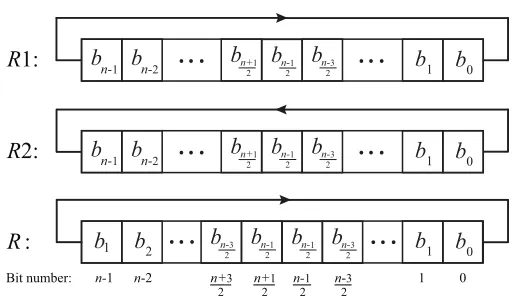
4.2 Circularn-bit shift register to store coordinates of operandB . . . 60
4.3 Proposed architecture for digit-Level SIPO RB multiplier, DL-RB-b . . . . 64
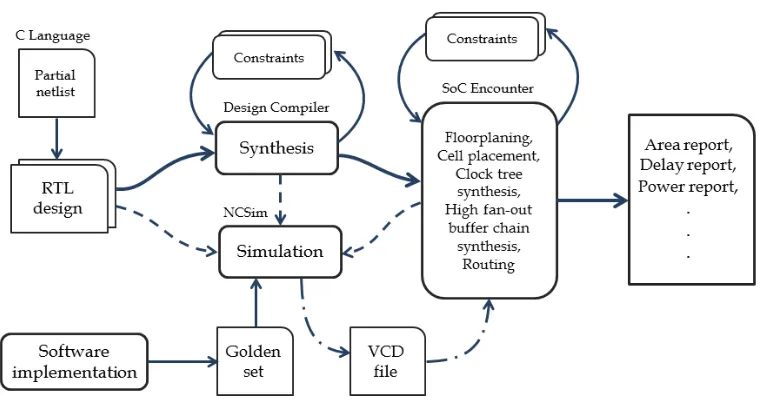
4.4 Design flow used to implement the proposed architectures . . . 71
4.5 Final layout of DL-RB-amultiplier for the case wherem= 233andw= 16. 72 4.6 Final layout of DL-RB-bmultiplier for the case wherem= 233andw= 16. 72 5.1 Word-level RNB multiplier composed of xax-cells [7] . . . 82
5.3 Simulation voltage waveforms of the selected nodes in the proposed domino
circuit . . . 86
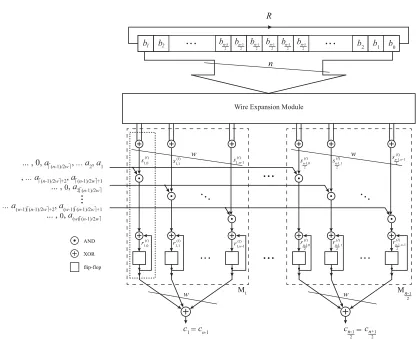
6.1 Serial-in Parallel-out reordered normal basis multiplier composed of xax-modules [5] . . . 99
6.2 Proposed design for XOR-AND-XOR function in domino logic . . . 101
6.3 Proposed layout for the XOR-AND-XOR function created in 65nm tech-nology . . . 103
6.4 Layout of the complete xax-module including three flip-flops . . . 104
6.5 Test-bench for performing corner analysis . . . 105
6.6 Block diagram of a full 233-bit RNB multiplier . . . 108
6.7 The proposed layout for a 233-bit sequential RNB multiplier designed in domino logic . . . 110
1.1 Security comparison; estimated time for successful brute-force attacks, re-quired bit sizes for different security levels [2] . . . 3 3.1 Complexity comparison between digit-level redundant basis architectures . 39 3.2 Details of ASIC implementations for the digit-level RB multipliers listed
in table 3.1 forF2268 . . . 43
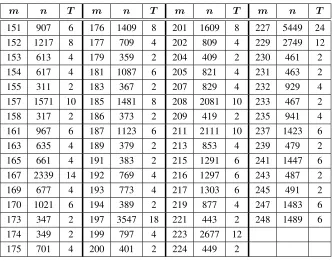
4.1 Smallest cyclotomic fieldF(2n)that containsF2mfor150 < m <250, when ncan be expressed asn =T m+ 1,T >2and even∗ . . . 52 4.2 Complexity comparison between digit-level architectures; The proposed
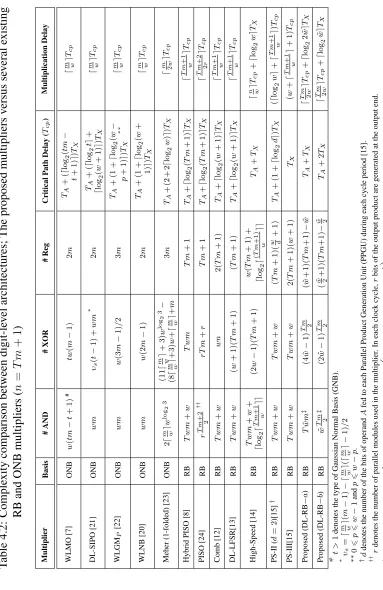
multipliers versus several existing RB and ONB multipliers (n =T m+ 1) . 67 4.3 Numerical complexity comparison of digit-level redundant basis and
op-timal normal basis multipliers in F2233 (embedded in F(467)2 in the case of
5.1 Results of the corner analysis simulation for the xax-cell; delay and power measurements . . . 87 5.2 Performance comparison between different233-bit word-level RNB
multi-pliers (w= 30, d= 8) designed in domino logic . . . 88 6.1 Gate-level complexity comparison between different bit-serial
RNB/type-II ONB multipliers overF2m. . . 98
6.2 Post-layout Corner Analysis Simulation Results of the xax-module; Delay (ps) and Power (µW/GHz) . . . 106 6.3 Complexity comparison between VLSI implementations of domino logic
and static CMOS designs for a sequential RNB multiplier inGF(2233). . . 112
3DES Triple Data Encryption Standard. AEDS AND-Efficient Digit-Serial. AES Advanced Encryption Standard.
ASIC Application-Specific Integrated Circuit. BPWS Bit-Parallel Word-Serial.
BSWP Bit-Seriall Word-Parallel. CAD Computer Aided Design.
CMOS Complementary Metal-Oxide-Semiconductor. DES Data Encryption Standard.
EC Elliptic Curve.
ECC Elliptic Curve Cryptograhy.
ECDH Elliptic Curve DiffieHellman key exchange algorithm. ECDSA Elliptic Curve Digital Signature Algorithm.
FLT Fermats Little Theorem.
FPGA Field-Programmable Gate Array. FSIPO Fully Serial-In Parallel-Out. GF Galois Field.
GNB Gaussian Normal Basis. IC Integrated Circuit.
IEEE Institute of Electrical and Electronics Engineers. IoT Internet of Things.
NB Normal Basis.
NIST National Institute of Standards and Technology. NMOS n-Channel MOSFET.
PIPO Parallel-In Parallel-Out. PISP Parallel-In Serial-Out. PMOS p-Channel MOSFET. RB Redundant Basis.
RNB Reordered Normal Basis. SIPO Serial-In Parallel-Out.
SMPO Sequential Multiplier with Parallel Output. SPB Shifted Polynomial Basis.
SSL Secure Socket Layer.
TSMC Taiwan Semiconductor Manufacturing Company. TSPC True Single Phase Clock.
Introduction
Assum-ing that the communication medium is shared between n users, since each pair of users require a different key to establish their own secure communication,n(n−1)/2different keys are requires in total which makes it hard to manage even in mid-size networks.
First introduced in1976by Whitfield Diffie and Martin Hellman [1], public-key cryp-tography is the solution to the key distribution problem. Instead of using single key, public-key cryptography functions using two separate, but mathematically related public-keys: public keyandprivate key. Public key is not kept secret, can be freely distributed in the network of users and is used for the purpose of encryption. Private key, on the other hand, instead of being shared between the two parties, is held by only one party and is used in decryp-tion process only. The pair of public key and its corresponding private key must be used together and has a reciprocal relationship such that using the key pair together achieves the same result as using a symmetrical key twice. It also should be noted that public-key cryptography has the advantage over symmetric-key cryptography in that it can provide additional security services such as key-exchange, digital signature, identity authentication and message integrity verification [2, 3].
cryp-Table 1.1: Security comparison; estimated time for successful brute-force attacks, required bit sizes for different security levels [2]
Security Cryptosystem Family (Algorithm)
Security Estimation Level
(bit)
Symmetric key (AES, 3DES)∗
Integer Fac-torization
(RSA)†
Discrete Logarithm (ElGamal)
Elliptic Curve (ECDH, ECDSA)‡
Short term (few days) 56 56 512 512 112
Medium term (few years) 80 80 1024 1024 160
Medium term (few decades) 112 112 2048 2048 224
without quantum computing 128 128 3072 3072 256
Long term (several decades) 192 192 7680 7680 384
even with quantum computing] 256 256 15360 15360 512
∗
Triple DES (3DES), consists of three consecutive DES encryptions.
†The fastest factoring algorithm used to break RSA is the General Number Field Sieve (GNFS) algorithm. ‡ECDH: Elliptic Curve DiffieHellman key exchange algorithm, ECDSA: Elliptic Curve Digital Signature
Algorithm. The only known algorithm to attack ECC is the Pollards rho algorithm.
]Based on the known quantum computing algorithms in2010.
tographic protocols that utilized RSA and ElGamal versus ECC. These key sizes are listed at different levels of comparable security. Three important facts can be observed from the table: First, the ECC keys are significantly smaller than those of RSA and ElGamal for any given level of security. Second, the ratio of the key sizes for RSA/ElGamal to the key sizes for ECC increases from approximately6 : 1for80-bit comparable security level to30 : 1
for 256-bit level. As a result, the higher security is required, the more efficient ECC be-comes compared with the two other public-key schemes. Third, the key lengths of elliptic curve algorithms are twice as long as those of symmetric algorithms for the same level of security which reflects the higher computational complexity of the public-key schemes.
from resource-constrained platforms such as Internet of Things (IoT) and Wireless Sensor Networks (WSN) to compute-intensive applications such as high performance servers to run Secure Socket Layer (SSL) protocols. It might be of interest to know that the hardest reported ECC schemes broken to date are associated to the prime field of degree 112 in July2009and extension field of degree109in April2004[8, 9]. The former took about6
months on a cluster of more than200PlayStation3(PS3) game consoles, though as claimed could have been finished in3.5months if the hardware resources were continuously used. The latter took17months on2600computers equivalent to the CPU time of an Athlon XP
3200+working non-stop for about1200years. Note that, currently, binary field sizes are required to be at least 160 bits for ECC applications which would be approximately one hundred million times harder to solve. Despite the advantages of ECC over other public-key schemes, implementation of ECC in software usually leads to a long computation time, hence making it difficult to be adopted in real-time or time-sensitive applications.
The realization of an elliptic curve cryptosystem is often described as a hierarchy of operations which typically can be broken down into four levels as shown in Fig. 1.1. The top level contains elliptic curve standards and protocols such as Elliptic Curve Digital Sig-nature Algorithm (ECDSA) for authentication and Elliptic Curve Diffie-Hellman (ECDH) for key-exchange protocol. In ECC, a confidential message is mapped as a point on an El-liptic Curve (EC) and the encryption process moves this point to another point on the curve corresponding to an encrypted message [10, 3]. The encryption operation is achieved by elliptic curve scalar multiplication, the most fundamental and dominant operation in ECC, which forms the next (lower) level. Scalar multiplication is expressed asQ=kP wherek
Figure 1.1: Design hierarchy for realizing elliptic curve cryptosystems
constructing the bottom-most layer of the hierarchy.
Two most commonly used classes of finite fields in cryptography are prime fields of degree one (GF(p)) and binary extension fields of degree greater than one (GF(2m)). The latter is a subclass of a more generalized group of finite fields known as finite prime extension fields (GF(pm)) where the characteristic p is equal to two and the extension degreemis greater than one. (More details about finite fields will be presented in Chapter
2). It is been shown that elliptic curve cryptosystems over prime fields can provide the same level of security as cryptosystems over binary extension fields of degree m when
p ≈ 2m [11]. Nonetheless, binary fields are more attractive for high speed cryptography applications as the basic field operations addition and multiplication in the underlying field
F2 can be readily realized by a bit-wise XOR and a bit-wise AND operations, respectively.
based on Fermats Little Theorem (FLT) [12]. Finite field addition is a low cost operation as it can be implemented by a series of XOR gates performing a field addition for each pair of corresponding coordinates inGF(2). This field operation is a carry-free operation. The complexity of the squaring operation depends on the basis by which field elements are represented. In the case of normal basis and redundant basis, squaring operation is realized by reordering the coordinates of field elements at no hardware cost (for more details about representation systems see Chapter 2). In the most general case, squaring operation can be viewed as a special case of multiplication operation when the two operands are equal. Finite field multiplication, on the other hand, is not only computationally complex but also one of the most frequently used finite field operations which makes it a key factor for any cryptosystem based on finite field computations.
Different architectures for finite field multipliers can generally be categorized into bit-serial, bit-parallel and digit-level architectures. The first two represent the two extreme design styles. Given a binary extension field of degreem, bit-level multipliers require m
contrary, decreasing the value of w will lead to longer multiplication delay and smaller area requirement. This flexibility in making a trade-off between area and delay makes the digit-level architectures the most commonly implemented type of architectures in practice.
1.1
Outline of the Dissertation
The rest of this dissertation is organized as follows. Chapter2gives a brief review of the basic concepts in abstract algebra with a focus on finite fields. At first, basic algebraic structures such as group, ring and field together with the main associated properties are explained. Then, the concept of representation systems for finite fields is covered. Three types of representation systems, namely polynomial basis, normal basis and redundant ba-sis are discussed in detail. For each representation systems, basic arithmetic operations and their distinct properties are explained. Finally, the relationship between redundant basis and two important subclasses of normal basis are highlighted.
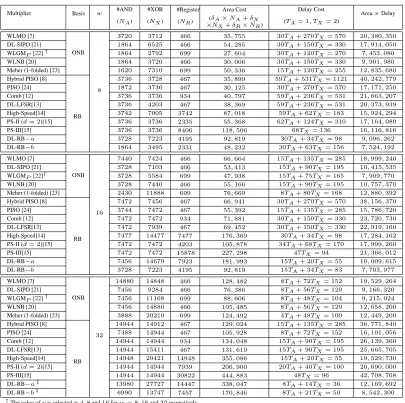
place&route implementations. To draw a fair comparison, all of the digit-level architec-tures were implemented in 65nm CMOS process for two different practical digit sizes as Application Specific Integrated Circuit (ASIC) modules. The complexity comparison shows that the proposed architecture has the smallest area-delay complexity compared to existing digit-level architectures. It also possesses one of the smallest area requirements which makes it a good candidate for resource-constrained applications.
Chapter4presents two high-speed serial-in parallel-out finite field multiplier using re-dundant representation. Despite great advantage of rere-dundant representation stemming from accommodating ring type operations, the main drawback of the this representation system is that it contains certain amount of redundancy as embedding a finite field in a larger cyclotomic field is not a one to one mapping operation. As a result, redundant rep-resentation requires more bits to represent field elements, thus generally requiring more hardware resources for hardware implementation. Redundant representation enables sig-nificant reduction in architectural complexity for certain classes of finite fields which can compensate for the inherent redundancy in this representation system. This subclass in-cludes, but is not limited to, all the fields for which type-II optimal normal basis exists. Another unique feature of the new digit-level architectures is that the critical path delay is neither dependent on the digit size nor the field size. This feature is highly useful when utilizing a high level of parallelism to achieve a higher speed in high performance appli-cations. Both proposed architectures possess highly regular structures which make them suitable for full-custom VLSI implementations. It is shown that significant reduction in hardware complexities are achieved in comparison to existing digit-level RB architectures. Finally, hardware realizations of the proposed multipliers in65nmCMOS process for three practical digit sizes are also presented.
static logic circuits is that they can effectively improve the circuit operation speed which makes them a favorite choice for the critical path of high performance multipliers. How-ever, this improvement is achieved at the cost of significant increase in power dissipation. Extra power dissipation is associated with higher switching activities of the internal nodes which is an inherent characteristic of domino logic circuits. The work presented in this chapter mainly focuses on reduction of the contention current at the beginning of the eval-uation phase as it is the second contributing factor in the high power consumption. Several techniques have been proposed in the open literature to tackle the high power consumption of the domino circuits. Nonetheless, these techniques would be more effective in the cases of circuits with very large Pull Down Networks (PDNs) such as64-bit or128-bit multiplex-ers. When integrated with the xax-cell, the relatively large number of transistors used in the existing techniques in comparison to the total number of transistors used in the design of the xax-cell imposes significant power and area overhead. It is shown that the performance of the xax-cell can be improved by employing the proposed domino circuit. Transistor-level simulation results for a digit-Transistor-level Reordered Normal Basis (RNB) multiplier shows that the proposed technique significantly increases the maximum operating frequency and compares favorably to existing domino techniques in terms of power consumption.
of digital circuits, as the technology node scales down less delay and power is expected. The reason lies in the fact that the smaller the dimensions of transistors become, the less capacitance has to be charged and discharged. However, the negative effect of intercon-nect and parasitic capacitances has become a more dominant factor with device shrinkage. In other words, the gap between schematic and post-layout simulations is widened after interconnect and parasitic capacitance are taken into considerations and this increases the difficulties in accurate evaluation of designs when only relying on schematic or synthesis level simulations. This effect is well reflected by large discrepancies between the char-acteristics of the schematic level and the layout level implementations of the sequential multiplier. The post place&route simulations shows that the proposed implementation can perform multiplication with31%higher speed than the static CMOS counterpart (also im-plemented with a full-custom layout) while consuming marginally less power. The size of the multiplier is currently recommended by the National Institute of Standard and Tech-nology (NIST) for binary field multiplication in Elliptic Curve Cryptography (ECC). The proposed design methodology can also be used in the implementation of similar finite field multipliers possessing highly regular architectures.
[1] W. Diffie and M. Hellman, “New directions in cryptography,”IEEE Transactions on Information Theory, vol. 22, pp. 644–654, Sep 2006.
[2] C. Paar and J. Pelzl,Understanding Cryptography: A Textbook for Students and Prac-titioners. Springer Publishing Company, Incorporated, 3th ed., 2010.
[3] Handbook of Applied Cryptography (Discrete Mathematics and Its Applications).
Boca Raton, Florida: CRC Press, 1996.
[4] R. L. Rivest, A. Shamir, and L. Adleman, “A method for obtaining digital signatures and public-key cryptosystems,”Commun. ACM, vol. 21, pp. 120–126, Feb 1978. [5] T. ElGamal, “A public key cryptosystem and a signature scheme based on discrete
logarithms,” IEEE Transactions on Information Theory, vol. 31, pp. 469–472, sep 2006.
[6] N. Koblitz, “Elliptic curve cryptosystems,” Mathematics of Computation, vol. 48, no. 177, pp. 203–209, 1987.
[7] V. S. Miller,Use of Elliptic Curves in Cryptography, pp. 417–426. Berlin, Heidelberg: Springer Berlin Heidelberg, 1986.
[8] “Certicom announces elliptic curve cryptography challenge winner.” Avail-able at https://www.certicom.com/news-releases/300-solution-required-team-of-mathematicians-2600-computers-and-17-months-.
[9] “112-bit prime ECDLP solved.” Available at http://lacal.epfl.ch/112bit prime. [10] D. Hankerson, A. J. Menezes, and S. Vanstone,Guide to Elliptic Curve Cryptography.
Secaucus, NJ, USA: Springer-Verlag New York, Inc., 2003.
[11] S. Blake-Wilson, A. K. Lenstra, A. Odlyzko, U. M. Maurer, and N. Koblitz,Towards
a Quarter-Century of Public Key Cryptography. Secaucus, NJ, USA: Springer US,
[12] T. Itoh and S. Tsujii, “A fast algorithm for computing multiplicative inverse in
GF(2m)using normal basis,”Information and Computation, vol. 78, no. 3, pp. 171– 177, 1988.
[13] J. Omura and J. Massey, “Computational method and apparatus for finite field arith-metic,” May 1986. US Patent 4,587,627.
[14] H. Wu, M. Hasan, I. Blake, and S. Gao, “Finite field multiplier using redundant rep-resentation,”IEEE Transactions on Computers, vol. 51, pp. 1306–1316, Nov 2002. [15] G. B. Agnew, R. C. Mullin, I. M. Onyszchuk, and S. A. Vanstone, “An implementation
for a fast public-key cryptosystem,” Journal of Cryptology, vol. 3, pp. 63–79, Jan 1991.
[16] R. Azarderakhsh and A. Reyhani-Masoleh, “Low-complexity multiplier architectures for single and hybrid-double multiplications in gaussian normal bases,”IEEE Trans-actions on Computers, vol. 62, pp. 744–757, April 2013.
[17] A. Reyhani-Masoleh and M. A. Hasan, “Low complexity sequential normal basis multipliers overGF(2m),” inProceedings of the 16th IEEE Symposium on Computer Arithmetic, pp. 188–195, June 2003.
[18] H. Wu, “Low complexity LFSR based bit-serial montgomery multiplier inGF(2m),”
in Proceedings of the IEEE International Symposium on Circuits and Systems
(IS-CAS2013), pp. 1962–1965, May 2013.
[19] M. A. Hasan, M. Z. Wang, and V. K. Bhargava, “A modified massey-omura paral-lel multiplier for a class of finite fields,”IEEE Transactions on Computers, vol. 42, pp. 1278–1280, Oct 1993.
[20] C. K. Koc¸ and B. Sunar, “Low-complexity bit-parallel canonical and normal basis multipliers for a class of finite fields,” IEEE Transactions on Computers, vol. 47, pp. 353–356, Mar 1998.
[21] A. Reyhani-Masoleh and M. A. Hasan, “A new construction of massey-omura parallel multiplier over GF(2m),” IEEE Transactions on Computers, vol. 51, pp. 511–520, May 2002.
[22] H. Wu and M. A. Hasan, “Low complexity bit-parallel multipliers for a class of finite fields,”IEEE Transactions on Computers, vol. 47, pp. 883–887, Aug 1998.
[24] A. H. Namin, H. Wu, and M. Ahmadi, “A word-level finite field multiplier using normal basis,”IEEE Transactions on Computers, vol. 60, pp. 890–895, June 2011. [25] A. Reyhani-Masoleh, “Efficient algorithms and architectures for field multiplication
using gaussian normal bases,”IEEE Transactions on Computers, vol. 55, pp. 34–47, Jan 2006.
[26] A. H. Namin, H. Wu, and M. Ahmadi, “Comb architectures for finite field multiplica-tion inF2m,”IEEE Transactions on Computers, vol. 56, no. 7, pp. 909–916, 2007.
[27] A. Reyhani-Masoleh and M. A. Hasan, “Efficient digit-serial normal basis multipliers overGF(2m),” inProceedings of the IEEE International Symposium on Circuits and Systems, ISCAS 2002, vol. 5, pp. V–781–V–784 vol.5, 2002.
[28] A. H. Namin, H. Wu, and M. Ahmadi, “High-speed architectures for multiplication using reordered normal basis,”IEEE Transactions on Computers, vol. 61, pp. 164– 172, Feb 2012.
[29] C.-Y. Lee and P. Meher, “Area-efficient subquadratic space-complexity digit-serial multiplier for type-II optimal normal basis ofGF(2m)using symmetric TMVP and block recombination techniques,”IEEE Transactions on Circuits and Systems I: Reg-ular Papers, vol. 62, pp. 2846–2855, Dec 2015.
[30] C. Y. Lee and P. K. Meher, “Subquadratic space-complexity digit-serial multipliers over GF(2m)using generalized (a,b)-way karatsuba algorithm,” IEEE Transactions
Mathematical Preliminaries
2.1
Introduction
2.2
Algebraic Structures
This section briefly explains the definition and main properties of several fundamental al-gebraic structures defined in abstract algebra. These concepts are extensively used in the area of finite field arithmetic and are frequently referred to within the subsequent chapters.
2.2.1
Group
[3, 2]
Agroupis defined as a finite or infinite set of elements(G)together with a group operator
(∗)by which any two elements can be combined to form a third element. This group is denoted by(G,∗) and its operator satisfies the following four properties, also known as
group axioms:
Axiom 2.2.1(Closure). GroupGis a closed set under the group operator∗, i.e. Ifa,b∈G, then the result ofa∗b∈G.
Axiom 2.2.2(Associativity). The group operator is associative, i.e. Ifa,b,c∈G, then the result of(a∗b)∗cis essentially equal to the result of(a∗b)∗c.
Axiom 2.2.3(Identity). There exist an identity elementI ∈Gwhich leaves other elements
unchanged when combined with it, i.e. for alla∈G,a∗I =I∗a=a.
Axiom 2.2.4(Inverse). There exist an inverse elementa−1∈Gfor eacha∈G, such that
a∗a−1 =a−1∗a=1.
The set of rational integers{. . . ,−3,−2,−1,0,+1,+2,+3, . . .}together with the ad-dition operation (+) can be named as the most familiar example of a group and is denoted by(Z,+).
Finite Groups
element of the group, the order of an elementaof a finite groupGis defined as the smallest power ofnsuch thatan =I.
Commutative Groups
A commutative group (also referred to as an abelian group) is a group that also satisfies the commutativity property, i.e. for alla,b∈G,a∗b=b∗a.
The set of integer numbers(Z)under binary operation “+” would be the most common example of an infinite group.
2.2.2
Ring
[3, 2]
Aring(short for number ring) is defined as a finite or infinite closed set of elements(R)
together with two binary operations (+,∗) such that it satisfies the following four condi-tions:
1. Rhas a commutativity property with respect to the binary operation “+“. 2. The binary operator∗is associative, meaning that ifa,b,c∈Rthen
(a∗b)∗c=(a∗b)∗c.
3. Rhas distributive property with respect to its two operations+and∗.
4. R has an identity element with respect to operation ”+“, i.e. for all a ∈ R there exists an identity elementIalso∈Rsuch thata∗I =I∗a=a. This identity element is calledzero element.
A ring may also satisfies multiplicative commutativity, i.e. for alla, b∈R,a∗b=b∗
a. A rign is termedcommutative ringif the multiplicative commutativity holds.
According to the above definition, a ring must contain at least one element, however it does not necessarily required to contain a multiplicative identity or to show commutativity property. The set of integer numbers(Z)under the usual addition and multiplication(+,×)
can be taken as an example of a commutative ring with the identity element “0”. The set of integers modulo n,(Zn), also forms a commutative ring under addition and multiplication modulon.
2.2.3
Field
[3, 2]
A field is defined as a finite or infinite closed set of elements (F) together with two bi-nary operations (+,∗) that satisfies the following two properties in addition to the ring’s properties:
1. Fhas the commutativity property under the both binary operation “+” and “∗“. 2. Nonzero elements ofFform a group with the binary operation∗and have
multiplica-tive inverses, i.e. ifa∈F(a6= 0), then there exist an elementa−1in
Fsuch thata∗
a−1 =a−1 ∗a=1.
Equivalently, A field is a ring whose nonzero elements form an abelian group under multiplication. The most common example of a field would be the set of real numbers (R) under the usual addition and multiplication(+,×).
2.2.4
Finite Field
power), i.e. q=pm, wherepis a prime number andmis a positive integer [4]. For a given
q, there exists exactly one finite field of order q, meaning that all fields of the same order areisomorphic. In other words, two finite fields of orderqhas the same structure and one field representation can be obtained by relabeling the elements of the other representation. Isomorphic fields of order q = pm are denoted as
Fpm, or GF(pm) in honor of Evariste
Galois, a French mathematician who did early work on finite fields. Note that except for the zero element, the remainingq−1elements of GF(pm)form a multiplicative group and have multiplicative inverses. In a finite field of orderq =pm,pis called thecharacteristic of the field and the sum ofpcopies of any element of the field always equals to zero.
2.2.5
Prime Field
Given two integer numbersaandm ∈Z, the remainder of dividingabymis obtained by applying themodulom operator toa. Two integersa andb ∈ Zare said to becongruent
modulomifa modm=b modm and are expressed asa ≡ b(modm). Thecongruence class(also known asresidue class) of integeramodulomis the set{a, a±m, a±2m, . . .}
consisting of all the integers congruent to a modulo m, denoted by Zm. Given a prime number p, the set of residue classes modulo p, ([0 p−1]), together with addition and multiplication modulo p as field operations form the prime field of order p denoted by either notationFporGF(p).
2.2.6
Extension Field
Given prime numberp, elements in the prime fieldFpcan be used to span anmdimensional vector space denoted as Fmp or equivalently GF(pm). A resulting m-dimensional vector space is called anextension fieldconsisting ofpmdifferent elements. In the special case of
p= 2, the extension field is called abinary fieldor acharacteristic-two field. Finally, note that in the following chapters, two notations of GF(2m) and
F2m are
2.3
Representation Systems
AGF(2m)can be viewed as a vector space of dimensionmoverGF(2)with2melements. In other words, each element of this space can be uniquely represented bymindividual co-ordinates with respect to a basis, each with possible values from the subfieldGF(2), which is limited to the set{0,1}. A basis is a linearly independent spanning set consisting ofm
linearly independent elements, e.g. I ={β0, β1, . . . , βm−1}, such that each element of the
extension field can be uniquely expressed as a linear combination of this set. LetAbe an arbitrary element inGF(2m)andI be the vector set of a basis inGF(2m), thenAcan be represented with respect toI asA =Pm−1
i=0 aiβi,ai ∈GF(2) for06i 6m−1. A basis for the extension field of GF(2m) can be defined in different mathematically equivalent ways. From a hardware-oriented point of view, each of these bases has its own pros and cons. The choice of the basis by which field elements are represented has a major effect on the efficient implementation of finite field operations. A number of bases over extension fields has been introduced in the academic literature among which polynomial basis (PB), Normal Basis (NB) and Redundant Basis (RB) are the most commonly used bases in prac-tice [2, 5, 6, 7]. In what follows, such representation bases are briefly introduced and in each case the prominent features are highlighted.
2.3.1
Polynomial Basis
Polynomial basis, also referred to as the standard or canonical basis, can be named as the most common representation basis in software applications. In polynomial basis, the elements of a binary extension field of degreemare represented in the form of polynomials of degree at mostm −1, with coefficients in GF(2). Let a basis elementβ ∈ GF(2m)
Using this representation system, any field elementA∈GF(2m)can be represented as
A=a0+a1β+a2β2+· · ·+am−1βm−1 =
m−1
X
i=0
aiβi, ai ∈GF(2). (2.1)
It is also common to represent the coordinate sequence in the form of an m-dimensional vector as (a0, a1, a2, . . . , am−1) beginning with the coefficient of the least-degree root at
the left side.
Addition Operation
Addition is the most basic operation in finite field arithmetic. Compared to the other field operations in polynomial basis, implementation of addition operation requires the least amount of hardware resources. Assuming thatAandB are two field elements inGF(2m)
represented as A = Pm−1
i=0 aiβ
i andB = Pm−1
i=0 biβ
i respectively, the addition operation can be given by
A+B =
m−1
X
i=0
((ai+bi)mod2)βi. (2.2)
As equation (2.2) suggests, the addition operation inGF(2m)is a carry-less operation and can be broken down into coefficient-wise (mod 2)-additions of the corresponding co-ordinates, carried out in GF(2). From a hardware-oriented point of view, each modular addition inGF(2) can be realized by utilizing a 2-input XOR gate. As a result, (m−1)
XOR gates are required to conduct an addition operation inGF(2m).
Multiplication and Squaring Operations
LetP(x)be the irreducible field polynomial and two field elementsA andB ∈ GF(2m) be represented in polynomial basis as,A=Pm−1
i=0 aiβi andB =
Pm−1
Then, the extension field multiplication ofAandB in polynomial basis is given by
C =A.B =
m−1
X
i=0 aiβi.
m−1
X
j=0
bjβj (2.3)
=
m−1
X
i=0
m−1
X
j=0
aibjβi+j (2.4)
=
2m−2
X
`=0 d`β`
modP(x) =
m−1
X
k=0
ckβk (2.5)
where
d` =
X
i+j=`
aibj
mod2 0< i, j < m−1 (2.6)
Apart from the field addition operation, which can be easily realized by a series of XOR gates as explained earlier, calculating the final results of any field operation requires two modular reductions in the base and the binary extension fields. Nonetheless, as it will be shown in the following sections, specific features of the normal and redundant bases can effectively facilitate hardware implementation of field multiplication and field squaring operations which is not the case for polynomial basis.
2.3.2
Normal Basis
Let P(x) be an irreducible polynomial of degreem over GF(2) and I = {β20
, β21
, . . . ,
β2m−1}be the set ofm linearly independent roots ofP inGF(2m). In other words, none of the subsets ofI can add up to zero. Then, the elements of set I form a basis referred to as normal basis(NB) and β is called a normal element [2]. It can be proven that for every positive integer m, there exist at least one m-degree irreducible polynomial whose roots form a normal basis [2]. By choosing setIas the representation basis, a field element
A∈GF(2m), can be expressed by a unique linear combination of the basis elements as
A=a0β+a1β2+· · ·+am−1β2
m−1
=
m−1
X
i=0 aiβ2
i
, ai ∈GF(2). (2.7)
Addition Operation
Addition using normal basis over binary extension fields is carried out in the same way explained earlier for polynomial basis. Assuming that field elementsAandB ∈ GF(2m) are represented as A = Pm−1
i=0 aiβ2
i
andB = Pm−1
j=0 bjβ2
j
respectively, then the sum of the two elementsAandB can be calculated as:
A+B =
m−1
X
i=0
((ai+bi)mod2)β2
i
Squaring Operation
The squaring operation in normal basis is of a great interest as it only requires a single circular shift operation on the coordinates of the field element which can be realized in hardware at virtually no cost. For example if A is represented using NB as shown in (2.7), the square ofAcan be easily calculated asA2 =Pm−1
i=0 aiβ 2(i+1)
=Pm−1
i=0 a(i+1)β 2i
, and implemented by a simple right circular shift onA’s coordinates. More generally, any exponentiation to an integer power of 2, i.e. A2n, n ∈ N can be readily carried out by circularly moving the coordinates ofA,nposition to the right. Such powers are extensively used in the computation of higher level finite field operations such as field inversion.
Multiplication Operation
LetP(x)be the irreducible polynomial of the extension field and two field elementsAand
B ∈ GF(2m)be represented in normal basis as in equation (2.7),A = Pm−1
i=0 aiβ 2i
and
B = Pm−1
j=0 bjβ2
j
, respectively. Then, the extension field multiplication of A and B in normal basis can be written as
C =A.B =
m−1
X
i=0 aiβ2
i .
m−1
X
j=0 bjβ2
j
(2.9)
=
m−1
X
i=0
m−1
X
j=0
aibjβ2
i
β2j. (2.10)
Defineδij(k) ∈ F(2)be the coefficient ofβ2k in the expansion of the productβ2i·β2j when
represented with respect to the normal basis, as β2i .β2j
= Pm−1
k=0 δ (ij)
k β
2k
substitution in (2.10) forδ(ijk), it follows that
C =
m−1
X
i=0
m−1
X
j=0 aibj
m−1
X
k=0
δ(kij)β2k (2.11)
=
m−1
X
k=0
m−1
X
i=0
m−1
X
j=0
aibjδk(ij)
!
β2k (2.12)
=
m−1
X
k=0
m−1
X
i=0
m−1
X
j=0
ai+kbj+kδ
(ij) 0
!
β2k (2.13)
whereδ0(ij)are the elements of a matrix known as themultiplication matrix,M, expanding the product ofβ2i
.β2j
for all0< i, j < m−1. M is anm×mmatrix whose entries belong to the subfieldGF(2). From (2.13), the coordinates of the productC in normal basis can be obtained by
ck= m−1
X
i=0
m−1
X
j=0
ai+kbj+kδ(0ij). (2.14)
As an example, consider the binary expansion field ofGF(25)and the irreducible polyno-mialP(x) =x5 +x4+x3 +x+ 1. Letβ be the root ofP(x)generating a normal basis I ={β20, β21, β22, β23, β24, β25}. Then, the multiplication matrixM can be calculated as
M =
0 1 0 0 0
0 0 1 0 1
0 1 1 1 0
1 1 0 0 1
0 1 0 1 0
(2.15)
required. Different field sizes and the use of different irreducible polynomials may result in various multiplications complexities. However, in order to achieve the minimum hardware resources required to implement the multiplication operation, it would be advantageous to find the field size-irreducible polynomial pairs that results in a smaller CN. Mullin et al. [14] have shown that for a givenm,CN varies between two extreme values of2m+ 1and
m2, and is minimal in the case of two subclasses of normal basis, known as type I and II
Optimal Normal Bases (ONB). In the case of type-II ONB, none of the rows or columns of the multiplication matrix contains more than two non-zero entries.
2.3.3
Redundant Basis
Letβ be a primitiventh root of unity in an extension field ofGF(2). In other words,β is
the root of P(x) = xn−1, a polynomial of degree positive integer n. The smallest field extension over whichP(x)decomposes into linear factors is called thenth cyclotomic field
and is denoted byF2(n)[6]. Then, an elementA ∈F(2n)can be represented by the generator of this cyclotomic field,β, as
A=a0+a1β+a2β2+· · ·+an−1βn−1 =
n−1
X
i=0
aiβi, ai ∈GF(2). (2.16)
This presentation of the field elements is calledredundant representationand the set con-sisting of the power ofβ, I = {β0, β1, β2, . . . , βn−1}is referred to as a Redundant Basis
(RB).
To be able to perform finite field multiplication over a binary extension field using re-dundant basis, we are particularly interested in the case in whichGF(2m)can be contained in F(2n). Let GF(2m) denotes an extension field of characteristic 2. The following theo-rem describes the relationship betweennandmthat should be satisfied in order to embed
GF(2m)in
F(2n).
extension field ofGF(2m)is contained inF2(n)iff the multiplicative order of2modulonis divisible bym.
Proof. This theorem is a special case of Theorem 2.47 in [2] where q is equal to 2. As-suming thatdshows the multiplicative order of 2 modulo n, sinceF2(n) has degreed, F(2n) and F2d are isomorphic with respect to each other. The theorem follows as F2d contains GF(2m)iff mdividesd.
Note that for a given elementA ∈ GF(2m)the representation of (2.16) is not unique, i.e. for a given element ofF(2n) expressed by then-tuple (a0, a1,· · · , an−1), ai ∈ GF(2), there exist other n-tuples in F(2n) referring to the same element. For instance, let β be a primitive5th root of unity. Since,1 +β+β2 +· · ·+βn−1 = 0, then two coordinate sets
{1,0,0,1,0}and{0,1,1,0,1}essentially refer to the same element.
Addition Operation
Addition using normal basis over binary extension fields is carried out in the same way explained earlier for polynomial basis. Assuming that the extension field GF(2m)is em-bedded inF(2n), and two field elementsAandB ∈GF(2m)are represented with respect to a redundant basis asA =Pn−1
i=0 aiβi andB =
Pn−1
j=0 bjβj respectively, then the sum ofA andB can be calculated as:
A+B =
n−1
X
i=0
((ai+bi)mod2)βi. (2.17)
Squaring Operation
Assume that Ais represented by redundant basis as shown in (2.16). Considering the fact thatβn = 1, the square ofAcan be given by
A2 =
n−1
X
i=0
(ai)2 βi
2
=
n−1
X
i=0
aiβ2i = n−1
X
i=0
aiβ2imodn (2.18)
which can be carried out by performing a simple permutation over the coordinates of A
without dedicating any specific hardware resources.
Multiplication Operation
Let two redundant representation ofAandB ∈ GF(2m)be expressed asA =Pn−1
i=0 aiβ
i andB = Pn−1
j=0bjβi with respect to basisI = [1, β, β2, . . . , βn−1], respectively. ThenC, the product ofAandB, can be given by
C=A·B =
n−1
X
i=0
(aiβi)·B
=
n−1
X
i=0 ai
n−1 X
j=0 bjβi+j
=
n−1
X
i=0 ai
n−1 X
j=0
b(j−i)nβ
j
=
n−1
X
j=0
n−1 X
i=0
aib(j−i)n
βj, (2.19)
The notation of(j −i)n denotes that(j −i)is to be reduced modulo n. Define,A·B =
C ,Pn−1
j=0cjβj, thencj can be given by
cj = n−1
X
i=0
aib(j−i)n, j = 0,1, . . . , n−1. (2.20)
Since n is always greater than the degree of binary extension field, m, embedding
GF(2m)in cyclotomic field
rep-resentation requires more bits to represent a field element. The number of required bits is dictated by the size of cyclotomic field in which the underlying field is embedded. Conse-quently, for a givenmthe minimum value ofnsuch thatGF(2m)can be embedded in
F(2n)
is desired.
Remark 2.1. GF(2m)can be embedded in
F(2m+1),(n=m+ 1), If there exists an optimal
normal basis of type I for binary extension field ofGF(2m)[7].
Remark 2.2. GF(2m) can be embedded in
F(22m+1), (n = 2m + 1), If there exists an
optimal normal basis of type II for binary extension field ofGF(2m)[7].
[1] R. Lidl and H. Niederreiter,Finite Fields (Encyclopedia of Mathematics and its Ap-plications). Cambridge University Press, Oct 1996.
[2] R. Lidl and H. Niederreiter,Introduction to Finite Fields and Their Applications. New York, NY, USA: Cambridge University Press, second ed., 1997.
[3] J. W. Harris and H. Stocker,The Handbook of Mathematics and Computational Sci-ence. Secaucus, NJ, USA: Springer-Verlag New York, Inc., 1st ed., 1997.
[4] G. Birkhoff and S. Mac Lane, A Survey of Modern Algebra. Macmillan New York, 1941.
[5] R. Katti and J. Brennan, “Low complexity multiplication in a finite field using ring representation,”IEEE Transactions on Computers, vol. 52, pp. 418–427, April 2003. [6] S. Gao, J. von zur Gathen, and D. Panario, “Gauss periods and fast exponentiation in finite fields,” inLATIN ’95: Theoretical Informatics, vol. 911 of Lecture Notes in Computer Science, pp. 311–322, Springer Berlin Heidelberg, 1995.
[7] H. Wu, M. Hasan, I. Blake, and S. Gao, “Finite field multiplier using redundant rep-resentation,”IEEE Transactions on Computers, vol. 51, pp. 1306–1316, Nov 2002. [8] Digital Signature Standard (DSS), U.S. Department of Commerce, National Institute
of Standards and Technology (NIST), FIPS 186-4, July 2013.
[9] C. K. Koc¸ and B. Sunar, “Low-complexity bit-parallel canonical and normal basis multipliers for a class of finite fields,” IEEE Transactions on Computers, vol. 47, pp. 353–356, Mar. 1998.
[10] T. Itoh and S. Tsujii, “Structure of parallel multipliers for a class of fieldsGF(2m),”
Inf. Comput., vol. 83, pp. 21–40, Oct. 1989.
[12] E. D. Mastrovito, “VLSI designs for multiplication over finite fields GF(2m),” in
Proceedings of the 6th International Conference, on Applied Algebra, Algebraic
Al-gorithms and Error-Correcting Codes, AAECC-6, (London, UK, UK), pp. 297–309,
Springer-Verlag, 1989.
[13] A. Halbuto˘gullari and c. K. Koc¸, “Mastrovito multiplier for general irreducible poly-nomials,”IEEE Transactions on Computers, vol. 49, pp. 503–518, May 2000.
A Fully SIPO Digit-Level Finite Field
Multiplier in
F
2
m
Using Redundant Basis
3.1
Introduction
Finite field multiplication is the most frequently used arithmetic operation among basic field operations as more complex field operations such as field inversion and field exponen-tiation can be realized by consecutive use of field multiplication. As a result, an efficient implementation of finite field multipliers plays a major role in the overall performance of a cryptosystem. One important factor that directly affects the complexity of the finite field multiplication in hardware realization is the choice of the basis by which the elements of a finite field are represented. In redundant basis, the cyclotomic field by which the field elements are represented accommodates ring type operations, thus eliminating the need for modular reduction when performing multiplication operation. Furthermore, redundant basis offers a cost-free squaring operation which can be carried out by a single permu-tation operation over a set of field coordinates, thus making it an interesting choice as a representation basis.
The idea of employing a larger ring that contains all the elements of a finite field was first introduces by Drolet [6]. Wu et al. proposed the first architecture for finite field multiplication using so-called redundant representation (aka Redundant Basis (RB)) in [7]. Several digit-level architectures have been proposed afterwards in attempts to reduce the complexities of the RB multipliers in terms of area requirement and/or multiplication delay including [8, 9, 10, 11].
Depending on how the inputs are fed into a multiplier and how the output coordinates are generated, existing architectures for digit-level RB multipliers can be categorized into Serial-In Parallel-Out (SIPO), Parallel-In Serial-Out (PISO) and Parallel-in Parallel-Out (PIPO). In all of the above architectures, at least one of the input coordinate sets should be loaded into the multiplier preceding the multiplication computations. For given multiplier of degreenand data bus of sizew, it would takek =dn
Conse-quently, the preloading process causes additional delay to the multiplication operation, thus causing a longer multiplication latency.
The solution to this problem would be a type of architecture that takes one digit of each operand simultaneously at each clock cycle. Inspired by the works done by El-Razouk et al. [12, 13], in this work, we propose a new architecture for digit-level RB multipliers that takes one digit of each coordinate sets at each clock cycle (starting from the most significant digit) and generates the output afterkclock cycles. Following the same naming convention, we refer to this type of architecture as Fully Serial-In Parallel-Out (FSIPO). Complexity comparisons with the existing digit-level RB architectures suggest that the new FSIPO architecture offers lower area-delay complexities. The proposed architecture would be well suited for the applications in which parallel loading of the inputs is not possible due to a limited internal data bus capacity. To the best of the authors’ knowledge, no FSIPO architecture has yet been introduced for redundant representation.
The organization of this chapter is as follows: In Section3.2a brief review of redundant representation is given. Section3.3 presents a new digit-level architecture for RB multi-plication. Hardware implementation and performance comparison are discussed in Section
3.4. Finally, concluding remarks are given in Section3.5.
3.2
A Brief Review of Redundant Basis Representation in
F
2mLetK denote a field of characteristic2andf(x)∈K[x]be a polynomial defined overK. Thesplitting fieldof polynomialf(x)is a field that contains all of the roots off(x). Given
f(x) = xn−1, then the corresponding splitting field is referred to as thenthcyclotomic field
over K and is denoted by F(2n). Letβ be a primitiventh roots of unity in some extension
represented as follows
A=a0+a1β+a2β2+· · ·+an−1βn−1, ai ∈F2. (3.1)
The set{1, β, β2, . . . , βn−1}can be viewed as a basis for any subfield of
F(2n)containingK.
Note that this representation ofAis not unique. For example, for a given element in F(2n) represented by(a0, a1,· · · , an−1),ai ∈F2, since1 +β+β2+· · ·+βn−1 = 0, both of the n-tuples(a0, a1, . . . , an−1)and(1−a0,1−a1, . . . ,1−an−1)represent the same element.
Thus, basisI ={1, β, β2, . . . , βn−1}is referred to as a Redundant Basis(RB) and (3.1) is
called aredundant representationofA. Assuming thatF(2n)is the cyclotomic field in which
F2m is embedded, the following relationship betweennandmshould be satisfied.
Lemma 3.1. Let n be an odd positive integer greater than m (n ≥ m+ 1). Then, F(2n)
containesF2miff mdivides the multiplicative order of2modulon[14].
3.3
Proposed Digit-level FSIPO Multiplier Using
Redun-dant Representation
In this section, the proposed digit-level FSIPO multiplier using redundant representation is presented. The multiplication process begins once the first digit of the input operands are fed into the multiplier. Starting from the most significant digit, one digit of each operand enters the multiplier at each clock cycle. Assuming that the digit size is denoted by w, the product coordinates are computed after k = dn
we clock cycles. In what follows, the required formulations are first explained and, based on that, a multiplication algorithm for the digit-level FSIPO RB multiplier (FSIPO-RB) is presented. Then, a new architecture for the proposed algorithm is introduced.
Lemma 3.2. LetA ∈F2mand that its redundant representation is given by(a0, a1, . . . , an−1)
kequal digits,w-bit long each, as
A=a0. . . aw−1
| {z }
A0
aw. . . a2w−1
| {z }
A1
. . . a(k−1)w. . . an−1 0. . .0
| {z }
Ak−1
Reading one digit from the data bus at each clock cycle (starting from the most significant digit),Acan be reconstructed duringkclock cycles using the following recursive formula:
A(`) =Ak−`+ (βwA(`−1)), `= 1, . . . , k, (3.2)
whereA(0) = 0,(k−`)th digit ofAis individually represented with respect to redundant
basis asAk−` =Pw
−1
i=0 aw(k−`)+iβ
i,A=A(k)and`denotes the current clock cycle.
Proof. Expanding recursive formula (3.2) into explicit expressions, one can obtain
A =A(k) = A0+βw(A1+. . . βw(Ak−2+βw(Ak−1)). . .)
= 1
X
`=k
β(k−`)wAk−`. (3.3)
Then, by substitutingPw−1
i=0 aw(k−`)+iβ
i forA
k−`in (3.3), we have:
A =
1
X
`=k w−1
X
i=0
aw(k−`)+iβw(k−`)+i
=
w−1
X
i=0
aiβi+ w−1
X
i=0
aw+iβw+i +· · ·+
w−1
X
i=0
aw(k−1)+iβw(k−1)+i
=
n−1
X
i=0 aiβi.
3.3.1
The Proposed Multiplication Algorithm
Using the above lemma, the product ofA andB can be expressed asC =A(`)B(`)
`=k as follows:
A(k)B(k) = A0+ (βwA(k−1))
B0+ (βwB(k−1))
= A0 B0+ (βwB(k−1))
+
B0(βwA(k−1)) +A(k−1)B(k−1)β2w. (3.4)
Define two intermediate vectorsPi(`)andC(`),i= 0,1, . . . , w−1as
Pi(`)=aw(k−`)+iB(`)+bw(k−`)+i βwA(`−1)
βi (3.5)
and
C(`) =
w−1
X
i=0
Pi(`)+C(`−1)β2w, (3.6)
where0≤` ≤kdenotes the current clock cycle. Note that the length of the first term and the second term in (3.5) are different in bits. As a result, the addition operation between the two terms implies that only the first (n−w) coefficients of each term will be added together and the remainingwcoefficients of the first term will remain intact. Afterkclock cycles, the value ofC(k)will be equal to the product ofAandB.
P roof : By substituting the right side of the equation (3.5) forPi(`) andA(`−1)B(`−1) for C(`−1), the product equation (3.6) can be rewritten as:
C(`) =
w−1
X
i=0
aw(k−`)+i Bk−`+ (βwB(`−1))
+
bw(k−`)+i βwA(`−1)
βi+A(`−1)B(`−1)β2w
=
w−1
X
i=0
aw(k−`)+iβi Bk−`+ (βwB(`−1))
w−1
X
i=0
bw(k−`)+iβi βwA(`−1)
+A(`−1)B(`−1)β2w
= Ak−` Bk−`+ (βwB(`−1))
+Bk−`(βwA(`−1)
+
A(`−1)B(`−1)β2w. (3.7)
Upon computing (3.6) for k clock cycles we arrive at equation (3.4). A new FSIPO algorithm (MSB first) for digit-level multiplication using RB is given in Algorithm3.1.
Algorithm 3.1FSIPO Multiplication Algorithm Using RB
Input: Ak−`,Bk−`,`= 0, . . . , k, w.r.t. RB Output: C =A×B = (c0, . . . , cn−1)w.r.t. RB
1: Initialization: k=dn
we,C
(0) = 0
2: for allvalues of`= 1,2, . . . , k, compute in serial
3: for allvalues ofi= 0,1, . . . , w−1, compute in parallel
4: Pi(`) =
aw(k−`)+iB(`)+bw(k−`)+i(βwA(`−1))
βi
5: end for
6: C(`) =Pwi=0−1Pi(`)+C(`−1)β2w
7: end for
3.3.2
The Proposed Multiplier Architecture
A new multiplication architecture can be readily constructed based on Algorithm3.1. To do so, the above algorithm should be considered at a fixed clock cycle as the architecture remains unchanged over time. Two n-bit shift registers are required to reconstruct two input operands,AandB, duringk clock cycles according to (3.2). For a giveniin Step 4,
n AND gates are required to multiply all of the coordinates of operandB (received up to the`thclock cycle and padded with zeros) by theithcoordinate of the most recently loaded
digit of A. (n−w)additional AND gates are also needed to multiply all of the received coordinated ofAup to the previous clock cycle (padded with zeros) by the ith coordinate
of the most recently loaded digit ofB. The addition operation is realized by employing
Register C
GF(2m) adder chain n n n n w n-w n-w n-w n-w n-w n n n w n-w n-w n-w n-w n w n n w n-w n-w n-w n-w
β 0
β i
β 2w
β w-1
w
Register B
Register A 0 ... w-1 w w+1 ... n-1
0 ... w-1 w w+1 ... n-1
D at a bus 1 1 1 1 1 1
P(ℓ) 0
C(ℓ)
P(ℓ)
i
P(ℓ)
w-1 conc at ena ti on conc at ena ti on conc at ena ti on
Figure 3.1: Proposed digit-level fully serial-in parallel-out architecture for redundant basis multipliers
most significant bits of the first set of AND gates and then are multiplied by βi to form
Pi(`). Multiplication byβi can be simply carried out by a cost-free permutation operation over the coordinates of eachPi(`).
During Step 6, all thePi(`)s are added together by a network of XOR gates. To realize the accumulation operation used in this step, ann-bit register is utilized to store the product coordinates. At each clock cycle, the latest computed value of the output is circularly shifted by(2w)positions first and is added to the sum ofPi(`)s by an adder chain. Next, the previous value of the output stored in registerCis replaced with the new value of the sum. Finally, the product coordinates can be read from the output register after k clock cycles. Fig. 3.1 presents the block diagram of the new architecture constructed based on Algorithm