DEVELOPMENT-INDUCED DISPLACEMENT OF INFORMAL SETTLEMENTS IN MAKKAH, SAUDI ARABIA
MAJRASHI, ABDULRAHMAN ABDULAZIZ M
DEVELOPMENT-INDUCED DISPLACEMENT OF INFORMAL SETTLEMENTS IN MAKKAH, SAUDI ARABIA
MAJRASHI, ABDULRAHMAN ABDULAZIZ M
A thesis submitted in fulfilment of the requirements for the award of the degree of Doctor of Philosophy (Urban and Regional Planning)
Faculty of Built Environment Universiti Teknologi Malaysia
iii
DEDICATION
Specially dedicated to my family
To the great father
To the Kind mother
To my beloved brothers and sisters
To My wife
ACKNOWLEDGEMENT
First and foremost, all praises and thanks are due to Allah (SWT), the Omnipotent, the Merciful, and the Compassionate for giving me the strength, patience, courage, and determination to complete this work. Alhamdulillah.
I would also like to thank the Ministry of Education, Umm Al-Qura university, Department of Islamic Architecture, for funding my study.
It is difficult to overstate my gratitude to my Ph.D. supervisor, Prof. Dr. Ho Chin Siong and Prof. Dr. Ibrahim Bin Ngah. I have been amazingly fortunate to have supervisors who gave me the freedom to explore on my own, and at the same time, the guidance to recover when my steps faltered. Their patience, encouragement, and support helped me overcome many difficult situations and finish this thesis.
Never forget the unofficial external Supervisor from Umm Al-Qura University who started the journey with me but he left this world to better life ‗May Allh have mercy on soul of Prof. Dr. Al-Shareef Mohammed‘
Special thanks for Albalad Alameen Company for Development and Urban Regeneration to carry out my survey progress.
Also, I would like to express my Great thanks to Omraniyoun Company for their kind assist during all the stages of this journey.
v
ABSTRACT
ABSTRAK
vii
TABLE OF CONTENTS
CHAPTER TITLE PAGE
DEDECLARATION ii
DEDICATION iii
ACKNOWLEDGEMENT iv
ABSTRACT v
ABSTRAK v
TABLE OF CONTENTS vii
LIST OF TABLES xiii
LIST OF FIGURES xv
LIST OF ABBREVIATIONS xvii
LIST OF APPENDICES xviii
1 INTRODUCTION 1
1.1 Background 1
1.2 Problem Statement 4
1.3 Research Aim and Objectives 7
1.4 Research Questions 7
1.5 Significance of the Study 8
1.6 Scope of the Study 8
1.7 Structure of the Thesis 9
2 LITERATURE REVIEW 12
2.1 Introduction 12
2.2 The Nature of Informal Settlements in Developing
Countries 13
2.2.2 The Characteristics of Informal Settlements 15 2.2.3 Causes of Informal Settlement Proliferation
in Developing Countries 16
2.2.4 Approaches to Development of Informal
Settlements 20
2.2.4.1 Clearance 21
2.2.4.2 Upgrading and Self-Help 21
2.2.4.3 Urban Renewal 22
2.3 Development Induced Displacement 25
2.3.1 The Concept of Development Induced
Displacement 25
2.3.2 Causes of Development Induced
Displacement 27
2.3.3 Factors that lead to Development Induced
Displacement on Makkah 32
2.3.3.1 Al-Masjid Al-Haram Expansion 34 2.3.3.2 The Holy Sites Development 34 2.3.3.3 Informal Settlements Re-development 35 2.3.3.4 Transportation Infrastructure
Development 35
2.3.3.5 Urban Development Management
Scheme 36
2.3.4 Consequences of Development Induced
Displacement (DID) 36
2.3.5 International Law and Development Induced
Displacement and Resettlement (DIDR) 41 2.4 Comparative Experiences of Displaced People around
the World 42
2.5 Theoretical Model of Analysing
Development-Induced Displacement 44
2.5.1 Cernea‘s Theory on Development Induced
Displacement 44
2.5.1.1 Landlessness 46
ix
2.5.1.3 Homelessness 47
2.5.1.4 Marginalization 48
2.5.1.5 Food Insecurity 48
2.5.1.6 Increased Morbidity 49
2.5.1.7 Loss of Access to Common Property 50 2.5.1.8 Community Disarticulation 51
2.5.2 Resettlement 51
2.5.3 Scudder-Colson Model of successful
Resettlement 52
2.5.4 Theory of Satisfaction 53
2.6 Conclusion 56
3 INFORMAL SETTLEMENT AND
DEVELOPMENT-INDUCED DISPLACEMENT IN MAKKAH 57
3.1 Introduction 57
3.2 An Overview of Saudi Arabia 57
3.2.1 Ruling System and Governance 60
3.2.2 Urban Planning System in Saudi Arabia 61
3.2.3 The System of Government 62
3.3 Makkah Province 63
3.3.1 History and Uniqueness of Makkah 65
3.3.2 Function of Makkah 67
3.4 Informal Settlements in Makkah 68
3.4.1 Current Situation of Makkah Informal
Settlements 70
3.4.2 Jabal Al-Sharashif Informal Settlement 74 3.5 Adequacy of Measures towards Addressing the
Problem of Informal Settlements in Makkah 75 3.5.1 Views Household about Important Factors
for the development 78
3.5.2 Views of stakeholders about important
3.6 Conceptual Meaning of Land 79 3.6.1 Land Ownership and Dead Land Reviving in
Saudi 79
3.6.2 Steps of Transferring the Ownership of the
Dead Lands 80
4 METHODOLOGY 84
4.1 Introduction 84
4.2 Research Approaches 84
4.2.1 Selection of Research Method 85
4.3 Research Design and Procedure 88
4.3.1 Phase 1: Research Establishment 90
4.3.2 Phase 2: Research Methodology 90
4.3.3 Phase 3: Data Collection 91
4.3.4 Phase 4: Data Analysis 91
4.3.5 Phase 5: DID-SR validation by experts 91
4.4 Sampling Design 92
4.5 Instruments for Data Collection 92
4.5.1 Questionnaire 93
4.5.1.1 Pilot Study 96
4.5.2 Interview 98
4.6 Data Collection Method 99
4.7 Quantitative Data Analysis 101
4.7.1 Descriptive analysis 101
4.7.2 Exploratory Factor Analysis 102
4.7.3 Structural Equations Modeling (SEM) 104 4.7.3.1 Goodness-of-Fit Criteria 107
4.7.4 Justification for using SEM 110
4.8 Ethical Issues 111
xi
5 THE CONSEQUENCES OF DEVELOPMENT INDUCED
DISPLACEMENT 113
5.1 Introduction 113
5.2 Background of Respondents 113
5.3 Descriptive Analysis of Socio-Economic Change of
Affected People before and After Displacement 118 5.4 Analysis of Level of Satisfaction of Affected People
After Displacement 126
5.5 Descriptive Analysis of Dependent Variables 130
5.6 Validity and Reliability Test 131
5.7 Exploratory Factor Analysis 132
5.8 Confirmatory Factor Analysis for Measurement
Models 136
5.8.1 Measurement Model for House Unit 136 5.8.2 Measurement Model of Neighbourhood
Facilities and Services 139
5.8.3 Measurement Model of Social Relationship 142 5.8.4 Measurement Model of Environment Safety 146 5.8.5 Measurement Model of Economic well-being 148 5.8.6 Measurement Model of Households‘
Satisfaction 151
5.8.7 Pooled Measurement Model 154
5.9 Full Structural Model 158
5.10 Hypothesis Testing 163
5.11 Resultant DID-SR Model 165
5.12 DIDS-R Model Validation by Experts 166
5.13 Summary 170
6 CONCLUSION AND RECOMMENDATION 173
6.1 Introduction 173
6.2 Summary of Findings 173
6.2.1 Informal Settlement in Makkah 174 6.2.2 Socio-economic consequences Before and
6.2.3 Level of Satisfaction and Factors Affecting
Satisfaction 175
6.2.4 A proposed SEM Model for Understanding
the Consequences of DID-SR 176
6.3 Theoretical Implications 176
6.4 Policy Implications 177
6.5 Limitation of the Study Future Research 180
6.6 Future Research 180
6.7 Conclusion 181
REFERENCES 182
xiii
LIST OF TABLES
TABLE NO TITLE PAGE
2.1 Resettlement Compensation Options 52
2.2 The Four Stage process for Achieving Successful
Resettlement 53
3.1 Table showing Regions in Saudi Arabia, their Area, Capital
and Population 59
3.2 Table showing Makkah Province, their Area and Population 65
3.3 Jabal Al-Sharashif Land use Pattern 72
3.4 Jabal Al-Sharashif Structural System Percentage 73
3.5 Summary of actions to be taken to address proliferation of
informal settlements in Makkah city 77
4.1 Variables and their Sources 94
4.2 Cronbach's Alpha Reliability Coefficient Rules 97
4.3 Validity of the pilot study 98
4.4 Fit Indices Used 110
5.1 Respondents Citizenship 114
5.2 Gender of Respondents 114
5.3 Age Group of Respondents 115
5.4 Respondent‘s Place of Birth 115
5.5 Respondent‘s Level of Education 116
5.6 Respondent‘s Occupation 116
5.7 Duration of stay before displacement 117
5.8 Household size before and after displacement 118
5.9 Family type before and after displacement 119
5.10 Tenure type before and after displacement 119
5.11 Reasons for staying in the neighbourhood before and after
5.12 Monthly income before and after displacement 121
5.13 Monthly expenditure before and after displacement 122
5.14 School location before and after displacement 123
5.15 Health centre location before and after displacement 123
5.16 Shopping centre location before and after displacement 124
5.17 Parking location before and after displacement 125
5.18 Al-Masjid Al-Haram location before and after displacement 125
5.19 House unit size and condition after displacement 126
5.20 Neighbourhood Services and Facilities measurement items 127
5.21 Social measurement items 128
5.22 Environment safety measurement items 129
5.23 Economic well-being measurement items 130
5.24 Satisfaction measurement items 131
5.25 Reliability coefficient of the constructs under study 132
5.26 KMO Measure of Sampling 133
5.27 The Pattern Matrix of All Variables 134
5.28 EFA for All Constructs Summary 135
5.29 CFA Measurement Model for House Unit Results 138
5.30 CFA Measurement Model for Neighbourhood Services and
Facilities Results 141
5.31 Revised CFA Measurement Model for Social 145
5.32 CFA Measurement Model for Environment Safety 147
5.33 CFA Measurement Model for Economic 150
5.34 First order CFA Measurement Model for Satisfaction 153
5.35 Structural Model Results 160
5.36 The Validity Results of the Hypothesized Paths 163
5.37 Hypotheses Test Results 164
5.38 DID-SR Model Usefulness 167
5.39 DID-SR Model Improvement 168
xv
LIST OF FIGURES
FIGURE NO TITLE PAGE
1.1 Research Flow Chart 11
2.1 Population growth of Saudi Arabia. 19
2.2 Number of people displaced in Latin America because of Dam Construction. Sources: Cernea 1997 and Terminski
2013 28
2.3 Number of People Displaced in Africa because of Dam
Construction. Sources: Cernea 1997 and Terminski 2013 29
2.4 Number of People Displaced in Asia because of Dam
Construction. Sources: Cernea 1997 and Terminski 2013 29
2.5 Major causes of DID (Terminski, 2012) 31
2.6 Projects that lead to Development Induced Displacement in
Makkah 33
2.8 Causes and consequences of DID 37
2.9 Impoverishment Risks and Reconstruction (IRR) Framework 45
2.10 Causes and Consequences of Displacement and Household
Satisfaction 55
2.11 Proposed Model for the Study 56
3.1 Map of Saudi Arabia. 58
3.2 Flow of the administration system in Saudi Arabia 60
3.3 Map of Makkah showing its cities and neighbours 63
3.4 Map of Makkah Informal Settlement 69
3.5 The five informal settlements in the centre of Makkah city. 71
3.6 Map show the study area before and after displacement of
Informal Settlements 74
5.1 Hypothesized House Unit Measurement Model 136
5.3 Hypothesized Neighbourhood Services and Facilities
Measurement Model 140
5.4 Neighbourhood Services and Facilities Measurement Model
with factor loading 142
5.5 Hypothesized Social Relationship Measurement Model 143
5.6 Revised Measurement Model for Social 144
5.7 Hypothesized Environment safety Measurement Model 146
5.8 Measurement Model for Environment Safety with factor
loading 148
5.9 Hypothesized Economic well-being Measurement Model 149
5.10 Economic well-being Measurement Model with factor
loading 151
5.11 Hypothesized Household‘ Satisfaction Measurement Model 152
5.12 Satisfaction Measurement Model with factor loading 154
5.13 Revised Proposal Measurement Model 155
5.14 Second Revised Proposal Measurement Model 157
5.15 Hypothesized Structural of DID-SR Model 158
5.16 Resultant DID-SR Model 162
xvii
LIST OF ABBREVIATIONS
ABAM - Albalad Alameen Company for Development and Urban Regeneration
CFA - Confirmatory Factor Analysis
DCOMM - The Development Commission of Makkah Al Mukarramah and Mashaaer
DID - Development Induced Displacement
DIDR - Development Induced Displacement and Resettlement EFA - Exploratory Factor Analysis
GFI - Goodness-of-Fit Index HMM - Holy Makkah Municipality
IDMC - Internal Displacement Monitoring Centre IDPs - Internally Displaced Persons
IRR - Impoverishment Risks and Reconstruction
KMO - Kaiser-Meyer-Olkin
NRC - The Norwegian Refugee Council PAPs - Project-Affected Persons
RMR - Root Mean Square Residual
SRMR - Standardized Root Mean Square Residual
UN - United Nation
WCD - The World Commission on Dams
RMSEA - Root Mean Square Effort of Approximation JSIS - Jabal Al-Sharashif Informal Settlement
LIST OF APPENDICES
APPENDIX TITLE PAGE
A Output of Exploratory Factor Analysis 210
B Output of Structural Equation Modeling 217
C Study Area Maps 218
D Stakeholders Interview Questions 224
E Households Interview Questions 227
F Questionnaire 230
G Summary of Experts Participated on Stakeholders Interview 234
CHAPTER 1
INTRODUCTION
1.1 Background
Development induced displacement is the main issue among all the internally displaced populations (IDPs) around the world (Robinson, 2003). Most development-induced displacement and resettlement (DIDR) activities have traditionally been associated with mega projects ranging from infrastructure development to conservation and urban renewal projects which force the inhabitants to move away from their areas (Cahlikova and Stojanov, 2013; Agrawal and Redford, 2009; Vandergeest, 2007). Throughout the world, experts estimate the number of people that were displaced due to development projects in the last twenty years to be 250 million (Kagan, 2006). Majority of the displaced are from India and China; about 50 million people in India and 40 million in China have been displaced due to development projects in the last 50 years (IDMC, 2008; Robinson, 2003). The number of people that are likely to be affected will continue to soar in the coming years with urban growth rate exceeding 6% annually, which calls for more urban expansion and redevelopment of the existing settlements (UN,2008). By 2030, the population of urban areas of the world is anticipated to rise from the present 3.4 billion to almost 5 billion (UN, 2008; Montgomery, 2008) and more than 2 billion people (about one-third of the earth‘s population) will be residing in large cities with population of more than one million by the year 2025 (Robinson, 2003).
―involuntary resettlement under development projects, if unmitigated, often gives rise to severe economic, social, and environmental risks: production systems are dismantled; people face impoverishment when their productive assets or income sources are lost; people are relocated in environments where their productive skills may be less applicable and the competition for resources greater; community institutions and social networks are weakened, kin groups are dispersed; and cultural identity, traditional authority, and the potential for mutual help are diminished or lost.‖
Regeneration or renewal and urban development program are the main approaches used in overcoming urban related problems such as informal settlements, squatter settlements and or slum areas. Most of these development approaches target informal settlements, squatters and slums area inhabited by disadvantaged and low-income households. And relocation of these people from the inner city to the periphery areas would certainly affect their livelihood, as they are more likely to lose important locations linked to their survival. Cernea (2000) revealed that forced population displacement causes disruption to socioeconomic and cultural identities of those affected; tends to break up living patterns, dismantles existing modes of production, disrupts social networks and increases the risk of epidemics and health problems. Cernea (2006) also observed similar negative effects of displacement of by development, including exposure to epidemics, loss of physical and mental health and reduced access to health facilities such as hospitals and clinics. They equally noted that access to educational facilities is also hindered which leads to delayed educational opportunities for children.
3 of the building regulations by official bodies. The land occupied by informal settlement in some cases normally belongs to the state, and thus compensation will be limited and more on the basis of humanitarian grounds. The re-development of informal settlement was also justified on the basis of their lack of satisfactory basic amenities such as water, electricity and sanitation (Tuladhar, 2005). Unfavourable land policies as well as urban and land use development programs in most of the developing countries contribute to the spread of informal settlement. Today, informal settlements are habitat for quite number of underprivileged people in most underdeveloped and developing countries. The reason for this phenomenon is widespread poverty and inadequate funding for shelter and land development caused by a lack of affordability.
Therefore, this study attempts to examine the nature of informal settlements in Makkah; consequences of development-induced displacement of informal settlements on the people affected; by developing a model for Development – Induced Displacement and Self Resettlement (DID-SR). It will look into the different impacts of the displacement in terms of the different socio-economic backgrounds of those affected and seeks to find the best way to pursue the programme of resettlement for the development induced displacement in the future.
1.2 Problem Statement
In the 1960‘s and 1970‘s, Saudi Arabia grew along Makkah and Madinah corridors. The growth brought about the creation of a grid of broad streets to ease the traffic to the northern and eastern part. The country is experiencing rapid urban growth because of its effort to accommodate an ever-increasing number of pilgrims who annually come to the Kingdom from all parts of the world to attend religious ceremonies. As a result, the older parts of the city were absorbed into the modern fabric. While efforts are being made to shape the modern city with planned streets and regular subdivisions within the new urban arrangement, the old villages turned into informal settlements. Similarly, poor Saudi families and migrants who are in dire need of cheaper accommodation created many informal settlements along the fringes of the city. All these areas have been categorized as unplanned settlements or slums (Karimi and Parham, 2012). According to Municipality of Jeddah report (2009), there are about 50 unplanned or informal settlements in Jeddah with an estimated population of one million. Most of these informal settlements are undergoing redevelopment.
5 facilities/services as well as accommodation to meet the increasing demand. This has affected some parts of informal settlements in Makkah region, where thousands are displaced, and more are expected to be displaced in near future.
Despite efforts of Saudi authorities and private developers to address the problem of informal settlement by provision of housing needs through market-driven infrastructure development programs, the problem of informal settlement persists (DAG, 2007). Al-Shareef (2002) contends that informal settlement is one of the major problems in Saudi Arabia cities. Informal settlement may be seen as a purely urban problem, but it is a product of political, economic and social factors. For example, the development project in Makkah is expected to displace 25,000 households (Al-Khudairi, 2012) and the programme is expected to compensate the affected households without any plan for formal resettlement. Most of these informal settlements are undergoing redevelopment.
own new property as money given to them as compensation was insufficient to purchase house or landed property which converted them to tenants, not as owners as before. Due to their illegal dwelling status, some of them received no compensation. Many displaced residents faced difficulty to find suitable accommodation within the vicinity of the formal places. This development has also made room for manipulation in real estate to derive benefit as demand for rental increased.
Makkah, particularly, Jabal Al-Sharashif is unique due to its location next to Al-Masjid Al-Haram. The area was formerly a village dominated by different communities around the world, but due to the increasing urban growth and also increasing number of visitors to the Holy Land, the area is absorbed to be part of the city. Due to incompatibility of development in the area with that of the urban area, the area is considered as informal settlement, and part of the residents are displaced for expansion of urban infrastructure to meet the increasing demand. More are also to be displaced. Therefore, due to uniqueness of the area, there is need for a model that can guide future displacement of the people living in informal settlement in Makkah.
In addition to the compensation approach to displacement, little or no attention was given to public participation, which should be an integral part of the planning process for the expansion projects of Makkah. Apart from neglecting local people, the redevelopment of informal settlements in Makkah also gives less consideration to local experts. Fekade (2000) argues that due to failure of market driven infrastructural programs and ineffective land delivery system, the urban renewal programme has not yielded the desired result. Thus, informal settlements in Makkah were relocated spontaneously in new places, posing urban and social problems to the city.
in-7 direct impacts of displacement on the people. Conducting a research on this subject matter can reveal what has been done and what needs to be done in order to reduce the number of informal settlements and as well minimise the impact of displacement in Makkah. Therefore, this research is aimed at conducting in-depth investigation of the impact of development-induced displacement on the people through the use of survey, interview and observation to obtain in-depth understand of both the direct and indirect impacts of displacement on their socio-economic well-being, compare their experience before and after displacement, and develop a model for Development-Induced Displacement and Self-Resettlement.
1.3 Research Aim and Objectives
The aim of this research is to examine the impact of development-induced displacement of informal settlement in Makkah and to develop a model for development-induced displacement and self-resettlement . To achieve this aim, four objectives have been formulated. These objectives are:
i. To examine the current situation of Makkah informal settlements. ii. To compare the socio-economic change of affected households before
and after displacement.
iii. To assess the level of satisfaction of affected households with house unit size/condition, neighbourhood services/ facilities, social relationship, environment safety and economic well-being after displacement.
iv. To develop a model for understanding and predicting the impact of future development of informal settlements in Makkah.
1.4 Research Questions
i. What is the current situation of Makkah informal settlements?
iii. What is the level of satisfaction of the affected households with house unit size/condition, neighbourhood services/ facilities, social relationship, environment safety and economic well-being after displacement?
iv. What are the causal relationships between house unit size/condition, neighbourhood services/facilities, social relationship, environment safety and economic well-being with satisfaction?
v. What is the appropriate model for future development of informal settlements in Makkah?
vi. What are the experts‘ opinions about the (DID-SR) model?
1.5 Significance of the Study
Conducting a rigorous empirical study on this subject matter will help in identifying the various obstacles that impede successful achievement of urban development programs and beautification embarked upon by government in its bid to address the problem of informal settlement in Makkah region. The study is also important for government and policy makers as it will shed light on the need to look at the land policies and other related issues surrounding informal settlement, so that such laws and policies may be reviewed in order to accommodate such unforeseen circumstance. To urban managers, the study can reveal the social and economic impacts of the urban renewal programme by looking at the present condition of the people that have been displaced.
1.6 Scope of the Study
9 of the city. Due to high influx of people into this settlement and the high demand for housing, structures without planning approval spring up indiscriminately. The residents of the study area include both the Saudi citizens and other nationalities that were already displaced. The consequences before (pre-displacement) and after (post-displacement) displacement were assessed and analysed in line with the diagnostic approach of Cernea‘s Impoverishment Risk and Reconstruction Model. Different socio-economic backgrounds of the affected resident‘s pre and post displacement were assessed. Moreover, consequences of displacement were finally assessed, and a model was developed for DID-SR.
1.7 Structure of the Thesis
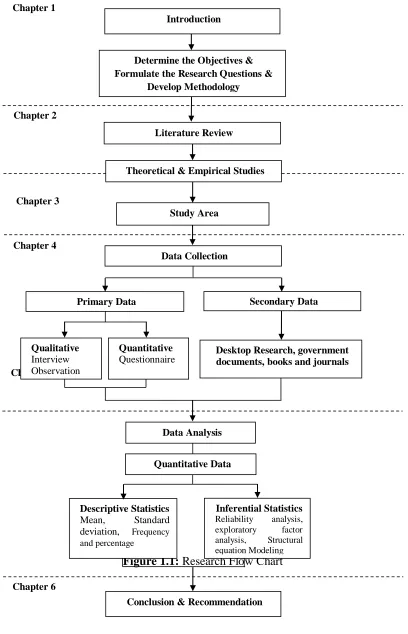
This section provides a brief outline on the organization of the thesis chapters. The research flowchart is shown in Figure 1.1. This includes the following:
Chapter One presents a general introduction of the thesis, The research problem that includes causes and consequences of this proliferation is also presented, with particular reference to Jabal Al-Sherasheef in Makkah. The study objectives and research questions to address them are also presented in this chapter. The significance of the study to government, policy and decision makers as well to urban managers are discussed. Finally, the scope of the study is clearly stated in the chapter.
Chapter Three presents an overview of the study area, rulings and the urban planning system. This chapter also discusses the origin of informal settlements in Makkah city, their characteristics, causes and factors that lead to development induced displacement. Finally, the primary study for problem identification was discussed through interview with households and stakeholders.
Chapter Four provides the methodological approach used in data collection and the data analysis procedure. In particular, research design guiding the study, sampling technique and size and statistical techniques adopted for the data analysis are discussed in detail. The various household and stakeholders involved in the interview are also highlighted. Procedure for testing the proposed model of Development Induced Displacement and Self-Resettlement was explained in detail. The model was assessed using fitness indices as suggested by literature.
Chapter Five discusses the results from the quantitative analysis. The main aim of this chapter is to provide answers to research questions posed in this thesis. Thus, the chapter looks at the socio-economic consequences of urban renewal programme on people residing in the informal settlements and their perception towards the whole issue. The level of satisfaction of the affected households with between house unit size/condition, neighbourhood services/facilities, social relationship, environment safety and economic well-being after displacement were identified. Moreover, the causal relationships between the factors and the satisfaction finally defined the appropriate model for future development of informal settlements in Makkah. In addition, validation of the model by experts in field of urban renewal and resettlement programme in Makkah was conducted.
Chapter Six provides a general conclusion for the study. In this chapter, a brief summary of findings from the study are highlighted, implication of the study was also presented and discussed. Based on the findings, recommendations are made on how to address some of the issues raised.
11
Figure 1.1: Research Flow Chart
Chapter 5
Chapter 6
Conclusion & Recommendation Quantitative Data
Analysis Data Analysis
Inferential Statistics
Reliability analysis, exploratory factor analysis, Structural equation Modeling
Descriptive Statistics
Mean, Standard deviation, Frequency and percentage
Desktop Research, government documents, books and journals Quantitative
Questionnaire
Qualitative
Interview Observation
Chapter 4 Chapter 3
Study Area Chapter 2
Literature Review
Theoretical & Empirical Studies Chapter 1
Introduction
Determine the Objectives & Formulate the Research Questions &
Develop Methodology
Data Collection
REFERENCES
Abbott, J. (2002). An analysis of informal settlement upgrading and critique of existing methodological approaches. Habitat International, 26(3), 303-315.
AbdulMajid, N. (2007). Academic Report Writing From Research to Presentation. Selangor Malaysia: Prentice Hall.
Adam, A. G. (2014). Informal settlements in the peri-urban areas of Bahir Dar, Ethiopia: An institutional analysis. Habitat International, 43, 90-97. Addo, I. A. (2015). Assessing residential satisfaction among low income households
in multi-habited dwellings in selected low income communities in Accra. Urban Studies, 0042098015571055.
Agrawal, A., and Redford, K. (2009). Conservation and displacement: an overview. Conservation and Society. 7(1), 1.
Al-Ankary, K. (1977). Geographical Mohammed Evolution of the Urban Structure of Makkah, University of Oregon.1977.
Alder, G. (1995). Tackling poverty in Nairobi's informal settlements: developing an institutional strategy. Environment and Urbanization, 7(2), 85-108.
Al-Ghamdi, K et al (2012). Impacts of urban growth on flood hazards in Makkah City, Saudi Arabia. International Journal of Water Resources and Environmental Engineering, Vol. 4(2), pp. 23-34, February 2012.
Al-Khedheiri, A. A. (1998). The Role of Secondary Cities in the National Development Process of Saudi Arabia (Doctoral dissertation, University College London (University of London).
183 Allen, G. (2013). The Influence of Organizational Culture on Affinity for Knowledge
Management Practices of Registered Nurses. Walden University.
Al-Sakran, M. S. and Muneer, S. T. (2003). Rural –Urban Migration in Some of The Administrative Regions in Saudi Arabia And Its Effect On Agricultural Development. Department of Agricultural Extension and Rural Sociology. Faculty of Food and Agricultural Sciences, King Saud University.
Al-Shareef, M. 2003.The Squatting Development in Makkah AL-Mukkaramah Characteristics, Problems and Solutions. Firist issue,Volum 4.Sicntific journal of King Faisal University, Saudi Arabia.
Al-Shareef, M. and Seraj, M. (1992). Koz Al-Nikasah: A Field Study of Informal Endemicity Areas in Makkah.
Al-Shareef (2002). The Problem Changing Urban Cities of Saudi Arabia: The National and Regional Perspective. Journal of Building Technology, Saudi Arabia. Issue 1.
Al-Sobhi, H. (2014) Towards Comprehensive Strategy of Future Treatments of Informal Areas in Makkah. Master's degree in architecture, department Islamic architecture Umm al-Qura University.
Al-Zahrani, K. (2014). Slum areas in Makkah between hope and reality " toward a safe environment and sustainable. Master's degree in architecture, department Islamic architecture Umm al-Qura University.
Amy, W. (2002). The Management of Customer Relationships in the Retail Industry. Monash University, Australia.
Arbuckle, J. L., & Wothke, W. (1999). Amos 4.0 user's guide. Chicago, IL: SmallWaters Corporation.
Asian Centre for Human Rights, 2 January 2007, p.30-31.
Babbie, E. (2002). The Basic of Social Research. Canada: Thomson Learning.
Bagozzi, R. P., and Philips, L. W. (1982). Representing and Testing Organizational Theories: A Holistic Construal. Administrative Science Quarterly, 27(3), 459–489.
Bagozzi, R. P., Yi, Y., & Phillips, L. W. (1991). Assessing construct validity in organizational research. Administrative science quarterly, 421-458.
Barrett, P. (2007). Structural equation modelling: Adjudging model fit. Personality and Individual differences, 42(5), 815-824.
Baru, P. (1998), International Banking and Rural Development, Ashgate: Aldershot, England.
Barutciski, M. (2006). International Law and Development-Induced Displacement and Resettlement. Development Induced Displacement: Problems, Policies and People, 71-104.
Baumgartner, H., & Homburg, C. (1996). Applications of structural equation modeling in marketing and consumer research: A review. International journal of Research in Marketing, 13(2), 139-161.
Baviskar, B. S., and Attwood, D. W. (1995). Finding the middle path: the political economy of cooperation in rural India.
Bechtel, C., & Jayaram, J. (1997). Supply chain management: a strategic perspective. The international journal of logistics management, 8(1), 15-34.
Bennett, J. (1998). Forced Migration within National Borders: the IDP agenda. Forced Migration Review, 1(1).
Bennett, J. A. (2000). Physical Functioning in Elders: Testing the Fit of a Conceptual Model using Structural Equation Modeling. University of California San Francisco.
Bentler PM, Bonnet DG. (1980). Significance tests and goodness-of-fit in the analysis of covariance structure. Psychological Bulletin; 88:588–606. Bernard, H. R. (1988). Research methods in cultural anthropology. Newbury Park,
CA: Sage.
Bisht, T., C. (2009) Development-Induced Displacement and Women: the Case of the Tehri Dam, India, The Asia Pacific Journal of Anthropology, 10, 4, pp.301-317.
Blyth, B. (2008). Mixed mode: the only ‗fitness‘ regime? International Journal of Market Research. 50(2), 241–266.
Bogdan, R. C., & Biklen, S. K. (2007). Research for education: An introduction to theories and methods. New York: Pearson.
185 Bose, P.S (2007), Chris de Wet (Ed.), Development-Induced Displacement: Problems, Policies and People. Int. Migration & Integration, 8:243–244. Botes, L., & Van Rensburg, D. (2000). Community participation in development:
nine plagues and twelve commandments. Community Development Journal, 35(1), 41-58.
Brown, L. A., and Moore, E. G. (1970). The Intra-Urban Migration Process: A Perspective. Geografiska Annaler. Series B, Human Geography, 52(1), 1-13.
Bryant, F. B., & Yarnold, P. R. (1995). Principal-components analysis and exploratory and confirmatory factor analysis.
Burra, S and Patel,S. (2001). Norms and Standards in Urban Development. The experience of an Urban Alliance in India. Paper Presented at the International Workshop on Regulatory Guideline for Urban Upgrading. Bourton- on-Dunsmore. May 17-18
Burton, A. (2001). Urbanisation in Eastern Africa: an historical overview, c. 1750– 2000. Azania: Journal of the British Institute in Eastern Africa, 36(1), 1-28.
Busacca, B., & Padula, G. (2005). Understanding the relationship between attribute performance and overall satisfaction: Theory, measurement and implications. Marketing Intelligence & Planning, 23(6), 543-561.
Byrne, B. M. (1989). Multigroup Comparisons and the Assumption of Equivalent Construct Validity Across Groups: Methodological and Substantive Issues. Multivariate Behavioral Research, 24(4), 503-523.
Byrne, B. M., and Shavelson, R. J. (1986). On the structure of adolescent self-concept. Journal of Educational Psychology, 78(6), 474.
Byrne, D. S. (1998). Complexity theory and the social sciences: an introduction. Psychology Press.
criteria for evolutionary architectural design. In Applications of Evolutionary Computation (pp. 204-213). Springer Berlin Heidelberg. Cahliková, Z., & Stojanov, R. (2013). Development-induced Displacement and
Sustainable Development: The Case Study of Slezská Harta Dam in the Czech Republic. Problemy Ekorozwoju–Problems of Sustainable Development, 8(2), 75-84.
Cahliková, Z., & Stojanov, R. (2013). Development-induced Displacement and Sustainable Development: The Case Study of Slezská Harta Dam in the Czech Republic. Problemy Ekorozwoju–Problems of Sustainable Development, 8(2), 75-84.
Campbell, A., Converse, P. E., and Rodgers, W. L. (1976). The Quality of American Life: Perceptions, Evaluations, and Satisfactions: Perceptions, Evaluations, and Satisfactions. Russell Sage Foundation.
Campbell, J. L., Quincy, C., Osserman, J., & Pedersen, O. K. (2013). Coding in-depth semistructured interviews problems of unitization and intercoder reliability and agreement. Sociological Methods & Research, 42(3), 294-320.
Canter, D. (1983). The Purposive Evaluation of Places: A Facet Approach. Environment and Behavior, 15(6), 659-698.
Carlson, K. M. K. D. S. (1999). Across Human Resource Situations. Journal oprp/ied Social Psychology, 29(6), 1293-1315.
Carmines, E., and Mclver, J. (1981). Analysing Models with Unobserved Models: Analysis of Covariance Structures.
Catinella, B., Haynes, M. P., Giovanelli, R., Gardner, J. P., & Connolly, A. J. (2008). A pilot survey of HI in field galaxies at redshift z~ 0.2. The Astrophysical Journal Letters, 685(1), L13.
Cavalheiro, D. C., & Abiko, A. (2015). Evaluating Slum (Favela) Resettlements: The Case of the Serra do Mar Project, Sao Paulo, Brazil. Habitat International, 49, 340-348.
Central Department of Statistics & Information Saudi Arabia (CDSI), Saudi Arabia. Centre on Housing Rights and Evictions (COHRE) (2002). Forced Evictions:
187 Cernea, M. (1997), African Involuntary Population Resettlement in a Global
Context, Washington DC: World Bank.
Cernea, M. (2000). Risks, Safeguards and Reconstruction: A Model for Population Displacement and Resettlement. Economic and Political Weekly, 35(41), 3659-3678.
Cernea, M. M., & McDowell, C. (Eds.). (2000). Risks and reconstruction: Experiences of resettlers and refugees. World Bank Publications.
Cernea, M. M. (1990). Poverty risks from population displacement in water resources development. Development Discussion Paper Harvard Institute for International Development, (355).
Cernea, M. M. (1993) Anthropological Approaches to Resettlement: Policy, Practice and Theory. Boulder, San Francisco and Oxford: Westview Press.
Cernea, M. M. (1995) Understanding and Preventing Impoverishment from Displacement: Reflection on the State of Knowledge, Journal of Refugee Studies 8(3): 245-64.
Cernea, M. M. (1996) Impoverishment Risks and Livelihood Reconstruction: A Model for Resettling Displaced Populations. Washington, DC: The World Bank, Environment Department.
Cernea, M. (1997). The risks and reconstruction model for resettling displaced populations. World development, 25(10), 1569-1587.
Cernea, M. M. (2003). For a new economics of resettlement: a sociological critique of the compensation principle. International Social Science Journal, 55(175), 37-45.
Cernea, M. M. (2006). Development-induced and conflict-induced IDPs: bridging the research divide. Forced Migration Review, 261, 25-27.
Cernea, M. M. (Ed.). (1999). The economics of involuntary resettlement: Questions and challenges. World Bank Publications.
Chapin F. S. And Kaiser E. J. ,1985, Urban Land Use Planning. University of Illinois Press, Urbana and Chicago, USA.
Chin, W. W. (1998). The partial least squares approach to structural equation modeling. Modern methods for business research, 295(2), 295-336.
Choguill, C. L. (1999). Community infrastructure for low-income cities: The potential for progressive improvement. Habitat International, 23(2), 289-301.
Choguill, C. L., Franceys, R., & Cotton, A. (1993). Building Community Infrastructure in the 1990s: Progressive Improvement∗. Habitat International, 17(4), 1-12.
Christensen, A and Harild, N (2009) Forced Displacement – The Development Challenge. Social Development Department Sustainable Development Network. The World Bank Group. December 2009
Clark, C. (2006). Livelihood networks and decision-making among Congolese young people in formal and informal refugee contexts in Uganda (No. 13). Households in Conflict Network.
Clark, W. A., & Onaka, J. L. (1983). Life cycle and housing adjustment as explanations of residential mobility. Urban studies, 20(1), 47-57.
Cohen, L., Manion, L., and Morrison, K. (2007). Research Methods in Education. New York: Routledge.
Comrey, A. L., and Lee, H. B. (1992). A first Course in Factor Analysis. Hillsdale, NJ: Erlbaum.
Connelly, L. M. (2008). Pilot studies. Medsurg Nursing, 17(6), 411–412.
Costello, A. B. & Osborne, J. W. (2005). Best practices in exploratory factor analysis: four recommendations for getting the most from your analysis. Practical Assessment Research & Evaluation, 10(7).
Creswell J. W. (2012). Planning, Conducting and Evaluating Quantitative and Qualitative Research Four Edition Educational research Pearson Education, Inc. 501 Boylston Street, Boston, MA
Creswell, J. W. (2003). Research design: Qualitative, quantitative and mixed methods approaches (2nd ed.).
189 Creswell, J. W. (2002). Educational research: Planning, conducting, and evaluating quantitative and qualitative approaches to research. Upper Saddle River, NJ: Merrill/Pearson Education.
Creswell, J. W., & Garrett, A. L. (2008). The" movement" of mixed methods research and the role of educators. South African Journal of Education, 28(3), 321-333.
Creswell, J. W., Clark, P.V. L., Gutmann, M. L., and Hanson, W. E. (2003). Advanced mixed methods research designs. Handbook of mixed methods in social and behavioral research (pp. 209–240). Thousand Oaks, CA: Sage.
Creswell, J.W, (2009b). Qualitative, Quantitative, and Mixed Method Approaches. Sage Publications, Inc.
Creswell, J.W. and Clark, P.V.L. (2007). Designing and Conducting Mixed Methods Research. Thousand Oaks, CA: Sage Publications.
Crowley, S.L. and Fan, X. (1997), Structural Equation Modeling: Basic Concepts and Applications in Personality Assessment Research, Journal of Personality Assessment, 68 (3), 508-31.
CSE (1985) India: The State of Environment 1984±85 – The Second Citizens' Report. New Delhi: Centre for Science and Environment.
DAG (2007). Living on the Edge: A Study of the Delft Temporary Relocation Area. Development Action Group: South Africa.
Daniel, J. (2012). Sampling Essentials: Practical Guidelines for Making Sampling Choices. SAGE Publications, Inc.
Das, V. (1996) Dislocation and Rehabilitation: Defining a Field. Economic and Political Weekly 31(24): 1509-14.
Dassopoulos, A., & Monnat, S. M. (2011). Do perceptions of social cohesion, social support, and social control mediate the effects of local community participation on neighbourhood satisfaction? Environment and Behavior, 43(4), 546-565.
De Camargo Cavalheiro, D., & Abiko, A. (2015). Evaluating slum (favela) resettlements: The case of the Serra do Mar Project, São Paulo, Brazil. Habitat International, 49, 340-348.
De Leeuw, E.D. (2005). To mix or not to mix data collection modes in surveys. Journal of Official Statistics. 21(2), 233–55.
De Vos, A. S. (Ed.). (2002). Research at grass roots: For the social sciences and human services professions. van Schaik.
De Wet, C. J. (2006). Development-induced displacement: problems, policies, and people (Vol. 18). Berghahn books.
Dear, C. and McCool, S. (2010). Causes and Consequences of Displacement Decision–Making in Bahine National park, Mozambique. Conservation and Society 8(2) 103-111.
Denscombe, M; (2003). The Good Research Guide For Small-Scale Social Research Projects For Small-Scale Social Research Projects. Third Edition. Open University Press England
Development Commission of Makkah Al-Mukarramah and Mashaaer (DCOMM) (2008). Project of the List of Informal Settlement Development in Makkah Region.
Development Commission of Makkah Al-Mukarramah and Mashaaer (DCOMM) (2014).http://www.adm.gov.sa/project/king-abdullahprojectreconstruction-Makkah/. Retrieved 10 December 2014
Diamantopoulos, A., and Siguaw, J. A. (2000). Introducing LISREL. London: Sage Publications.
Dillman, D. A., Tortora, R. D., & Bowker, D. (1998, August). Principles for constructing web surveys. In Joint Meetings of the American Statistical Association.
Dolma, S. (2010). The central role of the unit of analysis concept in research design. Journal of the School of Business Administration, 39(1), 169–174.
Dooley, L. M. (2002). Case Study Research and Theory Building. Advances in Developing Human Resources, 4(3), 335-354.
191 Downing, T. E., & Garcia-Downing, C. (2009). Routine and dissonant cultures: A theory about the psycho-sociocultural disruptions of involuntary displacement and ways to mitigate them without inflicting even more damage. Development and Dispossession.
Durand-Lasserve, A. (2006). Informal settlements and the Millennium Development Goals: global policy debates on property ownership and security of tenure. Global Urban Development, 2(1), 1-15.
Dwivedi, R. (1996). Parks, people and protest: some observations on the mediating role of environmental action groups in grassroots resource conflicts. ISS Working Paper Series/General Series, 228, 1-34.
Dwivedi, R. (1997). People's movements in environmental politics: a critical analysis of the Narmada Bachao Andolan in India. ISS Working Paper Series/General Series, 242, 1-49.
Dwivedi, R. (1998). Resisting dams and ‗development‘: contemporary significance of the campaign against the Narmada projects in India. The European Journal of Development Research, 10(2), 135-183.
Dwivedi, R. (2002). Models and Methods in Development–Induced Displacement (Review Article). Development and Change, 33(4), 709-732.
Elsheshtawy, Y. (2011). Informal Encounters: Mapping Abu Dhabi's Urban Public Spaces. Built environment. 37(1), 92-113.
Fekade, W. (2000). Deficits of Formal Urban Land Management and Informal Responses Under Rapid Urban Growth, An International Perspective. Habitat International. 24(2), 127-150.
Fernandes, C., & Karney, B. W. (1999). Assessing water quality issues in water distribution systems from source to demand. Water industry systems: modelling and optimization applications, 2, 231-239.
Fernandes, E. (2007). Implementing the urban reform agenda in Brazil. Environment and Urbanization, 19(1), 177-189.
Fernandes, E. (2011). Regularization of Informal Settlements in Latin America. Cambridge, MA, USA: Lincoln Institute of Land Policy.
Fernandes, W. (2003). Development Displaced and The Right to Life: Implications for the Northeast. Keynote Address, Workshop on Development-induced Displacement, Department of Political Science, Assam University, Silchar, Assam, March 27, 2002, published in Tanmoy Bhattacharjee (ed). Problems of Internally Displaced Persons in Assam with Special Reference to Barak Valley. Silchar: Department of Political Sciences, Assam University, March 2003, pp. 3-27.
Fernandes, W., N.G. D‘Souza, A. Roy Choudhury and M. Asif. (2001). Development-induced Displacement, Deprivation and Rehabilitation in Andhra Pradesh 1951–1995: A Quantitative and Quantitative Study of Its Extent and Nature. New Delhi: Indian Social Institute and Guwahati: North-eastern Social Research Centre.)
Field, A. (2005). Discovering Statistics Using SPSS 2nd ed. London: SAGE Publications.
Field, A. (2009). Discovering statistics using SPSS. Sage publications.
Fink, A. (1995). The Survey Handbook. Thousand Oaks, CA: Sage Publications. Fischer, F. (1995). Evaluating public policy. Belmont CA: Wadsworth Group.
Francescato, G., Weidemann, S., and Anderson, J. R. (1986). Residential Satisfaction and Residential Quality: An Overview of Recent Applications. In 21st International Congress of Applied Psychology, Jerusalem, Israel.
Francis, P., & Jacobs, S. (1999). Institutionalizing social analysis at the World Bank. Environmental Impact Assessment Review, 19(3), 341-357.
Galster, G. C., & Hesser, G. W. (1981). Residential satisfaction compositional and contextual correlates. Environment and behavior, 13(6), 735-758.
Ganster, D. C., Hennessey, H. W., and Luthans, F. (1983). Social Desirability Response Effects: Three Alternative Models. Academy of Management Journal, 26(2), 321–331.
Garson, D. (2014). Path Analysis. (Statistical Associates Blue Book Series 22). Statistical Associates Publishers
193 http://www.emoderators.com/ipct-j/1998/n3-4/hill.hmtl Accessed 4th April, 2015.
George, D., & Mallery, M. (2003). Using SPSS for Windows step by step: a simple guide and reference. Boston, MA: Allyn y Bacon.
Gliner, J. A., and Morgan, G. A. (2000). Research Methods in Applied Settings: An Integrated Approach to Design and Analysis. New Jersey: Lawrence Erlbaum Associates Publishers.
Googleearth Pro (2015). Google Earth Maps.
Gorsuch, R. L. (1997). Exploratory Factor Analysis: Its Role in Item Analysis. Journal of Personality Assessment, 68(3), 532-560.
Gorsuch, R. L. (1974). Factor Analysis, Philadelphia: WB Saunders Co. GorsuchFactor Analysis1974.
Chicago Gorsuch, R. L. (1983). Factor Analysis.
second edition,
Hillsdale:
Lawrence Erlbaum Associates.
Guadagnoli, E., and Velicer, W. F. (1988). Relation of Sample Size to the Stability of Component Patterns. Psychological Bulletin, 103, 265–275.
Gutman, P. S. (1994). Involuntary resettlement in hydropower projects. Annual review of energy and the environment, 19(1), 189-210.
Hair Jr, J. F., Hult, G. T. M., Ringle, C., & Sarstedt, M. (2013). A primer on partial least squares structural equation modeling (PLS-SEM). Sage Publications. Hair, J. F., Anderson, R. E., Babin, B. J., & Black, W. C. (2010). Multivariate data
analysis: A global perspective (Vol. 7). Upper Saddle River, NJ: Pearson. Hair, J. F., Black, W. C., Babin, B. J., Anderson, R. E., & Tatham, R. L. (1998).
Multivariate data analysis . Uppersaddle River. Multivariate Data Analysis (5th ed) Upper Saddle River.
Hakim, C. (2000). Research design: Successful designs for social and economic research. Psychology Press.
Hameed, E.H.A.S. (2014). Towards a Comprehensive Strategy of Future Treatments of Informal Areas in Makkah. Umm Al-Qura University. Unpublished Masters Thesis.
Hayduk, L., Cummings, G. G., Boadu, K., Pazderka-Robinson, H., and Boulianne, S. (2007). Testing! Testing! One, Two Three – Testing the theory in structural equation models! Personality and Individual Differences, 42(2), 841–850.
Hill, M.C., 1998, Methods and guidelines for effective model calibration. U.S. Geological Survey Water-Resources Investigations Report 98-4005.
Hirschon, R. (2000). The creation of community: well-being without wealth in an urban Greek refugee locality. Risks and Reconstruction: Experiences of Resettlers and Refugees, Washington DC, The World Bank.
Howe, K. R., & Moses, M. S. (1999). Ethics in educational research. Review of research in education, 21-59.
Hsieh, H.-J. (2007). Organizational Characteristics, Knowledge Management Strategy, Enablers, and Process Capability: Knowledge Management Performance in U.S. Software companies. Lynn University.
Hsu, S.-Y. (2006). Team Transformational Leadership, Trust, Empowerment, Satisfaction, and Commitment: Testing a Structural Equation Model in Software Development Teams. Nova Southeastern University.
Hu, L. T., & Bentler, P. M. (1999). Cutoff criteria for fit indexes in covariance structure analysis: Conventional criteria versus new alternatives. Structural equation modeling: a multidisciplinary journal, 6(1), 1-55.
Hutcheson, G. D., and Sofroniou, N. (1999). The Multivariate Social Scientist: Introductory Statistics Using Generalized Linear Models. Thousand Oaks, CA: SAGE Publications.
Iacono, J. C., Brown, A., & Holtham, C. (2011). The use of the Case Study Method in Theory Testing: The Example of Steel eMarketplaces. The Electronic Journal of Business Research Methods, 9(1), 57-65.
Ibrahim, I., Aziz, N. A., Hussain, F., Aminudin, N., Young, M. A., & Yahya, S. A. I. (2012). Issues and Policies on the Aftermath of Squatters Resettlement: A Case Study on Kg. Desa Hormat Tambahan, Selangor. Procedia-Social and Behavioral Sciences, 36, 698-706.
Informal Service Centre (INSEC), 2004, Human Rights Yearbook 2004 (Kathmandu: Informal Sector Service Centre).
195 Internal Displacement Monitoring Centre (IDMC) of the Norwegian Refugee Council (NRC) (2008). Submission to the Committee on Economic, Social and Cultural Rights: 40th Session. Economic, Social and Cultural Rights of Internally Displaced Persons (IDPs) in India April 2008.
International Displacement Monitoring Centre (2005) Development Induced Displacement. Training on the protection of IDPs.
Isaac, S., & Michael, W. B. (1995). Handbook in research and evaluation. San Diego, CA: Educational and Industrial Testing Services.
Jaccard, J., and Wan, C. K. (1996.). LISREL Approaches to Interaction Effects in Multiple Regression. Thousand Oaks, CA: Sage Publications.
Jacobs, J. (1961). The death and life of great American cities. Vintage.
Jones, P. W., Harding, G., Berry, P., Wiklund, I., Chen, W. H., & Leidy, N. K. (2009). Development and first validation of the COPD Assessment Test. European Respiratory Journal, 34(3), 648-654.
Jöreskog, K. and Sörbom, D. (1993), LISREL 8: Structural Equation Modeling with the SIMPLIS Command Language. Chicago, IL: Scientific Software International Inc.
Jöreskog, K. and Sörbom, D. (1996), LISREL 8: User‘s Reference Guide. Chicago, IL: Scientific Software International Inc
Joreskong, K. G., and Sorbom, D. (1986). LISREL VI: Analysis of Linear Structural Relationships by Maximum Likelihood, Instrumental Variables, and Least Squares Methods (4th ed.). Mooresville, IN: Scientific Software.
Julious, S. A. (2005). Sample size of 12 per group rule of thumb for a pilot study. Pharmaceutical Statistics, 4(4), 287-291.
Jun, M., Cai, S., and Shin, H. (2006). TQM Practice in Maquiladora : Antecedents of Employee Satisfaction and Loyalty, 24, 791–812.
Jung, G.-M. (2007). Structural Equation Modeling Between Leisure Involvement, Consumer Satisfaction, and Behavioral Loyalty in Fitness Centres in Taiwan. United States Sports Academy.
Kaida, N., and Miah, T. M. (2015). Rural-Urban Perspectives on Impoverishment Risks in Development-Induced Involuntary Resettlement in Bangladesh. Habitat International, 50, 73-79.
Kaiser, H. F. (1960). The Application of Electronic Computers to Factor Analysis. Educational and Psychological Measurement, 20, 141–151.
Kaiser, H. F. (1974). An Index of Factorial Simplicity. Psychometrika, 39(1), 31– 36.Kanooni, A. (2009). Organizational Factors Affecting Business and Information Technology Alignment: A Structural Equation Modeling Analysis. Capella University.
Karimi. K and Parham E. (2012). An Evidence Informed Approach to Developing an Adaptable Regeneration Programme for Declining Informal Settlements. Proceedings: Eighth International Space Syntax Symposium Edited by M. Greene, J. Reyes and A. Castro. Santiago de Chile: PUC, 2012.
Kelloway, E. K. (1998). Using LISREL for structural equation modeling: A researcher's guide. Sage.
Khalid, A.Z. (2014). Slum Areas in Makkah: Between Hope and Reality Towards Safe Environment and Sustainability. Umm Al-Qura University. Unpublished Masters Thesis.
Kibwana, K. (2000). Land Tenure, Spontaneous Settlement and Environmental Management in Kenya. Essays on Land Law. The Reform Debate in Kenya, Faculty of Law, University of Nairobi, 105-136.
Kim, S.H. (2010). Issues of squatters and eviction in Seoul: From the perspectives of the dual roles of the state. City, Culture and Society 1 (2010) 135–143 King Abdulaziz Public Library (2015). www.kapl-hajj.org/jamarat_bridge.php.
Accessed on 5th February, 2015.
Kline P. (2014). An easy guide to factor analysis New York: Routledge.
Kline, R. B. (1998). Software review: Software programs for structural equation modeling: Amos, EQS, and LISREL. Journal of psychoeducational assessment, 16(4), 343-364.
197 Kline, R.B. (2005), Principles and Practice of Structural Equation Modeling (2nd
Edition ed.). New York: The Guilford Press.
Koeing, D. (2006). Enhancing Local Development in Development–Induced Displacement and Resettlement Projects in: Development Induced Displacement and Resettlement, Problems, Policies and People (ed. deWet, C) Pp 105-140. New York Berghahn Books.
Koenig, D. (2001) Toward Local Development and Mitigating Impoverishment in Development-Induced Displacement and Resettlement", Final Report Prepared for ESCOR R7644 and the Research Programme on Development- Induced Displacement and Resettlement organized by the Refugee Studies Centre, University of Oxford July 2001
Kondylis, F (2007). Conflict-Induced Displacement and Labour Market Outcomes: Evidence from Post-War Bosnia and Herzegovina. Centre For Economic Performance CEP Discussion Paper No 777.
Krejcie, R.V., and Morgan, D.W., (1970). Determining Sample Size for Research Activities. Educational and Psychological Measurement.
Leedy, P. D., and Ormrod, J. E. (2005). Practical research: Planning and design (8th ed.). Upper Saddle River, N.J.: Pearson Education.
Legislative Council (2009) Panel on Development. LC Paper No. CB(1)570/08-09(09).http://www.legco.gov.hk/yr08-09/english/panels/dev/papers/dev0 120cb1-570-9-e.pdf
Lim, S. J. (2006). The Influence of Service Quality on Customer Satisfaction, Attitudinal Loyalty, and Behavioral Future Intentions for Participation of Fitness Centres in South Korea: A Structural Equation Modeling Approach. United States Sports Academy.
Lu, M. (1999). Determinants of residential satisfaction: Ordered logit vs. regression models. Growth and change, 30(2), 264-287.
MacCallum, R. C., Widaman, K. F., Preacher, K. J., & Hong, S. (2001). Sample Size in Factor Analysis: The Role of Model Error. Multivariate Behavioral Research, 36(4), 611-637.
Majale, M.M (1998) Settlement Upgrading in Kenya. The Case for Environmental Planning and Management Strategies, PhD Thesis University of Newcastle (Unpublished).
Marsh, H. W., Hau, K. T., & Wen, Z. (2004). In search of golden rules: Comment on hypothesis-testing approaches to setting cutoff values for fit indexes and dangers in overgeneralizing Hu and Bentler's (1999) findings. Structural equation modeling, 11(3), 320-341.
Marsh, H. W., and Hocevar, D. (1985). Application of Confirmatory Factor Analysis to the Study of Self-Concept: First- and Higher-Order Factor Models and their Invariance across Groups. Psychological Bulletin, 97, 562–582. Makkah province. (2012). Illegal residents. Retrieved January 21, 2013, from
http://www.saudigazette.com.sa/index.cfm.
Malhotra, N. K. (2007). Marketing Research an Applied Orientation (5th Ed.). New Jersey: Pearson Prentice Hall.
Manovas, M. (2004). Investigating the Relationship between Knowledge Management Capability and Knowledge Transfer Success. Concordia University.
Mburugu, E. K. (1993). ―Dislocation of Settled Communities in the Development Process: The Case of Kiambere Hydroelectric Project.‖ In Cynthia C. Cook. (ed.) Involuntary Resettlement in Africa, World Bank Technical Paper No. 227, Washington, DC: World Bank.
McDonald, R. P., & Ho, M. H. R. (2002). Principles and practice in reporting structural equation analyses. Psychological methods, 7(1), 64.
McDowell, C. (1996). Understanding impoverishment: The consequences of development-induced displacement (Vol. 2). Berghahn books.
McLeod, R. (2001). The Impact of Regulations and Procedures on The Livelihoods and Asset Base of the Urban Poor: A Financial Perspective. Paper presented at the International Workshop on Regulatory Guideline for Urban Upgrading. Bourton- On-Dunsmore. May 17-18.
199 Michelson, W. (1966). An empirical analysis of environmental preference. Journal
of the American Institute of Planners, 32, 335-60.
Mills, J. E. (2002). An Analysis, Instrument Development, and Structural Equation Modeling of Customer Satisfaction with Online Travel Services. Purdue University.
Ministry of Higher Education of Saudi Arabia. (2012). Universities in Saudi Arabia. http://www.mohe.gov.sa/en/studyinside/aboutKSA/Pages/default.aspx Retrieved January 11, 2013.
Mohit, M. A., & Azim, M. (2012). Assessment of residential satisfaction with public housing in Hulhumale‘, Maldives. Procedia-Social and Behavioral Sciences, 50, 756-770.
Mohit, M. A., & Elsawahli, H. M. H. (2010). Crime and housing in Malaysia: case study of Taman Melati terrace housing in Kuala Lumpur. Asian Journal of Environment-Behaviour Studies, 1(3), 25-36.
Mohit, M. A., & Mahfoud, A. K. A. (2015). Appraisal of residential satisfaction in double-storey terrace housing in Kuala Lumpur, Malaysia. Habitat International, 49, 286-293.
Mohit, M. A., and Al-Khanbashiraja, A. M. M. (2014). Residential Satisfaction-Concept, Theories and Empirical Studies. Planning Malaysia, 47.
Montgomery, M. R. (2008). The urban transformation of the developing world. Science. 319(5864), 761-764.
Moore, G. C., & Benbasat, I. (1991). Development of an instrument to measure the perceptions of adopting an information technology innovation. Information systems research, 2(3), 192-222.
Morvaridi, B. (2004). Resettlement, rights to development and the Ilisu Dam, Turkey. Development and Change, 35(4), 719-741.