Depth Map Super-Resolution for Multi-view
Images
Pallavi D. Chavanke, Supriya Thombre
M. Tech Student, Dept. of Computer Science & Engg. Y.C.C.E. Nagpur, India
Asst. Professor, Dept. of Computer Technology, Y.C.C.E., Nagpur, India
ABSTRACT: Increase the image sharpness of low resolution image is an important concept in many applications. It is widely used in medical applications, satellite images and many more. The content of low resolution image is improved by using content of neighboring high resolution image. High resolution image get divide into high frequency image and low frequency image. Thus, the generated high frequency content is used to improve image quality of low resolution image by using depth map of an image. Depth map of an image is generated by using stereo matching algorithm over a pair of an image. Afterward Basic block matching technique is used. Displacement estimation is further calculated. Finally super-resolution algorithm is used to generate super resolved image.
KEYWORDS: Mixed-Resolution, Multi-view, Image registration, Super-resolution, Depth map
I. INTRODUCTION
Super-resolution is widely discussed topic to increase the visual quality and sharpness of low resolution image. As images are used in many application domains such as medical field, satellite images and many more. Generally the images captured by low resolution a camera that does not contain the complete details about the scenarios. When images are zoomed out to large size it will get blurred. To preserve the details of an image such as edges in an image, super resolution is required
Also multimedia content plays important role in our everyday’s life. Nowadays devices like mobile, desktop, Digital TV have capability to display high resolution images for better viewing experience. Therefore the need arises to enhance the resolution of available images in real time for better perceptual quality.
The inputs images can be in the form of medical images, digital video, satellite terrain imagery, from many other sources. In many visual applications like military and civilian areas the imaging sensors used are having very poor resolution outputs. Due to some limitations i.e. cost or hardware, resolution cannot be improved by replacing imaging sensors, hence super resolution algorithms plays a crucial role in improving the resolution of the output image. The Super resolution (SR) algorithms can be implemented in such cases as SR algorithms is a low cost algorithm and easy to implement.
The Low Resolution (LR) images hence will contain non redundant information which is taken from the same scene by the image sensor. The non-redundant information (pixels) from different scenes is fused to a single HR image which is the main goal of super resolution image. The spatial resolution of HR image is always higher than any single LR image where spatial resolution indicates the density of pixels per unit area. The image contains more details if the spatial resolution is higher. The magnification factor i.e. increase in resolution depends on the number of non-redundant LR images available from the scene.
Generating a high resolution (HR) image using multiple low-resolution (LR) images, known as "super resolution". High resolution means increasing the number of pixels, also referred to as high-definition (HD). High resolution image brings out details that would be blocked out in Low Resolution image.There is always a demand for better quality images. In many applications such as License plate reader, military applications, Medical diagnosis may be made more easily if data generated from a number of images can be combined into a single more detailed image.
one sub-category is reconstruction based methods, where a set of low resolution images of the same scene are aligned with sub-pixel accuracy to generate a high resolution image. The other sub-category of the traditional approaches is frame interpolation, which usually generate over-smoothing images.
For HR image generation, images from different view registered accurately. Block-matching algorithm used for registration of an image [21]. Frequency domain method is also used for image registration [22].
Digital images can be described in terms of several parameters one of these is the image resolution. More specifically, the resolution describes the amount of details present in the image. The amount of details and the actual resolution are directly proportional to each other. Image resolution is a general term which includes several other sub terms such as spatial, spectral, and pixel resolutions. The need for high resolution images helps in enhancing the image detection and recognition systems, plus allowing for more information to be extracted from those images.
II. RELATED WORK
The topic of super- resolution (SR) first appeared in the early 1980s, with one of the first papers in the signal processing community, the paper by Tsai and Huang. The Super Resolution Reconstruction (SRR) of an image is one of the most well known techniques of digital imaging. This SRR technique aims in reconstructing a High Resolution (HR) image by gathering or fusing the different low resolution frames containing different information of the same scene. The SRR technique is also used in up sampling of under sampled images which filters out the distortions such as noise and blur.
High-frequency content of a high resolution view can be used for increasing the image quality of a neighboring low resolution camera perspective. The algorithm is based on displacement compensated high-frequency synthesis and aims at correcting the projection errors introduced by inaccurate depth information. This approach is further effectively extended by a signal extrapolation technique [1].
Yongqin Zhang, Jiaying Liu, Wenhan Yang, and Zongming Guo propose a joint super-resolution framework of structure modulated sparse representations to increase the performance of sparsity-based image super-resolution [2]. Deep learning for single image super-resolution (SR) method is used. In this method mapping between the low and high-resolution images is done. Deep convolutional neural network (CNN) that takes the low-resolution image as the input and generate the high-resolution one [3]
In depth super-resolution (SR) method [4] depth image and a high-resolution (HR) intensity image is used. The high resolution intensity image is represented as an undirected graph, in which pixels are denoted by vertices, and relations between them encoded as an affinity function. In Adaptive Macro Block Topology [5] combining the selection of the most similar frames and adaptive sized Macro-Blocks (MBs) with a Multi-Camera (MC) system.
There are many more approaches for image super-resolution. In Bayesian Nonparametric Approach Gibbs sampling is used [8] .In single image super-resolution linear mapping of low and high patches is done by using linear function [9]. For single image super-resolution, sparse representation is used for low and high resolution patches [10]. Now a day’s super-resolution is widely used in agrobased applications. It used to find missing high frequency content of infected leaf images [11].
Existing Super-resolution Techniques:
Super-resolution can perform by two ways: 1. Adaptive Image Super-resolution 2. Non-Adaptive Image Super-resolution
Adaptive Image Super-resolution manipulation of pixels takes place instead of feature of an Image. Non-adaptive techniques are nearest neighbor bilinear and bicubic. In nearest neighbor interpolation, it assigns intensity to each new location with its nearest neighbor in the original image. In bilinear interpolation, it uses four nearest neighbor pixels values to estimate the intensity at a given location. It gives better result than nearest neighbor. Whereas in bicubic interpolation, it includes sixteen nearest neighbor of a point.
There exist some super-resolution algorithms for satellite images [13] .In that some interpolation approaches used for enlarging satellite images, and then 2D filter used for sharpening. For super-resolution we need to calculate depth of an image. Sometimes depth of an image is low to resolve the solution hybrid approach is used to improve resolution of low depth images [15].
Fei Zhou, Tingrong Yuan, Wenming Yang, and Qingmin Liao perform the single image super resolution based on compact Kernel principal component analysis (KPCA) coding kernel regression [17]. In patch based sparse algorithm [18] sparse transform is used. Depth up-sampling can be perform by synthesis guided depth super-resolution algorithm [19]. For refining disparity of an image, combination of Mean shift and Belief Propagation algorithms used[20].
III. PROPOSED METHODOLOGY
In the previous approaches, people used example based, patch based approaches for generation of super resolution image. Generated Image is not smoother by these approaches. To overcome this limitation depth based super resolution approach is used. The main aim of proposed approach is to generate a smooth image. In this approach first select the left view high resolution image and right view high resolution image for super resolution. These left view and right view image are of the same scene.
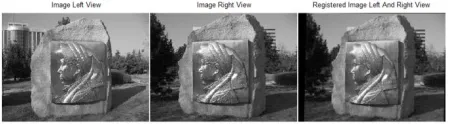
Firstly, we need to register these left view and right view image. For image registration correspondence between these images need to calculate. For the pixel in left image we need to find its corresponding pixel in right image. Finally registered image is formed. The low resolution image is to be selected. The final generated image is same as this image, but in improved form. This low resolution image needs to be interpolated to form the same size as left view and right view images. The high and low frequency images generated by performing down sampling and up sampling on left view and right view image.
Processing steps:
1. Registration of Images
2. Generate low frequency Images 3. Generate high frequency Images 4. Calculate Depth of an Image 5. Displacement Estimation 6. Super-Resolution of Image
1. Registration of an Image:
Quality of generated image depends on the accuracy of a registration. The quality of the generated high resolution image is good when the pixels of low resolution image are arranged at regular pattern.
Image Registration Techniques:
1. Intensity based automatic image registration 2. Control point registration
Search for the relation between the images
Setting up the correspondence is known as registration of images. Final information is gained from combination of various data sources.
2. Generate Low frequency and High frequency Images
Low frequency images are generated by down-sampling of a both left view image and right view image. High frequency images are generated by up-sampling of a left view and right view image. The generated high frequency content need to be shifted in a low resolution image where the pixels values are missing. The content missing in a low resolution image improved by high frequency image by using the depth information.
Fig 1: Divide high resolution image into low frequency and high frequency images.
3. Depth of an Image:
Depth information generated from a neighboring high-resolution view is used to warp the missing high frequencies into the image plane of the low-resolution view. Depth information assume to be error free.
Fig 2: Flow to calculate depth map of an image
Depth information can be obtained by two ways, one is by using depth camera and other is by disparity estimation. Disparity estimation is mostly used in many application fields to calculate depth information. Disparity estimation is low cost and efficient technique.
Stereo Matching Algorithm:
To compute the depth map between two stereo images, basic block matching is used. Stereo vision is the process of recovering depth from two or more views of the same scene. Binocular stereo uses only two images.
1. Read Stereo Image pair - Color image converted to gray image for matching process.
2. Basic Block Matching - For every pixel in the right image, extract 7 by 7 pixel block around it and search along the same row in the left image for the block that best matches it.
3. Sub-pixel Estimation
SAD=
∑ [L(x)
-R(x)]
x€N
HR Image
High Frequency Image
A. Sum of Absolute Differences
SAD finds the intensity differences for every center pixel (i, j) in a window W(x, y) as follows:
Where IL and IR are pixel intensity functions of the left and right image, respectively. W(x, y) is square window that covers the position (x, y) of the pixel. The disparity SAD (x, y, d) calculation is continue within the x-coordinate in the image row, which is defined by maximum disparity dmax of the scene. The minimum difference disparity value shows the best matching pixel, and position of the minimum defines the disparity of the actual pixel.
B. Sum of Squared Differences
The Sum of Squared Difference algorithm is similar to the previously described SAD algorithm. In previous it computing the absolute value, where in the SSD computes squares of the intensity differences as follows:
Here IL is the pixel intensity functions of respective left image and IR is the pixel intensity functions of right image, respectively. W(x, y) is square window that covers the neighboring pixels of the position (x, y) of the pixel.
4. Displacement Estimation:
For displacement estimation difference between the low resolution image and generated low frequency images is calculated. If the resulting difference exceeds a pre-defined threshold q, the corresponding displacement-compensated high-frequency information is rejected, otherwise generated high frequency information shifted to low resolution image.
IV. EXPERIMENTAL RESULT
To evaluate performance, multi-view images from a personal photo collection are used. The enhancement in super resolution image was compared with the original low resolution image via the increase peak signal-to-noise ratio (PSNR). The experiments were executed on an Intel Core TM 2 duo CPU @ 2.5 GHz with 2 GB RAM and results are obtained using MATLAB 2013b version tool.
For generating the super-resolved image, firstly low resolution and high resolution image need to be selected from set of image database. High resolution image divided into low frequency image and high frequency image. Low frequency image generated by down-sampling of a high resolution image whereas high frequency image generated by up-sampling of an image. In a generated low frequency image shows a small variation between a pixel values. But in high frequency image there is large variation between pixels values occurs. It mainly contains the edges details of an image.
Fig 4: Generated low frequency left view and right view image
Fig 5: Generated high frequency left view and right view images
Depth map of an image is calculated by using stereo matching algorithm. In that basic block matching technique is used. By using Generated depth map, high frequency content is shifted to a low resolution image.
Fig 6: Depth map of left view and right view images
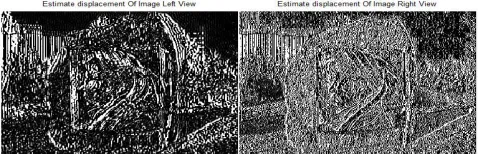
Displacement estimation is perform to find the displacement between the low resolution image and low frequency image. If any error occurs then high frequency content is not shifted to low resolution image.
Fig 7: Displacement estimation of left view and right view image
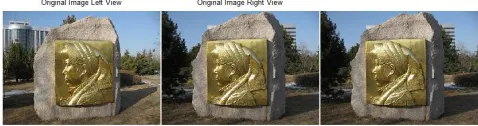
Fig 8: Left view image Right view image and Super-Resolution image
Increase in resolution of an image:
Quality of generated image is calculated by using the following formula. Size of the image multiply by 2 to the power n.
Size of the image*2^n
Where n is varies from 1…n.
By using this formula, resolution of an image increased twice than that of original image. It means if the resolution of an original image is 100x100 then resolution of a super-resolved image is 200x200.
Calculation of PSNR and MSE of super-resolved image:
PSNR and MSE values:
PSNR (peak signal to noise ratio) is calculated between original image and generated super-resolution image. PSNR=20*log(1/MSE)
MSE(mean square error) is the error matrix used to find squared error between compressed and original image.
Error= [f(x, y)-g(x, y)] ^2
MSE=mse + error
It will note that performance of single image super-resolution may not be as good as those from approaches using multiple images.
V. CONCLUSION ANDFUTURESCOPE
Super-Resolution performed over a mixed resolution multi-view images. Images from different view are register to get final image. For image registration, correspondence between the left view image and right view image is calculated. Both the view divides into low frequency image and high frequency image. High frequency content of these images used to generate super resolved image using the depth information. Depth map estimated by stereo matching algorithm, based on Basic block matching technique. Sum of Squared Differences (SSD) and Sum of Absolute Differences (SAD) used to find error in the depth of an image. Finally obtain a dense high quality super resolution result.
REFERENCES
[1] Thomas Richter, Jurgen Seiler and Andre Kaup,” Robust Super-Resolution for Mixed-Resolution Multiview Image plus Depth Data” IEEE Transactions on Circuits and Systems for Video Technology 10.1109/TCSVT.2015.2426498
[3] Chao Dong, Chen Change Loy, Kaiming He and Xiaoou Tang,” Image Super-Resolution Using Deep Convolutional Networks”, IEEE Transactions on Pattern Analysis and Machine Intelligence DOI 10.1109/TPAMI.2015.
[4] Bumsub Ham, Dongbo Min and Kwanghoon Sohn,” Depth Superresolution by Transduction”, IEEE Transactions on Image Processing, Vol. 24, no. 5, May 2015
[5] Eduardo Quevedo, Jesús de la Cruz, Luis Sánchez, Gustavo M. Callicó and Félix Tobajas,” Super-Resolution with Adaptive Macro-Block Topology Applied to a Multi-Camera System”, IEEE Transactions on Consumer Electronics, Vol. 61, No. 2, May 2015
[6] Jun Xie, Rogerio Feris, Shiaw-Shian Yu, Ming-Ting Sun,” Joint Super Resolution and De-noising from a Single Depth Image”, IEEE Transactions on Multimedia 2015
[7] Younghee Kwon, Kwang In Kim, James Tompkin, Jin Hyung Kim and Christian Theobalt,” Efficient Learning of Image Super-resolution and Compression Artifact Removal with Semi-local Gaussian Processes”, IEEE Transactions on Pattern Analysis and Machine Intelligence 2015
[8] Gungor Polatkan , Mingyuan Zhou, Lawrence Carin, David Blei and Ingrid Daubechies ,” A Bayesian Nonparametric Approach to Image
Super-Resolution”, IEEE Transactions on Pattern Analysis and Machine Intelligence, Vol. 37, no. 2, February 2015
[9] Marco Bevilacqua, Aline Roumy, Christine Guillemot, Marie-Line Alberi Morel,” Single-Image Super-Resolution via Linear Mapping of
Interpolated Self-Examples”, IEEE Transactions on Image Processing, Vol. 23, no. 12, December 2014
[10] Tomer Peleg and Michael Elad,” A Statistical Prediction Model Based on Sparse Representations for Single Image Super-Resolution”, IEEE Transactions on Image Processing, Vol. 23, no. 6, June 2014
[11] Mr. Sanket B. Kasturiw Ala, Dr. S.A.Ladhake,” Adaptive Image Superresolution for Agrobased Application”, 2015 International Conference on
Industrial Instrumentation and Control (ICIC) College of Engineering Pune, India. May 28-30,2015
[12] Seokhwa Jeong, Inhye Yoon, Jaehwan Jeon and Joonki Paik,” Multi-Frame Example-Based Super-Resolution Using Locally Directional Self-Similarity”, IEEE International Conference on Consumer Electronics 2015
[13] Abdullah Al-Shabili, Bilal Taha, Hussain Al-Ahmad,” Superresolution Algorithm for Satellite Still Images”, International Conference on Information and Communication Technology Research 2015
[14] Yuehong Chen, Yong Ge, Gerard B. M. Heuvelink, Jianlong Hu, and Yu Jiang ,” Hybrid Constraints of Pure and Mixed Pixels for Soft-Then-Hard Super-Resolution Mapping With Multiple Shifted Images”, IEEE Journal of selected topics in Applied Earth Observations and Remote Sensing, Vol. 8, no. 5, May 2015