Evolution IOT Concept of Face
Recognization: A Survey for Related
Methodologies
Abhishek Kumar 1, Dr. Prabhakar reddy2,
Research Scholar, Department of Computer Science, University of Madras, Chennai, Tamilnadu, India1
Professor, Department of Computer Science, University of Madras, Chennai, Tamilnadu, India2
ABSTRACT: This paper represents a facial features recognition system using Bezier curves approximation technique.
The approach is predicated on countenance extraction victimization the data of the face pure mathematics and approximated by third order Bezier end points demonstrate the link among the act of features and change in facial expressions. In the concerns of color shading in the picture, person face identification such problems were supported by hybrid method of fuzzy classification was used which changes the difference among colors. By doing various operations prunes produces that the mechanism will acknowledge the facial motions with an absolute of over 90cases. Finally the system has been enforced employing a manipulator golem and provision facial features commands. From human face structure; we tend to divide in three regions like right eye, left eye and mouth areas from the face image. First comes the face detection then detection of the skin region. We crop the facial skin region and connect the most important skin region to discover the skin surface of the external body parts.
KEYWORDS: Face detection, facial expressions, fuzzy logic, comparison with extreme parts and depth search
I. INTRODUCTION
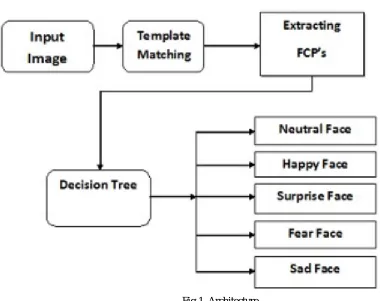
Fig 1. Architecture
Expression analysis was basically an exploration theme for clinicians. However, recent advances in picture handling and example acknowledgment have persuaded significant research works on programmed outward appearance acknowledgment. Previously, a ton of exertion was devoted to recognize facial articulation in still pictures. For this reason, numerous systems have been connected: neural networks, Gabor wavelets and dynamic appearance models. A critical restriction to this system is the reality that still pictures more often than not catch the peak of the articulation, i.e., the moment at which the pointers of feeling are generally checked. In their day by day life, individuals only here and there show peak of their outward appearance during normal correspondence with their partners, except if for very specific cases and for extremely concise periods of time. The programmed outward appearance acknowledgment framework incorporates:
The facial feature recognition system has the following blocks: • Face Detector.
• Face movement extraction mouth and both eyes.
• Person face character is dependent on FCP extractor algorithm. • Face feature identifier.
utilized in our everyday life in various parts. We trust that human life can be incredibly assisted with this innovation. Some commonplace applications are recorded as pursues:- Business Meeting, Gathering.
• Education Teaching assistant.
• Audio-video speech acknowledgment..
II. RELATEDWORK
Authors [1] utilized channel in identifying the illuminated highlights. Picture was first changed over to dim scale and after that face was identified and resized. Maybe a couple of the most delegate highlights are chosen through highlight determination technique and SVM is utilized to arrange.
Authors [2] built up calculation of recognize least number of Gabor wavelet variables to characterise FER. Its converts picture to dark values and helps in scaling mechanism and apply a channel after that highlights are inspected, measurements of highlight vector was diminished utilizing PCA.
Authors [3] and final et al [4] have showcased the usage in edgebased incorporate extract of Gabor Highlights. Picture was channel by Gabor and tangle with different edge identifier. It utilises different edge identifier in light of the way that each edge revelation issue of manual assurance of edge regard. The features are lessened in estimation with PCA, SVM, which came about 92% affirmation quantity of data storage server among the subject ward affirmation.
Abhishek.et.al [17] implemented a system and executed by usage of wavelet change by help of PCA and LBP [5]. Such cross breed mechanism gives 89% typical affirmation rate for JAFFE server.
Authors proposed a hybrid procedure for Canny edge acknowledgment, PCA and ANN (Fake Neural System) [6].It recognize the close-by position on the face, for instance, like different areas of face by then lessening the estimation using PCA.
Authors [7] implements PCA for Face Acknowledgment and FER. For PCA gathering is for execution and, delayed consequence of affirmation rate is approximately 80% for both CSU ATT database.
Authors [8] analysed FER by the help of PCA overlap situate,Forpreprocessing shading space change, skin area disclosure, hullabaloo departure along morphological action by applying on pictures. By then subject to PCA, Eigen vectors and Eigen faces are resolved and gather enunciation using Euclidean Partition. This philosophy came about 96.667% affirmation rate for the 60 Eigen appearances for JAFFE database and also have surveyed PCA based FER strategies for curved pictures. They are worked with the variety of servers, as CMU and ORL servers which are in same edifying condition and learn Eigen faces. In this paper, the relationship of affirmation rate, which result with approximate of 90% for both CMU and ORL database..
Authors [9] made FER with mixed space using LFDA (Neighbourhood Fisher Discriminant Analysis). There is a test to work with mixed space paying little heed to whether there isn't incredible affirmation rate for decoded territory. This system is associated with JAFFE and MUG servers having an affirmation rate independently 94% as well as 95%. Modified FER by picture progression by the help of LBP mechanisms are cleared up. It closely attempts for totally robotized facial feature acknowledgment for face enunciation. The several incredible centers were recognized overall face. For plan SVM mechanism is in existence. It is the development over normal recognizable proof over core interests.
Authors [10] developed an upgrade mechanism in enunciation express neighbourhood parallel model characters (Es-LBP) that is an adjustment for customary LBP. There are remove enunciation related mechanisms for planning stage in usage of SVM.
III.HOWWORKISGOINGINTHISFIELD
appearance classification, just as the level of outward appearance change. At long last, the framework has been actualized by issuing outward appearance directions to a controller robot. Played that controls equivocalness in hues [11, 12]. Exploratory outcomes show that this procedure can vigorously characterize skin locale and non-skin area. So as to choose whether the skin locale is face or not, biggest network analysis has been utilized. This technique can perceive the outward appearance classification, just as the level of outward appearance change. At long last, the framework has been executed by issuing outward appearance directions to a controller robot. and approach Based are Lower complexity, Less computer demanding. And disadvantages are difficult to extend with more emotions, less precise, Difficult to generalize to new data. The Coding Based: advantages are Precise, Versatile and Extensible.[13,14,15]
There is a mistaken area and following of facial focuses. Likewise Pose, development and revolution of the test individual are restricted. Glasses may thwart characterization, particularly thick and dull casings in recognizing feelings. Face Reader can examine one face at any given moment. Face Reader can't order outward appearances in test people with a fractional facial loss of motion[16,17]
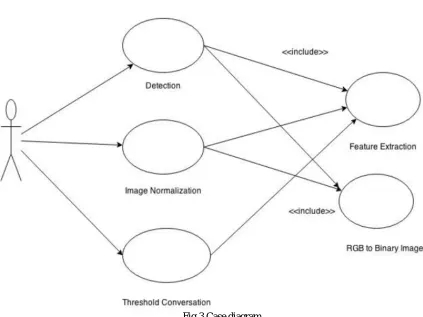
Fig 3 Case diagram
Requirements [18,19,20] HARDWARE RESOURCES: • Device Processor: Pentium IV. • Bus: 32- Bit.
• RAM: 512MB DDR RAM.
• Hard disk storage: 20GB (of minimum). • Display: colour Monitor.
• Key board: QWERTY Keyboard. • Web Camera (OPTIONAL).
IV.RESULTS
Let’s take at major steps in the significant changes in terms of project running performance. We can observe the huge numbers of tasks should complete as soon as possible. You cannot start the task without any usage by the time we are using.
STEP 1: INPUT IMAGE
Here the normal picture is taken from the phone or from the web camera and given to the device as input for further processing.
STEP 2: CONTRAST EXTENDING OF THE IMAGE
STEP 3: SKIN COLOUR CHANGE IN PICTURE
For shading change, the body for various individual was changed over the white pixel along it remains of the variations of changed over in dark pixel. Any RGB advanced picture that can changed over into YCrCB shading space utilizing by below condition:
Y=0.299R + 0.587G + 0.114B Cb = -0.169R - 0.331G + 0.500B Cr = 0.500R - 0.419G - 0.081B
STEP 4: DETECTING CONNECTED REGION
Associated part marking was utilized over PC in identifying associated districts in double advanced pictures, despite the fact that shading pictures and information with higher dimensionality can likewise be handled. At the point when incorporated into a picture acknowledgment framework.
STEP 5: BINARY CONVERSION OF THE IMAGE
The shading Rizvi School of Designing, Bandra, Mumbai. utilized for the object(s) in the picture is the frontal area shading while whatever remains of the picture is the foundation shading
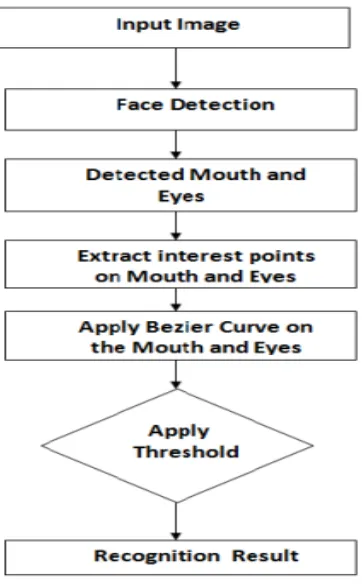
STEP 6: EXTRACTING EYES AND LIPS FROM THE BINARY IMAGE TO RECOGNISE BEZIER CURVES For the image verification and identification first the algorithm should design and draw the required major parts of the face like lips and both the eyes. By the help of Bezier bends, feelings were identified for contrasting its qualities over the servers.
STEP 7: TO RECOGNISE FEELINGS OF AN INDIVIDUAL
Different angles were drawn and regarded terms form the Bezier bends were separated as well as contrasted and terms from the server along a suitable feeling was recognized.
Fig4: Dividing face into partitions
V. CONCLUSIONANDFUTURESCOPE
undertaking in investigating, for example in improving Eye-Lip recognition method as well as experimenting with venture of pictures captured in various edges along greater goals. High right acknowledgment rate (CRR), noteworthy execution enhancements in our framework. Promising results are gotten under face enlistment mistakes, quick preparing time. Framework is completely programmed and has the ability to work with video nourishes just as pictures. It can perceive unconstrained articulations. Our framework can be utilized in Digital Cameras where in the picture is caught just when the individual grins, or if the individual doesn’t squint his eyes. In security frameworks which can recognize an individual, in any type of articulation he introduces himself. Rooms in homes can set the lights, TV to a people taste when they go into the room. Specialists can utilize the framework to comprehend the power of agony or disease of a hard of hearing patient.
REFERENCES
1. "R. T. Mylavarapu and B. K. Mylavarapu, ""Huge information extraction techniques of Data Security,"" 2018 Second International Conference on Inventive Communication and Computational Technologies (ICICCT), Coimbatore, 2018, pp. 179-183.
doi: 10.1109/ICICCT.2018.8473017"
2. "B. K. Mylavarapu and R. T. Mylavarapu, ""A Framework for Hierarchical Big Image Data,"" 2018 Second International Conference on Inventive Communication and Computational Technologies (ICICCT), Coimbatore, 2018, pp. 169-173.
doi: 10.1109/ICICCT.2018.8473339"
3. "Kumar. Attangudi P. Perichappan, S. Sasubilli and A. Z. Khurshudyan, ""Approximate analytical solution to non-linear Young-Laplace equation with an infinite boundary condition,"" 2018 International Conference on Computing, Mathematics and Engineering Technologies (iCoMET), Sukkur, 2018, pp. 1-5.
doi: 10.1109/ICOMET.2018.8346349"
4. AttangudiPerichiappanPerichappan, Kumar. (2018). Greedy Algorithm Based Deep Learning Strategy for User Behavior Prediction and Decision Making Support. Journal of Computer and Communications. 06. 45-53. 10.4236/jcc.2018.66004.
5. "S. Chandrasekaran, ""Contemplated Method for Predicting Disease by Deep Learning Approach Over Big Data,"" 2018 International Conference on Research in Intelligent and Computing in Engineering (RICE), San Salvador, 2018, pp. 1-5.
doi: 10.1109/RICE.2018.8509090"
6. U. S. Sekhar, G. Sasubilli and A. Z. Khurshudyan, "Computer model of point sources in control problems for heating bodies," 2018 International Conference on Computing, Mathematics and Engineering Technologies (iCoMET), Sukkur, 2018, pp. 1-5.doi: 10.1109/ICOMET.2018.8346361
7. U. S. Sekhar and G. Sasubilli, "A Multi Level Shared Procedure Mechanism for Huge Pictures by Using Large Statistics," 2018 Second International Conference on Inventive Communication and Computational Technologies (ICICCT), Coimbatore, 2018, pp. 159-163. doi: 10.1109/ICICCT.2018.8473052
8. Automatic facial expression analysis: A survey; B. Fasel and J. Luettin, Pattern Recognition, vol.36, no. 1, pg.259-275, 2003 Edition. 9. Facial expressions of emotion: An old controversy and new findings discussion;P. Ekman, E. T. Rolls, D. I. Perrett, and H. D. Ellis, Phil.
Trans. Royal Soc. London Ser. B, Biol. Sci., vol. 335, no. 1273, pp. 63-69, 1992 10. Nonverbal Communication; A. Mehrabian,London, U.K.: Aldine, 2007.
11. Dynamics of facial expression: Recognition of facial actions and their temporal Segments from face profile image sequences ; M. Pantic and I. Patras,IEEE Trans. Syst., Man, Cybern. B, vol. 36,no. 2, pp. 433 449,2006.
12. Samad, Rosdiyana, and Hideyuki Sawada. "Edgebased Facial Feature Extraction Using Gabor Wavelet and Convolution Filters." In MVA, pp. 430-433. 2011.
13. Sisodia, Priya, AkhileshVerma, and SachinKansal. "Human Facial Expression Recognition using Gabor Filter Bank with Minimum Number of Feature Vectors." International Journal of Applied Information Systems, Volume 5 – No. 9, July 2013 pp. 9-13.
14. Thai, Le Hoang, Nguyen Do Thai Nguyen, and Tran Son Hai. "A facial expression classification system integrating canny, principal component analysis and artificial neural network." arXiv preprint arXiv: 1111.4052 (2011).
15. Abdulrahman, Muzammil, Tajuddeen R. Gwadabe, Fahad J. Abdu, andAlaaEleyan. "Gabor wavelet transform based facial expression recognition using PCA and LBP." In Signal Processing and Communications Applications Conference, 2014 22nd, pp. 2265-2268. IEEE, 2014.
16. Sobia, M. Carmel, V. Brindha, and A. Abudhahir. "Facial expression recognition using PCA based interface for wheelchair." In Electronics and Communication Systems, 2014 International Conference on, pp. 1-6. IEEE, 2014.
17. Abhishek Kumar, K. Rawat, and D. Gupta, "An advance approach of pca for gender recognition," in Information Communication and Embedded Systems (ICICES), 2013 International Conference on. IEEE, 2013, pp. 59-63
18. D Kumar, R Singh, A Kumar, N Sharma An adaptive method of PCA for minimization of classification error using Naïve Bayes classifierProcedia Computer Science, 2015. Elsevier, pp.9-15
19. Kumar, A., & SAIRAM, T. (2018). Machine Learning Approach for User Accounts Identification with Unwanted Information and data. International Journal of Machine Learning and Networked Collaborative Engineering, 2(03), 119-127.