Segmenting Metals in Optical Microstructure
Images using Haar Features
K. Gajalakshmi*1, S. Palanivel2, S.Saravanan3
Department of Computer Science and Engineering, Annamalai University, Annamalainagar, Tamilnadu, India*1
Department of Computer Science and Engineering, Annamalai University, Annamalainagar, Tamilnadu, India2
Department of Mechanical Engineering, Annamalai University, Annamalainagar, Tamilnadu, India3
ABSTRACT: In this study, segmentation of layers in the optical microstructure of an explosive clad, based on their texture is attempted. 300 numbers of two and three layer clad microstructures, stored in a database, are classified by means of segmentation by extracting Haar features and their mean. The experimental results show that the Haar features successfully segment the multilayer clad microstructure with an accuracy of 96.7%, determined by the performance accuracy technique.
KEYWORDS: microstructure, Segmentation, Haar features, Accuracy.
I. INTRODUCTION
In the last decades, with the considerable increase in competition among industries, the quality control of equipments and materials become a basic requisite to remain competitive in national and international markets. The control of quality is important for critical applications where, weld failure is catastrophic, such as in pressure vessels, load-bearing structural members, and power plants. The quality of a weld joint is determined by performing destructive testing on the random samples, which represent the quality of the whole batch. However, this lacks real-time and reliance, and hence, it reduces the efficiency of the production line. To overcome this, the computer vision technology for the image analysis is an effective tool.
In the welding industry, methods based on image analysis is employed for seam tracking [1] , weld pool size controlling [2], weld geometry controlling, and weld quality assessing [3], as well as for adaptive controlling welding processes [4]. However, studies related to the segmentation of layers in a clad, using image processing techniques, is limited and is attempted in this study. In this study, optical microstructures obtained from similar and dissimilar multilayer explosive cladding is segmented, based on their variation in texture, using Haar features and the accuracy of segmentation computed.
II. PERCEPTION AND DESCRIPTION Methodology
Fig. 1 Workflow of texture segmentation
Optical microstructure
Microstructure of dissimilar explosive cladding shows a unique wavy morphology. The segmentation of microstructure is performed by two vital steps following Haar transform and thresholding. Haar transform is used for segmentation based on the mean values of the two region, while, thresholding determines the exact location and number in layers in the clad microstructure. A three layer dissimilar explosive clad (Al-Cu-Cu) microstructure is shown in Fig. 2.
Fig. 2 Explosive clad microstructure (Al-Cu-Cu)
Haar features
Haar features are simplified from Haar wavelet. Due to their in sensitivity to illumination and strong ability in representing textures, Haar-like features are applied widely [5,6]. Haar feature are employed for determining covariance for pedestrian detection [7], with non orthogonal feature for matching, reconstruction [8], with stochastic context-free grammar for hand gesture recognition [9]. In this work, Haar feature is proposed for microstructural texture segmentation. The calculation of mean based on the Haar feature is discussed in the next section.
Mean based Haar Feature
The method proposed by earlier researchers [10-12] employed two simple rectangle features to classify the images. The regions within the rectangle have the same size, shape and vertically adjacent (Fig. 3). In this work, absolute difference between mean of pixel intensities in the two regions of the rectangle is used as feature.
Fig. 3 Two rectangles
Images
Pre-processing
Haar Feature
Extraction
Thresholding
Segmented
To evaluate the novel approach, experiments are performed on the dataset of images chosen from explosive cladding images. Proposed segmentation method is based on Haar features. The overall accuracy [13] of the cladding segmentation is measured as
Accuracy= . 100% (1)
Where successfully segmented images means that the segmented layers of cladding microstructure image is nearly close to ± 5 pixel tolerance error in image. Total number of images in data base is considered and then the performance is calculated.
III. RESULTS AND DISCUSSION
Data base collection
The optical microstructure of various similar/dissimilar clads viz., aluminium (Al)-aluminum (Al), Al-Copper (Cu), Al-Al-Cu, Al-LCS, Al-SS 304 were determined following standard metallurgical practices viz., grinding, polishing and etching in an optical microscope (VERSAMAT–3) equipped with Clemex image analyzing system and stored as images in an unbiased database. Pre-processing is performed by accomplishing suitable size, brightness and contrast adjustments. For each combination of clad, microstructural images are collected totalling 100 images, are utilized for segmentation.
Pre-processing
The preliminary pre-processing stage converts the input microstructural image into a gray scale image, removing noise and resizing by cropping tool. Based on resizing the image, feature dimensions change from image to image. Resizing is required for cropping the essential portions of the microstructural images. Similar procedure is performed for all the images (100 numbers) stored in the database and stored for further processing. The pre-processed images having gray textures are subjected to feature extraction and it is described in the next section.
Segmentation using Haar features
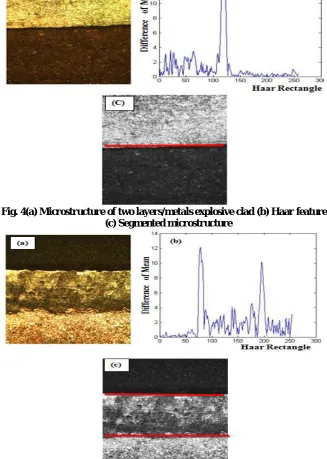
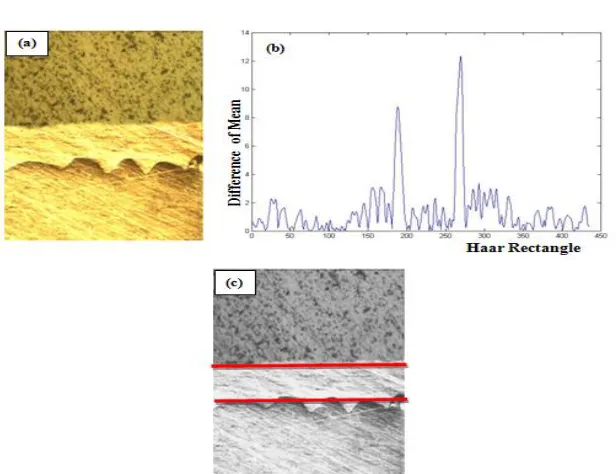
Haar-like feature is used in this work is the absolute difference between mean of pixel intensities in shaded rectangles and the white region of the rectangle. Subsequently, the rectangle is shifted vertically over the mid section of the microstructural image and the Haar feature is extracted. The size of the rectangle is 30 pixels X 10 pixels is chosen. This rectangle is moved with a 10% adjacent overlap in ‘y’ direction to extract the Haar feature. The Haar features are plotted and the peaks indicating the number of metals (texture) in the clad. A single peak in the contrast of mean represents the clad image has two layers, while dual peak represent the clad having three layers/metals. Similarly, this methodology can be adopted for a microstructure having any number of metals/layers. The mean of the peaks, which represent the segmented position, is determined to find the segmentation point. Finally the segmentation line is drawn on the image by corresponding to the peak.
Experiments
Fig. 4(a) Microstructure of two layers/metals explosive clad (b) Haar features (c) Segmented microstructure
Fig. 6 (a) Three layer cladded microstructure with similar metals and wavy 6 (b) Haar features 6 (c) Segmented microstructure
Performance Measure
` Out of 300 images, there are 100 two layer and 100 threes layer images. Some wavy structures with defects are not segmented properly, achieving 96.7 % accuracy in segmentation. Similarly, in case of four and five layer clads, few images are segmented incorrectly. The details of the number of layers and their accuracy of segmentation are shown in Table 5.1.
Table 5.1 Segmentation Accuracy
Numbers of welding layers Images
Accuracy
(%)2 100 99.0
3 100 97.5
4 40 96.5
5 10 96.0
More than 5 50 91.0
IV. CONCLUSION
The segmentation of cladded microstructure employing Haar features is proposed in this paper. The following salient conclusions were drawn from this experimental study. Thresholding based segmentation utilizing Haar features can effectively be employed in segmenting welded image based on their optical microstructure. The method achieved an accuracy of 96.7% for segmenting layers in optical microstructure image.
REFERENCES
1. Kim J.S., Son Y.T., Cho H.S., Koh K.II.,A robust method for vision-based seam tracking in robotic arc welding, Proceedings of the IEEE Intern. Symp. on Intelligent Control, 163-168,1995.
3. Xu D., Wang L., Tan M., Image processing and visual control method for arc welding robot. Proc. of the IEEE Intern. Conf. on Robotics and Biomechanics, Shenyang, China, 727-732, 2004.
4. Albuquerque V. H. C., Cortez P. C., Alexandria A. R., Image segmentation system for quantification of microstructures in metals using artificial neural networks, Revista Matéria 394-407 (12), 2007.
5. Viola. P, Jones. M, Rapid object detection using a boosted cascade of simple features, Proceedings of the 2001 IEEE Computer Society Conference, vol 1, pages: 511-518, 2001.
6. Viola. P, Jones. M, Robust real-time face detection, International Journal of Computer Vision 57(2), 137-154, 2004, vol 2, pages: 747-747, July 2001.
7. Paisitkriangkrai. S, Shen. C, Zhang. J, Fast Pedestrian Detection Using a Cascade of Boosted Covariance Features, Circuits and Systems for Video Technology, IEEE Transactions, vol 18, pages: 1140-1151, Aug 2008.
8. Feng Tang, Crabb. R, Hai Tao, Representing Images Using Nonorthogonal Haar-Like Bases, Pattern Analysis and Machine Intelligence, IEEE Transactions, vol 29, pages: 2120-2134, Dec. 2007.
9. Chen. Q, Georganas. N. D, Petriu. E. M, Hand Gesture Recognition Using Haar-Like Features and a Stochastic Context-Free Grammar, Instrumentation and Measurement, IEEE Transactions, vol 57, pages: 1562-1571, Aug 2008.
10. Lausser. L, Schwenker. F, Palm. G, Detecting zebra crossings utilizing AdaBoost, 16th European Symposium on Artificial Neural Networks, Bruges, Belgium, April 23-25, 2008.
11. R. Lienhart, L. Liang, and E. Kuranov. A detector tree of boosted classifiers for real-time object detection and tracking. In IEEE ICME2003, pages 277–280, 2003.
12. Nguyen Khac, Ju H. Park, Ho-Youl Jung, Face Detection using Variance based Haar-Like feature and SVM , World Academy of Science, Engineering and Technology 60 , 165-168, 2009.