ABSTRACT
SangPil Hwang. Dynamic Time Series Analysis Using Logistic Function. (Under the
direction of David A. Dickey.)
This paper investigates a set of autoregressive time series models whose coefficients
have the form of a logistic function. The transfer function type models give additional
flexibility over the fixed coefficients models and include them as a special case. NLAR
models with the AR(1) coefficient being a hyperbolic tangent function work well for
modeling series which have asymmetric stochastic volatility or changing amplitude
Dynamic Time Series Analysis Using Logistic Function
by
SangPil Hwang
A dissertation submitted to the Graduate Faculty of North Carolina State University
in partial fulfillment of the requirements for the Degree of
Doctor of Philosophy
STATISTICS
Raleigh
2004
APPROVED BY:
David A. Dickey Sastry G. Pantula
Chair of Advisory Comittee
Biography
SangPil Hwang was born in ChangWon, the Republic of Korea on Feburary 1, 1967.
He entered Department of Economics at Seoul National University in 1985 and took
his B.S. in Economics in 1989. He worked for the Bank of Korea from 1992 to 2000.
He joined Department of Statistics, North Carolina State University for the pursuit
Acknowledgements
I would like to express my deepest gratitude and biggest appreciation to my advisor
Dr. David A. Dickey. I am also grateful for precious instruction and helpful
sugges-tions from Dr. Sastry G. Pantula, Dr. Bibhuti B. Bhattacharyya and Dr. Matt Holt.
Contents
List of Tables vi
List of Figures vii
1 Introduction 1
2 Transfer function type models 13
2.1 some nonlinear models . . . 13
2.2 simulation . . . 41
2.3 application . . . 43
3 Nonlinear autoregressive model 94 3.1 NLAR(1) model . . . 94
3.2 simulation . . . 117
3.3 further analysis . . . 123
3.4 application . . . 129
4 Conclusion 205
List of Tables
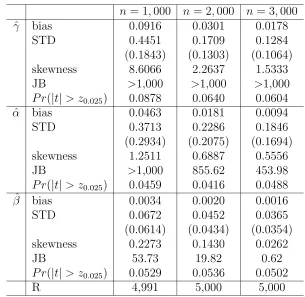
2.1 Distribution of ˆγ,α,ˆ and ˆβ for model (2.1) . . . 66
2.2 The summary of yearly precipitation and stream flow(1949-2001) . . . 68
2.3 Major Hurricane or tropical storm passing through both regions . . . 69
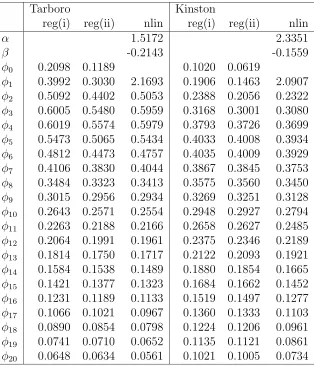
2.4 The coefficient estimates from the fitted models . . . 70
3.1 Estimation of α and β for model (3.1) where f(y) = y . . . 150
3.2 Distribution of ˆα and ˆβ for model (3.1) where f(y) = y . . . 153
3.3 Comparison of ARMA and nonlinear estimation for model (3.1) where f(y) = y . . . 157
3.4 Estimation of α and β for model (3.1) where f(y) = |y| . . . 159
3.5 Distribution of ˆα and ˆβ for model (3.1) where f(y) = |y| . . . 162
3.6 Comparison of ARMA and nonlinear estimation for model (3.1) where f(y) = |y| . . . 166
3.7 The distribution of ˆα and ˆβ whereβ = 0 n = 1,000 . . . 168
3.8 Distribution of ˆα and ˆβ for model (3.2) where f(y) = y . . . 169
3.9 Distribution of ˆα and ˆβ for model (3.2) where f(y) = |y| . . . 173
3.10 The mean of model (3.1) with γ = 0.99, 0.999 and 1.00, α = 1.0, and β = 0.8 . . . 177
3.11 Estimation of α and β with γ fixed at 0.99 wheref(y) = y . . . 179
List of Figures
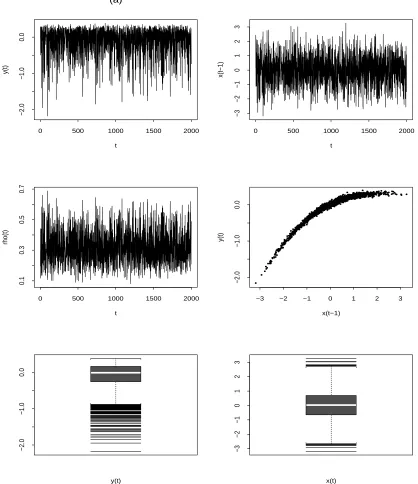
2.1 yt and xt where (a) (γ, α, β, σ) = (1.0,0.8,0.5,0.04) . . . 72
2.2 yt and xt where (b) (γ, α, β, σ) = (1.0,−1.0,−0.8,0.04) . . . 73
2.3 (a) the log transformed stream flow series of Goldsboro(dotted line) and
Kinston(solid line), (b) prediction(dotted line) and actual series(solid
line) for Kinston . . . 74
2.4 The cross-correlation of ∇yt and ∇xt . . . 75
2.5 (a) the log transformed stream flow series of Goldsboro, (b) ρ(dxt−2)
vs time, (c)1−ρ(dxt−2) vs time . . . 76
2.6 (a) phase spectrum and (b) squared coherency of two log transformed
stream flow series at a high flow period(solid line) and a low flow
pe-riod(dotted line) . . . 77
2.7 The response deviations and the changes in ρ(dxt−2) from the
equi-librium state by the given impulse of (a) AR(1), (b) AR(2), and (c)
AR(5), at a high flow(solid line) and a low flow(dotted line) . . . 78
2.8 (a) the log transformed stream flow series of Kinston(dotted line) and
Fort Barnwell(solid line), (b) prediction(dotted line) and actual
se-ries(solid line) for Fort Barnwell . . . 79
2.9 (a) the cross-correlation of∇yt and∇xt, (b) the cross-correlation ofyt
and xt . . . 80
2.10 (a) 1−ρ1(dxt−2)−ρ2(dxt−2) vs time, (b)ρ1(dxt−2) vs time, (c)ρ2(dxt−2)
vs time . . . 81
2.11 SOI and recruitment series . . . 82
2.12 Scatterplot of recruitmentytwith lagged SOI data,xt−h, h= 0,1,4· · ·,10 83
2.13 The cross-correlation of yt and xt . . . 84
2.14 (a) ρ(xt−5) vs time, (b) ρ(xt−5) vsxt−5 . . . 85
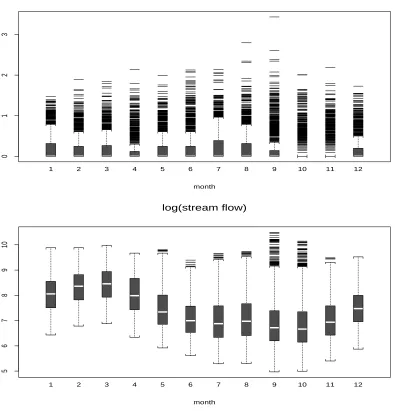
2.15 Boxplot of rainfall and stream flow in Tarboro(on a daily basis) . . . 86
2.16 Boxplots of rainfall and stream flow in Kinston(on a daily basis) . . . 87
2.17 Scatterplot of yearly rainfall and stream flow in Tarboro and
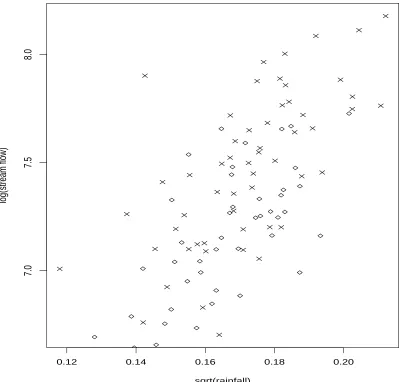
Kin-ston(daily average): ♦ Tarboro and× Kinston . . . 88
2.18 QQ plots of rainfall and stream flows in Tarboro and Kinston . . . . 89
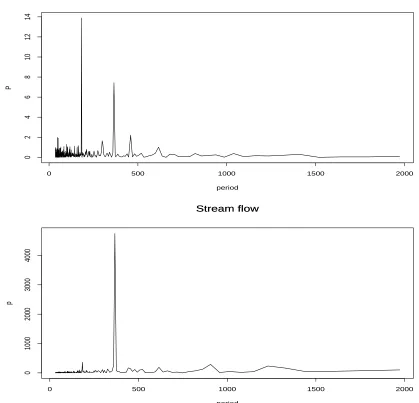
2.20 Periodograms of rainfall and stream flows in Kinston . . . 91 2.21 The cross-correlations of rainfall and stream flows in Tarboro(solid line)
and Kinston(dotted line) . . . 92
2.22 The phase spectrum of rainfall and stream flows in Tarboro and Kinston 93
3.1 ytandρ(yt−1) of series generated by (a) (γ, α, β) = (0.99,1.0,0.8) where
f(y) = y . . . 181
3.2 yt and ρ(yt−1) of series generated by (b) (γ, α, β) = (0.99,−3.0,0.1)
wheref(y) =y . . . 182
3.3 yt and ρ(yt−1) of series generated by (c) (γ, α, β) = (0.99,−1.0,−1.2)
wheref(y) =y . . . 183
3.4 yt and ρ(yt−1) of series generated by (d) (γ, α, β) = (0.99,1.0,0.8)
wheref(y) =|y|. . . 184
3.5 yt and ρ(yt−1) of series generated by (e) (γ, α, β) = (0.99,−3.0,0.1)
wheref(y) =|y|. . . 185
3.6 yt and ρ(yt−1) of series generated by (f) (γ, α, β) = (0.99,−1.0,−0.8)
wheref(y) =|y|. . . 186
3.7 Examples of series generated by (γ, α, β, σ) = (0.99,0.8,0.45,0.1)
un-der (a)ηt=et (b) ηt= 0.95ηt−1 +et where f(y) =y . . . 187
3.8 The trend of mean withσ2 = 1.0 where f(y) = y . . . 188
3.9 The trend of mean withσ2 = 0.25 where f(y) = y . . . 189
3.10 The areas where t tests of α = α0 and β = β0 have empirical
re-jection rates not significantly different from 0.05 based on binomial
test. f(y) = y and nonlinear estimation convergence rates bigger than
99.5%; (a) σ= 1.0 and (b) σ= 0.5 . . . 190
3.11 The areas where t tests of α = α0 and β = β0 have empirical
rejec-tion rates not significantly different from 0.05 based on binomial test.
f(y) = |y| and nonlinear estimation convergence rates bigger than
99.5%; (a) σ= 1.0 and (b) σ= 0.5 . . . 191
3.12 The trend of yt and ρ(yt−1); (a)c= 4.0, (b)c= 1.0, (c)c= 0.0. From
the left, γ = 0.9, γ = 1.0. For ρ(yt−1), the solid line is at γ = 0.9 and
the dotted line is at γ = 1.0. . . 192
3.13 The trend of yt and ρ(yt−1); (d) c=−0.2, (e) c=−1.0, (f) c=−4.0.
From the left,γ = 0.9, γ = 1.0. Forρ(yt−1), the solid line is atγ = 0.9
and the dotted line is at γ = 1.0. . . 193
3.14 Examples of series generated by (a) (γ, α, β) = (0.99,1.0,0.8), (b)
(γ, α, β) = (1.0,1.0,0.8) where f(y) =y . . . 194
3.15 Examples of series generated by (a) (γ, α, β) = (0.99,1.0,0.8), (b)
(γ, α, β) = (1.0,1.0,0.8) where f(y) =|y| . . . 195
3.16 The distribution of ˆα; (a) before unit root test, extreme observations
eliminated, (b) after unit root test. From the top, n = 1,000 and
3.17 The distribution of ˆβ; (a) before unit root test, extreme observations
eliminated, (b) after unit root test. From the top, n = 1,000 and
n= 3,000 repectively . . . 197
3.18 The areas where t tests of α=α0 and β =β0 have empirical rejection
rates not significantly different from 0.05 based on binomial test.
Non-linear estimation convergence rates bigger than 99.5%. σ2 = 1.0 and
f(y) = y; (a) α=α0, (b) β =β0 . . . 198
3.19 The areas where t tests of α=α0 and β =β0 have empirical rejection
rates not significantly different from 0.05 based on binomial test.
Non-linear estimation convergence rates bigger than 99.5%. σ2 = 1.0 and
f(y) = |y|; (a) α=α0, (b) β =β0 . . . 199
3.20 Stream flows in Goldsboro; (a) original series(yt), (b) scatter plot ofyt
andyt−1, (c) autocorrelation ofyt, (d) partial autocorrelation ofyt, (e)
prediction(yt: solid line, prediction: dotted line), (f) ρ(yt−1) vsyt−1 . 200
3.21 Stream flows in Kinston; (a) original series(yt), (b) scatter plot of yt
andyt−1, (c) autocorrelation ofyt, (d) partial autocorrelation ofyt, (e)
prediction(yt: solid line, prediction: dotted line), (f) ρ(yt−1) vsyt−1 . 201
3.22 Weekly soybean prices in North Carolina; (a) soybean prices, (b)
pe-riodgram of soybean prices, (c) scatter plot ofyt and yt−1, (d) boxplot
of yt, (e) autocorrelation ofyt, (f) partial autocorrelation of yt . . . . 202
3.23 Prediction of Soybean prices; (a) prediction of prices(dotted line), (b)
ρ(yt−1) vs time, (c) ρ(yt−1) vsyt−1 . . . 203
3.24 The estimated conditional standard errors(
ˆ
Chapter 1
Introduction
Dynamic time series analysis based on nonlinear models has become a topic of
interest lately. Here we will analyze time series whose coefficients involve the logistic
function. The models studied include a transfer function type model and a nonlinear
extension of the autoregressive model.
The usual transfer function has the form
yt =
∞
i=0
γixt−i+zt
= γ(B)xt+zt
where i|γi|<∞.
We assume the input process xt and noise process zt are both stationary and are
mutually independent. The coefficients γ0, γ1,· · · describe the weights assigned to
past values ofxt used in predictingyt and
γ(B) =
∞
i=0
where B is the backshift operatorB(xt) =xt−1(Shumway and Stoffer, 1999).
The model allows yt to depend on current and past values of the explanatory
variableX. For this standard model, the coefficients are fixed, neither they nor their
estimates change with time. We extend this to a model which has flexible weights,
reflecting a different impact of explanatory variables at different times.
We first consider a simple nonlinear transfer function model where the weight is
expressed using a logistic function. Our model is
yt =γρ(xt−1)xt−1+et
where ρ(xt−1) = exp( 1
α+βxt−1)+1.
Thus, ρ(xt−1) is a function of the explanatory variable X. The model can be
extended to, for example,
yt=γ1ρ(xt−d)xt−1+γ2(1−ρ(xt−d))xt−2+et
where ρ(xt−d) = exp(α+βx1
t−d)+1 and d= 1,2,· · ·, or
yt = γ1[1−ρ1(xt−d)−ρ2(xt−d)]xt+γ2ρ1(xt−d)xt−1
+ γ3ρ2(xt−d)xt−2+et
where ρ1(xt−d) = exp(α1+β1xt−d) 2
i=1exp(αi+βixt−d)+1
and ρ2(xt−d) = exp(α2+β2xt−d) 2
i=1exp(αi+βixt−d)+1
. d =
0,1,2,· · ·.
Also, variants of
where ρ(xt−d) = exp(α+βx1
t−d)+1 and d= 0,1,2,· · ·, are considered.
The idea of the model with two lagged Xs is to allow the relative importance of
xt−1 andxt−2 to vary with the magnitude ofX. For example, it may be that whenX
is small, the coefficient of xt−2 receives relatively little weight as compared to xt−1.
This model is a simple variant of smooth transition regression(STR) model
intro-duced in the literature(Bacon and Watts, 1971; Granger and Ter¨asvirta, 1993).
yt = (c11+φ10xt+φ11xt−1+· · ·+φ1pxt−p)
+ (c12+φ20xt+φ21xt−1+· · ·+φ2pxt−p)F(xt−d) +et
where F(xt−d) is a continuous function which may be either even or odd and d =
0,1,2,· · ·. For example, F(xt−d) may be a cumulative distribution function such as
a N(µ, σ2), or an odd, monontonically increasing function with F(−∞) = 0 and
F(∞) = 1. Where F(xt−d) changes very sharply, it could be viewed as a threshold
model with 2 regimes.
Here, we focus on the changing behavior of the coefficients rather than the regime
shifting. In this way, the nonlinear estimation could be more efficient and the model
is easily extended to three or more weight models. The estimation with more weights
is implemented easily as well.
The model has worked well in fitting to a string of log transformed daily flows
for the Neuse River in North Carolina in which Y is downstream flow and X is a
flow at an upstream location. In a period of high upstream flow, water would move
downstream faster. On the other hand, the water upstream could take longer to clear
issue.
Another goal of this paper is to investigate the possibility of allowing the second
moment properties of a univariate time series to change dynamically by using constant
variance innovations but dynamically changing difference equation coefficients. This
also can be accomplished through the use of the logistic function. This gives somewhat
different dynamic effects than the well known ARCH models in that the conditional
innovation variance changes in ARCH models.
ARIMA models are the most common time series models for data fitting and
forecasting. In these models yt represents the observation at time t, µrepresents the
long term mean and et represents the innovation, that is, et is an uncorrelated mean
0, variance σ2 sequence consisting of the portion of yt that can not be forecast from
the past. The general model is
yt−µ−φ1(yt−1−µ)− · · · −φp+d(yt−p−d−µ) = et−θ1et−1− · · · −θqet−q
where φ1,· · ·, φp+d, θ1,· · ·, θq are fixed but unknown parameters. They are not
ran-dom. The behavior of the data generated from this model is dependent on the roots
of the “characteristic equation”mp+d−φ
1mp+d−1−· · · −φp+d= 0. It is assumed that
d of these roots are 1 and that the remainingproots are less than 1 in magnitude. If
d = 0, the model is called ARMA and has the property that a convergent weighted
sum of theetsequence exists which, when used asyt−µ, solves the difference equation
above.
Furthermore, if d = 0, estimates of the parameters based on linear (if q = 0) or
If d = 0, the series is typically referred to as “stationary” meaning that yt−µ has
mean 0 and lag j covariance that is a function of j only. If d and q are both 0, the
model is autoregressive of order p,AR(p). Low order autoregressive models are often
used for modeling.
Stationary models have autocorrelations that are bounded by an exponentially
decaying function of the lag number. This quickly decaying correlation seems
incon-sistent with many observed time series. The traditional method of dealing with this
has been to difference the data at least once, and then fit an ARMA model to the
dif-ferences, that isdis taken to be 1 or more. In the class of ARIMA(p,d,q) models, one
linear difference equation with fixed parameters is assumed to govern the behavior of
the series at all times.
Over the past 20 years, various models that allow more flexibility have been
in-troduced. They can be divided into nonparametric, semiparametric, and parametric
groups in general. In the parametric group, where a specific functional form is
as-sumed, usually with some parameters to be estimated, we have
(i) the polynomial model, for example, the quadratic
yt =δ+βZt+ZtCZt+et
where C is a symmetric matrix of parameters. Zt consists of independent
ex-planatory variables or lagged variables,
(ii) the smooth transition regression(STR) model
where F is a function for capturing the transition aspect of the model such as
a normal CDF or a logistic function,
(iii) the flexible Fourier form
yt =δ+βZt+ZtCZt+
q
j=1
{cjsin(j(γZt)) +djcos(j(γZt))}+et
which is the polynomial model with sine and cosine terms added,
(iv) neural networks
yt =α+
q
j=1
βjφ(γjZt) +et
whereφis a squashing function, such as a cumulative distribution function or a
logistic function andZtconsists of independent explanatory variables or lagged
variables.
(Granger and Ter¨asvirta, 1993).
In the area of the nonlinear autoregressive(NLAR) models, amplitude-dependent
exponential autoregressive(EXPAR) models were independently introduced by Jones
(1976) and Ozaki and Oda(1978), and have become widely known. The EXPAR
model is
yt=
q
j=1
[αj+βjexp(−δyt2−1)]yt−j +et
where δ >0.
Also, the autoregressive conditionally heteroscedastic(ARCH) model of Engle(1982)
and subsequent variants GARCH, EGARCH etc, are very popular. These models
al-low the variance to change in a dynamic way by letting the variance at timet satisfy
In this paper, we begin by proposing a minor adjustment to the AR(1) model.
This adjustment appears to provide quite a bit of flexibility in terms of the types of
data structure it can provide.
The usual autoregressive order 1 model with mean 0 satisfies
yt=ρyt−1+et
where ρ and σ2, the variance ofet, are constant.
Our proposed model retains the constant innovations variance and uses dynamic
coefficients to model changing variances in the observations. The modification is to
replaceρby a modified logistic function of pastY values, namely, the random variable
γρ(yt−1).
yt=γρ(yt−1)yt−1+et
where ρ(yt−1) = exp(α+βf(yt−1))−1
exp(α+βf(yt−1))+1. Here f(y) =|y| orf(y) =y,|γ| ≤1, and β >0.
The modified logistic function we are using is also called a hyperbolic tangent.
tanhz = sinhz
coshz =
exp(2z)−1
exp(2z) + 1
where z = 12(α+βf(y)). The range of tanhz is (-1,1).
Notice that |γρ(t)|<|γ|. So, the model can produce local autocorrelation
coeffi-cients quite close to±1 if|γ|is near 1. This allows the model to generate data which is
locally nonstationary in appearence but in the long term tends to be mean reverting.
The model is useful for explaining series which have asymmetric stochastic volatility
than an exponential decay. A model whereρ(yt−1) has the form exp(α+βf(yt−1))−1
exp(α+βf(yt−1))+1 gives
more interesting features such as mentioned previously, with 2 or more regimes, than
does a model using the form exp( 1
α+βf(yt−1))+1.
The model can be considered as a variant of the logistic smooth threshold
autore-gressive(LSTAR) model such that
yt = γρ(yt−1)yt−1+et
= γexp(α+βf(yt−1))−1
exp(α+βf(yt−1)) + 1yt−1+et
= γyt−1−2γyt−1 1
exp(α+βf(yt−1)) + 1 +et.
A gradual transition between the different regimes is obtained by a smoothly changing
logistic function, which changes from 0 to 1 depending on f(yt−1). This can also
be thought of as a very simple form of the single neural network model mentioned
previously.
The STAR model has been used a lot to analysis regime-switching behavior of
series. The STAR model for a univariateyt, which is observed at t= 1−p,1−(p−
1),· · · −1,0,1,· · ·, T −1, T, is given by
yt=φ1xt[1−G(st;γ, c)] +φ2xtG(st;γ, c) +t
wherext= (1,x˜t)with ˜xt= (yt−1,· · ·, yt−p)andφi = (φi,0, φi,1,· · · φi,p), i= 1,2. t= 1,· · ·, T. The model allows exogenous variables z1t,· · ·, zkt as additional regressors.
The t’s are assumed to be a martingale difference sequence with E[t|Ωt−1] = 0 and
E[2t|Ωt−1] =σ2.Ωt−1 ={yt−1, yt−2,· · ·, y1−p−1, y1−p}.
be-tween 0 and 1. Usually, the logistic function
G(st;γ, c) = (1 + exp{−γ(st−c)})−1
where γ >0 and the exponential function
G(st;γ, c) = 1−exp{−γ(st−c)2}
where γ > 0 are used. st could be a lagged endogenous variable, an exogenous
variable, a time trend or a function of them. The resultant models are called the
logistic STAR(LSTAR) and the exponential STAR(ESTAR) model respectively.
The conditions under which STAR models generate series that are stationary are
not well known(Chan and Tong, 1986; Tong, 1990; Franses and van Dijk, 2000). The
stationarity and ergodicity of the series are generally pre-assumed. Testing unit roots
in TAR models has been discussed in Enders and Granger(1998). Tong(1990) has
proved that the nonlinear least square(NLS) estimates of the stationary and ergodic
LSTAR model are consistent and asymptotically normal. Specification, estimation,
and evaluation of STAR models are introduced in detail in Ter¨asvirta(1994) and
Eitrheim and Ter¨asvirta(1996).
Recently, various extensions of the basic STAR model have been suggested. The
multiple STAR(MRSTAR) model is obtained by encapsulating two different two
regime STAR models(van Dijk and Franses, 1999).
yt = [φ1xt(1−G1(s1t;γ1, c1) +φ2xtG1(s1t;γ1, c1)][1−G2(s2t;γ2, c2)] + [φ3xt(1−G1(s1t;γ1, c1) +φ4xtG1(s1t;γ1, c1)]G2(s2t;γ2, c2) +t
The model allows for a maximum of four different regimes. It can be extended to
The flexible coefficient STAR model(Medeiros and Veiga, 2000) can be derived
from the MRSTAR. It is obtained by assuming the transition variables s1t and s2t
are linear combinations of lagged dependent variables, i.e., sit = αtx˜t, i = 1,2, and
imposing the restriction φ1,j −φ2,j −φ3,j+φ4,j = 0 for j = 1,· · ·, p. The model can
be rewritten as
yt=φ∗0xt+φ∗1xtG1(α1x˜t;γ1, c1) +φ∗2xtG2(α2x˜t;γ2, c2) +t
where φ∗0 = φ1, φ∗1 = φ2 −φ1 and φ∗2 = φ3 −φ1(van Dijk, Ter¨asvirta, and Franses,
2002).
If one of the transition variables is taken to be time t, MRSTAR leads to
time-varing STAR(TVSTAR) model. The model is useful for analyzing the time series
which display both nonlinearity and structural instability(Franses and van Dijk, 2000;
van Dijk, Ter¨asvirta, and Franses, 2002).
In addition, the fractionally integrated STAR(FISTAR) model which combines the
features of long memory and nonlinearity into a single model has been suggested(van
Dijk and Franses, 2000) and STAR-GARCH model where the errors have GARCH
structure have been used for forecasting(Chan and McAleer, 2002).
We pay attention to the first order LSTAR model
yt=φ2yt−1 + (φ1 −φ2)yt−1 1
exp(α+βf(yt−1) + 1) +et
where φ1 = −γ and φ2 = γ with |γ| < 1. A series with a strong persistent
auto-correlation like a long memory process is generated when |γ| is near 1 and we prove
ergodicity of the series, and consistency and asymptotic distributions of parameter
We can incorporate serially correlated errors into the model easily and still get
the properties above.
yt = γρ(yt−1)yt−1+ηt,
and
ηt=δ1ηt−1+· · ·+δkηt−k+et.
NLAR(1) with serially correlated errors can be displayed as a LSTAR with many
regimes.
Usually, for threshold models, it is not easy to estimate many regimes at once
including the identification of order p and the delay factor d. The parameters of
our suggested model can be easily estimated by using the Gauss-Newton algorithm,
and one-step-ahead prediction is easily obtained from the fitted model. There is a
possibility that the usual STAR fitting process, because of its generality, does not work
well for the data generated by our suggested NLAR models(Granger and Ter¨asvirta,
1993; Ter¨asvirta,1994).
Estimation problems(non-convergence) are fairly common for some parameter
set-tings. However, we find that setting γ set to a value near, but less than 1 gives good
convergence and provides good prediction mean square errors, even if the true γ is
not near 1. It will be shown through simulation that the fitting is fairly robust with
respect to the assumed γ.
Finally, we deal with the model with γ = 1.
whereρ(yt−1) = exp(α+βf(yt−1))−1
exp(α+βf(yt−1))+1. When the parameter space of|γ|is not restricted to
|γ|<1, e.g., γ = 1, it is not easy to obtain the theoretical distribution of parameter
estimates. In fact, it appears that no single distribution applies, even for large
sam-ples, across the full range of possible (α, β) values. The Monte Carlo study suggests
that similar distributional results to those of parameter estimates with |γ| near but
less than 1 are obtained using only those series which reject a unit root, and we find
a region in which the normal approximation works reasonably well. The region is
analogous to the stationarity region in standard ARIMA models in which standard
behavior of estimators seems to hold. This extension to the case γ = 1 distinguishes
Chapter 2
Transfer function type models
2.1
some nonlinear models
We will study some time series models of the transfer function type here. A simple
case to begin with is
yt =γρ(xt−1)xt−1+et (2.1)
where ρ(xt−1) = exp( 1
α+βxt−1)+1. In this model, xt could be a sequence of fixed values
or a random process. The et are independent draws from aN(0, σ2) distribution and
are independent of X. Here, γ is a scale adjustment. An intercept could be added
and xt−1 replaced by (xt−1 −µ). Notice that ρ(xt−1) depends on the explanatory
variable X(see Figure 2.1 and 2.2). This model can be estimated by nonlinear least
squares.
is a function of the observations andθ.The least squares estimator of θ0 is the θ that
minimizes
Qnl(θ) = 1
n
n
t=1
(yt−ft(θ))2
where ft(θ) = γρ(xt−1)xt−1. Thus, atθ =θ0
1
n
n
t=1
2(yt−ft(θ))ft(θ) = 0.
The functionQn(θ), up to a scalar constant, is the negative of the logarithm of the
likelihood in the case of maximum likelihood estimation for the model with normal
independentet.
The Gauss-Newton algorithm gives a one step adjustment based on an initial
estimate ˆθa.
ˆ
θ(a+1) = ˆθa+ (Fnk (ˆθa)Fnk(ˆθa))−1Fnk (ˆθa)ˆea
whereFt(θ) is thek dimensional vector of first derivatives offt(θ),t= 1,2,· · ·, n, and
Fnk(θ) = [F1(θ), F2(θ),· · ·, Fn(θ)]
is the n× k matrix of first derivatives. ˆea = ˆea(ˆθa) is a vector of residuals using
current estimates.
For θ = (γ, α, β), Fnk(θ) will have the form
⎛ ⎜ ⎜ ⎜ ⎜ ⎜ ⎜ ⎜ ⎜ ⎜ ⎜ ⎜ ⎜ ⎜ ⎝
ρ(x0)x0 −γρ(x0)(1−ρ(x0))x0 −γρ(x0)(1−ρ(x0))x20
ρ(x1)x1 −γρ(x1)(1−ρ(x1))x1 −γρ(x1)(1−ρ(x1))x21
ρ(x2)x2 −γρ(x2)(1−ρ(x2))x2 −γρ(x2)(1−ρ(x2))x22 ..
. ... ...
ρ(xn−2)xn−2 −γρ(xn−2)(1−ρ(xn−2))xn−2 −γρ(xn−2)(1−ρ(xn−2))x2n−2
ρ(xn−1)xn−1 −γρ(xn−1)(1−ρ(xn−1))xn−1 −γρ(xn−1)(1−ρ(xn−1))x2n−1
So, Fnk (θ)Fnk(θ) will be
n
t=1
ρ2(xt−1)x2t−1 γρ2(xt−1)(1−ρ(xt−1))x2t−1 γρ2(xt−1)(1−ρ(xt−1))x3t−1
γρ2(xt−1)(1−ρ(xt−1))xt2−1 γ2ρ2(xt−1)(1−ρ(xt−1))2x2t−1 γ2ρ2(xt−1)(1−ρ(xt−1))2x3t−1 γρ2(xt−1)(1−ρ(xt−1))xt3−1 γ2ρ2(xt−1)(1−ρ(xt−1))2x3t−1 γ2ρ2(xt−1)(1−ρ(xt−1))2x4t−1
.
We need Fnk(θ) to be nonsingular everywhere in some neighborhood of the true
parameters. Obviously, we have to exclude the possibility of γ = 0. If β = 0, Fnk(θ)
is singular and it violates the rank qualification(Gallant, 1986). Thus, in practice,a
failure of the estimates to converge could be caused by γ or β being 0. When β is
0, ρ(xt−1) is constant and it becomes impossible to break the product of constants
γρ(xt−1) into meaningful components based on observed data. Column 2 of Fnk(θ)
becomes a constant multiple of column 1. Of course, we must also assume that X
takes on enough values so thatX and X2 are not linearly dependent. Note also that,
as a practical matter, the logistic function, for certain α and β, and range of X,
can be almost flat(i.e., constant) so that an analyst should always hold the constant
coefficient model as a possible model when non-convergence is encountered. Threshold
models with 2 regimes could be considered as competitors whenβ approaches infinity.
When β = 0, the matrix will satisfy the rank qualification. Thus, there will be
1
nFnk (θ)Fnk(θ) and a limit matrix provided 1n
n
t=1xjt−1 converges forj = 2,3,4.
Mak-ing this assumption, we write the limit as
B(θ0) = lim
n→∞
1
nF
nk(θ0)Fnk(θ0)
Thus, we are assuming β0 = 0.
Also, in our model, we have only one local minimum at θ = θ0. This is called
identification condition in Gallant(1986). For the uniqueness of θ0, we show
S(θ) = lim
n→∞
1
n
(ft(θ)−ft(θ0))2
has a unique minimum at θ =θ0.
Note
1
exp(α+βx) + 1 =
1
exp(α0 +β0x) + 1.
only if
exp(α+βx) + 1 = exp(α0+β0x) + 1.
Thus, if β =β0, αmust equalα0. Ifβ =β0, thenxmust be α−α1
β−β1, that is, the curves
cross at only one x. So, if γ =γ0, the curves,
f(x) = γ 1
exp(α+βx) + 1
and
f0(x) = γ0 1
exp(α0+β0x) + 1
cross at only one x, that is, the curves are equal only if α =α0 and β = β0. Note if
γ =γ0 = 0, then they are equal even ifα =α0, etc.
Setting f(x) = f0(x), we have, assuming γ0 = 0,
γ γ0 =
exp(α+βx) + 1
On the left is a constant. On the right is a function of x which can only be
constant if α =α0, and β = β0. Thus, we must have α = α0, β =β0, in which case
the right is the constant 1 and γ =γ0.
In conclusion, under all combinations of θ = (γ, α, β) that have β = 0 and γ = 0,
S(θ) = 0 is obtained only when α=α0, γ =γ0 and β=β0. Hence a unique minimum
exists at θ =θ0.
To begin with, we suppose xt to be a sequence of fixed values or conditionally
fixed as in classical theory. Under the conditional approach, xt is ancillary in the
sense that the joint distribution of xt does not depend on model parameters. In the
case of fixed Xs, it is reasonable to assume that |xt|< c <∞.
The consistency of ˆθn is obtained using theorem 6 in Jennrich(1969). With xt
fixed and et from an IID (0, σ2), if a unique minimum exists at θ = θ0, then ˆθn is a
strongly consistent estimator of θ0.
We quote theorem 6 from Jennrich(1969) in our notation.
Assume
(i) A sequence of real valued responses yt has the structure
yt=ft(θ0) +et
where the ft are known continuous functions, and θ0 is in a compact subset Θ
(ii) The tail cross product [f, f] of f = (ft) with itself exists and
(f(θ)−f(θ0))2dF(x)
has a unique minimum at θ =θ0. We define [f, f] and x below.
Let ˆθn be a sequence of least squares estimators. Under assumptions (i) and (ii),
ˆ
θn and ˆσ2n are strongly consistent sequences of estimators for θ0 and σ2(Jennrich,
1969).
For the assumptions, let x = (xt) and y = (yt) be two sequences of real numbers
and let (x, y)n =n−1nt=1xtyt. If (x, y)n converges to a real number, its limit (x, y)
will be called the tail product of x and y. Let g and h be two sequence valued
functions on Θ. If (g(α), h(β))n → (g(α), h(β)) uniformly for all α and β in Θ, let
[g, h] denote the function on Θ×Θ which takes < α, β > into (g(α), h(β)). This
function will be called the tail cross product of g and h (Jennrich, 1969).
Jennrich(1969) proved if ˜g and ˜hare bounded and continuous functions on X×Θ,
gt = ˜g(xt, θ) and ht = ˜h(xt, θ), where x1, x2,· · · is a sequence of vectors in X whose
sample distribution functionFnapproaches a distribution functionF completely, then
(g(α), h(β))n →
˜
g(x, a)˜h(x, a)dF(x)
uniformly for all α and β in Θ. Hence the tail cross product [g, h] exists.
In our case, f is a bounded and continuous function on X × Θ where xt is a
bounded sequence of real numbers and |γ|< M <∞.
We assume the sample distribution functionFn(x) approaches a distribution function
F(x) completely. Thus the tail cross product [f, f] exists. With the identification
con-dition shown before, the assumptions in Jennrich’s theorem are all satisfied. Hence,
ˆ
θn is a strongly consistent sequence of estimators for θ0.
For the asymptotic distribution of ˆθn,theorem 7 in Jennrich(1969) could be used.
In addition to assumption (i) and (ii) from theorem 6, assume
(iii) Forθ = (θ1,· · ·, θk), the derivatives [ft(1)(θ),· · ·, ft(k)(θ), ft(11)(θ),· · ·, ft(1k)(θ),
ft(k1)(θ),· · ·, ft(kk)(θ)] exist and are continuous on Θ and that all tail cross
prod-ucts of the form [g, h] whereg, h=f, f(j), f(jr), exist.
(iv) The true parameter vector θ0 is an interior point of Θ and the matrix B(θ0) is
nonsingular, where B(θ0) = limn→∞ n1Fnk (θ0)Fnk(θ0).
Then, under assumption (i),(ii),(iii) and (iv),
n1/2(ˆθn−θ0)−→d N[0, B−1(θ0)σ2]
(Jennrich, 1969).
We have already shown assumptions (i) and (ii) are satisfied.
With Lt=α+βxt−1, we have
∂ft(θ)
∂γ =
1
exp(Lt) + 1xt−1,
∂ft(θ)
∂α = −γ
exp(Lt)
(exp(Lt) + 1)2xt−1,
∂ft(θ)
∂α2 = −γ
exp(Lt)(1−exp(Lt))
∂ft(θ)
∂β = −γ
exp(Lt)
(exp(Lt) + 1)2x
2
t−1
∂ft(θ)
∂β2 = −γ
exp(Lt)(1−exp(Lt))
(exp(Lt) + 1)3 x
3
t−1,
∂ft(θ)
∂γ∂α = −
exp(Lt)
(exp(Lt) + 1)2xt−1,
∂ft(θ)
∂γ∂β = −
exp(Lt)
(exp(Lt) + 1)2x
2
t−1,
∂ft(θ)
∂α∂β = −γ
exp(Lt)(1−exp(Lt))
(exp(Lt) + 1)3 x
2
t−1
where the derivatives are not 0.
All derivatives are bounded and continuous functions where xt is a bounded
se-quence of real numbers and |γ| < M < ∞. Thus all tail cross products exist and
assumption (iii) is satisfied. Assumption (iii) is needed to get asymptotic normality
of ˆθn using the central limit theorem. For assumption (iv), our conditions γ = 0 and
β = 0 ensure the existence of a nonsingular B(θ0). Hence, according to theorem 7
in Jennrich, the sequence of least squares estimators will be asymptotically normally
distributed.
Fuller(1996) showed one-step Gauss-Newton estimator has a limiting normal
dis-tribution. We introduce theorem 5.5.4 in Fuller(1996) in our notation.
We write the model as
yt=ft(θ0) +et
where the et are IID (0, σ2) random variables or are (0, σ2) martingale differences.
For the model, the vector sequence {[Ft(θ0)et, et]} satisfies
E{|[Ft(θ0)et, et]|2+ν|At−1}< MF <∞, E{[Ft(θ0)Ft(θ0)e2t]|At−1}=Ft(θ0)Ft(θ0)σ2
a.s., for allt, whereδ >0 and MF is a positive constant.
At−1 is the σ-field generated by
{x1,x2, ...,xt, e1, e2, ..., et−1}.
xt could be fixed or random.
Let ˜θ be the one-step Gauss-Newton estimator of θ0 given by
˜
θ = ˆθ+ (Fnk (ˆθ)Fnk(ˆθ))−1Fnk (ˆθ)ˆe.
Assume
(i) There is an open set S such that S is in Θ, θ0 ∈S, and
p lim
n→∞
1
nF
(θ)F(θ) = B(θ)
is nonsingular for all θ inS, where F(θ) is the n×k matrix withtj-th element
given by ft(j)(θ).
(ii) plimn→∞ 1
nG(θ)G(θ) = L(θ) uniformly in θ on the closure ¯S of S, where the
elements of L(θ) are continuous functions of θ on ¯S, and G(θ) is an n×(1 +
k+k2+k3) matrix witht-th row given by
ft(θ), ft(1)(θ),· · ·, ft(k)(θ), ft(11)(θ),· · ·, ft(1k)(θ),
whereft(j)(θ), ft(jr)(θ), ft(jrs)(θ) denote the first, second and third partial
deriva-tive of ft(θ) with respect to j, jr, jrs-th element of θ.
(iii) The initial estimator ofθ0, say, ˆθ, satisfies (ˆθ−θ0) = Op(an), where limn→∞an=
0.
(iv) n−1/2nt=1Ft(θ0)et −→d N[0, B(θ0)σ2] and a2n =o(n−1/2).
Then
˜
θ−θ0 = (F(θ0)F(θ0))−1F(θ0)e+Op{max(a2n, ann−1/2)}
and
n1/2(˜θ−θ0)−→d N[0, B−1(θ0)σ2].
(Fuller, 1996).
We know ˆθn is a strongly consistent estimator of θ0. Now, we assume the initial
estimator to be consistent where (ˆθ −θ0) = Op(n−1/2)(condition (iii)). An initial
consistent estimator can be obtained through a random search of n values of θ for
the oneθ∗n which minimizes Qn(θ)(Jennrich, 1969).
In our case, ft(θ) = γρ(xt−1)xt−1 is continuously differentiable with respect to θ,
and Fnk (θ)Fnk(θ) is nonsingular except for the case γ = 0 or β = 0. We assume the
true θ, θ0 has γ = 0 and β= 0 as well.
As before, we suppose xt to be a sequence of fixed values or conditionally fixed as
in classical theory. Then, all sample variation enters only via the random variables
Under this assumption, Ft(θ0) has (conditionally) all fixed values and the
condi-tions for the model are satisfied with et from a N(0, σ2) distribution. E(|et|2+ν) <
M <∞ is enough for et.
Specifically,
Ft(θ0) = [ρ0(xt−1)xt−1,−γ0ρ0(xt−1)(1−ρ0(xt−1))xt−1, −γ0ρ0(xt−1)(1−ρ0(xt−1))x2t−1]
where ρ0(xt−1) = exp( 1
α0+β0xt−1)+1.
Thus, under given At−1,
E{[Ft(θ0)et, et, et2]|At−1} = [0,0, σ2].
E{|[Ft(θ0)et, et]|2+ν|At−1} = E{[ρ20(xt−1)x2t−1
+ γ02ρ20(xt−1)(1−ρ0(xt−1))2x2t−1
+ γ02ρ20(xt−1)(1−ρ0(xt−1))2x4t−1
+ 1](2+ν)/2[e2t](2+ν)/2|At−1}
= [ρ20(xt−1)x2t−1+γ02ρ02(xt−1)(1−ρ0(xt−1))2x2t−1
+ γ02ρ20(xt−1)(1−ρ0(xt−1))2x4t−1+ 1](2+ν)/2
E{[e2t](2+ν)/2|At−1}.
WithE(|et|2+ν)< M < ∞,E{|[F
t(θ0)et, et]|2+ν|At−1}< MF <∞.
Now, for condition (i), plimn→∞ 1
nF(θ)F(θ) = B(θ) =
1
n
ρ20(xt−1)x2t−1 γ0ρ20(xt−1)(1−ρ0(xt−1))x2t−1 γ0ρ20(xt−1)(1−ρ0(xt−1))x3t−1
γ0ρ20(xt−1)(1−ρ0(xt−1))x2t−1 γ02ρ02(xt−1)(1−ρ0(xt−1))2x2t−1 γ20ρ20(xt−1)(1−ρ0(xt−1))2x3t−1 γ0ρ20(xt−1)(1−ρ0(xt−1))x3t−1 γ02ρ02(xt−1)(1−ρ0(xt−1))2x3t−1 γ20ρ20(xt−1)(1−ρ0(xt−1))2x4t−1
where ρ0(xt−1) = exp(α 1
0+β0xt−1)+1. In the case of fixed Xs, it is reasonable to assume
that |xt| < c < ∞, and that n−1xjt, j = 2,3,4, converges to some appropriate nonzero constant.
Condition (ii) is also satisfied with X fixed.
With Lt=α+βxt−1, we have
∂ft(θ)
∂γ =
1
exp(Lt) + 1xt−1,
∂ft(θ)
∂α = −γ
exp(Lt)
(exp(Lt) + 1)2xt−1,
∂ft(θ)
∂α2 = −γ
exp(Lt)(1−exp(Lt))
(exp(Lt) + 1)3 xt−1,
∂ft(θ)
∂α3 = −γ
Cexp(Lt)
(exp(Lt) + 1)4xt−1,
∂ft(θ)
∂β = −γ
exp(Lt)
(exp(Lt) + 1)2x
2
t−1
∂ft(θ)
∂β2 = −γ
exp(Lt)(1−exp(Lt))
(exp(Lt) + 1)3 x
3
t−1,
∂ft(θ)
∂β3 = 2γ
Cexp(Lt)
(exp(Lt) + 1)4x
4
t−1, ∂ft(θ)
∂γ∂α = −
exp(Lt)
(exp(Lt) + 1)2xt−1,
∂ft(θ)
∂γ∂β = −
exp(Lt)
(exp(Lt) + 1)2x
2
t−1,
∂ft(θ)
∂α∂β = −γ
exp(Lt)(1−exp(Lt))
(exp(Lt) + 1)3 x
2
t−1,
∂ft(θ)
∂α2∂γ = −
exp(Lt)(1−exp(Lt))
(exp(Lt) + 1)3 xt−1,
∂ft(θ)
∂α2∂β = −γ
Cexp(Lt)
(exp(Lt) + 1)4x
2
t−1,
∂ft(θ)
∂β2∂γ = −
exp(Lt)(1−exp(Lt))
(exp(Lt) + 1)3 x
3
t−1,
∂ft(θ)
∂β2∂α = −γ
Cexp(Lt)
(exp(Lt) + 1)4x
3
∂ft(θ)
∂γ∂α∂β = 2
exp(Lt)(1−exp(Lt))
(exp(Lt) + 1)3 x
2
t−1
where the derivatives are not 0 and where C = 1−4 exp(Lt) + exp(2Lt). Thus we
have L(θ) such that plimn→∞ 1
nG(θ)G(θ) converges uniformly in θ on the closure ¯S
of S as in condition (i). All tail cross products exist for each term in the matrix.
To show condition (iv) is satisfied, we need to show that for any k-dimensional
vector λ, λ= 0,
λ[n−1/2Fnk (θ0)en] =
n
t=1
n−1/2
k
j=1
λjft(j)(θ0)et
converges in law to a univariate normal distribution. Fuller(1996) proved it using
theorem 5.3.4 for general nonlinear model.
Theorem 5.3.4 in Fuller(1996) gives a central limit theorem for martingale
differ-ences as follows.
Let{Ztn : 1≤t ≤n, n≥1}denote a triangular array of random variables defined
on the probability space (Ω, A, p), and let {Atn : 0≤t ≤n, n≥1} be any triangular
array of sub-σ-fields of A such that for eachn and 1≤ t≤ n, Ztn is Atn-measurable
and At−1,n is contained in Atn. For 1≤k≤n,1≤j ≤n, and n≥1, let
Skn =
k
t=1
Ztn,
δtn2 = E{Ztn2 |At−1,n}, Vjn2 =
j
t=1
δtn2 ,
and
Assume
(i) E(Ztn|At−1,n) = 0 almost surely for 1≤t ≤n,
(ii) Vnn2 s−nn2 −→p 1,
(ii) limn→∞s−nn2jn=1E{Zjn2 I(|Zjn| ≥snn)|At−1,n} = 0 for all >0. I(A) denotes
the indicator function of a set A.
Then, as n→ ∞,
s−nn1Snn −→d N(0,1)
(Fuller, 1996).
Note that n−1/2F
nk(θ0)en is already normal with et from an IID N(0, σ2)
distri-bution. We quote the proof in our notation. Let
Ztn =n−1/2
k
j=1
λjft(j)(θ0)et
and let At,n be At,0≤t≤n, n≥1. Then
E{Ztn|At−1,n}= 0
almost surely and
Vnn2 =
n
t=1
E{Ztn2 |At−1,n}=σ2λ[n−1Fnk (θ0)Fnk(θ0)]λ.
Also