Vertical Handover Sustaining QoS and QoE
on HetNet’s Using Context Aware Computing
G.Kamesh, V.Praveen Kumar
Asst. Professor, Department of Computer Science, Tagore Engineering College, India
M.E Student, Tagore Engineering College, India
ABSTRACT: An Heterogeneous networks mostly WiFi & WiMax technology is widely used technology among internet users.These HetNet’s provide massive speed and well Quality of Experience ,but failed to avoid fast handover failure. An Handover failure mostly happen only the lack of knowledge by system that , when to handover the MN.This makes communication drop resulting in QoS fading of HetNet’s.In our paper we propose Context Aware Handover Decision Algorithm(CAHDA) which sense SINR & RSS ratio of AP’s and Load of the cells in network and took decision to handover smartly.So we make use of Media Independent Handover i.e.IEEE 802.21.Simulation made in NS2 which measure throughput after applying this algorithm and showed handover latency and throughput of the system.
KEYWORDS: SINR, RSS, Media Independent Handover, CAHDA
I. INTRODUCTION
In future vertical handover in heterogeneous network will be the essential research topic for the Inter Of Things (IoT), while latest integrated technology of Wifi and WiMax makes the communication in wide range and point to point access of the WiMax which makes more reliable for the user. But the network devices will roam seamlesssley across various technologies like wifi,WiMAx,CDMA,GSM,PSTN etc.,Thus the Vertical handover in this Heterogenous
network will be the challenging task for network provider to sustain QoS in their service and QoE on end user.The
handover process stresses these performance bounds by introducing delays due to discovery, configuration, authentication and binding update procedures associated with a mobility event [4].
One of the important design aspect for WiFi-WiMAX integration is: when should a user perform handover from the
WiFi interface to the WiMAX interface and vice versa?lot of researches has been already carried out to answer how to
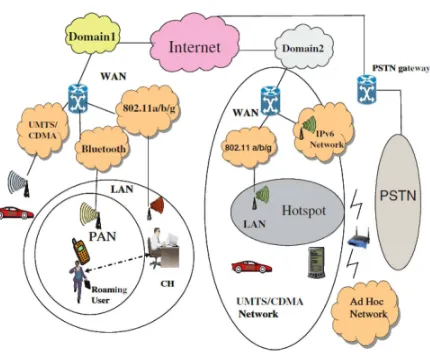
Figure 1 Seamless Roaming In Heterogeneous Network
Users prefer WiFi over WiMAX because of its low-cost availability1, and less power consumption2, and WiMAX is typically used to provide connectivity to the endusers when Wi-Fi network is not available or performs poorly. A user migrates from WiFi to WiMAX either because there is no WiFi connectivity, or the WiFi fails to provide desired QoS requirements.
Mobility is not the only issue that triggers handover between two technologies in a HetNet environment. A quintessential problem of WiFi hotspots is unbalanced traffic load distribution among the APs or BSSs [13]. The traffic load at WiFi access points are highly dynamic and varies with time of the day and geographic locations [14]. This causes overload in some APs where as other APs in the network remains underutilized. QoE of users connected through the overloaded APs deteriorates [15] as the traffic load increases in the APs. Real time applications have strict
bounds on network parameters such as end-to-end delay, jitter and packet loss rate. In order to provide mobility,
802.16e supports handover mechanisms.
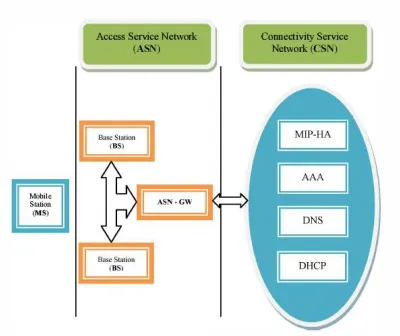
Figure 2 WiMax Architecture
The proposed handover policy can coexist and work on the top of any vertical and horizontal handover (handover between two similar technologies) framework, that takes care of lower layer complexities, such as message decoding, differences in lower layer (MAC and physical) frame formats, signal decoding issues etc. The major contributions of this paper are as follows.
This paper proposes a bandwidth management and admission control scheme for proper distribution of total network traffic over the WiFi-WiMAX integrated environment. The load-imbalance problem in WiFi BSSs is mitigated through distributing the traffic load among the overlapping APs in a WiFi hotspot. The WiMAX network is used to distribute traffic load among the underlying WiFi hotspots, as it has access to all the users’ information.
This paper proposes a bandwidth management and admission control scheme for proper distribution of total
network traffic over the WiFi-WiMAX integrated environment. The load-imbalance problem in WiFi BSSs is mitigated through distributing the traffic load among the overlapping APs in a WiFi hotspot. The WiMAX network is used to distribute traffic load among the underlying WiFi hotspots, as it has access to all the users’ information.
Based on the bandwidth management scheme, a handover policy is designed that instructs the users when to
do handover between WiFi and WiMAX interfaces, other than normal handover performed due to mobility, to maintain QoS and QoE of the end-users while preferring WiFi interface for communication.
The performance of the proposed scheme is analyzed using simulation results. The performance is also compared with two other recently proposed schemes in the literature - one that proposes a WiFi-WiMAX integrated environment based on media independent handover strategy [2], and another one that considers QoS assurance during vertical handover between WiFi and WiMAX [3].
II. RELATED WORKS
designed call admission control mechanisms during handover in heterogeneous network environment. However, they do not consider the different traffic load scenarios and their sensitivity over the two different technologies. In a recent work [16] have proposed a tight coupling based WiFi-WiMAX integrated HetNet architecture, and designed a QoS assisted handover procedure among the two technologies. They have designed an estimation mechanism, both at the WiFi and theWiMAX network, to find out available bandwidth and projected delay, and have used that information to instruct the users to switch between the two technologies. However, their architecture gives equal priority to the WiFi and WiMAX networks, which is not effective in terms of cost per- bit and average power consumption, as discussed earlier. Further, they have not considered overlapping BSSs or WiFi hotspots architecture under the WiMAX coverage, which is more common in today’s HetNet framework. As a consequence, their scheme does not address load balancing among different APs, as well as among different access technologies, which is essential for a complex HetNet as addressed in this paper.
III. THE PROPOSED SCHEME: CONTEXT AWARE HANDOVER DECISION ALGORITHM AND LOAD BALANCING
This paper proposes a load balancing and handover decision policy that instructs a user to switch between the two wireless technologies. In a HetNet environment, the users may have mobility, and therefore we use the term mobile node (MN) throughout the rest of this paper. We assume a scenario where there are several APs interconnected through a backhaul network or distribution system (DS). There are WiMAX BSs that provide larger coverage area, and WiFi BSSs creates hotspots under the WiMAX coverage. The WiMAX BS is also connected with the back-haul. The HetNet architecture considered in this paper has following properties.
1) A group of overlapping APs creates a WiFi hotspot under the WiMAX coverage area. There can be more than one WiFi hotspots under the coverage of a single WiMAX BS. However, it is not necessary that WiFi connectivity exists at all points under the WiMAX coverage.
2) Every MN has at least two, one WiFi and another WiMAX interfaces.
3) If a MN generates traffic flows from more than one service classes, the higher priority traffic class is considered for handover. This assumption is necessary to decide whether the MN meets the specific QoS requirements. We give more weights to the higher priority traffic flows to ensure QoE of a MN (or user). 4) The bandwidth reserved for the WiMAX UGS traffic flows is not used to allocate bandwidth to the MNs. UGS represents a traffic of fixed sized data packet at fixed intervals, intended mainly for leased lines like E1 and T1 traffic. It is difficult to provide such a service in WiFi in presence of other traffic flows in the same BSS. Such a service shall be retained in the WiMAX network only.
5) The proposed load balancing scheme is designed for a scenario, where excess bandwidth is available at the network to allow MNs to associate either with the AP
or with the BS, while maintaining QoS and QoE. It can be noted that traditionally WiFi network does not have any admission control mechanism, and therefore QoS/QoE can be affected if more MNs associate with an AP than its maximum capacity. Therefore, an admission control mechanism is designed in this paper to tackle this situation.
During load balancing, traffic shall be transferred between WiFi and WiMAX. Conventionally, WiFi and WiMAX have different group of traffic classes. However to maintain interoperability among these two technologies, mapping from WiFi service classes to the WiMAX service classes is necessary. The mapping between the different traffic classes is done as follows.
WiMAX ertPS traffic maps to WiFi AC VO traffic; as both represents constant bit rate real time traffic like
VoIP with silence suppression.
WiMAX rtPS traffic maps to WiFi AC VI traffic; as both represents variable bit rate real time traffic flows,
like Video Streaming
WiMAX nrtPS traffic maps to WiFi AC BK traffic; as both represents non-real time traffic with some
minimum bandwidth guarantee.
takes advantage of the presence of WiMAX BS to smooth out the handover related glitches, such as increase in handover latency and occasional transient overload in APs. The scheme has three components:(i) admission control at AP and BS, (ii) Context Aware Handover and Class aware Load Balancing.
A. Admission Control
Admission control is required to limit the traffic load at AP and BS within available bandwidth, and also to keep provision for the different traffic classes. Admission control is necessary when a MN first joins a WiFi AP or WiMAX BS. Admission control is also needed when a MN performs handover between APs and BS..
1. Admission Control at WiFi AP:A MN joining the WiFi AP for the first time with a traffic class is admitted only if the bandwidth occupied by the class does not exceed the lower limit of reserved bandwidth. Let a new flow
of class C having a bandwidth requirement of BWc needs to be admitted. It is admitted only if it satisfies Equation
(1).
BWc + Oc <= Lc (1)
Where Lc is the lower limit of the reserved bandwidth for class C and Oc is the bandwidth already occupied by
class C.
A MN failing to join an AP is expected to try joining other AP, and in case no AP admits the MN, the MN associates with the WiMAX BS. A MN performs a horizontal inter-BSS handover from one WiFi AP to another, when it finds that it can not continue to communicate through the associated AP due to poor signal strength, measured in terms of received signal strength indicator (RSSI). The MN performs interleaved scanning, to find accessible APs and performs a horizontal inter-BSS handover to the AP having the best RSSI. During horizontal handover, a MN shall be admitted
even if Equation (1) is violated. This is possible because of the reservation from the spare bandwidth Sap within the
WiFi AP. Let Ovo, Ovi and Obk are the bandwidth occupied by flows of class AC_VO, AC_VI and AC_BK respectively.
A MN, performing a horizontal inter-BSS handover, is admitted to a WiFi AP if Equation (2) is satisfied.
BW - (O
vo+ O
vi+ O
bk) >=S
ap(2)
2. Admission Control at WiMAX BS: As discussed earlier, a MN with traffic class C initiates association with the WiMAX
BS when the association with all the WiFi APs in its vicinity fails because of the unavailability of spare bandwidth for traffic
class C at the WiFi hotspot. In the proposed scheme in this paper, if C is a non BE class then the BS finds the total
number of MNs with class C. Let this number be Nc. BS admits the MN with a probability P where,
P
= 1-(N
c/B
c/B
ac) (3)
Where Bc and Bac are the reserved bandwidth for class C and the average bandwidth demand of a MN with traffic flows
of class C, respectively.
B. Class Aware Load Balancing and Context Aware Handover:
As discussed earlier, a WiFi AP admits a handover MN (either horizontal or vertical) of traffic class C, even
when the lower limit of bandwidth reservation, Lc exceeds, however the total bandwidth occupancy for traffic class
C is less than the upper limit of reservation, Uc. This indicates an impending load overflow for traffic class c, at
that AP, say APa. Then APa initializes load balancing by instructing some of the MNs associated with it to perform
a horizontal inter-BSS handover, if possible (spare bandwidth is available at one of the APs in its vicinity), to another AP in their vicinity. It can be noted that
Procedure 1 Load Balancing at WiFi APs
Trigger: A WiFi AP, APa, admits a MN with traffic class C. After admission, the total bandwidth occupancy for traffic
Operation: APa initiates the load balancing procedure
Trigger: A WiFi AP, APa, admits a MN with traffic class C. After admission, the total bandwidth occupancy for traffic
class C at APa exceeds Lc, though less than Uc
Operation: APa initiates the load balancing procedure
Step 1:Let Mcadenotes the set of MNs associated with APa, andhave traffic flows of class C. APa selects a MN, MNs ϵ
Mca, that has the lowest RSSI. This can be achieved bybroadcasting a probe request, and a probe reply from theMNs
that carries the RSSI information.
Step 2:The AP sends a MoveRequest message to MNs.
Step 3:MNs scans different WiFi channels using the interleaved scanning method [23], and builds a list of accessible
APs into APList.
Step 4:MNs sends a MoveResponse message to APa along with APList.
Step 5:APa sends a LoadRequest(C) message where C is the intended traffic class, using the back-haul or DS, to all the
APs in the APList. Therefore this does not incur any signaling or control overhead at the wireless channel.
Step 6:The APs receiving the LoadRequest(C) message, replies with a LoadResponse(C) message through the
back-haul or DS, containing its current spare bandwidth for traffic class C.
Step 7: Based on the replies it receives from the APs in APList, APa selects APs from APList to which the MN can
handover as per Equation(9) . APa keeps the list of such APs in HCList.
HCList = {APi | APi ϵAPList ^ Oic + Msc <= Lc} (9)
Here Oic is the total bandwidth occupancy at APi fortraffic class C, Msc is the bandwidth demand for MNs
with traffic class C, and Lc is lower limit for bandwidth reservation for traffic class c.
Step 8:APa sends HCList in a message, HTMsg, to the MNs.
Step 9:MNs selects the AP from HCList, from which it receives the strongest RSSI. Let this AP be called APtarget
Step 10:MNs then sends a disassociation message to APa that contains the target AP address.
Step 11:APa sends context information of MNs to APtarget and disassociates MNs.
Step 12:MNs changes channel to that of APtarget.
Step 13:MNs sends re-association message to APtarget, and completes
the horizontal inter-BSS handover to balance traffic load.
this may initiate a cascading procedure. To avoid handover flapping (continuous changes in the AP association), a MN does not re-initiate an association with an AP from which it has received a disassociation request earlier. The
load-balancing procedure at WiFi APs has been described in Procedure 1. MNs may not be able to handover to a WiFi AP as
HCList may be empty. In that case MNs performs handover to WiMAX BS. MNa sends a disassociation message to APa
that contains the BS address. APa sends context information to BS through the back-haul or DS. On receiving context
information for MNs, BS prepares itself to allow MNs to join. MNs sends a association message to the BS, switches
from WiFi to WiMAX interface, and performs a handover. To minimize cost-per-bit as well as average power consumption, MNs communicating through WiMAX prefer to switch back to WiFi whenever possible. MNs with high mobility may not want to switch to WiFi to avoid frequent handover and hence to reduce the possibility of incurring packet drop or connection drop during handover. The proposed procedure for handing over from BS to AP is similar to
Procedure 1, except the BS performs the duties of APa and MNs is the intended MN that checks for the possibility of
switching back from WiMAX to WiFi. The MNs which are associated with the BS, checks for possible WiMAX to WiFi migration after a fixed timeout interval, called WlanSwitchT imer. In our implementation WlanSwitchT imer is set to 3 sec.
The load-balancing and handover (horizontal inter-BSS as well as vertical) policy designed in this paper has following important properties.
in lower layer (MAC and physical) frame formats, signal decoding issues etc. In our implementation, the lower layer handover complexities are handled by the IEEE 802.21 MIH
strategy [6], as it simultaneously takes care of both the horizontal and the handover issues.
Property 2: A MN associates with the WiMAX BS only in two situations, either (i) there is no WiFi connectivity, or (ii) it does not get desired QoS/QoE because of traffic overload at all of the APs in its vicinity. Therefore, QoS/QoE degradation at a MN, when it is associated with WiMAX BS, indicates that the network is severely overloaded. As the APs are already overloaded, the BS does not have an opportunity to initiate a load balancing for instructing some of the MNs to migrate back to the WiFi.
This paper addresses the problem of designing a QoS/QoE based handover policy from the end users’ perspective as well as from the network perspective. While the end users migrate from one network to another to balance between desired QoS/QoE profile and cost-per-bit/energy consumption, the network also initiates handover to instruct some of the users to migrate, on the vision of balancing the total traffic load throughout the network. This allows the users to maintain their choice, while the network allows more number users to associate while maintaining their desired QoS/QoE profiles. The performance of the proposed scheme is analyzed in thenext section with simulation results.
IV. SIMULATION RESULTS, PERFORMANCE EVALUATION AND COMPARISON
The performance of the proposed Context Aware handover decision algorithm and Class Aware Load Balancing algorithm have been evaluated with the scenario shown in figure 3. The overall system throughput for different data rates are shown in figure 9, which shows that Average best effort based handover has outperformed the RSS based handover techniques in providing higher system throughput, and increment becomes more prominent at higher data rate.
Figure 3 Simulation Scenario Figure 4 Network Capacity
V. CONCLUSION
QoS/QoE requirements. This enables the end users to effectively utilize the capacity and advantages of both the networks. This paper proposes a bandwidth reservation and admission control policy based on traffic requirements for different QoS associated services. A class aware load balancing and context aware handover policy is designed, that maintains the bandwidth reservation for different traffic classes, and instructs the users to perform a handover to distribute traffic load uniformly throughout the network. This load balancing mechanism allows more end users to associate with the WiFi network, while using the WiMAX for smooth handover to maintain QoS/QoE. Simulation results show that the proposed scheme significantly improves the QoS/QoE for the end users with less communication cost.
REFERENCES
[1] Abhijit Sarma, Member, IEEE, Sandip Chakraborty, Member, IEEE, Sukumar Nandi, Senior Member, IEEE"Deciding Handover Points based on Context Aware Load Balancing in a WiFi-WiMAX Heterogeneous Network Environment",DOI 10.1109/TVT.2015.2394371, IEEE Transactions on Vehicular Technology
[2] Ammar A. Bathich, Mohd Dani Baba, Muhammad Ibrahim,"IEEE 802.21 Based Vertical Handover in WiFi and WiMAX Networks",2012 IEEE Symposium on Computers & Informatics
[3] E.Prince Edward,Dr.V.Sumathy"Enhanced SIP Based Method For Vertical Handoff Between WiFi And WiMax Networks",ICON 2008
[4] Francesco Guidolin, Irene Pappalardo, Andrea Zanella, Senior Member, IEEE, and Michele Zorzi, Fellow, IEEE "Context-Aware Handover Policies in HetNets",IEEE TRANSACTIONS ON WIRELESS COMMUNICATIONS, VOL. 15, NO. 3, MARCH 2016
[5] Shubhajeet Chatterjee,Jayanta Kr. Bag , Milton Samadder,"Reducing Handover Failure Probability by Repetitive Scanning Process",2012 International Conference on Communication, Information & Computing Technology (ICCICT), Oct. 19-20, Mumbai, India,
[6] Deyun Gao and Jianfei Cai, Nanyang Technological University, Singapore King Ngi Ngan, Chinese University of Hong Kong, Hong Kong,"Admission Control in IEEE 802.11e Wireless LANs",IEEE Network • July/August 2005
[7] Ján Balažia, Ivan Kotuliak,"Seamless handover in 802.11 networks",978-1-4673-2994-1/12/©2012 IEEE
[8] Mehmet Ali Ertürk, Luca Vollero, Muhammed Ali Aydin, Özgür Can Turna, Massimo Bernaschi,"A framework for modeling and implementing QoS-aware Load Balancing solutions in WiFi Hotspots",978-1-4799-5863-4/14/
2014 IEEE[9] WiMAX, Intel, “Intel WiMAX/WiFi link 5350 and Intel WiMAX/WiFi link 5150,” 2014. [Online]. Available: http://www.intel.com/products/ wireless/wimax/wifi/index.htm?iid=pr hyrelease link8
[10] W.-S. Lim, D.-W. Kim, Y.-J. Suh, and J.-J. Won, “Implementation and performance study of IEEE 802.21 in integrated IEEE 802.11/802.16e networks,” Comput. Commun., vol. 32, no. 1, pp. 134–143, 2009.
[11] G. Prasath, K. R. Raghu, and M. Ma, “Integration of WLAN and WiMAX with base station assisted QoS,” in proceedings of the 5th IFIP International Conference on Wireless and Optical Communications Networks, 2008, p1–5.
[12] J. Jackson Juliet Roy, V. Vaidehi, and S. Srikanth, “Always bestconnected qos integration model for the WLAN, WiMAX heterogeneous network,” in proceedings of First International Conference on Industrial and Information Systems, 2006, pp. 361–366.
[13] Z. Dai, R. Fracchia, J. Gosteau, P. Pellati, and G. Vivier, “Vertical handover criteria and algorithm in IEEE 802.11 and 802.16 hybrid networks,” in proceedings of the IEEE International Conference on Communications, 2008, pp. 2480–2484.
[14] D. Niyato and E. Hossain, “Wireless broadband access: WiMAX and beyond - integration of WiMAX and WiFi: Optimal pricing for bandwidth sharing,” IEEE Communications Magazine, vol. 45, no. 5, pp. 140–146, May 2007.
[15] H.-T. Lin, Y.-Y. Lin, W.-R. Chang, and R.-S. Cheng, “An integrated WiMAX/WiFi architecture with QoS consistency over broadband wireless networks,” in proceedings of the 6th IEEE Conference on Consumer Communications and Networking Conference, 2009, pp. 474–480.
[16] W. Wang, X. Liu, J. Vicente, and P. Mohapatra, “Integration gain of heterogeneous WiFi/WiMAX networks,” IEEE Transactions on Mobile Computing, vol. 10, no. 8, pp. 1131–1143, Aug. 2011.
[17] R. C. Meier, K. Dettloff, and J. G. Waclawsky, “System and method for integrated WiFi/WiMAX neighbor AP discovery and AP advertisement,” Mar. 2013, US Patent 20,130,070,641.
BIOGRAPHY
G.Kamesh is a Assistant Professor in the Computer Science Department, Tagore Engineering College Anna University. His research interests are Computer Networks (wireless Networks), Heterogenous networks Handover Management Algorithms.