A Survey on Automated Sentimental Analysis
of Feedback Generated from Large Scale
Teacher Training Programs
Bhagyashree Gajanan Nene, Rekha Ramesh
M. E Student, Shah and Anchor Kutchhi Engineering College, Mumbai University, Mumbai, India
Assistant Professor, Department of Computer Engineering, Shah and Anchor Kutchhi Engineering College, Mumbai,
India
ABSTRACT: Sentiment Analysis is the process of determining whether a piece of writing is positive, negative or neutral. It’s also known as opinion mining, deriving the opinion or attitude of a speaker. A common use case for this technology is to discover how people feel about a particular topic. This project is used to do analysis of feedback collected from each remote center from large scale teacher training programs. That feedback is in subjective manner. For improvement in the workshop conduction it requires analysis of feedback. Analysis of feedback is done using NLP (Natural Language Processing). For working with NLP we require tree structure of feedback which is consider as training set to get final result drawn using Ontology.
KEYWORDS: NLP, Feedback, Sentimental Analysis, Feedback Rating, Feedback Automation
I. INTRODUCTION
II. RELATED WORK
Hierarchical Classification in Text Mining for Sentiment Analysis Sentiment is subtly reflected by the tone, affective state or emotion of a writer’s expression in words. Conventional text mining techniques which are based on keyword frequency counting usually run short of accurately detecting such subjective information implied in the text. In this paper they have evaluated several popular classification algorithms, along with three filtering schemes. The filtering schemes progressively shrink the original dataset, with respect to the contextual polarity and frequent terms of a document. In general the proposed approach is coined hierarchical classification. The effects of the approach in different combination of classification algorithms and filtering schemes are discussed over three sets of controversial online news articles where binary and multi-class classifications are applied.
Sentence-level and Document-level Sentiment Mining for Arabic Texts. In thisWord can have several different forms with different suffixes, affixes, and prefixes. Special labels called diacritics are used instead of vowels and they differ according to the word form and the part of speech. Morphological analyzers are needed to enable consideration of all word forms in the text and perform suffix, affix, prefix, and root extraction. Grammatical analyzers or part-of-speech (POS) taggers are also needed.
Automatic Sentiment Analysis for Unstructured Data Sentiment analysis is done on three levels Document Level, Sentence Level , Entity or Aspect Level. Document Level Sentiment analysis is performed for the whole document and then decide whether the document express positive or Negative sentiment. Entity or Aspect Level sentiment analysis performs finer-grained analysis. The goal of entity or aspect level sentiment analysis is to find sentiment on entities and/or aspect of those entities.
Ontology-Based Sentiment Analysis Model of Customer Reviews for Electronic ProductsThis paper reports on a generalizable system model design that analyzes the unstructured customer reviews inside the posts about electronic products on social networking websites. For the purposes of this study, posts on social networking websites have been mined and the keywords are extracted from such posts. The extracted keywords and the ontologies of electronic products and emotions form the base for the sentiment analysis model which is used to understand online consumer behavior in the market.
Methodological study of opinion mining and sentiment analysis techniques Decision making both on individual and organizational level is always accompanied by the search of other’s opinion on the same. With tremendous establishment of opinion rich resources like, reviews, forum discussions, blogs, micro-blogs, Twitter etc provide a rich anthology of sentiments. This user generated content can serve as a benefaction to market if the semantic orientations are deliberated. Opinion mining and sentiment analysis are the formalization for studying and construing opinions and sentiments. The digital ecosystem has itself paved way for use of huge volume of opinionated data recorded. This paper is an attempt to review and evaluate the various techniques used for opinion and sentiment analysis.In this paper, categorization of work done for feature extraction and classification in opinion mining and sentiment analysis is done. In addition to this, performance analysis, advantages and disadvantages of different techniques are appraised.
III. PROPOSED ALGORITHM
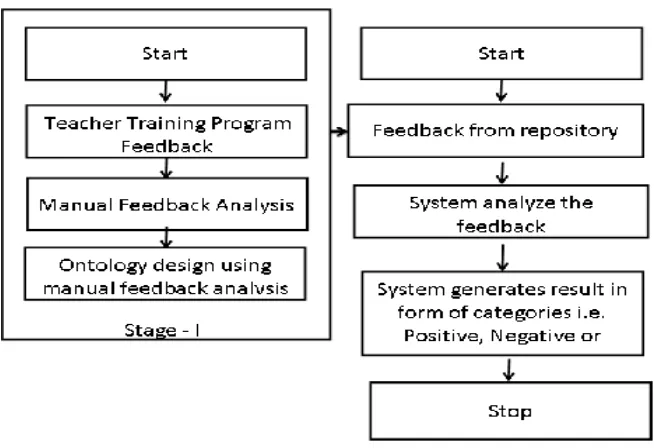
Fig I: Block Diagram of proposed system
The block diagram shows actual flow of system. Here the user feedbacks are stored in a feedback repository. System uses these feedbacks as an input. Here I have designed ontology of the feedbacks by using protégé which gives a file with .owl extension. This file is used as an input for system to extract keyword from the user input. The system will give node count as a output. This will use to improve quality of workshop conduction.
.
Fig II. Flow Chart for summarization process
Works
hop
AUTOMATED
FEEDBACK
ANALYSIS
Onto
Classifi
ed
Feed
“Reduce the no of assignments Dynamic use of wiki was explained only after ques was asked if it was explained in slides it would be better since voice was not audible during qus session.”
Fig III. Feedback Sample Flow
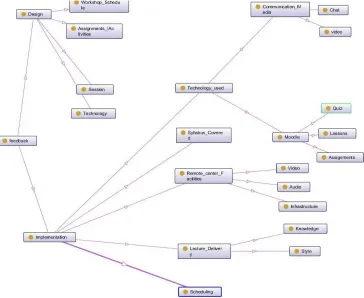
Above print screen shows some sample feedback collected from workshop candidates. I have taken one sample example and design respective ontology which gives different nodes like Design, Implementation etc.
We are developing a system which analyse this feedback and find out the sentiments. In above example the candidate is talking about the assignments and expects reduction of assignment. This is nothing but negative opinion about the workshop.
IV. CONCLUSION AND FUTURE WORK
Opinion mining is one of the important sub branches of data mining. It is also called as sentimental analysis. I have done the same in this project. The feedback contains positive, negative or neutral opinions about some aspects of workshop. The aim of project is to find out pro & corns of workshop conduction for improvement.
In this project I have used ontology as a knowledge representation technique which provides entire hierarchy of important aspects. The system generates score of positive, negative or neutral feedback at each level of ontology. It is to be done by using ontology as well as feedback as an input. The ontology is drawn using software named protégé.
REFERENCES
[1] Jinyan Li, Simon Fong, Yan Zhuang “Hierarchical Classification in Text Mining for Sentiment Analysis” Department of Computer and Information Science Richard Khoury Department of Software Engineering.
[2] Mr. A. A. Sattikar1, Dr. R. V. Kulkarni “Natural Language Processing For Content Analysis in Social Networking” V. P. Institute of Management Studies & Research, Sangli, Maharashtra, India, Shahu Institute of Business Education & Research (SIBER), Kolhapur, Maharashtra, India.
[3] Jalaj S. Modha Prof & Head Gayatri S. Pandi Sandip J. Modha “Automatic Sentiment Analysis for Unstructured Data” Computer Engineering, LJIET Computer Engineering, LJIET Computer Engineering Gujarat Technological University Gujarat Technological University DA-IICT Gujarat, India Gujarat, India Gujarat, India. Volume 3, Issue 12, December 2013 ISSN: 2277 128X
[4] Pravesh Kumar Singh , Mohd Shahid Husain “METHODOLOGICAL STUDY OF OPINION MINING AND SENTIMENT ANALYSIS TECHNIQUES” M.Tech, Department of Computer Science and Engineering, Integral University, Lucknow, India, Assistant Professor, Department of Computer Science and Engineering, Integral University, Lucknow, India International Journal on Soft Computing (IJSC) Vol. 5, No. 1, February 2014
[5] International Journal of Emerging Trends & Technology in Computer Science (IJETTCS) Web Site: www.ijettcs.org Email: [email protected], Volume 2, Issue 4, July – August 2013 ISSN 2278-6856 Volume 2, Issue 4 July – August 2013 Page 375
[6] TextsNoura Farra, Elie Challita, Rawad Abou Assi, Hazem Hajj “Sentence-level and Document-level Sentiment Mining for Arabic” Department of Electrical and Computer Engineering American University of Beirut Lebanon 2010 IEEE International Conference on Data Mining Workshops.