Auditing for Cloud Consistency in CaaS using
Cloud Computing
A.Arun, M.Mayuranathan
PG Scholar, Dept. of CSE, Valliammai Engineering College, Chennai, India
Assistant Professor, Dept. of CSE, Valliammai Engineering College, Chennai, India
ABSTRACT: Cloud storage services have become commercially favorite due to their overpowering advantages. To provide omnipresent always-on access, a cloud service provider (CSP) maintains multiple reproductions for each piece of data on geographically shared servers. A key problem of using the replication technique in clouds is that it is much overpriced to achieve strong consistency on a worldwide scale. In this paper, we first present a novel consistency as a service (CaaS) model, which consists of a large data cloud and multiple small audit clouds. In the CaaS model, a cloud data is preserved by a cloud service sanitize, and a social group of people that compose an audit cloud can verify whether the data cloud provides the assure level of consistency or not. We propose a two-level auditing architecture, which only requires a slackly synchronized clock in the audit cloud. Then, we design algorithms to convey the severity of violations with two metrics: the commonality of violations, and the staleness of the value of a read. Finally, we devise a heuristic auditing strategy (HAS) to reveal as many violations as possible. Extensive experiments were performed using a collection of simulations and real cloud deployments to validate HAVE.
KEYWORDS: Cloud storage, consistency as service(Caas), two-level auditing and heuristic auditing strategy (HAS)
I.INTRODUCTION
Now a day’s Cloud computing has become more popular, as it provide advantages like security, scalability, elasticity and high availability at lower cost .Cloud storage service have become more accepted due to their very great advantages .Cloud service provider retain many replicas for every piece of data on physically distributed server.
Replication method is used to improve performance and increase reliability .Replica it allows
remote sites to go on working in the event of local failure. To maintain continuous accessibility the file is replicated at many different places in cloud so even if one of the site is down still you can retrieve the data from another place .Cloud storage services which involves the transfer of data storage as a service including data base like services and NAS (network attach storage) frequently billed on service computing basis. Example Amazon simple database it is non-relational data store. Support store and query function usually provided only by relational database and it also hold to increase performance web application User can store and query data item by means of web service request. It
manages manually the infrastructure provisioning and hardware, software maintenance replicate on and indexing of
ate items. By use the Cloud storage services, the clients can access data stored in a cloud anytime and anywhere using any device, without any capital investment when they are deploying the underlying hardware infrastructures.
II.RELATED WORK
strict consistency to weak Consistency.High consistency implies high cost and reduced availability .Client-centric consistency model they do not care about the internal state of a storage system. They explained how these two communicate to each other and introduced an approach which allows to compute the staleness of data, or how soon ‘eventual’ in eventual consistency.
III. SYSTEM ANALIYS
A. Problem Statement
To provide everywhere on access, cloud service provider maintains numerous replicas for each pieces of data on geographically scattered servers. The problem of using the replication method in cloud is that it is very expensive to accomplish strong consistency on a worldwide scale. Existing solutions can be classified into trace-based verifications and benchmark-based verifications .Trace-based verifications focus on three consistency semantics: safety, regularity, and atomicity.
Safety: - A register is safe if a read is not parallel with any write returns the value of the most recent write and a read that is parallel with a write can return any value.
Regularity: - A register is regular if a read is not parallel with any write returns the value of the most recent write , and a read that is parallel with a write return either the value of the most recent write ,or the value of the concurrent write .
Atomicity: - A register is atomic if every read returns the value of the most recent write.
B.Advance Solution
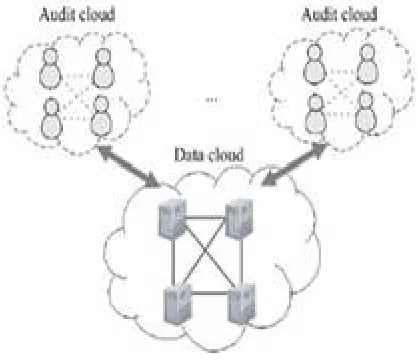
We instant a novel consistency as a service (CaaS) model , where a social group of users that constitute an audit cloud can verify whether the data cloud provides the promised level of consistency or not.
Figure 1-Consistency as a service model
The discuss about figure 1 Consistency as a service model consists of large data cloud and various audit cloud .A service level agreement (SLA) will be busy between the data cloud and the audit cloud ,which will tell what level of consistency the data cloud must provide, and how much will be charged if the data cloud violates the service level agreement .
IV. ARCHITECTURE DIAGRAM
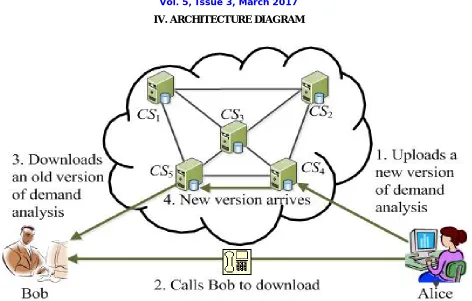
Figure 2-System Architecture
The discuss about Figure 2 system architecture. In this there are two users Bob and Alice they both are working on Project using a Cloud Storage Service. Data clouds that have data that data is replicated at many places. Data is replicated to five cloud server that is CS1,CS2,CS3,CS4,CS5 .After uploading a new document to CS4 ,Alice calls Bob to download the latest version for integrated design .Here ,after Alice calls Bob, the causal relationship is accepted between Alice’s update and Bob’s read .Therefore ,the cloud should give causal consistency, which ensures that Alice’s update is committed to all of the replicas before Bob’s read. If the cloud provides only eventual consistency , then Bob’s is allowed to access an old version of the requirement analysis from CS5 .In this case ,the integrated design that is based on an old version may not satisfy the real requirements of customers. Different applications have different consistency requirements.
A. System Process
The CaaS model consists of a large data cloud and multiple small audit clouds. The data cloud is preserve by a CSP, and an audit cloud consists of a group of users that cooperate on a job, e.g., a document or a project. We present alimited audit cloud can verify whether the data cloud provides the promised level of consistency or not. We propose a two-level auditing structure, which only requires a loosely synchronal clock for ordering operations in an audit cloud. We design algorithms to ideality the severity of violations with different metrics. We devise a rule auditing strategy (HAS) to reveal as many violations as possible. Extensive testing was improved using a combination of simulations and real cloud deployments to validate HAVE.
List of Modules:
• Client Authentication
• File Upload
• File Sharing
• Editable Cloud
• Consistency Service
B. Client Authentication
Client authentication is similar to server authentication except that the telnet servers invite a certificate from the client to verify that the client is who it claims to be used. The certificate must be an X.509 certificate and signed by a document authority (CA) trusted by the server. You can only use client proof when a server requests a certificate from a client. Not all servers support client proof, including the Host On-Demand Redirector. The later versions of the IBM expression Servers (CS/NT, CS/AIX, etc.) all support client authentication. When a server requests a certificate, the client has the option to send a document or assay to connect without it. The server allows the connection if the client's certificate can be trusty. When a client assayto connect without a document, the server might give the customer access but at a lower security level.
C.File Upload
When there is a transfer of data from a remote system to another remote system, the process is called "remote uploading". This is used by some online file host in services. Remote uploading is also used in environment where the computers that need to share data are located on a distant high-speed LAN, and the remote control is being performed using a comparatively slow dial-up modem connection.
The user remotely accesses a file hosting service at MyRemoteHost.
The user finds a public file at PublicRemoteHost and wants to keep a copy in their MyRemoteHost.
To have it done they process of "remote upload" the file from PublicRemoteHost to MyRemoteHost. None of the hosts are located on the user's local network.
Without remote uploading practility, the user would be required to download the file first to their local host and then upload it to the remote file hosting server.
Where the connection to the remote computers is via a dial-up connection, the moment time required
to download locally and then upload again could increase from seconds to hours or days.
D. File Sharin
which may be excavate from multiple peers and then reassembled by the downloader. This is done while the peer is simultaneously uploading the clump it already has to other peers.
E. Editable Cloud
The list of model data inCloud storage and the physical environment is typically owned and managed by a hosting company. These cloud storage providers are trustworthy for keeping the data available and available, and the physical environment protected and running. People and enterprise buy storage capacity from the providers to store end user, enterprise, or application data. Cloud storage services may be crowd through a co-located cloud compute service, a web service application programming interface (API) or by applications that utilize the API, such as cloud desktop storage, a cloud storage gateway or Web-based content management systems. The editable cloud is used to edit the files from the server and update automatically used to view all the users for view the files.
F. Consistency Service
The consistency services is a method is used to edit the storage content by all the users and update automatically the server and replicate to all the servers to his own. In that at the time of updating and replicating user need in waiting state. Otherwise it will be intimate to the users. Each and every process of the users to be updated to the each server. His importance of consistency in particular is huge. Customers want to have confidene that we’ll deliver on our promises every time, not just when it’s convenient. Consistently deliver good products and services across our enterprise, if we mean what we say and say what we mean, if we under promise and over deliver, the potential for our organization to not only grow but reach extraordinary heights are real. It won’t pledge success but it will lay the basis for us to achieve more and it will usually separate us from our competitors.
V. CONCLUSION
The paper, we instant a consistency as a service (CaaS) model and a two-level auditing structure to help users verify whether the cloud service provider (CSP) is providing the promised consistency, and to quantify the severity of the violations, if any. With the CaaS model, the users can evaluate the quality of cloud work and choose a right CSP among various candidates, e.g. the least costlyone that still provides capable consistency for the users’ applications.
REFERENCES
[1] Qin Liu ,Guojun Wang ,Jie Wu, “ Consistency as a Service : Auditing Cloud Consistency ,” 2014 .
[2] M. Rahman, W. Golab, A. AuYoung, K. Keeton, and J. Wylie, “Toward a principled framework for benchmarking consistency,” 2012 . [3] H. Wada, A. Fekete, L. Zhao, K. Lee, and A. Liu, “Data consistency properties and the trade-offs in commercial cloud [4] D. Bermbach and S. Tai, “Eventual consistency: how soon is eventual?” 2011
[5] E. Anderson, X. Li, M. Shah, J. Tucek, and J. Wylie, “What consistency does your key-value store actually provide,” 2010
[6] M. Armbrust, A. Fox, R. Griffith, A. Joseph, R. Katz, A. Konwinski,G. Lee, D. Patterson, A. Rabkin, I. Stoica, et al., “A view of cloud DFISAAECAcomputing,” Commun. ACM, vol. 53, no. 4, 2010
[7] W. Lloyd, M. Freedman, M. Kaminsky, and D. Andersen, “Don’t settle for eventual: scalable causal consistency for wide- area storage with COPS,” in Proc. 2011 ACM SOSP,
[8] P. Mell and T. Grance, “The NIST definition of cloud computing (draft),”NIST Special Publication 800-145 (Draft), 2011 [9] S. Esteves, J. Silva, and L. Veiga, “Quality-of-service for consistency of data geo-replication in cloud computing,” 2012
[10] T. Kraska, M. Hentschel, G. Alonso, and D. Kossmann, “Consistency rationing in the cloud: pay only when it matters,” in Proc. 2009.
BIOGRAPHY