Scholarship at UWindsor
Scholarship at UWindsor
Electronic Theses and Dissertations Theses, Dissertations, and Major Papers
2014
THE IMPLEMENTATION OF A NEW PROGRAM OF LEADERSHIP
THE IMPLEMENTATION OF A NEW PROGRAM OF LEADERSHIP
DEVELOPMENT WITH FEMALE VARSITY ATHLETES: A PILOT
DEVELOPMENT WITH FEMALE VARSITY ATHLETES: A PILOT
STUDY
STUDY
Ashley Michelle Duguay
University of Windsor
Follow this and additional works at: https://scholar.uwindsor.ca/etd
Recommended Citation Recommended Citation
Duguay, Ashley Michelle, "THE IMPLEMENTATION OF A NEW PROGRAM OF LEADERSHIP DEVELOPMENT WITH FEMALE VARSITY ATHLETES: A PILOT STUDY" (2014). Electronic Theses and Dissertations. 5228. https://scholar.uwindsor.ca/etd/5228
This online database contains the full-text of PhD dissertations and Masters’ theses of University of Windsor students from 1954 forward. These documents are made available for personal study and research purposes only, in accordance with the Canadian Copyright Act and the Creative Commons license—CC BY-NC-ND (Attribution, Non-Commercial, No Derivative Works). Under this license, works must always be attributed to the copyright holder (original author), cannot be used for any commercial purposes, and may not be altered. Any other use would require the permission of the copyright holder. Students may inquire about withdrawing their dissertation and/or thesis from this database. For additional inquiries, please contact the repository administrator via email
THE IMPLEMENTATION OF A NEW PROGRAM OF LEADERSHIP DEVELOPMENT WITH FEMALE VARSITY ATHLETES: A PILOT STUDY
by
Ashley M. Duguay
A Thesis
Submitted to the Faculty of Graduate Studies through the Department of Kinesiology in Partial Fulfillment of the Requirements for
the Degree of Master of Human Kinetics at the University of Windsor
Windsor, Ontario, Canada
2014
by
Ashley M. Duguay
APPROVED BY:
______________________________________________ Dr. M. El-Masri
Faculty of Nursing
______________________________________________ Dr. K. Chandler
Department of Kinesiology
______________________________________________ Dr. T. Loughead, Advisor
Department of Kinesiology
DECLARATION OF ORIGINALITY
I hereby certify that I am the sole author of this thesis and that no part of this
thesis has been published or submitted for publication.
I certify that, to the best of my knowledge, my thesis does not infringe upon
anyone’s copyright nor violate any proprietary rights and that any ideas, techniques,
quotations, or any other material from the work of other people included in my thesis,
published or otherwise, are fully acknowledged in accordance with the standard
referencing practices. Furthermore, to the extent that I have included copyrighted
material that surpasses the bounds of fair dealing within the meaning of the Canada
Copyright Act, I certify that I have obtained a written permission from the copyright
owner(s) to include such material(s) in my thesis and have included copies of such
copyright clearances to my appendix.
I declare that this is a true copy of my thesis, including any final revisions, as
approved by my thesis committee and the Graduate Studies office, and that this thesis has
ABSTRACT
The purpose of the current study was to develop, implement, and examine a new program
of leadership development with varsity athletes. The sample comprised 27 varsity athletes
(Mage= 20.30, SD = 2.07) who were assigned to a rookie (n = 7), emerging (n = 11), or
veteran (n = 9) leader group based on their year of tenure. Each group participated in four
workshops over the course of a season focused on developing both leader (human capital)
and leadership (social capital) capabilities. In terms of leader development, results
indicated significant increases in ratings of the use of eight of 10 targeted leader
behaviors from pre-intervention to post-intervention. In terms of leadership development,
results indicated significant increases in ratings of task-involving climate, team
integration, personal development, and team performance as well as a desired significant
ACKNOWLEDGEMENTS
This thesis would not have been possible without the support of many people.
First and foremost I would like to thank my advisor, Dr. Todd Loughead. Under your
guidance, I have been provided a number of challenging academic and professional
opportunities that have helped me develop as a student, researcher, and person. I count
myself extremely fortunate not only to have been mentored by such a prominent scholar
but also to have been trusted with this project. I am excited to continue learning from
your example and am grateful to continue my graduate studies under your leadership. I
would also like to thank Dr. Krista Chandler for her valuable insight and feedback on my
thesis. Your passion for and knowledge of our field is inspiring. I look forward to
working with you in the future. To Dr. Maher El-Masri, thank you for agreeing to be a
member of my thesis committee. Your feedback, time, and knowledge were much
appreciated.
I would also like to extend an enormous thank you to the members of the Sport
and Exercise Psychology Lab. Having had the opportunity to work with and learn from
each of you every day is a big part of what made my experience here at the University of
Windsor so memorable.
Above all, I would like to thank my family whom this thesis is dedicated to. To
my parents, Anne Marie and Mitch Duguay, words cannot describe what your love and
support has meant to me over the years. My passion for sports and learning is grounded
in the foundation you both built for me. I am forever grateful for the leadership you have
provided and the examples you have set. To my brother, Jordan, thank you for always
when challenges arose. Your support has meant more to me than you will ever know.
Finally, to Dawn, I could not have done this without you. Thank you for your selfless
sacrifice in helping me accomplish this goal. Your unwavering confidence in me always
shone through when I needed it most. I am beyond grateful to have had you by my side
TABLE OF CONTENTS
DECLARATION OF ORIGINALITY ... iii
ABSTRACT ... iv
ACKNOWLEDGEMENTS ...v
LIST OF TABLES ... ix
LIST OF FIGURES ...x
LIST OF APPENDICES ... xi
RESEARCH ARTICLE ...1
Introduction ...1
Method ...10
Participants ...10
Measures ...11
Procedure ...19
Intervention ...20
Data Analysis ...22
Results ...22
Missing Data ...22
Descriptive Statistics ...23
Main Analyses ...25
Effect Sizes ...27
Discussion ...28
References ...40
Tables ...50
LITERATURE REVIEW ...68
Leadership Development ...86
References ...103
Figures ...114
APPENDICIES ...117
LIST OF TABLES
Table 1 Athlete Leadership Development Intervention Outline ...50
Table 2 A Description of the Athlete Leadership Development Intervention ...51
Table 3 Bivariate Correlations Pre-Intervention ...58
Table 4 Bivariate Correlations Post-Intervention ...61
Table 5 Decriptive Statistics for Leader Development Variables ...64
Table 6 Descriptive Statistics for Leadership Development Variables ...65
LIST OF FIGURES
Figure 1 Multidimensional Model of Leadership ...113
Figure 2 Full Range Model of Leadership ...114
LIST OF APPENDICES
Appendix A Athlete Descriptives ...116
Appendix B Leadership Scale for Sports ...117
Appendix C Differentiated Transformational Leadership Inventory...120
Appendix D Group Environment Questionnaire ...122
Appendix E Athlete Satisfaction Questionnaire ...124
Appendix F Peer Motivational Climate in Youth Sport Questionnaire ...126
Appendix G Scale of Effective Communication in Team Sports-2 ...128
Appendix H Letter of Information for Consent to Participate in Research ...130
REASEARCH ARTICLE
Introduction
Effective leadership has long been recognized as important within sport
psychology (Chelladurai & Riemer, 1998). In fact, leadership has been cited by coaches
and athletes as being vital to achieving both team and individual success in sport
(Chelladurai & Riemer, 1998; Dupuis, Bloom, & Loughead, 2006; Weinberg &
McDermott, 2002). While coaches have been historically viewed as the primary source of
leadership within their team (Chelladurai, 1993; Chelladurai & Riemer, 1998), research
has also recognized the important leadership contributions of athletes (Glenn & Horn,
1993; Gould, Hodge, Peterson, & Petlichkoff, 1987). Despite this, athlete leadership has
only recently begun to receive increasing empirical attention (e.g., Bucci, Bloom,
Loughead, & Caron, 2012; Gould & Voelker, 2010; Loughead & Hardy, 2005).
Athlete leadership is defined as “an athlete occupying a formal or informal
leadership role within the team who influences a group of team members to achieve a
common goal” (Loughead, Hardy, & Eys, 2006, p. 144). Within this definition, two types
of leadership roles that athletes can occupy within their team are highlighted. The first is
the formal athlete leader whereby individuals are assigned the position (e.g., team
captain), typically by the coaching staff or by team selection. Unfortunately, this type of
leadership role is only available to a select number of team members. The second
leadership role is the informal athlete leader, which emerges over a period of time
through interactions with teammates. Consequently, this type of leadership role is
available to an unlimited number of team members.
While early athlete leadership research suggested that teams require one or two
1993), recent findings have suggested the actual number of athlete leaders is much
higher. For instance, in their study of 238 athletes from a wide range of independent (e.g.,
track and field) and interdependent (e.g., ice hockey) sport teams, Loughead and Hardy
(2005) found varsity athletes indicated approximately 27% of their teammates served in a
leadership capacity. While this research focused on the perceived number of athlete
leaders within a team, Crozier, Loughead, and Munroe-Chandler (2013) examined what
athletes perceived to be the ideal number of athlete leaders and the benefits of having this
ideal number. In their study of 104 varsity athletes from three interdependent team sports
(i.e., basketball, volleyball, and hockey), results indicated that 19% of athletes on a roster
should occupy a formal leader role, while 66.5% of athletes an informal leader role. That
is, over 85% of athletes on a team should occupy some type of leader role. Furthermore,
participants reported that an ideal number of athlete leaders would positively influence a
number of group dynamics constructs, including team attributions (e.g., increased
resources), team cohesion (e.g., increased team unity), team outcomes (e.g., enhanced
performance), team structure (e.g., improved role clarity), team processes (e.g., better
communication), individual outcomes (e.g., increased satisfaction), and leadership
behaviors (e.g., the occurrence of transactional and transformation behaviors). Given
these findings, it has been emphasized both within sport psychology (Crozier et al., 2013)
and organizational psychology (Pearce & Sims, 2002) that all team members be included
in leadership development efforts.
To date, there are only two known published empirical studies that have
implemented an athlete leadership development program. In the first study, Gould and
approach consisting of: (1) a one-day in-person workshop; and (2) a self-study captain’s
workbook. The authors noted that they typically offer four to eight clinics per academic
year with between 100 and 200 student athletes attending each time. Results of this study
discussed what had gone well (e.g., athletes have reported that the workshops have been
helpful and enjoyable), what had been changed from previous workshops (e.g., increased
emphasis on learning leadership), and current challenges (e.g., lack of supervising
teachers and coach involvement). The authors also discussed various future directions
including the importance of developing a concurrent program for coaches and the need to
hold participants more accountable (e.g., feedback provided to captains through a
leadership report card). Strengths of this intervention program include athlete driven
discussions, the use of supplementary material (i.e., self-study captain’s guide), and the
emphasis of leadership as a skill that can be developed.
In the second study, Voight (2012) used a case study approach to assess the
effectiveness of an athlete leader development program implemented over the course of a
season with two NCAA Division 1 volleyball teams. The intervention included 15
leadership development stages developed by the author and delivered through emails,
visits by the author, and video conferences with the author. Program effectiveness was
determined through both teams meeting their seasonal goals and the primary objectives of
the program set by the author and coaching staff (i.e., return to the Final Four, improve
team communication and functioning, assist in leading the team on a day to day basis,
and provide leadership development of captains, assistant captains, and captain
apprentices). Additionally, results from individual interviews with team captains revealed
captains’ perceived benefits of the intervention (e.g., the program was time well spent),
leadership lessons learned (e.g., insight about personal leadership skills), and suggestions
for improvement (e.g., involve more team members and include more session).
While these studies contributed to the advancement of athlete leadership
development literature, there remains several noteworthy limitations. The first limitation
is that both studies have focused predominantly on the leadership development of the
team captains (i.e., formal leaders). For instance, participants in the study conducted by
Gould and Voekler (2010) were restricted to sophomore and junior high school athletes
who were purposefully selected to attend the clinic by their high school athletic
departments. These participants were either currently serving as formal leaders (i.e.,
captains) or were identified as “possessing the leadership potential to become one
[captain] in the future” (Gould & Voelker, 2010, p. 4). While Gould and Voelker noted
the importance of including athletes who were motivated to be in the program, it has been
reported by coaches that poor selection practices (i.e., choosing the wrong person as
captain) are problematic (Gould, Voelker, & Griffes, 2013). Consequently, it is
conceivable that athletes who would potentially benefit from the leadership training
program may have been overlooked. Furthermore, as mentioned previously, recent
research has advocated all team members be included in leadership development efforts,
as it has been demonstrated that a high percentage of team members actually fulfill
formal and informal leadership roles (e.g., Crozier et al., 2013; Loughead & Hardy,
2005). Similarly, the study conducted by Voight (2012) seemed to emphasize the
development of team captains. Specifically, although the participants for this study did
providing team captains with support and direction throughout the season. For instance,
toward the end of the pre-season, team members (i.e., non-captains) were interviewed to
gather feedback for the captains. This feedback included what they needed from their
captains this season in order for individuals as well as the team to accomplish their goals,
suggestions for each captain to help improve their leadership effectiveness, and how each
captain contributed to the leadership of the team. Team members (i.e., non-captains) were
also asked what they would do to help their captains. However there was no indication of
targeting the leadership development of non-captains within the intervention protocol.
As a second limitation, neither program is clear regarding its theoretical
foundation. For instance, in the Voight (2012) study it was stated that the program “is
based on organizational psychology and leadership research, in collaboration with the
leadership consultant’s team and leadership consulting experiences spanning over
fourteen years, and the input and feedback from participating coaching staffs and peer
leaders” (pp. 619-620). There was no discussion of a theoretical underpinning that guided
this intervention study. As discussed by Avolio, Reichard, Hannah, Walumbwa, and
Chan (2009), “leadership interventions appear to differ in terms of their impact based on
the theoretical focus of the leadership model” (p. 783). Further, research in other domains
such as the field of public health interventions, have repeatedly found theory-based
interventions to be the most effective (e.g., Albada, Ausems, Bensing, & Dulmen, 2009;
Ammerman, Lindquist, Lohr, & Hersey, 2002). Specifically, French et al. (2012)
explained that theory can be used to understand the factors that influence behaviors being
targeted and to uncover techniques that could be used to target the behaviors. In addition,
combination with theory, empirical evidence can inform which behaviors should be
targeted and which techniques and modes of delivery are likely to be effective (French et
al., 2012). As such, it is important to build upon relevant theoretical and empirical
foundations.
A third limitation was related to the need for theoretically and empirically
grounded interventions. Specifically, research has emphasized the importance of
developing both individuals as leaders (i.e., leader development) and leadership within
teams (i.e., leadership development; Day, 2001; Van Velsor, McCauley, & Ruderman,
2010). While both studies (i.e., Gould & Voelker, 2010; Voight, 2012) appear to focus on
leader development, neither specifically targeted nor operationally defined leadership
development.
The terms leader development and leadership development have been used
interchangeably in the literature (Dalakoura, 2010). According to Rost (1993), equating
leader development with leadership development is the number one problem with
leadership development programs. Some researchers have conceptually made a
distinction between the two concepts (Day, 2001; Van Velsor et al., 2010). Accordingly,
leader development is the expansion of an individual’s capacity to be effective in
leadership roles and processes. Within this definition, leadership roles pertain to formal
and informal positions while leadership processes are those that allow groups of team
members to work together in meaningful ways (Day, 2001; McCauley, Moxley, & Van
Velsor, 1998; Van Velsor et al., 2010). That is, leader development is an effort to build
self-confidence, individual-based knowledge, skills, behaviors and abilities associated with
leadership roles (Day, 2001).
In terms of developing human capital, it has been argued that Full Range
Leadership Development (FRLD; Bass & Avolio, 1999) “is the premier leadership
paradigm, currently garnering more research attention than any other leadership theory or
model” (Sosik & Jung, 2010, p. 8). As noted by Ardichvili and Manderscheid (2008), not
only is there a significant body of literature documenting the validity of the framework
(Bass, 1998), but there is also substantial evidence that this model has been successfully
used in leadership training and development (Avolio, 2005; Avolio & Gardner, 2005). In
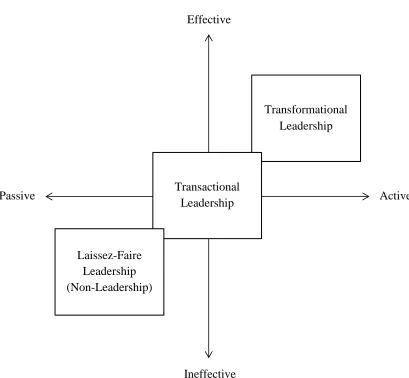
the Full Range Model of Leadership (FRML; Avolio, 1999), leadership falls on a
continuum of active-passive and effective-ineffective forms of leadership (see Figure 2).
Specifically, leadership is viewed as multidimensional including transformational,
transactional, and laissez-faire behaviors (Price & Weiss, 2013). Transformational
leadership is viewed as the most active and effective form of leadership (Bass, 1985). It
involves a relationship between the leader and followers that involves personal,
emotional, and inspirational exchanges (Burns, 1978). Following transformational
leadership in the FRML is transactional leadership, which involves exchange processes
between the leader and followers that are contingent upon the follower’s performance
(Burns, 1978). Lastly, laissez-faire, also known as non-leadership, is the most passive and
ineffective form of leadership. It is defined as an absence of leadership, where individuals
avoid responsibility and are indifferent to important issues (Sosik & Jung, 2010). As
Avolio (1999) has suggested that effective leaders primarily display transformational
leadership behaviors and use, on occasion, transactional leadership behaviors.
In contrast, leadership development is defined as expanding the collective
capacity of team members to engage effectively in leadership roles and processes as
outlined above (Day, 2001; McCauley et al., 1998; Van Velsor et al., 2010). Unlike
leader development, where the emphasis is on human capital, leadership development
focuses on the development of social capital. In this way, efforts are placed on the
development of interpersonal relationships in areas such as social skills (e.g., building
cohesion, communication) and social awareness (i.e., empathy; Day, 2001). Leadership
development may include developing the collective’s shared beliefs about leadership,
developing the collective’s leadership practices, and evaluating the collective’s ability to
produce leadership (Van Velsor et al., 2010).
In terms of developing social capital, a number of studies have examined the
behaviors of athlete leaders in relation to various aspects of the team environment. For
example, Callow, Smith, Hardy, Arthur, and Hardy (2009) investigated how the
transformational leadership behaviors of team captains were related to perceptions of
cohesion amongst 309 club ultimate Frisbee players. Findings indicated that the
leadership behaviors of fostering acceptance of group goals and promoting team work,
high performance expectations and individual consideration significantly predicted task
cohesion. Additionally, fostering acceptance of group goals and promoting teamwork
significantly predicted social cohesion. Expanding on the above results, Price and Weiss
(2013) examined the relationship between athlete leadership behaviors, cohesion, and
competitive travel teams. Findings showed that transformational athlete leadership
behaviors were positively related to task cohesion, social cohesion, and collective
efficacy. In contrast, the transactional leadership behaviors of management-by-exception
active and a passive/avoidant factor (comprised of management-by-exception passive and
laissez-faireleadership behaviors) were both negatively related to task cohesion. In
addition, Smith, Arthur, Hardy, Callow, and Williams (2013) examined whether
intra-team communication mediated the effects of transformational leadership behaviors on
task cohesion in a sample of 199 university level ultimate Frisbee players. In relation to
perceptions of their captain's transformational leadership behaviors, results indicated that
the communication dimensions of communication acceptance, positive conflict, and
negative conflict mediated the relationship between the leadership behavior of foster
acceptance of group goals and task cohesion.
Despite the positive relationship between athlete leadership and variables such as
cohesion, communication, and collective efficacy, very little research has implemented a
theoretically driven leadership development program for all team members in sport. That
is to say that athlete leader and leadership development programs are scarce. This scarcity
is not surprising given the relative infancy of athlete leadership research; however it is
significant for a number of reasons. For instance, in their sample of high school captains,
Voelker, Gould, and Crawford (2011) found these captains received little to no training
for their leadership positions. As a result, these captains did not feel prepared to fulfill
their leadership responsibilities. In addition, mere participation in sport does not
automatically foster leadership (Gould & Voelker, 2012), nor does it correlate strongly to
becomes important that athletes have access to leadership development programs that are
theoretically driven and available to all team members. To fill this gap in the literature,
the purpose of the current study was to develop, implement, and examine a new program
of leadership development with varsity athletes that was theoretically grounded, involved
all team members, and incorporated both leader (i.e., human capital) and leadership
development (i.e., social capital). It was hypothesized that both leader and leadership
development outcomes would increase from pre-intervention to post-intervention.
Method
Participants
A total of 29 female varsity athletes from two interdependent sport teams that
compete within the Ontario University Association consented to participate in the current
study at the beginning of the 2013-2014 season. These two teams were chosen as both
coaches had expressed interest in participating in the study. The first team was a
women’s basketball team consisting of 12 players and the other was a women’s
volleyball team consisting of 17 players. Following the first workshop, two volleyball
players were removed from the study as they were removed from the team. Therefore, the
final sample consisted of 27 athletes from these two teams. Participants ranged in age
from 18 to 27 years (M = 20.30, SD = 2.07) and included seven rookie leaders (25.9%),
11 emerging leaders (40.7), and nine veteran leaders (33.3%). When asked to self-rate
their leadership status, 11.1% of participants described themselves as a formal leader
(i.e., captain), while 59.3% described themselves as an informal leader. The remaining
Measures
Athletes completed measures to assess leader development (i.e., athlete leadership
behaviors) and leadership development (i.e., cohesion, athlete satisfaction, motivational
climate, and communication). Each questionnaire’s items, response format, and
psychometric properties are outlined below.
Leader Development
Athlete leadership behaviors. Athlete leadership behaviors were assessed using
two leader behavior questionnaires. The first questionnaire was the Leadership Scale for
Sports (LSS; Chelladurai & Saleh, 1980), which is a 40-item questionnaire that measures
five leadership behaviors. Democratic behavior (9 items) assesses the extent to which the
leader allows team members to participate in decisions related to the team. A sample item
is "Asks for the opinion of team members on strategies for specific competitions."
Autocratic behavior (5 items) assesses a leader’s independence in decision-making. A
sample item is "Works relatively independent of the athletes." Positive feedback (5 items)
assesses leader behavior that reinforces a team member by recognizing and rewarding
good performance. A sample item is "Tells a team member when he/she does a
particularly good job." Social support (8 items) assesses leader behavior aimed at creating
a positive team environment and cultivating interpersonal relationships with team
members. This includes showing concern for the welfare of team members. A sample
item is "Helps team members with their personal problems." Lastly, training and
instruction (13 items) assesses leader behavior aimed at improving athletic performance.
This includes emphasizing strenuous training and teaching the skills, techniques, and
tactics of the sport. A sample item is "Sees to it that every team member is working to
(never) to 5 (always). The items for each behavior are summed and averaged to yield a
mean frequency with higher scores reflecting stronger perceptions of leadership
behaviors. The stem preceding the items is "I."
While originally developed to measure coach leadership behaviors, the LSS has
recently been used by researchers (e.g., Loughead & Hardy, 2005; Vincer & Loughead,
2010) to measure athlete leadership behaviors. Loughead and Hardy (2005) reported the
following Cronbach’s alphas for each of the five athlete leadership behaviors from a
sample of 258 varsity athletes (140 males and 118 females): democratic behavior, α =
.81; autocratic behavior, α = .75; positive feedback, α = .85; social support, α = .86; and
training and instruction, α = 0.87.In addition, Vincer and Loughead (2010) demonstrated
that the five factor model (i.e., democratic behavior, autocratic behavior, positive
feedback, social support, and training and instruction) provided a reasonably good fit to
the data (Comparative Fit Index [CFI] = .99, Tucker Lewis Index [TLI] = .98, and Root
Mean Square Error of Approximation [RMSEA] = .05).
The second questionnaire that was used to measure athlete leadership behaviors
was the Differentiated Transformational Leadership Inventory (DTLI; Callow et al.,
2009). The DTLI consists of 26 items and assesses six transformational and one
transactional behavior. Within the transformational dimension, individual consideration
(3 items) assesses athlete leader behavior that demonstrates recognition and respect for
team member’s personal needs and feeling. A sample item is "Recognizes that different
athletes have different needs." Inspirational motivation (4 items) assesses athlete leader
behavior that motivates and inspires. A sample item is "Talks in a way that makes me
that encourages team members to be innovative and creative. A sample item is
"Challenges me to think about problems in new ways." Fostering acceptance of group
goals and promoting teamwork (3 items) assesses athlete leader behavior that promotes a
focus on common goals. A sample item is "Gets the team to work together for the same
goal." High performance expectations (4 items) assesses athlete leader behavior that
encourages high standards. A sample item is "Will not settle for second best." Lastly,
idealized influence (4 items) assesses leader behavior that promotes values and
appropriate conduct. A sample item is "Leads by example." Within the transactional
behavior dimension, contingent reward (4 items) assesses athlete leader behavior that is
characterized by an exchange process between the leader and team members. A sample
item is "Gives us praise when we do good work." Responses are provided on a 5-point
Likert scale ranging from 1 (not at all) to 5 (all of the time). The items for each behavior
are summed and averaged to yield a mean frequency with higher scores reflecting
stronger perceptions of leadership behaviors. The stem preceding the items is "I."
Research has shown the DTLI to have acceptable internal consistency and
factorial validity (Callow et al., 2009). Specifically, the following Cronbach’s alphas for
each of the seven athlete leadership behaviors have been reported in a group of 309 club
ultimate Frisbee players (204 males and 105 females): individual consideration, α = .66;
inspirational motivation, α = .75; intellectual stimulation, α = .82; fostering acceptance of
group goals and promoting teamwork, α = .73; high performance expectations, α = .86;
idealized influence, α = .81; contingent reward, α = .82 (Callow et al., 2009). In addition,
the seven-factor model of the DTLI demonstrated factorial validity with a CFI = .98 and
Leadership Development
Cohesion. Group cohesion was assessed using the Group Environment
Questionnaire (GEQ; Carron, Widmeyer, & Brawley, 1985). The GEQ consists of 18
items that assess the following four dimensions of group cohesion: individual attractions
to the group-task (ATG-T; 4 items), individual attractions to the group-social (ATG-S; 5
items), group integration-task (GI-T; 5 items), and group integration-social (GI-S; 4
items). The first dimension, ATG-T, measures team member's perceptions of personal
involvement in task aspects of the group. A sample item is, "This team gives me enough
opportunities to improve my personal performance." The second dimension, ATG-S,
measures team member's perceptions of personal and social acceptance within the group.
A sample item is, "Some of my best friends are on this team." The third dimension, GI-T,
measures team member's perceptions of group task unity as a whole. A sample item is,
"Our team is united in trying to reach its goals for performance." The fourth dimension,
GI-S, measures team member's perceptions of group social unity as a whole. A sample
item is, "Members of our team would like to spend time together in the off season." It is
important to note that 12 of the 18 items developed by Carron et al. (1985) were
negatively worded. However, questions have been raised about the internal consistency
of the GEQ (Eys, Carron, Bray, & Brawley, 2007). It has been suggested that the
discrepancies in internal consistency values may result from the presence of these
negatively worded items (Eys, Carron, et al., 2007).Using two independent samples (i.e.,
intramural university athletes and undergraduate students), Eys, Carron, et al. (2007)
found that an all positively worded version of the GEQ demonstrated higher internal
worded items. As a result, the present study used all positively worded items of the GEQ.
All items are measured on a 9-point Likert scale anchored by (1) strongly disagree to (9)
strongly agree. The items for each dimension are summed and averaged to yield a mean
frequency with higher scores representing stronger perceptions of cohesiveness. The
GEQ (Carron et al., 1985) has demonstrated content (e.g., Carron et al., 1985), concurrent
(e.g., Brawley, Carron, & Widmeyer, 1987), predictive (e.g., Brawley, Carron, &
Widmeyer, 1988), and factorial validity (e.g., Carron et al., 1985)
Athlete satisfaction. Athlete satisfaction was assessed using the Athlete
Satisfaction Questionnaire (ASQ; Riemer & Chelladurai, 1998). The ASQ measures 15
dimensions of athlete satisfaction: individual performance (3 items), team performance (3
items), ability utilization (5 items), strategy (6 items), personal treatment (5 items),
training and instruction (3 items), team task contribution (3 items), team social
contribution (3 items), ethics (3 items), team integration (4 items), personal dedication (4
items), budget (3 items), medical personnel (4 items), academic support services (3
items), and external agents (4 items). For the purpose of the current study, eight of the
dimensions were removed (i.e., ability utilization, strategy, personal treatment, training
and instruction, budget, media personnel, academic support services, and external
agents), as they more accurately reflect responsibilities of the head coach or associated
personnel and consequently would not be influenced by athlete leadership. As a result,
seven dimensions were deemed relevant for inclusion in the current study (i.e., individual
performance, team performance, team task contribution, team social contribution, ethics,
team integration, and personal dedication), as they are directly related to athlete
personal task performance. A sample item is, "The improvement in my skill level." The
second dimension, team performance, measures satisfaction with the team's level of
performance. A sample item is, "The team's win/loss record this season." The third
dimension, team task contribution, measures satisfaction with actions where the group
serves as a substitute for leadership for the athlete. A sample item is, "The guidance I
receive from my teammates." The fourth dimension, team social contribution, measures
satisfaction with how teammates contribute to the athlete on a personal level. A sample
item is, "My social status on the team." The fifth dimension, ethics, measures satisfaction
with the ethical nature of teammates. A sample item is, "My teammates' sense of fair
play." The sixth dimension, team integration, measures satisfaction with the contributions
and coordination of team members' efforts toward the team's task. A sample item is, "The
extent to which teammates play as a team." The seventh dimension, personal dedication,
measures athlete's satisfaction with his/her personal contribution to the team. A sample
item is, "My commitment to the team." All items are measured on a 7-point Likert scale
anchored by (1) not at all satisfied to (7) extremely satisfied. The items for each
dimension are summed and averaged to yield a mean frequency with higher scores
representing stronger perceptions of satisfaction. The stem preceding the items is "I am
satisfied with."
Riemer and Chelladurai (1998) demonstrated that the ASQ is psychometrically
sound with adequate internal consistency values for each of the dimensions used in the
current study: individual performance, α = .85; team performance, α = .95; team task
contribution, α = .83; team social contribution, α = .91; ethics, α = .79; team integration,
construct validity (Eys, Carron, Bray, & Beauchamp, 2003; Riemer & Chelladurai,
1998).
Motivational climate. Peer-created motivational climate was assessed using the
Peer Motivational Climate in Youth Sport Questionnaire (PeerMCYSQ; Ntoumanis &
Vazou, 2005). The PeerMCYSQ is a 21-item questionnaire consisting of two higher order
dimensions: task-involving climate (i.e., encourages effort and rewards individual
improvement and task mastery), and ego-involving climate (i.e., fosters social
comparison), each of which is composed of lower order factors. Within the
task-involving climate are the factors of improvement, relatedness, and effort. Improvement
(4 items) assesses athletes’ delivery of help and encouragement to their teammates to
improve. A sample item is "Teach their teammates new things." Relatedness support (3
items) assesses support for the need of relatedness. A sample item is "Make their
teammates feel valued." Effort (5 items) assesses whether athletes emphasize to their
teammates the importance of trying hard and putting forth effort. A sample item is
"Praise their teammates to try their hardest." Within the ego-involving climate are the
factors of intra-team competition/ability and intra-team conflict. Intra-team
competition/ability (5 items) assesses the extent to which there is an emphasis on
outperforming teammates. A sample item is "Try to do better than their teammates."
Intra-team conflict (4 items) assesses measure negative behaviors towards teammates. A
sample item is "Complain when the team doesn’t win." Responses are provided on a
7-point Likert scale ranging from 1 (strongly disagree) to 7 (strongly agree). The stem
preceding the items is "On this team, most athletes." The PeerMCYSQ has demonstrated
& Vazou, 2005). Specifically, the following Cronbach’s alphas for each of the five
motivational climate lower order factors have been reported: improvement, α = .77;
relatedness support, α = .73; effort, α = .70; intra-team competition/ability, α = .69; and
intra-team conflict, α = .73 (Ntoumanis & Vazou, 2005). Vazou, Ntoumanis, and Duda
(2006) reported similar internal consistencies for improvement, α = .70; relatedness
support, α = .73; effort, α = .70; intra-team competition/ability, α = .69; and intra-team
conflict, α = .73. In addition, the following Cronbach’s alphas for the two higher order
dimensions were reported: peer task-involving climate, α = .78 and peer ego-involving
climate, α = .76 (Vazou et al., 2006).
Communication. Interpersonal communication was assessed using the Scale of
Effective Communication in Team Sports-2 (SECTS-2; Sullivan & Short, 2011). The
SECTS-2 consists of 15-items that assess the following four dimensions of effective team
communication: distinctiveness (3 items), acceptance (4 items), positive conflict (4
items), and negative conflict (4 items). The first dimension, distinctiveness, measures if
the team’s communication distinguishes them from other social units. A sample item is,
"Use nicknames." The second dimension, acceptance, measures if the team’s
communication conveys acceptance of each other. A sample item is, "Trust each other."
The third dimension, positive conflict, measures intra-team conflict that is positive or
constructive in nature. A sample item is, "Get all problems out in the open." The fourth
dimension, negative conflict, measures intra-team communication that is negative in
nature. A sample item is, "Shout when upset." All items are measured on a 7-point Likert
scale anchored by (1) hardly ever to (7) almost always. The stem preceding the items is
The SECTS-2 has been demonstrated to be a valid, reliable, and psychometrically
sound measure of interpersonal communication within sport teams (Sullivan & Short,
2011). Specifically, Sullivan and Short (2011) reported acceptable internal consistency
across two studies with the following Cronbach’s alphas: distinctiveness, α = .81, .78;
acceptance, α = .77, .75; positive conflict, α = .77, .63; and negative conflict, α = .80, .71.
In addition, Sullivan and Short reported that the full four-factor model of the SECTS-2
demonstrated good fit to the data (CFI = .92, non-normed fit index [NNFI] = .90,
LISREL goodness-of-fit index = .92, standardized root mean square residual [SRMR] =
.60, and RMSEA = .08).
Procedure
Prior to data collection,ethics approval was obtained from the University of
Windsor’s Research Ethics Board. During pre-intervention data collection
(October/November), athletes were provided with and asked to review (1) a letter of
information for consent to participate in research (Appendix H) and (2) a consent to
participate in research form (Appendix I). Once consent was obtained, pre-intervention
questionnaires were administered measuring leader (i.e., DTLI and LSS) and leadership
(i.e., ASQ, GEQ, PeerMCYSQ, and SECTS-2) development outcomes. Following
pre-intervention data collection, athletes participated in four leadership development
workshops over the course of three months. As suggested by Conger (1992), each
workshop used a variety of learning strategies including multimedia, case studies, and
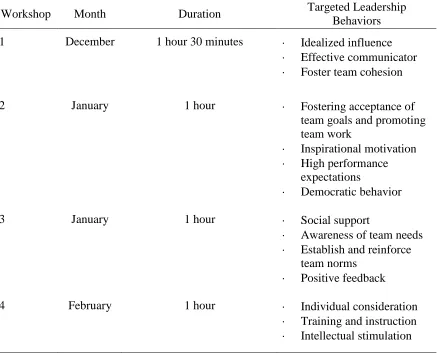
reflection activities to target various athlete leadership behaviors. Each workshop lasted
approximately one hour. An outline of each workshop including their associated
data comprising the leader and leadership development outcomes obtained
pre-intervention were collected (February).
Intervention
Research has stressed the importance of customizing leadership development
opportunities based on individual needs and characteristics (e.g., different targeted
outcomes or methods of delivery based on position within the team; Duguay, Loughead,
& Munroe-Chandler, 2013; McCauley, Kanaga, & Lafferty, 2010). Consequently,
participants in the current study were divided into a rookie leader group (n = 7), an
emerging leader group (n = 11), and a veteran leader group (n = 9). Rookie leaders were
those athletes competing in their first year with their current team. Emerging leaders were
those athletes competing in their second or third year with their current team. Veteran
leaders were those athletes competing in their fourth or fifth year with their current team.
As this was the first time participants were exposed to this leadership development
program, the content and method of delivery remained the same for each group.
Consequently, the leadership groupings gave our participants the opportunity to take part
in the program with other athletes who have the same team tenure (i.e., year of
competition) as themselves. This allowed athletes with similar leadership status to share
ideas, difficulties, and experiences with each other (Duguay et al., 2013).
The intervention included four workshops all facilitated by a graduate student,
who was well versed in athlete leadership development literature and has instructed a
number of previous workshops with athletes (e.g., mental skills training and leadership
development). As a former varsity athlete and team leader, she was familiar and
at developing leaders (e.g., Kelloway, Barling, & Helleur, 2000), the current study
implemented a formal classroom approach using a workshop format. Each workshop was
designed using the recommendations offered by Whetten and Cameron (1995) for
leadership development. Specifically, these authors suggest that for each workshop
participants be given (1) a presentation of the behavioral principles to be learned; (2) a
demonstration of these leadership principles in action; and (3) the opportunity to practice
these leadership principles.
As it pertains to the present study, each workshop was focused on developing
both leader (human capital) and leadership (social capital) capabilities (Day, 2001). To
accomplish this objective, each workshop featured a set of athlete leadership behaviors
that were targeted for developing human capital (see Table 1). The order of introducing
the leadership behaviors was based on research examining the importance athletes placed
on athlete leadership behaviors (Duguay et al., 2013). In their study of 133 intercollegiate
athletes, Duguay et al. (2013) found that athletes believe it is important for athlete leaders
to display a full range of leadership behaviors. For the current study, leadership behaviors
were presented based on how important they were perceived to be by athletes, with
behaviors viewed as most important introduced earlier in the intervention.
As for developing social capital, participants worked either individually or in
small groups to complete activities designed to reinforce and practice the behavioral
principles covered within each workshop. Subsequently, all activities finished with a
large group discussion highlighting how the leadership behaviors not only help to benefit
communication, motivation, and satisfaction). A description of the athlete leadership
development intervention is provided in Table 2.
In addition to the workshops, each participant was given a leadership workbook to
support, reinforce, and expand on the material presented within the workshops (Gould &
Voelker, 2010). The workbooks included an introduction to the program, important
definitions (e.g., leader development, leadership development), activities to accompany
the targeted behaviors, and reflection sections. In addition, a takeaway activity (i.e.,
digging deeper) for each workshop was also included. These were designed to encourage
athletes to further develop their leadership abilities.
Data Analysis
Prior to conducting the main analyses, data were screened for missing values.
Measurement subscales were then examined for reliability using alpha coefficients and
correlation matrices were generated. To determine the overall impact of the leadership
intervention, a series of within-subjects repeated measures multivariate analyses of
variance (MANOVAs) were conducted followed by within-subjects univariate analyses
to further explore significant findings.
Results
Missing Data
It was found that missing data were less than 5% and were deemed to be missing
at random (Fox-Wasylyshyn & El-Masri, 2005). Consequently, missing data were
replaced using the following two imputation techniques: case mean substitution and
group mean substitution. Case mean substitution was carried out by replacing missing
1986). Where this could not be applied (i.e., participant was missing data for all items of
a particular subscale), group mean substitution was implemented. Group mean
substitution was carried out by replacing missing data points with the group level (i.e.,
rookie [basketball or volleyball], emerging [basketball or volleyball], or veteran
[basketball or volleyball]) mean within that particular group (Fox-Wasylyshyn &
El-Masri, 2005). For instance, if data were missing for a rookie player from the basketball
team, the group mean from this cohort was used.
Descriptive Statistics
All subscales were evaluated for internal consistency using alpha coefficients (see
Tables 3 and 4). Cronbach’s alphas revealed that four subscales would achieve a
minimum reliability of .70 (Nunnally & Bernstein, 1994) if one item was removed from
each of the following subscales at pre-intervention: individual consideration (DTLI), high
performance expectations (DTLI), attractions to group-task (GEQ), and negative conflict
(SECTS-2).1 In addition, the ego-involving climate (PeerMCYSQ), personal dedication
(ASQ), ethics (ASQ), and distinctiveness (SECTS-2) subscales at pre-intervention as well
as the individual consideration (DTLI), individual attractions to the group-task (GEQ),
and personal dedication (ASQ) subscales at post-intervention demonstrated reliabilities
lower than .70 (Nunnally & Bernstein, 1994). It has been suggested that alphas of greater
than .60 are acceptable for factors comprising fewer than 10 items (Loewenthal, 1996).
Consequently, items were removed to achieve this .60 threshold by omitting one item
each from the ego-involving climate (PeerMCYSQ) subscale at pre-intervention, the
1 Individual consideration (DTLI) item deleted: Help team members to develop their strengths.
High performance expectations (DTLI) item deleted: Will not settle for second best.
Individual attractions to the group-task (GEQ) item deleted: I am happy with the amount of playing time I get.
individual attractions to the group-task (GEQ) subscale at post-intervention, and the
personal dedication (ASQ) subscale at post-intervention.2 Following the removal of one
item, the individual consideration subscale (DTLI) at post-intervention had an internal
consistency value of .48 and could not be improved by removing any additional items.3
As such, the individual consideration subscale was removed from further analyses.
Summaries of the bivariate correlations between all outcome variables at
pre-intervention and post-pre-intervention are presented in Table 3 and Table 4, respectively. As
can be seen, significant bivariate correlation coefficients at pre-intervention ranged from
r = .38 to .89 and at post-intervention ranged from r = .38 to .87, providing evidence that
multicollinearity was minimal (Mayers, 2013; Tabachnick & Fidell, 2007).
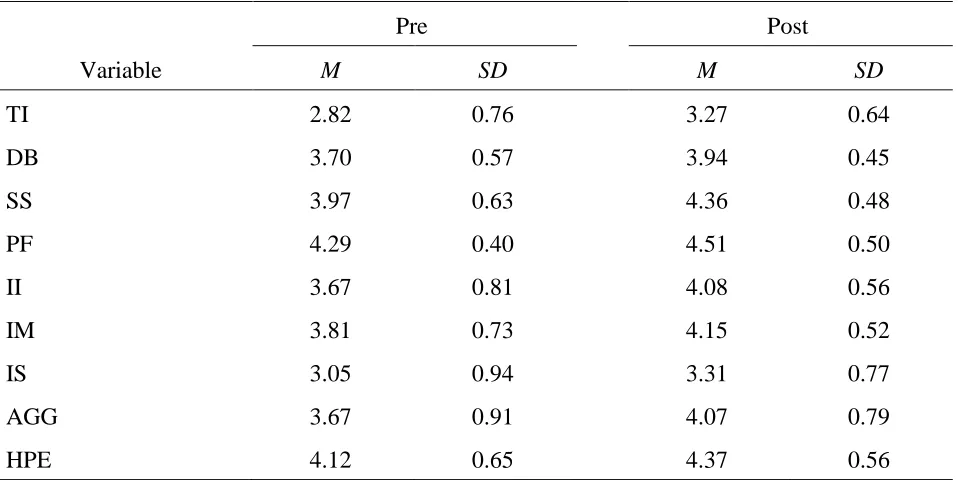
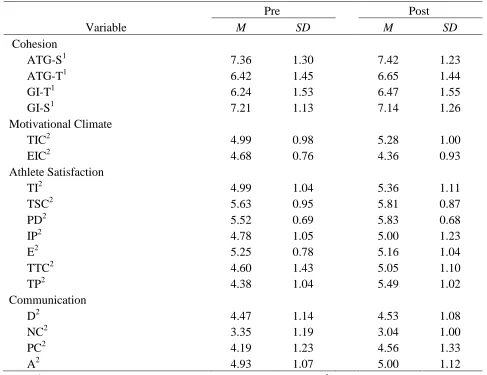
Means and standard deviations for each leader development and leadership
development outcome variables are presented in Table 5 and Table 6, respectively. In
terms of leader development, post-intervention means for all leadership behaviors saw a
hypothesized increase from those reported pre-intervention. This trend continued within
the leadership development outcome variables. Specifically, only two outcome variables:
group integration-social and ethics saw unexpected decreases in means post-intervention.
It is important to note that ego-involving climate and negative conflict also saw
reductions in means post-intervention, however a decrease in the means of these variables
is desired.
2 Ego-involving climate (PeerMCYSQ) item deleted: Laugh at their teammates when they make mistakes.
Individual attractions to the group-task (GEQ) item deleted: I am happy with the amount of playing time I get.
Personal dedication (ASQ) item deleted: The degree to which I do my best for the team.
Main Analyses
Prior to conducting the main analyses, assumptions of repeated measures
MANOVA including the examination of outliers and normality were evaluated (Mayers,
2013). Outliers were assessed using z-scores. One case was found to be above the cut-off
of 3.29 (Field, 2013). To improve the accuracy of future analyses and preserve sample
size, Winsorizing was used to replace the outlier (Field, 2013). Specifically, the outlier
was adjusted to reflect the next lowest value within that respective outcome variable.
Examination of the z-scores following the adjustment confirmed that the value was no
longer an outlier. Following this process, the assumption of normality was assessed using
Shapiro-Wilk values. It was found that the data were approximately normally distributed.
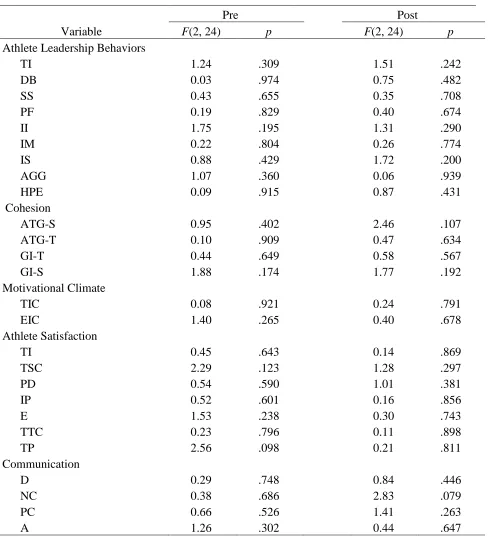
In order to determine whether team tenure of the participants (i.e., rookie,
emerging, veteran leadership groups) influenced the leader development and leadership
development outcome variables, a one-way analysis of variance (ANOVA) was
conducted. The ANOVA revealed a non-significant main effect for team tenure (see
Table 7). Therefore, the data from rookie, emerging, and veteran leadership groups were
combined for subsequent analyses.
Leader development and leadership development were measured at two time
points: prior to the leadership development intervention and following the intervention.
To evaluate the overall impact of the program, a series of within-subjects repeated
measures MANOVAs were conducted. Specifically, separate within-subjects repeated
measures MANOVAs were calculated for leader development (i.e., athlete leadership
motivational climate, satisfaction, and communication). These were followed by
within-subjects univariate analyses to further explore the significant findings.
Leader Development
Athlete leadership behaviors. Results of the within-subjects repeated measures
MANOVA revealed a significant multivariate effect for time, V = 0.64, F(10, 17) = 2.99,
p = .023, partial η2 = 0.64. Within-subjects univariate analyses indicated that training and
instruction, F(1, 26), = 21.71, p = < .001, 95% CI [-.65, -.25]; democratic behavior, F(1,
26), = 5.54, p = .026, 95% CI [-.45, -.03]; social support, F(1, 26), = 22.12, p = < .001,
95% CI [-.55, -.22]; positive feedback, F(1, 26), = 5.53, p = .027, 95% CI [-.42, -.03];
idealized influence, F(1, 26), = 10.82, p = .003, CI [-.66, -.15]; inspirational motivation,
F(1, 26), = 8.44, p = .007, 95% CI [-.59, -.10]; high performance expectations, F(1, 26),
= 9.83, p = .004, 95% CI [-.41, -.09]; and fostering acceptance of group goals and
promoting team work, F(1, 26), = 6.78, p = .015, 95% CI [-.73, -.09], showed significant
mean increases from pre-intervention to post-intervention.
Leadership Development
Cohesion. Results of the within-subjects repeated measures MANOVA indicated
no significant multivariate effect for time, V = 0.23, F(4, 23) = 1.69, p = .186, partial η2 =
0.23. This indicates that none of the four cohesion dimensions changed significantly from
pre-intervention to post-intervention.
Motivational climate. Results of the within-subjects repeated measures
MANOVA revealed a significant multivariate effect for time, V = 0.32, F(2, 25) = 5.81, p
= .008, partial η2 = 0.32. Within-subjects univariate analyses indicated that task-involving
increase from pre-intervention to post-intervention. In contrast, ego-involving climate,
F(1, 26), = 6.24, p = .019, 95% CI [.06, .58], showed a significant mean decrease from
pre-intervention to post-intervention.
Satisfaction. Results of the within-subjects repeated measures MANOVA
revealed a significant multivariate effect for time, V = 0.69, F(7, 20) = 6.36, p = .001,
partial η2 = 0.69. Within-subjects univariate analyses indicated that team integration, F(1,
26), = 6.44, p = .018, 95% CI [-.66, -.07]; personal dedication, F(1, 26), = 4.61, p = .041,
95% CI [-.60, -.01]; and team performance, F(1, 26), = 21.63, p = < .001, 95% CI [-1.59,
-.62], showed significant mean increases from pre-intervention to post-intervention.
Communication. Results of the within-subjects repeated measures MANOVA
indicated no significant multivariate effect for time, V = 0.17, F(4, 23) = 1.16, p = .354,
partial η2 = 0.17. This result indicates that none of the four communication dimensions
changed significantly from pre-intervention to post-intervention.
Effect Sizes
Cohen (1988; 1992) has suggested general guidelines for what constitutes a small
(d = 0.2), medium (d = 0.5), and large effect (d = 0.8), however has stressed the
importance of drawing upon the context of the findings to more effectively interpret
effect sizes. In light of these guidelines, the following leader behaviors from the
univariate analyses demonstrated small to medium effects: democratic behavior (d =
-0.42), inspirational motivation (d = -0.47), fostering acceptance of group goals and
promoting team work (d = -0.44), and high performance expectations (d = -0.39).
Training and instruction (d = -0.59), social support (d = -0.62), positive feedback (d =
motivational climate, both task-involving climate (d = -0.30) and ego-involving climate
(d = 0.42) had small effects. For athlete satisfaction, team integration (d = -0.34), and
personal dedication (d = -0.45) demonstrated small effects while team performance (d =
-1.07) revealed a large effect.
Discussion
The purpose of the current study was to develop, implement, and examine a new
program of leadership development with varsity athletes. In particular, the present study
explored the effects of an intervention program on leader (i.e., athlete leadership
behaviors) and leadership (i.e., cohesion, motivational climate, satisfaction, and
communication) development outcomes. In terms of leader development, the results
demonstrated the intervention program positively impacted most of the athlete leadership
behaviors targeted. More precisely, participants reported using eight of the ten leadership
behaviors (i.e., training and instruction, democratic behavior, social support, positive
feedback, idealized influence, inspirational motivation, high performance expectations,
and fostering acceptance of group goals and promoting team work) significantly more
often after completing the leadership development program compared to when they
started the program. Additionally, the results demonstrated the athlete leadership
development program positively influenced the leadership development variables of
athlete satisfaction and motivational climate. Specifically, participants reported being
significantly more satisfied with the contributions and coordination of team members'
efforts toward the team's task (team integration), her personal contribution to the team
(personal dedication), and the team's level of performance (team performance). Further,
less levels of ego-involving climate. That is, athletes believed their team climate was one
that encouraged effort and rewarded individual improvement and task mastery rather than
one that fostered social comparison.
To the author’s knowledge, this study is the first to quantitatively measure both
leader development and leadership development within a sport context. Drawing on
previous leadership development literature, the current study revealed some promising
findings. For instance, in their meta-analysis examining leadership interventions from
areas such as business, military, and education, Avolio et al. (2009) found a small,
positive effect on all outcomes (d = 0.59). In comparison, the current study yielded
comparable effects, demonstrating small to medium effect sizes for athlete leadership
behaviors (d = 0.39 to 0.62), small effect sizes for motivational climate (d = 0.30 and
0.42), and small to large effect sizes for satisfaction (d = 0.34 to 1.07). Although these
findings are encouraging, using the above effect sizes as a basis for future power
computations is cautioned (Kraemer, Mintz, Noda, Tinklenberg, & Yesavage, 2006;
Leon, Davis, Kraemer, 2011). As a pilot study, adjustments to the overall research design
(e.g., scheduling of workshops, modifications to the takeaway activity) have been
suggested throughout the remainder of the discussion. While it is hoped these
adjustments will lead to a stronger main study design, such corrections bring into
question whether any effect size calculated based on this pilot study would represent the
true effect size in the main study (Kraemer, 2006). Rather, the above effect sizes should
be interpreted as preliminary findings. The importance of each finding is discussed
Athlete leadership behaviors have been found to positively influence a number of
aspects of the team environment (e.g., Callow et al., 2009; Price & Weiss, 2013; Smith et
al., 2013). Despite this, athlete leader development programs designed to specifically
target leadership behaviors are scarce. In fact, to the author’s knowledge, the current
study is the first to directly target the development of athlete leadership behaviors in
sport. Specifically, in line with the FRML (Avolio, 1999), the athlete leadership
behaviors included in the present study reflected transformational and transactional
leadership behaviors. Notably, eight of the ten leadership behaviors showed significant
increases post-intervention, highlighting the importance of developing a broad
perspective or full range of leadership behaviors in athletes. This finding is consistent
with previous research suggesting athletes employ a full range of leadership behaviors
(Bucci et al., 2012). Consequently, Duguay et al. (2013) examined the importance
athletes placed on 17 athlete leadership behaviors. Participants were asked to rank the
importance of each athlete leadership behavior. Participants believed it was important for
athletes to display a full range of leadership behaviors, with 16 of the 17 leadership
behaviors receiving mean scores above three out of five with higher scores representing
greater importance. The current study found similar findings to Duguay et al. with all of
the leadership behaviors receiving mean scores above three (out of five). Ironically, in the
study conducted by Duguay et al. intellectual stimulation received one of the lowest
scores in terms of importance while in the current study participants reported using this
leadership behavior amongst the least. The items assessing intellectual stimulation focus
heavily on problem solving and viewing obstacles in sport from new perspectives.
mentor. In fact, research examining the relationships among peer athlete mentor
leadership behaviors, mentoring functions, and perceptions of satisfaction, found
intellectual stimulation to be related to vocational mentoring, a type of mentoring
designed to improve an athlete’s development in sport (Hoffmann & Loughead, 2014).
Consequently, it is not surprising that this athlete leadership behavior did not increase
significantly post-intervention.
Previous studies on motivational climate interventions in physical activity have
demonstrated that, when a task-involving motivational climate is emphasized rather than
an ego-involving climate, individuals are more likely to be intrinsically motivated, to
exert extra effort, to attribute their performance to effort, and less likely to evaluate their
competence based on objective criteria (e.g., wins and losses; see Ntoumanis & Biddle,
1999). Furthermore, research has indicated that athletes who perceive higher levels of a
task-involving peer motivational climate have reported higher levels of enjoyment,
physical self-worth, and effort (Vazou, et al., 2006). Conversely, perceptions of an
ego-involving motivational climate have been associated with higher levels of competitive
trait anxiety (Vazou et al., 2006). Notably, it has been suggested that sporting
environments should emphasize the characteristics of a task-involving climate in order
for sport participation to facilitate athlete well-being (Reinboth & Duda, 2006).
Importantly, the present study highlighted the potential for the current athlete leadership
development program to impact peer motivational climate. Specifically, a significant
increase in task-involving motivational climate along with a significant decrease in
The relation between effective leadership and athlete satisfaction has long been of
interest to researchers (e.g., Chelladurai, 1978; Riemer & Chelladurai, 1995). While these
early studies examined the coach leadership to satisfaction relationship, Eys, Loughead,
and Hardy (2007), noted that athlete leaders are partially responsible in creating the
perceived socially constructed environment in which satisfaction is associated.
Advancing this notion, Eys, Loughead, et al. examined the relationship between the
perceived number of athlete leaders on a sport team and satisfaction. To accomplish this,
athlete leader dispersion and athlete satisfaction were measured at two time points (i.e.,
prior to the beginning of the competitive season and following the completion of the
competitive season). Similar to the current study, athlete satisfaction was measured using
the ASQ (Riemer & Chelladurai, 1998); however Eys, Loughead, et al. only included
four dimensions (individual performance, team performance, team task contribution, and
team integration). Findings indicated those athletes who perceived all three leadership
functions (i.e., task, social, external) to be equally represented (as compared to those who
perceived an imbalance), were more satisfied with the degree to which the team was
integrated and their team’s performance. Similarly, the current study found athletes were
significantly more satisfied with the degree to which their team was integrated and their
team’s performance. Although not measured by Eys, Loughead, et al., the current study
also found athletes were significantly more satisfied with their personal dedication
post-intervention. It should also be noted that the post-intervention means for team integration,
team performance, individual performance, and team task contribution were all slightly