Vol. 5, Issue 3, March 2017
An Analytic Method to Study the Efficiency of
Different Software Model
Jimmy Soni
M.Tech Scholar, Software Engineering, Aravali Institute of Technical Studies, Udaipur, India
ABSTRACT: To acquire the most productivity the use of minimum aid is the purpose of any software industry.
Software engineering presents an abstraction procedure to develop software program product. It has introduced various methodologies, principles and ideas. Most of them are the software program technique models that are also known as software program lifestyles cycle fashions. In the software industry extraordinary types of tasks (small, medium, big, complicated) arrive in random inter arrival time for the improvement of software products. On the simple of take a look at of the tasks performed through Acnosys Software program vt. Ltd. Earlier than enforcing the goods, task managers decide the precise software technique model in documentation this is used in manufacturing of merchandise.
An empirical have a look at performed in 2012 that offers diverse effecting factors for choosing any software life cycle version. One of the essential elements among them is group length. Software enterprise has a development team which goes in co-ordination and depends on each other. Every now and then project managers aren't intelligently assigned assets to precise phases of software program life cycle model. Consequently to triumph over these issues we're simulating iterative waterfall and incremental version to determine ideal resources for each section of software existence cycle model. This observes shall permit the project supervisor to decide most appropriate resource without imposing software product.
KEYWORDS: SDLC model, Software engineering.
I. INTRODUTION
Software development Life Cycle Model
SDLC models are the methodologies used to build the complex and large management and informal projects. A methodology [5, 6] is a procedure, concept and practical implementation rule which can be used as a set of well defined steps or phases. The Software process model is used for doing production in a systematic way. There is a description of a process for a particular perspective
Specification Design Validation Evolution
Vol. 5, Issue 3, March 2017
Problem identify
Customer Evolution
1
4
Testing
Fig. 1.2: Basic structure of software process model A few
Iterative Waterfall Software life cycle model
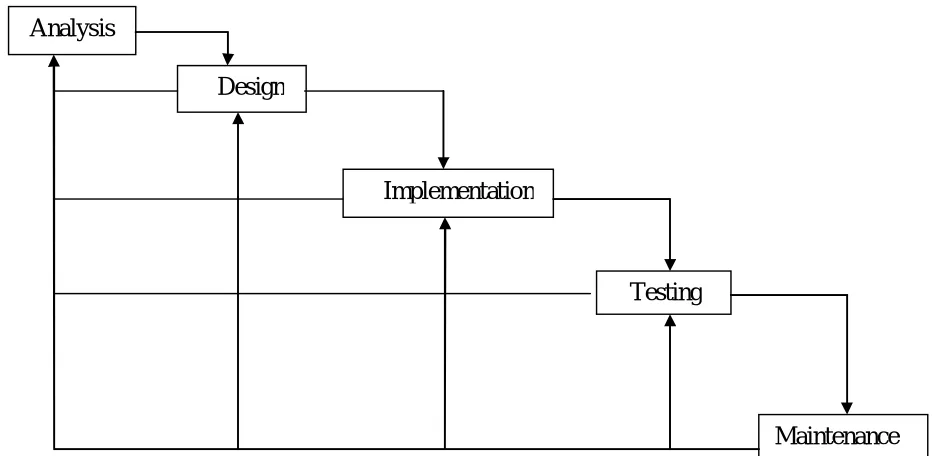
Iterative waterfall software process model was proposed by Winston W.Royce in 1970. This model became popular and provided the practical guidelines for developing the software products. Its name is derived from structural specification. Every phase comes after a phase is completed and the tasks can be divided according to the phases. The output of one phase becomes input of next phase but we have the option to revisit the phases in the next cycle. We already have gone through the literature documentation [9] on iterative waterfall model. We have observed distinct approach used for expressing the iterative waterfall model. There are commonly five phases in iterative waterfall model such as analysis, design, coding, testing and maintenance man.
Fig 1.3: Iterative waterfall software life cycle model
3
Identify tool
and
Develop solution
2 5Design
Implementation
Testing
Analysis
Vol. 5, Issue 3, March 2017
Incremental software life cycle model
It is combined with the linear sequential steps technique for building the philosophy of the increment prototyping. The basic idea that the increment [11] should be used for building the baseline of the product. With each increment, specific functionality is added for creating a full quality product. Each increment is used as an input of the next increment. It is used where the customer requirement is frequently changing. Initially the developer and the customer communication takes place, customer tells about the requirement and the technology which is required. The developer understands requirements of the client and starts building the product. Now the first increment is completed and the product is delivered to the customer and put into the operational environment for testing the conformance of the requirements. In the iterative waterfall model we can‟t add specification functionality after
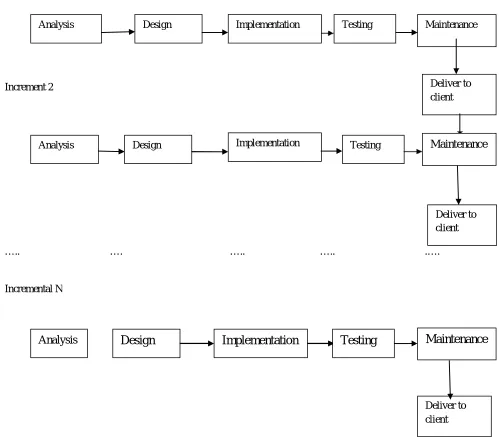
starting the production. This is possible in incremental model. Incremental model is explained below with the help of diagram.
Incremental 1
Increment 2
….. …. ….. ….. .….
Incremental N
Fig 1.4 Incremental Software development life cycle
Analysis Design Implementation Testing Maintenance
Analysis Design Implementation Testing Maintenance
Deliver to client
Analysis
Design
Implementation
Testing
Maintenance
Deliver to client
Vol. 5, Issue 3, March 2017
Comparison of iterative waterfall and incremental modal
TABLE 1.1 COMPARSION OF INCREMENTAL AND ITERATIVE WATERFALL MODEL
Iterative waterfall model Incremental model
1. This model is used for implementing, the [12] software product when the requirement is clearly defined.
1. When there is always a possibility of changing the requirement we prefer this model.
2. Customers do not interact with the software until the final phase is [13] not accomplished. (customer evaluation after the final stage)
2. There is a core (baseline) product which is created after each increment. So the clients are able to take review before executing the final phase(customer evaluation in each increment)
3. The Human resource is dependent on the requirements of clients.
3. Less human resource is required when the increments are small
4. The Project failure risk will be high. 4. The Project failure risk will be low.
Some effecting factor for the choice of development life cycle model
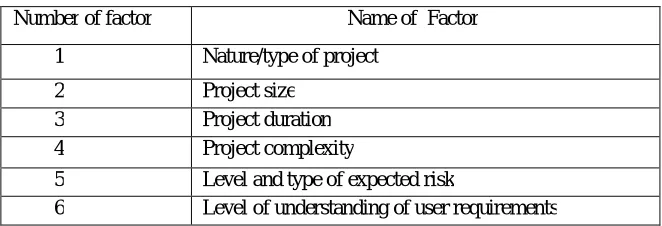
Today the software product cost and time overruns, user requirement not fulfils, so constructing reliable software is a challenge to developer. In 1960 customer used to tell their requirements to the developer and they directly enter in coding phase, but at that time softwares were small. But now a days we are implementing the large information management softwares .So in the absence of software process model the project risk failure will be increased. An empirical study is conducted on Indian software industry for selecting a particular life cycle model. This study presents the factors which are critical for choosing software life cycle. A total of 14 factors were considered in this study. One of them is the team size. Now a days software product is becoming large and complex, which needs a coordinated work between the team members of the software industry.
II. MOTIVATION AND PROBLEM STATEMENT
We are stimulated from a survey conducted in Indian software program enterprise in 2015. There were diverse analytical factors which were influencing the software industry for choosing the software method model for the unique software product. Various styles of projects come within the software program industry in step with day. Our purpose is to gain the maximum productiveness the use of the minimal assets.
Table 3.1 LISTS OF FACTORS EFFECTING SOFTWARE INDUSTRY [9]
Number of factor Name of Factor
1 Nature/type of project
2 Project size
3 Project duration
4 Project complexity
5 Level and type of expected risk
Vol. 5, Issue 3, March 2017
7 Level of understanding of the application area
8 Customer involvement
9 Experience of developers
10 Team size
11 Man-machine interaction
12 Availability of tools and technology
13 Versions of the product
14 Level of reliability required
Simulation model
We have long past via 4 distinct varieties of projects which might be created via Acnosys software pvt. Lmt, Udaipur[24]. This organization has accompanied identical technique as any other software agency. We've taken into consideration 4 tasks the use of the iterative waterfall and the increment version. The Iterative waterfall version has remarks loop so the chance of failure (mistakes) concept has been used. The Simphony.Net 4.6 simulation tool is used to decide the optimized aid for a particular software program technique model. The Iterative waterfall version is less complicated to simulate due to the fact on this levels execute one after some other, however within the incremental model, stages are dependent on task managers, how they deal with it. We will restoration the character of incremental version for simulation. Under is the discern which indicates the increment version which we've simulated. For increment 1 all the 5 phases are done and brought to the consumer. In increment 2 requirement analysis, layout and coding are not wanted, so the increment 1 output becomes the input of increment 2 however nonetheless the customer’s choice isn't fulfilled in it. Now in increment three the four phases design, coding, checking out and preservation are repeated once more and the desired product is completed.
increment 1 increment 2 increment3
Fig 3.1 Project manager decides the incremental model that is used in software industry for building the
Deliver to
client
Testing
Testing
Maintenance
Maintenance
Deliver to
client
Design
Implementatio
Maintenance
Deliver to
client
Testing
AnalysisDesign
Vol. 5, Issue 3, March 2017
software products
For creating the software industry environment we have divided the incoming projects into the four types-
1.
Small Scale Project (National Research Center Seed and Spices.Com)2.
Medium Scale Project (MyAjmer.com)3.
Large Scale Project (Information Management System for Aryabhatt College)4.
Complex Scale Project (Stock Management System)Practically it is not possible that same types of projects arrive in a software industry. Therefore we can divide arrival projects on the behalf of probability. We have considered that 45% of projects are of small scale, 35% of the projects are of medium scale, 15% of large scale and 5% of complex scale project. The Software projects arrive in software industry at random time. We can fix the inter-arrival time from a triangular distribution function for simulation. We specify that the minimum arrival time of a project is 10 days, the maximum arrival time is 30 days and the average time is 20 days.
Mathematically we can say
Every software process model requires team work. Presently there are a mix of specialists employees and resources (workers) which provide the base on project complexity in an industry.
To optimize the resource in an industry we should have a fruit full combination of employees.
We can provide 1 business analyst, 1 designer, 2 programmers, 2 testers and 1 maintenance employees for the small Scale projects.
We can provide 2 business analysts, 2 designers, 4 programmers, 5 testers and 1 maintenance employees for the medium Scale projects.
We can provide 3 business analysts, 3 designers, 7 programmers, 8 testers and 3 maintenance employees for the large Scale projects.
We can provide 4 business analysts, 4 designers, 12 programmers, 15 testers and 4 maintenance employees for the complex scale projects.
Vol. 5, Issue 3, March 2017
1.
10 Business Analysts2.
10 Designers3.
25 programmers4.
30 Testers5.
9 Maintenance ManIII. SIMULATION RESULTS
We simulate iterative waterfall and incremental software program existence cycle version. These fashions are accomplished five times for 2025 millisecond with incoming a hundred tasks using mathematical distribution feature and Simphony.Net 4.6 environment. Our intention is to evaluate iterative waterfall and incremental software manner fashions (SDLC) for optimizing the resource.
IV. CONCLUSSION
This chapter explained problem statement and motivations. We have studied four different type of projects used at Acnosys software services Pvt. Ltd, Udaipur. Microsoft .NET framework 1.1 and Simphony.NET 4.61.1.3.14 simulation tool along with their basic features and characteristics are properly explained. These tools are used for creating simulation environment.
REFERENCES
[1] Nabil Mohammed Ali Munassar and A.Govardhan, “A Comparison Between Five Models Of software Engineering” IJCSI International Journal of Computer Science Issues, Vol 7,Issue 5, Sep, 2010
[2] Pratap K.J Mohapatra “ Software Engineering:Life cycle Approach”,ISBN 978-81-24-2721- 9,1th ed., NAIL, 2010
[3] Ian sommervilla, Software Engineering ,Addison Wesley,9th ed,2010
[4] Roger S. Pressman,“Software engineering: A practitioner’s approach”,ISBN 0-07-365578- 3,5th ed., TMH, 2001 [5] Stephen R. Schach,“Object oriented software engineering”,ISBN 978-0-07-352333-0 ,1th ed,THM,2008 [6] Steve Easterbrook,”software life cycle “university of toronto Department of computer science ,2001.
[7] Royce, W., “Managing the Development of Large Software Systems”, Proceedings of IEEEWESCON 26, pp.1-9, 1970. [8] IEEE-STD-610,“A Compilation of IEEE Standard Computer Glossaries”, IEEE Standard Computer Dictionary, 1991