Electronic Theses and Dissertations Theses, Dissertations, and Major Papers
2014
Computational Studies into Iron-Based Biocatalysis
Computational Studies into Iron-Based Biocatalysis
Rami Gherib
University of Windsor
Follow this and additional works at: https://scholar.uwindsor.ca/etd
Recommended Citation Recommended Citation
Gherib, Rami, "Computational Studies into Iron-Based Biocatalysis" (2014). Electronic Theses and Dissertations. 5127.
https://scholar.uwindsor.ca/etd/5127
This online database contains the full-text of PhD dissertations and Masters’ theses of University of Windsor students from 1954 forward. These documents are made available for personal study and research purposes only, in accordance with the Canadian Copyright Act and the Creative Commons license—CC BY-NC-ND (Attribution, Non-Commercial, No Derivative Works). Under this license, works must always be attributed to the copyright holder (original author), cannot be used for any commercial purposes, and may not be altered. Any other use would require the permission of the copyright holder. Students may inquire about withdrawing their dissertation and/or thesis from this database. For additional inquiries, please contact the repository administrator via email
Computational Studies into
Iron-Based Biocatalysis
By Rami Gherib
A Thesis
Submitted to the Faculty of Graduate Studies through the Department of Chemistry and Biochemistry
in Partial Fulfillment of the Requirements for the Degree of Master of Science at the
University of Windsor
Computational Studies into Iron-Based Biocatalysis
by
Rami Gherib
APPROVED BY:
______________________________________________
S. Goodwin
School of Computer Science
______________________________________________
J. Rawson
Department of Chemistry & Biochemistry
______________________________________________
J. Gauld, Advisor
Department of Chemistry & Biochemistry
Declaration of Co-Authorship
I. Co-Authorship Declaration
I hereby declare that this thesis material incorporates material that is a result of joint research as follows:
Chapter 3 was done in collaboration with Daniel Simard and Vanessa Susevski under the supervision of Prof. James W. Gauld.
Chapter 4 was done in collaboration with Dr. Eric A. C. Bushnell and Anthony J. Deschamps under the supervision Prof. James W. Gauld.
Chapter 5 was done in collaboration with Dr. Eric A. C. Bushnell and Anthony J. Deschamps under the supervision Prof. James W. Gauld.
Chapter 6 was done in collaboration with Dr. WenJuan Huang under the supervision Prof. James W. Gauld.
I am aware of the University of Windsor Senate Policy on Authorship and I certify that I have properly acknowledged the contribution of other researchers to my thesis, and have obtained written permission from each of the co-authors to include the above material in my thesis.
I certify that, with the above qualifications, this thesis, and the research to which it refers, is the product of my own work.
II. Declaration of Previous Publications
Citation Status
Gherib, R.; Dokainish, H. M.; Gauld, J. W. Int. J. Mol. Sci. 2013, 15, 401.
Published
Chapter 3 Gherib, R.; Simard, D. J.; Susevski, V.; Gauld, J. W. In preparation
To be submitted
Chapter 4 Gherib, R.; Bushnell. A. C.; Deschamps, A. J.; Gauld, J. W. In preparation
To be submitted
Chapter 5 Gherib, R.; Bushnell. A. C.; Deschamps, A. J.; Gauld, J. W. In preparation
To be submitted
Chapter 6 Gherib, R.; Huang, W.-J.; Gauld, J. W. In preparation To be submitted
I certify that I have obtained written permission from the copyright owners to include the above-published materials in my thesis. I certify that the above material describes work completed while registered as a graduate student at the University of Windsor.
I declare that to the best of my knowledge, my thesis does not infringe upon anyone’s copyright nor violates any proprietary right and that the ideas techniques, quotations or any other material, are fully acknowledged in accordance with the standard practices. Furthermore, to the extend that I have included copyrighted material that surpasses the bounds of fair dealing within the meaning of the Canada Copyright Act, I certify that I have obtained written permission from the copyright owners to include such material in my thesis.
Abstract
Dedication
Acknowledgements
Academic research is not an easy thing to do because it mostly involves failing. For every successful result, there is usually behind it a very long line of failed attempts. It can often be demotivating and highly stressful. However my overall experience during these past 2 years has been extremely pleasant and I owe it mostly to the people around me. I want to take this opportunity to acknowledge them and thank them.
Firstly, I would like to thank my supervisor Prof. James Gauld. During my graduate studies he has always made himself available to help me resolve research-related issues. Problems that I would spend months trying to solve would be instantaneously resolved as soon as I’d describe them to him. He has been an excellent supervisor. I am very grateful for having been his student.
I would also like to thank Prof. Jeremy Rawson and Prof. Scott Goodwin for taking their time in reading my thesis.
time. I would also like to extend my thanks to Erum Kazim, Gyllian Porteous, Peter Boateng and Omid Beiraghi for their sunny personalities.
I would like to thank my family for their unconditional love and support. I am grateful to my mother, Monia Ayadi, for her tenderness, her affection and for reminding me to eat once in a while. I would like to thank my father, Faouzi Ghrib, for his devotion, for always looking out after my future and for all the conversations we had in the car to and from school. I would like to thank my brother, Amine Gherib, for his friendship, for his jokes, for changing my mind off research when I got home. From the bottom of my heart, I would to thank my wonderful girlfriend WenJuan Huang for all of the support she has given me in these past years. She is by far the best thing I have acquired from joining the Gauld group.
Table of Content
Declaration of Co-authorship ... iii
Abstract ... v
Dedication ... vi
Acknowledgements ... vii
List of Tables ... xiv
List of Figures ... xvi
List of Schemes ... xx
List of Appendices ... xxi
List of Abbreviations ... xxii
Chapter 1
Introduction
1.1 Biological Iron ... 21.2 Catalysis ... 2
1.3 The Efficiency of Enzymes ... 2
1.4 Iron-Based Enzymes ... 3
1.5 Computational Enzymology ... 4
1.6 Computational Investigation into Iron-Based Biocatalysis ... 5
1.7 References ... 5
2.2.1 The Time-Dependent Schrodinger Equation ... 9
2.2.2 The Born-Oppenheimer Approximation ... 10
2.2.3 Atomic and Molecular Orbitals ... 11
2.2.4 Slater Determinants ... 11
2.2.5 The Variational Theorem ... 12
2.3 Hartree-Fock Method ... 12
2.4 Density Functional Theory ... 13
2.4.1 The Electron Density ... 13
2.4.2 Hohenberg-Kohn Theorems ... 14
2.4.3 Local Density Approximation ... 15
2.4.4 Generalized Gradient Approximation ... 15
2.4.5 Hybrid Density Functional Theories and B3LYP ... 16
2.5 Basis Machinery of MO/DFT Calculations ... 16
2.5.1 Slater and Gaussian Basis Sets ... 16
2.5.2 Gaussian Split Valence Basis Sets ... 17
2.5.3 Polarization and Diffuse Functions ... 18
2.5.4 Effective Core Potentials ... 18
2.5.5 Electron Correlation ... 19
2.6 Molecular Mechanics ... 19
2.7 Quantum Mechanics/Molecular Mechanics ... 20
2.8 Classical Molecular Dynamics Simulations ... 21
2.9 Potential Energy Surfaces ... 22
Chapter 3
The Different Catalytic Rate of Fe(II)/M(II)-GpdQ Explained with DFT
3.1 Introduction ... 26
3.2 Computational Methods ... 28
3.3 Results and Discussion ... 29
3.3.1 Protonation State of Active Site ... 29
3.3.2 Substrate Coordination and Displacement of Terminal Water ... 36
3.3.3 Mechanistic Study of Fe(II)/M(II)-GpdQ Catalysis ... 39
3.3.4 The Origin of GpdQ’s Catalytic Power ... 47
3.4 Conclusion ... 51
3.5 References ... 52
Chapter 4
Modeling Compound I in Coral Allene Oxide Synthase: A Challenge for
Density Functional Theory
4.1 Introduction ... 564.2 Computational Methods ... 58
4.2.1 Molecular Docking ... 58
4.2.2 QM/MM Model ... 59
4.2.3 QM/MM Calculations ... 59
4.3 Results and Discussion ... 61
4.3.1 Basis Set Assessment ... 61
4.3.2 Axial Ligand Environment ... 66
4.3.3 DFT Functional Assessment ... 67
4.5 Conclusions ... 74
Chapter 5
Compound I Reactivity in Coral Allene Oxide Synthase: A QM/MM
Study
5.1 Introduction ... 80
5.2 Computational Methods ... 83
5.2.1 Molecular Docking ... 83
5.2.2 QM/MM Model and Calculations ... 84
5.3 Results and Discussion ... 85
5.3.1 Cpd I/cAOS Hydroxylation of Arachidonic Acid ... 85
5.3.2 Cpd I/cAOS Epoxidation of Arachidonic Acid ... 93
5.4 Conclusions ... 100
5.5 References ... 101
Chapter 6
Insights from MD and QM/MM into the Biocatalysis of LuxS
6.1 Introduction ... 1066.2 Computational Methods ... 110
6.2.1 Molecular Dynamics (MD) Simulations ... 110
6.2.2 QM/MM Calculations ... 110
6.3 Results and Discussion ... 112
6.3.1 Deprotonation of C3Substrate by Cys84 ... 112
6.3.2 MD Simulations ... 113
6.3.3 Water Mediated Transfer HC4-Substrate to O2Substrate ... 118
6.3.4 Thioether Bond Cleavage by Glu57 ... 118
6.3.5 The Mechanistic Role of Fe(II) ... 122
6.4 Conclusions ... 123
Chapter 7
Conclusions
7.1 Conclusions ... 128
7.2 References ... 131
List of Tables
Table 3.1. Selected interatomic distances in DFT models and averaged crystal structure (PDB: 3D03). ... 34
Table 3.2. RMSD of the DFT models at the medium and large-scale. ... 36
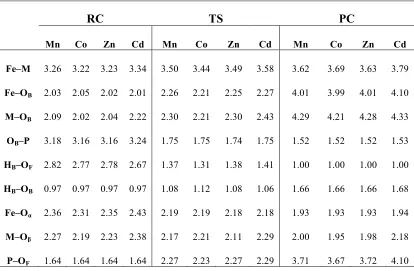
Table 3.3. Selected atomic distances (Å) of optimized species along the reaction pathway of DMP hydrolysis with neutral His81 model ... 43
Table 3.4. Selected atomic distances (Å) of optimized species along the reaction pathway of DMP hydrolysis with protonated His81 Mn(II) and Co(II) containing models. ... 46
Table 3.5. Selected atomic distances (Å) of optimized species along the reaction pathway of DMP hydrolysis with protonated His81 Zn(II) and Cd(II) conatining models ... 47
Table 4.1. Optimized Fe–OTyr distances (Angstroms) obtained at the ONIOM(B3LYP/BSi:AMBER99) level of theory ... 63
Table 4.2. Selected spin densities, relative spin splitting and conformational energies obtained at the ONIOM(B3LYP/6-311+G(2df,p):AMBER)//ONIOM(DFT/BSi:AMBER 96) level of theory. ... 65
Table 4.3. Selected distance (Angstroms) obtained at the ONIOM(DFTi /6-31G(d,p):AMBER96) level of theory (DFTi = BLYP, B3LYP*, B3LYP, M06, M06-L) ... 68
Table 4.4. Selected spin densities and relative energies obtained at the ONIOM(DFT i/6-311+G(2df,p):AMBER96)//ONIOM(DFTi/6-31G(d,p):AMBER96) level of theory ... 70
Table 4.5. Difference in energies (ΔE; kJ mol–1) between models obtained at the
ONIOM(DFTi/6-311+G(2df,p):AMBER96//ONIOM(B3LYP/6-31G(d,p):AMBER96)
and ONIOM(DFTi/ 6-311+G(2df,p):AMBER96//ONIOM(DFTi/6-31G(d,p):AMBER96)
Table 5.1. Selected spin densities obtained at the ONIOM(B3LYP/6-311+G(2fd,p):AMBER96//B3LYP/LANL2DZ(Fe),6-31(d,p)(C,H,N,O):AMBER96) level
of theory for the hydroxylation pathway ... 99
Table 5.2. Selected spin densities obtained at the ONIOM(B3LYP/6-311+G(2fd,p):AMBER96//B3LYP/LANL2DZ(Fe),6-31(d,p)(C,H,N,O):AMBER96) level
List of Figures
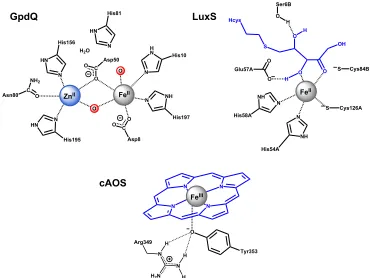
Figure 1.1. Schematic representation of selected Fe–containing enzymatic active sites ... 4
Figure 2.1. Schematic representation of Slater (blue/solid) and Gaussian (red/dashed) type basis functions ... 17
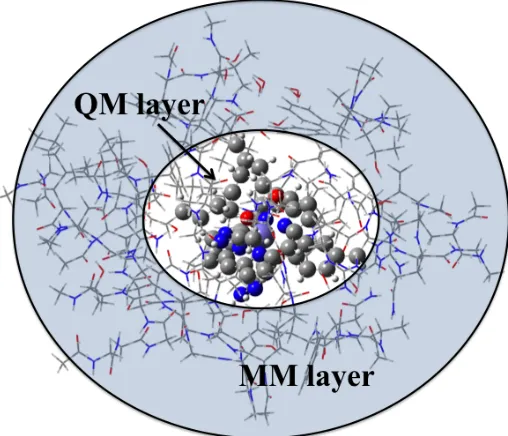
Figure 2.2. Representation of a QM/MM model. The shaded region correspond the MM layer and the center corresponds to the QM region ... 21
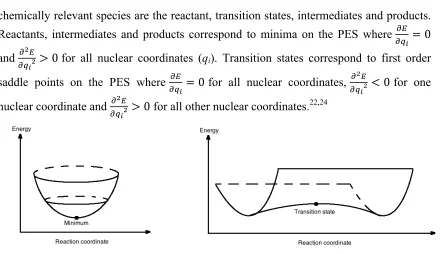
Figure 2.3 Schematic representation of a minimum/reactant/intermediate/product (left and saddle point/transition state (right) ... 22
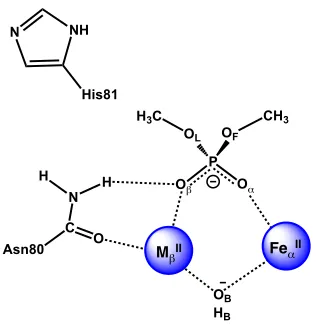
Figure 3.1. Schematic representation of the GpdQ active site ... 27
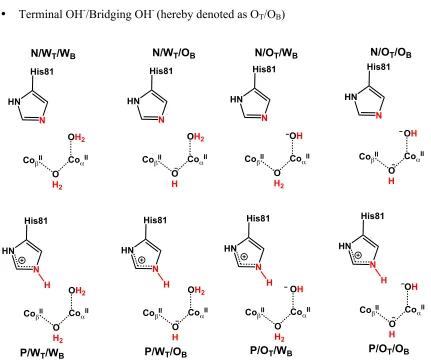
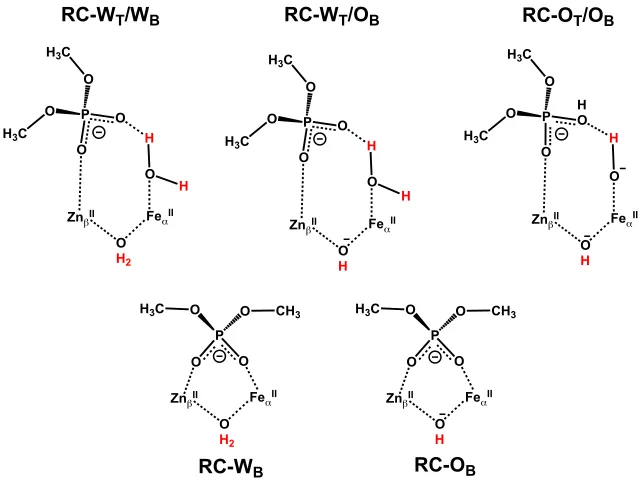
Figure 3.2. Schematic representations of all considered models and protonation states of the GpdQ active site ... 30
Figure 3.3. Atoms considered in the second (medium-sized) scale. Only the positions of the β site water (OW), the nitrogen atom on His81 and the atoms in the first coordination sphere have been considered. ... 35
Figure 3.4. Schematic representations of all considered reactant models in the active site of GpdQ ... 37
Figure 3.5. Schematic representations of neutral His81 containing reactant models and designation of atoms ... 40
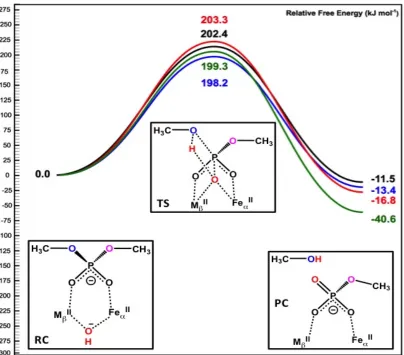
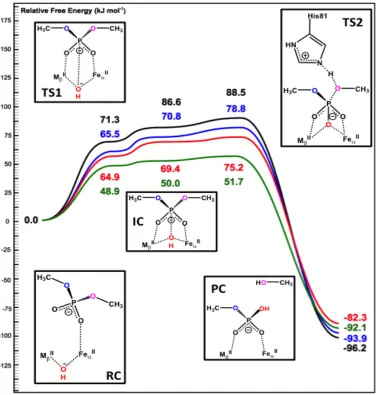
Figure 3.6. Schematic free energy surface of the DMP hydrolysis by Fe(II)/M(II)–GpdQ with the bridging hydroxide ligand acting as the nucleophile and neutral His81. Color
key: black/M=Zn, red/M=Mn, blue/M=Co, green/M=Cd ... 42
Figure 3.8. Schematic free energy surface of the DMP hydrolysis by Fe(II)/M(II)–GpdQ with the bridging hydroxide ligand acting as the nucleophile and positively charged
His81. Color key: black/M=Zn, red/M=Mn, blue/M=Co, green/M=Cd ... 45
Figure 3.9. Selected portion of HOMO (isovalue=0.07) of Cd (up/left), Mn (up/right), Co (down/left) and Zn (down/right) containing RC’s obtained at
B3LYP/aug-cc-pVTZ-PP(Cd),6-311+G(2d,2p)(H,C,N,O,O,Fe) for Cd and B3LYP/6-311+G(2d,2p) for Mn, Co
and Zn containing systems ... 49
Figure 4.1. Schematic representations of (left) Cpd I and (right) electronic configurations
of its near degenerate lowest-lying doublet (in parentheses) quartet and doublet states ... 56
Figure 4.2. Schematic representation of the QM/MM active site model for Cpd I/cAOS complex. The components in the inner circle occupy the QM layer while those in the
outer circle occupy the MM layer ... 60
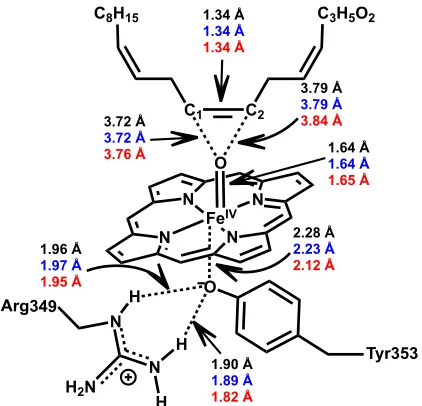
Figure 4.3. Schematic representation of the structure of Cpd I/cAOS optimized at the ONIOM(B3LYP/6-31G:AMBER96) level of theory with selected bond distances
(angstroms). Color code: black (singlet), blue (quartet) and red (sextet) ... 61
Figure 5.1. Schematic representation of (left) Cpd I (right) Cpd II in P450 ... 81
Figure 5.2. Schematic representation of the QM/MM active site model for Cpd I/cAOS complex. The components in the inner circle occupy the QM layer while those in the
outer circle occupy the MM layer ... 85
Figure 5.3. Schematic free energy surface of the hydroxylation of arachidonic acid by Cpd I/cAOS. Color code: doublet (black), quartet (blue) and sextet (red) spin-states ... 87
Figure 5.4. Schematic representations of optimized geometries of RC (i.e. Cpd I/cAOS) and TS1H with selected bond lengths (Å). Color code: doublet (black), quartet (blue) and sextet (red) spin-states ... 89
Figure 5.6. Schematic representations of optimized geometries of IC2H (Cpd II/cAOS) and TS3H with selected bond lengths (Å). Color code: doublet (black), quartet (blue) and
sextet (red) spin-states ... 92
Figure 5.7. Schematic representations of optimized geometries of PCH with selected bond lengths (Å). Color code: doublet (black), quartet (blue) and sextet (red) spin-states ... 93
Figure 5.8. Schematic representations of optimized geometries of TS1E with selected bond lengths (Å). Color code: doublet (black), quartet (blue) and sextet (red) spin-state
... 94
Figure 5.9. Schematic free energy surface of the epoxidation of arachidonic acid by Cpd I/cAOS. Color code: doublet (black), quartet (blue) and sextet (red) spin-states ... 95
Figure 5.10. Schematic representations of optimized geometries of 4PCE with selected bond lengths (Å). ... 96
Figure 5.11. Schematic representations of optimized geometries of 6IC1E and 6TS2E with selected bond lengths (Å). ... 97
Figure 5.12. Schematic representations of optimized geometries of 2,6PCE with selected bond lengths (Å). Key distances for the doublet and sextet geometries are given in black
and red, respectively. ... 98
Figure 6.1. Carbon numbering in deuterium insertion in DPD ... 108 Figure 6.2. Schematic representation of the ONIOM QM/MM active site model with 2-keto-SRH bound with the inner circle indicating moieties in the QM layer and the outer
circle indicating moieties in the MM layer ... 111
Figure 6.3. Schematic representation of optimized structure with selected bond length in angstrom (Å) of RC, TS1 and IC1 ... 112
Figure 6.4. .Plot of HO–Glu57A···O2Substrate (red) and HO–Glu57A···O3Substrate (blue) distances (Å)
Figure 6.5. Plot of OGlu57A··· HC4–Substrate (green) and SCys84B··· HC4–Substrate (orange) distances
(Å) during the MD simulation of putative 3-keto intermediate bound to LuxS active site
with anionic Glu57A ... 115 Figure 6.6. Schematic representation of optimized structure with selected bond length in
angstrom (Å) of TS2, IC2 and TS3 ... 117 Figure 6.7. Plot of SSubstrate···HO–Glu57A distance (Å) during MD simulation of IC2 ... 120 Figure 6.8. Schematic representation of optimized structure with selected bond length in
angstrom (Å) of IC3 and TS4 ... 120 Figure 6.9. Schematic representation of optimized structure with selected bond length in
angstrom (Å) of IC4, TS5 and PC ... 121 Figure 6.10. Schematic free energy surface of the conversion of putative 2-keto
List of Schemes
Scheme 3.1. Proposed hydrolytic mechanism of GpdQ by Hadler et al. ... 27
Scheme 3.2. Schematic representations of the optimizations of P/OT/OB and N/OT/WB. At the (B3LYP/LANL2DZ(Co);6-31G(d)(H,C,N,O) level of theory, both initial structures
break down and form N/WT/OB ... 32
Scheme 3.3. Schematic representations of the optimization of P/OT/WB at the (B3LYP/LANL2DZ(Co);6-31G(d)(H,C,N,O) level of theory ... 33
Scheme 3.4. Schematic representations of the optimizations of RC-OT/OB. At the
(B3LYP/LANL2DZ(Fe,Zn);6-31G(d)(H,C,N,O) level of theory ... 38
Scheme 3.5. Schematic representations of the displacement of a terminally water by DMP and corresponding thermodynamical properties in a) water and b) hydroxide bridging
ligand complexes obtained at the
(B3LYP/6-311+(2d,2p)//B3LYP/LANL2DZ(Fe,Zn);6-31G(d)(H,C,N,O) level of theory ... 39
Scheme 3.6. Schematic representation of the formation of a phosphate based bipyramidal complex with hydroxide Lewis base and DMP as Lewis acid ... 50
List of Appendices (on CD)
Table A1.Cartesian coordinates of optimized structure of N/WT/OB, P/OT/WB, N/WT/WB, N/WT/OB, N/OT/OB, P/WT/WB and P/WT/OB.
Table A2.Cartesian coordinates of optimized structures of RC–WT/WB, RC–WT/OB, RC– OT/OB, RC–WB and RC–OB.
Table A3.Cartesian coordinates of optimized structure of species along the mechanistic pathway of Fe(II)/M(II)-GpdQ with neutral His81.
Table A4. Cartesian coordinates of optimized structure of species along the mechanistic pathway of Fe(II)/M(II)-GpdQ with positively charged His81.
Table B1. Cartesian coordinates of Cpd I/cAOS optimized with 31G, 31G(d), 6-31G(d,p), 6-31+G, 6-31+G(d), 6-31+G(d,p), BS1, B2 and BS3 (see text).
Table B2. Cartesian coordinates of Cpd/cAOS optimized with ONIOM(DFTi /6-31G(d,p):AMBER96) where DFTi=BLYP, B3LYP*, B3LYP, M06, M06-L.
Table C1. Cartesian coordinates of optimized structures of species along the hydroxylation catalytic mechanism of arachidonic acid by Cpd I/cAOS.
Table C2. Cartesian coordinates of optimized structures of species along the epoxydation catalytic mechanism of arachidonic acid by Cpd I/cAOS.
Table D1. LuxS annealing protocol.
Table D2. Cartesian coordinates of optimized structures at the ONIOM(B3LYP/6-31G(d,p):AMBER96) level of theory. Single point energies were obtained at
List of Abbreviations and
Symbols
8R, 9S-EET 8R,9S-epoxyeicosatetranoic acid
8R-HPETE 8-hydroperoxyeicosatetreaenoic acid
8R-HETE 8-hydroxyperoxyeicosatetreaenoic acid
AI-2 Autoinducer-2
AO Atomic orbital
bpNPP Bisparanitrophenol
BO Born-Oppenheimer
BS Basis set
cAOS Coral allene oxide synthase
Cpd 0 Compound 0
Cpd I Compound I
Cpd II Compound II
DFT Density functional theory
DMP Dimethylphosphate
DPD Dihydroxy-2,3-pentadione
GGA Generalized gradient approximation
GpdQ Glycerophosphodiesterase
HF Hartree-Fock
HK Hohenberg-Kohn
HOMO Highest occupied molecular orbital
HSAB Hard soft acid base
LCAO Linear combination of atomic orbital
LDA Local density approximation
LUMO Lowest occupied molecular orbital
LuxS S-ribosylhomocysteinase
MD Molecular dynamics
MM Molecular mechanics
MO Molecular orbital
MOE Molecular operating environment
MSR Multi-state reactivity
ONIOM Our Own N-Integrated Molecular Orbital Molecular Mechanics
OP Organophosphate
PC Product complex
PES Potential energy surface
PhIO Iodosylbenzene
QM Quantum mechanics
QM/MM Quantum mechanics/molecular mechanics
QS-2 Quorum sensing-2
RC Reactant complex
RMSD Root mean square deviation
SCF Self-consistent field
SRH S-ribosylhomocysteine
TDSE Time-dependent Schrodinger equation
Introduction
Gold is for the mistress — silver for the maid —
Copper for the crafsman cunning at his trade.
“Good!” said the Baron, sitting in his hall,
“But Iron — Cold Iron — is master of them all.”
Cold Iron
1.1 Biological Iron
After aluminum, iron is the second most abundant metal in the earth’s crust.1 In its earliest stages, life was mainly devoid of oxygen and employed FeII.2 However, the emergence of O2 in the later stages of life enabled the oxidation of FeII to FeIII; an essential process for many life forms.2 Nearly all organisms require iron for survival.2,3 The latter performs a variety of biological processes including for example oxygen transport,4 reduction of ribonucleotides,5 electron transfers,6 oxygen activation,7 peroxide decomposition8 and phosphoester bond hydrolysis.9 Nature relies on iron due to its chemical versatility and abundance. Iron can acquire many oxidation states (from -2 to +6), coordination geometries (octahedral, trigonal bipyramidal and tetrahedral) and spin states.10
1.2 Catalysis
Catalysts are compounds that increase the rate of chemical reactions without being consumed.11 There exist different types of catalysts including organometallic compounds,12 nanoparticles,13 zeolites14 and enzymes.15 From a practical point-of-view, catalysts are very important industrially since approximately 80% of all chemical and pharmaceutical products are synthesized with their aid.1 Notably, organometallic compounds are prominent catalysts used in a variety of applications. Unfortunately, many of them use precious metals such as palladium, rhodium and iridium, which can often be costly and toxic.1,16 The use of iron-based organometallic catalysts is advantageous due to its low cost and availability.1 However, iron-based catalysis is currently limited partly due to the lack of insights concerning their mechanism.17
1.3 The Efficiency of Enzymes
enzymatic hydrolysis of urea at 20.8°C occurs at a rate of 3 × 10⁻¹⁰ s-1. But when catalyzed by urease at the same temperature, this reaction occurs at a rate of 3 × 10⁴ s-1.15 Others, like cysteinyl tRNA synthetase are highly specific and are capable of discriminating serine from cysteine by a factor of 108.19 Understandably, their catalytic power and their incredible specificity allow them to serve as models for synthetic catalysis.17 The insights acquired from studying their mechanisms, can be used for practical purposes including designing novel synthetic catalysts.
1.4 Iron-Based Enzymes
Figure 1.1. Schematic representation of selected Fe–containing enzymatic active sites.
1.5 Computational Enzymology
Many enzymes increase the rate of reactions by providing alternative pathways involving lower energy barriers. Hence, to understand the origin of the catalytic efficiency of enzymes, it is often important to characterize the alternative pathway it provides. This involves elucidating the nature of the intermediates and transitions states formed during the enzymatic reaction. Unfortunately many of these species are unstable, short-lived or not easily characterized by experimental methodologies.
One of the strengths of computational chemical methods, such as density functional theory (DFT)29 and quantum mechanics/molecular mechanics (QM/MM),30 is their ability to model and characterize intermediates and transition states formed during chemical reactions. Also, their ability to compute relative free energies allows them to evaluate the kinetic and thermodynamic properties of reactions. Other methods, including molecular dynamics (MD) simulation,31 can also model the structural dynamics of enzymes and
His197 NH N His10 H N N Asp8 C O O Asp50 C O O His156 HN N His195 N HN Asn80 C O NH2
O O H2O
His81 HN N O O O S NH N NH N S OH His54A Cys126A O O Glu57A Cys84B O Ser6B Hcys S H H H His58A N N N N O FeII
ZnII FeII
FeIII GpdQ LuxS cAOS Tyr353 N N H2N
Arg349
describe the interactions between active sites and substrates. It is no wonder why in recent years computational enzymology has drastically enhanced our understanding of biocatalysis.32,33
1.6 Computational Investigations into Iron-Based Biocatalysis
One of the greatest challenges of modern-day biochemistry and biophysics is to determine the origin of enzyme’s incredible catalytic power.33,34 Despite many years of research in the topic, our understanding of biocatalysis at the molecular level remains incomplete. Many theories on enzymes’ rate-enhancing abilities have been advanced.32 Indeed, while some are quantum-mechanical in nature (e.g. orbital steering35 and quantum tunneling36) others lean towards macromolecular levels (e.g. enzyme conformational dynamics).37 Consequently, current studies into biocatalysis often employ a multiscale approach.33,38
It is the objective of the work presented herein to elucidate some of the catalytic strategies employed by iron-containing enzymes and the role of iron in these strategies. While some studies use primarily a DFT-cluster approach, others synergistically employ MD simulations and QM/MM methods. The mechanisms of iron heme, mononuclear non-heme and binuclear non-heme enzymes are investigated. The culmination of the results and analyses presented herein contribute in providing a systematic rationalization on how iron-enzymes reduce activation barriers in biocatalysis.
1.7 References
(1) Enthaler, S.; Junge, K.; Beller, M. Angew. Chem. Int. Ed. 2008, 47, 3317. (2) Pierre, J. L.; Fontecave, M.; Crichton, R. R. Biometals 2002, 15, 341. (3) Beard, J. L.; Dawson, H.; Piñero, D. J. Nutr. Rev. 1996, 54, 295.
(5) Reichard, P. Science 1993, 260, 1773.
(6) Breuer, M.; Rosso, K. M.; Blumberger, J. Proc. Natl. Acad. Sci. 2014, 111, 611. (7) Shaik, S.; Kumar, D.; de Visser, S. P.; Altun, A.; Thiel, W. Chem. Rev. 2005, 105, 2279.
(8) Halliwell, B.; Gutteridge, J. Biochem. J. 1984, 219, 1.
(9) Vogel, A.; Spener, F.; Krebs, B. Encyclopedia of Inorganic and Bioinorganic Chemistry 2001.
(10) Plietker, B. Iron Catalysis in Organic Chemistry: Reactions and Applications; 1 ed.; Wiley-VCH: Weinheim, 2008.
(11) Coontz, R.; Fahrenkamp-Uppenbrink, J.; Szuromi, P. Science 2003, 299, 1683. (12) Michalak, A.; Ziegler, T. Organometallics 1999, 18, 3998.
(13) Bell, A. T. Science 2003, 299, 1688.
(14) Karge, H. G.; Weitkamp, J. Zeolites as Catalysts, Sorbents and Detergent Builders: Applications and Innovations; Elsevier, 1989.
(15) Jencks, W. P. Catalysis in Chemistry and Enzymology; Dover Publications: Toronto, 1987.
(16) Bullock, R. M. Angew. Chem. Int. Ed. 2007, 46, 7360. (17) Fürstner, A. Angew. Chem. Int. Ed. 2009, 48, 1364.
(18) Lewis, C. A.; Wolfenden, R. Proc. Nat. Acad. Sci. 2008, 105, 17328.
(19) Zhang, C.-M.; Christian, T.; Newberry, K. J.; Perona, J. J.; Hou, Y.-M. J. Mol. Biol. 2003, 327, 911.
(20) Guengerich, F. P. J. Biol. Chem. 2013, 288, 17063.
(21) Schenk, G.; Mitić, N.; Hanson, G. R.; Comba, P. Coord. Chem. Rev. 2013, 257, 473.
(24) Brash, A. R. Phytochemistry 2009, 70, 1522. (25) Tejero, J.; Stuehr, D. IUBMB Life 2013, 65, 358. (26) Pei, D.; Zhu, J. Curr. Opin. Chem. Biol. 2004, 8, 492.
(27) Huang, W.; Gherib, R.; Gauld, J. W. J. Phys. Chem. B 2012, 116, 8916.
(28) Vainshtein, B. K.; Melik-Adamyan, W. R.; Barynin, V. V.; Vagin, A. A.; Grebenko, A. I. Nature 1981.
(29) Ziegler, T. Chem. Rev. 1991, 91, 651.
(30) Warshel, A.; Levitt, M. J. Mol. Biol. 1976, 103, 227.
(31) Karplus, M.; McCammon, J. A. Nat. Struc. Mol. Biol. 2002, 9, 646.
(32) Llano, J.; Gauld, J. W. Mechanistics of Enzyme Catalysis: From Small to Large Active-Site Models, In Quantum Biochemistry:Electronic Structure and Biological
Activity; Matta, C. F., Ed.; Wiler-VCH: Weinheim, 2010; Vol. 2, p 920.
(33) Gherib, R.; Dokainish, H. M.; Gauld, J. W. Int. J. Mol. Sci. 2013, 15, 401.
(34) Warshel, A.; Sharma, P. K.; Kato, M.; Xiang, Y.; Liu, H.; Olsson, M. H. M.
Chem. Rev. 2006, 106, 3210.
(35) Storm, D. R.; Koshland, D. E. Proc. Natl. Acad. Sci. 1970, 66, 445.
(36) Masgrau, L.; Roujeinikova, A.; Johannissen, L. O.; Hothi, P.; Basran, J.; Ranaghan, K. E.; Mulholland, A. J.; Sutcliffe, M. J.; Scrutton, N. S.; Leys, D. Science
2006, 312, 237.
(37) Hammes, G. G.; Benkovic, S. J.; Hammes-Schiffer, S. Biochemistry 2011, 50, 10422.
(38) Kamerlin, S. C. L.; Vicatos, S.; Dryga, A.; Warshel, A. Annu. Rev. Phys. Chem.
Chapter 2
2.1 Introduction
The last several decades have made computational chemistry a required part of
chemical research.1 Today theoretical models are to be considered with the same weight
as spectroscopic methods.2 The foundations of computational chemistry are rooted in
quantum chemistry. Many of the theoretical methods used in this thesis, such as density
functional theory, are quantum mechanical in nature. Some, like molecular mechanics,
although being essentially empirical have been designed to reproduce quantum
mechanical methods. Hence this chapter will provide a brief summary of the methods and
their underlying concepts used throughout this work.
2.2 General Principles of Quantum Chemistry
2.2.1 The Time-Dependent Schrödinger Equation
Quantum mechanics (QM) provides mathematical methodologies allowing for the
properties of systems to be calculated. Many conventional ab initio methods involve the
mathematical manipulation of a system’s wavefunction. The wavefunction inherently
contains all information concerning the system in question.
For many systems, the wavefunction as well as their properties, change throughout
time. This is the case for atoms/molecules subjected to electromagnetic radiation. The
time-dependent Schrödinger equation (TDSE) describes how wavefunctions change
throughout time and allows future wavefunctions to be calculated starting from an initial
wavefunction (see Equation 2.1).
!ℏ!"! Ψ !,! = !Ψ !,! (2.1)
The term ! is the Hamiltonian operator (see Equation 2.2). For any given system, the
eigenvalues of ! correspond to the possible values of the system’s total energy (!). It is composed of a kinetic energy term, !!!!!∇! and a time-dependent potential energy term
! !,! :
In cases where the potential energy does not change in time, the TDSE simplifies to the
time-independent Schrödinger (TISE) equation (see Equation 2.3) where the potential
energy term is solely spatially dependent (see equation 2.4):
!Ψ ! =!Ψ ! (2.3)
!= −!ℏ!! ∇!+! ! (2.4) Solving the TISE can be seen as a partial differential problem or as an eigenvalue
problem where the total energy of the system corresponds to the eigenvalue of ! and
Ψ ! corresponds to its eigenfunction.
2.2.2 The Born-Oppenheimer Approximation
For molecules, the field free non-relativistic Hamiltonian operator takes the following
general form (see equation 2.5):
!= −!ℏ!! ! ∇!
!
! − ℏ
!
!!! ∇!
!
! + !!
!"
!!! + !!!!!
!"
!!! − !!!
!!
!,! (2.5)
The total energy of a molecule can be expressed as a sum of other energetic
contributions:
• Kinetic energy of electrons (first sum in equation 2.5)
• Kinetic energy of nuclei (second sum in equation 2.5)
• Coulombic repulsion between electrons (third sum in equation 2.5)
• Coulombic repulsion between nuclei (fourth sum in equation 2.5)
• Coulombic attraction between electrons and nuclei (last sum in equation 2.5)
The Born-Oppenheimer (BO) approximation posits that due to their significantly higher
mass, nuclei travel much slower than electrons. Using a classical analogy; during their
cycle of electronic motion, the change in nuclear position is negligible. Hence to a
reasonable approximation, the Hamiltonian operator (equation 2.5) can be simplified by
allows the energy due to nuclear repulsions to be treated as a constant rather than a part of
the Hamiltonian. The BO approximation yields the electronic Hamiltonian operator (see
equation 2.6):
!! =−!ℏ!! ! ∇!
!
! + !!
!"
!!! − !!!
!!
!,! (2.6)
2.2.3 Atomic and Molecular Orbitals
The second term in the electronic Hamiltonian (see equation 2.6) makes the electronic
Schrodinger equation unsolvable for multielectronic systems. To a reasonable
approximation we can assume that each electron moves independently of one another.
This allows each electron to be associated to its own one-electron orbital. An atomic
orbital (AO) is the wavefunction of an electron in an atom (!!). A molecular orbital (MO)
is the wavefunction of an electron in a molecule. The linear combination of atomic orbital
approximation asserts that MOs (!) can be expressed as a linear combination of atomic
orbitals (LCAO) (see equation 2.7) where the terms !! are expansion coefficients and
correspond to the contribution each AO has on the MO (see equation 2.7).
! ! = !!!!!!! ! (2.7)
2.2.4 The Slater Determinant
Because of their half-integral spin angular momenta, the total wavefunction of
multi-electronic systems requires antisymmetric wavefunctions. These obey the requirement
that, upon interchanging the spatial and spin coordinates of two particles, their sign
changes (see eq.
Ψ !!,!!,…,!! =−Ψ !!,!!,…,!! (2.8)
The antisymmetry requirement is also called the Pauli principle. In non-relativistic QM,
the Pauli principle is treated as an additional postulate. It has the important consequence
This consequence, also called the Pauli exclusion principle, forces electrons of same spin
to keep apart from one another, which ultimately reduces the total energy of the system.
The Slater determinant satisfies the requirement of antisymmetry. The components of a
Slater determinant are spin-orbitals, which are the product of a MO and a one-electron
spin function. For a system with N electrons, the Slater determinant is as follows (see equation 2.9), where the !!! term allows the Slater determinant be normalized.
Ψ !!,!!,…,!! = !!!
!! 1 ! 1 !! 1 ! 1 ⋯ !! 1 ! 1 !! 2 ! 2 !! 2 ! 2 ⋯ !! 2 ! 2
⋮ ⋱ ⋱ ⋮
!! ! ! ! !! ! ! ! ⋯ !! ! ! !
(2.9)
The α and β terms correspond to the eigenfunctions of the total spin angular-momentum
operator. They are also eigenfunctions of the z-axis spin angular momentum with eigenvalues of +!!ℏ and −!!ℏ respectively.
2.2.5 The Variational Theorem
In the framework of time-independent wavefunction based QM, the variational theorem
asserts that if ! is any well-behaved wavefunction that obeys the same boundary of the
exact wavefunction and where !! is the lowest-energy eigenvalue of the corresponding
Hamiltonian operator then:
!! ≤!! = !∗!!!!
!∗!!! (2.10)
It should be noted that the notation for the lowest-energy eigenvalue (i.e. !!) in
equation 2.10 has been used repeatedly in numerous quantum chemistry textbooks.3-6
2.3 Hartree-Fock Method
The Hartree-Fock (HF) method is the corner stone of conventional ab initio quantum
chemical calculations. It assumes that electrons are moving in a smeared electrostatic
Furthermore, based on the central-field approximation, it assumes that the effective
potential acting on an electron can be approximated by a function of radii only, while
averaging over the angles. The wavefunctions used in HF theory are Slater determinants
whose MO components are LCAOs. The expansion coefficients (see section 2.2.3) are
optimized to minimize the variational integral.
From this process emerge the Roothaan-Hall equations, which can be written in matrix
form (see equation 2.11). It possesses a Fock matrix operator (F), a coefficient matrix (C),
an overlap matrix (S) and the orbital energies matrix (ε). The components of the C and ε
matrices correspond not only to the eigenvectors and eigenvalues of the Fock matrix but
also to the optimized expansion coefficients and corresponding orbital energies.
!" =!"# (2.11)
The components of F are themselves functionals of AOs. Therefore, prior to deriving
the component of C and ε, an initial set of expansion coefficients is required to generate
the Fock matrix operator. The alternating process of deriving new expansion coefficients
before inserting them into the Fock matrix operator is repeated until the variational
energy ceases to change. At such point, the calculation is said to have reach
self-consistency. This process is called the self-consistent field (SCF) cycle.
2.4 Density Functional Theory
2.4.1 The Electron Density
The electron density describes the probability of finding any one of the electrons within
a certain volume at a specific distance from the molecular nuclear framework. This
quantity can be derived from the modulus squared of the wavefunction and integrating
over N-1 electron coordinates (see equation 2.12). It should be noted that unlike the
wavefunction, the electron density always has three variables independent from the size
of the system.7
! ! =! ⋯ Ψ !!,!!,⋯!! !!!
In density functional theory (DFT), the properties of atoms and molecules are calculated
from their corresponding electron densities. In application, the electron density of the
overall system is the sum of the electron density of spin up electrons and spin down
electrons. These are expressed as the sum of alpha and beta MOs respectively (see
equation 2.13).8
! ! = !! ! +!! ! = !!!
!"# ! + !"#!!! ! (2.13)
DFT not only has rigorous theoretical foundations but also tends to provide results that
can rival post-HF methods in terms of accuracy at the fraction of their computational
costs. For such reasons, it is currently the workhorse of most computational chemical
studies.9
2.4.2 Hohenberg-Kohn Theorems
The Hohenberg-Kohn (HK) theorems use some of the basic foundations of quantum
mechanics to validate DFT. The first HK theorem demonstrates that the eigenfunctions
(i.e. wavefunctions) of two Hamiltonian operators with differing external potentials can
never produce the same electron densities.10 In time-independent adiabatic DFT, the
external potential is generated from the nuclear charges and their spatial positions. Hence,
from the first HK theorem, it stems that for any given electron density, there exists a
single nuclear framework whose wavefunctions correspond to it. The ramification of the
first HK theorem is that any ground state properties of a molecule is a functional of the
ground state electron density. The second HK theorem is analogous to the variational
theorem. It states that any trial electron density (ρt) will give an energy value (Et) higher
than the true ground state energy (E0) (see equation 2.14).10
2.4.3 Local Density Approximation
In DFT, the properties of atoms and molecules are calculated from functionals of the
electron density. One particularly important functional is the one that calculates the
energy of atoms and molecules. Unfortunately the exact mathematical expression of such
functionals is unknown and current DFT methods rely on approximative functionals. The
local density approximation (LDA) assumes that the electron density can be treated as a
uniform electron gas at a given point. LDA functionals depend only on the electron
density. The Thomas-Fermi,11,12 Dirac13 and Vosko-Wilk-Nusair14 functionals use the
LDA. They calculate respectively the kinetic, exchange and correlation energies. The
Dirac exchange energy functional is provided underneath (see equation 2.15):13 !!! =−!
! !
!! !/!
!!! ! ! !" (2.15)
2.4.4 Generalized Gradient Approximation
Generalized gradient approximations (GGA) DFT methods employ functionals that
depend not only the electron density but also on their gradients. Compared to LDA
functionals, which perform poorly for systems with nonhomogeneous electron densities,
such as atoms and molecules, many GGA functional perform relatively well.5 Indeed, the
LDA underestimates the exchange energy by 10%.15 Many GGA functionals calculate
more accurately exchange and correlation energies contributions, which overall provide
different but cost-effective ways of considering electron correlation compared to
wavefunction-based methodologies.8
Arguably, one of the most popular GGA functionals at the present time is the Becke 88
exchange functional.15 It has the capacity to reproduce the same exchange energies as
those of the exact Fock exchange. It remains highly potent and widely used in
computational chemical studies.5,8,16 In its earliest forms, Becke 88 adopted the following
!!!= !
!!−0.0042 !!!/! !
∇!! ! !!!/!!
!
!!!.!"# ∇!!!
!!!/!! !"#!!!
∇!! ! !!!/!!
!" (2.16)
2.4.5 Hybrid Density Functional Theories and B3LYP
Hybrid DFT functionals contain the exact exchange from HF theory. The exact
exchange component uses Kohn-Sham orbitals instead of the electron density and
corresponds to a system of non-interacting electrons. Arguably, the most popular
functional today is the hybrid B3LYP developed by Becke17 and later modified by
Stephens et al.18 The B3LYP functional currently employed in the Gaussian 09 suite of
programs is expressed as follows (see equation 2.17):19
!!!!!!"# =0.2!
!!" +0.8!!!+0.72!!!+0.19!!!"#+0.81!!!"# (2.17)
Due to its surprisingly good performance, B3LYP is widely used today for many
applications including open-shell transition-metal chemistry.20
2.5 Basic Machinery of MO/DFT Calculations
2.5.1 Slater and Gaussian Basis Sets
Atomic orbitals in molecular calculations are expressed in term of linear combination of
basis functions (see equation 2.18). These can correspond to any known mathematical
functions that can efficiently be manipulated to model AOs, MOs and total electronic
wavefunctions. During calculations, their expansion coefficients are optimized as to
minimize the total energy of the system’s wavefunction.
! = !!!!!!! (2.18)
A basis set is a set of basis functions. Amongst the wide variety of existing basis
functions are Slater and Gaussian-types basis functions. The former are quasi-near ideal
descriptions of AOs. They decrease exponentially far from the nuclei and obey Kato’s
other hand, Gaussian-type basis functions do not adequately model AO near nuclear
positions and fall relatively fast far from the nuclei (see 2. 2.1).22
Figure 2.1: Schematic representation of Slater (blue/solid) and Gaussian (red/dashed)
type basis functions.
Although Gaussian-type basis functions do not accurately model AO, they are preferred
in practice because they allow for efficient calculation of molecular integrals.22 Today,
most computational software employ Gaussian-type basis sets, although it should be
noted that some like Amsterdam Density Functional (ADF) use Slater-type basis sets.23
2.5.2 Gaussian Split Valence Basis Sets
Split valence basis set divide valence orbitals into two parts: an inner shell and an outer
shell. Since chemical bonds involve primarily valence orbitals, the motivation behind
split valence basis sets is that it describes more accurately MO’s, which in turn describes
more accurately wavefunctions (if we are using ab initio methods) and electron densities
(if we are using DFT).
To understand the composition of split valence basis set, we will consider the example
of 3-21G. This basis set represents atomic orbitals of core electrons by a single basis
function expressed as a linear combination of three Gaussian primitives. The atomic
orbitals of valence electrons are represented by two Gaussian basis functions
shell is composed of two basis primitives. The outer shell basis function is composed of a
single basis primitive. It should be noted that during the SCF cycle, the coefficient
underlining the contribution of Gaussian primitive inside individual basis functions do not
change. Only those of overall basis functions are optimized as to minimize the energy of
the system.
2.5.3 Polarization and Diffuse Functions
Polarization functions allow electron orbital and distributions to be polarized by
inclusion of functions of higher angular momentum. For hydrogen and helium atoms, this
corresponds to the incorporation of p-functions. For second-row atoms, this involves the
incorporation of d-functions. They are routinely used in molecular calculations and permit
orbitals to distort from their original atomic symmetry. 6-31G(d,p) is a common example
of a polarized split-valence basis set.22
Diffuse functions allow for a more accurate description of orbitals in regions far from
nuclei, which emerge in anions and lone-pairs. Diffuse functions make the value of
atomic orbitals fall very slowly, as electrons move away from their nuclei. Diffuse
functions are denoted by a (+) sign.22
2.5.4 Effective Core Potentials
Starting with the third row on the periodic table, the number of electron becomes large
enough to slow down calculations considerably. For many of these systems, the cost
comes primarily from the large number of core electrons, which are not always
chemically relevant. Furthermore, additional complications arise due to the emergence of
relativistic effects in elements in the lower half part of the periodic table. Effective core
potentials (ECP) are often used to treat this issue. This approach modifies the Fock
are have been specially parameterized for the use of ECPs and implicitly consider orbital
contractions produced from relativistic effects.22 LANL2DZ is a basis set used in ECP’s.
2.5.5 Electron Correlation
Electron correlation refers to the interaction between a pair of electrons. Different
computational methods often differ in the way they consider and model electron
correlation. In HF, the repulsion between electrons is treated with every electron moving
in a smeared-out average electrostatic field created by all other electrons. However this
does not depict reality since in fact, each electron moves under the repulsion of individual
electrons rather than average electron clouds. HF tends to underestimate the
electron-electron repulsion and increase the total electron-electronic energy. In the context of
wavefunction-based methods, alternative approaches exist whose treatment of electron
correlation are more accurate than that of HF. However, these post-Hartree Fock methods
can sometimes involve multiple Slater determinants. Due to the resulting computational
costs, they cannot typically be used routinely for large systems.
2.6 Molecular Mechanics
Molecular mechanics (MM) is based on the model of a molecule as a set of balls held
together by springs. The former corresponds to individual atoms and the latter to chemical
bonds.24 The general approach to MM is to mathematically express the potential energy
of a molecule as a function of its resistance towards bond stretching (ES), bending (Eb),
torsion (ET) and non-bonding interactions through the use of an empirically derived
forcefield (see equation 2.19). Prototypical MM forcefields will often express bond
stretching and bending in terms of Hooke’s law (see equation 2.20). Torsion potentials
often rely on combinations of sine and cosine functions (see equation 2.21).
!!"#$% = !!+ !!+ !!+ !!+ !! (2.19)
!! = !!+ !!!!! 1+!"# !" (2.21) The non-bonding interactions are typically dissected into two contributions: Van der
Waals (EV) and electrostatic interactions (EE). The former are usually evaluated through
Lennard-Jones potentials (see equation 2.23) and the latter through Coulomb’s law (see
equation 2.24) and parameterized partial charges.
!! =!! !!
!"
!"
− !!
!" !
(2.22)
!! =!!!!
!!" (2.23)
It should be noted that different forcefields exist, each often specially parameterized for
a particular group/type of molecules. The Assisted Model Building with Energy
Refinement25 (AMBER) is a forcefield particularly adept in modeling biopolymers such
as carbohydrates, proteins and nucleic acids.
One of the strengths of MM methods is their speed and relatively low computational
costs. Adequately parameterized forcefields are often very accurate and can rival ab initio
and DFT calculations. One of their weaknesses is their inability to model electronic
properties. Typical MM methods cannot model transition states and the parameterization
of certain systems including those involving transition metals remains challenging.
2.7 Quantum Mechanics/Molecular Mechanics
Quantum mechanics/molecular mechanics (QM/MM) is a hybrid method that combines
the ability of quantum chemical methods to model electronic properties with the low
computational costs of molecular mechanics. It consists in dividing the systems into two
layers: one whose energy is obtained through QM theory and the other obtained from
MM. The QM layer models the reactive parts of the system and considers the dynamics of
electrons in bond formation/cleavage. The MM layer considers surroundings and its steric
Figure 2.2 Representation of a QM/MM model. The shaded region corresponds the MM
layer and the center corresponds to the QM region.
In computational enzymology, QM/MM enhances the ability to model the
non-homogenous nature of active sites. DFT is typically employed in modeling the QM layer
while a forcefield parameterized for proteins is used for the MM region. The energy of a
system calculated through QM/MM can be partitioned in two ways: through an additive
or a subtractive scheme. Our Own N-Integrated Molecular Orbital Molecular Mechanics
(ONIOM) is a subtractive scheme that calculates the total energy as follows (see equation
2.25). The work presented herein uses the ONIOM scheme as implemented in the
Gaussian suite of programs.19
!!!"#!$!" = !
!"#!!−!!"!!+!!"!" (2.24)
2.8 Classical Molecular Dynamics Simulations
Molecular dynamics (MD) simulations are used to model the trajectory of atoms and
simulate their time-dependent behavior. They can model conformational changes in
calculations of forces applied on each atom and velocities derived from kinetic theory.
The forces are calculated from the MM forcefield and correspond to the negative of the
potential energy gradient with respect to the atomic spatial coordinates. Starting from a
set of initial atomic positions, the atomic trajectories are calculated by integrating
Newton’s law of motion.24
2.9 Potential Energy Surfaces
The BO approximation allows the ground state energy of a molecule to be expressed as
a function of the nuclear positions. Potential energy surfaces (PES) correspond to
multidimensional surfaces relating energy to nuclear positions. In chemical reactions, the
chemically relevant species are the reactant, transition states, intermediates and products. Reactants, intermediates and products correspond to minima on the PES where !!"!
!= 0 and !!!!!
!! > 0 for all nuclear coordinates (qi). Transition states correspond to first order saddle points on the PES where !!"!
! =0 for all nuclear coordinates, !!!
!!!! <0 for one nuclear coordinate and !!!
!!!! >0 for all other nuclear coordinates.
22,24
Figure 2.3 Schematic representation of a minimum/reactant/intermediate/product (left
and saddle point/transition state (right)
2.10 References
(2) Blomberg, M. R. A.; Borowski, T.; Himo, F.; Liao, R.-Z.; Siegbahn, P. E. M.
Chem. Rev.2014.
(3) McQuarrie, D. A. Quantum Chemistry; University Science Books: Sausalito,
1983.
(4) Szabo, A.; Ostlund, N. S. Mondern Quantum Chemistry: Introduction to
Advanced Electronic Structure Theory; Dover Publications: Mineola, 1989.
(5) Koch, W.; Holthausen, M. C.; Holthausen, M. C. A Chemist's Guide to Density
Functional Theory; 2 ed.; Wiley-Vch Weinheim, 2001.
(6) Schatz, G. C.; Tatner, M. A. Quantum Chemistry in Chemistry; Dover
Publications, Inc.: Toronto, 2002.
(7) Levine, I. N. Quantum chemistry; Prentice Hall Upper Saddle River, NJ, 2000.
(8) Gill, P. M. W. J. Chem. Phys.1994, 100, 5066.
(9) Salahub, D. R.; De La Lande, A.; Goursot, A.; Zhang, R.; Zhang, Y. Recent
Progress in Density Functional Methodology for Biomolecular Modeling; Springer:
Heidelberg, 2013.
(10) Hohenberg, P.; Kohn, W. Phys. Rev.1964, 136, B864.
(11) Thomas, L. H. Proc. Camb. Phil. Soc.1927, 23, 542.
(12) Fermi, E. Rend. Accad. Lincei.1927, 6, 602.
(13) Dirac, P. A. M. Proc. Camb. Phil. Soc.1930, 26, 376.
(14) Vosko, S. H.; Wilk, L.; Nusair, M. Can. J. Phys.1980, 58, 1200.
(15) Becke, A. D. Phys. Rev. A1988, 38, 3098.
(16) Cohen, A. J.; Mori-Sánchez, P.; Yang, W. Chem. Rev.2011, 112, 289.
(17) Becke, A. D. J. Chem. Phys.1993, 98, 5648.
(18) Stephens, P. J.; Devlin, F. J.; Chabalowski, C. F.; Frisch, M. J. J. Phys. Chem.
1994, 98, 11623.
(19) Frisch, M. J.; Trucks, G. W.; Schlegel, H. B.; Scuseria, G. E.; Robb, M. A.;
H.; Caricato, M.; Li, X.; Hratchian, H. P.; Izmaylov, A. F.; Bloino, J.; Zheng, G.;
Sonnenberg, J. L.; Hada, M.; Ehara, M.; Toyota, K.; Fukuda, R.; Hasegawa, J.; Ishida,
M.; Nakajima, T.; Honda, Y.; Kitao, O.; Nakai, H.; Vreven, T.; Montgomery, J., J. A. ;
Peralta, J. E.; Ogliaro, F.; Bearpark, M.; Heyd, J. J.; Brothers, E.; Kudin, K. N.;
Staroverov, V. N.; Kobayashi, R.; Normand, J.; Raghavachari, K.; Rendell, A.; Burant, J.
C.; Iyengar, S. S.; Tomasi, J.; Cossi, M.; Rega, N.; Millam, J. M.; Klene, M.; Knox, J. E.;
Cross, J. B.; Bakken, V.; Adamo, C.; Jaramillo, J.; Gomperts, R.; Stratmann, R. E.;
Yazyev, O.; Austin, A. J.; Cammi, R. P., C.; Ochterski, J. W.; Martin, R. L.; Morokuma,
K.; Zakrzewski, V. G.; Voth, G. A.; Salvador, P.; Dannenberg, J. J.; Dapprich, S.;
Daniels, A. D.; Farkas, Ö.; Foresman, J. B.; Ortiz, J. V.; Cioslowski, J.; Fox, D. J.
Gaussian, Inc., CT: Wallingford 2009.
(20) Sameera, W. M. C.; Maseras, F. WIREs Comp. Mol. Sci.2012, 2, 375.
(21) Kato, T. On the Eigenfunctions of Many-Particle Systems in Quantum Mechanics;
Wiley Subscription Services, Inc., A Wiley Company, 1957; Vol. 10.
(22) Lewars, E. Computational Chemistry: Introduction to the Theory and
Applications of Molecular and Quantum Mechanics; Springer: Boston, 2010.
(23) Te Velde, G.; Bickelhaupt, F. M.; Baerends, E. J.; Fonseca Guerra, C.; van
Gisbergen, S. J. A.; Snijders, J. G.; Ziegler, T. J. Comp. Chem.2001, 22, 931.
(24) Andrew, R. L. Molecular Modelling: Principles and Applications; 3 ed.; Pearson
Education: Essex, 2001.
(25) Pérez, A.; Marchán, I.; Svozil, D.; Sponer, J.; Cheatham Iii, T. E.; Laughton, C.
A.; Orozco, M. Biophys. J.2007, 92, 3817.
The Different Catalytic Rates
of Fe(II)/M(II)-GpdQ
Explained with DFT
P
O
O
O
O
CH
3
H
3
C
H
O
CH
3
P
O
H
O
O
O
CH
3
H
2
O
Fe(II)/M(II)–GpdQ
3.1 Introduction
The glycerophosphodiesterase from Enterobacter aerogenes (GpdQ) is a binuclear
metalloenzyme whose ability to hydrolyse P–O bonds in a wide range of phosphoesters
has recently attracted attention.1,2 Indeed, while the specificity of most phosphoesterases
centers around a particular class of phosphoesters, GpdQ can hydrolyse mono, di and
triesters.3,4 Furthermore it can breakdown some organophosphate pesticides and EA 2192,
a toxic product generated from the degradation of organophosphate (OP) nerve agents.5
Consequently, it can potentially be used as a enzymatic bioremediator.6,7
Existing GpdQ crystal structures indicate the presence of two distinct metal binding
sites (see Figure 3.1).2 The first, labeled as the α site, contains Asp8, His10, Asp50 and
His197 and the second, labeled as the β site, contains Asp50, Asn80, His156 and His195.
Metal ion affinity studies have suggested that metal ions coordinated to the α site are
more tightly bound then those occupying the β site.1,2,8 Furthermore, it has been shown
that the metal ion affinity of the β site increases in the presence of a substrate.9
The metal ion composition of GpdQ in biological conditions is elusive.10 However it
has been shown that enzymatic activity can manifest from different divalent metal ions
such as Mn(II), Co(II), Zn(II) and Cd(II).1,11 A recent study by Daumann et al.10 have
investigated the catalytic activity of GpdQ with different heterodinuclear metal ion
compositions. Specfically, by generating different Fe(II)/M(II)-GpdQ compositions (with
M(II) occupying the β site), it has been shown that GpdQ acquires differing catalytic rates
of approximately 0.21 s-1 for Fe(II)/Zn(II), 0.68 s-1 for Fe(II)Co(II), 2.15 s-1 for
Fe(II)/Mn(II) and 2.35 s-1 for Fe(II)/Cd(II) for the hydrolysis of bisparanitrophenol
(bpNPP). It remains uncertain as to why these differing metal ion compositions would
cause significant deviations in catalytic rates.
The catalyic mechanism of GpdQ remains elusive12 partly due to the ambigious nature
terminal oxygens,1,2 it remains uncertain as to whether these correspond to hydroxide or water ligands. Importantly, uncovering their nature would allow one to discern whether
these could act as nucleophiles. Furthermore, the protonation of His81, which occupies
the second coordination sphere remains unknown. The latter could have significant
implications where substrate coordination could be affected or by being directly involved
in the mechanism.
Figure 3.1. Schematic representation of the GpdQ active site.1,2
From structural and spectroscopic investigations, Hadler et al.2,9,13,14 have suggested a
mechanism whereby the terminal bound hydroxide/water molecule attacks the substrate’s
phosphorus atom (see Scheme 3.1). The bridging OH- has been proposed to activate the
terminal nucleophile inducing a nucleophilic attack resulting in the release of an alcohol
product.
Scheme 3.1. Proposed hydrolytic mechanism of GpdQ by Hadler et al.9,13,14
His197 NH N His10 H N N Asp8 C O O Asp50 C O O His156 HN N ! " His195 N HN Asn80 C O NH2
O
O H2O
His81 HN N OAsp50 ! " O H OH P O O O O R R OAsp50 ! " O H OH P O O O O R R OAsp50 ! " O H OH OH2
H2O