CBIR Framework based on Bag-of-Features
(BoF) and Super Vector Coding (SVC)
Rohini Ashok Bhadane, Prof. Vidya R. Khapli
Lecturer, Department of Computer Technology, K.K.Wagh Women’s Polytechnic, Nashik, India
Principal, K.K.Wagh Women’s Polytechnic, Nashik, India
ABSTRACT: Content based image retrieval (CBIR) is a method of retrieving images from large image database, this has been found to be very effective. CBIR involves the use of low-level image features like, color, texture, shape, and spatial location, etc. to represent images in terms of their features. To improve existing CBIR performance, it is very important to find effective and efficient feature extraction mechanisms.
Image classification assigns one or more category labels to an image. Bag-of-Features is the most popular and effective image classification framework. Feature coding is the key component of image classification and a number of coding algorithms have been proposed. The best feature coding method, Super vector coding is proposed in this system. For feature extraction, Scale invariant feature transform (SIFT) algorithm is used. The obtained features are invariant to scale, location and orientation. In descriptor coding, super vectors are generated and fed to SVM classifier. The proposed system aims at employing image classification with feature coding to develop an efficient CBIR system.
KEYWORDS: Super Vector Coding (SVC); Feature coding; CBIR; bag-of-features (BoF); Image Classification
I. INTRODUCTION
The most promising computer technique i.e. content based image retrieval is used to solve searching problem for digital image in the huge database. In content based image retrieval, various image features such as color, texture and shape are considered for retrieving an image. For getting these features, Feature Extraction technique is projected. To increase speed of retrieving an image in enormous databases and to increase accuracy of retrieval, Image classification or categorization is proposed.
Image classification is a machine learning approach. For image classification, in conventional statistical approaches only gray values are used. For enhanced and effective retrieval results, various innovative techniques such as Genetic Algorithms (GA), Support Vector Machines (SVM), Fuzzy measures, Artificial Neural Networks (ANN), and Genetic Algorithms through Neural Networks can be used. The bag-of-features (BoF) [6], developed from the bag-of-words model, is probably the most popular and effective image classification framework in the recent literature. It has achieved the state-of-the-art performance in several databases (e.g.15-Scenes [8] and Caltech-256 [9]) and competitions (e.g. PASCAL VOC [10] and ImageNet [11]).
The main steps of our method are: • Detection and description of image patches
• Assigning patch descriptors to a set of predetermined clusters (a vocabulary or codebook) • Constructing a bag of features, this counts the number of patches assigned to each cluster
• Applying a classifier, treating the bag of features as the feature vector, and thus determine which category or categories to assign to the image.
II. RELATED WORK
In paper [2], Accurate Legendre Moments (ALM) based content based image retrieval system is proposed for gray scale images. In this system, they worked on shape feature of image, for image classification. As SVM is a kernel method and kernel function in SVM plays important role in determining performance, with appropriate parameters a kernel function should be preferred. The choice of kernel and tuning of appropriate parameters is the most challenging problem. The image classification efficiency is improved by retaining Support Vector Machine (SVM) classifier.
For content based image classification [4], a nonparametric approach is proposed. In this paper, classification system is proposed which allows distinguishing and improving the cluster of a query image based on its content. CBIR system designates each image by automatically extracted set of features. Then, the obtained feature vectors are specified as an input to a classifier. The various descriptors and practices are used for the practices of image feature selection and extraction such as Bag-of-Words (BoW), scale invariant feature transform (SIFT), and spatial histograms (SP). The naive bayes nearest neighbour (NBNN) algorithm, which belongs to the category of non-parametric classifiers, is used for the classifier. In image classification, other classifiers are also used, that are described briefly.
In paper [3], SVM used as a classifier for classification of various image categories and obtained optimal result. Accuracy and error rate should be found to obtain precise result. This method contributes much enhanced performance than the traditional method of image retrieval. With the help of classification technology, image similarity accomplished by conjoining multiple feature distances [25]. A new two step strategy developed to handle the noisy positive examples, which integrating the methods of data cleaning and noise tolerant classifier. To validate the effectiveness of the CBIR using SVM algorithm, the extensive experiments carried out on two different real image collections.
III.PROPOSED WORK
To link feature extraction and feature pooling [24, 25], core component of image classification is used i.e. feature coding that significantly impacts image classification in terms of both accuracy and speed. In proposed system, content based image retrieval (CBIR) system uses feature coding technique for image classification. As per paper [1], super vector coding (SVC) is the best coding method among all the methods of feature coding. In [23], using local visual descriptors a new framework i.e. SVC introduced for image classification. In this framework, a nonlinear feature transformation on descriptors performed, and then the results are combined to form an image-level representation, and lastly a classification model applied.
A. Proposed System:
In proposed system(Figure I), most imminent image classification method i.e feature coding is implemented in CBIR system. Among all feature coding techniques, SVC is selected. The proposed system, mainly consist of Bag-of-Features(BoF) and Super Vector Coding(SVC). After preprocessing, image passed through two stages, BoF and SVC. Extracted features are compared with Feature Database using similarity metrics, precision & recall calculated and most relevant image retrieved from image database. All the stages of proposed system(Figure I) are explained as follows:
Preprocessing
In preprocessing, query image is converted into gray scale image which is given as input to find image patches.
Image Patches
With the grayscale images as input, image patches are obtained as output. This process implemented via sampling local areas of images. Canny edge algorithm used here to get image patches.
Feature Descriptors
Codewords
The inputs of this step are feature descriptors extracted from all training images and the outputs are codewords. For computational efficiency, in real application, usually a subset of descriptors is randomly sampled from all descriptors as the input. The codewords are typically generated by K-means clustering [21] over feature descriptors or codeword learning in a supervised [22–24] manner. All codewords compose a codebook.
Figure I: Block diagram of proposed system
In kernel k-means clustering algorithm likelihood, a nonlinear mapping function Ф(.) is used to map the input
sample into a feature space. For this it needs to minimize the objective function eq.(1):
k l+n
J= ∑ ∑ || Ф(xj) – Ф(vi) ||2 eq.(1) i=1 j=1
k: Number of clusters vi: cluster center of ith cluster
l: Total number of normal examples n: Total number of abnormal examples
By solving this optimization problem, it returns set of local clusters. Thus, kernel k-means clustering algorithm takes input as the set of feature descriptors and the count of number of clusters. It randomly initializes ’k’ cluster center and compute the distance of each feature descriptor and the cluster center in the transformation space. It then assigns a feature descriptor to that cluster whose center distance is minimum. These steps are repeated till data points are reassigned. For a given cluster j, assume that there exist lpjnormal examples and lnjnegative examples.
Feature Extraction
Features extraction is usually implemented via statistical analysis over pixels of image patches. The scale invariant feature transform (SIFT) describes an image patch with local accumulation of the magnitude of pixel gradients in each orientation. It generates a histogram vector with 128 dimensions (16 subregions multiplied by 8 orientations).
Super Vector Coding
Descriptor coding
To form a high-dimensional sparse vector, each descriptor of an image is nonlinearly mapped. An innovative nonlinear coding method i.e. Super-Vector coding projected, which is algorithmic extension of Vector Quantization (VQ) coding. A smooth nonlinear function f(x) is defined on a high dimensional space Rd. To derive a good coding
scheme (nonlinear mapping) φ(x) such that f(x) can be well approximated by a linear function on it, namely ωTφ(x)
which provides a piece-wise linear function to approximate a nonlinear function f(x)
Only assumption here is that f(x) should be sufficiently smooth. Let us consider a general unsupervised learning setting, where a set of bases C Rd, called codebook or dictionary, is employed to approximate any x, namely,
x≈∑υєϹ ϒυ(x) υx
Where ϒ(x)=[ϒυ(x)]υєϹis the coefficients,
and sometimes ∑υ ϒυ(x)=1.f(x) can be expressed as a linear function on a nonlinear coding scheme
f(x) ≈ g(x) ωTφ(x) where φ(x) is called the Super-Vector (SV) coding of x,
defined byφ(x) = [ s ϒυ(x), ϒυ(x)(x-υ)T]T υєϹ
where s is a nonnegative constant.
The proposed SV coding is a simple extension of VQ, and may lead to a better approach to image classification.
Spatial Pooling Pooling:
For each local region, to form a single vector, the codes of all the descriptors are aggregated. Then to form the image level feature vector, vectors of different regions are concatenated. Pooling is based on a probability kernel incorporating the similarity metric of local descriptors.
Let each image be represented as a set of descriptor vectors x that follows an image-specific distribution, represented as a probability density function p(x) with respect to an image independent back-ground measure. We can
simply employ φ(x) as nonlinear feature vector and then learn a linear classifier using this feature vector. The effect is
equivalent to using nonlinear kernel K(X,X’) between image pairs X and X’. The above kernel can be re-written as an inner product kernel of the form
K(X,X’) = (φ(X), φ(X’)), where
|Ϲ|
φ(x)= 1/N ∑ (1/√Pk)∑φ(x) k-1
xєXk
Weighting by histogram Pk is equivalent to treating density as piece-wise constant around each VQ basis, under a
specific choice of background measure µ(x) that equalizes different partitions. This representation is not sensitive to the choice of background measure µ(x), which is image independent. This means that the space of linear classifier f(x) =
ωTφ(x) remains the same.
Spatial Pyramid Pooling: To incorporate the spatial location information of x, we appl the idea of spatial pyramid matching. Let each image be evenly partitioned into 1 x 1, 2 x 2, and 3 x 1 blocks, respectively in 3 different levels. Based on which block each descriptor comes from, the whole set X of an image is then organized into three levels of subsets. Then we apply the pooling operation introduced to each of the subsets. An image's spatial pyramid representation is then obtained by concatenating the results of local pooling.
Image classification
SVMs method consists of the following phases:
1. Mapping input data to high-dimensional feature space. 2. Selecting a kernel and computes the hyper planes.
3. To maximize the distance from the closest points, this is called the margin. 4. To detect the outer boundaries.
Its performance was auspicious because it reduces prediction error and complexity at the same time.
Similarity Metrics
To check similarity between two images, distance metrics can be used. Different distance metrics can be used for (a) finding similarity amongst two images and (b) ordering a set of images based on their distances from a given image. Here, the Euclidean distance function computes the difference between two feature vectors, in d-dimensional feature space.
IV.EXPERIMENTAL SETUP
All Experimentation is performed using Pentium processor and 4 GB RAM. The operating system is windows 7(32 bit) with visual studio 10.
A. Dataset: Caltech-256
The Caltech-256 database is a typical database for object classification. It contains 29,780 images containing 256 object categories along with a background class. At least 80 images are contained in each category. On this database, the common experimental setting is used. Different numbers of images used for training and for testing, at most 25 images per class chosen randomly.
Caltech-101
Pictures of objects distributed over 101categories. Per category near about 40 to 800 imagesare included. Most categories have around 50 images.The size of each image is 300 x 200 pixels approximately.General number of training images is 1, 3, 5,10, 15, 20, 30. Popular numbers of testing images: 20,30.
Corel
Corel dataset contains 1000 jpeg images. Based on ground truth, the dataset is divided into 10 categories. 100 images of similar type are contained in each category. Each image is of size 256x384 or 384x256.
B. Performance Measure:
Performance of CBIR is calculated in terms of precision and recall. Precision is the fraction of retrieved images that are relevant whereas recall is the fraction of relevant images that are retrieved. Both precision and recall are based on understanding and measure of relevance. Classification accuracy can be measured by average precision based on the precision/recall curve.
Precision= Number of Relevant images retrieved / Total number of images retrieved
The precision of the distance metric is calculated by changing the number of retrieved images. Once, the distance of query image is calculated with all the images in the database, it is sorted. The order of sorting depends on the type of distance metric. So, the denominator for calculating precision i.e. Total No. of images retrieved is varied by considering 5, 10, 15 and 20 nearest neighbours. Out of these nearest neighbours, how many of them belong to the same category as the query image, that’s the precision.
V. RESULTS
Query as Known Image
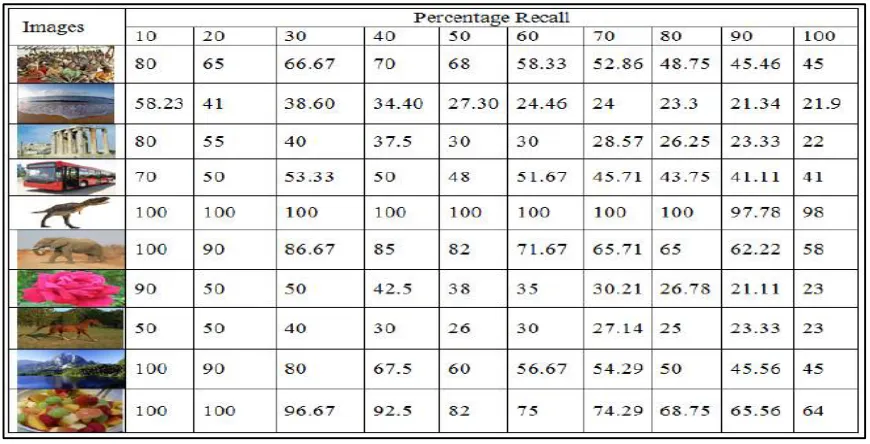
category containing 100 images. The average precision is obtained for each category at each level of recall. Table I shows the average precision for 10 categories of images from the Corel Dataset at different recalls.
Table I: Average Precision for 10 categories of Images from Corel Database at different Recall
Query as Unknown Image
The proposed system was tested for the images which were not used to build the proposed system. Table II shows the precision for unknown images at different recalls. Categories of these unknown images are same as that of images present in Corel dataset.
Precision for top 100 retrieval
Each image in each category is once used as query image and top 100 images were retrieved each time. Average precision was calculated based on this experiment. Table III gives average precision for each category.
Table III: Top 100 average precision over 10 categories
Category Precision Category Precision
African 70.53 Elephant 49.56 Beach 50.28 Rose 58.89 Architectures 43.49 Horse 79.64 Bus 61.37 Mountains 56.47 Dinosaurs 99.49 Food 66.95
VI.CONCLUSION AND FUTURE WORK
Content based image retrieval is a challenging method of capturing relevant images from a large storage space. In the proposed work, content based image retrieval system is projected to overcome the problem of previous approaches. CBIR is developed using image classification approach Bag-of-Features(BoF), feature coding method i.e. Super Vector Coding(SVC) and Scale Invariant Feature Transform(SIFT). Super vector coding consists of three methods viz. descriptor coding, spatial pooling and image classification. Linear classifier SVM used for image classification. Feature extraction is done using SIFT, which extracts 128 dimensional features invariant to translation, rotation and orientation.The proposed system demonstrates the application of super vector coding with SIFT as feature extraction method.
From Table I, it is observed that average precision for certain categories such as dinosaurs, rose and horse is significantly improved. Overall performance of proposed system is also better compared with existing CBIR systems. It also can be observed from Table II that in some cases the proposed system gives better results for the query image from unknown dataset compared to the images from same category in Corel dataset.
From Table III, it can be observed that average precision for top 100 retrieval is better for the image categories like dinosaurs and horse.
Though theproposed system gives better performance, there is still a scope to enhancethe retrieval accuracy by performing clustering on SIFT feature descriptors for eachimage to produce large number of clusters so as to have proper representation for eachimage present in database.Also, the applicability of the proposed system can be analyzed for image database containinglarge number images with large number of categories.
VII. ACKNOWLEDGEMENT
I would like to express my special thanks to all those people who have helped me to complete this work. I am very grateful to my principal, Prof. Mrs. V. R. Khapli, Principal, K.K.Wagh Women’s Polytechnic, Nashikfor her guidance, encouragement and the interest shown in this project.She has continuously helped and encouragned me in my work.
REFERENCES
1. Yongzhen Huang, Liang Wang and Tieniu Tan,” Feature coding in Image Classificaion: A comprehensive study”,IEEE Transactions on
imageprocessing.
2. Sarita Sharma, Avinash Dhole,” Content Based Image Retrieval Based on Shape Feature using Accurate Legendre Moments and Support
Vector Machines”, IJCSET, ISSN:2231-0711, May 2013 , Volume 3, Issue 5,194-199.
3. Sonali Jain, Satyam Shrivastava, “A novel approach for image classification in Content based image retrieval using support vector
machine”,IJCSET, ISSN: 2229-3345, Vol. 4 No. 03 Mar 2013.
4. Paulo M. Ferreira, Mario A.T. Figueiredo and Pedro M. Q. Aguiar,”Content-Based Image Classification: A Non-Parametric Approach”
5. Lipton, R. Jain, Satyam Shrivastava,”A novel approach for image classification in Content based image retrieval using support vector machine”
6. Collins, T. Kanade, H. Fujuyoshi, Y. Tsin, D. Tolliver, N.Enomoto, and O. Hasegawa, D. Duggins,”A system for video surveillanceand
monitoring, technical report”: CMU-RI-TR-00-12, PA, 2000, Pittsburgh.
7. A. Lipton, R. Collins, T. Kanade, H. Fujuyoshi, Y. Tsin, D. Tolliver, N.Enomoto, and O. Hasegawa, D. Duggins, “A system for video
8. A. K. Jain, A. Vailaya, M. A. T. Figueiredo, and H. J. Zhang, “Image classification for content-based indexing”, IEEE Transactions on Image Processing, vol. 10, no. 1, pp. 117130, 2001.
9. R. Sharma, V. I. Pavlovic, and T. S. Huang, “Visual interpretation of hand gestures for human-computer interaction: A review”, IEEE
Transactions on Pattern Analysis and Machine Intelligence, vol. 19, pp. 677 695, 1997.
10. A. Ross, A. K. Jain and S. Prabhakar, “An introduction to biometric recognition”, IEEE Transactions on Circuits and Systems for Video Technology, vol. 14, no. 1, pp. 420, 2004.
11. C. Bray, C. Dance, G. Csurka and L. Fan, “Visual categorization with bags of keypoints”, ECCV, 2004.
12. T. Joachims, “Text categorization with support vector machines: Learning with many relevant features”, ECML, 1998.
13. J. Geusebroek, C. Veenman, J. Gemert and A. Smeulders, “Kernel codebooks for scene categorization”, ECCV, 2008.
14. C. Dance and F. Perronnin, “Fisher kernels on visual vocabularies for image categorization”, CVPR, 2007.
15. J. Sanchez, F. Perronnin and T. Mensink, “Improving the Fisher kernel for large-scale image classification”, ECCV, 2010.
16. K. Yu, Y. Gong, J. Yang and T. Huang, “Linear spatial pyramid matching using sparse coding for image classification”, CVPR, 2009.
17. T. Wang, K. Yu and Y. Gong, “Nonlinear learning using local coordinate coding”, NIPS, 2009.
18. J. Yang, K. Yu, J. Wang, F. Lv, T. Huang and Y. Gong, “Localityconstrained linear coding for image classification”, CVPR, 2010.
19. T. Zhang and K. Yu, ‘Improved local coordinate coding using local tangents’, ICML, 2010.
20. Kanchan Singh, Ashok K. Sinha, NidhiSingh, “A Novel Approach for Content Based Image Retrieval”, Procedia Technology 4, C3IT-2012.
21. K. Huang, Y. Yu, Y. Huang and T. Tan, “Salient coding for image classification”, CVPR, 2011.
22. Y. Huang, L. Wang, Z. Wu and T. Tan, “Group encoding of local features in image classification”, ICPR, 2012.
23. K. Yu, X. Zhou, T. Zhang and T. Huang, “Image classification using super-vector coding of local image descriptors”, ECCV, 2010.
24. J. Ponce, Y. Boureau and Y. LeCun, “A theoretical analysis of feature pooling in visual recognition”, ICML, 2010.
25. F. Bach, Y. LeCun, Y. Boureau and J. Ponce, “Learning mid-levelfeatures for recognition”, CVPR, 2010.
BIOGRAPHY
Prof.Mrs. VidyaR. Khapliis BE (Electronics and Power), (1985), from College of Engg, Amravati, M.S. India and M.Tech (Electronics) from VNIT, Nagpur, M.S. India, in 1996. She is in field of education from last 28 years. Currently she is Principal at K K Wagh Women’s Polytechnic, Nashik, MS, India. She is a research scholar pursuing for Ph.D. at Govt. Engineering. College Aurangabad, M.S., India. Her areas of interest are Image Processing, Digital Signal Processing, Parallel Computing and Basic Electronics. Her research area is Content Based Image Retrieval. She has submitted the Ph.D. thesis in June 2015.