ABSTRACT
BING, JADA QUINOME. Distance Education Teaching Methods and Student Responses in the Animal Sciences. (Under the direction of Shannon Pratt-Phillips and Charlotte Farin).
Distance Education Teaching Methods and Student Responses in the Animal Sciences
by
Jada Quinome Bing
A dissertation submitted to the Graduate Faculty of North Carolina State University
in partial fulfillment of the requirements for the degree of
Doctor of Philosophy
Animal Science & Poultry Science
Raleigh, North Carolina 2012
APPROVED BY:
_______________________________ ______________________________
Shannon Pratt-Phillips Charlotte E. Farin
Committee Chair Committee Co-Chair
________________________________ ________________________________
DEDICATION
BIOGRAPHY
Jada was born in the Bronx, New York. She attended Westchester Community College in Valhalla, New York and received her Associate’s degree in Math/Science. Jada continued her education at Delaware State University in Dover, Delaware and received her Bachelor’s degree in Pre-Veterinary Medicine with the plans on attending Vet school. By the end of her academic stint, Jada decided to change her career goals and not attend Vet school. Instead, she went for a Master’s degree in Animal and Poultry Science at Tuskegee University in Tuskegee, Alabama. It was at Tuskegee University that Jada realized that she wanted to pursue a career in teaching. She then enrolled in the PhD program in the Department of Animal Sciences at North Carolina State University.
ACKNOWLEDGMENTS
I want to thank my advisors and committee members for all their advice and guidance. Thank you for your kindness and time to help me with my research and answer questions even with your busy schedules.
To Dr. Shannon Pratt-Phillips: thank you so much for the opportunity to assist you with the Distance Education course for ANS 205/206- Anatomy and Physiology of the Domestic Animals. Your guidance and assurance has helped me to realize that I can accomplish more than I thought.
To Dr. Charlotte Farin: thank you for seeing the potential in me and
encouraging me to continue with my degree when I wanted to give up. I know there were rough times but your words of encouragement helped me get through many hurdles.
To Dr. Scott Whisnant: thank you for helping me with the cortisol study and being available to help me with any part of my research.
To Dr. Koralalage “Jay” Jayaratne: thank you for assisting me with all the surveys needed in my research. Your expertise in making sure they were in compliance with IRB was greatly appreciated.
To Dr. Consuela Arellano: thank you for helping me to understand which statistics I should use and why. Your availability was endless.
To the graduate students in the Department of Animal Sciences: thank you for the opportunity to assist with your projects and opening my eyes to the research side of science. I also thank you for the late night conversations, writing sessions and just being there for me; your friendships mean the world to me.
To the Farin, Pratt-Phillips and Whisnant labs: thank you for allowing me to be a part of your teams and opening your labs to me.
TABLE OF CONTENTS
LIST OF TABLES ... viii
LIST OF FIGURES ... ix
CHAPTER 1: LITERATURE REVIEW ...1
Introduction ...1
Part I: Distance education teaching methods ...2
Distance Education ...3
Teaching aspects of Distance Education...6
Student aspects to Distance Education ...7
Distance Education in Anatomy and Physiology...9
Supplemental Online Resources ...14
Part II: Student Responses ...21
Hypothalamic-Pituitary-Adrenal Axis and its response to stress ...22
Cortisol ...24
Salivary cortisol as a method for stress assessment ...24
Statement of the Problem ...29
Literature Cited ...31
CHAPTER 2: UNDERGRADUTE PERFORMANCE IN A DOMESTIC ANIMAL LABORATORY TAUGHT VIA DISTANCE EDUCATION...36
Abstract ...37
Introduction ...38
Materials and Methods ...39
Results and Discussion ...42
Literature Cited ...48
Tables and Figures ...49
CHAPTER 3: EFFECT OF SUPPLEMENTAL ONLINE RESOURCES IN DISTANCE EDUCATION FORMAT ON UNDERGRADUATE ANIMAL SCIENCE LABORATORY INSTRUCTION ...51
Introduction ...53
Materials and Methods ...54
Results and Discussion ...59
Summary ...64
Literature Cited ...65
Tables and Figures ...67
CHAPTER 4: UNDERGRADUATE STUDENT CORTISOL CONCENTRATIONS AND PIGLET CORTISOL CONCENTRATIONS DURING BLOOD DRAWING PROCEDURES ...71
Abstract ...72
Introduction ...73
Materials and Methods ...74
Results and Discussion ...77
Literature Cited ...83
Tables and Figures ...85
LIST OF TABLES
Table 2.1. Method of presentation for laboratory lessons in fall 2008 and spring 2009
...49
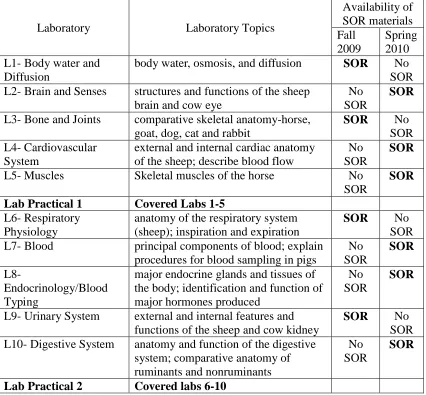
Table 3.1. Availability of SOR materials for laboratory lessons in fall 2009 and spring 2010...67
Table 3.2. Pearson Correlation Constant values (r) for relationship between Lab Practical exam scores with sessions opened, files viewed, and time spent for Fall 2009 and Spring 2010...68
Table 4.1. Pre-study survey responses (out of 61 students)...85
Table 4.2. Post-study survey responses (out of 61 students) ...86
LIST OF FIGURES
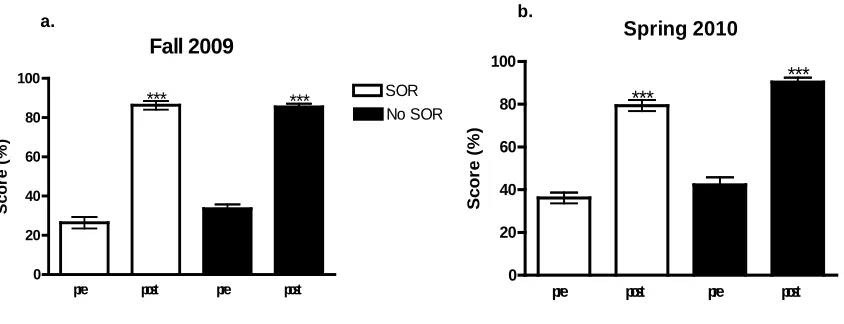
Figure 2.1. Effect of method of materials presentation on (a) Lab Practical Exam 1 and (b) Lab Practical Exam 2 for Fall 2008 and Spring 2009. ...50 Figure 3.1. Effect of presentation material on pre- and post-test scores. SOR:
Introduction
As technology changes, so must the way teaching is accomplished.
Part I
In four-year colleges and universities, one out of every four students drops out during their first year (Braxton et al., 2007-2008). Unfortunately, the reasons students drop out are unknown in many institutions. High student drop-out rates cause retention and enrollment numbers to decrease. A major challenge with science programs in four-year colleges and universities is maintaining enrollment and retention (Allen, 1983). Jesse and Ellersieck (2009) conducted a study where one of their objectives was to determine why students change their major or fail to complete their BS degree in the Animal Sciences and found that over a quarter of the students reported that the curriculum was not flexible enough and students were not offered more than one option of learning in areas of interest. This is relevant because programs such as Animal Science need to meet the needs of a changing student population (Barnes et al., 1999). Student backgrounds are more diversified and this creates a challenge to retain them in academic programs such as Animal Science (Allen, 1983).
Distance education teaching methods
re-evaluate their teaching methods since more incoming students are increasingly computer savvy and technology oriented (Allen, 1983; Barnes et al., 1999).
Encouraging the use of computers in animal agriculture and their incorporation in into academic curriculums (Allen, 1983) is an important goal for departments because this
resource will increase information retention (Barnes et al., 1999) and an opportunity to include classes where there is no internal expertise (Buchanan, 2008). Being computer savvy is critical because students will expect this resource to be used in their educational experience (Buchanan, 2008).
Distance Education
The use of the internet for educational purposes began over thirty years ago, starting with large mainframe computers in the 1960s and moving to personal computers in the 1990s, with the numbers of personal computers using the internet growing more than 30% in the last twenty years (Pallen, 1995; Lowe et al., 1996; Johnson, 1999). Student access to information technology and the internet has become available in homes, schools, and libraries since the 1990s (Lim et al., 2008). Fifty-one percent of American households had one or more computers in 2000 and 42% of the households had at least one member who used the internet (U.S. Bureau of Census, 2001). By 2009, 69% had a computer in the home with internet access (U.S. Bureau of Census, 2011).
times, may come together in person. This contemporary teaching method combines the visual, textual, and audio information used in educational settings in such a way that students find it easily accessible and convenient (Johnson, 1999). The simplest form of Distance Education is a course that consists entirely of written communication (Allen et al., 2002). Some Distance Education courses are managed using audio, video, or other means of
broadcasting, with written communication incorporated into the course (Allen et al., 2002). The use of educational technology at university and college campuses has grown and changed substantially in the last 15 years (Weston, 2005). In the USA during the 2000-2001 academic years, 56% of all two-year and four-year degree-granting institutions reported offering distance education courses with an additional 12% planning to implement distance education courses within the next three years (Banks and Faul, 2007). In 2007, 3.94 million students had taken at least one online course, 80% of which are studying at the undergraduate level (Allen & Seaman, 2008).
Using Distance Education as a method of teaching is requiring many universities and colleges, as well as researchers, to re-evaluate how learning materials are presented and if the learning experience is still deemed valuable. Besser and Bonn (1996) described the motives behind the movement to distance education learning. Some of the motives included
promoting higher quality education that is economical and designed to fit an individual’s needs as well as schedule; pressure to become involved in distance education so that enrollment may increase, resulting in more tuition money; and conserving financial
course or program offered. A problem with this approach is that research is needed to determine if material currently being taught in person can be successfully transformed into Distance Education format. Distance education researchers agree that the key to effective distance education learning is to make it highly interactive (Johnson, 1999). Distance education learning should be approached with clear purposes, focused outcomes and objectives and include both problem-based and knowledge-based learning (The American Distance Education Consortium, 2000). Students must be able to gain knowledge as well as apply that knowledge to everyday situations. While textbooks will never cease to exist, universities are gradually publishing educational information on the Internet for student use (Johnson, 1999). Internet-published information can be easily updated and done so at a reasonable cost.
information. Similarly, there may be a greater use of adjunct faculty in addition to using graduate students to minimize costs (Besser & Bonn, 1996).
Distance Education will also have an impact on the student. Besser and Bonn (1996) note that if a student is taught primarily through distance education, they miss out on building relationships among themselves as well as building relationships with faculty that can prove to be beneficial to them in the long run. However, Handelsman et al (2004) observed that students who had online courses showed better problem-solving skills and a better
understanding of concepts than students who had traditional lecture formats. Allen et al (2002) conducted a meta-analysis of 25 colleges and universities who compared student satisfaction with a distance education course to a course using traditional face-to-face methods and the authors concluded based on their results, that distance education does not devalue the level of student satisfaction when compared to traditional face-to-face methods of instruction.
Teaching aspects of Distance Education
some faculty members who are apprehensive to apply technology to their curriculums because they have vague conceptions of its benefits and believe the technology needs to be clearly defined and easy to understand in order to be used (Weston, 2005).
The effectiveness of integrating a dissection software package entitled, the Visible Human Dissector (VHD), into undergraduate anatomy classes in Colorado was assessed by Weston (2005). In his study, 13 instructors from 10 institutions participated and used the VHD application to present lecture material with a computer projector or present
demonstrations and asked questions about images to smaller groups with a personal or laptop computer. Students were also able to use the software in computer labs or at home. Overall, instructors were motivated to use the software because they felt it was a substitute for other more limited educational resources such as cadavers. Furthermore, the instructors were generally comfortable using technology. The VHD software allowed students to access simulated cadaver structures free of time restrictions. It was also used for quizzing students on the structures, providing a means for students to learn the anatomy lessons in a different learning environment. Instructors recognized that the VHD software benefited as a plausible learning tool for students and overall, the use of technology in an educational setting has the potential to alter how teaching and learning occurs at universities and colleges.
acknowledge responsibility for their own learning process (Aly et al., 2003). Lim et al (2008) investigated the effects of three different methods of instructional delivery on student achievement and satisfaction during a wellness course at a Midwestern university. One hundred fifty-three undergraduate students registered into one of three modes of instructional delivery based on their preference and were divided into three groups: online learning group, traditional learning group, and combined online and traditional learning group. The online learning group (n=31) received only online education with no face-to-face instruction between instructor and students and no interactions amongst the students. The traditional learning group (n=82) was taught on campus using a traditional face-to-face method. The combined online and traditional learning group (n=40) was taught on campus with a
combination of online instruction and traditional face-to-face instruction. Regardless of the learning groups, most students indicated that they would like to see an online option when enrolling in the course in the future. Students in both the online and combined learning groups showed significantly higher achievement on exam scores compared to the traditional learning group. However, there was no significant difference in student achievement on exams between the online and combined learning groups. Students in the online learning and combined learning group stated that their particular section of the course helped them to increase their computer and internet skills. The findings in this study suggest that a well-designed online course can be effective in teaching a wellness course; however, it is
Aly et al (2003) conducted a study to develop and evaluate an interactive multimedia courseware package in orthodontics, which would provide dental undergraduate and
postgraduate students with an interactive means of self-study and self-evaluation. The courseware package was presented for evaluation through a questionnaire to four groups of students. The first three groups consisted of third, fourth, and fifth year undergraduate students, respectively. The fourth group consisted of postgraduate students. There were 25 students in each group and each group was given all the time they needed to go through the package at their own speed. The authors reported that while the multimedia courseware package was generally liked by both the undergraduate and postgraduate students as a
teaching method, the fifth year undergraduate students and postgraduate students appreciated the multimedia courseware package more so than the third and fourth year undergraduate students. This difference in preference was attributed to differences in experience and amount of educational background of the third and fourth year students compared to the fifth year and postgraduate students. The more senior students were likely more familiar with unconventional educational teaching methods. The authors argued that third and fourth year undergraduates likely were less experienced and exhibited less confidence confronted by unfamiliar multimedia programs.
Distance Education in Anatomy and Physiology
few areas of science where medical disciplines are introduced and habits are formed (Rizzolo and Stewart, 2006). However, anatomy courses are also seen as time consuming, labor-intensive, and costly (Rizzolo and Stewart, 2006) for students as well as instructors. Also, the proportion of time spent in anatomy laboratories may be decreasing but the costs of operating an anatomy laboratory increases, creating a mismatch between costs and benefits (McLachlan et al., 2004). Currently, there are fewer and fewer qualified instructors available to teach anatomy (Josephson & Moore, 2006). Trained anatomists are considered a
diminishing pool and have expressed concern about who will be their future replacements (McLachlan et al., 2004). With the increase of financial expenses to keep an anatomy laboratory functioning, it has been suggested that distance education be considered an alternative to traditional teaching formats (McLachlan et al., 2004).
distance education formats may miss out on peer learning opportunities. Theoret et al (2007) discovered that self-directed learning and peer-facilitated learning are important benefits that are derived from performing traditional cadaver dissection. Students can benefit from technology being incorporated into the curriculum but questions remain as to whether use of technology in teaching is helpful. There is greater motivation for a student to come to the anatomy lab to dissect then to simply sit and watch a video or work at a computer station. Also, according to Theoret et al (2007), the major difference between video and live
dissection is that the video camera shows a rigid point of view, whereas a student watching a live dissection can gather information by viewing all aspects of the dissection. Although Theoret et al (2007) suggested that traditional dissections should remain a part of the anatomy course, it was also noted that students can still benefit from using the computer-based materials.
watching and interacting with the simulations than students who had the live-animal laboratory, but this did not affect their performance on the tests. The effect of using the DVD under the conditions of the study showed there was no difference found within test performances between groups. Although student exam performance did not differ significantly between the DVD group and the No DVD groups, the levels of confidence seemed greater for students in the DVD group (80%) compared to the No DVD group (31%). Improved student confidence could arise from the fact that students using the DVD had the opportunity to repeatedly view and listen to the material about the structures that were identified on both the cadavers used and the video. In addition, student in the DVD groups were more consistent in their dissections compared to the No DVD groups. For example, a dissection of one of the No DVD groups made it impossible to see internal structures that lay beneath the skin. The data suggest that the impact of the DVD use helped students make more accurate dissections and become more confident about their answers on the exam. However, the authors also propose that using the DVD over an extended period of time may lead to less time being spent in the laboratory and prevent the students from understanding the material in depth. Therefore, it is suggested that more time be invested into expanding the usefulness of the DVD method.
Buzzell et al (2002) found that learning the material via the web-based tutorials was determined to be equally enjoyable for the tutorials only group as learning via either of the other two methods. This observation demonstrates that the web-based tutorials can be just as effective as the lecture-based format for teaching some types of course content. The authors suggested that academic institutions should take the time to develop web-based tutorials and further suggested that long term benefits will arise from a cost efficiency standpoint.
the content offered may have performed better on the quizzes than those who did not pay as much attention to the course content. The results of the study indicated that web-based courses for undergraduate students can be successfully implemented in a medical school curriculum. Students appeared to be supportive of the web-based course in that they rated it as efficient. However, they also indicated that overall, they would have preferred the course to be presented in a hybrid (traditional plus online) fashion. The students preferred to have access to the whole course content at the beginning of the course and were very interested in having access to the web material even after the course had ended. Bernardo et al (2004) pointed out several positive and negative aspects to having a web-based course. On the positive side, students had permanent access to the online material, the ability to print the material on an as needed basis, immediate feedback on their lessons/quizzes and the freedom of scheduling their time. On the negative side, students had to cope with technical
difficulties throughout the course, difficulty reading the material from a computer screen as well as adapting to the web-based technology and had trouble dealing with the lack of
communication with professors. The authors indicated that a lot of the negative points would have been reduced if the course was presented in hybrid format, where instructors and
students can come together and discuss the material that was presented online. Supplemental Online Resources
2001). These types of programs and materials have been referred to as computer-assisted learning (Holt et al., 2001), computer assisted instruction (Schittek et al., 2001), web-based materials (Granger et al., 2006) or supplemental online resources (SOR). They are tools that provide learners with interactive and individualized instruction as well as provide ways to present the material in a manner preferred by the user (Al-Rawi et al., 2007). The use of SOR can be used to enhance the learning opportunities for topics that may not be taught or expressed as well with traditional methods (Schittek et al., 2001). SOR may also enhance student learning by allowing students to learn at their own pace as well as permit additional interactions between the student and the subject content or learning material (Schittek et al., 2001).
the course with their previous experience of being taught through the traditional lectures. There was no significant difference in the examination scores between the two student groups. Students in both the traditional format and computer-assisted learning groups showed improved scores after completing the course. Students in the computer-assisted learning group found use of this technology to be efficient and easy to run. Many of the students stated that the most beneficial part of the program was its flexibility. The majority of the students indicated that the computer program should be used as an addition to the traditional lectures even though they found it to be easy to use, efficient and acceptable.
component to the course. While the group who had sole access to the computer-aided learning package scored significantly better than the group who learned through the
traditional lecture-style tutorial, the majority of students expressed that they did not want to see the computer-aided learning package replace existing course teaching tools. It was stated that making the computer-aided learning package a required part of the course may result in a loss of its appeal and students would become less interested in it over time. Regarding the use of the learning package as a supplemental component, students felt they were able to work and learn in a stress-free environment at their own pace without fear of repercussion. The students also communicated that the computer-aided learning package was a good way to assess their ability to learn the material and also allowed them to review their areas of weakness. The results of the study have shown that computer programs can be used as effective teaching tools but the authors believe challenges lies in persuading other instructors that using computer-based learning systems will have educational value and will be a
successful educational resource.
demonstration, stopping throughout the laboratory activity to engage in question and answer interactions. The computer software simulation was a prerecorded demonstration of
cardiovascular physiology using heart models and offered during the scheduled laboratory period. The software was intended to complement, rather than replace, the traditional lecture format used to teach the course. When asked to choose between the two labs if only one could be offered, 34% of students selected the animal demonstrations whereas 66% students chose the computer lab. Many students indicated that the computer demonstration was straightforward because it allowed the students to focus on one question at a time. The students also pointed out that the animal demonstration appeared to more advance because the pace of the demonstration was set and they could not review the demonstration
repeatedly. The combination of animal laboratories and computer simulations was regarded by the authors as highly effective teaching tools and they anticipate continued use and approval of this combination by the students.
Having the flexibility to utilize computer-assisted learning (CAL) is deemed important within an academic setting, especially for those students who enroll in part-time study due to other obligations (Lewis, 2003). CAL is also seen as an effective supplement to conventional teaching methods, particularly in subjects such as anatomy and physiology (Lewis, 2003). A brief survey was conducted by Lewis (2003) to examine previously
published studies that were performed to evaluate the utility of CAL in teaching anatomy and physiology within subject areas allied with medicine. Ten studies met the following survey criteria: comparing the efficacy of CAL to some other form of teaching, either as a
students; and using CAL in anatomy and physiology education. Lewis (2003) reported based on his meta-analysis of the data that there was an improvement in student performance after using CAL tools compared to more traditional methods of learning. In general, survey responses were positive, which further supports the use of CAL for teaching anatomy and physiology. The author viewed CAL as a tool that, if well designed, is useful for both the student and teacher to facilitate the learning process. It was also suggested that the most likely application of CAL will be as a complement to existing traditional courses, where it can provide students with additional resources to help retain information learned especially in the subjects related to medicine.
supplemental teaching aid for dissections will soon be an ordinary development in the field of anatomy in the 21st century (Reeves et al., 2004).
In order to be effective and efficient enough to teach anatomy, online programs need to show accurate and thorough evaluation methods (Granger et al., 2006). Granger et al (2006) created an online interactive anatomy program to enhance dissection experiences, observational learning, and three dimensional anatomical comprehensions. This program was evaluated by first-year medical students at three institutions as well as by an advisory board composed of faculty from the three institutions. The computer program was designed to help prepare students improve their dissection technique; understand the
structures and functions well enough to repeat on an exam and to utilize laboratory time in a more efficient manner. The authors demonstrated that the web-based program had a positive impact on the laboratories, met the course objectives and allowed the instructors to focus more on the anatomy and less on the performance. The dissection videos were recorded with narration and contained a series of 2-4 minute series of various body regions. Each
dissection step was linked to a resource page that was relevant to the particular dissection. Students completed pre-use surveys at the beginning of their anatomy course and post-use surveys at the completion of the anatomy course. Instructors who taught the course
prepare for laboratory lessons and examinations. The faculty on the advisory board indicated on the survey that the program improved both students’ and instructors’ use of time in
dissection and their overall learning experience. Based on the post-use surveys, the authors concluded that a comprehensive online program is a useful teaching tool and can
significantly improve the quality and efficiency of human anatomy instruction.
Advancement in instructional technology may provide a reasonable, cost-effective alternative to teaching (Buzzell et al., 2002). Computer use has increased student knowledge and can be as effective as traditional teaching (Devitt & Palmer, 1998). The use of online education can provide students with a range of sources and increase their
opportunities to improve the skills and knowledge to succeed in their academic career (Lim et al., 2008). Supplemental online resources provide additional information that students can use at their own pace (Lewis, 2003).
For students majoring in medical, dental or veterinary curriculums, anatomy and physiology can be one of the most stressful subjects to enroll in (Takatsuji et al., 2008). Stowell (2003) states that the term “academic stress” should be used to cover not only examinations but other related stress factors such as completing homework assignments, participating in presentations and/or demonstrations, and scheduling classes. The
consequence of failing the tests and examinations taken in anatomy and physiology courses has the potential to cause student stress because a failing grade will have an impact on their academic success (Takatsuji et al., 2008). A student’s academic achievement may be
affected by two types of stress: ‘favorable stresses’, which may be used to help learning and performance improvement; and ‘unfavorable stresses’, where situations presented may come with overwhelming consequences (Saipanish, 2003). Depending on the individual’s coping skills, too much stress can cause physical and mental health problems (Saipanish, 2003).
Hormones known as glucocorticoids are needed to cope with the body’s reaction to mental and/or physical stresses (de Kloet et al., 1999). Cortisol is a glucocorticoid that is a key regulator of stress responses (Ng et al., 2003). The measurement of cortisol
concentrations has proven to be a reliable tool in determining which physical and mental stressors affect the body and activate the release of cortisol, resulting in cortisol
concentrations rising above a resting baseline (normal levels) (Harris et al., 2007). The method in which cortisol concentrations are determined vary among species but salivary cortisol measurements have been noted as more accurate because there is a short delay
between the time of production and the time cortisol is detectable in the saliva (Scholey et al., 2009; Strazdins et al., 2005; Ng et al., 2003).
Hypothalamic-Pituitary-Adrenal Axis and its response to stress
portal system (Marieb, 2005). Blood from a capillary network in the hypothalamus flows through vessels to the anterior portion of the pituitary gland and enters a second capillary system. Hormones released from the hypothalamus travel through this portal system to reach cells of the anterior pituitary (Frandson et al., 2003).
The pituitary gland has two functional lobes; the anterior pituitary and the posterior pituitary. These lobes provide direct delivery of stimulatory and inhibitory hormones from the hypothalamus into the bloodstream (Marieb, 2005). While the anterior pituitary contains hormone producing cell bodies and secretes its hormones into capillary beds, the posterior pituitary contains axons from neural cell bodies of the hypothalamus (Marieb, 2005;
Frandson et al., 2003). Hormones are transported from the hypothalamus through the axons to the posterior pituitary and released directly into blood vessels going to their target cells (Frandson et al., 2003).
The adrenal glands are two bean-shaped organs found immediately above the kidneys that are comprised of glandular and neural tissue (Marieb, 2005). The glandular tissue, known as the adrenal cortex, produces three major groups of steroid hormones:
mineralocorticoids, glucocorticoids and sex hormones (Marieb, 2005). When human beings or animals encounter stress, the HPA axis is activated and it releases glucocorticoids from the adrenal cortex into the blood and helps to increase the individual’s ability to cope with the particular stress effector (Marieb, 2005; Bollini et al., 2004; Korte, 2001; de Kloet et al., 1999). The secretion of glucocorticoids is regulated by adrenocorticotropic hormone
Cortisol is a major glucocorticoid produced as a result of adrenalcortical activity (Ng et al., 2003). Like other steroids hormones, cortisol is lipophilic so it is able to diffuse quickly through cellular membranes (Scholey et al., 2009). Cortisol has long been an important hormone used to measure stress response (Harris et al., 2007). Cortisol follows a circadian rhythm and is usually found in high concentrations in blood in the early morning hours with decreasing concentrations throughout the day (Harris et al., 2007; Scholey et al., 2009). More than 90% of circulating cortisol is bound to corticoid-binding globulin (CBG) with the remaining 10% circulating freely. Only the freely circulating hormone is
biologically active (Wedekind et al., 2000). The binding of CBG increases to saturation when the body is subjected to a long-term stressor, resulting in a reduction of free cortisol secretion (Wedekind et al., 2000). This leads to inaccurate measurements of total cortisol concentrations in blood because the biologically active fraction is not reflected in CBG saturation (Wedekind et al., 2000). Salivary cortisol concentrations have been used to exhibit the biologically active unbound cortisol concentrations (Scholey et al., 2009; Wedekind et al., 2000). Cortisol enters saliva by intracellular diffusion and its concentration can reliably estimate serum cortisol concentrations (Scholey et al., 2009; Lindfors & Lundberg, 2002; Wedekind et al., 2000; Blackshaw & Blackshaw, 1989; Bonnin et al., 1993).
Cortisol
Salivary cortisol as a method for stress assessment
cortisol being at lower concentrations than blood cortisol and usually following the same time course as blood cortisol in humans (Ng et al., 2003; Lindfors & Lundberg, 2002; Strazdins et al., 2005). As noted above, cortisol enters saliva by intracellular diffusion and its concentration is unaffected by salivary flow rate. Because increased cortisol
concentrations are associated with increased stress, salivary cortisol concentrations can be used as a physiological marker of stress (Scholey et al., 2009). There are several advantages of using salivary cortisol concentrations over serum concentrations of cortisol to monitor the stress response: (1) it is a stress-free and noninvasive method of collection, (2) simple collection of saliva allows multiple sampling for monitoring changes in adrenal activity and (3) saliva is easier to collect than urine or blood and can be used to measure biochemical and immunological markers (Bonnin et al., 1993; Strazdins et al., 2005).
Strazdins and colleagues (2005) investigated whether specific methods of data collection have an impact on the measurements of salivary cortisol and secretory
terms of comfort, ease, pleasantness and willingness to participate. Sixteen participants provided saliva samples using each method, in rotation, used in study one and were asked to rate each collection for the comfort level, pleasantness, ease of taking sample as well as willingness to participate in a study. Results from study one indicated that salivettes
provided significantly lower values for cortisol compared to passive and eyespear collection, suggesting that the salivettes showed greater interference in collection than the other methods of collection. In study two, participants indicated that there was no difference in their
perception of collection methods and the methods would unlikely affect their willingness to volunteer for a study.
difficult exam questions, feelings or beliefs regarding mastery in the subject as well as relative importance of the exam.
A study conducted by Takatsuji et al. (2008) determined the effect of examinations on salivary cortisol, IgA and CgA in nursing students. Fifteen female fourth-year nursing
students completed a one hour, 100 multiple-choice anatomy and physiology examination. Saliva samples were collected by placing a cotton wad under the tongue for 1 minute and samples were taken 10 minutes before the exam, immediately after the exam and two hours after finishing the examination. The results revealed that while the stress of taking the examination increased IgA and CgA concentrations, it did not affect the concentration of salivary cortisol. The authors of this study suggested that salivary cortisol, in this case, may not be sensitive to the examination stressor.
Studies have shown that chewing may have anti-stress properties and that the chewing of gum or paraffin wax may reduce cortisol concentrations when a stressor is introduced to the subject (Scholey et al., 2009; Tahara et al., 2007). The goals of Scholey et al (2009) study were to prove that chewing gum would reduce self-rated stress, result in reduced cortisol concentrations and improve task performance. Forty young adults
throughout the 20 minute protocol and had mandatory 20 minute rest periods between the 4 protocols. This was repeated for the next level of stress intensity, both while chewing and not chewing. Results from this study showed that cortisol concentrations fell during both levels of stress intensities. It was suggested that chewing was associated with significantly better alertness and reduced stress and anxiety.
Tahara et al (2007) investigated the effects of chewing and clenching on relaxation under stress by measuring salivary cortisol concentrations. Seventeen males participated in the two-part study. The males were asked to provide a saliva sample and rest for 30 minutes to become more comfortable with the experiment. Next, they were given a series of
A limited number of studies have investigated the effectiveness of DistEd anatomy courses to train veterinary students (Theoret, et al., 2007); however, none have examined the effectiveness of teaching animal anatomy to undergraduate students using a DistEd format. The use of SOR may enhance the learning opportunities for topics that may not be taught or expressed as well with traditional methods (Schittek et al., 2001). SOR may also enhance student learning, by allowing students to learn at their own pace, as well as permit interactions between the student and content or learning material (Schittek et al., 2001). There have been many studies conducted to determine the effects of stress using cortisol concentrations involving human and animal subjects (Scholey et al., 2009; Strazdins et al., 2005; Ng et al., 2003; Armario et al., 1996). However, little information is known on the relationship between cortisol concentrations when humans and animals interact.
Statement of the Problem
The overall objective of this dissertation is to observe whether or not an Anatomy & Physiology Distance Education course offered in the Animal Science Department will prove to be valuable in the learning process for students. This dissertation had three purposes:
1. To determine whether gross anatomy of animals could be taught effectively at the undergraduate level using a DistEd delivery style (the hypothesis was that students would perform similarly when evaluated based on material presented in a DistEd format compared to material presented in a F2F format)
2. To determine the effectiveness of SOR on student learning in an undergraduate domestic animal anatomy laboratory (the hypothesis was that student learning would be enhanced when SOR was available compared to learning without the availability of SOR)
3. To determine whether there was a relationship between undergraduate student cortisol levels, using a saliva collection method, and piglet cortisol levels during blood
Literature Cited
Allen, C.E. 1983. New Horizons on Animal Agriculture: Future Challenges for Animal Scientists. Journal of Animal Science, 57(2), 16-27
Allen, I.E. and J. Seaman. 2008. Staying the Course: Online Education in the United States.
Available
Allen, M., J. Bourhis, N. Burrell and E. Mabry. 2002. Comparing Student Satisfaction with Distance Education to Traditional classrooms in Higher Education: A Meta-Analysis. The American Journal of Distance Education, 16(2), 83-97
Al-Rawi, W.T., R. Jacobs, B.A. Hassan, G. Sanerink and W.C. Scarfe. 2007. Evaluation of web-based instruction for anatomical interpretation on maxillofacial cone beam computed tomography. Dentomaxillofacial Radiology, 36, 459-464
Aly, M., G. Willems, C. Carels and J. Elen. 2003. Instructional multimedia programs for self-directed learning in undergraduate and postgraduate training in orthodontics. European Journal of Dental Education, 7, 20-26
Aly, M., J. Elen and G. Williams. 2004. Instructional multimedia program versus standard lecture: a comparison of two methods for teaching the undergraduate orthodontic curriculum. European Journal of Dental Education, 8, 43-46
American Distance Education Consortium. 2000. ADEC Guiding principles for distance
teaching and learning. Available:
Armario, A., O. Marti, T. Molina, J. de Pablo and M. Valdes. 1996. Acute stress markers in humans: Response of plasma glucose, cortisol and prolactin to two examinations differing in the anxiety they provoke. Psychoneuroendocrinology, 21(1), 17-24
Banks, A.C. and A.C. Faul. 2007. Reduction of Face-to-Face Contact Hours in Foundation Research Courses: Impact on Students’ Knowledge Gained and Course Satisfaction. Social Work Education, 26(8), 780-793
Besser, H. and M. Bonn. 1996. Impact of Distance Independent Education. Journal of the American Society for Information Science, 47(11), 880-883
Blackshaw, J.K. and A.W. Blackshaw. 1989. Limitations of Salivary and Blood Cortisol Determinations in Pigs. Veterinary Research Communications, 13, 265-271
Bollini, A.M., E.F. Walker, S. Hamann and L. Kestler. 2004. The influence of perceived control and locus of control on the cortisol and subjective responses to stress. Biological Psychology, 67, 245-260
Bonnin, R., C. Villabona, A. Rivera, E. Guillen, E. Sagarra, J. Soler and M.A. Navarro. 1993. Is Salivary Cortisol a Better Index than Free Cortisol in Serum or Urine for Diagnosis of Cushing Syndrome? Clinical Chemistry, 39(6), 1353-1354
Braxton, J., E. Brier and S. Steele. 2007-2008. Shaping retention form research to practice. Journal of College Student Retention, 9(3), 377-399
Buckley, T.M. and A.F. Schatzberg. 2005. REVIEW: On the interactions of the hypothalamic-pituitary-adrenal (HPA) axis and sleep: Normal HPA axis activity and circadian rhythm, exemplary sleep disorders. Journal of Clinical Endocrinology & Metabolism, 90(5), 3106-3114
Buchanan, D.S. 2008. ASAS Centennial Paper: Animal science teaching: A century of excellence. Journal of Animal Science, 86, 3640-3646
Buzzell, P.R., V.M. Chamberlain and S.J. Pintauro. 2002. The Effectiveness of Web-based, Multimedia Tutorials for Teaching Methods of Human Body Composition Analysis.
Advances in Physiology Education, 26(1), 21-29
de Kloet, E., M.S. Oitzl and M. Joëls. 1999. Stress and cognition: are corticosteroids good or bad guys? Trends in Neuroscience, 22, 422-426
Devitt, P. and E. Palmer. 1998. Computers in Medical Education 1: Evaluation of a Problem-Oriented Learning Package. Australian and New Zealand Journal of Surgery, 68, 284-287 Frandson, R.D., Wilke, W.L., Fails, A.D. 2003. Anatomy and Physiology of Farm Animals. 6th edition. Wiley-Blackwell. ISBN: 978-0-8138-1394-3 (or 2009 7th edition)
Granger, N.A. and D. Calleson. 2007. The Impact of Alternating Dissection on Student Performance in a Medical Anatomy Course: Are Dissection Videos an Effective Substitute for Actual Dissection? Clinical Anatomy, 20, 315-321
Handelsman, J., D. Ebert-May, R. Beichner, P. Bruns, A. Chang, R. DeHaan, J. Gentile, S. Lauffer, J. Stewart, S.M. Tilghman and W.B. Wood. 2004. Scienctific teaching. Science, 304, 521-522
Harris, A., H. Ursin, R. Murison and H.R. Erikson. 2007. Coffee, stress and cortisol in nursing staff. Psychoneuroendocrinology, 32, 322-330
Holt, R.I.G., P. Miklaszewicz, I.C. Cranston, D. Russell-Jones, P.J. Rees, and P.H. Sonksen. 2001. Computer assisted learning is an effective way of teaching endocrinology. Clinical Endocrinology, 55, 537-542
Jesse, G.W. and M.R. Ellersieck. 2009. Determining graduation rate of students who initially enrolled as animal science majors at the University of Missouri during a consencutive four-year period. Journal of Animal Science, 87(11), 3825-3829
Johnson, L.A. 1999. The Internet-Approaching a ubiquitous tool for dental education. Journal of the American College of Dentists, 66(2), 16-28
Josephson, E. and L. Moore. 2006. An Electronic Instructor for Gross Anatomy Dissection. Journal of Veterinary Medical Education, 33(3), 465-473
Korte, S.M. 2001. Corticosteroids in relation to fear, anxiety and psychopathology. Neuroscience and Biobehavioral Reviews, 25(2), 117-142
Lewis, M.J. 2003. Computer-assisted learning for teaching anatomy and physiology in subjects allied to medicine. Medical Teacher, 25(2), 204-206
Lim, J., M, Kim, S.S. Chen and C.E. Ryder. 2008. An Empirical Investigation of Student Achievement and Satisfaction in Different Learning Environments. Journal of Instructional Psychology, 35(2), 113-119
Lindfors, P. and U. Lundberg. 2002. Is low cortisol release an indicator of positive health? Stress and Health, 18, 153-160
Marieb, E.N. 2005. Essentials of Human Anatomy and Physiology. 8th edition. San Francisco, CA: Benjamin Cummings
McLachlan, J.C., J. Bligh, P. Bradley and J. Searle. 2004. Teaching anatomy without cadavers. Medical Education, 38, 418-424
Moore, M. 1973. Speculations on a definition of independent study. In Proceedings of a Conference on Independent Learning. Vancouver, Canada: W.K. Kellogg Report No. 7. pp. 25-41. ERIC# ED285573
Ng, V., D. Koh, B.Y.Y. Mok, S-E Chia and L-P Lim. 2003. Salivary Biomarkers associated with Academic Assessment Stress Among Dental Undergraduates. Journal of Dental Education, 67(10), 1091-1094
Nnodim, J.O. 1988. Learning human anatomy: student preference of methods in a Nigerian medical school. Medical Education, 22, 412-417
Pallen, M. 1995. Introducing the Internet. BMJ: British Medical Journal, 311(7017), 1422-1424
Radcliffe, C. and H. Lester. 2003. Perceived stress during undergraduate medical training: a qualitative study. Medical Education, 37, 32-38
Reeves, R.E., J.E. Aschenbrenner, R.J. Wordinger, R.S. Roque and H.J. Sheedlo. 2004. Improved Dissection Efficiency in the Human Gross Anatomy Laboratory by the Integration of Computers and Modern Technology. Clinical Anatomy, 17, 337-344
Rizzolo, L.J. and W.B. Stewart. 2006. Should We Continue Teaching Anatomy by Dissection When…? The Anatomical Record (Part B: New Anat.), 295B, 215-218 Saipanish, R. 2003. Stress among medical students in a Thai medical school. Medical Teacher, 25(5), 502-506
Samsel, R.W., G.A. Schmidt, J.B. Hall, L.D.H. Wood, S.G. shroff and P.T. Schumacker. 1994. Cardiovascular Physiology teaching: Computer simulations vs. Animal
demonstrations. Advances in Physiology Education, 11(1), S36-S46
Schittek, M., N. Mattheos, H.C. Lyon, and R. Attstrom. 2001. Computer assisted learning. A review. European Journal of Dental Education, 5, 93-100
Scholey, A., C. Haskell, B. Robertson, D. Kennedy, A. Milne and M. Wetherell. 2009. Chewing gum alleviates negative mood and reduces cortisol during acute laboratory psychological stress. Physiology & Behavior, 97, 304-312
Stowell, J.R. 2003. Use and abuse of academic examinations in stress research. Psychosomatic Medicine, 65, 1055-1057
Strazdins, L., S. Meyerkort, V. Brent, R.M. D’Souza, D.H. Broom and J.M. Kyd. 2005. Impact of saliva collection methods on sIgA and cortisol assays and acceptability to participants. Journal of Immunological Methods, 307, 167-171
Tahara, Y., K. Sakurai and T. Ando. 2007. Influence of Chewing and Clenching on Salivary Cortisol Levels as an Indicator of Stress. Journal of Prosthodontics, 16(2), 129-135
Takatsuji, K., Y. Sugimoto, S. Ishizaki, Y. Ozaki, E. Matsuyama and Y. Yamaguchi. 2008. The effects of examination stress on salivary cortisol, immunoglobulin A, and chromogranin A in nursing students. Biomedical Research, 29(4), 221-224
Theoret, C., E. Carmel and S. Bernier. 2007. Why Dissection Videos should not replace Cadaver Prosections in the Gross Veterinary Anatomy Curriculum: Results from a Comparative Study. Journal of Veterinary Medical Education, 34(2), 151-156
U.S. Bureau of Census. 2001. Home Computers and Internet use in the United States: August 2000. (Current Population Reports, P23-207). Washington, DC: Author
U.S. Bureau of Census. 2011. The 2011 Statistical Abstract: Internet Access and Usage:
CHAPTER 2
Undergraduate performance in a domestic animal laboratory taught via distance education
J. Bing*, S. Pratt-Phillips*1, L.-A. Gillen†, and C.E. Farin* *Department of Animal Science
†
Distance Education & Learning Technology Applications- DELTA North Carolina State University
1
To whom correspondence should be addressed: Department of Animal Science, Polk Hall 259, Box 7621, NCSU Campus, Raleigh, NC 27695; E-mail: [email protected]
ABSTRACT: The objective of this study was to determine if laboratory modules of an undergraduate animal anatomy course offered in distance education (DistEd) format were as effective as face-to-face (F2F) format in helping students learn. Students (n=159) completed an anatomy pre-test as well as a pre-survey to assess prior DistEd experience. Alternating each week, laboratory topics were presented either as F2F or as virtual DistEd laboratories. Two laboratory examinations were administered and included material from both lab formats (DistEd and F2F). Questions from the pre-test were also included and used to generate the “post-test” scores. At the end of the semester, students completed a post-survey to determine if DistEd was a viable alternative to F2F. Student grades on each examination were
compared using an ANOVA model that included main effects of presentation method
(DistEd, F2F), semester (fall, spring) and their interaction. Learning was evaluated based on the students’ performance on pre- and post-test scores using unpaired t-tests. There was an increase (P<0.0001) in anatomy post- vs. pre-test scores for both semesters, indicative of student learning, although there was no effect of presentation method (F2F or DistEd). On exam 1, students achieved higher scores in fall 2008 (P<0.0001) on material presented via DistEd compared to that presented as F2F. However, in spring 2009 students scored higher on material presented as F2F. There was no effect of presentation method on exam 2 scores for either semester. Based on the post-survey, 79.3% of students in fall 2008 and 52% of students from spring 2009 agreed that DistEd laboratories were a viable alternative to F2F laboratories. The results of this study support the conclusion that anatomy material can be taught effectively by distance education methods.
Introduction
Computer-based courses and degree programs have become more common as an option for educating students (Barnes et al., 1999). Distance education (DistEd) may consist of teaching and learning methods that are presented mostly by printed or electronic media (Moore, 1973; Walker & Kelly, 2007; Hofmann & Miner, 2008). Using DistEd as a means of instruction has encouraged educators to re-evaluate methods of material presentation and determine if the learning experience associated with instructional methods such as DistEd are valuable (Besser and Bonn, 1996).
Many animal science programs require students to enroll in an anatomy course as part of a curriculum that will prepare them for various careers or for post-graduate education such as veterinary school. Traditionally, students have learned anatomy through teaching
laboratories utilizing preserved specimens; however, such laboratories are costly and labor intensive for faculty. Presentation through a DistEd format has been suggested as an
attractive alternative to meet the needs of the students and reduce faculty workload once the format is implemented and running smoothly (Barnes et al., 1999). However, there has been concern regarding the effectiveness of replacing ‘face-to-face’ (F2F) laboratories for
hypothesis to be tested was that students would perform similarly when evaluated based on material presented in a DistEd format compared to material presented in a F2F format.
Materials and Methods
Approval was obtained from the University’s Institutional Review Board, and all participants provided written informed consent. No identifying information was used in data analysis, and participation in data collection was entirely voluntary.
Anatomy of Domestic Animals (ANS 206) is a required course for all students in the Department of Animal Science at North Carolina State University. This laboratory-based course is offered every semester and meets once a week for two hours, with three separate laboratory sections for which the students can register. At the end of the course, students should be able to identify the major organs, bones, and muscles of the body and understand how the organs function. In each laboratory lesson, students are introduced to the gross anatomy of a major organ system, using one or more of the domestic animal species as examples for study.
students were enrolled in ANS 206, with 56 females and 20 males. Forty-six percent were freshman, 34% were sophomores and 20% were juniors and seniors.
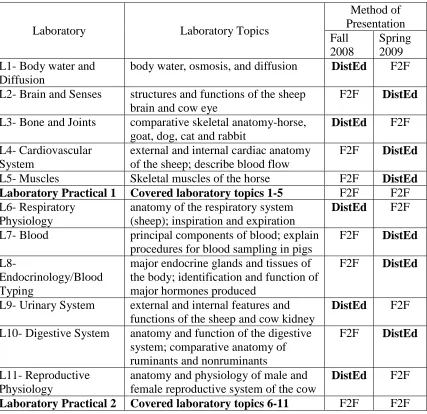
Laboratory lessons were presented either as DistEd or F2F modules. In a given semester, students participated in the same laboratory each week such that all students participated in a DistEd laboratory one week and all students participated in a F2F laboratory the next week. In order that each content topic was presented either as a F2F laboratory or through DistEd over the two semesters in which the study was conducted, the presentation style (F2F, DistEd) was switched between the fall and spring semesters. For example, if Laboratory 1 was taught using DistEd in the fall, then it was taught F2F in the following spring (Table 1).
Each F2F laboratory began with an introductory presentation made by the teaching assistant, which was followed by students viewing models and performing specimen dissections. DistEd laboratories were created using Blackboard Vista (Blackboard,
demonstrations provided by a commercial dissection program, and graded quizzes prepared and administered using Blackboard Vista. In addition, a commercial dissection program (Froguts, Inc., Seattle, WA) was made available so students could download the program to their personal computers, perform virtual dissections and learn about various systems of the body. Unlike the F2F laboratories, students were allowed to return to the DistEd material throughout the semester for further clarification of laboratory objectives as well as to practice their virtual dissections during the course of the semester.
A pre-survey was administered on the first day of class and was used to collect demographics, information on prior knowledge or experience with DistEd and students’ opinions on DistEd courses. A pre-test consisting of 11 questions was also administered on the first day of class and was used to determine how much prior knowledge students had about anatomy. A post-survey, given on the last day of the semester, was used to collect general feedback on the course and gather opinions as to whether ANS 206 in a DistEd format would be a viable alternative to a F2F version.
in the pre-test were also included in the appropriate Laboratory Practical examination. Performances on these 11 questions were considered the students’ “post-test” score.
All statistical analyses were conducted using SAS (SAS Inst. Inc., Cary, NC). Chi-square tests were performed to determine if differences existed in the proportions of students by gender or student classification. Unpaired t-tests were used to determine, within each semester, if student classification (freshman, sophomore) and gender (male, female) had an effect on final grade. Paired t-tests were performed on pre-test and post-test scores to assess student learning for both the fall and spring semesters. Analysis of variance using the mixed procedure was used to determine if there was a difference in learning between DistEd and F2F formats. The overall model included pre- and post-test scores, presentation style (DistEd, F2F) and their interactions. Analysis of variance was also performed to establish whether there was a difference between the scores on each of the laboratory practical examinations. The overall model for Laboratory Practical 1 & 2 included materials presentation (DistEd, F2F), the semester (2008, 2009) and their interactions. One-tail unpaired t-tests were performed to determine if students with prior DistEd experience had higher overall final grades. Data from the post-survey regarding whether DistEd was a viable option were analyzed using a Chi-square test. Statistical significance was accepted at an alpha level of P<0.05.
Results and Discussion
79%, respectively) semesters. There was no significant difference between the proportion of males as well as females between the fall and spring semesters (16/83, 19% vs. 20/76, 26% for males, fall and spring respectively; 67/83, 81% vs. 56/76, 74% for females, fall and spring respectively).
There was no significant difference with regard to the overall final grade achieved for freshman versus sophomores in either fall (79.6% vs. 80.3%, respectively) or spring (77.1% vs. 78.0% respectively) semesters. However, there was a significant difference (P<0.01) in the proportion of freshman as well as sophomores between the fall and spring semesters (6/72, 8% vs. 35/61, 57% for freshman, fall and spring respectively; 66/72, 92% vs. 26/61, 43% for sophomores, fall and spring respectively).
There was an overall increase in post-test compared to pre-test scores for both
semesters. The students in fall 2008 had an increase (P<0.01) in post-test scores compared to pre-test scores (88.0%±1.3% vs. 42.2%±1.9%, respectively). Similarly, post-test scores for students in spring 2009 were increased (P=0.0004) compared to pre-test scores (86.5%±1.7% vs. 40.3%±2.1%, respectively). While there was no effect of method of presentation on pre- and post-test performance, there was significant increase in learning for both the DistEd and F2F material for students in fall 2008 (P=0.02) as well as in spring 2009 (P<0.01), suggesting that learning occurred through both methods.
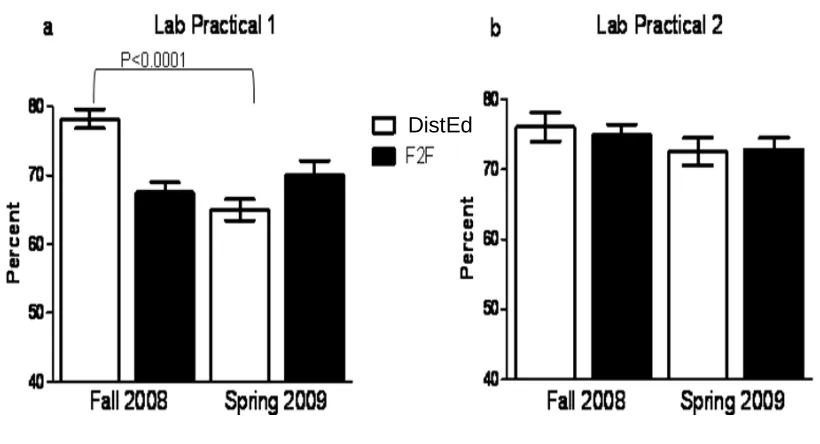
the students in spring 2009, 72.8%, but there was no significant difference between the two semesters. On the Laboratory Practical examination 1, students achieved higher scores in fall 2008 (P<0.0001) on the material presented in DistEd format than the students in spring 2009 (Figure 1a). There was no difference between scores on material presented in F2F format on Laboratory Practical 1. On Laboratory Practical 2 (Figure 1b), students from both fall 2008 and spring 2009 averaged similar scores and there was no significant difference between style of materials presentation and semesters.
Although student performance on the Laboratory Practical examinations differed among semesters, students performed similarly overall when tested on material presented in DistEd format versus F2F format. Students in the present study were able to repeatedly review material, which may have allowed them to perform better on Laboratory Practical 2. Although it cannot be concluded in the present study that the availability of repeated review of material through DistEd always improved student performance, it has been demonstrated that students taught using DistEd methods performed at least as well as using F2F methods. It is also possible that material presented in the spring semester was not taught as effectively as in the fall semester, since the laboratory topics presented as either DistEd or F2F were
Theoret et al. (2007) conducted a study with first year veterinary students and found that students learned anatomy equally well when instruction was provided by either live instruction or video demonstration. Results of the present study also demonstrate that
students can learn anatomy of domestic animals from using computer-based material. Grizzle et al. (2008), Theoret et al. (2007), and Aly et al. (2004) suggested traditional dissections should remain a part of the anatomy course and that online teaching should be seen as a complement to traditional teaching that is more suited to clinical practices. Offering
supplemental material through DistEd format may enhance learning and therefore a blended or hybrid type of approach to anatomy should be evaluated. However, Josephson and Moore (2006) reported that use of a DVD supplemented format for learning how to perform active anatomy dissections resulted in students scoring similarly on examination questions to those who were not provided the DVD- supplemented format.
trouble adjusting to the expectations of studying and learning in college compared to what they executed in high school (Carew et al., 1997), and this may have contributed to the difference in attitude with the spring 2009 class. Investigating a similar hypothesis as the present study, Aly et al. (2003) also implied that the less experienced backgrounds associated with first-year undergraduates compared to upperclassmen are cause for the uncertainty with multimedia courseware packages Willems et al. (2003) also noted that upperclassmen students would appreciate computer-assisted learning software more because they would be more familiar with unconventional educational approaches.
Students that have adapted themselves to traditional teaching methods may dislike the transition to online teaching practices because it forces them to modify their learning styles (Willems et al., 2003). It seems students in this study were overall more agreeable to a change in teaching style based on the fact that the majority of students from both 2008 and 2009 semesters agreed that a DistEd option is feasible for teaching anatomy, although notably more from the fall 2008 semester expressed this opinion than from the spring 2009 semester. The students in fall 2008 were largely made up of sophomores, thus they were more likely to adapt to alternate teaching methods than the freshman students in spring 2009. However, once the students in spring 2009 adjusted to the laboratory course format, they performed equally well on Laboratory Practical 2, and exhibited an equal overall grade performance, regardless of the method of materials presentation.
In summary, students appeared to perform similarly when tested on material
Literature Cited
Aly, M., G. Willems, C.Carels and J. Elen. 2003. Instructional multimedia programs for self-directed learning in undergraduate and postgraduate training in orthodontics. Eur J Dent Educ. 7: 20-26.
Barnes, D.M., J.P. Sims and W. Jamison. 1999. Use of Internet-based resources to support an introductory animal and poultry science course. J. Anim. Sci. 77: 1306-1313.
Besser, H and M. Bonn. 1996. Impact of Distance Independent Education. JASIS 47: 880-883.
Carew, L.B., V. Chamberlain and F. Alster. 1997. Evaluation of a Computer-Assisted Instructional Component in a College-Level Nutrition Course. J. Nutr Educ. 29:327-334. Grizzle, J.M., A.M. Saxton, P. Snow and C. Edmonds. 2008. A virtual laboratory for undergraduate instruction in domestic animal reproductive physiology: help or hindrance? NACTA Journal. 52(2): 49-54.
Hofmann, J. and N. Miner. 2008. Real Blended Learning Stands Up. ASTD 62:28-31.
Josephson, E. and L. Moore. 2006. An Electronic Instructor for Gross Anatomy Dissection. J Vet Med Educ. 33: 465-473.
Moore, M. 1973. Speculations on a definition of independent study. Page 25 in W.K. Kellogg Report No. 7 of Proc. Conf. Ind. Learn, Vancouver, Canada ERIC #ED285573.
Theoret, C., E. Carmel and S. Bernier. 2007. Why Dissection Videos should not replace Cadaver Prosections in the Gross Veterinary Anatomy Curriculum: Results from a Comparative Study. J Vet Med Educ. 34: 151-156.
Walker, C.E. and E. Kelly. 2007. Online Instruction: Student Satisfaction, Kudos, and Pet Peeves. QRDE, 8: 309-319.
Tables and Figures
Table 1. Method of presentation for laboratory lessons in fall 2008 and spring 2009.
Laboratory Laboratory Topics
Method of Presentation Fall 2008 Spring 2009 L1- Body water and
Diffusion
body water, osmosis, and diffusion DistEd F2F L2- Brain and Senses structures and functions of the sheep
brain and cow eye
F2F DistEd L3- Bone and Joints comparative skeletal anatomy-horse,
goat, dog, cat and rabbit
DistEd F2F L4- Cardiovascular
System
external and internal cardiac anatomy of the sheep; describe blood flow
F2F DistEd
L5- Muscles Skeletal muscles of the horse F2F DistEd
Laboratory Practical 1 Covered laboratory topics 1-5 F2F F2F L6- Respiratory
Physiology
anatomy of the respiratory system (sheep); inspiration and expiration
DistEd F2F L7- Blood principal components of blood; explain
procedures for blood sampling in pigs
F2F DistEd L8-
Endocrinology/Blood Typing
major endocrine glands and tissues of the body; identification and function of major hormones produced
F2F DistEd
L9- Urinary System external and internal features and functions of the sheep and cow kidney
DistEd F2F L10- Digestive System anatomy and function of the digestive
system; comparative anatomy of ruminants and nonruminants
F2F DistEd
L11- Reproductive Physiology
anatomy and physiology of male and female reproductive system of the cow
DistEd F2F Laboratory Practical 2 Covered laboratory topics 6-11 F2F F2F
Figure 1. Effect of method of materials presentation on (a) Lab Practical Exam 1 and (b) Lab Practical Exam 2 for Fall 2008 and Spring 2009. DistEd- distance education, F2F: face-to- face.
CHAPTER 3
Effect of supplemental online resources in distance education format on
undergraduate animal science laboratory instruction
J Bing, S Pratt-Phillips1, CE Farin
Department of Animal Science
North Carolina State University, Raleigh, NC 27695
1
To whom correspondence should be addressed: Department of Animal Science, Polk Hall 259, Box 7621, NCSU Campus, Raleigh, NC 27695; E-mail: [email protected]
ABSTRACT: The objective of this study was to determine if supplemental online resource (SOR) availability in a distance education (DistEd) format could enhance student learning. Students (n=137) in an undergraduate animal science laboratory course completed an
anatomy pre-test and pre-survey to assess their experience with, and attitudes towards, SOR. Supplemental Online Resource modules were made available for randomly selected
laboratories. Two laboratory practical exams were administered and included questions from labs for which SOR was made available as well as labs that had no SOR. Questions from the pre-test were included in the exams and used to generate “post-test” scores. Student learning and performance was evaluated using a hierarchical design that included test scores, SOR availability and their interactions. Results are presented as mean±SEM. Post-test scores (87±2%) were higher (P<0.0001) than pre-test scores (34±2%), indicative of student learning. On Laboratory Practical 1, students scored higher (P=0.0012) on questions from laboratories with SOR compared with laboratories without SOR (80±1% and 75±1%, resp.). In contrast, on Laboratory Practical 2, there was no effect of SOR supplementation on student scores (83±1% and 83±1%, for SOR and no SOR, resp.). A majority of students (93/137, 68%) surveyed indicated that SOR was at least somewhat useful for improving their grade.