OPTIMIZATION OF RESOURCE MECHANISM AND BANDWIDTH ALLOCATION TECHNIQUES IN WIRELESS NETWORK AND ITS APPLICATION
M. Sagar1, Dr. Amit Jain2
Department of Electronics and Communication Engineering
1,2
OPJS University, Churu, Rajasthan (India)
Abstract
This research uses an observation method to identify optimization of the resource mechanism and bandwidth allocation techniques in wireless networks and their applications. We describe in detail the state of the art of Intelligent technology, which covers spectrum and access detection approaches that perceive and adapt to wireless environments. We present powerful machine learning algorithms that improve perception and reconfigurability in wireless networks from the artificial intelligence system in the next chapter. We analyze the practical applications of these techniques to existing and future wireless networks, such as heterogeneous networks and device-to-device (D2D) communications, with performance evaluation through the AI system. We have also developed some open research challenges in Intelligent technology and machine learning and suggest possible improvements in future wireless networks.
1. OVERVIEW
Sensor networks and satellite constellations face numerous challenges for reliable and robust communications. The increasingly heterogeneous nodes and a large number of new emerging Earth science applications place further limits on performance and postpone needs. These problems are further exacerbated by power and bandwidth constraints in network nodes. The quality of service and the performance of these wireless networks, in consideration of these problems, are extraordinarily influenced by network routing and bandwidth allocation. We propose another class of routing algorithms in consideration of swarm-based standards, which could possibly address these issues in an autonomous and intelligent way. These swarm-based
intelligence [1] is the core of an enabling technology for a new class of routing and optimization algorithms with interesting features, such as autonomy, robustness and fault tolerance, which makes it suitable for MANETS. Swarm-based algorithms have been developed over the past few years for wired networks [2-12], but their properties are also interesting for ad-hoc networks. We examine the specific challenges of wireless networks and propose adaptations of swarm-based algorithms to address them both for network routing and for network bandwidth allocation.
2 OPTIMIZATION OF RESOURCES MECHANISM
The fundamental parameters of the reconfigurable physical state incorporate waveform, modulation, time interval, frequency band and power allocation. For example, to achieve higher performance, and to meet certain restrictions, such as service qualification requirements, various optimization algorithms have been produced, including graph-based and market-based methodologies. The main challenges on the topic, which include imperfect data, real-time requirements and complexity limits, have been considered in the current formulation.
2.1Waveform and Modulation Design
To update the use of the spectrum and limit the impedance of essential users can optimize the plant waveform and modulation for secondary users. In the previous day's spectrum, secondary users can apply ultra wideband (UWB)
waveforms and optimize the width and position of the bar. In the spectrum arriving to lay above, orthogonal frequency division multiplexing (OFDM) is an interesting method that enables or disables adaptive transmission tones to accommodate radio environments.
2.2Resource Allocation and Power Control
Resource allocation and power control have been successful methodologies for wireless networks. With the improvement of intelligent and Intelligent wireless systems, different types of users can exist together in a similar area and offer spectrum resources accessible through cutting-edge dynamic methods. The latest advancement in the dynamic allocation of resources and the control of adaptive power from various perspectives, including data accessibility, allocation behavior, requirements and metrics.
• Accessibility to information: in the allocation of resources and in energy control, accessible data, for example channel status data (CSI), are essential. For intelligent wireless networks, these data take a more important part in the dynamic allocation of resources and in adaptive power control.
inclusive task and, as a result, achieve high performance.
• Requirements: to meet the different applications and application requirements, the allocation of resources and ideal power control can be outlined in several ways. The decency and the probability of obscuring the joint allocation of speed and power for Intelligent radio networks are contemplated in a dynamic spectrum to reach the environment.
• Metrics: with the explosive growth of wireless communications, spectrum scarcity and energy use have been carefully considered. The latest research on resource allocation and power control focused on spectrum efficiency and energy efficiency measurement.
2.3Graph-Based and Market-Based Approaches
Graph theory is a helpful tool to display combine savvy connections between nodes. Most regular utilization of graph theory to resource optimization is conflict graph, or obstruction graph, which depicts co-channel impedance utilizing nodes and edges.
Nash Equilibrium (NE): if the conflict graph of secondary users admits particular topologies characterized as mean substantial.
In graphical game that depicts channel choices for deft spectrum get to systems is ended up being a potential game and a
NE, which Minimizes Media Access Control (MAC) layer obstruction.
Market-based methodologies of resource optimization regard spectrum resources as tradable things. These methodologies give essential and secondary users inspirations, for the most part opportunities of augmenting their own particular utilities, to participate in a predesigned spectrum sharing system.
Spectrum-and Energy-Efficient Designs: With the detonating number of wireless devices expending a lot of energy, energy efficiency is likewise important for dynamic spectrum access and resource optimization. Therefore, it has gotten expanded consideration as of late, particularly for battery-powered cell phones.
3BAND WIDTH ALLOCATION
TECHNIQUES
3.1Wideband and Higher Frequencies
enhance the level of insight and empower more applications, we will propose further advancement in the areas of wide band and higher frequencies, full-duplex radios, and massive MIMO. For every space, we will introduce specialized challenges and call attention to the conceivable utilization of discernment, reconfiguration, and machine learning strategies to address these challenges.
3.2Full-Duplex Radios
FD communications require culminate coordination of resource optimization in up connect and down connection to control the self-obstruction, which additionally expands the complexity of resource allocation and needs further examination. Insight is therefore basic for FD communications.
3.3Massive MIMO
Utilizes countless, generally at base stations, and can conceivably acquire enormous enhancements throughput and energy efficiency. To empower the misuse of additional degrees of flexibility gave by the abundance of radio wires, insight is particularly important and can upgrade both the performance and efficiency in the new situation.
3.4Dynamic Spectrum Access Techniques
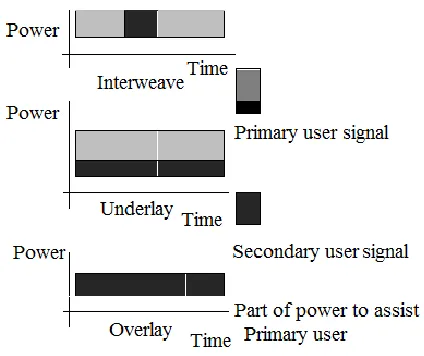
Based on the available information of the wireless environments and particular regulatory con-straints, dynamic spectrum access techniques can be classified as interweave, underlay, overlay, and hybrid schemes, as illustrated in Figure 1.
Fig. 1Dynamic Spectrum Access with
Temporal Spectrum Sharing.
Interweave: As the original motivation for Intelligent radio, secondary users exploit gaps in time, frequency, space, and / or other domains that are not occupied by primary users in this paradigm. Obviously, awareness of the wireless environment is very important to identify these gaps, called holes in the spectrum, so that secondary users communicate opportunistically. The aforementioned perception techniques, such as spectrum detection, are therefore essential for interlocking communications. Ideally, interference in this paradigm is avoided since user activities are not found in the holes of the spectrum. In practice, there may still be less interference for the main users with reliable spectrum detection.
within an acceptable level. In this paradigm, the tolerable interference level in a primary receiver can be modeled by the concept of interference temperature defined by the FCC [164]. To ensure reliable operation of primary users, the interference restriction is very restrictive and, as a consequence, secondary transmitters are generally very conservative in their transmission capacities.
Overlay: n this paradigm, secondary users can also simultaneously transmit with the main users in the same frequency band at the same time. Unlike the underlying communications, the interference generated by a secondary transmitter in a primary receiver in overlapping communications can be compensated by using part of the secondary user power to aid the primary user transmission. The overlap paradigm requires cooperation between primary and secondary users so that the secondary system has some knowledge of the primary system and uses it to design advanced encoding and transmission schemes.
Hybrid: the hybrid paradigm combines some of the previous paradigms to overcome its drawbacks. For example, the interleaving paradigm does not consider the tolerable interference level in a primary receiver, while the underlying armament paradigm does not allow secondary transmission to a total power level. Conversely, a hybrid scheme may allow a secondary user to
access a busy frequency band with a controlled power and an inactive frequency band with a maximum power. This paradigm has received great attention in recent literature, although the term "hybrid" is not always used explicitly.
4CONCLUSION
REFERENCES
[1]. E. Bonabeau, M. Dorigo, and G. Théraulaz, Swarm intelligence: from natural to artificial systems, Oxford University Press, 1999.
[2]. M. Dorigo, V. Maniezzo, and A. Colorni, “The ant system: optimization by a colony of cooperating agents,” IEEE Transactions on Systems, Man, and Cybernetics, part B, vol. 26, no. 1, pp. 29-41, 1996.
[3]. R. Schoonderwoerd, O. Holland, J. Bruten and L. Rothkrantz. “Ant-based Load Balancing in Telecommunication Networks,” Adaptive Behavior, vol. 5, pp. 169-207, 1996.
[4]. S. Guerin, “Optimisation multi-agents en environnementdynamique: application au routagedans les reseaux de telecommunications,” DEA Dissertation, University of Rennes I, France, 1997
[5]. D. Subramanian, P. Druschel, and J. Chen. “Ants and reinforcement learning: a case study in routing in dynamic networks,” Proc. 1997 International Joint Conf. on Artificial Intelligence, Palo Alto, CA, pp. 832-838, 1997.
[6]. M. Heusse, D. Snyers, S. Guérin, and P. Kuntz, “Adaptive agent-driven routing and load balancing in communication network,” Proc. ANTS'98, First International Workshop on Ant Colony Optimization, Brussels, Belgium, October 15-16, 1998.
[7]. G. Di Caro and M. Dorigo, “AntNet: distributed stigmergetic control for communications networks,” Journal
of Artificial Intelligence Research, vol. 9, pp. 317-365, 1998.
[8]. G. Di Caro and M. Dorigo, “AntNet: a mobile agents approach to adaptive routing”, Tech. Rep. IRIDIA/97-12, UniversitéLibre de Bruxelles, Belgium, 1997
[9]. T. White, B. Pagurek, and F. Oppacher, “Connection management using adaptive agents,” Proc. International Conf. on Parallel & Distributed Processing Techniques & Applications, pp. 802-809, 1998. [10]. G. Di Caro and M. Dorigo,
“Extending AntNet for best effort quality-of-service routing,” Proc. ANTS'98 - First International Workshop on Ant Colony Optimization, Brussels, Belgium, October 15-16, 1998.
[11]. E. Bonabeau, F. Henaux, S. Guerin, D. Snyers, P. Kuntz, and G. Theraulaz, “Routing in telecommunications networks with “smart”ant-like agents,” Proc. Intelligent Agents for Telecommunications Applications, 1998.