Article
Strategy for Sustained Growth with Enhancing
Facility
Experts’
Knowledge-Sharing Intention with
Purchasing Decision-Makers
Quik Noh 1 and Hyoungtark Lee 2,*
1 Department of Business Administration, Keimyung University, 1095 Dalgubeol-daero, Daegu 704-701,
Korea; [email protected]
2 Department of Business Administration, Keimyung University, 1095 Dalgubeol-daero, Daegu 704-701,
Korea; [email protected]
* Correspondence: [email protected]; Tel.: +82-53-580-6372 (H.L.)
Abstract: This research focuses on the knowledge-sharing intention of an expert with the purchasing decision-maker in a company as a marketing point for business-to-business transactions, where a company’s facilities expert connects the company’s purchasing decision-maker with the supplier. By providing information about the supplier’s products and companies to this decision-maker, the
expert plays an important role in the purchasing decision-maker’s knowledge on suppliers.
Therefore, this study aims to improve expert word-of-mouth (WOM) intentions and examines the strategies that influence them. Statistical verification is employed by considering the answers of 103 engineering experts, and a hierarchical multiple-regression analysis is used to test this study’s hypotheses. As a strategy for influencing expert WOM intentions, both the supplier’s and
purchasing decision-maker’s expertise and the tie strength with the supplier are examined; the tie
strength with the purchasing decision-maker is considered as the moderating variable. Three of the four hypotheses are supported. This paper gives advices to the facility suppliers who want sustained growth. they should not only appeal their expertise to the facility experts who visit their exhibition booth, but also specify who the visitors are and manage the relations with them personally with a long term perspective.
Keywords: knowledge-sharing intention; B2B marketing; expertise; tie strength
1. Introduction
The majority of researchers in business-to-business (B2B) transactions believed that managers make purchase decisions based on objective and technical factors, such as price, quality, function, and service and that their decisions are directed toward long-term transactions based on these [1]. But with the recent rapid technological advances, differences in product quality have gradually faded, making it no longer possible for only technical factors to guarantee sustainable growth of the company [2]. Thus, what other marketing strategies besides technical factors can differentiate them? Purchasing decision-makers also face uncertainty about the purchase of products from companies that are not well-known. Industrial goods are considered vital purchasing decisions as they are generally expensive durable goods and can only stay production competitive when the goods are managed reliably over the long term. Of the many companies that do not substantially differ in their technology, which supplier do buyers choose?
Internal and external information sources, such as facility experts, are frequently used in these high-risk purchase decisions. In particular, advice from experienced facility operations experts within the enterprise is considered critical to decision-makers. According to [3], the word-of-mouth (hereafter, “WOM”) of experts in the field is critical information for industry buyers.
Voluntary sharing of information, such as WOM, is an important form of knowledge sharing and transfer within the company. In B2B transactions, facility experts are those who are not only familiar with the characteristics of the various companies and products in the industry but also operate the facilities within the company. Further, facility experts continually evaluate information about suppliers and the facilities they provide, and as important influencers in the company, are critical in connecting suppliers and purchasing decision-makers by communicating such information to the purchasing decision-makers.
Based on previous studies [4], which posit that the relational factors between buyers and suppliers are important in B2B transactions, this study focuses on the relational factors with facility-operating experts that connect suppliers with purchasing decision-makers in B2B companies. While B2B WOM is a relatively less-studied field compared to research on business-to-consumer WOM, it is always a highly significant market factor. Therefore, this study aims to improve the WOM intentions of facility experts—who are critical in initiating transactions between purchasing
decision-makers and suppliers—by examining influential factors.
2. Literature Review
2.1. Word-of-Mouth
Literature provides various definitions of WOM; these range from personal communications in which individuals share their experiences [5] to consumers communicating their experiences of a company and its products [6]. WOM characteristically involves transmitting information that affects
the information receiver’s attitude and future purchasing behavior.
Generally, customers are highly concerned with the information they receive from others and consider it important [7]; in particular, buyers tend to rely more on WOM information when they perceive some risk about purchasing a product [8]. Thus, WOM information has a variety of positive effects, such as reducing risk [9]; improving psychological states, including beliefs, convictions, and empathy [10]; and increasing purchasing possibilities [11].
Further, WOM is critical in the decisions involving B2B as well as consumer purchase transactions [3]. Purchasing decision-makers tend to evaluate products longer as they often face uncertainty in terms of the product's quality and price [12]. Decision-makers purchasing industrial products can reduce uncertainty through longer search times, but it is difficult to reduce the risks associated with the quality of the product or service they purchase. Therefore, purchasing decision-makers in the B2B market may seek objective, professional information about products and services from a trusted intermediary that serves to connect them with suppliers. Specifically, WOM is important in choosing and building supplier relationships [13]. The B2B industry is characterized by
relatively few potential customers in selling products and services. Further, the customer facility’s
operation experts are well-aware of the supplier’s capabilities and attitudes, and the former’s positive,
trustworthy WOM is critical in marketing the facility’s products. Therefore, this research will focus
on WOM in the B2B facility industry.
2.2. Expertise
2.2.1. The Supplier’s Expertise
Expertise is the ability to successfully perform product-related work [14] and involves highly skilled practitioners with experience in delivering outstanding results in a particular field [15]. While researchers have proposed different definitions, they commonly include consistently high-performing individuals with above-average skills, knowledge, and attitudes in a particular field.
2.2.2. The purchasing decision-maker’s expertise
Recipients can react differently to messages depending on their various personal characteristics [18]. Among them, the recipient’s expertise is defined as the ability to successfully perform the tasks associated with a product [14]; these affect purchasing decisions as well as the degree to which the recipient actively seeks WOM information [19]. As WOM clarifies unclear information through communication with the sender [9], recipients will attempt to gain WOM information to decrease risk as the perceived level of risk increases [8]. Specifically, the greater the recipient’s perceived risk, the greater their willingness to accept WOM information. In fact, many researchers have noted that the lower the recipient’s expertise, the more information they will seek [20].
The recipient’s expertise is also important in understanding the decision-maker’s behaviors,
such as exploring information [21], judgments [22], and purchasing [23]. The greater the recipient’s
experience with the product or service, the less external information he or she will seek [24]. Compared to cases of information recipients with low expertise, recipients with higher expertise look for relatively less information [20]; further, it is also argued that highly experienced consumers who are knowledgeable about the product tend to judge based on the information they have, and therefore, may not recognize the need for additional information [25]. These experts also tend to expend less effort to explore the information needed to make purchasing decisions [26]. In other words, less
specialized consumers seek other people’s opinions about the product more than consumers with
more expertise and experience [27].
2.3. Tie Strength
2.3.1. Tie strength between suppliers and experts
Tie strength is the power that exists between two people and connects their relationships [30].
Given the transfer of information from a specific relational network of suppliers and experts—rather
than from the simple movement of information through a two-person dialogue [28]—tie strength,
between the supplier and expert should be considered as an important factor in understanding the
WOM between them. Many researchers have examined social relationships’ effects on WOM, as
WOM activity occurs through the influence of social relationships [29]. This study assumes that the stronger the bond strength, such as the depth of intimacy and the time spent with each other, the closer the relationship between the supplier and the expert; subsequently, the current research focuses on the effects of the strength of this relationship.
2.3.2. Tie strength between purchasing decision-makers and experts
According to the information-sharing theory, consumers want to help those around them make purchasing decisions and tend to share their information with those around them to gain impressions of their capabilities and receive their goodwill [31]. In particularly uncertain purchasing situations, buyers actively seek to find and rely on those around them to gain the information needed to make decisions [32].
Social network theory argues that members acquire and utilize the new information generated within social networks to increase their individual performance [33]. As the access to WOM information resources is also based on collaborations within this social network [34], this information is more easily exchanged when strong ties exist. Therefore, this study defines the ties between the sender and receiver as the depth of emotion, intimacy, and the duration of the relationship between the expert and purchasing decision-maker.
3. Building Hypotheses
3.1. Expertise in the Supplier’s and Expert’s WOM Intentions
Expertise refers to the ability to successfully perform product-related tasks [14]. This section
First, [35] observed that suppliers can obtain loyalty—as expressed through repurchasing intentions
or WOM—if they continue to transact with extraordinary knowledge, attitudes, and skills. Similarly,
[36] stated that expertise is the extent to which the purchaser recognizes that the supplier can provide accurate judgements of, and correct answers to, the purchaser’s problems. If the supplier offers products that exceed the purchaser’s expectations, the buyer’s satisfaction increases [37]. Therefore, if the provider has expertise and the facility expert has facilities and services that exceed expectations, the latter will not only share these positive experiences with others but will also generate WOM to the decision-maker for additional positive experiences. Thus, the following hypothesis is established:
H1: The supplier’s expertise positively influences the expert’s WOM intentions.
3.2. The tie strength between the supplier and expert and the expert’s WOM intentions
Differences exist in the motivation to exchange information with others depending on the nature of social relationships. The reasons why people want to access others differ because the differences in social contexts with the other person can result in a variety of behaviors [28]. Further, intimacy occurs among similar people [38] and what develops over time through frequent interactions and increased affinity. Intimacy not only improves cooperation and communication, but also contributes to essential intimacy and emotional commitment in relationships [39]. Additionally, individuals exchange both social and emotional support in close networks [39], while these emotional commitments and altruistic behaviors are linked to this intimate network interaction [40].
The ties between suppliers and facility experts—which occur due to physical distance or familiarity with each other—can be strengthened through frequent encounters, or specifically,
transactional experiences. This social bonding between suppliers and experts affects experts’
decision-making processes by actively providing information about suppliers to the purchasing decision-makers [41]. Thus, it can be inferred that the expert’s WOM intentions will be enhanced under strong supplier-expert ties, and the following hypothesis is established based on these inferences:
H2: The tie strength with suppliers positively influences the expert’s WOM intentions.
3.3. Moderating effect of tie strength between the expert and purchasing decision-maker
The social network structure is critical in both WOM processes and purchasing decisions [42]. The tie strength concept in particular represents the degree of the relationship as an element of social network characteristics; it is measured by such variables as the frequency of social contacts [43], intimacy and social support [30], and the type of social relationships between members [44]. The tie strength is also associated with trust. As trust is developed through a mutual disclosure of information between individuals, the stronger the bond, the more trust the other person tends to exhibit. From a macro-perspective, WOM information is transmitted at a social network level, rather than simply between two people [28]; consequently, the strength of the connections between people, senders and receivers, and suppliers and purchasing decision-makers is an important element of the social network itself [28]. This demonstrates that groups with higher degrees of intimacy with each other communicate through more diverse media than those with lesser intimacy. Further, members who perceive themselves as highly similar to the information provider tend to more easily accept the arguments that the information provider conveys [45]. This WOM information is more often sought in strong-tie relationships due to the high trust and close physical proximity to the sender, as well as the high levels of acceptance of this information. Thus, WOM communication in intimate relationships can affect purchasing behavior or decision-making [46]; this study establishes the following hypothesis based on this information:
H3: The tie strength with a purchasing decision-maker has a positive, moderating effect on the
3.4. The non-linear effect of the purchasing decision-maker’s expertise on the expert’s WOM intentions
Purchasing decision-makers who receive WOM information may have different reactions to these messages due to their different personal characteristics [18]. Previous studies also report
conflicting results. Among studies on former recipients’ expertise, [26] said that highly specialized
receivers tend to avoid hard work to obtain additional product information or assessments, or the opinions of those around them in decision-making because they already have sufficient information for their purchasing-related decisions. In other words, a negative relationship exists between the WOM receiver’s expertise and the willingness to accept WOM information. [27] also confirmed
negative impacts on the WOM recipient’s expertise and the value of WOM information. Recipients
with high expertise can more easily obtain the information they need [47] and are more likely to obtain the information they want even in poorly structured environments [24]. Therefore, high-expertise recipients will not attempt to obtain WOM information from others or negatively react toward receiving WOM information from others.
Some studies present opposing arguments, in that consumers without sufficient prior knowledge of products to be purchased tend to avoid efforts to obtain the information necessary to make purchase decisions [20], while more informed consumers tend to acquire this information [48]. Moreover, [49] argued that decision-makers with high expertise are likely to collect more information. In other words, a decision-maker with higher expertise regarding a particular product may be more willing to accept WOM information. [50] argued that WOM information has a stronger effect among high-expertise WOM receivers than those who have low expertise, as high-expertise decision-makers can detect missing information and make appropriate judgments [51].
To summarize these conflicting arguments, it can be observed that the recipient’s expertise in
seeking and receiving information also causes variations in the extent to which they understand and analyze the information associated with the product or service [14]. Further, [19] noted that customers with moderate advanced knowledge of a product tend to exhibit the highest information exploration, but customers with sufficient or no prior knowledge demonstrate low information exploration.
These existing studies allow for the following inference regarding low-expertise purchasing decision-makers, in that the higher the purchasing decision-maker’s expertise, the greater the expert’s WOM intentions. In contrast, regarding high-expertise purchasing decision-makers, the higher the
purchasing decision-maker’s expertise, the lower the expert’s WOM intentions. Thus, the following
hypothesis is established based on this previous research:
H4: The expert’s WOM intentions appears to increase and then decrease again, or follows a
reverse U-shape, due to the purchasing decision-maker’s increased expertise.
4. Results
4.1. Samples
This study distributed a questionnaire using the items with reliability and validity verified by previous research. The data was collected from facility experts who participated in plastics and rubber exhibitions held in India, Germany, the United States, Italy, and Saudi Arabia from January to November 2015. All the subjects provided informed consent for their inclusion before they participated in the study. Event participants included facility experts from plastics manufacturing
companies worldwide who are appropriate for this study, which targets B2B companies’ technical
experts. Facility experts refer to those who belong to a particular company and are responsible for the operation of its facilities; these are people with sufficient experience working with the facility provider and its sales representatives. The 103 survey respondents ranged in experience, from 4 to 21 years, with an average experience of 9.98 years. They are qualified to respond as experts given their sufficient knowledge of the products and sufficient understanding of the suppliers of plastics manufacturing machines.
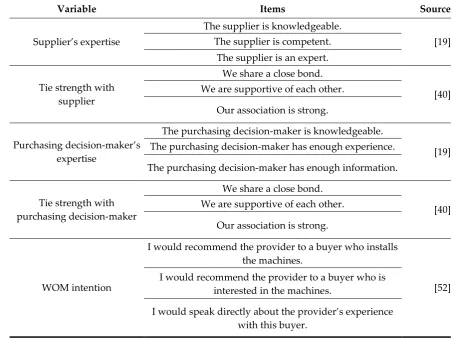
Items from existing studies were used in the current work’s survey but were modified to suit the context. Table 1 displays the measurement questionnaires and sources for each variable.
Table 1. Variables
Variable Items Source
Supplier’s expertise
The supplier is knowledgeable.
[19] The supplier is competent.
The supplier is an expert.
Tie strength with supplier
We share a close bond.
[40] We are supportive of each other.
Our association is strong.
Purchasing decision-maker’s
expertise
The purchasing decision-maker is knowledgeable.
[19] The purchasing decision-maker has enough experience.
The purchasing decision-maker has enough information.
Tie strength with purchasing decision-maker
We share a close bond.
[40] We are supportive of each other.
Our association is strong.
WOM intention
I would recommend the provider to a buyer who installs the machines.
[52] I would recommend the provider to a buyer who is
interested in the machines.
I would speak directly about the provider’s experience
with this buyer.
4.3. Measurement test
4.3.1. Reliability and Validity
This study uses a Cronbach’s α coefficient to verify the internal reliability among multiple items; the Cronbach’s α value for all variables is greater than or equal to 0.7. As Table 4-2 demonstrates, the composite reliability also exceeded the 0.6 threshold [53], ensuring all indicators’ internal consistency. After verifying reliability, a confirmatory factor analysis was performed using AMOS 16.0
software to verify the factors’ validity. The measurement model was then verified—including both
exogenous and endogenous variables—to confirm both convergence and discriminative validity [54].
The analysis reveals that the values of the λ estimates linking the measurement items to the corresponding variables are all significant, and hence, convergence validity is ensured (Table 2).
Table 2. Confirmatory factor analysis results
Variables Items Estimate SE t-value α CR AVE
Supplier’s expertise
SX1 0.74
0.74 0.76 0.61
SX2 0.67 0.13 6.27
SX3 0.71 0.11 6.76
Tie strength with supplier RSX1 0.70 0.78 0.79 0.64
RSX3 0.72 0.17 6.33
Tie strength with purchasing decision-maker
RXB1 0.78
0.87 0.88 0.69
RXB2 0.87 0.11 8.70
RXB3 0.83 0.12 8.29
Purchasing decision-maker’s
expertise
PdX1 0.76
0.83 0.82 0.6
PdX2 0.82 0.14 7.62
PdX3 0.73 0.13 7.17
WOM intention
WI1 0.74
0.80 0.81 0.60
WI2 0.76 0.15 6.75
WI3 0.81 0.16 7.14
Note: CMIN = 1248.462, df = 80, CMIN / df = 1.560, RMR = 0.066, GFI = 0.859, NFI = 0.893, TLI = 0.911, CFI = 0.933, RMSEA = 0.077.
The discriminant validity results indicate that the measurement variable explaining the latent variable suggested in the research model is appropriate, as it portrays inter-construct correlations with the shared average variance extracted (Table 3).
Table 3. The PHI Matrix
1 2 3 4 5
1. Supplier’s expertise 0.78
2. Tie strength with supplier 0.693 0.80
3. Tie strength with purchasing decision-maker 0.585 0.433 0.83
4. Purchasing decision-maker’s expertise 0.597 0.504 0.390 0.77
5. WOM intention 0.735 0.535 0.692 0.320 0.77
Note: Diagonal values indicate the root average variance extracted.
4.4. Hypotheses test
To prevent multiple collinearity, which can be noted in H3 and H4, a mean centering method was used; the results were then presented and interpreted in accordance with work by [55].
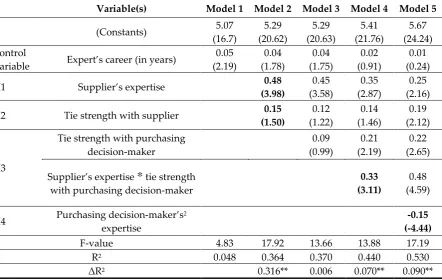
A hierarchical multiple regression analysis is required to verify the hypotheses presented in this study, in which the research model has been validated step by step as follows: Model 1 identified the influence of the expert’s professional experience, which should be controlled because it can affect the expert’s WOM intentions. The supplier’s expertise and the tie strength between the supplier and expert were added to Model 1 to verify H1 and H2.
Study Model 3 adds the moderating variable—or the tie strength between the expert and purchasing decision-maker—to Model 2. Study Model 4 adds the (supplier’s expertise x the tie strength between the expert and the purchase decision-maker) to verify H3, regarding the moderating effect of the tie strength between experts and purchasing decision-makers.
Study Model 5 adds the square value of the purchasing decision-maker’s expertise to verify H4,
regarding the inverse U-shaped influence of the purchase decision-maker’s expertise on the expert’s
WOM intentions.
1. Model 1: WOM = β0 + β1Yr + ε1
2. Model 2: WOM = β0+ β1Yr + β2Xpt_Su + β3T_Su + ε2
4. Model 4: WOM = β0+ β1Yr + β2Xpt_Su + β3T_Su + β4T_Pd + β5Xpt_Su*T_Pd + ε4
5. Model 5: WOM = β0+ β1Yr + β2Xpt_Su + β3T_Su + β4T_Pd + β5Xpt_Su*T_Pd + β6Xpt_Pd2+ ε5
where,
WOM = Expert’s word of mouth intentions
Yr = Expert’s career (in years) Xpt_Su = Supplier’s expertise
Xpt_Pd = Purchasing decision-maker’s expertise
T_Su = Tie strength with supplier
T_Pd = Tie strength with purchasing decision-maker
This study statistically verifies the moderating effect of the tie strength between experts and purchasing decision-makers, as well as the nonlinear influence of purchasing decision-makers’ expertise by using an F-test of the amount of changes in R2 as presented by [56, 57]. Table 4 displays
the results.
Table 4. Hypotheses Test Results
Variable(s) Model 1 Model 2 Model 3 Model 4 Model 5
(Constants) 5.07
(16.7) 5.29 (20.62) 5.29 (20.63) 5.41 (21.76) 5.67 (24.24) Control
Variable Expert’s career (in years)
0.05 (2.19) 0.04 (1.78) 0.04 (1.75) 0.02 (0.91) 0.01 (0.24)
H1 Supplier’s expertise 0.48
(3.98) 0.45 (3.58) 0.35 (2.87) 0.25 (2.16)
H2 Tie strength with supplier 0.15
(1.50) 0.12 (1.22) 0.14 (1.46) 0.19 (2.12) H3
Tie strength with purchasing decision-maker 0.09 (0.99) 0.21 (2.19) 0.22 (2.65)
Supplier’s expertise
*
tie strength with purchasing decision-maker0.33 (3.11)
0.48 (4.59)
H4 Purchasing decision-maker’s
2
expertise
-0.15 (-4.44)
F-value 4.83 17.92 13.66 13.88 17.19
R2 0.048 0.364 0.370 0.440 0.530
ΔR2 0.316** 0.006 0.070** 0.090**
Notes: (1) ** p<0.05; (2) non-standardization value; (3) ( ) is t-value
The variables were added hierarchically to ensure that the proposed models could better predict WOM intentions with the addition of these variables. First, Model 1 only has a control variable, and it was found that the longer the expert’s career experience, the more likely the WOM intentions (R2 =
0.048).
The R2 in Model 2—which adds supplier expertise and the tie strength between the supplier and
expert to Model 1—demonstrates that the R2 increased by 0.316 compared to Model 1, and the F-value
of the increase in R2 exhibited significant differences at the 0.05 level.
The R2 in Model 3, which adds the tie strength between the expert and purchasing
decision-maker, is 0.370. Although this is an increase of 0.006 over R2 in Model 2, it is not a statistically
significant difference. This demonstrates that the tie strength between the expert and purchasing decision-maker is not a variable that directly explains the expert’s WOM intentions.
The R2 of Study Model 4, which adds the (supplier expertise x tie strength between the expert
variables was statistically significant. This reveals that the supplier’s expertise x tie strength with purchasing decision-maker variable affects WOM intentions. The R2 of Model 5, which adds the
purchasing decision-maker’s expertise2 to Model 4, is 0.530, with an increase of 0.09 in the R2
compared to that in Study Model 4; this is also statistically significant.
The hypotheses suggested in this study are then individually summarized. First, the supplier’s
expertise significantly and positively affects WOM intentions (β = 0.48, t = 3.98), and thus, H1 is supported. Second, H2 was not supported, as the supplier-expert tie strength was not found to significantly affect WOM intentions (β = 0.15, t = 1.50). Regarding H3, the (supplier’s expertise x the tie strength between the expert and purchasing decision-maker) significantly influenced WOM intentions, indicating that this tie strength has a moderating effect to enhance supplier expertise’s influence on WOM intentions (β = 0.33, t = 3.11). Finally, H4—regarding the purchasing decision-maker’s expertise 2 was found to be significant, and exhibited an inverted U-shaped nonlinear effect;
therefore, this hypothesis is also supported (β = -0.15, t = -4.44).
5. Conclusion
5.1. Findings
This study focused on expert WOM intentions based on both the expertise and relationship of the supplier and purchasing decision-maker. First, expertise of suppliers was found to increase WOM intentions. This conforms to the common knowledge that suppliers’ expertise will be important in the B2B industry. Second, it has been confirmed that experts do not necessarily intend to convey WOM for the suppliers who maintain good relationships with them. Third, experts are more actively engaged in providing high-expertise suppliers to their purchasing decision-makers who have strong ties with these experts. The relationships between experts and purchasing decision-makers were found to have a moderating effect on furthering enhance supplier expertise effects on experts’ WOM intentions. Finally, the purchasing decision-maker’s expertise exhibited an inverted U-shaped influence on the experts’ WOM intentions. In other words, if a purchasing decision-maker has very low or very high knowledge of a facility, the expert is less likely to engage in WOM for this particular supplier. Conversely, experts have demonstrated an increased intention to engage in WOM for the supplier to the purchasing decision-makers with moderate (not low and not high) expertise.
5.2. Implications and Limitations
B2B facility companies should have specific strategies that differ from those in other industries. In this regard, this research focuses on facility experts’ knowledge-sharing intentions with purchasing decision-makers to provide the following important practical implications.
This study found that supplier companies can increase sales by building relationships with facility experts, the latter of which can convey positive WOM to the purchasing decision-maker. Therefore, the supplier must constantly manage its relationships with experts.
Second, this study’s results revealed that the intent of the reverse U-shaped sphere can be predicted depending on the purchasing decision-maker’s expertise. In other words, if the expert recognizes that the purchasing decision-maker’s expertise is either low or high, the facility expert will exhibit low WOM. If the purchasing decision-maker is deemed to have sufficient knowledge of the facility, the expert will not want to infringe upon the decision-maker’s authority; if decision-makers are unfamiliar with the equipment, it is inferred that the expert will have fewer WOM intentions as the expert is fully responsible for the facility as determined by his or her recommendation. Subsequently, the supplier can prevent the expert’s decreased WOM intention when the decision -maker is not knowledgeable by operating a collective credit program to alleviate the burden of responsibility incurred by the expert’s WOM.
characteristics of various B2B facility industries. Second, although business etiquettes may vary among cultures, this research was conducted by selecting purchasing decisionmakers and experts in the facility industry without distinguishing the country or culture; thus, future research must consider cultural characteristics. Despite these limitations, this study is significant in that it has demonstrated the WOM that occurs in the B2B facility industry.
Author Contributions: Conceptualization, Q.N.; methodology, H.L.; software, H.L.; validation, H.L.; formal analysis, H.L.; investigation, Q.N.; resources, Q.N.; data curation, Q.N.; writing—original draft preparation, Q.N.; writing—review and editing, H.L.; visualization, H.L.; supervision, H.L.; project administration, Q.N.; funding acquisition, H.L. Data curation, Quik Noh; Funding acquisition, Hyoungtark Lee; Project administration, Hyoungtark Lee. All authors have read and agreed to the published version of the manuscript.
Funding: This work was supported by the Ministry of Education of the Republic of Korea and the National Research Foundation of Korea (2019S1A5A2A01051292).
Conflicts of Interest: The authors declare no conflict of interest.
References
1. Cullinane, J. Word of mouth process: Your way to sales success. J. Selling & Major Acct. Manag.2006, 6(1), 64-68.
2. Satyajit, J.; Guin, K.K.; Dash, S.B. Effect of relationship building and constraint‐based factors on business buyers’ relationship continuity intention: A study on the Indian steel industry. J. Ind. Bus. Res.2011, 3(1), 22-42.
3. A Study on the Importance of Word-of-Mouth Communication to Business Buyers. Available online: https://ssrn.com/abstract=1934170 (accessed on 11 January 2020).
4. Roth, M.S.; Money, R.B.; Madden, T.J. Purchasing processes and characteristics of industrial service buyers in the U.S. and Japan. J. World Bus. 2004, 39(2), 183-198.
5. Borgida, E.; Nisbett, R.E. The differential impact of abstract vs. concrete information on decisions. J. Appl.
Soc. Psychol. 1977, 7(3), 258-271.
6. Richins, M. L. Word of mouth communication as negative information. Adv. Cons. Res. 1984, 11, 697-709. 7. Price, L.L.; Feick, L.F. The role of interpersonal sources in external search: An informational perspective.
Adv. Cons. Res. 1984, 11, 250-255.
8. Arndt, J. Role of product-related conversations in the diffusion of a new product. J. Mark. Res. 1967, 4(3), 291-295.
9. Murray, K.B. A test of services marketing theory: Consumer information acquisition activities. J. Mark. 1991, 55(1), 10-25.
10. Sweeney, J.C.; Soutar, G.N.; Mazzarol, T. Factors influencing word of mouth effectiveness: Receiver perspectives. Eur. J. Mark. 2008, 42(3/4), 344-364.
11. Wilson, W.R.; Peterson, R.A. Some limits on the potency of word-of-mouth information. Adv. Cons. Res. 1989, 16, 23-29.
12. Rauyruen, P.; Miller, K.E. Relationship quality as a predictor of B2B customer loyalty. J. Bus. Res. 2007, 60(1), 21-31.
13. Oppel, K.; Hartman, E.; Lingenfelder, M.; Gemuenden, H.G. Electronic B2B Marketplaces—Impact on B2B Transactions and Relationships? Proceedings of the 17th Annual IMP Conference, Oslo, Norway,2001, pp. 9-11.
14. Alba, J.W.; Hutchinson, J.W. Dimensions of consumer expertise. J. Cons. Res. 1987, 13(4), 411-454. 15. Ericsson, K. A.; Lehmann, A. C. Expertise. Encycl. Creativity 1999, 1, 695-707.
16. Herling, R. W. Expertise: The Development of an Operational Definition for Human Resource Development. Academy of Human Resources Development: Los Angeles, 1998.
17. Dreyfus, H.L.; Dreyfus, S.E. Mind over Machine. Free Press: New York, 1986.
18. Ajzen, I. The theory of planned behavior. Organiz. Behav. Human Dec. Proc. 1991, 50(2), 179-211.
19. Bansal, H. S.; Voyer, P. A. Word-of-mouth processes within a services purchase decision context. J. Serv.
Res. 2000, 3(2), 166-177.
20. Gilly, M.C.; Graham, J.L.; Wolfinbarger, M.F.; Yale, L.J. A dyadic study of interpersonal information search.
21. Rao, A.R.; Sieben, W.A. The effect of prior knowledge on price acceptability and the type of information examined. J. Cons. Res. 1992, 19(2), 256-270.
22. Frankenberger, K.D.; Liu, R. Does consumer knowledge affect consumer responses to advertised reference price claims? Psychol. Mark. 1994, 11(3), 235-252.
23. Park, D. H.; Kim, S. The effects of consumer knowledge on message processing of electronic word-of-mouth via online consumer reviews. Electr. Comm. Res. Appl. 2009, 7(4), 399-410.
24. Brucks, M. The effects of product class knowledge on information search behavior. J. Cons. Res. 1985, 12(1), 1-16.
25. Ratchford, B.T.; Talukdar, D.; Lee, M.S. A model of consumer choice of the Internet as an information source. Int. J. Electr. Comm. 2001, 5(3), 7-21.
26. Bloch, P.H.; Sherrell, D.L.; Ridgway, N.M. Consumer search: An extended framework. J. Cons. Res. 1986, 13(1), 119-126.
27. Furse, D.H.; Punj, G.N.; Stewart, D.W. A typology of individual search strategies among purchasers of new automobiles. J. Cons. Res. 1984, 10(4), 417-431.
28. Frenzen, J.; Nakamoto, K. Structure, cooperation, and the flow of market information. J. Cons. Res. 1993, 20(3), 360-375.
29. Reingen, P.H.; Kernan, J.B. Social perception and interpersonal influence: Some consequences of the physical attractiveness stereotype in a personal selling setting. J. Cons. Psychol. 1993, 2(1), 25-38.
30. Frenzen, J.K.; Davis, H.L. Purchasing behavior in embedded markets. J. Cons. Res. 1990, 17(1), 1-12. 31. Hennig-Thurau, T.; Gwinner, K.P.; Walsh, G.; Gremle, D.D. Electronic word-of-mouth via
consumer-opinion platforms: What motivates consumers to articulate themselves on the Internet? J. Interactive Mark. 2004, 18(1), 38-52.
32. Aggarwal, P.; Mazumdar, T. Decision delegation: A conceptualization and empirical investigation. Psychol.
Mark. 2008, 25(1), 71-93.
33. Nonaka, I.; Takeuchi, H. The knowledge-creating company: How Japanese companies create the dynamics of innovation. Oxford University Press: Oxford, England, 1995.
34. Sparrowe, R.T.; Liden, R.C.; Wayne, S.J.; Kraimer, M.L. Social networks and the performance of individuals and groups. Acad. Manag. J. 2001, 44(2), 316-325.
35. Dabholkar, P.A. Consumer evaluations of new technology-based self-service options: An investigation of alternative models of service quality. Int. J. Res. Mark. 1996, 13(1), 29-51.
36. Bimbaum, M.H.; Stegner, S.E. Source credibility in social judgment: Bias, expertise, and the judge’s point of view. J. Personality Soc. Psychol.1979, 37(1), 48-74.
37. Kotler, P. Marketing management: The millennium edition. Mark. Manag. 2000, 23(6), 188-193. 38. Carley, K. A theory of group stability. Amer. Sociol. Rev. 1991, 56(3), 331-354.
39. Brass, D.J. Power in organizations: A social network perspective. Res. Pol. Soc. 1992, 4(1), 295-323.
40. Wiseman, J.P. Friendship: Bonds and binds in a voluntary relationship. J. Soc. Pers. Rel.1986, 3(2), 191-211. 41. Brown, J.J.; Reingen, P.H. Social ties and word-of-mouth referral behavior. J. Cons. Res. 1987, 14(3), 350-362. 42. Ozcan, K. (University of Michigan, Ann Arbor, Michigan, United States); Consumer-to-consumer interaction in a networked society: Word-of-mouth theory, consumer experience, and network dynamics. Ph.D. Dissertation, 2004.
43. Granovetter, M.S. The strength of weak ties. Amer. J. Sociol. 1973, 78(6), 1360-1380.
44. Ibarra, H. Paving an alternative route: Gender differences in managerial networks. Soc. Psychol. Quart. 1997, 60(1), 91-102.
45. Feick, L.; Higie, R.A. The effects of preference heterogeneity and sourcecharacteristics on ad processing and judgements about endorsers. J. Adv. 1992, 21(2), 9-24.
46. Richins, M.L. Negative word-of-mouth by dissatisfied consumers: A pilot study. J. Mark. 1983, 47(1), 68-78. 47. Shanteau, J. Competence in experts: The role of task characteristics. Organiz. Behav. Human Dec. Proc.1992,
53(2), 252-266.
48. Johnson, E.J.; Russo, J.E. Product familiarity and learning new information. J. Cons. Res. 1984, 11(1), 542-550.
49. Herr, P.M.; Kardes, F.R.; Kim, J. Effects of word-of-mouth and product-attribute information on persuasion: An accessibility-diagnosticity perspective. J. Cons. Res. 1991, 17(4), 454-462.
51. Sanbonmatsu, D.M.; Kardes, F.R.; Herr, P.M. The role of prior knowledge and missing information in multiattribute evaluation. Organiz. Behav. Human Dec. Proc. 1992, 51(1), 76-91.
52. File, K.M.; Judd, B.B.; Prince, R.A. Interactive marketing: The influence of participation on positive word‐ of‐mouth and referrals. J. Serv. Mark.1992, 6(4), 5-14.
53. Bagozzi, R.P.; Yi, Y.; Nassen, K.D. Representation of measurement error in marketing variables: Review of approaches and extension to three-facet designs. J. Econ. 1998, 89(1), 393-421.
54. Bollen, K.A. A new incremental fit index for general structural equation models. Sociol. Methods Res. 1989, 17(3), 303-316.
55. Aiken, L.S.; West, S.G.; Reno, R.R. Multiple Regression: Testing and Interpreting Interactions. Sage Publications: Thousand Oaks, CA, United States, 1991.
56. Taylor, S.A.; Baker, T.L. An assessment of the relationship between service quality and customer satisfaction in the formation of consumers’ purchase intentions. J. Retailing 1994, 70(2), 163-178.