R E S E A R C H
Open Access
Effect of awareness programs in
controlling the disease HIV/AIDS: an optimal
control theoretic approach
Priti Kumar Roy
*, Shubhankar Saha and Fahad Al Basir
*Correspondence: [email protected]
Centre for Mathematical Biology and Ecology, Jadavpur University, Raja S.C. Mallick Road, Kolkata, 700032, India
Abstract
Research reveals that most HIV infections come from undiagnosed people and untreated people, but principally from unaware people. Human awareness results in the reduction of susceptibility to infection, naturally, in the epidemiological study this factor should be included. Researchers have produced a wealth of information about the disease, including a number of critical tools and interventions to diagnose, prevent and treat HIV. Broadcast media have tremendous reach and influence, particularly with young people, so in this study, we incorporate the influence of media and investigate the effect of awareness program in disease outbreaks. We divided the whole susceptible and infected populations into two sub-classes: ‘unaware class’ and ‘aware class’. A detailed mathematical analysis has been carried out and numerical simulations have been performed to show the role of some of the important model parameters.
Keywords: epidemic model; HIV; awareness programs; basic reproductive number; numerical simulation; optimal control
1 Introduction
It has been nearly thirty years since the first cases of human immunodeficiency virus (HIV) garnered the world’s attention. Without treatment and awareness, the virus slowly debili-tates a person’s immune system until they fall prey to illness. The epidemic has claimed the lives of nearly . million worldwide [] and has affected many more. In India, approxi-mately . million [. to . million] people are acquiring HIV every year and more than . to . million people [] are living with HIV. Unless we take bold actions, however, we anticipate a new era of rising infections and even greater challenges in serving people living with HIV and higher health care costs.
HIV/AIDS epidemic is a serious, growing public health problem worldwide. The cause is known and the principal routes of transmission understood, but resources for treating HIV infected patients and for combating the spread of the virus are limited. Though the best way of disease control is mass vaccination, but for the case of HIV, the usage of vac-cination is very costly and conferred immunities are temporary. We have observed that basic mathematical models [–] mainly deal with the interaction between susceptible and infective individuals. In view of controlling HIV/AIDS, there are many antiretroviral
therapies (ART) available nowadays [–] which help the immune system in prevent-ing the infection even though it is not possible to cure it. There are many other factors such as unsafe sex and low condom usage, injecting drug use, widespread stigma,
educa-tion, migration and mobilityetc.which also affect the wideness of this infectious disease.
Awareness programs introduce people with the disease and help them to take precautions to reduce the chances of being infected. Moreover, it is important to mention that awak-ing people through media in the population results in less interaction between susceptible and infected individuals, which lowers the disease transmission rate into susceptible in-dividuals. So, awareness factor can be considered as a strong tool against the expansion of HIV/AIDS. Saying particulary, awareness factor has a great visitation not only on the behavioral changes in individuals, but it also helps governmental health care interventions to control the spread of the disease HIV/AIDS.
Many mathematical models have been developed to monitor HIV/AIDS and explore the
impact of intervention strategies that are being implemented. Misraet al.[, ] studied
the effect of awareness programs through media on disease dynamics in a variable
popu-lation with immigration. Van Segbroecket al.[] analytically studied the disease
dynam-ics of a well-mixed population with rescaled infectiousness where the contact network reshaping occurs much faster than disease spreading. Recently, Samanta and Chattopad-hyay [] have studied a slow-fast dynamics with the effect of awareness program in disease outbreak.
In this present study, we have analyzed a simple SI network epidemic model to study the impact of awareness programs conducted through media campaigning on the spread of HIV/AIDS in a variable population with immigration. However, these results will fall into the non-network epidemic models category. We assume that the growth rate of the cumulative density of awareness programs driven by media is proportional to the number of the infective present in the population. We also assume that the awareness programs against the disease will alert the susceptible to isolate themselves from infective individ-uals and to form a separate class. We have formulated the mathematical model and also discuss the equilibrium points and their stability. Lastly, we use an optimal control theory paradigm to our mathematical model, in which the contact processes between unaware susceptible and infected classes with aware susceptible and infected classes are controlled. We also solve the model numerically and then discuss the analytical and numerical results according to biological aspect.
2 Formulation of mathematical model with basic assumptions
We consider a basic HIV model
dS
dt =–βSI–dS, dI
dt =βSI– (d+δI)I,
()
whereS(t) andI(t) are the densities of the susceptible and infected populations,
respec-tively, in the region under consideration at any timet. Therefore, the total population is
N(t) =S(t) +I(t).is the constant recruitment rate in the susceptible population either
the population andδIis the additional death rate due to HIV infection. It is assumed that
the disease spreads due to direct contact between the susceptible and the infective only. Furthermore, the total susceptible and infected, each population is divided into two
sub-classes such thatS(t) =S–(t) +S+(t) andI(t) =I–(t) +I+(t) due to the awareness programs
driven by the mediaM(t), where the ‘–’ sign denotes the unaware class and ‘+’ sign
rep-resents the aware class. As the awareness disperses, people respond to it and change their behavior to alter their susceptibility. It is also assumed that due to awareness programs, aware susceptible and infected individuals avoid being in contact with the infective, form
separate ‘aware classes’ (S+(t) andI+(t)) and do not get involved in sexual relations or in
any other means that causes AIDS. But due to lack of their memory, a portion of aware people ignore the indemnities and become unaware again. We assume that this transfer
rate from aware class to unaware class isλi(i= , ).
On the basis of the above assumptions, system () reduces to
dS–
dt =–βS–I––αS–M+λS+–dS–, dS+
dt =αS–M–λS+–dS+, dI–
dt =βS–I––αI–M+λI+– (d+δI)I–, dI+
dt =αI–M–λI+– (d+δI)I+, dM
dt =ηI––ηM
()
with the initial conditions S–() =S–,S+() =S+, I–() =I–,I+() =I+, M() =M,
whereαi(i= , ) is the contact rate between unaware individuals and media. Awareness
programs are implemented proportionally with the change of unaware infective
individ-uals at a rateηand cut down at a rateηdue to their ineffectiveness. Note that aware
individuals die out with a lower, but very smaller rate than that of unaware individuals. So, with no loss of generality, we assume that aware susceptible and aware infected classes of
people die at the same rates as unaware classes,i.e.,dandd+δI, respectively. Therefore,
N=S–+S++I–+I+, and using this fact, the above system () reduces to
dN
dt =–dN–δI(I–+I+), dS+
dt =α(N–S+–I––I+)M–λS+–dS+, dI–
dt =β(N–S+–I––I+)I––αI–M+λI+– (d+δI)I–, () dI+
dt =αI–M–λI+– (d+δI)I+, dM
dt =ηI––ηM.
Since the model monitors human populations and media coverage, it is assumed that all
the state variables are non-negative at timet= . All parameters of the model are assumed
non-negative for allt≥. In the absence of HIV infection,N→d ast→ ∞, provided N() <d. Thus, the following feasible region
D=
(N,S+,I–,I+,M)∈ +:S+≤N≤
d; ≤I–,I+; ≤M≤
η ηd
is positively invariant. It is therefore sufficient to consider solutions inD. In this region,
the usual existence, uniqueness and continuation results hold for the system.
3 Equilibrium points and stability analysis
In order to obtain equilibrium points, we set all equations of () equal to zero as
–dN–δI(I–+I+) = , ()
α(N–S+–I––I+)M–λS+–dS+= , ()
β(N–S+–I––I+)I––αI–M+λI+– (d+δI)I–= , ()
αI–M–λI+– (d+δI)I+= , ()
ηI––ηM= . () System () has two non-negative equilibria.
3.1 Disease-free equilibrium point
The disease-free equilibrium always exists and is of the form
EN,S+,I–,I+,M=
d, , , ,
.
The linearization of the second, third, fourth and fifth equations of model () at the
disease-free stateEcan be rewritten in the following form:
dX
dt = (F–V)X,
where
X= [S+,I–,I+,M]T,
F=
⎡ ⎢ ⎢ ⎢ ⎣
α
d
βd λ
η
⎤ ⎥ ⎥ ⎥ ⎦,
V=
⎡ ⎢ ⎢ ⎢ ⎣
λ+d
d+δI
λ+d+δI
η
⎤ ⎥ ⎥ ⎥ ⎦.
A threshold criterionR, which is referred to as basic reproductive number, can be
we must find the largest eigenvalue ofFV–. Thus,
The characteristic equation ofFV–is
κ
The disease-free equilibrium pointEalways exists, and it is locally asymptotically stable
whenR< and unstable whenR> []. We use the thresholdRto answer the question
of whether the infection can be established. WhenR> , HIV infection can take hold.
Otherwise the infection will be eliminated.
3.2 Endemic equilibrium point
The endemic equilibrium for system () should be in the form E∗(N∗,S∗+,I–∗,I+∗,M∗), in
I–∗is a positive, real root of the quadratic equation
Theorem . The disease-free equilibrium(DFE)Eexists and is locally asymptotically stable when R=d(βd+δ
I) < .Whenever R=
β
d(d+δI) > ,E
becomes unstable and the
en-demic equilibrium point E∗exists.
4 Optimal control strategy
Optimal control is useful for controlling an epidemiological system. Generally, we solve these types of problems by finding the time-dependent profiles of the control variable to optimize a particular performance. Our target is to maximize the aware susceptible (or aware infected) population by controlling the interaction between unaware susceptible (or unaware infected) through media. Thus, the optimal control problem, where the state system is given by
dS–
Here,u(t) andu(t) represent the control parameters for the interactions betweenS–with
MandI–withM, respectively, by invoking awareness among people through media. Also it is our objective to keep the cost function, measured in terms of time, as low as possible. Thus, the objective function to be minimized is
Ju(t),u(t)
The parametersP> andQ> are dimensionless weight functions on the benefit of the
cost. These are the costs of per media campaigning for unaware susceptible and unaware infected populations, respectively, per unit time.
In this problem, we are seeking the optimal control pair (u∗,u∗) such that
Ju∗,u∗=minJ(u,u) : (u,u)∈U
,
whereU={(u,u) :uimeasurable, ≤ui(t)≤,t∈[t,tf] fori= , }.
To determine the optimal controlu∗andu∗, we use the Pontryagin minimum principle
[]. To solve the problem, we use the Hamiltonian [, ] given by
+ξ
By using the Pontryagin minimum principle and for the existence condition of the op-timal control theory [], we obtain the following theorem.
Theorem . If the objective cost function J(u,u)over U attains its minimum for the optimal control u∗= (u∗,u∗)corresponding to the endemic equilibrium(S–∗,S∗+,I–∗,I+∗,M∗),
Proof According to the Pontryagin minimum principle, the unconstrained optimal con-trol variablesu∗ andu∗satisfy
∂H
∂u∗ =
∂H
∂u∗ = . ()
Equation () can be rewritten as
H=Pu(t) –ξα
We can obtain from ()
Since the standard control is bounded, we conclude for the controluthat
According to the Pontryagin minimum principle, it can be written as follows:
dξi
The necessary conditions satisfying the optimal controlu∗(t) are
Hxi(t),u∗(t),ξi(t),t
Using (), we can get the adjoint system () corresponding to systems () and ().
The optimal system consists of the state system (), satisfying the initial conditionS–() =
S–,S+() =S+,I–() =I–,I+() =I+,M() =M, and the adjoint system (), satisfying
transversality conditionξi(tf) = fori= , , , , .
4.1 Uniqueness of the optimal control
To prove the uniqueness of the optimality system, we use a simple lemma for the small time interval.
Lemma [] The function u∗(s) =min(max(s,a),b)is Lipschitz continuous in s,where a<b are some fixed positive constants.
Theorem . The solution of the optimal system is unique for sufficiently small[t,tf].
+d
From the above expressions, all these ten integrals are added and estimated to obtain the result. After combination, we get
+θ
tf
t
|p–p¯|+|p–p¯|+|p–p¯|+|p–p¯|+|p–p¯|
+|q–q¯|+|q–q¯|+|q–q¯|+|q–q¯|+|q–q¯|
dt
≤K˜ +K˜eθtf
tf
t
|p–p¯|+|p–p¯|+|p–p¯|+|p–p¯|+|p–p¯|
+|q–q¯|+|q–q¯|+|q–q¯|+|q–q¯|+|q–q¯|
dt< . ()
HereK˜ andK˜depend on the model parameters and constant terms.
We chooseθsuch thatθ>K˜ +K˜andtf<θ ln(θ–K˜K˜
), then
p=p¯, p=p¯, p=p¯, p=p¯, p=p¯,
q=q¯, q=q¯, q=q¯, q=q¯, q=q¯.
()
Thus, the system has a unique optimal solution for a small time interval. If the state equation has the initial condition and the adjoint equation has the final time condition,
then the optimal controlsu∗ andu∗ give a unique and optimal control strategy for the
density of awareness programs driven by the media in the region under consideration.
5 Numerical simulation
To study the dynamical behavior of model (), we perform numerical computations with
initial valuesS–() = , S+() = ,I–() = ,I+() = andM() = . The set of
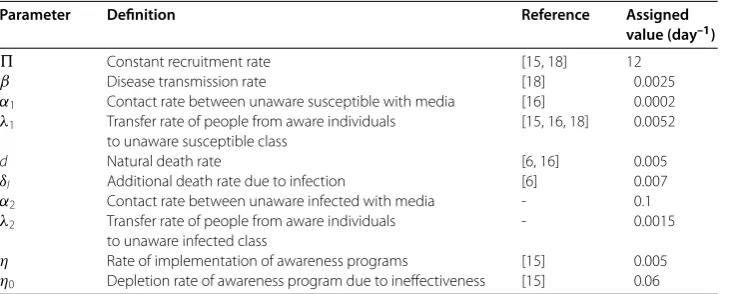
pa-rameter values is given in Table . These values are collected from different peer reviewed international journals, and the rest are hypothetical parameters relevant to HIV/AIDS. This set of parameter values is constant throughout the numerical experiments except
the values ofλandλ. Numerical simulations are done using MATLAB (version ..).
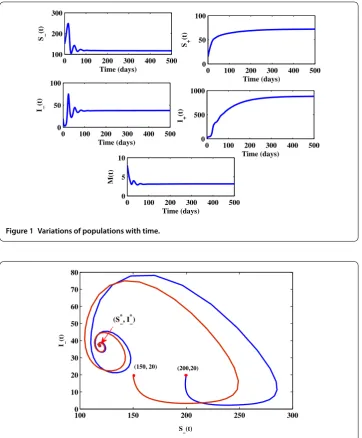
Trajectories for all populations and for cumulative awareness programs are drawn in
Fig-ure , which shows the changes in their behavior at any timet. From this figure, we can see
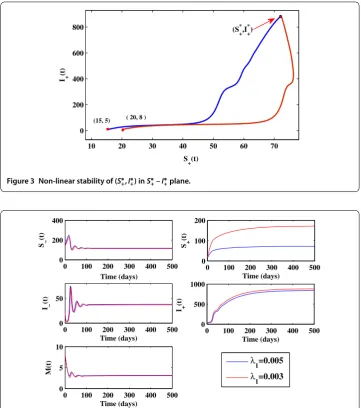
that aware populations start increasing in nature from their initial values and other pop-ulations approach their equilibrium values. The non-linear stabilities of (S∗–,I–∗) inS–∗–I–∗ plane and (S∗+,I+∗) inS∗+–I+∗plane are shown in Figure and Figure , respectively. We can
Table 1 List of parameters used for system (2)
Parameter Definition Reference Assigned
value (day–1)
Constant recruitment rate [15, 18] 12
β Disease transmission rate [18] 0.0025
α1 Contact rate between unaware susceptible with media [16] 0.0002 λ1 Transfer rate of people from aware individuals
to unaware susceptible class
[15, 16, 18] 0.0052
d Natural death rate [6, 16] 0.005
δI Additional death rate due to infection [6] 0.007
α2 Contact rate between unaware infected with media - 0.1
λ2 Transfer rate of people from aware individuals
to unaware infected class
- 0.0015
η Rate of implementation of awareness programs [15] 0.005
Figure 1 Variations of populations with time.
Figure 2 Non-linear stability of (S∗–,I∗–) inS∗––I–∗plane.
see that all trajectories initiating inside the region of attraction approach towards the equi-librium values (S∗–,I–∗) and (S∗+,I+∗). It is also worthy to mention that the rate of transfer from
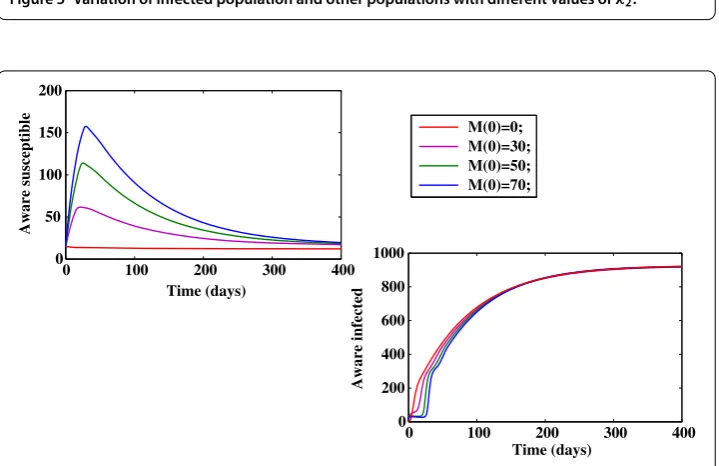
aware class to unaware class,i.e.,λandλ, play an important role in the system. In Figure
and Figure , trajectories are drawn for different values ofλandλ(λ= ., . and
λ= ., .), respectively, and it is found that value changes inλandλalter different
Figure 3 Non-linear stability of (S∗+,I∗+) inS∗+–I∗+plane.
Figure 4 Variation of infected population and other populations with different values ofλ1.
infection rate at a higher prevalence (. <β< .) and compare increased ‘media
awareness campaign’ to become aware of the potential risks and hazards of STD (sexually transmitted disease) like HIV and its countermeasures. Our simulation study reveals that increasing the awareness campaign during high infection period has the potential to delay the onset of infection among aware people for longer period compared to unaware class of population (Figure ). It is also to be noted that the population which has already been infected may show some revival prospect due to the acquired informational wealth, but the response is very slow as they loose self-confidence to recover completely once they become infected.
Numerical illustrations for optimal control induced problems () and () are done, and
we perform optimality test of the system by making the changes of the variableτ =t/tf
and transferring the interval [, ]. Hereτrepresents the step size, used for better strategy
with a line search method, which will maximize the reduction of performance measure.
Figure 5 Variation of infected population and other populations with different values ofλ2.
Figure 6 Awareness performance for different values of media campaign,M0under high infection
scenario (0.002 <β< 0.007).
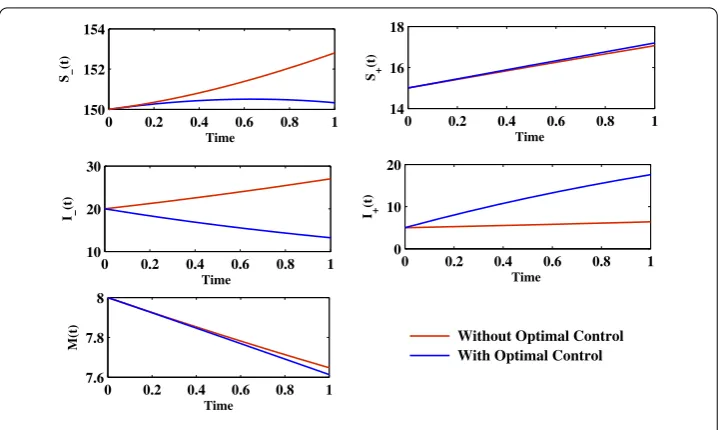
value oftf = . The solution of the optimal system () and ‘control measures’ for
differ-ent populations are displayed in Figure . In this figure, we can see that the control pair,
(u,u) has a meaningful bearing on the system. Note that after inducing control approach,
unaware susceptible and infected population sizes are decreasing, while the sizes of aware susceptible and infected populations are increasing as per our expectation. In Figure ,
control performances of media coverageuanduindicate that the frequency of
Figure 7 The system behavior for optimal control when final time istf= 1 (keeping all other parameters same as before considered).
Figure 8 Optimal control parametersu∗1andu∗2are plotted as the functions of time, keeping all other parameters same.
6 Discussion and conclusion
In this research article, we deal with a non-linear SI mathematical model reflecting the effect of awareness programs on a certain population with constant recruitment rate. We have studied the impact of awareness as a novel intervention for the control of epidemi-ological diseases. In the modeling process, it is assumed that media campaigns create awareness regarding personal protection as well as control AIDS. As a result, behavioral changes (transfer from unaware to aware) occur within the human population, which
re-sults in the formation of a new class,i.e., aware class. Individuals of this class not only
pro-tect themselves from the infection, but being aware they also take part in reducing AIDS by taking precautions. Our analytical study shows that the basic reproduction number
R, which determines the existence of the disease, does not contain any awareness related
transmission and cut down the size of the disease. Numerical simulations, which are very realistic, add an extra dimension to our analytic conclusions. On the basis of the existence conditions and analytical results, we showed that the system has a unique optimal
con-trol pair (u∗,u∗) for which the cost function will be minimum and outcomes will be time
worthy. This implies that the presence of awareness in the population makes the disease expedition difficult and shorter. But in practical sense, disease remains endemic, because factors like low education, ignorance in taking precautions, social problems,
immigra-tionetc.play negative roles in the system. We discuss a simple model that captures some
important features, and we believe these findings may help in controlling AIDS through awareness.
Competing interests
The authors declare that they have no competing interests.
Authors’ contributions
All authors contributed equally to the writing of this paper. All authors read and approved the final manuscript.
Acknowledgements
The authors would like to thank the referees for their constructive and insightful comments, which helped us to improve the quality of this work. This work is supported by the Department of Science and Technology, Government of India.
Received: 2 March 2015 Accepted: 18 June 2015 References
1. www.who.int/gho/hiv/en
2. http://www.worldbank.org/en/news/feature/2012/07/10/hiv-aids-india
3. Del Valle, S, Evangelista, AM, Velasco, MC, Kribs-Zaleta, CM, Schmitz, SH: Effects of education, vaccination and treatment on HIV transmission in homosexuals with genetic heterogeneity. Math. Biosci.187, 111-133 (2004) 4. Gumel, AB, Moghadas, SM, Mickens, RE: Effect of a preventive vaccine on the dynamics of HIV transmission.
Commun. Nonlinear Sci. Numer. Simul.9, 649-659 (2004)
5. Baryarama, F, Luboobi, LS, Mugisha, JYT: Periodicity of the HIV/AIDS epidemic in a mathematical model that incorporates complacency. Am. J. Infect. Dis.1(1), 55-60 (2005)
6. Hove-Musekwaa, SD, Nyabadza, F: The dynamics of an HIV/AIDS model with screened disease carriers. Comput. Math. Methods Med.10(4), 287-305 (2009)
7. Roy, PK, Chatterjee, AN, Greenhalgh, D, Khan, QJA: Long term dynamics in a mathematical model of HIV-1 infection with delay in different variants of the basic drug therapy model. Nonlinear Anal., Real World Appl.14, 1621-1633 (2013)
8. Roy, PK, Chatterjee, AN: Effect of HAART on CTL mediated immune cells: an optimal control theoretic approach. In: Electrical Engineering and Applied Computing, vol. 90, pp. 595-607. Springer, Berlin (2011)
9. Roy, PK, Chatterjee, AN: Anti-viral drug treatment along with immune activator IL-2: a control-based mathematical approach for HIV infection. Int. J. Control85(2), 220-237 (2012)
10. Roy, PK, Chowdhury, S, Chatterjee, AN, Chottopadhyay, J, Norman, R: A mathematical model on CTL mediated control of HIV infection in a long term drug therapy. J. Biol. Syst.21(3), 1350019 (2013)
11. Wodarz, D, Nowak, MA: Specific therapy regimes could lead to long-term immunological control to HIV. Proc. Natl. Acad. Sci. USA96(25), 14464-14469 (1999)
12. Wodarz, D, May, RM, Nowak, MA: The role of antigen-independent persistence of memory cytotoxicTlymphocytes. Int. Immunol.12, 467-477 (2000)
13. Kim, WH, Chung, HB, Chung, CC: Optimal switching in structured treatment interruption for HIV therapy. Asian J. Control8(3), 290-296 (2006)
14. Liu, R, Wu, J, Zhu, H: Media/psychological impact on multiple outbreaks of emerging infectious diseases. Comput. Math. Methods Med.8(3), 153-164 (2007)
15. Misra, AK, Sharma, A, Singh, V: Effect of awareness programs in controlling the prevalence of an epidemic with time delay. J. Biol. Syst.19, 389-402 (2011)
16. Samanta, S, Rana, S, Sharma, A, Misra, AK, Chaattopadhyay, J: Effect of awareness programs by media on the epidemic outbreaks: a mathematical model. Appl. Math. Comput.219, 6965-6977 (2013)
17. Van Segbroeck, S, Santos, FC, Pacheco, JM: Adaptive contact networks change effective disease infectiousness and dynamics. PLoS Comput. Biol.6(8), e10008 (2010)
18. Samanta, S, Chattopadhaya, J: Effect of awareness program in disease outbreak - a slow-fast dynamics. Appl. Math. Comput.237, 98-109 (2014)
19. Heffernan, JM, Smith, RJ, Wahl, LM: Perspectives on the basic reproductive ratio. J. R. Soc. Interface2(4), 281-293 (2005)
20. Van den Driessche, P, Watmough, J: Reproduction numbers and sub threshold endemic equilibria for compartmental models of disease transmission. Math. Biosci.180, 29-48 (2000)
22. Kamien, M, Schwartz, NL: Dynamic Optimisation, 2nd edn. North-Holland, New York (1991) 23. Swan, GM: Application of Optimal Control Theory in Biomedicine. Dekker, New York (1984) 24. Fleming, W, Rishel, R: Deterministic and Stochastic Optimal Controls. Springer, New York (1975)