R E S E A R C H
Open Access
A novel compressed sensing-based
non-orthogonal multiple access scheme for
massive MTC in 5G systems
Kesen He
*, Yangqing Li, Changchuan Yin and Yanbin Zhang
Abstract
The main challenges for massive machine type communication in 5G system are to support random access for massive users and to control signaling overhead and data processing complexity. To address these challenges, we propose a novel compressed sensing (CS)-based non-orthogonal multiple access (NOMA) scheme, called CS-NOMA, which introduces low coherence spreading (LCS) signatures to enable joint activity and data detection without requiring the activity information of users in advance. We present a sufficient condition for the construction of the LCS signatures to ensure that a CS-based multi-user detection (CS-MUD) can be effectively deployed in base station. Furthermore, we study the CS-NOMA scheme with imperfect channel state information (CSI) and present a bound for the performance of the CS-NOMA scheme. Simulation results show that the proposed scheme achieves a relatively high system overload (up to 4) when the active users are relatively sparse with an activity ratio of 1%, which implies that the CS-NOMA scheme can significantly improve the spectral efficiency, avoid the control signaling overhead, and reduce the transmission latency.
Keywords: Non-orthogonal multiple access, Compressed sensing, Sparse multi-user detection, Massive machine type communication, Channel state information
1 Introduction
Massive machine type communication (MMTC) char-acterized by the requirements of low data rates, small packet sizes, and in some cases, tight delay constraints is expected to be one of the major drivers for the 5th gen-eration (5G) wireless communication system. In the 5G system, a single base station will serve 10 to 100 times more machine type devices (MTDs) than the personal mobile phones, which poses great challenges to efficiently support massive users random access [1–3]. According to the statistics of mobile traffics [4], the number of active users is usually much smaller than the number of all possible users even in the busy hours in cellular commu-nications, especially for 5G MMTC applications, where users can sporadically access or leave the system. Thus, the sparsity of user activity naturally exists in massive
*Correspondence:[email protected]
Beijing Laboratory of Advanced Information Networks, Beijing Key Laboratory of Network System Architecture and Convergence, Beijing University of Posts and Telecommunications, Beijing, China
connectivity. In order to reduce the overhead of the MTD transmission, the sparse multi-user detection in the base station (BS) is expected to be deployed without requir-ing the activity knowledge of MTD, thereby reducrequir-ing the control signaling overhead [5].
Recently, compressive sensing (CS) theory [6–8] has been widely used to recover sparse signals and also shows that reliable signal reconstruction far below the Nyquist sampling rate is possible provided that the signal is sparse. In order to address the challenge in future MMTC, the authors in [9–12] propose a novel physical layer signal processing scheme, called CS-based multi-user detection (CS-MUD), which takes advantage of the CS technol-ogy to detect the received sparse multi-user signals. The CS-MUD enables joint activity and data detection, which facilitates a reliable detection of direct random access. In [9, 13], the CS-MUD is deployed in a code division multiple access (CDMA) system. Then, a CS-MUD algo-rithm designed for single-carrier orthogonal frequency division multiplexing (SC-OFDM) systems is proposed in [10]. To improve the flexibility and scalability of accessing
both time and frequency resources, Monsees et al. [11] and Bockelmann et al. [12] apply the CS-MUD to multi-carrier transmissions. However, all these multiple access schemes belong to the category of orthogonal multiple access (OMA), which are difficult to meet the require-ments of massive connectivity for MMTC in 5G systems.
To address the challenge of spectrum scarcity in 5G communications, recently some novel non-orthogonal multiple access (NOMA) schemes [14–20], e.g., the power domain NOMA [14], the low-density spreading (LDS) [15, 16], the sparse code multiple access (SCMA) [17], and the multi-user shared access (MUSA) [18], are pro-posed. In these well-known NOMA schemes, MUD is implemented using the successive interference cancella-tion (SIC) or the message passing algorithm (MPA), which requires the receiver to be exactly notified about the activity information of users in advance, resulting in high-transmission latency and control signaling overhead. In order to address this problem, the authors in [21, 22] proposed grant-free NOMA schemes for the OFDM sys-tem without requiring the activity information of users, which significantly reduces the signaling overhead and transmission latency.
However, nearly all the prior works on CS-based NOMA typically use the pseudo random noise (PN) sequence as the spread signatures and do not consider
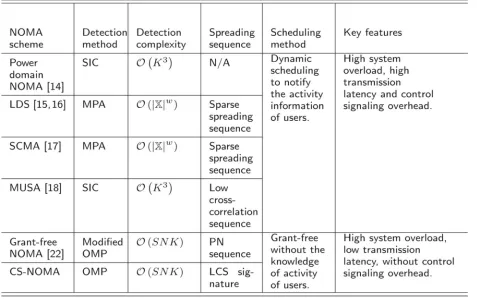
the general construction method for the spread signatures to ensure the sufficient recovery for users’ signals in CS-based multi-user detection. In our recent work [23], we propose a novel CS-based NOMA scheme for the CDMA and /or the OFDM systems in which CS-MUD is deployed to enable joint activity and data detection without knowl-edge of the activity information of the users in advance. In this paper, we further extend the previous work to the more general case. We present a sufficient condition for the construction of the spreading signatures of users to ensure the successful CS-based multi-user detection. We also consider the case when the channel state infor-mation (CSI) is not perfect and present a bound on the performance of the CS-based NOMA scheme. In order to facilitate the understanding of different NOMA schemes in the literature, we compare them for the main different features in Table1. Note that in the table|X|denotes the cardinality of the constellation setX, andwis the max-imum number of nonzero signals superimposed on each chip or subcarrier. In addition,K,S, andNare the num-ber of users, the numnum-ber of active users, and the spreading factor, respectively.
We summarize the main contribution of this paper as follows:
1) We propose a based NOMA scheme, called CS-NOMA, and introduce a new version of spreading
signature, called low coherence spreading (LCS) signature. We also present a sufficient condition for the construction of the LCS signatures and then theoretically prove the reliability of this condition. 2) We present a generating algorithm for the LCS
matrix that consists of the LCS signatures of all users. 3) We present a bound on the performance of signal
reconstruction under the case when the channel state information is not perfect.
The rest of the paper is structured as follows. In Section2, we introduce the system model. In Section3, we provide sufficient condition for the design of LCS signa-tures to ensure that CS-MUD can be effectively deployed in the BS, and present the generating algorithm for the
LCS matrix. In Section 4, we discuss the CS-NOMA
scheme under imperfect CSI. In Section 5, we present the simulation results. Finally, we draw the conclusions in Section6.
Notation: Throughout this paper, vectors and matrices will be represented by boldfaced lowercase and uppercase letters (e.g.,xandX), respectively. All vectors are defined as column vectors. Variables and constants are denoted in lowercase and uppercase letters (e.g.,xandX), respec-tively. Superscript and† represent the transpose and the Moore-Penrose pseudoinverse of a matrix, respec-tively. The notation N(0, 1) is denoted as the Gaussian distribution with zero mean and unit variance, andE{x} represents the mean ofx.
2 System model
We consider an MMTC scenario where a set of users (i.e., MTDs),K = {1, ...,K}, sporadically accesses to a single BS over multi-path wireless channels in the presence of additive white Gaussian noise (AWGN). All users shareN (NK) CDMA chips at the same time, which means that
the gain of the spreading signature isN. Furthermore, we consider that at mostS(SN) users are active in a given time, and letρa = S/K(ρa 1) andβ = K/N(β > 1) denote the activity ratio and the system overload, respec-tively. We assume that the active users transmit symbols from a symbol alphabetA, and the inactive users transmit nothing, i.e., the transmitted symbols are equal to zero. In the following, we present the proposed CS-NOMA scheme for the CDMA system.
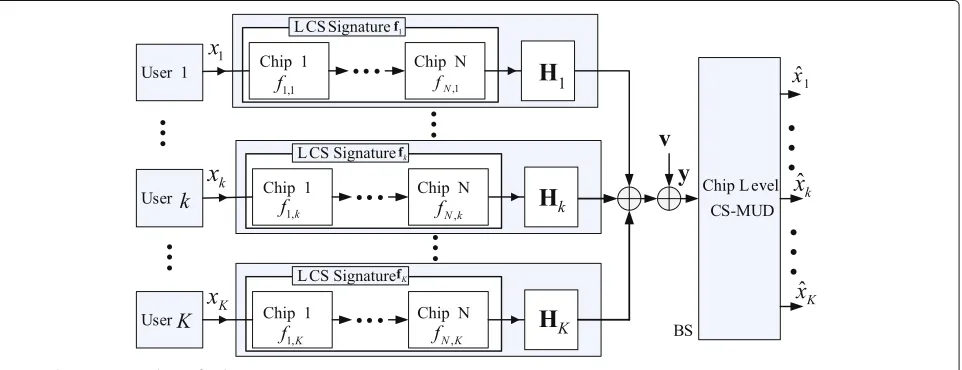
In a conventional CDMA system, user separation can be achieved by uniquely assigning orthogonal spreading signature to each user. However, given the gain N, the number of orthogonal spreading signatures cannot exceed N, which means that the total number of users that the system can support at the same time cannot be greater than N. In our proposed CS-NOMA scheme shown in Fig. 1, we introduce a new version of spreading signa-ture, called low coherence spreading (LCS) signasigna-ture, to achieve the system overload. Unlike orthogonal spreading signatures whose mutual coherence is equal to zero, the mutual coherence between the LCS signatures is non-zero, but is very low, such as far less than 1. Specifically, given the gainN, the number of LCS signatures can exceed N, resulting in a system overload, i.e.,β > 1. Letxk ∈ X be the transmitted symbol of userk ∈ K, where X = {A∪0}, then letx=[x1,. . .,xK] ∈XK×1be the multi-user transmitted signal vector. We assume that at most S users are active at a given time, which means that up to S users transmit symbols while other users transmit nothing at a given time. Thus, based on the CS theory [6], the multi-user transmitted signal vector x is an S-sparse signal vector, i.e., there are at most S non-zero elements inx. Symbolxk spreads over the LCS signature
fk =
f1,k,. . .,fN,k
∈ RN×1for userk. Then, the LCS
matrix is defined by F = [f1,. . .,fK] ∈ RN×K, which contains the LCS signatures of all users.
The proposed CS-NOMA scheme is essentially a typical asynchronous CDMA uplink transmission scheme simi-lar to [24]. Furthermore, the spread symbols of each user are distorted by a user-specific frequency-selective chan-nel with impulse responsehk =
h1,k,. . .,hL,k ∈ CL×1 (k ∈ K) of lengthLwhich is constant for a whole frame, and let H = [h1,. . .,hK] ∈ CL×K denote the channel response matrix of all users with the same number of channel pathsL. Then, considering the effect of convolu-tion operaconvolu-tion of the channels on users’ signals, we can model the channel matrix for userkas
Hk =
where the values of the entries which are not shown in the matrixHk in (1) are zeros, and such typical channel model has been widely used in machine-type communica-tion (MTC) [9,13]. In the BS, the received signal formed byNchips is denoted byy = y1,. . .,yN
∈CN×1, and
the noise vector is defined asv = [v1,. . .,vN] ∈ CN×1. Thus, the received signal vector is given by
y= K
k=1
Hkfkxk+v (2)
=Bx+v, (3)
where the effective channel matrixBcan be written as
B=[H1f1,. . .,HKfK]∈CN×K. (4)
In order to enable joint activity and data detection without requiring the activity knowledge of users, the CS-MUD is deployed in the BS to recover the sparse signal
x in (3). In Fig. 1, xˆ = xˆ1,. . .,xˆK
∈ XK×1 is the estimation of x; and it can be achieved by the orthog-onal matching pursuit (OMP) algorithm [25, 26], which is a typical greed algorithm for CS-MUD. Based on the CS theory [6,7], the effective channel matrixBin (3) is expected to be an effective sensing matrix which guar-antees the recovery of the sparse signalx. In (4),Bis a synthetic matrix generated by the channel matrices (i.e.,
H1,. . .,HK) and the LCS signatures (i.e.,f1,. . .,fK) of all users. Specifically, due to the physical propagation prop-erty of the channel, the channel matrices naturally exist in some form and can not be artificially controlled. Thus, we expect that the effective channel matrixBis an effec-tive sensing matrix. Therefore, in the next section, we will discuss how to design the LCS signatures (i.e., the design ofF) to ensure that the effective channel matrixB
guarantees the recovery of the sparse signalx.
3 Design of the LCS signatures
In this section, we discuss how to design the LCS signa-tures to ensure that the effective channel matrixBin (4) to be an effective sensing matrix which can guarantee the recovery of the sparse signalx. According to the CS the-ory [27,28], coherence of the sensing matrix (i.e.,B) can provide sufficient condition for guaranteeing recovery of the sparse signal. Therefore, by analyzing the coherence of matrixB, we present sufficient conditions at which the LCS signatures should satisfy. Then, based on these con-ditions for the design of the LCS signatures, we present a generating algorithm to construct the LCS matrixF. Note that in this section we only consider the design of LCS signatures and the effective channel matrix in real num-ber value, which can be extended directly to the complex number value case.
3.1 Coherence of the effective channel matrix
Now, we first give the definition of the mutual coherence between two nonzero vectorsa1,a2∈RN×1, i.e.,
that whenK N, the lower bound, known as the Welch
bound [32], is approximatelyμ(A)≥1√N. In order to facilitate analysis, we rewrite (4) as
B=[F1h1,. . .,FKhK]∈RN×K, (7)
In the sequel, we first present a theorem to clarify the conditions at which the LCS signatures should satisfy to ensure the sparse signalxcan be recovered, then based on this theorem, we propose a construction algorithm for the LCS matrix F in Section3.2.
Theorem 1Given two matrices H = [h1,. . .,hK] ∈
The proof of Theorem1is presented in Appendix1.
From Theorem 1, we have an upper bound for the
coherence ofB, which is denoted as
μup= μ2 1−θ−μ1
. (14)
Moreover, from the proof of Theorem1in Appendix1, we have that the upper boundμupis only determined by the LCS signaturesf1,. . .,fK (i.e., matrixF) and has noth-ing to do with the channel response vectors h1,. . .,hK (i.e., matrixH). In [27,28], the authors have proved that the coherence of a sensing matrixB(i.e.,μ(B)) can guar-antee the recovery of S-sparse signal when S satisfies
S< 1
Based on Theorem1, the LCS signatures satisfying the properties (10)-(12) ensure thatμ (B) ≤ μup = 1−μθ−2μ1, so we have the minimum sparsity determined by B as follows channel matrix B absolutely guarantees the recovery of theS-sparse signalx.
In summary, Theorem1presents a sufficient condition for the construction of the LCS signatures. Specifically, when the LCS signatures or the matrixFsatisfy the prop-erties in (10)-(12), based on the above discussion, we can ensure that the effective channel matrixBin (3) is an effec-tive sensing matrix which can guarantee the recovery of Smin-sparse signalx.
In order to further interpret the proposed CS-NOMA scheme with the LCS signatures satisfying Theorem1, we introduce the restricted isometry property (RIP)[7] which is another necessary and sufficient condition for guaran-teeing the recovery of the sparse signalxin the presence of noise [7, 27]. First, we give the definition of RIP, i.e., a matrix Asatisfies the RIP of order S if there exists a
δS∈(0, 1)such that
(1−δS)x22≤ Ax22≤(1+δS)x22 (17)
holds for allS-sparse signalx. In the following, we present a corollary of Theorem 1, which analyzes the RIP ofB
consisting ofHwith unit-norm columns.
Corollary 1In Theorem 1, when H has unit-norm columns, i.e.,hk22=1,1≤k≤K , thenBhas the RIP of order S with constantδS=θ+μ1+(S−1)μ2for arbitrary S<1+1/μup, i.e.,
(1−δS)x22≤ Bx22< (1+δS)x22, (18)
wherex∈RK×1is an S-sparse signal.
The proof of Corollary 1 is presented in Appendix2. In this paper, we assume that each user has the same transmit power and then normalize the channel response vectors of all usersh1,. . .,hK, then the channel response matrixHwill have unit-columns. In addition, the authors of [34,35] have proved that a matrixAsatisfying the RIP of order 2Scan guarantee the recovery of theS-sparse signal. Thus, in our CS-NOMA scheme, from Corollary 1, the LCS signatures satisfying Theorem1ensure thatBhas the RIP of order 2S < 2Smin = 1+1/μupwhich guarantees the recovery ofS-sparse signal in the presence of noise.
Based on the above analysis, the LCS signatures satis-fying Theorem1 can guarantee the recovery of a sparse signal either in terms of the coherence property or RIP. In the following, we present a generating algorithm for the LCS matrixFbased on Theorem1.
3.2 Generating algorithm of the LCS matrixF
Based on the results in Theorem1, the LCS matrixF ∈
following distribution N = M, which implies that the entries of ξ are inde-pendent realizations of±Bernoulli random variables with
ςn:=
following, we give some interpretation on Algorithm 1.
Algorithm 1Construction of the LCS matrixF
Input: K,N,M,L,μ1,μ2.
In Algorithm 1,procedure1 andprocedure2 ensure that the designed LCS signatures satisfy the properties in (10) and (11), respectively. Inprocedure1, we randomly gener-ateξ and letfj = ξ, repeating this process until finding a LCS matrixFis initialized asfjobtained inprocedure1. Kiterdenotes the number of the columns ofF and is ini-tialized as 1.Nexceis defined as the number of the columns
ofF that makesμkjmax = maxn
and is initialized as 0 in each repeat of thewhileat line 11. Then,fjandFjare updated by implementingprocedure1. We compute theμkjmaxbetweenfk(1≤k≤Kiter) andfj. If
μkj
max> μ2, i.e.,Nexce=1, we stop thewhileat line 14 and then repeat thewhileat line 11. Ifμkjmax≤μ2for arbitrary k, i.e.,Nexce=0, we updateF =F∪fj,Kiter= Kiter+1, and then repeat thewhileat line 11. We repeat the above operations until K = Kiter, and finally output the LCS matrixF.
4 Effect of the imperfect channel state information (CSI)
Since the CS-MUD is applied to perform joint activity and data detection, the BS needs to know the sensing matrix B = [F1h1,. . .,FKhK] based on the CS theory [7]. Because the LCS matrix F is designed in advance, i.e.,Fk (1 ≤ k ≤ K) is known to the BS. The channel response vectorhk (1 ≤k ≤ K) is generally obtained by using a channel estimation algorithm in BS. However, the channel state information (CSI) is generally not perfect, which means that there exists some error in the estima-tion of hk in BS. Let hˆk and ek denote the estimated channel response vector and the error vector of user k, respectively. Then, we have estimated matrix of Bin the BS. From Theorem 1, we know that the upper bound of μ(B), i.e., μup, is only determined by the LCS signatures f1,. . .,fK (i.e., the LCS matrix F) and has nothing to do with the chan-nel response vectorsh1,. . .,hK (i.e., the channel response matrixH). Specifically, the differences between BandBˆ
only exist in the channel response vectors, i.e., BandBˆ
have the same upper bound of coherenceμup. Then, the coherence ofBˆ, i.e.,μ(Bˆ), satisfies the inequality
which implies thatBˆ is also an effective sensing matrix. In the sequel, we analyze the performance of sig-nal reconstruction under the imperfect CSI case for the CS-NOMA scheme. We first introduce Theorem
2 which plays an important role in analysis of the
Theorem 2(Theorem 3.1 in [36]). Suppose that the coherence ofA ∈ RN×K (N K ) isμA andx ∈ RK×1
is an S-sparse signal, where S < (1/μA+1) /4.
Further-more, suppose that the measurementy∈RN×1is obtained byy=Ax+n, wheren∈RN×1is a noise vector. Then, the estimation ofxis given by
ˆ
Theorem2provides a bound for the worst-case perfor-mance given a bounded noisen, i.e.,n2≤C, whereCis an absolute constant [36,37]. Note that this theorem holds for the case when =0 as well asn2=0. Thus, it also applies to the noise-free setting. Furthermore, there is no restriction onn2≤. In fact, this theorem is valid even when=0 butn2=0 [37]. However, as noted in [36], Theorem2is the result of a worst-case analysis and will typically overestimate the actual error.
In the perfect CSI case, from Theorem 2, the CS-NOMA scheme has a coherence-based bound on the performance for the bounded noisev, which is given by
x− ˆx2≤ √ v2+ In this paper, we denote the perfect LCS signatures as ones that are designed with the parametersμ1 → 0,μ2 → 0, andθ = 1 (i.e.,μB → 0). From (25), the CS-NOMA
scheme using the perfect LCS signatures has a bound, i.e.,
x− ˆx2≤ v2+. (26)
In fact, the channel response estimation error can eventually be considered as a noise error. Thus, based
on Theorem 2, we analyze the bound on the
perfor-mance of the CS-NOMA scheme under imperfect CSI
for bounded ek, 1 ≤ k ≤ K. For the correspond-triangle inequality [38], we have
n2= Bex+v2≤ Bex2+ v2. (28)
where λDmin and λDmax are the minimum and maximum eigenvalues ofD = BeBe ∈ RK×K, respectively.D is ofD, thendk,jsatisfies the following properties:
• (1−θ−μ1)e22≤dk,k≤(1+μ1)e22, ∀k;
• K
j=1,j=k
dk,j≤(K−1)μ2e22, ∀k.
From Theorem3in Appendix1, we have that
λ (D)≤(1+μ1+μ2(K−1))e22=ϕe22, (33)
Thus, from Theorem2, we have the coherence-based bound on the performance of the CS-NOMA scheme in the case that CSI is not perfect, i.e.,
which is supported by the perfect LCS signatures. Note that (36)-(37) are the results of the worst-case analysis and typically overestimate the actual error.
5 Simulation results
In our simulations, we consider an MMTC scenario in whichK users sporadically access to a single BS over the multi-path wireless channels in the presence of AWGN. All users share N CDMA chips, i.e., the gain of LCS signature is N. We adopt BPSK modulation and assume that all users’ wireless channels have L paths. Here, we consider that the entries of the channel response vec-tor hk (1 ≤ k ≤ K) follow i.i.d. N(0, 1) for user k. Furthermore, we also discuss the case that the CSI is not perfect and assume that the entries of the channel response estimated error vectorek(1 ≤k ≤K) are i.i.d. Gaussian variables withN0,σ2(σ2 1). In addition, the LCS matrixF ∈ RN×K is generated by Algorithm 1 with the predetermined parametersM,μ1,μ2. The OMP [25,26] are employed to demonstrate the effectiveness of the proposed scheme. We evaluate the mean-square-error (MSE) performance, which is defined as
MSE =xˆ−xx2
2 , (38)
wherexˆis an estimate ofx.
Based on the analysis in Section4, we present the MSE performance for the cases that the CSI is perfect and imperfect. using the perfect LCS signatures (i.e.,μB→0), we have
MSE1= v2+
Note that (39)-(42) are the worst-case results and typi-cally overestimate the actual MSEs. In addition, we con-sider =0 for these MSEs in (39)-(42).
5.1 Validation for the coherences with different LCS signatures
For ease of reference, we denote μ(B)max as the maxi-mum coherence of different B that consist of different H and a fixedF, and μ(Bˆ)max is defined as the maxi-mum coherence of differentBˆ which consist of different
ˆ
H = hˆ1,. . .,hˆK
and a fixedF. Furthermore, for com-parison, we give a counterexample of the LCS matrixF, which is given by
¯
F=[I,F] , (43)
whereIandFare the identity matrix and the LCS matrix generated by Algorithm 1, respectively. For the identity matrixI, we have thatθ = 1 andμ2 = 1, which implies that the LCS signatures inF¯ do not satisfy the properties (11) and (12) in Theorem1.
Figure2showsμ(B)versusμ1,μ2withN =M=800,
β = 1.5,L = 4. Note thatBF andBF respectively rep-resent the cases that consist ofFandF, andBˆFdenotes
the matrixBˆ that consists ofFin the imperfect CSI case with 1/σ2= 10 dB. From the figure, we see that, for
dif-max, but lower than the plane of
μBFmax. Thus, whenμ1andμ2are given (i.e., givenF),
maxare always less thanμup, i.e.,
μupis the upper bound ofμ (B)andμ
ˆ
B. These results verify that the designed LCS matrix F can ensure that the coherence of the effective channel matrix, i.e.,μ(B), has an upper boundμup that has nothing to do with the channel response matrixH. Since the differences between
ˆ
BandBonly exist in the channel response matrix,μ(Bˆ)
andμ(B) have the same upper bound μup. In addition, since the LCS signatures inF do not satisfy Theorem1,
μBFmaxis always equal to 1 for differentμ1andμ2. In summary, these simulation results verify the validity of the designed LCS signatures based on Theorem1.
5.2 Performance in perfect CSI case
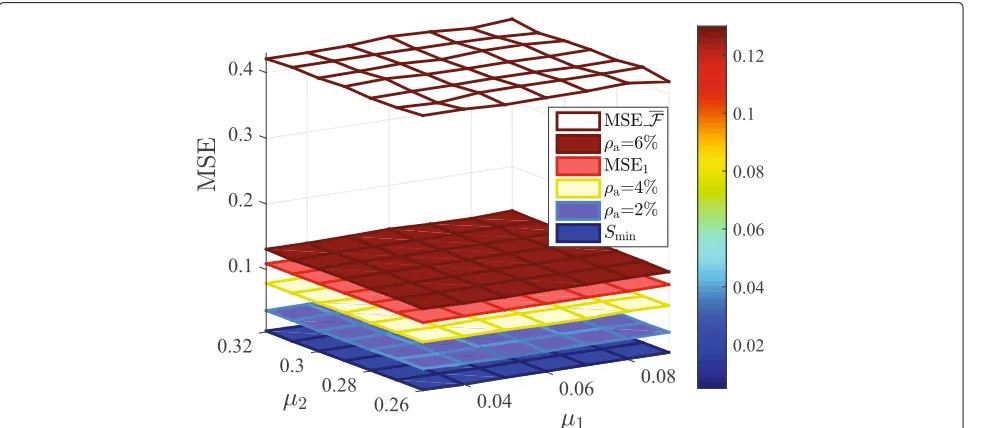
Figure3shows the MSE versusμ1,μ2for different
spar-sities withN = M = 800,L = 4,β = 1.5, and SNR
= 25 dB. In the figure, the notation MSE_F represents the MSE performance of the CS-NOMA scheme using the LCS matrixF in (43) withρa = 1%. Note that the CS-NOMA scheme always adopts the LCS matrixF satis-fying Theorem1unless otherwise specified in this paper. It can be seen from the figure that for different μ1and
μ2 (within a certain range, e.g., 0.03 ≤ μ1 ≤ 0.09 and 0.26≤μ2≤0.32), the MSE performances are almost the same when the sparsity of the signalxis given. In addition, the MSE performance of the CS-NOMA scheme using the LCS matrix F is the best when the sparsity ofxisSmin, and it decreases with the increase ofρa; whenρa = 6%, it is worse than the MSE1performance which is achieved by using perfect LCS signatures. As for comparison, the MSE_Fperformance is the worst, which implies that the
Fig. 2μ(B)versusμ1andμ2withN=M=800,β=1.5, andL=4
Furthermore, we also simulate the MSE versus SNR for different sparsities withN = M = 800,L = 4,β = 1.5,
μ1 = 0.03, andμ2 = 0.26, as shown in Fig.4. It can be seen that the MSE performance of the CS-NOMA scheme withFimproves with the increase of SNR and decreases with the increase ofρa; whenρa ≥ 5%, it is close to the MSE1 performance at high SNR, but always better than the MSEμperformance. However, as for comparison, the MSE_Fperformance is almost unchanged and quite poor for different SNR, even worse than both MSE1and MSEμ performances at high SNR.
In Fig.5, we show the MSE versus SNR for differentβ
withN = M = 800,L = 4,ρa = 1%,μ1 = 0.03, and
μ2 = 0.28. From the figure, it can be seen that the MSE performance of the CS-NOMA scheme improves with the reduction ofβ at the same conditions. In addition, the MSE performance of the CS-NOMA scheme is always better than the MSE1performance whenβ≤4. But, when
β = 5, it is worse than the MSE1 performance at high SNR, e.g., SNR≥ 20 dB. Thus, the proposed scheme can achieve a system overload of 4 when the active users are relatively sparse with an activity ratio of 1%.
Fig. 4The MSE versus SNR for different sparsities withN=M=800, L=4,β=1.5,μ1=0.03, andμ2=0.26
In addition, we also provide the BER performance of the
CS-NOMA scheme in Fig.6withN = M= 800,L =4,
β = 1.5,μ1 = 0.03, andμ2 = 0.26. In the figure, we compare the BER performances of the CS-NOMA scheme using the LCS signature with that using the PN signature which is the typical spreading sequence in CS-based MTC [9,13,21,22]. Here, after the column vector normaliza-tion of the PN matrix which contains the PN signatures of all users, we obtainθ = L/M = 1/200,μ1 = 0.31,
and μ2 = 0.47 for the PN matrix withL = 4, which
indicates that the PN matrix satisfies Theorem1. There-fore, these PN signatures used in the simulation are also LCS signatures, as such the BER performance of the CS-NOMA schemes using the LCS signature are almost the same with that using the PN signature at the same spar-sity. These results further validate the availability of our proposed scheme.
Fig. 5The MSE versus SNR for differentβwithN=M=800,L=4,
ρa=1%,μ1=0.03, andμ2=0.28
Fig. 6The BER versus SNR for different spreading signatures with N=M=800,L=4,β=1.5,μ1=0.03, andμ2=0.26
From the simulation results in Figs.3,4,5, and6, we can see that the designed LCS signatures based on Theorem1 can provide guarantee for the recovery of at least Smin -sparse signalx. In addition, both MSEμand MSE1provide bounds for the MSE for the proposed CS-NOMA scheme. It also admits the validity of the proposed CS-NOMA scheme. Furthermore, the proposed scheme achieves a relatively high system overload when the active users are relatively sparse, which implies that the CS-NOMA scheme can significantly improve the spectral efficiency.
5.3 Performance in imperfect CSI case
Figure7shows the MSE versusμ1,μ2in the imperfect CSI
case withN = M = 800, β = 1.5, L = 4,ρa = 1%,
and SNR = 25 dB. In the figure, the notations 15 dB repre-sents 1/σ2 = 15 dB. We can see that for differentμ1,μ2 (within a certain range, e.g., 0.03≤μ1≤0.09 and 0.26≤
μ2 ≤ 0.32), the MSE performances are almost the same when 1/σ2is given. Additionally, the MSE performance in
Fig. 8The MSE versus SNR in the imperfect CSI case with N=M=800,β=1.5,L=4,ρa=1%,μ1=0.03, andμ2=0.26
the imperfect CSI case improves with the increase of 1/σ2 and is better than the MSE2performances, but it is worse than the MSE performance in the perfect CSI case with the same conditions. These results imply that even in the imperfect SCI case, the LCS matrixFensures thatBis an effective sensing matrix.
In order to analyze the MSE performance in the imper-fect CSI case for different SNRs, Fig.8 shows the MSE versus SNR withN =M=800,β =1.5,L=4,ρa=1%,
μ1 = 0.03, andμ2 = 0.26. From the figure, we can see that the MSE performance improves with the increase of SNR, and it also improves with the increase of 1/σ2 in the imperfect CSI case. Furthermore, the MSE2results are better than other MSE results at the same SNR.
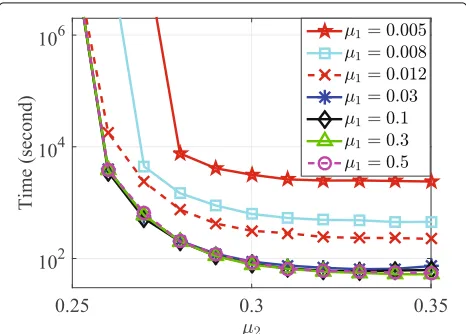
Fig. 9Simulation time of Algorithm 1 versusμ2for differentμ1with N=M=800,L=4, andβ=1.5
The results in Figs.7and8imply that the LCS matrix Fdesigned based on Theorem1ensures effective recov-ery of sparse signal even in the imperfect CSI case. In addition, the proposed CS-NOMA scheme enables joint activity users and data detection through CS-MUD, even if the CSI is not perfect.
5.4 Convergence and computational complexity of the proposed algorithm
It is hard to theoretically analyze the convergence performance and the complexity of Algorithm 1; there-fore, we use simulation approach to numerically quantify these performances. Figure9shows the simulation time of Algorithm 1 versusμ2for differentμ1. From the figure, we can see that when μ1are fixed, the simulation time slowly increases with decrease ofμ2. But it will tend to be infinite whenμ2is below a certain value, e.g.,μ2 < 0.26 forμ1 > 0.03. This indicates that Algorithm 1 may not be convergent whenμ2is below a certain value. Further-more, whenμ2is fixed, the simulation time decreases with increase ofμ1, but is almost saturated whenμ1is greater than a certain value, e.g., μ1 > 0.03. And, the conver-gence time of Algorithm 1 also increases with decrease ofμ1. The results imply that the convergence and com-putational complexity of Algorithm 1 are significantly affected byμ1andμ2, especially whenμ1andμ2take low values.
6 Conclusions
In this paper, a novel CS-NOMA scheme for MMTC in 5G was proposed to enable joint detection of active users and their data. Due to the introduction of the LCS signature, the proposed CS-NOMA scheme can achieve a relatively high system overload. Then, we presented a theorem for guiding the design of the LCS signatures which provided the theoretical guarantee for ensuring that the CS-MUD could be effectively deployed in the base station. Further-more, we presented a construction algorithm for the LCS matrix. We also discussed the imperfect CSI case and presented a corresponding bound for the performance of signal recovery for the CS-NOMA scheme. The sim-ulation results shown that the CS-NOMA scheme not only supported massive access, but also had high spectral efficiency and low transmission latency.
Appendix 1
In order to prove Theorem1, we first provide Theorem3 that plays an important role in the proof of Theorem1.
Theorem 3(Gershgorin Circle Theorem, Theorem2in [39]).The eigenvalues of an N×N matrixMwith entries mij,1≤i,j≤N, lie in the union of N discs di =di(ci,ri), 1 ≤ i ≤ N, centered at ci = mii and with radius ri =
Now, we prove Theorem1in the following.
ProofBased on the definition of coherence for a matrix,
μ (B)can be written as
where λkmin and λkmax are the minimum and maximum eigenvalues ofGk = FkFk ∈ RL×L, respectively. Letgmk,n
thengmk,nsatisfies the following properties:
• 1−θ ≤gmk,m≤1, 1≤m≤L, ∀k;
From Theorem3, all the eigenvalues ofGk satisfy the following inequality
1−θ−μ1≤λ
Gk≤1+μ1, ∀k, (47)
whereλ (A)represents the eigenvalues ofA. This implies that 1−θ−μ1≤λmink < λkmax≤1+μ1. Thus, for arbitrary In addition, since all columns of Fk are linearly inde-pendent (i.e.,Fk is full rank),Gk is a Gram matrix which means thatGkis positive definite. Thus, from Theorem3, the inequalityθ+μ1<1 is necessary to be held.
Step 2. Now, we discuss the upper bound of Fkhk,Fjhj which can be rewritten as hk,FkFjhj,
whereλkjmaxrepresents the maximum eigenvalue ofPkj =
sum of the absolute values of elements int-row ofPkj, i.e., thermore, from the root-mean square-arithmetic mean-geometric mean (RMS-AM-GM) inequality [40], we have
L Therefore, combining (49) and (54), we have the upper bound ofμFkhk,Fjhj the proof of Theorem1.
Appendix 2
Now we prove Corollary 1 using the similar tricks in the proof of Theorem1as follows.
Proof Let be an arbitrary subset of {1,. . .,K} and || =S, then B ∈ RN×S is obtained by only keeping the columns of B corresponding to . Similar to this, HandFare obtained by only keeping the columns of
HandF corresponding to, respectively. Thus,B is
(1 ≤ s ≤ S) ofHandF, respectively. Accordingly,Fs
This work is supported in part by the National Natural Science Foundation of China under Grants 61671086 and 61629101, the 111 Project (NO.B17007), and the Director Funds of Beijing Key Laboratory of Network System Architecture and Convergence (NO.2017BKL-NSAC-ZJ-04).
Funding Not applicable.
Availability of data and materials Not applicable.
Authors’ contributions
The authors have contributed jointly to all parts of the preparation of this manuscript, and all authors read and approved the final manuscript.
Authors’ information Not applicable.
Competing interests
The authors declare that they have no competing interests.
Publisher’s Note
Springer Nature remains neutral with regard to jurisdictional claims in published maps and institutional affiliations.
Received: 14 November 2017 Accepted: 5 March 2018
References
1. 3GPP, Service requirements for machine-type communications (MTC). Rel.12, 2–27 (2013)
2. JG Andrews, S Buzzi, W Choi, SV Hanly, A Lozano, AC Soong, JC Zhang, What will 5G be?. IEEE J Sel. Areas Commun.32(6), 1065–1082 (2014)
3. N Alliance, 5G white paper. Next Gener. Mob. Netw. White Pap (2015).
https://www.ngmn.org/5g-white-paper/5g-white-paper.html
4. J-P Hong, W Choi, BD Rao, Sparsity controlled random multiple access with compressed sensing. IEEE Trans. Wirel. Commun.14(2), 998–1010 (2015)
5. M Hasan, E Hossain, D Niyato, Random access for machine-to-machine communication in LTE-advanced networks: Issues and approaches. IEEE Commun. Mag.51(6), 86–93 (2013)
6. DL Donoho, Compressed sensing. IEEE Trans. Inf. Theory.52(4), 1289–1306 (2006)
7. EJ Candès, T Tao, Near-optimal signal recovery from random projections: Universal encoding strategies?. IEEE Trans. Inf. Theory.52(12), 5406–5425 (2006)
8. W Chen, MR Rodrigues, IJ Wassell, Projection design for statistical compressive sensing: A tight frame based approach. IEEE Trans. Signal Process.61(8), 2016–2029 (2013)
9. C Bockelmann, HF Schepker, A Dekorsy, Compressive sensing based multi-user detection for machine-to-machine communication. Trans. Emerg. Telecommun. Technol.24(4), 389–400 (2013)
10. Y Beyene, C Boyd, K Ruttik, C Bockelmann, O Tirkkonen, R Jäntti, in
AFRICON, 2015. Compressive sensing for MTC in new LTE uplink multi-user random access channel (IEEE, Addis Ababa, 2015), pp. 1–5
11. F Monsees, M Woltering, C Bockelmann, A Dekorsy, in2015 IEEE 81st Vehicular Technology Conference (VTC Spring). Compressive sensing multi-user detection for multicarrier systems in sporadic machine type communication (IEEE, Glasgow, 2015), pp. 1–5
12. C Bockelmann, F Monsees, M Woltering, A Dekorsy, Hardware-in-the-loop measurements of the multi-carrier compressed sensing multi-user detection (mcsm) system. arxiv preprint arxiv:1511.09278 (2015) 13. HF Schepker, A Dekorsy, in2011 8th International Symposium on Wireless
Communication Systems (ISWCS). Sparse multi-user detection for cdma transmission using greedy algorithms (IEEE, Aachen, 2011), pp. 291–295 14. Y Saito, Y Kishiyama, A Benjebbour, T Nakamura, A Li, K Higuchi, in2013
IEEE 77th Vehicular Technology Conference (VTC Spring). Non-orthogonal multiple access (NOMA) for cellular future radio access (IEEE, Dresden, 2013), pp. 1–5
15. R Hoshyar, FP Wathan, R Tafazolli, Novel low-density signature for synchronous cdma systems over awgn channel. IEEE Trans. Signal Proc. 56(4), 1616–1626 (2008)
16. M Al-Imari, P Xiao, MA Imran, R Tafazolli, in2014 11th International Symposium on Wireless Communications Systems (ISWCS). Uplink non-orthogonal multiple access for 5g wireless networks (IEEE, Barcelona, 2014), pp. 781–785
17. H Nikopour, H Baligh, in2013 IEEE 24th International Symposium on Personal Indoor and Mobile Radio Communications (PIMRC). Sparse code multiple access (IEEE, London, 2013), pp. 332–336
18. Z Yuan, G Yu, W Li, Multi-user shared access for 5g. Telecommun. Netw. Technol.5(5), 28–30 (2015)
19. Z Ding, X Lei, GK Karagiannidis, R Schober, J Yuan, VK Bhargava, A survey on non-orthogonal multiple access for 5g networks: Research challenges and future trends. IEEE J. Sel. Areas Commun.35(10), 2181–2195 (2017) 20. L Dai, B Wang, Y Yuan, S Han, I Chih-Lin, Z Wang, Non-orthogonal
multiple access for 5G: Solutions, challenges, opportunities, and future research trends. IEEE Commun. Mag.53(9), 74–81 (2015)
21. B Wang, L Dai, T Mir, Z Wang, Joint user activity and data detection based on structured compressive sensing for noma. IEEE Commun. Lett.20(7), 1473–1476 (2016)
22. B Wang, L Dai, Y Zhang, T Mir, J Li, Dynamic compressive sensing-based multi-user detection for uplink grant-free noma. IEEE Commun. Lett. 20(11), 2320–2323 (2016)
23. K He, Y Li, C Yin, in2016 IEEE 27th Annual International Symposium on Personal, Indoor, and Mobile Radio Communications (PIMRC). Sparse multi-user detection for non-orthogonal multiple access in 5G systems (IEEE, Valencia, 2016), pp. 1–5
24. L Applebaum, WU Bajwa, MF Duarte, R Calderbank, Asynchronous code-division random access using convex optimization. Phys. Commun. 5(2), 129–147 (2012)
26. JA Tropp, AC Gilbert, Signal recovery from random measurements via orthogonal matching pursuit. IEEE Trans. Inf. Theory.53(12), 4655–4666 (2007)
27. MF Duarte, YC Eldar, Structured compressed sensing: From theory to applications. IEEE Trans. Signal Process.59(9), 4053–4085 (2011) 28. DL Donoho, M Elad, Optimally sparse representation in general
(nonorthogonal) dictionaries via1minimization. Proc. Natl. Acad. Sci. 100(5), 2197–2202 (2003)
29. DL Donoho, X Huo, Uncertainty principles and ideal atomic decomposition. EEE Trans. Inf. Theory.47(7), 2845–2862 (2001) 30. JA Tropp, Greed is good: Algorithmic results for sparse approximation.
EEE Trans. Inf. Theory.50(10), 2231–2242 (2004)
31. R Gribonval, M Nielsen, Sparse representations in unions of bases. EEE Trans. Inf. Theory.49(12), 3320–3325 (2003)
32. L Welch, Lower bounds on the maximum cross correlation of signals. EEE Trans. Inf. Theory.20(3), 397–399 (1974)
33. T Strohmer, RW Heath, Grassmannian frames with applications to coding and communication. Appl. Comput. Harmon. Anal.14(3), 257–275 (2003) 34. EJ Candès, T Tao, Decoding by linear programming. IEEE Trans. Inf.
Theory.51(12), 4203–4215 (2005)
35. MA Davenport, Random observations on random observations: Sparse signal acquisition and processing. PhD thesis, Rice University (2010) 36. DL Donoho, M Elad, VN Temlyakov, Stable recovery of sparse
overcomplete representations in the presence of noise. IEEE Trans. Inf. Theory.52(1), 6–18 (2006)
37. MA Davenport, MF Duarte, YC Eldar, G Kutyniok, Introduction to compressed sensing. Preprint.93(1), 2 (2011)
38. N Bourbaki,Topological Vector Spaces: Chapters 1–5. (Springer Science & Business Media, France, 2013)
39. SA Geršhgorin, Über die abgrenzung der eigenwerte einer matrix. Akad. Nauk SSSR Ser. Fiz.-Mat. (6), 749–754 (1931)
40. PS Bullen, DS Mitrinovic, M Vasic,Means and Their Inequalities, vol. 31.