R E S E A R C H
Open Access
Exponential stability for differential equations
with random impulses at random times
Ravi Agarwal
1*, Snezhana Hristova
2and Donal O’Regan
3*Correspondence:
1Department of Mathematics, Texas
A&M University-Kingsville, Kingsville, 78363, USA
Full list of author information is available at the end of the article
Abstract
Impulsive differential equations with impulses occurring at random times arise in the modeling of real world phenomena in which the state of the investigated process changes instantaneously at uncertain moments. The investigation of these differential equations uses ideas in the qualitative theory of differential equations and probability theory. In this paper differential equations with randomly occurring impulses are considered and thep-moment exponential stability of the solutions is studied.
MSC: 34A37; 34E05
Keywords: impulsive differential equations; random moments of impulses; p-moment exponential stability
1 Introduction
Impulsive differential equations are studied extensively in the literature. Many authors consider impulsive differential equations with determined impulsive moments (see, for example, the monographs [–] and the references cited therein). However, in some real world phenomena the investigated process changes instantaneously at uncertain mo-ments. When modeling such processes, it is necessary to use random variables in jump conditions and impulsive differential equations with random impulses occurring at ran-dom moments. The presence of ranran-domness in the jump condition changes the behavior of solutions of differential equations significantly. In the case of impulses occurring at ran-dom moments, the solution is a stochastic process.
In the literature a number of results have been obtained for stochastic differential equa-tions with jumps [–]. Also, some results on the qualitative properties of equaequa-tions with random impulses have been obtained [–]. In the monograph [], impulsive differential equations with fixed impulses and random amplitude of jumps were studied.
In this paper we study nonlinear differential equations subject to random impulses oc-curring at random moments. Randomness is introduced both through the time between impulses, which is distributed exponentially, and through the amount of impulses. The p-moment exponential stability of the solution is studied by employing appropriate gen-eralized Lyapunov’s functions. In the literature many authors study the stability of impul-sive systems with deterministic moments of impulses (see [, , ] and the references cited therein), the exponential stability of impulsive delay differential equations with determin-istic moments of impulses [–] and thep-moment stability of stochastic differential equations with or without impulses [, , , ]. The behavior of solutions of stochastic equations is totally different from the behavior of ordinary differential equations, so the
study of stability properties of differential equations with impulses occurring at random moments is important.
2 Preliminary notes and results
Let the probability space (,F,P) be given. Let{τk}∞k=be a sequence of independent
ex-ponentially distributed random variables with a parameterλ> that are defined on the sample space. We will call the random variablesτk waiting times since they will de-fine the time between two consecutive impulses of the considered impulsive differential equation.
Define the sequence of random variables{ξk}∞k=such thatξ=Tandξk=T+
k
i=τi, k= , , . . . , whereT≥ is a fixed point.
We note that{ξk}∞k=is an increasing sequence of random variables.
Assume∞k=τk=∞with probability . Lett≥Tbe a fixed point. Consider the events
Sk(t) =
ω∈:ξk(ω) <t<ξk+(ω)
, k= , , . . . .
Let the pointstkbe arbitrary values of the random variablesτk,k= , , . . . , correspond-ingly. Define the increasing sequence of pointsTk=
k
i=ti,k= , , , . . . , that are values of the random variablesξk. Consider the initial value problem for the scalar impulsive differential equation with fixed points of impulses
x=ft,x(t) fort≥T,t=Tk,
x(Tk+ ) =Ik
tk,x(Tk– )
fork= , , . . . ,
x(T) =x,
()
wherex∈Rn,f: [,∞)×Rn→Rn,I
k: [,∞)×Rn→Rnandx∈Rn.
The solution of the impulsive differential equation with fixed moments of impulses () depends not only on the initial condition (T,x) but on the moments of impulsesTk, k= , , . . . ,i.e., the solution depends on the initially chosen arbitrary values tk of the random variablesτk,k= , , . . . . We denote the solution of initial value problem () by x(t;T,x,{tk}). We will assume thatx(Tk;T,x,{tk}) =limt→Tk–x(t;T,x,{tk}).
Remark We note that the length of the interval (Tk,Tk+) of the continuity of the
solu-tions of the initial value problem for impulsive differential equation with fixed moments of impulses () is equal totk, that is, a value of the random variableτk, called the waiting time. The set of all solutionsx(t;T,x,{tk}) of the initial value problem for the impulsive dif-ferential equation () for any valuestkof the random variablesτk,k= , , . . . , generates a stochastic process with state spaceRn. We denote it byx(t;T
,x,{τk}) and we will say that it is a solution of the following initial value problem for impulsive differential equations with random moments of impulses (RIDE):
x=ft,x(t) fort≥T,ξk<t<ξk+,
x(ξk+ ) =Ik
τk,x(ξk– )
fork= , , . . . ,
x(T) =x.
For any valuestk of the random variablesτk, the solutionx(t;T,x,{tk}) of the initial value problem for the impulsive equation with fixed points of impulses () will be calleda sample path solutionof RIDE ().
Define the stochastic processesk(t),k= , , . . . , by the equality
We note that for any fixed pointtand any elementω∈, there exists a natural numberk such thatω∈Sk(t) andω∈/Sj(t) forj=k, or for any fixed pointt, there exists a natural numberksuch thatk(t) = andj(t) = forj=k.
We will prove the following result for the stochastic processesk(t).
Lemma . Let{τk}∞ be independent exponentially distributed random variables(IED)
with a parameterλandξk=T+
Proof Using the distribution of random variablesτk, the definition of the mean of joint distributed exponentially random variables, and the definition of the sequence of random variables{ξk}∞ , we obtain
Corollary The probability that there will be exactly k impulses until the time t,t≥T,
is given by the equality
Proof The result follows immediately from the definition of the eventSk(t), Lemma .
Now we will illustrate some differences between impulsive differential equations with deterministic moments of impulses and differential equations with randomly occurring impulses.
Example (Ordinary differential equation) Consider the IVP
x= , x() =x= . ()
The solution of ()x(t) =xis stable but is not approaching .
Example (Impulsive differential equations with fixed points of impulses) Let the in-creasing sequence of points Ti,i= , , . . . , be given andlimk→∞Tk=∞. Consider the initial value problem (IVP) for the impulsive differential equation
x= fort≥,t=Tk,
x(Tk+ ) =ax(Tk– ) fork= , , . . . ,
x() =x= .
()
The solution of IVP () isx(t) =akx
fort∈(Tk,Tk+].
The solution is a piecewise continuous function.
The behavior ofx(t) depends significantly on the amplitude of jumps.
If|a|< , then|x(t)|is approaching (differentfrom the corresponding ordinary differ-ential equation considered in Example ).
Example (Impulsive differential equation with random points of impulses) Let the se-quence of independent exponentially distributed random variablesτi,i= , , . . . (waiting time) be given. Defineξk=kj=τk(moments of impulses).
Consider the IVP for the impulsive differential equation with random moments of im-pulses
x= fort≥,ξk<t<ξk+,
x(ξk+ ) =ax(ξk– ) fork= , , . . . , x() =x= .
()
Let, for anyk= , , . . . , the pointtkbe an arbitrary value of the random variableτk. Define the increasing sequence of pointsTk=
k
i=ti,k= , , . . . , that are values of the random variablesξk.
Consider the IVP for the corresponding impulsive differential equation with fixed points of impulses
x= fort≥,t=Tk,
x(Tk+ ) =ax(Tk– ) fork= , , . . . ,
x() =x.
()
The solution of () isx(t) =akx
It depends not only onxbut on the moments of impulsesTk,i.e., on the initially chosen arbitrary valuestkof the random variablesτk,k= , , . . . .
The set of all solutions of IVP () for any valuestkof the random variablesτkgenerates a stochastic process with state spaceRn. We will say it is a solution of the impulsive differen-tial equations with random moments of impulses () and it isx(t) =akxforξk<t≤ξk+.
The solution is a stochastic process.
Now, consider the expected value of the solution,
Ex(t)=|x|e–λt ∞
k= |a|k(λt)
k
k! =|x|e
–λt(–|a|).
If|a|< , thenE|x(t)|is approaching (compare with the impulsive differential equation with fixed moments of impulses considered in Example ).
We will say that conditions (H) are satisfied if
(H) For any initial values(t,x) :t≥T,x∈Rn, the initial value problem
x=f(t,x(t)),x(t) =xhas a unique solutionx(t) =x(t;t,x)defined fort≥t.
(H) f(t, ) = andIk(t, ) = fort≥,k= , , . . ..
(H) The random variables{τk}∞ are independent exponentially distributed random
variables with a parameterλandξk=T+
k
i=τi,k= , , , . . ..
Definition A stochastic processy(t) with an uncountable state spaceRnis said to be a solution of the initial value problem for the system of equations with randomly occurring impulses (),t≥T, if for any sample valuestkof the random variablesτk,k= , , . . . , correspondingly, the processy(t) satisfies the initial value problem for the impulsive equa-tion with fixed points of impulses (), where the moments of impulses are defined by Tk=T+
k
i=ti,k= , , . . . .
Remark We note that if condition (H) is satisfied, then the sample path solution of the initial value problem for the impulsive equation with impulses at random moments () exists for allt>t,t≥Tprovided that the times between two consecutive impulsestk are such thattk=∞.
Remark We note that if the valuestkare values of the random variablesτk,k= , , . . . , correspondingly, then the valueTk=t+
k
i=tiis a value of the random variableξk,k= , , . . . .
Definition We will say that the stochastic processesy(t) andu(t) satisfy the inequality y(t)≤u(t) fort∈J⊂Rif the state space ofv(t) =y(t) –u(t) is [,∞).
Definition Letp> . Then the trivial solution of the impulsive differential equation with random impulses () is said to bep-moment exponentially stable if for any initial datat≥Tandx∈Rn, there exist constantsα,μ> such thatE[x(t;T,x,{τk})p] <
αxpe–μ(t–t)for allt>t, wherex(t;T,x,{τk}) is the solution of the initial value prob-lem for the impulsive differential equation with random impulses ().
3 Main results
In this section we will use Lyapunov functions to obtain sufficient conditions for the p-moment exponential stability of the trivial solution of the nonlinear impulsive random system at random moments ().
First we obtain a formula for the solution of the following initial value problem for a scalar linear impulsive differential equation with random moments of impulses and ran-dom amplitude of jumps:
Lemma . Let the following conditions be fulfilled:
. Condition(H)is satisfied.
. The functionsa,Bk∈C(R+,R)(k= , , . . .).
Then the solution u(t;T,x,{τk})of the initial value problem for the linear impulsive dif-ferential equation with random moments of impulses()is given by the formula
ut;T,u,{τk}
and the expected value of the solution satisfies the inequality
Eut;T,u,{τk}≤ |u|e creasing sequence of pointsTk=
k
i=ti,k= , , , . . . , that are values of the random vari-ablesξkand consider the initial value problem for the linear impulsive differential equation with fixed points of impulses
u=a(t)u fort≥,t=Tk,
u(Tk+ ) =Bk(Tk–Tk–)u(Tk– ) fork= , , . . . ,
u(t) =u.
()
The solution of initial value problem () is given by the formula (see [])
According to Corollary , formula (), and the independence of the random variables
τk,k= , , . . . , we obtain that the random variablesBk(τk),k= , , . . . , are independent and the expected value of the solution of the initial value problem for the scalar linear impulsive differential equation with random moments of impulses () satisfies
Eut;T,u,{τk}=
In the special case when the expected values of all amplitudes of jumps are the same, we obtain the following result.
Corollary In the special case when additionally to the conditions of Lemma .the condition E(|Bk(τk)|)≤C<∞,k= , , . . . ,holds,then the expected value of the solution x(t;T,x,{τk})of initial value problem()satisfies the inequality
Eut;T,u,{τk}≤ |u|e
t
t(a(s)–λ(–C))ds. ()
In the special case when all amplitudes of jumps are deterministic, we obtain the follow-ing result.
Corollary Let Bk(u)≡bkbe nonnegative constants.Then the expected value of the solu-tion u(t;T,u,{τk})of initial value problem()satisfies the inequality
Now consider the following scalar linear impulsive differential inequality with random moments of impulses:
Lemma . Let the following conditions be fulfilled:
. Condition(H)is satisfied.
Then the state space of the solution u(t;T,{τk})of the linear impulsive differential inequal-ities with random moments of impulses()is[,∞).
Proof For any valuestkof the random variablesτk,k= , , . . . , we consider the increasing sequence of pointsTk=
k
i=ti,k= , , , . . . , and the linear impulsive differential inequal-ities with fixed points of impulses
u≥–a(t)u fort≥,t=Tk,
u(Tk+ )≥Bk(Tk–Tk–)u(Tk) fork= , , . . . , ()
u(t) = .
We prove that any solutionu(t) of inequalities () is a piecewise continuous function that is nonnegative. Assume the contrary.
Suppose that there exists a pointξ∈(t,T] such thatu(ξ) < . Then there exists a point
ξ∈(t,T] such thatu(ξ) < andu(ξ) < . That contradicts the first inequality of ().
Thereforeu(t)≥ on [t,T].
According to the second inequality of (), it follows that ifu(Tk)≥, thenu(Tk+ )≥. Using induction, assume thatu(t)≥ on [t,Tk]. If there exists a pointξk∈(Tk,Tk+]
such thatu(ξk) < , then, as in the proof above, we obtain a contradiction.
Since the above proof does not depend on the points of jumpsTk, it follows that for any pointsTk, the solution of () will be nonnegative.
Therefore the stochastic processu(t;T,{τk}), generated by all nonnegative functions
u(t), will have [,∞) as a state space.
We will use Lyapunov functions in order to obtain sufficient conditions for the p-moment exponential stability of the trivial solution of systems of nonlinear impulsive dif-ferential equations with impulses occurring at random moments.
We will say that the functionV:Rn→[,∞) belongs to the classifV(x) is a continu-ous differentiable almost everywhere function. We will use the following known definition in the literature for the derivative of the functionV∈along the trajectory of a differen-tial equation:
DV(t,x) = n
i=
∂ ∂xi
V(x)fi(t,x), ()
wheret≥,x∈Rn.
Remark The functionVdoes not depend ontbut its derivativeDVdepends ont be-cause of the functionf.
Theorem . Let the following conditions be fulfilled:
. Conditions(H)are satisfied.
. The functionV∈and there exist positive constantsa,bsuch that
(ii) for any(t,x)∈[,∞)×Rn,the inequality
Then the trivial solution of the impulsive differential equations with random moments of impulses()is p-moment exponentially stable.
Proof Let (t,x)∈[T,∞)×Rnbe arbitrary initial data and the stochastic processxτ(t) =
Define the stochastic processvτ(t) =V(xτ(t)) with an uncountable state spaceR+. From
conditions (ii), (iii) we obtain that the stochastic processvτ(t) satisfies the inequalities
vτ(t) =
Consider the initial value problem for the scalar linear differential equation with random impulses at random moments
u(t) = –m(t)u(t) forξk<t≤ξk+,
u(ξk+) =wku(ξk), k= , , . . . , u(t) =V(x).
()
According to Lemma ., the stochastic process
uτ(t) =V(x) lary we obtain the inequality
Euτ(t)≤V(x)e–
t
Considery(t) =uτ(t) –vτ(t),t≥t. The stochastic processy(t) satisfies () witha(t) =
m(t) > andBk(u) =wk. According to Lemma ., the state space ofw(t) is [,∞),i.e., the inequalityvτ(t)≤uτ(t),t≥tholds.
From inequality () and condition (i) we obtain the inequalities
Exτ(t)p≤ aE
vτ(t)≤ aE
uτ(t)=
aEuτ(t)
≤
aV(x)e
–(L+λ(–C))(t–t)
≤b
ax
pe–(L+λ(–C))(t–t). ()
Inequality () proves thep-moment exponential stability.
Corollary Let all the conditions of Theorem.be satisfied where inequality()is re-placed by
DV(t,x)≤–cxp, x∈Rn.
Then the inequality E(xτ(t)p)≤b axpe
–((–C)λ+cb)(t–t)holds.
Example (Exponential stability of IDE with random moments of impulses) Letτi,i= , , . . . , be independent exponentially distributed random variables with a parameterλ, i.e.,E(τi) = λ,i= , , . . . . Consider the following initial value problem for the system of impulsive differential equations with random moments of impulses:
x= –txx+y,
y=tyx–y fort≥,ξk<t<ξk+,
x(ξk+ ) =ax(ξk– ), y(ξk+ ) =by(ξk– ) fork= , , . . . , x() =x, y() =y,
()
wherea,bare constants such that|a|< ,|b|< . Consider the Lyapunov functionV(x,y) = .(x+y).
Since .(x+y) = .(x,y), condition (i) of Theorem . is satisfied fora=b= ..
In this particular case,
DV(t,x,y) = –txx+y+tyx–y= –tx–ty≤, t∈R+
and
V(ax,by) =ax+by≤CV(x,y),
whereC=max{a,b}.
Therefore, according to Theorem ., the solution of () is exponentially stable in mean square,i.e.,
Ex(t),y(t)<α(x,y)e–μ(t–t), t>t,
whereμ=λ( –C) > ,α=ba= and(x,y)=x+y.
Now, consider the system without any impulses,i.e., the system of ordinary differential equations
x= –txx+y,
y=tyx–y fort≥.
()
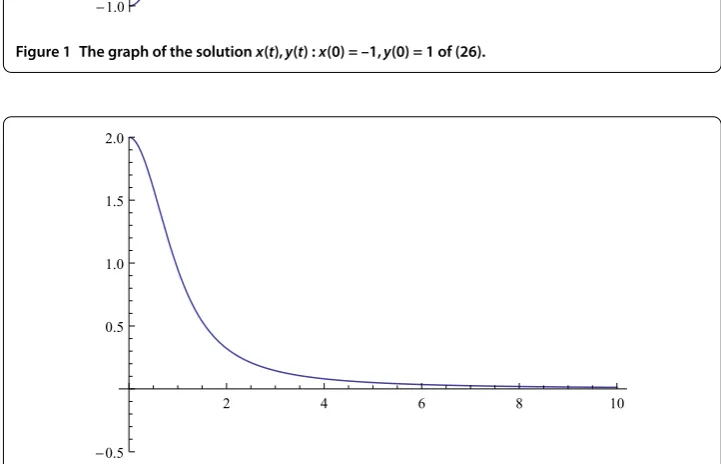
The solution of () is asymptotically stable (see Figures and ) but it is not ex-ponentially stable, sinceDV(t,x,y)≤ and .(x(t),y(t))=V(x(t),y(t))≤V(x,y) =
Figure 1 The graph of the solutionx(t),y(t) :x(0) = –1,y(0) = 1 of (26).
.(x,y), or (x(t) +y(t))≤(x+y)and there are no positive constantsαandμ
such that (x(t) +y(t))≤α(x
+y)e–μt,t> , for any initial pointsx,y.
Therefore, the presence of impulses at random time changes the behavior of the solution, i.e., the solution of IDE with random impulses is exponentially stable in mean square.
Competing interests
The authors did not provide this information.
Authors’ contributions
The authors did not provide this information.
Author details
1Department of Mathematics, Texas A&M University-Kingsville, Kingsville, 78363, USA.2Plovdiv University, Tzar Asen 24,
Plovdiv, 4000, Bulgaria.3School of Mathematics, Statistics and Applied Mathematics, National University of Ireland, Galway, Ireland.
Acknowledgements
Research was partially supported by Fund Scientific Research MU13FMI002, Plovdiv University.
Received: 1 October 2013 Accepted: 21 November 2013 Published:20 Dec 2013
References
1. Bainov, DD, Simeonov, PS: Impulsive Differential Equations: Asymptotic Properties of the Solutions. World Scientific, River Edge (1995)
2. Bainov, DD, Simeonov, PS: Systems with Impulsive Effects: Stability, Theory and Applications. Ellis Horwood, Chichester (1989)
3. Hristova, S: Qualitative Investigations and Approximate Methods for Impulsive Differential Equations. Nova Science Publishers, New York (2009)
4. Lakshmikantham, V, Bainov, DD, Simeonov, PS: Theory of Impulsive Differential Equations. World Scientific, Singapore (1989)
5. Sanz-Serna, JM, Stuart, AM: Ergodicity of dissipative differential equations subject to random impulses. J. Differ. Equ.
155, 262-284 (1999)
6. Wu, S, Hang, D, Meng, X:p-Moment stability of stochastic equations with jumps. Appl. Math. Comput.152, 505-519 (2004)
7. Wu, H, Sun, J:p-Moment stability of stochastic differential equations with impulsive jump and Markovian switching. Automatica42, 1753-1759 (2006)
8. Naghshtabrizi, P, Hespanha, JP, Teel, AR: Exponential stability of impulsive systems with application to uncertain sampled-data systems. Syst. Control Lett.57(5), 378-385 (2008)
9. Smalfuss, B: Attractors for nonautonomous and random dynamical systems perturbed by impulses. Discrete Contin. Dyn. Syst.9(3), 727-744 (2003)
10. Wu, S: The Euler scheme for random impulsive differential equations. Appl. Math. Comput.191, 164-175 (2007) 11. Samoilenko, A, Stanzhytskyi, O: Qualitative and Asymptotic Analysis of Differential Equations with Random
Perturbations. World Scientific, Singapore (2011)
12. Fu, X, Li, X: Razumikhin-type theorems on exponential stability of impulsive infinite delay differential systems. J. Comput. Appl. Math.224(1), 1-10 (2009)
13. Liu, B, Liu, X, Teo, L, Wang, Q: Razumikhin-type theorems on exponential stability of impulsive delay systems. IMA J. Appl. Math.71, 47-61 (2006)
14. Wang, Q, Liu, X: Exponential stability for impulsive delay differential equations by Razumikhin method. J. Math. Anal. Appl.309(2), 462-473 (2004)
15. Wu, Q, Zhoua, J, Xiang, L: Global exponential stability of impulsive differential equations with any time delays. Appl. Math. Lett.23(2), 143-147 (2010)
16. Xu, W, Niu, YJ, Rong, HW, Sun, ZK:p-Moment stability of stochastic impulsive differential equations and its application in impulsive control. Sci. China, Technol. Sci.52(3), 782-786 (2009)
17. Yang, J, Zhong, S, Luo, W: Mean square stability analysis of impulsive stochastic differential equations with delays. J. Comput. Appl. Math.216(2), 474-483 (2008)
10.1186/1687-1847-2013-372