R E S E A R C H
Open Access
On the CFO/Channel estimation technique for
MIMO-OFDM systems without using a prior
knowledge of channel length
Tsui-Tsai Lin
1and Fuh-Hsin Hwang
2*Abstract
In this paper, we propose an estimator which jointly estimates the carrier frequency offset (CFO) and channel state without a prior knowledge of channel length (CL) for a multiple-input multiple-output orthogonal frequency-division multiplexing system. A preliminary CFO/channel estimate is first reached based on the maximum-likelihood criterion. To improve the over-determined problem, a CL estimation technique is further developed. The first-order Taylor series expansion approach is used to determine the trimmed CFO estimate such that the exhaustive point search can be avoided. Simulation results have been presented to demonstrate that the proposed scheme provides a performance comparable to that of the optimal estimation which assumes that CL is known in advance.
Keywords: Multiple-input multiple-output (MIMO); Orthogonal frequency division multiplexing (OFDM); Carrier frequency offset (CFO); Maximum likelihood (ML); Channel length
1 Introduction
The multiple-input multiple-output (MIMO) scheme [1,2] incorporating with the orthogonal frequency divi-sion multiplexing (OFDM) [3,4] has attracted much atten-tion of research workers for a long while. MIMO-OFDM [5-7] becomes a key technique in wireless communica-tions because it provides many advantages including high-bandwidth efficiency, superior link quality, simple channel equalization, and resistance to the frequency-selective multipath distortion. In spite of providing these bene-fits, MIMO-OFDM is liable to performance degradation that is caused by some undesirable effects such as car-rier frequency offset (CFO) [8-11]. This is because CFO destroys the orthogonality between subcarriers and thus reduces the detectability of OFDM symbols. In addition, the bit error rate (BER) performance of a MIMO-OFDM system is also in relation to the channel estimation accu-racy [9,10]. Consequently, it is an important issue how we can improve the estimation accuracy of the channel for a reliable transmission, especially while CFO exists.
*Correspondence: [email protected]
2Department of Optoelectronics and Communication Engineering, National Kaohsiung Normal University, Kaohsiung 82444, Taiwan
Full list of author information is available at the end of the article
To this end, in this paper, we develop an interesting tech-nique which can jointly estimate both CFO and channel state prior to data decoding for a wireless communica-tion system. In the past, numerous algorithms have been proposed to deal with CFO and/or channel estimation for MIMO-OFDM systems. For instance, a number of studies have been presented based on the optimal pilot design and the optimization criteria of interest for channel estimation in MIMO-OFDM systems [12-14]. In [12], a power-efficient training preamble is employed to improve the estimate complexity while the effect of CFO is con-sidered. The Cramer-Roa lower bound (CRLB) is known to provide a lower bound on the statistical variance of any unbias estimator. In [14], the optimal pilot design and placement are determined by minimizing the CRLB in channel estimation. Zeng [15] has proposed a semiblind method for simultaneously estimating the CFO and chan-nel of an uplink multiuser MIMO-OFDM system where a great many data are needed to estimate the subspace. In [16], a technique of joint CFO and channel estimation for uplink MIMO orthogonal frequency division multi-ple access (MIMO-OFDMA) systems is investigated while time-varying channels are considered. By means of the training sequence, the maximum likelihood (ML) estima-tor, which asymptotically achieves the CRLB, is proposed
in [17]. Another novel ML-based scheme that estimates the aggregate effects of the channel and CFO by using two successive OFDM preambles can be found in [18]. Although the above-mentioned studies [16-18] including the ML estimate approaches [17,18] provide superior per-formance while taking their predominance into account, all of these approaches require a prior knowledge of chan-nel length (CL), but CL is difficult to be acquired espe-cially when CFO is considered in MIMO-OFDM systems. When CL is not known in advance or under-determined, the ML estimator’s performance will not asymptotically approach the CRLB any more because the degrees of free-dom are insufficient. It reveals that the knowledge of CL plays a very important role in CFO/channel estimate.
For CL estimation, a number of techniques can be found in the literatures. For example, the Akaike informa-tion criterion (AIC) [19] employs numerous data samples to represent the statistical characteristic of the chan-nel/noise for CL estimation. However, AIC encounters over-estimate when signal-to-noise ratio (SNR) is high. The frequency-domain channel length indicator (FCLI) scheme [20] requires only one snapshot channel estimate while a prior information of noise power is assumed to be known, but FCLI becomes impractical as CFO exists. The conditional model order estimation (CME) [21] is proposed for MIMO communication channels. However, CME assumes that the CIR remains unchanged during a data frame and the processing of the block of available observations is performed offline. In [22], a joint estimate approach for channel and instantaneous CL is proposed. Unfortunately, it fails to work properly in the presence of CFO. Based on information criterion, a joint channel and CL estimation is proposed for single-input single-output (SISO) OFDM systems in [23] where the Levinson recur-sion technique is employed without significant incremen-tal cost. Another CL estimate technique found in [24] is introduced based on the minimization of a combina-tion of cost funccombina-tions for single-input multiple-output (SIMO) channels where the channel is also assumed to be unchanged during a symbol frame. To the best of the authors’ knowledge so far, no work has been devoted to the development of a joint channel and CFO estimation where the information of CL is not available for MIMO-OFDM systems. In light of these works, it is essential to develop an approach to estimate CL especially for MIMO-OFDM systems as CFO exists.
In this paper, we aim to propose a CFO/channel esti-mation technique while achieving the estimate of CL for a MIMO-OFDM system over Rayleigh fading. The design concept of the proposed scheme is originated from the estimate technique based on the ML criterion. To deter-mine the channel impulse response, a preliminary CFO estimate is first developed, and we define a cost function according to the ML rule by introducing the cyclic prefix
(CP) length which is more than CL. By locating the min-imum value of the well-defined cost function, the CFO estimate is reached. The frequency-compensated data is then fed into the least square detector so as to compute the channel estimate while the square error function is being minimized. Although the coarse CFO and channel estimation can be obtained, the over-determined CL leads to a performance degradation. To overcome this problem, a novel CL estimation technique is derived by means of truncating the counterfeit signal paths. A fine CFO esti-mate employing the first-order Taylor series expansion [25] with the trimmed CL is achieved such that we can avoid employing the exhaustive point search approach. Simulation results prove the efficiency of the proposed CFO/channel estimation. Without using prior knowledge of CL, the proposed scheme is shown to provide a per-formance comparable to that of the optimal ML estimator which assumes a perfect knowledge of CL.
This paper is organized as follows. The data model and brief preview of the ML estimation algorithm are declared in Section 2. Furthermore, the performance analysis in terms of the estimation error of CL is also included in the section. Section 3 introduces the proposed CFO/channel estimation for a MIMO-OFDM system without know-ing the CL value. Section 4 presents the computational complexity of the proposed estimator and demonstrates the comparison of complexity between the proposed and ML schemes. In Section 5, simulation results are given to verify the efficiency of the proposed scheme. Finally, Section 6 concludes the paper.
The notations used in this paper are defined as follows. Vectors and matrices are typed with boldface lower and capital letters.Inrepresents ann×nidentity matrix.Om×n
is anm×nzero matrix.1nand0nstand for one and
all-zero vectors with lengthn, respectively. diag{a1,· · ·,an}
is a diagonal matrix with diagonal entries taking from
a1,· · ·,an.(·)∗,(·)T, and(·)H are, respectively, the
com-plex conjugate, transpose, and Hermitian transpose of(·). ⊗,{·},E{·},| · |, and·denote the operations taking the Kronecker product, real part, ensemble average, absolute value, and the Frobenius norm, respectively.
2 Data model and ML estimation 2.1 Data model
Let us consider an N-subcarrier MIMO-OFDM system deployed withNttransmit antennas andNrreceive
anten-nas in a multipath fading channel with length ofL. The transmitted data symbols are drawn from a specified con-stellation set such as quadrature amplitude modulation (QAM) and then are modulated by an OFDM modula-tor. A CP of lengthNgis inserted into the data stream to
prevent against the intersymbol interference (ISI) where
Ng ≥ L. At the receiving end, the received symbols are
and CP removing in sequential order. Let a specificN×1 received data vector of thejth receive antenna be given by:
yj=E(0)FH
sponding frequency offset normalized with respect to the subcarrier spacing. In order to simplify the expressions in (1), theN ×LNt matrixA(L)is constructed by placing
theN×Lpre-processed data matricesFHdiag{xi}FLfor i = 1, 2,· · ·,Ntside by side.xiis the
frequency-domain-transmitted symbol from theith transmit antenna.Hij = FLhij ∈ CN is the channel frequency response where hij ∈ CLis the channel response between theith
trans-mit antenna andjth receive antenna. For simplicity, the path number ofNtr=NtNrchannels is assumed to be the tiplication asX= Fx, wherexis the input time-domain signal, andXis the DFT of the signal.wj∈CNis the noise
vector of thejth receive antenna. Without loss of general-ity, we assume that all the entries ofxi∈CNare identically
and independently distributed random variables with zero mean and a common variance. The received array data
y= yT1,· · ·,yTNr
For the considered system given the true CLL, the ML-based CFO/channel estimation is designed in accordance with a criterion of minimizing the log-likelihood function in terms of the unknown parameters hand0.
Specifi-cally, we can solve the following minimization problem to obtain the CFO/channel estimates [17]:
the ML estimation forhexpressed by:
ˆ
h=AH(L)A(L)−1AH(L)EH()y∈CLNtr. (6)
Substituting (6) into (5) and applying the linear algebraic manipulations, we have the cost function:
C()=y−E()A(L)hˆ2
It can be found that the quadratic cost function with respect toin (7) reaches a minimum value while the con-dition of = 0 is satisfied [26]. In this way, the CFO
estimate can be implemented by searching the minimum of the cost function.
Because the computation of the frequency-dependent matrix E()P¯(L)EH(), which requires N2Nr2 complex multiplications for each , is very time-consuming, we rewrite the cost function in (7) as:
C()=aH()DHyP¯(L)Dya(), (9)
whereDy=diag{y}, and:
a()=1Nr ⊗ 1,e
j2π/N,· · ·,ej2(N−1)π/NT ∈CNNr.
(10)
This criterion only needs to compute DHyP¯(L)Dy ∈
CNNr×NNr once while executing the CFO estimation, and
the implementation complexity is thus greatly reduced. Note that the estimator’s performance of the ML-based scheme depends on L. When Lis perfectly known, the estimator of (11) reaches the CRLB of the CFO [17].
2.3 Performance analysis
The ML-based estimator has been shown to achieve the CRLB when the channel length is known in advance. Inevitably, the ML approach suffers from serious perfor-mance degradation when the CL estimate is erroneous. It is interesting to evaluate the impact of CL estimation error on the MSE performance of the CFO. In this subsection, the characteristic of the estimate error inLis examined. The theoretical analysis of the MSE performance associ-ated with the ML-based estimator will be derived in terms of the CFO. SubstitutingLwith the estimateLˆ, the cost function in (7) can be rewritten by:
C()=yHE()P¯(Lˆ)EH()y. (12)
The ML estimator reaches the CFO estimate while the cost function is minimized. That is, the CFO estimate is derived by finding the solution for the derivativedC()/d
being zero. Taking advantage of this feature, we analyze the MSE performance of the CFO in terms of the CL estimate.
Denote the estimated CFO asˆ0=0+whereis the
CFO estimation error and 1. The first derivative of the cost function is approximated by the first-order Taylor series expansion [25] written as:
˙
Recall that the CFO estimateˆ0is reached while the cost
function in (12) is minimized. By finding the solution of ˙
To investigate the effect of CL estimation error, the received data are rewritten in terms of CL estimateLˆ:
y=E(0) A(Lˆ)h¯+u
residual signal term,u[n] is the unit step function, and:
¯
For the over-determined case (Lˆ > L), the residual sig-nal vectoruvanishes (u=0) and the augmented entries inh¯ are all null. Using (17) in company with the identity
¯
It is clear that the estimation error in (19) depends on the value ofLˆ as well as the SNR. For sufficiently high SNR, the noise term is negligible such that the estimation error can be approximated by:
≈ −
2.3.1 Over-determined case
In the case of the correct or over-determined estimation, i.e.,Lˆ ≥L, sinceu=0NNr,can be further simplified to because (18) guarantees that the augmented channel responses in h¯ are zero. From (20), the MSE perfor-mance of the CFO mainly depends on the channel impulse responsehand noise. To examine the noise effect on the MSE, lethbe given and the mean and mean square of the estimation error can be thus derived as:
E{} ≈0;
respectively. As expected, for Lˆ ≥ L, the ML-based scheme is an unbias estimator, and the MSE value of the ML estimation is increased by the noise power.
2.3.2 Under-determined case
If CL estimate is less than the value ofL, i.e.,Lˆ < L, the residual signaluexists and cannot be omitted, especially for high SNR. Forσn2 1, sinceP¯(Lˆ)A(Lˆ) = ONNr×NNr,
the CFO estimation error is simplified to the following expression:
The above expression indicates that the estimation error depends on both h and Lˆ. Given h, the ML estimator becomes bias (E{} = 0). The ML estimator fails to achieve a reliable performance even when the SNR is increased. This implies that the ML estimation strongly depends on the accuracy of the CL estimation.
3 Proposed joint CFO and channel estimation It is well known that the ML-based scheme requires the prior knowledge ofLto constructA(L). In practice, the instantaneous value ofLis difficult to be reached, and it should be pre-determined prior to the ML estimation. In the case of the over-determined CL, the redundant dimen-sion of the subspace inP(L)leads to a large noise power, which slightly degrades the estimation performance. With regards to the under-determined CL, the ML-based esti-mator breaks down because of insufficiency of the degree of freedom for the channel estimation in (6). Therefore, a correct CL is essential for the ML-based estimation. In light of the aforementioned problems, it encourages us to develop a joint CFO and channel estimation, which does not require a prior knowledge of CL. Since the maximum path delay is less than the CP length,Ng, we can regard
the CP length as the preliminary estimate of CL to avoid the break down of performance owing to an insufficient degree of freedom. Here, we replaceNgwithLin (11), and
the coarse CFO estimate is derived by: ˆ
c=arg min aH()DHyP¯(Ng)Dya(). (21)
Although the coarse CFO can be obtained, the estimator suffers slight performance degradation due to a large noise term introduced by the redundant dimension ofA(Ng) ∈ CNNr×NgNtr. To alleviate the degradation, one may
prop-erly choose an L from the effective channel response, which is constructed by means of truncating the estimated channel response. Based on the coarse CFO estimate in (21), the frequency-compensated data is given byEH(ˆc)y
and the coarse channel estimate can be determined by the least square error criterion:
whose solution is derived:
Note that there are a few of counterfeit signal paths since Ng > L. This implies that a truncated scheme is
required where the effective paths are reserved and the other paths are eliminated. Owing to the hardware imple-mentation limitations, the receive antennas are usually spaced closely, and the channel response for each path between a specified transmit antenna and any receive antenna is assumed to be similar. To relieve the noise effect, the effective channel response is obtained by aver-aging all normalized channel responses of the paths from one specified transmit antenna to all receive antennas. The normalized channel response associated with theqth receive antenna is defined by:
˜
effective channel response is expressed by:
ˆ
According to (25), the estimated channel length,Lˆ, can be obtained by:
ˆ
L=arg max
i hˆeff(i) > γ, (26)
where hˆeff(i) denotes theith element ofhˆeff andγ is a
preset threshold. The chosen parameter should be small enough so as to decrease the miss probability and increase the probability of detection while avoiding a high false alarm probability. More detailed discussion about the selection ofγ will be given shortly in Section 5.
Replacing Ng with Lˆ in (21) and using the exhaustive
point search, we can obtain the trimming CFO estimate. The computational complexity of the search for CFO has relations with the number of subcarriers, paths, and trans-mit and receive antennas as well as the searching granular-ity. The smaller the granularity is, the better the estimation accuracy will be. However, decreasing the granularity will
increase the computational complexity, especially when there are a great number of subcarriers. A possible solu-tion is to utilize the first-order Taylor expansion technique associated with the preliminary CFO estimate in (21). In this way, the concave cost function can be transformed into a quadratic function with respect to the normalized CFO, in which the trimming CFO estimate achieves the minimum and can be easily obtained. Denotea0 = a(0)
Substituting (27) into (9), the cost function can be rewritten by:
which reaches the minimum as the first derivative of (28) equals to zero. Applying some linear algebraic manipula-tion techniques, the trimming CFO estimate is derived by:
ˆ
the trimming estimate of the channel response.
4 Computational complexity
Conveniently enough, the proposed estimator’s compu-tational complexity is evaluated by counting the approx-imate number of total arithmetic operations includ-ing addition and multiplication floatinclud-ing-point operations (flops) in the algorithm. Because the computational com-plexity of the proposed scheme is dominated by the pro-cessing in the coarse CFO estimation, the total complexity load can be approximated as the required number of flops for determining the solution of (21). The computation for finding the inverse of theNgNtr ×NgNtr block diagonal
Table 1 Comparison for the computational complexity between the proposed and ML schemes
Numbers of flops Algorithm (N,Ng,L)
(64,16,1) (64,16,5) (128,32,1) (128,32,5) (256,64,1) (256,64,5)
Proposed 1.240E8 1.240E8 4.963E8 4.963E8 1.996E9 1.996E9
ML 1.235E8 1.236E8 4.929E8 4.930E8 1.969E9 1.970E9
flops. In addition, constructing P¯(Ng) costs about N
1+Ng2Nt2+NNgNt
flops, and the calculation of = DHyP¯(Ng)Dy approximately requires N2Nr flops.
For every single search loop of , the computation of aH()a() demands N(1 + N + NNr) flops.
Conse-quently, the overall flops for the proposed scheme is approximated by:
FlopProposed≈
1
2NNt(1+Nt)
1+Ng(1+2Ng)
+4 3N
3
gNt3
+N 1+Ng2Nt2+N(NgNt+Nr)
+μN[1+N(1+Nr)] ,
(31)
where μ denotes the number of search points. Simi-larly, the total flop count for the ML approach in (11) is approximated by:
FlopML≈ 1
2NNt(1+Nt)[1+L(1+2L)]+ 4 3L
3N3 t
+N1+L2Nt2+N(LNt+Nr)
+μN[1+N(1+Nr)] .
(32)
As compared with (32), (31) shows that the proposed estimation seems to involve much more computational complexity than that of the ML scheme sinceNg L.
Fortunately, because calculation ofP¯(Ng)is independent
of the received data as well as the channel parameters, we can prestore the calculatedP¯(Ng)in the memory so
1 5 10 15 20 25 30 32
10−6 10−5 10−4 10−3 10−2
Channel Length Estimate
MSE of CFO Estimation
(a)
ML (SNR=10 dB) CRB (SNR=10 dB) ML (SNR=20 dB) CRB (SNR=20 dB)
1 5 10 15 20 25 30 32
10−4 10−3 10−2 10−1 100 101
Channel Length Estimate
MSE of Channel Estimation
(b)
ML (SNR=10 dB) ML w/o CFO (SNR=10 dB) Optimal (SNR=10 dB) CRB (SNR=10 dB) ML (SNR=20 dB) ML w/o CFO (SNR=20 dB) Optimal (SNR=20 dB) CRB (SNR=20 dB)
as to avoid the copious calculations. That is, we simply have to consider the count of flops of the computation of and the search task in the coarse CFO estimation, and the computational complexity for the proposed scheme is thus reduced to:
FlopProposed≈N2Nr+μN[1+N(1+Nr)] . (33)
Here, we give a numerical example to demonstrate the comparison of complexity between two schemes. Given
Nt = Nr = 2 andμ = 104, Table 1 lists the
computa-tional complexity of the proposed and ML approaches in terms of flops for different sets of combination ofN,Ng,
andL, respectively. For(N,Ng,L) = (64, 16, 1), the flop
counts for the proposed and ML schemes are 1.240×10⁸ and 1.235×10⁸, respectively, and the percentage of the difference in this case is only 0.34%. Furthermore, the
maximum difference percentage in the table is under 1.5%. It shows that the proposed scheme operates at the expense of an acceptably increased complexity as compared with the ML approach.
5 Computer simulations
Some simulation results have been conducted to ver-ify the efficacy of the proposed CFO/channel estimator for a 128-subcarrier MIMO-OFDM system (N = 128), which is deployed with two transmit/receive antennas in a Rayleigh fading channel with channel length ofL = 5, where the channel impulse response is normalized such thatEhij2
=1. Here, the QPSK constellation is used in the data transmission where a CP of length N/4 is
inserted into the data stream. In the simulation mecha-nism, the CFO is uniformly and randomly generated from
−20 −18 −16 −14 −12 −10 −8 −6 −4 −2
10−6 10−5 10−4 10−3 10−2
Preset Threshold γ (dB)
MSE of CFO Estimation
(a) ML (SNR=10 dB)
Optimal (SNR=10 dB) Proposed (SNR=10 dB) CRB (SNR=10 dB) ML (SNR=20 dB) Optimal (SNR=20 dB) Proposed (SNR=20 dB) CRB (SNR=20 dB)
−20 −18 −16 −14 −12 −10 −8 −6 −4 −2
10−3 10−2 10−1 100
Preset Threshold γ (dB)
MSE of Channel Estimation
(b) ML (SNR=10 dB)
Optimal (SNR=10 dB) Proposed (SNR=10 dB) CRB (SNR=10 dB) ML (SNR=20 dB) Optimal (SNR=20 dB) Proposed (SNR=20 dB) CRB (SNR=20 dB)
the interval [−0.5, 0.5]. The SNR in decibel (dB) is defined as SNR = 10 log10EA(L)h2/σn2. To access the characteristic of the proposed estimator, the numerical results of the mean square errors (MSEs) of the CFO and channel estimation, which are defined by:
MSE= 1
Q Q
q=1
ˆ0(q)−02;
MSEh=
1
Q Q
q=1
Nr
j=1
ˆhj(q)−hj(q)2,
(34)
are provided to evaluate the estimator’s performance, where Qis the number of independent trials. For com-parison, means of the Cramer-Rao bounds (CRBs), which
depend on the channel impulse response h, are also included [28,29]:
CRB()= σ
2 n
2
hHAH(L)E˙0HP¯(L)E˙0A(L)h
−1 =γ σ2
n
CRB(h)=σn2AH(L)A(L)−1+γzzH
,
(35)
where:
γ = 1 2
hHAH(L)E˙0HP¯(L)E˙0A(L)h
−1
z=AH(L)A(L)−1AH(L)E˙0A(L)h.
(36)
Throughout the simulations, the granularity of the point search is given by 10−4for the ML-based estimation. Each simulation point is obtained by taking the averages of all
0 5 10 15 20 25 30 35 40
10−8 10−7 10−6 10−5 10−4 10−3 10−2
SNR (dB)
MSE of CFO Estimation
(a)
ML Optimal
Proposed (γ=−10 dB) Proposed (γ=−15 dB) CRB
0 5 10 15 20 25 30 35 40
10−5 10−4 10−3 10−2 10−1 100
SNR (dB)
MSE of Channel Estimation
(b)
ML Optimal
Proposed (γ=−10 dB) Proposed (γ=−15 dB) CRB
Figure 3The MSE performance of the proposed estimation versus the input SNR for the considered system.(a)MSE of CFO estimation;
0 5 10 15 20 25 30 35 40 10−4
10−3 10−2 10−1 100 101 102 103
SNR (dB)
MSE of Channel Length Estimation
L=2 L=5 L=10 L=20
Figure 4The MSE performance of the proposed CL estimation at different number of paths for the considered system.
independent trials, in which each trial uses a different set of the CFO, channel impulse response, and data/noise sequences.
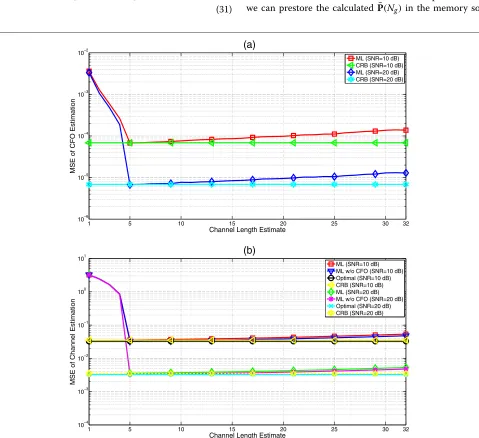
In Figure 1, we investigate the effect of the estimation error in the channel length with different values of SNR. The MSE of the CFO versus CL estimate is plotted in Figure 1a. It shows that the MSE reaches a minimum value when channel length is correctly used(Lˆ = 5). In regard to the under-determined case, the ML estimator in (11) is not able to provide a reliable performance. This is because the degree of freedom is not sufficiently large for reconstructing the received signal, which results in an erroneous cost function expressed by (7). A reliable CFO estimate cannot be obtained by searching the minimum of the erroneous cost function. For Lˆ > L, the MSE in
CFO increases by the value of L = ˆL− L. Further-more, we examine the MSE performance of the channel estimation while varying CL estimate. For comparison, the simulation results associated with the ML estimator without CFO are also included. The corresponding results shown in Figure 1b and Figure 1a have a similar tendency. As expected, the MSE performance is slightly degraded owing to CFO.
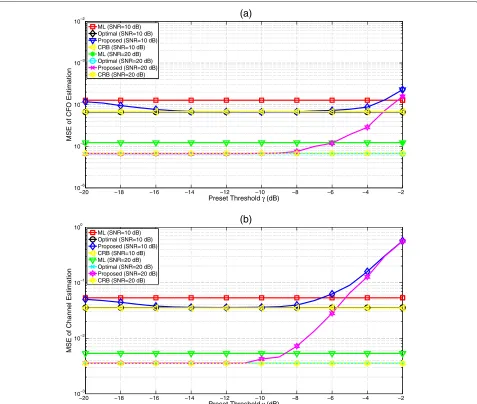
In Figure 2, we examine the impact of the preset thresh-old γ on the estimate performance for SNR = 10 and 20 dB. For comparison, the results obtained with the ML estimator using the CP length and true CL are also included and represented by ML and optimal, respec-tively. This figure indicates that the proposed estimation approaches the optimal case whenγ is sufficiently small
0 5 10 15 20 25 30 35 40
10−3 10−2 10−1 100 101 102 103
SNR (dB)
MSE of Channel Length Estimation
γ=−5 dB γ=−10 dB γ=−15 dB γ=−20 dB
(−15 dB< γ <−10 dB). For a large preset threshold, the proposed scheme substantially degrades since the mean-ingful paths are not successfully detected. There is a large miss probability in the detection of the channel response, which prevents a reliable CFO and channel estimation. It is noteworthy that deep faded paths are filtered by a large preset thresholdγ, especially for high SNR. On the con-trary, for SNR=10 dB, a performance degradation occurs as the preset threshold is very small (γ = −20 dB) owing to a large false alarm in detecting the channel response. It concludes that a proper choice ofγ is essential in the presence of the CFO. Since the impact of the performance caused by a path signal which is much less than−10 dB is slight when compared with that caused by the dom-inant path, the acceptable range of SNR in this case is about−20< γ <−10 dB.
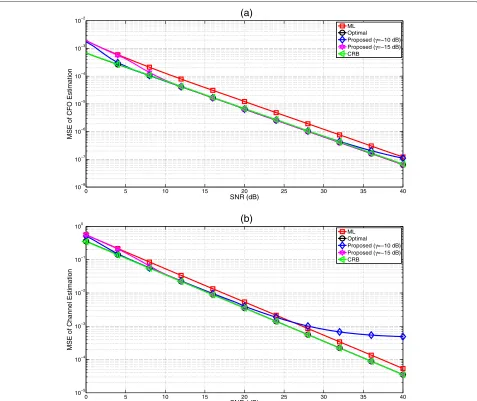
In Figure 3, we investigate the impact of the SNR on the proposed CFO/channel estimator withγ = −10 and−15 dB. From Figure 3a, it can be shown that the MSE decreases as the value of SNR increases. In addition, using the preset thresholdγ = −15 dB, the proposed scheme provides a performance similar to that of the ML estima-tor with a prior knowledge of channel length. The result verifies the efficiency of the proposed CFO estimation. For low SNR, a large false alarm introduced by noise drops the MSE performance in the CFO estimation. Figure 3b shows the MSE performance of the channel estimation. It is observed that the estimator’s performance can be improved by increasing the SNR. The proposed scheme with CL estimation achieves a performance similar to that of the optimal estimation forγ = −15 dB. However, in the case ofγ = −10 dB, the proposed estimator fails to offer a
0 5 10 15 20 25 30 35 40
10−8 10−7 10−6 10−5 10−4 10−3 10−2
SNR (dB)
MSE of CFO Estimation
(a)
(Nt,Nr)=(2,2) (N
t,Nr)=(2,3) (Nt,Nr)=(2,4) (N
t,Nr)=(3,2) (Nt,Nr)=(3,3) (N
t,Nr)=(3,4)
0 5 10 15 20 25 30 35 40
10−5 10−4 10−3 10−2 10−1 100 101
SNR (dB)
MSE of Channel Estimation
(b)
(N t,Nr)=(2,2) (N
t,Nr)=(2,3) (N
t,Nr)=(2,4) (N
t,Nr)=(3,2) (N
t,Nr)=(3,3) (N
t,Nr)=(3,4)
Figure 6The MSE performance versus the input SNR for the considered system with different numbers of transmit/receive antennas.
performance comparable to that of the optimal case while the SNR is getting higher and higher. This is because the proposed CL estimator exhibits under-determining due to a deep fading.
In Figure 4, we present the MSE of CL estimation ver-sus SNR for a set of different CL values while setting the preset threshold γ = −15 dB. It can be shown that in the figure the MSE of the proposed CL estimation sud-denly approaches to zero while the SNR is greater than 15 dB. On the contrary, when the SNR is smaller than 10 dB, large noise power results in over-determination and thus significantly degrades the MSE performance of CL estima-tion. In a rich multipath environment (L= 20), the weak paths introduced by deep fading are removed because they can be treated as noise while the path number is being determined. This results in the under-determined problem.
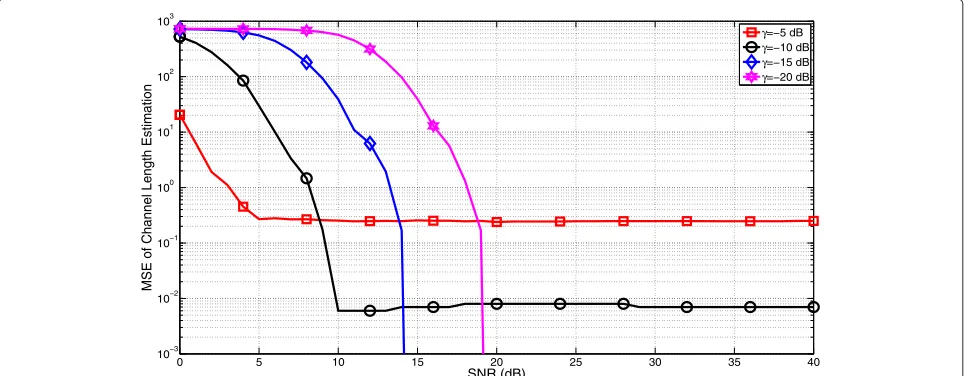
In Figure 5, we illustrate the impact of the preset thresh-oldγ on CL estimation. Figure 5 shows the MSE versus SNR for different values ofγ. Givenγ = −15 or−20 dB, the proposed CL estimator reaches CL perfectly when SNR is greater than 15 dB. On the contrary, when γ >−10 dB, the miss probability increases and the under-determination is brought about owing to the weak paths caused by deep fading being punctured. For the under-determination cases, there are error floors even when the SNR is increased.
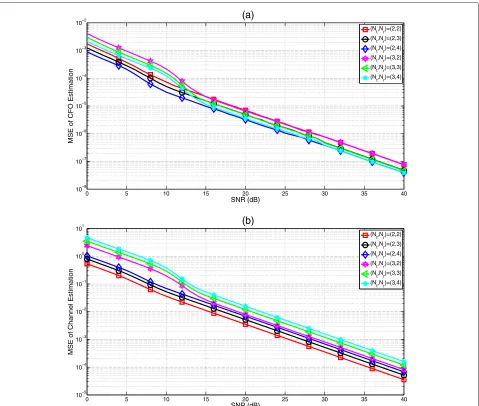
Figure 6a plots the MSE curves of CFO versus SNR for several sets of (Nt,Nr). It shows that the MSE
perfor-mance of CFO can be improved by increasing the receive diversity asNtis given. When SNR is low, a little
degra-dation in the MSE performance is induced because fewer degrees of freedom are provided for the minimization problem in (5). Figure 6b shows the MSE performance of the channel estimation. GivenNt, the MSE performance
degrades asNrincreases because the larger the size ofhis,
the poorer the performance of channel estimation will be.
6 Conclusions
An algorithm for the joint CFO and channel estimation is presented for the MIMO-OFDM scenario. As compared with the conventional ML estimate approach, the nov-elty of the proposed algorithm is that it does not require to know the channel length in advance. Furthermore, we derived a set of beneficial analyses for the MSE of channel length estimate, which can be further applied to the con-ventional ML estimator. Analytic and simulation results for the proposed estimate technique have been presented where the prior knowledge of channel length is not used because channel length estimate can be reached in our scheme simultaneously. It can be shown that the pro-posed scheme offers a performance comparable to that of the optimal ML-based estimator which operates well only when perfect channel length is assumed. The feasibility of
implementation for the proposed approach is ensured by the presented complexity analyses.
Competing interests
The authors declare that they have no competing interests.
Acknowledgements
This works was supported in part by the Ministry of Science and Technology under Grand MOST 103-2221-E-239-013.
Author details
1Department of Electronic Engineering, National United University, Miaoli
36003, Taiwan.2Department of Optoelectronics and Communication Engineering, National Kaohsiung Normal University, Kaohsiung 82444, Taiwan.
Received: 2 October 2014 Accepted: 3 March 2015
References
1. O Besson, P Stoica, On parameter estimation of MIMO flat-fading channels with frequency offsets. IEEE Trans. Signal Process.51(3), 602–613 (2003) 2. H Sampath, S Talwar, J Tellado, V Erceg, A Paulraj, A fourth generation
MIMO-OFDM broadband wireless system design, performance, and field trial results. IEEE Commun. Mag.40(9), 143–149 (2002)
3. BHu X Wang, A low-complexity ML estimator for carrier and sampling frequency offsets in OFDM systems. IEEE Commun. Lett.18(3), 503–506 (2014)
4. NL Hung, LN Tho, CC Ko, Turbo processing for joint channel estimation, synchronization, and decoding in coded MIMO-OFDM systems. EURASIP Wireless Commun. Netw (2009). doi:10.1155/2009/206524
5. H Minn, M Al-Dhahi, Y Li, Optimal training signals for MIMO OFDM channel estimation in the presence of frequency offset and phase noise systems. IEEE Trans. Commun.54(10), 1754–1759 (2006)
6. Y Jin, XG Xia, An interference nulling based channel independent precoding for MIMO-OFDM systems with insufficient cyclic prefix. IEEE Trans. Commun.61(1), 131–143 (2012)
7. X Ge, X Huang, Y Wang, M Chen, Q Li, T Han, C-X Wang, Energy-efficiency optimization for MIMO-OFDM mobile multimedia communication systems with QoS constraints. IEEE Trans. Veh. Technol.63(5), 2127–2138 (2014)
8. OH Salim, AA Nasir, H Mehrpouyan, W Xiang, S Durrani, RA Kennedy, Channel, phase noise, and frequency offset in OFDM systems: joint estimation, data detection, and hybrid Cramer-Rao lower bound. IEEE Trans. Commun.62(9), 3311–3325 (2014)
9. H Wang, XG Xia, Q Yin, Distributed space-frequency codes for cooperative communication systems with multiple carrier frequency offsets. IEEE Trans. Wireless Commun.8(2), 1045–1055 (2009)
10. S Rahimi, B Champagne, Joint channel and frequency offset estimation for oversampled perfect reconstruction filter bank transceivers. IEEE Trans. Commun.62(6), 2009–2021 (2014)
11. YCWu J Chen, S Ma, TS Ng, Joint CFO and channel estimation for multiuser MIMO-OFDM systems with optimal training sequences. IEEE Trans. Signal Process.56(8), 4008–4019 (2008)
12. M Ghogho, A Swami, Training design for multipath channel and frequency-offset estimation in MIMO systems. IEEE Trans. Signal Process. 54(10), 3957–3965 (2006)
13. Z Zhang, W Zhang, C Tellambura, MIMO-OFDM channel estimation in the presence of frequency offset. IEEE Trans. Wireless Commun.7(6), 2329–2339 (2008)
14. M Dong, L Tong, Optimal design and placement of pilots symbols for channel estimation. IEEE Trans. Signal Process.50(12), 3055–3069 (2002) 15. Y Zeng, AA Leyman, TS Ng, Joint semiblind frequency offset and channel
estimation for multiuser MIMO-OFDM uplink. IEEE Trans. Commun.58(9), 2697–2708 (2010)
16. KJ Kim, MO Pun, RA Iltis, Joint carrier frequency offset and channel estimation for uplink MIMO-OFDMA systems using parallel Schmidt Rao-Blackwellized particle filters. IEEE Trans. Commun.55(12), 2270–2278 (2007)
output-orthogonal frequency division multiplexing system. IET Commun. 7(15), 1567–1579 (2013)
18. E Manasseh, S Ohno, M Nakamoto, inProc. of Asia-Pacific Signal and Information Processing Association Annual Summit and Conference (APSIPA
ASC 2011), Oct 18–21. Preamble based joint channel and CFO estimation
for MIMO-OFDM systems with null subcarriers (Xi’an, China, 2011) 19. H Akaike, A new look at the statistical model identification. IEEE Trans.
Autom. Control.AC19(6), 716–723 (1973)
20. M Krondorf, TJ Liang, R Irmer, G Fettweis, inProc. Wireless Conf. April 2–5. Improved channel estimation for complexity-reduced MIMO-OFDM receiver by estimation of channel impulse response length (Athens Greece, 2006), pp. 1–6
21. DKC So, RS Cheng, Iterative EM receiver for space-time coded systems in MIMO frequency-selective fading channels with channel gain and order estimation. IEEE Trans. Wireless Commun.3(6), 1928–1935 (2004) 22. J Siew, J Coon, A Nix, M Beach, S Armour, J McGeehan, inProc. Commun.
Wireless Syst. Conf. Sept 20–22. A joint channel and channel length
estimation algorithm for MIMO-OFDM (Mauritius, 2004), pp. 285–289 23. A Tomasoni, G Gatti, S Bellini, M Ferrari, M Siti, Efficient OFDM channel
estimation via an information criterion. IEEE Trans. Wireless Commun. 12(3), 1352–1362 (2013)
24. J Via, I Santamaria, J Perez, Effective channel order estimation based on combined identification/equalization. IEEE Trans. Signal Process.54(9), 3518–3526 (2006)
25. M Greenberg,Advanced Engineering Mathematics, 2nd edn. (Prentice Hall, London, UK, 1997)
26. TC Chen, TT Lin, Blind carrier frequency offset mitigation in space-time block-coded multicarrier code division multiple access uplink transmission. Intl. J. Commun. Syst (2014). doi:10.1002/dac.2823 27. GH Golub, CF Van Loan,Matrix Computation, 3rd edn. (Johns Hopkins
University Press, Baltimore, MD, 1996)
28. P Stoica, O Besson, Training sequence design for frequency offset and frequency-selective channel estimation. IEEE Trans. Commun.51(11), 1910–1917 (2003)
29. S Salari, Ardebilipour, M Ahmadian, Jion for multiple-input
multiple-output-orthogonal frequency-division multiplexing systems. IET Commun.2(8), 1069–1076 (2008)
Submit your manuscript to a
journal and benefi t from:
7Convenient online submission
7Rigorous peer review
7Immediate publication on acceptance
7Open access: articles freely available online
7High visibility within the fi eld
7Retaining the copyright to your article