R E S E A R C H
Open Access
Automated traffic engineering using adaptive
inter-class mixing
Muhammad Salman Zafar
1*, Junaid Zubairi
2and Aasia Khanum
1Abstract
Traffic engineering (TE) optimizes the performance of a network by analyzing and regulating the data transmission. Traffic engineering with link coloring (TELIC) was proposed to automatically assign LSPs in multi-protocol label switching domain based on bandwidth and class of service attributes. TELIC dynamically assigns colors to links in the network domain on the basis of reservable bandwidth. Different classes of traffic are entitled for using different colored links. The main contribution of TELIC is segregation of premium and non-premium traffic results in
predictable service for premium traffic. After the introduction of TELIC, the Internet engineering task force introduced two important bandwidth constraint models (BCM): maximum allocation model (MAM) and Russian dolls model (RDM). MAM refers to segregation/isolation of class types (CTs) with no channel pre-emption, whereas RDM refers to aggregation by allowing lower classes for using the bandwidth of higher class on availability and emption when required. CT segregation in TELIC is similar to MAM; however, the inherent feature of pre-emption makes TELIC distinct from MAM. This article introduces an RDM version of TELIC by providing controlled traffic mixing by allowing lower classes to share the bandwidth of higher classes whenever possible. Conjunction factor and conjunction threshold are used for controlling the traffic mix. New rule set for bandwidth allocation and sharing are defined. Results show that RDM TELIC provides fair service to non-premium traffic without degrading the service for premium classes, as compared to other shortest distance-based methods.
Keywords:TELIC, RDM, MPLS, MPLS-TE, Diffserv, QoS
1. Introduction
The penetration of broadband resulted in development of numerous Internet applications moving the world toward global sharing and cooperation. Various Inter-net-enabled applications have been developed. Some of them can process the request in batches like e-mails; however, lot of applications requires real-time updates. Some of such applications are stock-exchange databases, online games, real-time multimedia exchange, and busi-ness intelligent applications. Moreover, the entire next generation telecommunication networking infrastructure is being migrated to IP network. Owing to the heavy usage of real-time Internet applications, it is desirable that connectionless networks should be designed in such a way that they work like connection-oriented
circuits with guaranteed bandwidth and compliance with service level agreements (SLAs).
To cope with the emerging and most demanding application requirements on Internet, different proto-cols, compression techniques, and security architectures have been developed. Internet engineering task force (IETF) and different study groups are working on devel-oping new protocols and standards to realize the neces-sities of real-time applications. Among others, some protocols have taken care of quantitative guarantees to the flows like resource reservation protocol while some have addressed the qualitative guarantees by defining behavior aggregates (BA), e.g., Diffserv (differentiated services architectures) [1,2]. Multi-protocol label switch-ing (MPLS) strikes the middle ground by providswitch-ing label switched paths (LSP)-based quality of service (QoS) fra-meworks which ultimately implement traffic engineering (TE)[3].
While MPLS aware Diffserv domains address require-ments of QoS applications, TE issue of efficient * Correspondence: [email protected]
1
College of Electrical and Mechanical Engineering, National University of Sciences & Technology (NUST), Islamabad, Pakistan
Full list of author information is available at the end of the article
utilization of bandwidth and network resources still remains a question. Traffic engineering with link color-ing (TELIC) is an algorithm for automatcolor-ing the Traffic TE process on MPLS aware Diffserv domains [4,5]. Determining LSPs for different classes of traffic trunks based on dynamically determined prioritized link colors is the core of TELIC. The link coloring scheme in TELIC ensures that premium traffic does not have to share the links with non-premium traffic. While this segregation of traffic is good for premium traffic, it may result in less than desirable allocation for non-premium traffic on the account that premium traffic may be under-utilizing the bandwidth allocated to it.
After the introduction of TELIC in 2002, IETF intro-duced two important BCMs for Diffserv aware MPLS domain [6]: maximum allocation model (MAM) and Russian doll model (RDM). MAM refers to segregation/ isolation of class types (CTs) where different traffic classes have dedicated channels with no channel pre-emption. CT segregation in TELIC is similar to MAM; however, the inherent feature of pre-emption in favor of premium classes makes TELIC distinct from MAM. RDM (RFC 4127) [6] refers to aggregation by allowing lower classes to use the bandwidth of higher class on availability with pre-emption when required. It can move up to 64 different order aggregates or CTs; thanks to 3 EXP bits in the shim header of MPLS and 3 bit TOS field. Currently, TELIC defines no specific rules for premium and non-premium classes to share the same link.
This article presents an RDM version of TELIC by introducing traffic mixing, i.e., lower classes can share the bandwidth of higher classes whenever possible. Con-junction factor (CF) and conCon-junction threshold are used for controlling the mix of traffic on the links. New rule sets for bandwidth allocation and sharing are defined.
The rest of the article is divided into five sections. In the following section, MPLS aware Diffserv network will be discussed in detail. In Section 3, existing work on TELIC is explained, Section 4 covers the proposed model, implementation, and results, and Section 5 pre-sents the conclusion and related future work.
2. MPLS-AWARE Diffserv
Diffserv emerged as a simple solution for providing QoS implementation. In Diffserv, the traffic is classified into different categories differentiated by TOS field of IP header. Three major CTs are defined in Diffserv which are further prioritized on the basis of values [2]. The major classes defined by Diffserv, in decreasing order of priority, are
•EF (expedite forwarding), i.e., CT2
•AF (assured forwarding), i.e., CT1
•DF (default forwarding), i.e., CT0
Here, EF (CT2) is the premium traffic [7] whereas DF (CT0) is the Best-Effort traffic. Diffserv routers employ class-based queuing with different queues for different CTs. Different bandwidths are allocated to different CTs, and if the bandwidth limit is approached by a par-ticular CT, then the corresponding queue is blocked from service till bandwidth becomes available. Diffserv is provided in a Diffserv domain, which is the set of nodes with Per Hop Behavior (PHB) and traffic conditioning capabilities. The boundary routers, i.e., ingress and egress, are used for checking technical specification of packets as per SLAs. Ingress node makes the decision for admission control and classifies the packet to one or more BAs. Each packet is marked with Diffserv code point and boundary nodes do the traffic conditioning by metering, policing, shaping, or dropping based upon the BA.
MPLS is a switching technique based on the use of labels. The boundary nodes are called Label Edge Router (LER) while the core nodes are known as Label Switch-ing Router (LSR) [8]. LER takes the responsibility of admission control as ingress in Diffserv by assigning labels to traffic as according to the forward equivalence class (FEC). Each LSR removes the previous label and makes the forwarding based on its label lookup table; the established path is called LSP which can guarantee certain level of performance and network utilization by implementing TE.
Diffserv and MPLS collectively can solve the IP QoS problem. Diffserv enables scalability in network designs with multiple classes of service and Bas; MPLS-TE, how-ever, facilitates resource reservation, fault-tolerance, and network resource optimization. MPLS-Diffserv-TE com-bines the advantages of both Diffserv and TE. The result is the capability of providing guaranteed QoS with opti-mized use of network resources. The QoS delivered by MPLS-Diffserv-TE enables network operators for pro-viding guaranteed services to specific applications such as voice over IP and other real-time application with require performance guarantees.
MPLS networks support Diffserv by mapping Diffserv BAs on to LSPs. MPLS can map Diffserv in several ways. Multiple BAs can be mapped to single LSP or sin-gle BA can be mapped to sinsin-gle LSP. When multiple BAs are mapped to single LSP, the method is called E-LSP (EXP is used to specify PHB) and L-E-LSP when sin-gle BA is mapped to sinsin-gle LSP [8].
may be eight distinct CTs, with a single priority level. Figure 1 shows the table of all possible classes with their priorities. Some sample TE classes are picked from TE0 through TE7, which are shown on left side of the table.
Several constrained routing algorithms have been introduced for MPLS-Diffserv domain. These algorithms integrate constraint-based routing with TE to carve out LSP tunnels that can carry aggregated or uni-class traffic while ensuring a certain level of bandwidth availability and resource utilization. It is desirable that these algo-rithms not only focus on engineering the traffic on MPLS-Diffserv domain, but also automate the engineer-ing process.
3. TELIC
TELIC’s objective is to automatically establish LSPs for incoming traffic trunks in MPLS aware Diffserv domain with constraint-based routing that achieves targets of TE for different traffic classes [4,6].
For using TELIC, each LSP request specifies the required amount of bandwidth as well as the FEC. Representing the domain as a graph, TELIC finds cost of each link in the graph using a cost function with bandwidth, reliability, and delay as parameters. Link costs are mapped to various colors that form a priori-tized hierarchy. The color values of silver, white, green, yellow, and red with corresponding cost metrics are indicated in [4]. The bandwidth that can be reserved on each type of link is set empirically and all the links initi-ally are set to either green or silver. Graduiniti-ally, silver links are converted to white and green are converted to yellow and finally to red when LSPs are assigned through them. The algorithm divides the entire domain graph into several sub-graphs based on link colors.
Based on the information in the requested traffic trunk, the algorithm tries to locate LSP using shortest path through a sub-graph that best meets the request [4]. On determining LSP, it is registered in master LSP table and the link color is updated.
For bandwidth sharing and congestion avoidance, a conjunction degree (CD) is defined which takes care of number of different types of LSPs passing over a link. Premium traffic is routed over links with low CD.
Load balancing on the network, avoidance of heavily utilized links, and CT segregation are some of the tar-gets achieved by TELIC. TELIC improves bandwidth allocation and network resource utilization as compared to commonly used shortest distance algorithm (SHORTD) and automates the process of TE. However, there are certain limitations in TELIC algorithm:
•Premium traffic links generally do not share their redundant bandwidth with other traffic due to CT segregation; this sometime leads to poor utilization of bandwidth and network resources.
•Initially, AF cannot be assigned to the silver links resulting in more rejections of AF traffic.
•CD is calculated on number of LSPs without the consideration of bandwidth used by each.
•TELIC preferably allocates the link bandwidth to premium traffic resulting in rejection and delay of other CTs. It pre-empts allocated DF requests if it cannot find the path for current outstanding pre-mium traffic requests.
These limitations are addressed in the proposed enhancement, RDM TELIC as described next.
4. RDM TELIC
The MAM and RDM BCMs were described briefly in previous sections. MAM is the most intuitive BCM which maps one bandwidth constraint (BC) to a single CT. Practically, the link is distributed into multiple channels as shown in Figure 2.
MAM results in the under utilization of link because of not sharing the bandwidth among multiple classes; however, MAM bears the advantage of guaranteed bandwidth for premium classes.
RDM can be symbolized with Russian doll toy, where one smaller doll BC(n) can be contained in the bigger doll (BC(n- 1)) which may further be compacted (con-tacted) in a yet bigger doll (BC(n- 2)), and so on. RDM has the advantage of the use of bandwidth by lower classes on availability and pre-emption when required. Thus, link utilization is increased as compared to MAM. Figure 3 illustrates the bandwidth allocation in RDM.
RDM TELIC not only provides compliance between TELIC and IETF BCMs, but also furnishes the missing parts of TELIC by allocating CT1 (i.e., AF) on silver links and introducing the mechanism for controlled pre-emption of best effort traffic. Some features which dif-ferentiate RDM TELIC from the existing work on TELIC are
•Bandwidth allocation procedure is altered; new rule sets are defined for making it compliant with RDM.
•In TELIC, AF is initially not allocated on silver links. This restriction is removed in RDM TELIC resultantly improving the allocation of AF on multi-ple sub-domains.
•TELIC pre-empts DF allocated LSP if it cannot find a path with enough bandwidth to satisfy an out-standing premium request. RDM TELIC defines the rule set for controlled pre-emption of best-effort traffic.
•CD of links is enhanced with threshold values to determine and possibly avoid congestion on the links.
The algorithm for RDM TELIC is presented in Table 1.
CD identifies the degree of sharing between different traffic classes on each link. It is calculated as
CDi= CD2 + CD1
where CD is the degree of the conjunction of the link i, CD2 refers to the bandwidth of EF shared by AF and DF, and CD1 is the bandwidth of AF shared by DF.
Since, bandwidth of the lowest class (i.e., DF) is not con-sumed by higher classes (i.e., EF, AF); thus, it is not taken into consideration while calculating the CD of a link. Traf-fic is passed on the link having lowest current CD.
In order to have controlled mixing of multiple class of service on the same link as well as help in congestion avoidance, conjunction threshold is defined. It is calcu-lated as
Cth=α
100×Bmax
whereCthis the threshold limit of each of the CT
cal-culated individually, ais the co-efficient based on the empirical values which can be set by domain administra-tor, and Bmax is the maximum reservable bandwidth.
The sum of all the individual class thresholds gives the threshold of the link.
CF of the domain is the sum of the CDs of individual links in the domain. The CF for the domain consisting ofnlinks can be defined as [4]
CF =
n
i=1 CDi
The LSP will be established on the sub-graph having low CF value, leading to the optimum network utiliza-tion and balanced load on the network.
Figure 3Russian doll model[1].
Table 1 Algorithm of RDM TELIC Input
• A graph consisting of multiple node connected through links. Each link specifies the amount of bandwidth available, delay, Reliability and colour. For better understanding node are represented by N, links by M links, bandwidth B, delay D, reliability R and color by C
Output
• An establishment of LSP between the designated ingress router and the egress router satisfying the minimum cost criteria and meeting the FEC criteria
Algorithm steps: (domain topology is loaded) • (1) Read the next request
• (2) Determine the Diffserv class of service
• (3) For EF, compare against available limit on the subgraphs that includes silver, white and green links in order. Check if it is used by lower classes, if yes then go for pre-emption and route the LSP with a subgraphs that includes silver, white and green links in that order otherwise queue the request at lower position
• (4) For AF, compare against available limit on the subgraphs that includes green, yellow, white & silver links in order. If the limit is available, then check if it is used by lower classes, if yes then go for pre-emption and route the LSP with a subgraphs that includes silver, white and green links in that order otherwise queue the request at the lower position. Route the LSP with a subgraphs that includes green, yellow white in that order
• (5) If it is DF, route the LSP with a subgraphs that includes red, yellow and green links in that order
• (6) Output the LSP, store it in the LSP table in the ingress router and reduce the available bandwidth, increasing the CD of the link
Upon LSP installation, the link colors are updated as in TELIC. In addition, some new rules are defined to make it compliant with RDM, for example:
•Configurable bandwidth limits are defined for each class of service.
•DF traffic, i.e., CT0 is permitted to initially be allo-cated on silver links which increase the allocation of CT0.
•Degree of sharing is controlled by conjunction threshold.
•If higher class arrives and its bandwidth resources is currently being used by lower CT and there is no other path available, first the availability of band-width after potential pre-emption is confirmed and then the lower class is pre-empted. The pre-empted lower class is placed at the tail of queue to wait for its turn of allocation.
5. Implementation and results
This section compares the performance of RDM TELIC with two algorithms: TELIC and SHORTD. While TELIC has been discussed above, some explanation of
SHORTD is in order here. SHORTD uses Dijkstra’s
algorithm for finding the shortest weighted path between the ingress and the egress router. The path weight (i.e., cost) is calculated as the aggregate of link weights in the path where weight of an individual link is equal to the currently available bandwidth on the link. For a path consisting ofnlinks, the cost is
C=
Unlike RDM TELIC which heuristically splits the domain graph into several sub-graph to account for dif-ferent class priorities, SHORTD takes into consideration the entire domain graph while deciding the traffic paths resulting in chaotic behavior sometimes, especially in case of EF traffic.
The simulation which is implemented in C++ works on static traffic sets generated using randomized multi-ple CT requests with uniform distribution. The perfor-mance of RDM TELIC is measured on the basis of randomized traffic sets as mentioned above on multiple domain, i.e., single path (SP), multipath (MP), several paths and irregular several paths (ISP), fish, and duck. The measured attributes are allocation, rejection, and pre-emption of CT1 and CT2 traffic.
The experiments have been carried out starting 80-20 split of requested traffic set in which 20% out of a trunk is carrying CT2 requests and the remaining 80% further split into 70-30 by assigning 30% to CT1. The ratio in different traffic trunks is altered by increasing CT2
traffic request. The experiment has been carried on around 20 traffic sets.
TELIC and RDM TELIC assign link colors based on cost function which involves several parameters col-lected from individual links in the path
Ci=
These results are discussed here keeping in view of three domains, i.e., ISP, fish, and duck networks, respectively.
5.1. Results portfolio for ISP domain
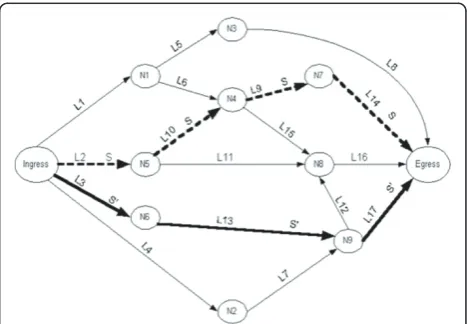
Figure 4 shows an example MPLS domain with single ingress and egress node on ISP topology. The domain consists of nine intermediate nodes, two edge routers, and multiple links which are used within domain edge routers.
The bandwidth allocation trend in case of ISP domain is plotted in Figures 5, 6, and 7 for CT2, CT1, and CT0, respectively.
It is evident from Figure 5 that all the bandwidth requests for CT2 are assigned by both TELIC and RDM TELIC. Since CT2 is the premium class, the same trend is highly desirable. On the other hand, SHORTD as shown has lesser allocation to CT2.
For class type CT1, the requested bandwidth is increased from first to last traffic trunk, It has been found that the allocation in RDM TELIC is almost 100%; however, TELIC has fluctuating trend in multiple traffic set for the selected ISP domain whereas SHORTD also has unpredicted behavior.
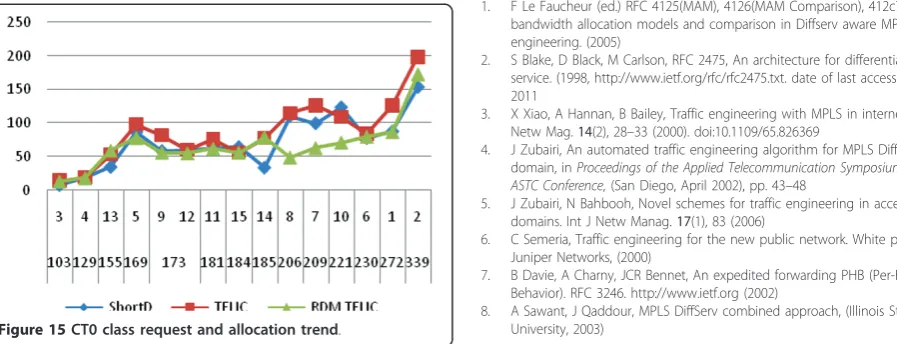
In CT0, the requested bandwidth was kept high at the start and then the allocation for CT1 and CT2 is increased. It has been observed that allocation is on ris-ing trend in case of TELIC; however, the allocation with respect to RDM TELIC is a bit low as shown in Figure 7.
It is evident from the above-mentioned graphs that RDM TELIC is performing nice for ISP domain in case of class-based service; however, more rejection in case of best-effort traffic (CT0) is observed.
5.2. Results portfolio for fish domain
Figure 8 shows an example fish domain with multiple hops and links. There are multiple ingress and egress nodes in fish topology, which are shown here. The
results are compiled by assigning on node as ingress and one as egress.
The allocation trend for different CTs is shown in Fig-ures 9,10, and 11, respectivly.
Allocation trend for CT2 is 100% in RDM TELIC as well as in TELIC; however, the curve is showing down-ward tilts on some request in SHORTD. This may be due to the order in which the requests arrive.
Figure 10 illustrates the allocation trend of CT1 for fish domain. It is evident fromt the graph that the allocation of CT1 is maximum in RDM TELIC; TELIC however has the fluctuating trend in the allocation and in some case none of the requests has been allcoated. It obviously depends heavily upon the ratio of green links on the domain.
Figure 11 shows the allocation of least priority class, i. e., CT0. It is evident form the graph that TELIC has maximum allocation for CT0.
5.3. Results portfolio for duck domain
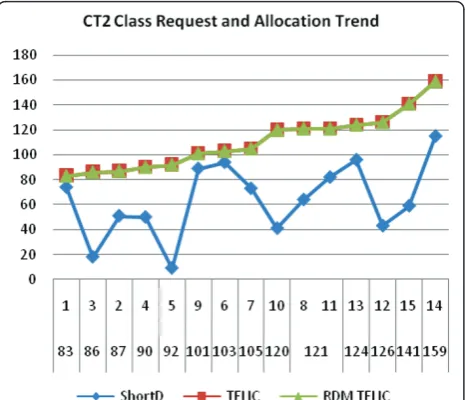
Figure 12 is showing an example of duck domain with multiple hops and links. There are multiple ingress and Figure 5CT2 class bandwidth request and allocation trend.
Figure 6CT1 class bandwidth request and allocation trend.
Figure 7CT0 class bandwidth request and allocation trend.
egress nodes in duck topology, which are shown here. The results are compiled by assigning node (1) as ingress and node (9) as egress.
Allocation in case of duck is shown in Figures 13, 14, and 15.
Allocation of CT2 in all of the tree algorithms is shown in Figure 13. It is understandable that because of bottleneck link 4 ® 9, the allocation trend of premi-mum traffic is a bit lower than requested. Still, alloca-tion in case of RDM TELIC is slightly higher than TELIC and the obvious differnce can be observed in case of SHORTD.
Similarly, the results for CT1 are shown in Figure 14. RDM TELIC again has the higher allocation for CT1 as compared to TELIC and SHORTD as shown in Fig-ure 14. The allocation for CT0 in duck is high in TELIC and SHORTD as compared to RDM TELIC.
The above results prove that RDM TELIC provides better performance than both TELIC and SHORTD in terms of allocation, rejection, and pre-emption of traffic for class-based traffic such as CT1 and CT2.
6. Conclusion and future work
We have worked on enhancing TELIC, a bandwidth allocation algorithm for MPLS-Diffserv domains to Figure 9CT2 class request and allocation trend.
Figure 10CT1 class request and allocation trend.
Figure 11CT0 class request and allocation trend.
Figure 12Duck domain with multiple links and nodes.
increase the overall BW utilization. An improved TE algorithm RDM TELIC has been proposed. This algo-rithm applies the RDM to TELIC for bandwidth alloca-tion resulting in better utilizaalloca-tion of network bandwidth. The implementation of the algorithm is done in C++. The results are analyzed on different domains and traffic sets as discussed above, showing performance improve-ment over SHORTD and TELIC algorithm.
There are other algorithms proposed for MPLS domains in the literature such as minimum interfer-ence routing (MIR) [9]. However, MIR deals with dif-ferent issues such as multiple ingress and multiple egress network domains. Its considerations are to route the LSPs in a way such that other ingress-egress pairs are protected from interference. Therefore, we have not compared RDM TELIC with MIR. In addi-tion, RDM TELIC supplements the algorithms avail-able for implementation of MPLS-TE. MPLS-TE is the whole framework of TE for the domain that includes
measurement, modeling, characterization, and control of network traffic. It includes constrained shortest path first (CSPF) (constrained routing), protection routing, and load balancing. CSPF routing algorithm uses maxi-mum bandwidth available (MBW) as one of the tie breakers for choosing links. RDM TELIC focuses on bandwidth allocation and routing. We have compared
RDM TELIC’s results with MBW (i.e., SHORTD)
showing performance improvement.
Future study may include incorporating LSP holding time to entertain bulk of requests to compute the delay and improvement of the algorithm performance. LSP holding times would allow us to run the algorithm for extended period of time, thus providing clearer feedback of its performance. Pre-emption priorities in different classes of service may also be integrated to handle larger number of classes.
Abbreviations
BA: behavior aggregates; BC: bandwidth constraint; BCM: bandwidth constraint models; CF: conjunction factor; CSPF: constrained shortest path first; FEC: forward equivalence class; IETF: Internet engineering task force; ISP: irregular several paths; LER: label edge router; LSP: label switched paths; LSR: label switching router; MAM: maximum allocation model; MBW: maximum bandwidth available; MIR: minimum interference routing; MPLS: multi-protocol label switching; PHB: per hop behavior; QoS: quality of service; RDM: Russian dolls model; SHORTD: shortest distance algorithm; SLAs: service level agreements; TE: traffic engineering; TELIC: traffic engineering with link coloring.
Author details
1
College of Electrical and Mechanical Engineering, National University of Sciences & Technology (NUST), Islamabad, Pakistan2State University of New York at Fredonia, 210 Fenton Hall, Fredonia, NY 14063, USA
Competing interests
The authors declare that they have no competing interests.
Received: 1 October 2010 Accepted: 1 August 2011 Published: 1 August 2011
References
1. F Le Faucheur (ed.) RFC 4125(MAM), 4126(MAM Comparison), 412c7(RDM), bandwidth allocation models and comparison in Diffserv aware MPLS traffic engineering. (2005)
2. S Blake, D Black, M Carlson, RFC 2475, An architecture for differentiated service. (1998, http://www.ietf.org/rfc/rfc2475.txt. date of last access July 2011
3. X Xiao, A Hannan, B Bailey, Traffic engineering with MPLS in internet. IEEE Netw Mag.14(2), 28–33 (2000). doi:10.1109/65.826369
4. J Zubairi, An automated traffic engineering algorithm for MPLS Diffserv domain, inProceedings of the Applied Telecommunication Symposium (ATS), ASTC Conference, (San Diego, April 2002), pp. 43–48
5. J Zubairi, N Bahbooh, Novel schemes for traffic engineering in access domains. Int J Netw Manag.17(1), 83 (2006)
6. C Semeria, Traffic engineering for the new public network. White paper, Juniper Networks, (2000)
7. B Davie, A Charny, JCR Bennet, An expedited forwarding PHB (Per-Hop Behavior). RFC 3246. http://www.ietf.org (2002)
8. A Sawant, J Qaddour, MPLS DiffServ combined approach, (Illinois State University, 2003)
Figure 14CT1 class request and allocation trend.
9. M Kodialam, TV Lakshman, Minimum interference routing with applications to MPLS traffic engineering, inProceedings of the IEEE INFOCOM 2000 Nineteenth Annual Joint Conference of the IEEE Computer and Communications Societies, vol. 2. (Tel Aviv, Israel, 26-30 March 2000), pp. 884–889
doi:10.1186/1687-1499-2011-49
Cite this article as:Zafaret al.:Automated traffic engineering using
adaptive inter-class mixing.EURASIP Journal on Wireless Communications
and Networking20112011:49.
Submit your manuscript to a
journal and benefi t from:
7Convenient online submission
7Rigorous peer review
7Immediate publication on acceptance
7Open access: articles freely available online
7High visibility within the fi eld
7Retaining the copyright to your article
![Figure 2 Maximum allocation model [1].](https://thumb-us.123doks.com/thumbv2/123dok_us/949504.1115980/3.595.57.291.587.715/figure-maximum-allocation-model.webp)
![Figure 3 Russian doll model [1].](https://thumb-us.123doks.com/thumbv2/123dok_us/949504.1115980/4.595.54.544.527.732/figure-russian-doll-model.webp)