CSEIT161113 | Received: 02 August 2016 | Accepted : 07 August 2016 | July-August 2016 [(1)1: 66-71]
International Journal of Scientific Research in Computer Science, Engineering and Information Technology © 2016 IJSRCSEIT | Volume 1 | Issue 1 | ISSN : 2456-3307
66
Congestion Detection and Mitigation Protocols for Wireless
Sensor Networks
Muhammad Zeeshan, Fazlullah Khan,Syed Roohullah Jan
Deptartment of Computer Science, Abdul Wali Khan University Mardan, Pakistan
ABSTRACT
Congestion control is tremendously important area within wireless sensor networks (WSN). With the appearance of new network applications, the non-stop increasing traffic is starting to experience unexpected situation of network congestion. Congestion in wireless sensor network affects the nonstop flow of data, loss of information, delay and reduces the energy of nodes due to overhead of retransmission. Therefore, congestion needs to be control in wireless sensor network in order to extend system lifetime, improve fairness and quality of service and to attain high energy efficiency. This paper revives different routing protocols used in wireless sensor networks to mitigate and control congestion and to provide consistency for different applications and prolong the life of the wireless sensor network.
Keywords : WSN (Wireless sensors networks), Congestion, Congestion Control.
I.
INTRODUCTION
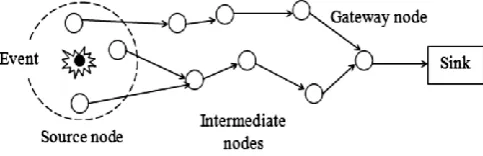
Wireless sensor networks (WSN)[1] consists of various wireless devices mount with various types of sensors, shown in Fig.1 to assemble information such as temperature, pressure, humidity, sound, vibration and wind speed from the surroundings. Wireless sensor network widely applied to environment such as environmental monitoring, target tracking, habitat monitoring, healthcare, telecommunication monitoring, military surveillance and factory monitoring. When the event is occurring for which the system is installed the sensors activate and begin to send the data to the base station.
Figure 1: Wireless Sensor network
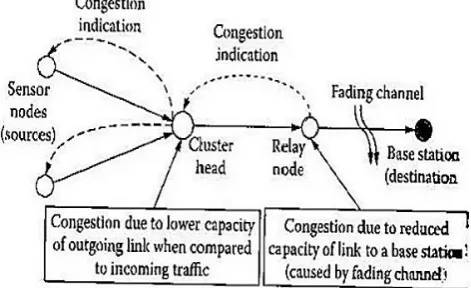
If the event is occurring frequently or with high value or many sensors capture the same event occurring they will send more packets to the base station as a result congestion starts from that point and spreads along its
links as shown in Fig 2. Data crossing that sub-network (area of congestion) would suffers from prolonged delays (buffer waiting) eventually leading to timeouts (loss rate).
Figure 2 : Congestion Scenario in WSN
the congestion occurs then we will try to mitigate the congestion using different techniques.
In Section “A” we have discussed FUSION which is congestion detection and avoidance mechanism uses hop by hop congestion detection like CODA [3] but the difference is that it uses implicit notification or congestion notification bit in the header of packet. It also include prioritized MAC scheme to ensure fairness i.e. unlike CSMA[2] which gives equal chance to every node to transmit their data but in this technique the high priority nodes which have more data then we assign extra time to drain their buffer. In Section “B” we have discuss the CODA (Congestion detection and avoidance) technique which uses the buffer overflow and channel sensing for congestion detection. Once the congestion is detected we use the back pressure and close loop method to inform the other nodes that the congestion is occurred and also to inform them to limit their sending data rate. In section “C” we have discuss anther protocol for congestion detection and avoidance named CCF(Congestion control and Fairness) protocol which states that every node is able to control the rate of its downstream nodes This allows the root node to reduce the generation rates of all downstream nodes. By reducing the transmission rates of all downstream nodes when this node's queue is full or about to become full, it allows the queue to empty. CCF guarantees simple fairness so that each node receives the same throughput. In Section "D" we have discussed another congestion control protocol which is priority based congestion control protocol for wireless sensor network. The node priority index is brought in to show the importance of every one node. In Section “E” we have discussed another congestion control protocol named ECODA (Enhanced Congestion Detection and Avoidance) protocol which is the superior version of CODA which uses dual buffer thresholds to detect congestion and a queue scheduler that arrange the packets for transmission and to drop the packets with low priority when the buffer is about to full or accedes the upper limit of the buffer. On node level it uses the back pressure method and bottle neck data sending rate control for congestion mitigation. ECODA cares of the high priority packets in the manner if the congestion has occurring the flexible queue scheduler select the low precedence packets for dropping to defeat the congestion.
II.
METHODS AND MATERIAL
A.Related Work
FUSION MECHANISIM
FUSION IS DESIGN TO PROVIDE UPSTREAM
CONGESTION CONTROL MECHANISM IT CONSISTS OF
THREE CONGESTION MITIGATION TECHNIQUES
APPLY IN DIFFERENT LAYERS, THAT IS
i. Hop-by-hop flow control
Using hop by hop flow control a sensor node present congestion detection and congestion mitigation congestion is discover through both queue occupancy and channel sampling techniques. The hop by hop flow control scheme in FUSION is similar to backpressure scheme in CODA[9]. The only difference in fusion is that each sensor node sets a congestion bit in the header of every outgoing packet instead of using backpressure messages.
ii. Rate limiting of source traffic in the traffic in the transit sensor nodes to provide fairness.
When a sensor node overhear a packet from its parent node (the node closer to the sink) with the congestion bit is set, it stops forwarding data toward the sink, Rate limiting is a defensive scheme to avoid congestion.
iii. Prioritized MAC(Medium Access Control)
FUSION also includes a prioritized MAC scheme to guarantee that congested nodes receive prioritized access to the channel. In traditional CSMA mechanism each node has the same opportunity to send the data over the channel but in WSN the parent’s nodes that are closed to the sink may gather more traffic and can overflows if it does not have more chances to send out its packets. To avoid this problem FUSION uses a random back-off time for each node is introduced which it related to its local congestion state so that the congested nodes may drain its buffer faster.
It involves three mechanism which is following:
B.Congestion Detection
Accurate and efficient congestion detection plays an important role in the congestion control of wireless networks. The detection method in CODA is the receiver based congestion detection. CODA uses a combination of the present and past channel loading conditions, and the current buffer occupancy, to infer accurate detection of congestion at each receiver with low cost. Sensor networks must know the state of the channel since the transmission medium is shared and may be congested with traffic between other nodes in the neighborhood. Listening to the channel to measure local loading incurs high energy costs if performed continually. Therefore, CODA uses a sampling scheme that activates local channel monitoring at the appropriate time to minimize cost while forming a accurate estimate.
Figure 3: Congestion detection and notification in CODA
i. Open-loop, hop-by-hop backpressure
Once congestion is detected node broadcast backpressure message and this message circulate towards the source as shown in Fig. 3. In CODA, a node broadcasts backpressure mechanism as long as it detects congestion. The node detecting congestion will report its upstream neighbors to reduce rate of data flow. A node that receives a backpressure message will adjust its sending rate by Adaptive Increase Multiplicative Decrease, the AIMD rate adjustment technique or by dropping packets based on the local congestion plan. When an upstream node (towards the source) receives the backpressure message, it decides whether it has to further propagate the backpressure upstream based on the local network situation.
ii. Closed-loop, multisource regulation
The cost of closed loop flow control is high compared to open loop flow control because it required feedback signaling. CODA runs Closed-loop congestion control mechanism on the sink to regulate multiple sources in the case of continual congestion. Essentially when the transmission rate of a source surpass maximum theoretical throughput (Smax) the source informs the sink by setting a bit in every packet that it transmits to the sink as long as the transmission rate remains higher than Smax. in response sink starts sending ACKs to the source until the sink detects congestion. When the sink detects congestion, it stops sending ACKs until the congestion is alleviated, to implicitly notify to drop its rate.
Disadvantages of CODA
1. Unidirectional control from sensors to sink. 2. Decreased reliability.
3. The delay and response time increases under heavy closed loop congestion
CCF(Congestion Control and Fairness)
Limitations:
i. CCF uses only packet service time to detect congestion and therefore it cannot detect either under utilization nodes or links.
ii. CCF does not provide any reliability mechanism i.e. preserve equal resource for each sensor node.
PCCP ( Priority Based Congestion Control Protocol):
In Priority based Congestion Control [7] node priority index is introduced to reflect the importance of each node. PCCP is a more rapid and more energy well-organized congestion control algorithm than CCF. PCCP maintains a priority index which is used as an indicator of the importance of each node. The packet inter arrival time and the packet service time are used together to find out the degree of congestion.
Intelligent congestion detection (ICD) Implicit congestion notification (ICN) Priority based rates adjustment (PRA)
C. Intelligent congestion detection (ICD):
Not like in TCP in which congestion is detected at the endpoints in PCCP congestion is locally detected in the intermediary nodes, based on the mean packet inter-arrival time (ta) which is the mean of the time
between two successively arriving packets and the packet service time (ts) [8] which is the time between
the MAC layer and the successful broadcast of the last bit ICD can be define as
d (i) = t
s/ t
aThe congestion degree helps in estimating the current congestion level at each intermediate node.
D. Implicit Congestion Notification (ICN)
PCCP uses the technique of ICN to attached congestion information in the header of the data packets. The congestion information is stored in the header of the packets that are forwarded when trigged by either of the following two events.
When the threshold is exceeded by the number of packets forwarded by a node.
When a congestion notification is heard by a node from its parent node.
At every node "i" PCCP attached ta, ts and overall
priority value.
E.Priority based rates adjustment (PRA)
The additive increase and multiplicative decrease (AIMD) used in conventional transport control protocols such as TCP is not of much help in adjusting the transmission rate as the congestion notification bit holding limited information. Therefore it is important for the nodes to be notified as to precisely how much to increase or decrease the rate the congestion degree. The priority index and the global priority values help in providing more information for exact rate adjustment.
ECODA (Enhanced Congestion Detection and Avoidance)
ECODA is an energy efficient congestion control scheme for sensor networks. In this method, the given method is followed.
i. Dual Buffer threshold Congestion detection:
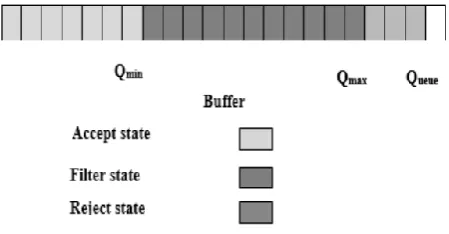
The dual buffer thresholds and weighted buffer difference are used to detect the congestion. The Fig shows the details of buffer state such as “accept state ”, “filter state” and “reject state)”. The different buffer states are pretend different channel loading which is used to accept or reject packets in different states.
Figure 4: Dual Buffer threshold Congestion
The ECODA [10] care of high priority packets, if the node data is most essential among its neighbors then if congestion take place, other nodes should lower down their data sending rate to mitigate node’s congestion so that the high priority packets may reach to the station in time.
Two thresholds Qmin and Qmax are used to show
different buffer states. Different buffer states imitate different channel loading, corresponding strategy is adopted to accept or reject packets in different states.
ii. Flexible queue scheduler and weighted fairness:
The Flexible Queue Scheduler is used to drop a low priority packet rather than the high priority packet when a high priority packet arrives if the queue in a sensor node is nearly full and dominated with low priority packets. At the same time, the high priority packet may be dropped due to queue overflow with tail-dropping.
For managing packets with different strategy, two thresholds are used such as Qmin and Qmax .
The scheduler works based on the following steps: a. If ( 0 ≤ N ≤ Qmin) :
All incoming packets are buffered, because queue utilization is low.
b. If ( Qmin ≤ N ≤ Qmax ) :
Some packets with low priority are dropped or overwritten by succeeding packets with high priority.
c. If ( Qmax ≤ N ≤ Q ):
Some packets with high dynamic priority is dropped or overwritten, then the expected average buffer length increases at a rate of two variables that can be tuned to achieve best possible system performance.
iii. A bottleneck-node-based source sending rate control scheme
Both transient (temporary) and persistent (continiual) congestion handle by ECODA. It makes use of hop-by-hop backpressure mechanism to handle transient congestion. It uses bottleneck node based source sending rate control and multipath load balancing to handle persistent congestion. This mechanism does not
required explicit ACK from sink; every node determines routing path status from sink and sender find better path to forward data. Bottleneck node identified and source data sending rate adjust more accurately using this mechanism.
III.
CONCLUSION
In this paper we have reviewed different wireless sensor routing protocols / algorithm for congestion control, reliability and packet loss. There are several protocols for congestion control in wireless sensor network. This paper present an overview of several congestion control techniques like FUSION, CODA, CCF, PCCP and ECODA. Also the comparative analysis of congestion control techniques is presented using several parameters like throughput, delay and energy consumption which shows among the these techniques Enhanced Congestion Detection and Avoidance (ECODA) is best for congestion control as it attain high throughput, less delay & less consumption of energy compare to other techniques [12-20].
Comparision Table of congestion control protocols
IV.REFERENCES
[1] Hull, B., Jamieson, K., Balakrishnan, H.: Mitigating congestion in wireless sensor networks. In: 2nd International Conference on Embedded Networked Sensor Systems. Maryland (2004)
networks," IEEE Communications Magazine, Vol: 40 Issue: 8, pp. 102-114, August 2002 [3] P802.11, IEEE Draft Standard forWirelessLAN
Medium Access Control (MAC) and Physical Layer (PHY) Specifications, D2.0, July 1995. [4] Wan C -Y, Eisenman S B, Campbell A T,
CODA: Congestion detection and avoidance in sensor networks. In the Proceedings of the First International Conference on Embedded Networked Sensor Systems (SenSys’03), Los Angeles, CA, USA, 2003,pp. 266–279
[5] V. Vijayaraja, Dr. R. Rani Hemalini, “Congestion in Wireless Sensor Networks and various techniques for Mitigation Congestion- A review”. IEEE International Conference on Computational Intelligence and computing Research.
[6] Chien- Yin Wan, Shane B. Eiseaman, Andrew T. Champbell, “ CODA: Congestion Detection and Avoidance”.
[7] V. Vijayaraja, Dr. R. Rani Hemalini, “Congestion in Wireless Sensor Networks and various techniques for Mitigation Congestion- A review”. IEEE International Conference on Computational Intelligence and computing Research.
[8] Yaghmaee, Mohammad Hossein, and Donald Adjeroh. "A new priority based congestion control protocol for wireless multimedia sensor networks." In World of Wireless, Mobile and Multimedia Networks, 2008. WoWMoM 2008. 2008 International Symposium on a, pp. 1-8. IEEE, 2008.
[9] Yaghmaee, Mohammad Hossein, and Donald Adjeroh. "A new priority based congestion control protocol for wireless multimedia sensor networks." In World of Wireless, Mobile and Multimedia Networks, 2008. WoWMoM 2008. 2008 International Symposium on a, pp. 1-8. IEEE, 2009.
[10] Wan ,C-Y, Eisenman, SB, Campbell, AT.. CODA: Congestion detection and avoidance in sensor networks. In: Proceedings of ACMSensys’03, November5–7, 2003, LosAngeles, California, USA; 2003.
[11] Tao LQ, Yu FQ. ECODA: enhanced congestion detection and avoidance for multiple class of traffic in sensor networks. Transactions on Consumer Electronics 2010.
[12] M. A. Jan, P. Nanda, X. He and R. P. Liu, “PASCCC: Priority-based application-specific congestion control clustering protocol” Computer Networks, Vol. 74, PP-92-102, 2014. [13] Khan, F., Bashir, F., & Nakagawa, K. (2012). Dual head clustering scheme in wireless sensor networks. In Emerging Technologies (ICET), 2012 International Conference on (pp. 1-5). IEEE.
[14] Khan, F. (2014). Secure communication and routing architecture in wireless sensor networks. In 2014 IEEE 3rd Global Conference on Consumer Electronics (GCCE) (pp. 647-650). IEEE.
[15] Khan, F., Jan, S. R., Tahir, M., Khan, S., & Ullah, F. (2016). Survey: Dealing Non-Functional Requirements at Architecture Level. VFAST Transactions on Software Engineering, 9(2), 7-13
[16] M. A. Jan, P. Nanda, X. He and R. P. Liu, “A Sybil Attack Detection Scheme for a Centralized Clustering-based Hierarchical Network” in Trustcom/BigDataSE/ISPA, Vol.1, PP-318-325, 2015, IEEE.
[17] Khan, F., & Nakagawa, K. (2012). Performance Improvement in Cognitive Radio Sensor Networks. the IEICE Japan.
[18] Khan, F., Khan, S., & Khan, S. A. (2015, October). Performance improvement in wireless sensor and actor networks based on actor repositioning. In 2015 International Conference on Connected Vehicles and Expo (ICCVE) (pp. 134-139). IEEE.
[19] M. A. Jan, P. Nanda, X. He, and R. P. Liu, “A Sybil Attack Detection Scheme for a Forest Wildfire Monitoring Application,” Elsevier Future Generation Computer Systems (FGCS), “Accepted”, 2016.