R E S E A R C H
Open Access
Adaptive collision resolution for efficient RFID tag
identification
Yung-Chun Chen
1, Kuo-Hui Yeh
2*, NaiWei Lo
1, Yingjiu Li
3and Enrico Winata
1Abstract
In large-scale RFID systems, all of the communications between readers and tags are via a shared wireless channel. When a reader intends to collect all IDs from numerous existing tags, a tag identification process is invoked by the reader to collect the tags’ IDs. This phenomenon results in tag-to-reader signal collisions which may suppress the system performance greatly. To solve this problem, we design an efficient tag identification protocol in which a significant gain is obtained in terms of both identification delay and communication overhead. Ak-ary tree-based abstract is adopted in our proposed tag identification protocol as underlying architecture for collision resolution. Instead of just recognizing whether tag collision happens at each interrogation time period, the reader can further obtain the reason of why the collision occurs in the current tag inquiry operation. With this valuable information, we can reduce tag signal collisions significantly and at the same time avoid all of the tag idle scenarios during a tag identification session. The rigorous performance analysis and evaluation show that our proposed tag
identification protocol outperforms existing tree-based schemes.
Keywords:anti-collision, RFID, tag identification
1. Introduction
As rapid advances in semiconductor technology have enabled the production of low-cost tags (usually in a range of five to ten cents), the Radio Frequency IDentifi-cation (RFID) technique is promptly adopted to replace traditional bar-code-based identification mechanism in many daily life applications such as inventory tracking, library book managing, and airport baggage conveying. RFID technology utilizes Radio Frequency (RF) to store and retrieve data via an RF compatible integrated cir-cuit. An RFID application system, in general, consists of a number of readers and tags (or tagged objects). The tags typically derive their energy for operation and data transmission from a reader’s electric, magnetic, or elec-tromagnetic field. The reader recognizes tagged objects through a wireless channel in which each tag transmits its unique ID and other information.
Tag reading throughput is critical while scanning tagged items in a large-scale RFID application. Two main performance criteria, i.e., tag reading delay (which
should be within acceptable time period) and the energy consumption of RF reader (which should be minimized) [1,2], are used for measuring RFID system throughput. In a normal tag identification process, the existence of numerous tags within the interrogation area of a reader may lead to a great number of signal collisions. This is because the reader and the tags communicate over a shared wireless channel. If more than two tags respond to the reader simultaneously, the signals transmitted by these tags collide with each other. Due to the signal col-lisions, either the reader cannot recognize tags (or tagged objects) or a retransmission request for tags’IDs is required, and thereby both of communication over-head and identification delay increase during the tag identification process. It is thus important to design an efficient tag collision arbitration mechanism in RFID systems.
In recent years, reader-talk-first (RTF) RFID tag iden-tification protocols have seriously been investigated as new improvements in silicon technology and digital sig-nal processing technology have mitigated or overcome the major shortcomings of RTF protocols: complex cir-cuitry and reader interfe-rence problem, and the cap-ability of RTF protocols on detecting large populations * Correspondence: [email protected]
2
Department of Information Management, Chinese Culture University, Taipei 111, Taiwan
Full list of author information is available at the end of the article
of tags in a short time period has been observed. RTF tag identification protocols are broadly classified into aloha-based schemes [3-12] and tree-based schemes [2,13-29]. In aloha-based schemes [30,31], a reader pre-dicts the number of current tags within its interrogation area and assigns estimated number of timeslots to all of the tags. The tags randomly pick up their own timeslots for ID transmission. Aloha-based protocols reduce the probability of tag collisions by separating tag responses into distinct timeslots. However, aloha-based mechan-isms suffer from the so-called “tag starvation problem,” in which certain tags may not be identified for a long time and the time period required for all tags’ recogni-tion may not be guaranteed.
On the other hand, tree-based schemes [32,33] utilize the tags-set splitting mechanism based on a prefix value issued by the interrogator, i.e., the reader continuously split a set of currently collided tags into two subsets until each set contains only one tag. This kind of proce-dure guarantees that all tags’IDs are identified within a certain time period. Nevertheless, the tree-based
proto-cols exploit the information obtained from tags’
responses to determine which tag subset should be con-structed. It results in higher energy consumption and identification delay due to the vast splitting and invok-ing operations. In general, for aloha-based protocols
synchronization command such as Null is used by
reader to signal all tags the end of a timeslot and conse-quently synchronize all tag responses in line with the time duration of given timeslots. Therefore, a signal col-lision caused by tag response can only be occurred at a given timeslot when multiple tags send their replies at the same timeslot. For tree-based protocols, bit-by-bit synchronization on tag response is desired such that the reader can detect the colliding bit positions of re-ceived tag responses. This kind of collision detection mechan-ism can be implemented using synchronization com-mand and specific signal encoding scheme such as Manchester code.
Recently, four more anti-collision studies were pre-sented. Zhu et al. [11] proposed an optimal-framed aloha-based anti-collision protocol, in which the reading process is modeled as a Markov Chain and the optimal reading strategy is accordingly derived by first-passage-time analysis. Later, Li et al. [12] presented an aloha-based anti-collision scheme. The capture-aware backlog estimation method and optimum frame length equation are exploited to analyze the maximum achievable throughput of their scheme. Jia et al. [29] developed an efficient tree-based tag identification protocol, where a collision tree is used to capture the complete communi-cations between the reader and the tags. The novelty of their me-thod is that the prefixes generation and tag group splitting are based on the collided bit directly.
Porta et al. [28] proposed a new metric, i.e., time system efficiency, to evaluate anti-collision protocols. This metric provides a direct measure of the time taken to read a group of tags. In this study, we propose a tree-based tag identification protocol, calledk-ary Tree-based Anti-collision Scheme (k-TAS) to pursue better identifi-cation efficiency. Ink-TAS, the reader first recognizes whether collision happens and, if it happens, the reason of why the collision occurs at each tag inquiry time per-iod. Within a tree-based structure, the reader knows which descendant nodes collide with the currently vis-ited node; in the next interrogation time, the reader can only focus on those nodes. As a result, this design allows the reader to avoid visiting all idle nodes. The reduction of tag signal collision and the elimination of all idle scenarios reduce the identification delay and communication overhead compared to existing tree-based protocols. Our performance analysis and evalua-tion show that k-TAS is efficient in reducing tag colli-sions while preserving low communication overhead.
This article is organized as follows. Section 2 intro-duces three application scenarios which are relevant to this study. A new RFID tag identification protocol (i.e.,
k-TAS) is introduced in Section 3. The performance
analysis on the identification delay and communication overhead ofk-TAS is addressed in Section 4. Next, Sec-tion 5 presents the simulaSec-tion results of our proposedk -TAS. Finally, we give a conclusion in Section 6.
2. Relevant applications
As RFID technology provides an efficient and accurate way to identify physical resources and at the same time preserves very attractive deployment characteristics to industries such as simple system installation and deploy-ment process, wireless accessibility and low-cost manu-facture, various innovative applications have promptly been developed. Each of these RFID applications might require distinct system criteria in terms of the knowl-edge of the number of current tags, the duration of tag identification and the tag reading speed [9]. We elabo-rate on three application scenarios which are most rele-vant to our study as follows.
2.1. Airport baggage checking Number of tags: known
Duration of tag identification: known Reading speed: fast
storage place of ready-to-take-off airplane where all pas-sengers’luggage is required to be assured again. In such scenario, the reader must be able to recognize tags as soon as possible in order to accelerate boarding activities.
2.2. Inventory managing Number of tags: known
Duration of tag identification: known Reading speed: slow
This section illustrates a scenario that might occur in a warehouse where companies could immediately know the location of any item as well as the management of inventory, such as goods boxes leaving, entering, and monitoring. In such scenario, there are a known number of tags within the reader’s interrogation area according to a goods list in the backend database. The reading speed could be slow as the reader might be either fixed on specific location, such as goods stand, or a mobile handheld device. Accordingly, the duration of tag identi-fication might be known.
2.3. Transported merchandise tracking Number of tags: known
Duration of tag identification: unknown Reading speed: fast
This case envisions future merchandise transporting in which goods are attached with tags on themselves. This case might occur at the retail distribution center where all tagged goods are being transported on a forklift through a portal embedded with a reader. Companies or retails could promptly recognize whether all transported merchandise exists at current time period by scanning attached tags. Hence, the reader requires identifying all tags as soon (and cor-rectly) as possible when the tagged merchandise passes through the monitoring portal.
3. New tag identification protocol
In this study, we focus on the tag identification in above RFID applications in which the reader must be able to identify all tags as fast as possible. We consider a target system where a single RFID reader intends to efficiently communicate with a pile of passive tags (denoted as q tags throughout this article) within in its interrogation range for object tracking and monitoring. In addition,k -TAS requires that all transmitted data between the reader and all involved tags are synchronized during each interrogation time period. Current RFID technolo-gies [4,6,16,28,34-37] have demonstrated this possibility by exploiting a Manchester encoding technique during each query session. In the following, we formally define some terminologies.
•Session
A session is the period from the moment the reader initializes the tag identification procedure to the time of all tags are actually recognized by the reader. Let Sl denote thelth session.
•Cycle
An interrogation cycle is the duration when the reader transmits a triggering signal command to all tags and the tags respond with their corresponding output. According to the number of tag responses, a cycle is idle, readable, or collided when no tag responds, one tag responds, or multiple tags respond, respectively. Note that in the abstract tree structure of tag identification protocol, such as Query Tree protocol, Binary Search (BS) Scheme, ork-TAS, a cycle can be represented as a node. Note that a session usually consists of numerous interrogation cycles.
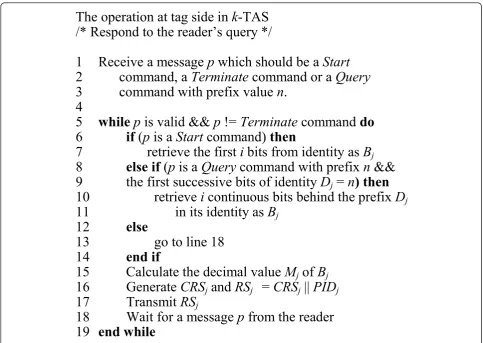
3.1.k-Ary tree-based anti-collision scheme (k-TAS) Ink-TAS, we exploit an abstractk-ary tree structure to resolve tag signal collisions more effectively. Based on triggering command issued by the reader, involved tags insert useful piece information, i.e., a bit-sequence derived from some part of their IDs, in the correspond-ing response, i.e., the tags will respond a new data sequence, which possesses extra (and useful) informa-tion for collision resoluinforma-tion, to the reader instead of just their IDs. This design allows the reader to greatly reduce tags’ response collisions and accordingly save more operation time and power energy during tag iden-tifi-cation procedure. Figures 1 and 2 show the pseudo-code at the tag side and the reader side, respectively, in k-TAS. We illustrate the detailed processes of k-TAS in the following.
Step 1: At the beginning of lth session Sl, the normal identification procedure is initially invoked when the reader broadcasts aStart command along with a prede-fined parameter ito all existing tags (lines 7-8 of Figure 2), wherei= log2k. Once receiving thisStartcommand,
each tagtjretrieves a bit blockBj(lines 6-7 of Figure 1), which is the firstibits of its identity IDj, and calculates the decimal valueMjof Bj(line 15 of Figure 1). A dis-tinctCollision Resolution String(CRSj) is then generated by each tagtj and sent to the reader as one part of the response. A bit sequence generator, which can be imple-mented with simple circuit logics and a bit counter, is utilized by a tagtjto construct its CRSj. The generation
process of CRSj is as follows. Every time the bit
sequence generator produces and sends out a bit, the bit counter is then increased by 1. The generator only generates bit 1 when the value of its bit counter is equal
Each tag tjperforms these procedures iteratively until the bit-length ofCRSjis 2i=k.
Once completingCRSj, each tagtjresets the value of its bit counter to zero and appends its partial identityPIDj behind theCRSjto construct aResponse String(RSj), i.e., RSj= CRSj||PIDj. Note thatPIDjis constructed by remov-ing the firstibits fromtj’s identityIDjand || denotes a concatenate operation. Finally, each tagtjsends the bit stringRSjto the reader as a response. The above pro-cesses can be referred to lines 16-17 of Figure 1.
Step 2: As a Manchester encoding technique is adopted for all data transmission, the communication channel among the reader and the tags at each interrogation cycle is synchronized. As a result, the reader can easily detect the positions of collided bits among receivedRSjbit strings from all responding tags. Then, the reader recognizes all Mjvalues based on the collided bit positions amongCRSj bit strings contained in receivedRSjbit strings (lines 14-16 of Figure 2). Note that if no bit collision occurs among receivedRSjbit strings at the first time of tag enquiry, it means that the reader identifies a tag which is the only one tag within the reader’s interrogation area. Next, the
reader recovers all recognizedMjvalues to the original bit blockBjvalues, and stores these values (lines 20-23 of Fig-ure 2). For eachBj, a commandQueryalong with a prefix valuenis broadcasted by the reader to all tags as tag ID interrogation in whichn=Bj(lines 10-13 of Figure 2).
Based on theQuerycommand and prefix valuen sent
from the reader, the tags act as follows.
Step 3: Once receiving Query command, only tags
which possess the same prefix value Dj, i.e.,Dj =n, in its identity IDj will respond. Each responding tag tj retrievesi conti-nuous bits, which is behind the prefix valueDjin itsIDj, as its bit blockBj(lines 10-11 of Fig-ure 1). Next, the involved tag tj computes the decimal value Mjof Bj. Based on the derived value Mj, each tag tjgenerates a corresponding output data sequenceCRSj and RSj= CRSj||PIDj in which PIDjis tj’s identity IDj except prefix valueDjand the conti-nuousi bits behind
Dj. Note that the generation procedure of CRSjis the
same with that in Step 1. Finally, each involved tag simultaneously sends its computed bit stringRSjto the reader as the responses. These processes can be referred to lines 15-17 of Figure 1.
The operation at tag side in
k
-TAS
/* Respond to the reader’s query */
1
Receive a message
p
which should be a
Start
2
command, a
Terminate
command or a
Query
3
command with prefix value
n
.
4
5
while
p
is valid &&
p
!=
Terminate
command
do
6
if
(
p
is a
Start
command)
then
7
retrieve the first
i
bits from identity as
B
j8
else if
(
p
is a
Query
command with prefix
n
&&
9
the first successive bits of identity
D
j=
n
) then
10 retrieve
i
continuous bits behind the prefix
D
j11 in its identity as
B
j12
else
13 go to line 18
14
end if
15 Calculate the decimal value
M
jof
B
j16 Generate
CRS
jand
RS
j=
CRS
j||
PID
j17 Transmit
RS
j18 Wait for a message
p
from the reader
19
end while
Step 4: With the synchronized channel, the reader first detects all positions of collided bits among received CRSj bit strings and recognizes allMjvalues. Based on the recognized Mj values, the reader can recover the
original bit block Bj values and store these recovered values (lines 20-23 of Figure 2). The reader then broad-cast aQuery command along with a new prefix valuen to all tags again (lines 10-13 of Figure 2). If no bit
The operation at reader side in
k
-TAS
/* Transmit queries and receives tag responses */
1
Initialize stack
Q
, temporary stack
TQ
, a predefined
2
parameter
i
and system values
m, n
3
Q
=
NULL
4
TQ
=
NULL
5
n =
φ6
7
Transmit a
Start
command to start current session
8
and go to line 14
9
while
Q
!=
NULL
do
10
m
= Pop(
Q
)
11
n
= Pop(
TQ
)
12
n
=
n
||
m
13 Transmit a
Query
command with prefix value
n
14 Wait for tag responses
RS
j=
CRS
j||
PID
jand
15 detect the positions of collided bits among
16 received
CRS
jbit strings
17
if
(there are bit collisions occurred among
18 received
CRS
jbit strings)
then
19
for
each collided bit position
20 retrieve
CRS
j21 restore
M
jand
B
j22 Push (
Q
,
B
j)
23 Push (
TQ
,
n
)
24
else if
(there is no collision occurred among
25 received
CRS
jbit strings)
then
26
if
(there are bit collisions occurred
27 among received
PID
jbit strings)
then
28 retrieve
CRS
jand the first successive
29 bit strings
o
until the 1
stcollision
30 bit position among
PID
jbit strings
31 restore
M
jand
B
j32 Push (
Q
,
B
j||
o
)
33 Push (
TQ
,
n
)
34
else if
(there is no collision occurred
35 among received
PID
jbit strings)
then
36 Store the tag
ID
37
end if
38
end if
39
end while
40 Empty
TQ
/* release consumed memory*/
41 Transmit a
Terminate
command to cease current
42 session
collision occurs among received RSj bit strings, it denotes that the reader actually identifies one tag within its interrogation area (line 36 of Figure 2). After that, the reader goes back to other unvisited (and collided) bit positions amongCRSjidentified at the last cycle and performs the collision resolution mechanism. The above identification process will be recursively operated until all existing tags have been exactly identified.
In lines 26-33 of Figure 2, we illustrate a scenario of that there is no collision occurred among receivedCRSj bit strings but some bit collisions happen among received PIDj bit strings. In such case, the reader requires not only resolving currently involved block Bj values, but also retrieving the first successive bit strings o from the first bit to the first collided bit position among receivedPIDj bit strings. The block values Bj, which consists of current prefix valuenand a bit string oretrieved from PIDj, will be maintained at reader side for next tag inquiry cycle. This design allows the reader to save more signal collision resolution steps ink-TAS by ignoring all non-collided bit position (or non-collided intermediate node in the abstract tree structure). Other-wise, for the aspect of tree structure, the reader must waste time on visiting some non-collided intermediate node without any useful feedback.
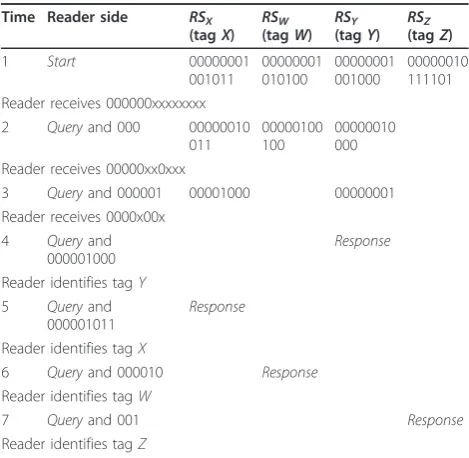
3.2. An example ofk-TAS
Table 1 demonstrates a normal tag identification process ofk-TAS with parameter i= 3. The identities of exam-ple tags are as follows.
Tag X,IDX= 000001011;Tag W,IDW= 000010100;
Tag Y,IDY= 000001000;Tag Z,IDZ= 001111101. At the beginning of sessionSl, the reader broadcasts a Start command to all tags. Once receiving this com-mand, tag X, W, Y, and Z retrieve the first three bits from its own identity to construct BX= 000, BW= 000, BY= 000, andBZ= 001, respectively. Next, based on the valueBj, each tagtjcalculates the corresponding output values Mj, CRSj, and RSj. Finally, each tag tj send its own RSj back to the reader simultaneously. Note that the communication channel among the reader and all existing tags is synchronized.
Upon obtaining the bit strings RSX, RSW, RSY, and
RSZ, the reader detects two collided bit positions, i.e., 0
and 1, among the CRSj bit strings contained in the
incoming data sequences. Note that the status of stack
Q andTQ is NULL so far. Next, the reader retrieves
twoCRSjbit strings from the result of resolving received
RSj bits sequences, and restores the corresponding
values Mj and Bj. Meanwhile, the stack Q andTQ is invoked to maintain derivedBjstrings for memorizing all unvisited collided bit positions.
RetrievedCRSj® 00000001; 00000010 RestoredMj®0; 1
RestoredBj®000; 001
Current status of stackQ®000; 001 Current status of stackTQ®j; j
Since stackQ is notNULL, the reader first takes an item, i.e.,m= 000 andn=j, out ofQandTQand pro-duces a new system value n =n||m = 000 as a prefix
value for next tag ID inquiry. AQuery command with
this derived valuenis then issued to all tags. Current status of stackQ®001
Current status of stackTQ®j
After getting theQuery command with prefix valuen = 000, only tags, i.e., X, W, and Y, which possess the same prefix 000 will respond. In such case, each responding tagtjindividually retrieves three continuous bits, which is behind the prefix valueDj= 000 in itsIDj, as the bit block Bjand calculates the decimal valueMj
ofBj. Next, the valuesCRSjandRSjare derived. Finally,
tagsX,W, and Ysend back the response bit sequences to the reader simultaneously.
Time Reader side RSX (tagX)
2 Queryand 000 00000010
011
3 Queryand 000001 00001000 00000001
Reader receives 0000x00x
6 Queryand 000010 Response
Reader identifies tagW
7 Queryand 001 Response
Reader identifies tagZ
BY= 001,MY= 1,CRSY= 00000010, RSY=CRSY||PIDY= 00000010000
From the incomingRSX, RSW, and RSYbit strings, the reader recognizes two collided bit positions, i.e., 1 and 2, among the received CRSj bit strings. Similarly, the reader retrieves these two identifiedCRSjbit strings, i.e., 00000010 and 00000100, and maintains the correspond-ing values Bj, i.e., 001 and 010, into stack Q. At the same time,TQis inserted with currently involved prefix values 000 twice.
Current status of stackQ®001; 010; 001 Current status of stackTQ®000; 000;j
Due to the non-NULL status of stack Q, the reader retrieves two objectsm = 001 andn= 000 fromQand TQ. Next, the reader calculates a new prefix valuen=n ||m= 000001 and broadcasts it with aQuerycommand to all tags.
Current status of stackQ®010; 001 Current status of stackTQ®000;j
With the incoming value 000001, tagsX andYwhich
own the same prefix value will retrieve a three bits block Bj behind the prefix valueDj = 000001 in their identities, and compute the decimal value Mj of Bj. Next, tagsX and Yderive the corresponding response se-quencesCRSX, CRSY, RSX, and RSY, and send them back to the reader at the same time.
BX= 011,MX= 3,CRSX= 00001000,
RSX=CRSX||PIDX= 00001000 ||j= 00001000 BY= 000,MY= 0,CRSY= 00000001,
RSY=CRSY||PIDY= 00000001 ||j= 00000001 Similarly, the reader will recognize two collided bit positions, i.e., 0 and 3, among the received CRSj bit strings which are 00001000 and 00000001. Then, the reader computes the corresponding values Bj, i.e., 000
and 011, and maintains them in stack Q. Note that
PIDX and PIXY are empty at the responding period.
Meanwhile, current involved prefix values 000001 is maintained inTQ.
Current status of stackQ®000; 011; 010; 001 Current status of stackTQ®000001; 000001; 000;j Because stackQis non-NULL, the valuesm= 000 and n= 000001 are extracted from QandTQ, respectively.
Next, the reader issues a prefix value n = n || m =
000001000 with a Querycommand to all tags and only
tagYwill respond and be identified by the reader. Current status of stackQ®011; 010; 001 Current status of stackTQ®000001; 000;j
In next step, the reader issues another new prefix value 000001011, which is constructed by the valuesm = 011 and n= 000001 in the top of Qand TQ, with a Querycommand to all tags. In that case, tagXis able to be recognized at current cycle.
Current status of stackQ®010; 001 Current status of stackTQ®000;j
Similar to above procedures, the reader detects that stack Qis notNULLand then retrievesm= 010 and n = 000 from stacks Qand TQ. With the derived prefix valuen =n||m = 000010, the reader will identify the tagWactually.
Current status of stackQ®001 Current status of stackTQ®j
Finally, the reader takes the last item, i.e., 001 and j,
from stacksQ and TQ and creates a prefix value 001
which is soon issued to all current tags. Tag Z then sends a response bit sequence 10000000101 back to the reader. With this response, the reader can actually iden-tify tagZ.
MZ= 7,CRSZ= 10000000,
RSZ=CRSZ||PIDZ= 10000000101
As the current status of stacksQandTQisNULL, the reader understands that all tags have been identified successfully. After that, the reader broadcasts a
Termi-nate command to cease current tag identification
session.
Current status of stackQ®NULL
Current status of stackTQ®NULL
4. Performance analyses
In this section, we analyze the identification delay and the communication overhead for recognizing all tags in k-TAS in terms of the amount of interrogation cycles and total transmitted bits [19,20,23,25]. Let Ar,ldenote the set of a tags within the reader r’s interrogation range during the lth tag identification session Sl. The identification delay, i.e., dtotal(Ar,l), caused by
recogniz-ing Ar,l is as follows. Note that dreader is the delay of
transmission time of the reader’s Query command
including any appended information, dtagis the delay
of delivering the tag ID, dcycle is the average delay of
an interrogation cycle andT(Ar,l) is the total interroga-tion cycles in a session when the reader r recognizes Ar,l.
dtotal(Ar,l) =
(dreader+dtag)≈T(Ar,l)·dcycle (1)
Lemma 1. The number of collided cycles in the bth layer of target abstractk-ary tree structure when k-TAS recognizesatags inAr,l,Ck-ary(a,b), is
idle cycles and readable cycles, respectively, in the bth layer of target abstractk-ary tree structure when k-TAS recognizes Ar,l. As the total nodes in the b th layer of targetk-ary tree iskb, Ik-ary(a,b) and Rk-ary(a,b) can be
Ik- ary(α,β) =kβ·
Hence, from (2) to (3), we obtain
Ck−ary(α,β) =kβ−Ik−ary(α,β)−Rk−ary(α,β)
nodes ofk-TAS for recognizingAr,l. Then, the number of required interrogation cycles whenr recognizesAr,l under ak-ary tree structure,Tk-ary(Ar,l), is
Tk−ary(Ar,l) =α+Ck−ary(Ar,l)
Proof: Since k-TAS always splits the set of currently collided tags intoksubsets, the whole tag identification procedure ofk-TAS can be represented as a k-ary tree when the readerr recognizesAr,l. It is obvious that ink -TAS all idle cycles are ignored. Therefore, in the target k-ary tree corresponded tok-TAS, all the intermediate nodes are collided nodes and all the leaf nodes are read-able nodes. cis the bit-length of each tag ID.
Proof: From Lemmas 1 and 2, the number of collided nodes while k-TAS recognizes Ar,l,Ck-ary(Ar,l), can be
mitted bits transmitted by the reader and all tags for recognizing Ar,l in k-TAS. Then, the total transmitted bits whenr recognizesAr,lunder a k-ary tree structure,
Sk-ary(Ar,l), is
collected from the depth bth layer of target abstractk -ary tree structure whenk-TAS recognizes Ar,l. As men-tioned before, the nature of k-TAS always makes the corresponding abstract k-ary tree structure possesses only collided nodes and readable nodes. In k-TAS, for each reader inquiry and each tag response, the trans-mitted bits isi·band 2i+(c-i·b-i), respectively. With the results of Lemma 1 and Equation 3, we obtain
Sk−ary(α,β) ={i·β+ [2i+ (χ−i·β−i)]} ·[Rk−ary(α,β) +Ck−ary(α,β)]
In brief summary, we learn from Theorems 1 and 2 that the total number of required interrogation cycles
Tk-ary(Ar,l) and the total amount of transmitted bitsSk
-ary(Ar,l) for k-TAS are mainly dependent on the bit
length of tag ID c, the value of k and the number of tags a. When the number of tags is large enough, for example a = 200, and the bit length of tag ID is long enough, for examplec= 96, then the main performance difference between 2-ary protocols (i= 1) andk-ary pro-tocol (k-TAS) where k= 2i andi≥2 are dependent on
comparison with 2-ary protocols (i= 1).
5. Performance evaluation
In this section, we evaluate the performance ofk-TAS in comparison with existing tree-based tag identification methods, i.e., Query Tree (QT) [13,14,21,27], BS [16,34], RN16QT [17], and ETIP [38], which are most relevant to k-TAS. The main criteria for evaluating the efficiency during a normal tag identification session are the
identi-fication delay and communication overhead
a session is critical for influencing the system perfor-mance of a tree-based tag identification protocol. This important metric usually can be denoted as the commu-nication overhead. Our simulation was written with C# under Visual Studio .NET environment. For simplicity, event dispatcher is implemented in our simulation tool to dispatch reader commands and tag responses as events. The reader and each tag have their own event queue to store events dispatched to it. All events are generated with timestamp. A global timer is implemen-ted. The reader gathers all tag response events occurred at the same timestamp for further data synchronization and signal collision detection. First, we investigate the effect of the parameter ion the performance ofk-TAS in which the best candidate value fori is derived. Sec-ond, we demonstrate that the performance ofk-TAS is superior to existing tree-based tag identification schemes under various numbers of tags and bit-lengths of tag ID.
5.1. Impact of the system parameteri
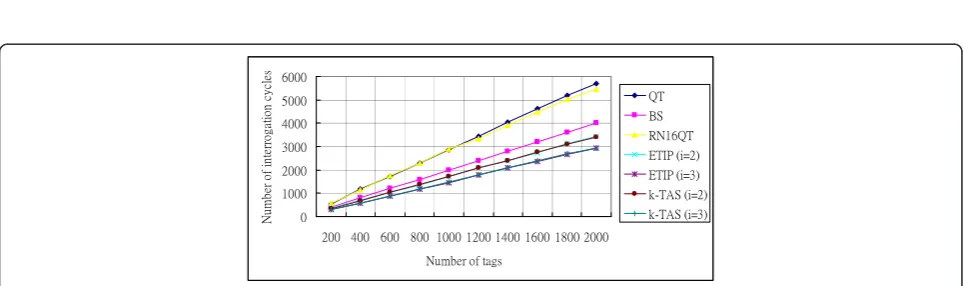
Figure 3 demonstrates that the identification delay of k -TAS under different number of tags and various
parameters i in terms of total interrogation cycles. In general, as the number of tags increases, the collided cycles will raise and this scenario causes longer identifi-cation delay. Since k-TAS does not possess any idle cycles, the factor of the number of collided cycles will play a significant role to influence the performance ofk -TAS. Note that the readable cycles ink-TAS is always equal to the number of the existing tags. More concre-tely, compared to traditional binary tree-based protocols, k-TAS can resolve tag signal collision more effectively, i. e., splitting currently collided tags set into k subsets instead of only two subsets. In addition, k-TAS can understand why the collision happens at each collided cycle, i.e., which descendant nodes collide with currently visited node in the abstract k-ary tree structure. This design allows the reader to avoid all idle scenarios. Hence, as shown in Figure 3, k-TAS can save at least 38.8 and 12% interrogation cycles when comparing to QT and BS, respectively. As the value of parameter i increases, the improvement is more significant. In Figure 4, we find that QT, BS, andk-TAS (i = 5) possess the same level of performance owing to similar amount of
Table 2 Comparison among k-TAS and other relevant studies
Assumption & collision detection technique Collision resolution mechanism
Performance comparison
Identification delay*
Communication overhead
k-TAS Transmission, synchronization & bit-by-bit collision detection k-splitting Low (logk(n)) Low
ETIP [38] k-splitting Low (logk(n)) High
BS [16,34] 2-splitting Medium (log2
(n))**
High
RN16QT [17] Additional tag Memory for randomly generated prefixes & bit-by-bit collision detection
2-splitting High (log2(n)) High
Query tree (QT) [13,17,21,27,32]
Bit-by-bit collision detection 2-splitting High (log2(n)) High
*nis the number of tags.
**BS gains a better performance than QT-based methods by eliminating all idle cycles.
Table 3 Improved ratio of the number of interrogation cycles ink-TAS under different bit-length of tag ID and different number of tags
Compared target Bit-length of tag ID Performance improvement ofk-TAS
QT 64 bits Reduce around 39.7-50.5% interrogation cycles
96 bits Reduce around 39.8-50.2% interrogation cycles
256 bits Reduce around 39.6-49.5% interrogation cycles
BS 64 bits Reduce around 12.8-27.9% interrogation cycles
96 bits Reduce around 11.8-28.6% interrogation cycles
256 bits Reduce around 13.4-26.6% interrogation cycles
RN16QT 64 bits Reduce around 37.9-49.8% interrogation cycles
96 bits Reduce around 36.1-47% interrogation cycles
256 bits Reduce around 38.4-49% interrogation cycles
ETIP 64 bits Almost the same interrogation cycles
96 bits Almost the same interrogation cycles
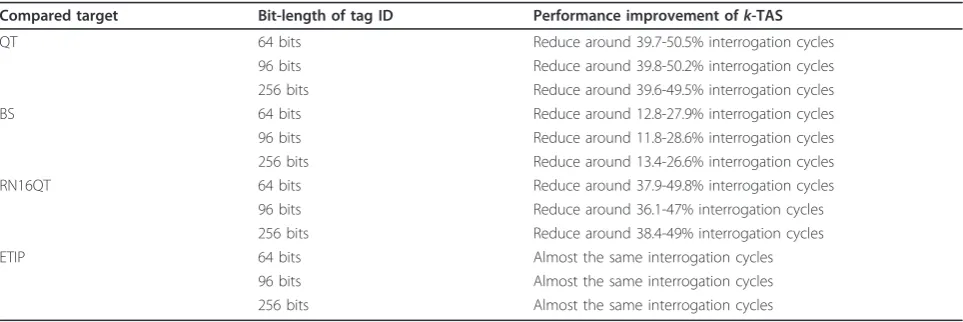
transmitted bits. Onlyk-TAS withi= 2, 3, or 4 can out-perform QT and BS, where at least 9.8-29.3% of trans-mitted bits can be eliminated. These results lead to a conclusion of that the best candidate value forishould be 2 or 3 due to the system efficiency tradeoff between the total interrogation cycles and the amount of trans-mitted bits. Note thati = 4 is an acceptable value, how-ever, it cannot provide the best performance due to the huge transmitted bits. In the next section, we present
the comparisons among k-TAS (i = 2 or 3), QT, BS,
ETIP, and RN16QT with different number of tags in our simulation program.
5.2. The performance comparisons amongk-TAS and other relevant studies
Figures 5 and 6 show the performance comparison amongk-TAS and other relevant tree-based tag identifi-cation protocols [13,14,16,17,21,27,34] in terms of the total interrogation cycles and the amount of transmitted bits. From Figure 5, we know that k-TAS requires fewer interrogation cycles for identifying all existing tags than other related methods. The improvement is significant as k-TAS eliminates around 39.8-50%, 11.8-28.6%, and 36.1-47% of interrogation cycles in comparison with
QT, BS, and RN16QT, respectively. This result is becausek-TAS reduces a significant number of collided cycles by arbitrating signal collision with k-splitting technique instead of two-splitting mechanism adopted
in QT, BS, and RN16QT. This nature allows k-TAS to
outperform other relevant studies during a collision resolution procedure on the aspect of the interrogation cycles. On the other hand, sincek-TAS and ETIP both utilizek-splitting-based arbitration to resolve each signal collision, their protocol efficiency on identi-fication delay are quite similar, i.e., the total interrogation cycles required in k-TAS is almost the same as ETIP. Next, as k-TAS uses a series of synchronized challenge-response bit sequences, such as CRSj and RSj, to communicate with the tags, all idle cycles in a tag identification pro-cess can be eliminated as ETIP and BS do. This
advan-tage makes k-TAS, ETIP, and BS more efficient than
QT and its variant RN16QT. In other words, sincek -TAS, ETIP, and BS can ignore all idle cycles instead of wasting time to visit them as QT-based scheme does, the improvement on identification efficiency is promised.
Figure 6 presents the comparison among k-TAS and
related studies in terms of the amount of transmitted
Table 4 Improved ratio of the amount of transmitted bits ink-TAS under different bit-length of tag ID and different number of tags
Compared target Bit-length of tag ID (bits) Performance improvement ofk-TAS
QT 64 Reduce around 27.8-39.6% transmitted bits
96 Reduce around 19.5-29.3% transmitted bits
256 Reduce around 8.8-13% inter transmitted bits
BS 64 Reduce around 27.3-39% transmitted bits
96 Reduce around 17.6-29.9% transmitted bits
256 Reduce around 8.9-13.1% transmitted bits
RN16QT 64 Reduce around 36.9-46.5% transmitted bits
96 Reduce around 26.5-35.7% transmitted bits
256 Reduce around 12.7-17.1% transmitted bits
ETIP 64 Reduce around 27.7-36.4% transmitted bits
96 Reduce around 18.8-27.6% transmitted bits
256 Reduce around 8.5-12.5% transmitted bits
˃ ˄˃˃˃ ˅˃˃˃ ˆ˃˃˃ ˇ˃˃˃ ˈ˃˃˃ ˉ˃˃˃ ˊ˃˃˃
˅˃˃ ˇ˃˃ ˉ˃˃ ˋ˃˃ ˄˃˃˃ ˄˅˃˃ ˄ˇ˃˃ ˄ˉ˃˃ ˄ˋ˃˃ ˅˃˃˃ ˡ̈̀˵˸̅ʳ̂˹ʳ̇˴˺̆
ˡ
̈̀
˵˸̅
ʳ̂
˹ʳ
˼́
̇˸
̅̅
̂˺˴
̇˼̂́ʳ
˶̌˶
˿˸̆ ˤ˧
˕˦ ˾ˀ˧˔˦ʳʻ˼ː˅ʼ ˾ˀ˧˔˦ʳʻ˼ːˆʼ ˾ˀ˧˔˦ʳʻ˼ːˇʼ ˾ˀ˧˔˦ʳʻ˼ːˈʼ ˾ˀ˧˔˦ʳʻ˼ːˉʼ ˾ˀ˧˔˦ʳʻ˼ːˊʼ
˃
Figure 4The communication overhead ofk-TAS with differenti. Note that the length of ID is 96 bits.
˃
Figure 5The identification delay ofk-TAS compared to other relevant studies in which the length of ID is 96 bits.
˃
Figure 6The communication overhead ofk-TAS compared to other relevant studies in which the length of ID is 96 bits.
˃
bits. Obviously,k-TAS significantly outperforms QT, BS, RN16QT, and ETIP by reducing around 19.5-29.3%, 17.6-29.9%, 26.5-35.7%, and 18.8-27.6% transmitted bits, respectively, in total. In comparison with QT, BS, and RN16QT, as less collided cycles are required ink-TAS, the corresponding transmitted bits collected from all col-lided cycles are less. This enhancement is from the effi-cientk-splitting scheme. Next, we find that the system efficiency of ETIP is not well-performed during tag signal responses collection and resolution. Therefore, the com-munication overhead of ETIP is large. This limitation inspires us to re-design a novel and efficient tag response
collection mechanism to gain better protocol perfor-mance. In addition, since no idle cycle exists ink-TAS, ETIP, and BS, the number of corresponding transmitted bits from idle cycle is zero in these three protocols, and the efficiency on communication overhead is guaranteed.
Table 2 introduces the main characteristics and perfor-mance comparison amongk-TAS and other related pro-tocols. The second column of Table 2 presents the assumption of each method and corresponding collision detection technique. Obviously, the feasibility ofk-TAS is reasonable as BS protocol does. Regarding the collision resolution scheme in the third column,k-TAS and ETIP ˃
˄˃˃˃ ˅˃˃˃ ˆ˃˃˃ ˇ˃˃˃ ˈ˃˃˃ ˉ˃˃˃ ˊ˃˃˃
˅˃˃ ˇ˃˃ ˉ˃˃ ˋ˃˃ ˄˃˃˃ ˄˅˃˃ ˄ˇ˃˃ ˄ˉ˃˃ ˄ˋ˃˃ ˅˃˃˃
ˡ̈̀˵˸̅ʳ̂˹ʳ̇˴˺̆
ˡ̈̀˵˸̅ʳ̂˹ʳ˼́̇˸̅̅
̂˺˴̇˼̂́ʳ˶̌˶˿˸
̆
ˤ˧ ˕˦ ˥ˡ˄ˉˤ˧ ˘˧˜ˣʳʻ˼ː˅ʼ ˘˧˜ˣʳʻ˼ːˆʼ ˾ˀ˧˔˦ʳʻ˼ː˅ʼ ˾ˀ˧˔˦ʳʻ˼ːˆʼ
Figure 8The identification delay ofk-TAS compared to other relevant studies in which the length of ID is 256 bits.
˃ ˈ˃˃˃˃ ˄˃˃˃˃˃ ˄ˈ˃˃˃˃ ˅˃˃˃˃˃ ˅ˈ˃˃˃˃
˅˃˃ ˇ˃˃ ˉ˃˃ ˋ˃˃ ˄˃˃˃ ˄˅˃˃ ˄ˇ˃˃ ˄ˉ˃˃ ˄ˋ˃˃ ˅˃˃˃
ˡ̈̀˵˸̅ʳ̂˹ʳ̇˴˺̆
ˡ
̈̀
˵˸
̅ʳ
̂˹
ʳ̇̅
˴́
̆̀
˼̇̇˸
˷ʳ
˵˼̇̆ ˤ˧
˕˦ ˥ˡ˄ˉˤ˧ ˘˧˜ˣʳʻ˼ː˅ʼ ˘˧˜ˣʳʻ˼ːˆʼ ˾ˀ˧˔˦ʳʻ˼ː˅ʼ ˾ˀ˧˔˦ʳʻ˼ːˆʼ
Figure 9The communication overhead ofk-TAS compared to other relevant studies in which the length of ID is 64 bits.
˃ ˄˃˃˃˃˃ ˅˃˃˃˃˃ ˆ˃˃˃˃˃ ˇ˃˃˃˃˃ ˈ˃˃˃˃˃ ˉ˃˃˃˃˃ ˊ˃˃˃˃˃
˅˃˃ ˇ˃˃ ˉ˃˃ ˋ˃˃ ˄˃˃˃ ˄˅˃˃ ˄ˇ˃˃ ˄ˉ˃˃ ˄ˋ˃˃ ˅˃˃˃
ˡ̈̀˵˸̅ʳ̂˹ʳ̇˴˺̆
ˡ
̈̀
˵˸
̅ʳ̂
˹ʳ
̇˴
́̆
̀
˼̇̇˸
˷ʳ
˵˼̇̆ ˤ˧
˕˦ ˥ˡ˄ˉˤ˧ ˘˧˜ˣʳʻ˼ː˅ʼ ˘˧˜ˣʳʻ˼ːˆʼ ˾ˀ˧˔˦ʳʻ˼ː˅ʼ
˾ˀ˧˔˦ʳʻ˼ːˆʼ
both exploit efficient k-splitting mechanism while the other methods adopt inefficient 2-splitting scheme. On the aspect of identification delay and communication overhead,k-TAS obviously outperforms other methods and is thus more practical for real world application.
5.3. Impact of bit-length of tag ID
This section describes the performance improvement of k-TAS under different bit-length of tag ID and different number of tags. From Figures 5, 7, and 8 and Table 3 it is obvious that the performance improvement ofk-TAS is independent with the factor of tag ID’s bit-length on the aspect of the identification delay, i.e., the number of interrogation cycles. We infer that tree-based tag identifi-cation protocol can identify all tags without visiting the leaf node of abstract tree structure in a tag inquiry ses-sion when the number of tags is not many. Nevertheless, as shown in Figures 6, 9, and 10 and Table 4, the total transmitted bits are significantly increased and the per-formance improvement ofk-TAS is decreased as the bit-length of tags ID becomes larger. This is because the amount of transmitted bits collected from all readable cycles becomes a significant part compared to the total transmitted bits ink-TAS when the bit-length of tag ID is longer. In that case, the effect of the transmitted bits collected from all collided cycles is comparatively smaller than that collected from all readable cycles while evaluat-ing the communication overhead ink-TAS. Note that no idle cycles exist in a tag identification process ofk-TAS.
6. Conclusions
Collision resolution is critical for efficiency improve-ment in impleimprove-menting an RFID tag identification proto-col. In this article, we present a novel anti-collision protocol, i.e., k-TAS, for identifying passive tags in which an adaptive collision resolution scheme is adopted to make whole tag identification process more efficient.
The nature of k-TAS exploits the information on
whether currently visited node is collided and, if yes, which descendant nodes collide with it. Such informa-tion is extracted from all tags’ response data at each inquiry time period. This design successfully avoids wasting time on many collided cycles and all idle cycles ink-TAS and accordingly increases the system through-put during tag identification procedure. Next, we ana-lyze the system performance of k-TAS in both theory and simulations, which show that our proposed schemes significantly reduce identification delay and communica-tion overhead at each tag identifying process. In the future, we would like to design a dynamic collision reso-lution mechanism for tag identification in which the
sys-tem parameter i could be adjusted dynamically to
pursue better protocol performance. Moreover, to iden-tify whether an optimal value of parameter iexists and
is suitable for any RFID application environment is another interesting research topic for us.
Acknowledgements
The authors gratefully acknowledge the support from the Taiwan Information Security Center (TWISC) and the National Science Council, Taiwan, under the Grant nos. NSC 100-2219-E-011-002, NSC 100-2218-E-011-005, and NSC 100-2218-E-034-001-MY2.
Author details
1Department of Information Management, National Taiwan University of
Science and Technology, Taipei 106, Taiwan2Department of Information Management, Chinese Culture University, Taipei 111, Taiwan3School of
Information Systems, Singapore Management University 178902, Singapore
Competing interests
The authors declare that they have no competing interests.
Received: 28 February 2011 Accepted: 26 October 2011 Published: 26 October 2011
References
1. I Chamtac, C Petrioli, J Redi, Energy-conserving access protocols for identification networks. IEEE/ACM Trans Netw.7(1), 51–59 (1999). doi:10.1109/90.759318
2. V Namboodiri, L Gao, Energy-aware tag anti-collision protocols for RFID systems. IEEE Trans Mobile Comput.9(1), 44–59 (2010)
3. T Cheng, L Jin, Analysis and simulation of RFID anti-collision algorithms, in
Proceedings of 9th International Conference on Advanced Communication Technology, 697–701 (2007)
4. EPC™Radio-Frequency Identification Protocols Class 1 Generation-2 UHF RFID Protocol for Communication at 860-960 MHz Version 1.0.9(EPCGlobal Inc., December 2005)
5. C Floerkemeier, M Wille, Comparison of transmission schemes for framed ALOHA based RFID protocols, inProceedings of International Symposium on Applications and the Internet Workshops, 92–97 (2006)
6. Information Technology-Radio Frequency Identification for Item Management-Part 6: Parameters for Air Interface Communications at 860 MHz to 960 MHz, Amendment 1: Extension with Type C and Update of Types A and B, ISO/IEC 18000-6:2004/Amd. 1:(E)(June 2006)
7. DK Klair, KW Chin, R Raad, On the suitability of framed slotted aloha based RFID anti-collision protocols for use in RFID-enhanced WSNs, inProceedings of 17th International Conference on Computer Communications and Networks, 583–590 (2007)
8. DK Klair, KW Chin, A novel anti-collision protocol for energy efficient identification and monitoring in RFID-enhanced WSNs, inProceedings of 17th International Conference on Computer Communications and Networks, 1–8 (2008)
9. Y Maguire, R Pappu, An optimal Q-algorithm for the ISO 18000-6C RFID protocol. IEEE Trans Autom Sci Eng.6(1), 16–24 (2009)
10. CP Wong, Q Feng, Grouping based bit-slot ALOHA protocol for tag anti-collision in RFID systems. IEEE Commun Lett.11(12), 946–948 (2007) 11. L Zhu, TSP Yum, Optimal framed aloha based anti-collision algorithms for
RFID systems. IEEE Trans Commun.58(12), 3583–3592 (2010)
12. B Li, J Wang, Efficient anti-collision algorithm utilizing the capture effect for ISO 18000-6C RFID protocol. IEEE Commun Lett.15(3), 352–354 (2011) 13. 860 MHz - 930 MHz Class 1 Radio Frequency Identification Tag Radio
Frequency and Logical Communication Interface Specification Candidate Recommdation Version 1.0.1, Auto-ID Center, (2002)
14. KW Chiang, C Hua, TS Peter Yum, Prefix-randomized query-tree protocol for RFID systems, inProceedings of IEEE International Conference on
Communications, 1653–1657 (2006)
15. JS Cho, JD Shin, SK Kim, RFID tag anti-collision protocol: query tree with reversed IDs, inProceedings of 10th International Conference on Advanced Communication Technology, 225–230 (2008)
17. JH Choi, D Lee, H Lee, Query tree-based reservation for efficient RFID tag anti-collision. IEEE Commun. Lett.11(1), 85–87 (2007)
18. Draft Protocol Specification for a 900 MHz Class 0 Radio Frequency Identification Tag, Auto-ID Center, (2003)
19. YC Lai, CC Lin, A pair-resolution blocking algorithm on adaptive binary splitting for RFID tag identification. IEEE Commun Lett.12(6), 432–434 (2008)
20. YC Lai, CC Lin, Two blocking algorithms on adaptive binary splitting: single and pair resolutions for RFID tag identification. IEEE/ACM Trans Netw.17(3), 962–975 (2009)
21. C Law, K Lee, KY Siu, Efficient memoryless protocol for tag identification, in
Proceedings of the 4th International Workshop on Discrete Algorithm and Methods for Mobile Computing and Communication, 75–84 (2000) 22. L Liu, ZH Xie, JT Xi, SL Lai, An improved anti-collision algorithm in RFID
system, inProceedings of 2nd International Conference on Mobile Technology, Applications and Systems, 1–5 (2005)
23. J Myung, W Lee, J Srivastava, Adaptive binary splitting for efficient RFID tag anti-collision. IEEE Commun Lett.10(3), 144–146 (2006). doi:10.1109/ LCOMM.2006.1603365
24. J Myung, W Lee, TK Shih, An adaptive memoryless protocol for RFID tag collision arbitration. IEEE Trans Multimedia8, 1096–1101 (2006) 25. J Myung, W Lee, J Srivastava, TK Shih, Tag-splitting: adaptive collision
arbitration protocols for RFID tag identification. IEEE Trans Parallel Distrib Syst.18(6), 763–775 (2007)
26. HS Ning, Y Cong, ZQ Xu, T Hong, JC Chao, Y Zhang, Performance evaluation of RFID anti-collision algorithm with FPGA implementation, in
Proceedings of 21st International Conference on Advanced Information Networking and Applications Workshops, 153–158 (2007)
27. TP Wang, Enhanced binary search with cut-through operation for anti-collision in RFID systems. IEEE Commun Lett.10(4), 236–238 (2006). doi:10.1109/LCOMM.2006.1613732
28. T La Porta, G Maselli, C Petrioli, Anti-collision protocols for single-reader RFID systems: temporal analysis and optimization. IEEE Trans Mobile Comput.10(2), 267–279 (2011)
29. XL Jia, QY Feng, CZ Ma, An efficient anti-collision protocol for RFID tag identification. IEEE Commun Lett.14(11), 1014–1016 (2010)
30. F Schoute, Dynamic frame length aloha. IEEE Trans Commun.31(4), 565–568 (1983). doi:10.1109/TCOM.1983.1095854
31. JE Wieselthier, A Ephremides, LA Michaels, An exact analysis and performance evaluation of framed aloha with capture. IEEE Trans Commun. 37(2), 125–137 (1989). doi:10.1109/26.20080
32. JI Capettanakis, Tree algorithms for packet broadcast channels. IEEE Trans Inf Theory25, 505–515 (1979). doi:10.1109/TIT.1979.1056093
33. J Mosely, P Humblet, A class of efficient contention resolution algorithms for multiaccess channels. IEEE Trans Commun.33(2), 145–151 (1985) 34. K Finkenzeller,RFID Handbook: Radio-Frequency Identification, Fundamentals
and Applications, (Wiley, 1999)
35. ISO/IEC 14443. Inentification cards–Contactless integrated circuit cards– Proximity cards
36. ISO/IEC 15693. Inentification cards–Contactless integrated circuit cards–Vicinity cards
37. ISO/IEC 18000. ISO/IEC 18000 Information Technology AIDC Technologies– RFID for Item Management–Air Interface
38. KH Yeh, NW Lo, E Winata, An efficient tree-based tag identification protocol for RFID systems, inProceedings of 22nd International Conference on Advanced Information Networking and Applications Workshops, 966–970 (2008)
doi:10.1186/1687-1499-2011-139
Cite this article as:Chenet al.:Adaptive collision resolution for efficient
RFID tag identification.EURASIP Journal on Wireless Communications and Networking20112011:139.
Submit your manuscript to a
journal and benefi t from:
7Convenient online submission
7Rigorous peer review
7Immediate publication on acceptance
7Open access: articles freely available online
7High visibility within the fi eld
7Retaining the copyright to your article